AQA · A-Level · Biology
Populations
Master AQA A-Level Biology's Populations topic (7.2) with this comprehensive guide. We'll break down population growth, succession, and the essential mark-release-recapture method, providing examiner insights and multi-modal resources to help you secure top marks."
- 8 min read
- 3 worked examples
- 5 practice questions
Study Notes
Overview
Welcome to the study of Populations, a cornerstone of ecology and a significant component of your AQA A-Level Biology exam (specification reference 7.2). This topic explores the dynamic interactions that govern the size and structure of populations, from the exponential growth of bacteria to the complex stability of a climax community. Understanding these principles is not just about memorising definitions; it's about applying them to analyse data, evaluate conservation strategies, and explain the intricate web of life. Examiners frequently use this topic to test your analytical and application skills (AO2 and AO3), often presenting you with novel scenarios and data sets. Expect questions that require you to interpret population graphs, calculate population sizes, and explain the process of ecological succession in detail. By mastering the concepts of carrying capacity, limiting factors, and succession, you will be well-equipped to tackle these challenging questions and demonstrate a deep understanding of ecological principles.
Key Concepts
Concept 1: Population Growth and Carrying Capacity
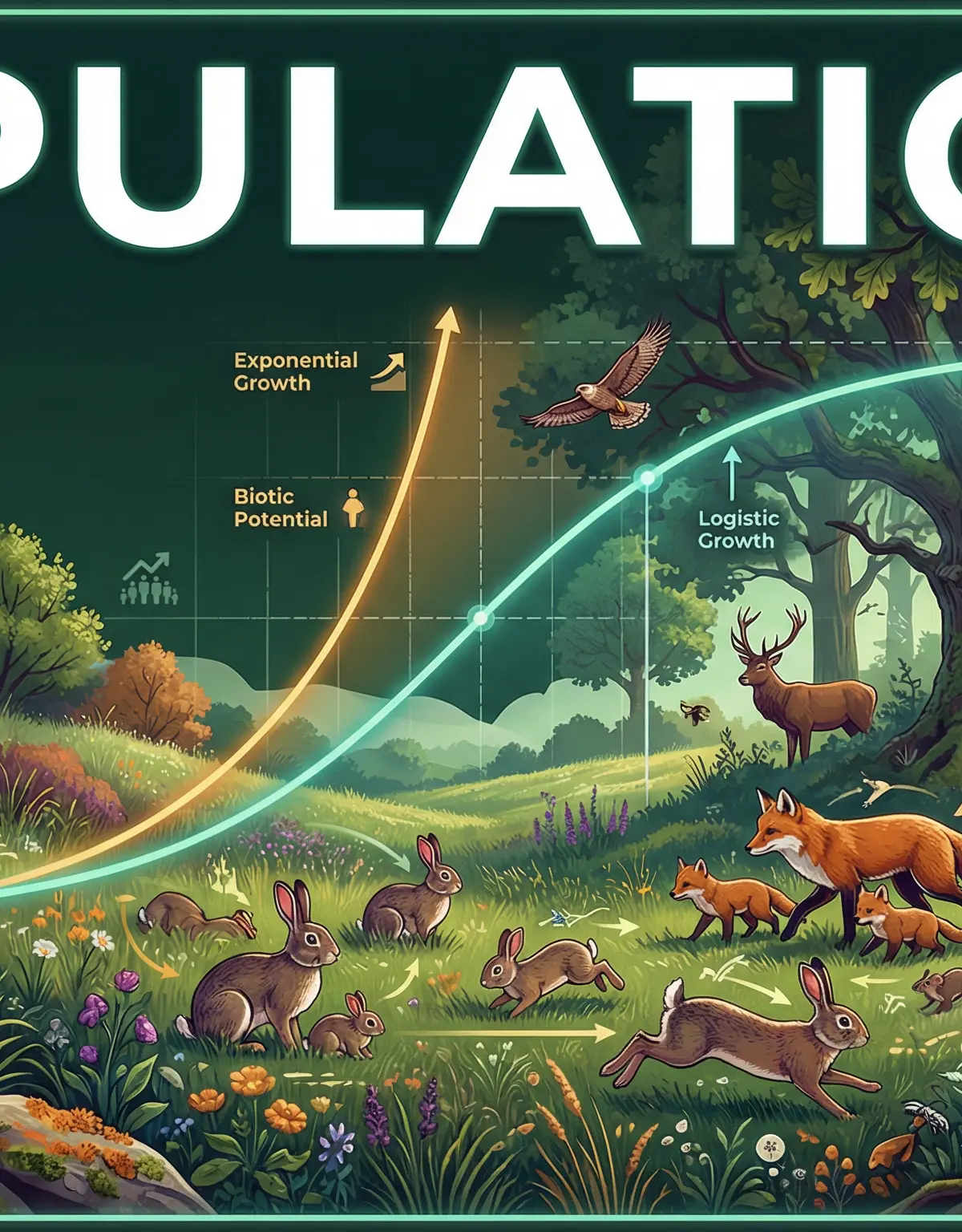
A population is a group of organisms of the same species living in the same area at the same time. When conditions are favourable (abundant resources, few predators), populations can exhibit biotic potential, their maximum possible growth rate. This leads to a J-shaped exponential growth curve.
However, no population can grow exponentially forever. The environment has a limited supply of resources, creating environmental resistance. This leads to a more realistic S-shaped (logistic) growth curve.
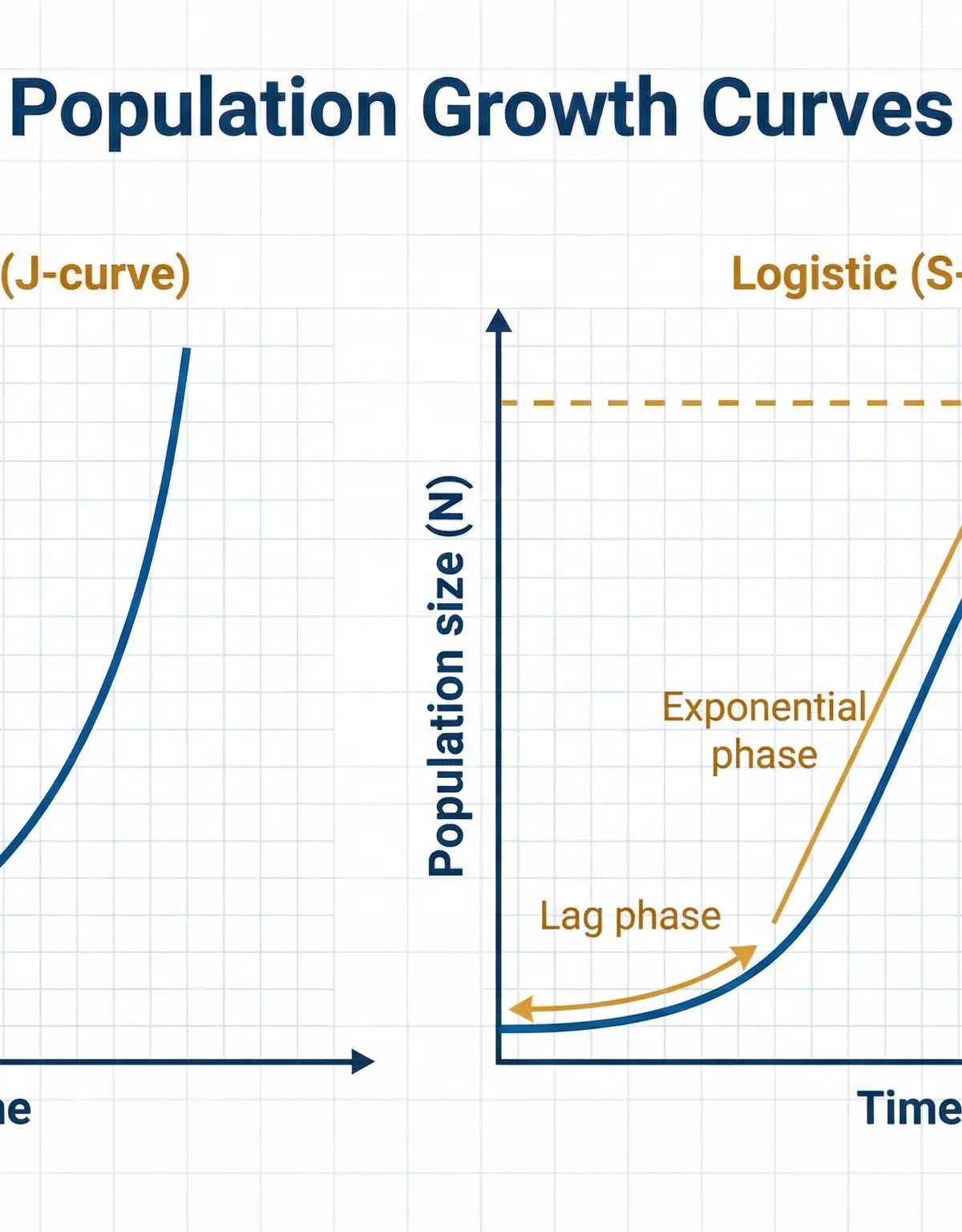
This curve has three distinct phases:
- Lag Phase: The population is small and acclimatising to the habitat. Growth is slow as individuals reach sexual maturity.
- Exponential (Log) Phase: Resources are plentiful, and the birth rate far exceeds the death rate. The population grows at a rapid, accelerating pace.
- Plateau (Stationary) Phase: The population size has reached the carrying capacity (K) of the ecosystem. Limiting factors, such as intense intraspecific competition, increased predation, and disease, cause the birth rate and death rate to become roughly equal. The population size oscillates around the carrying capacity.
Carrying Capacity (K) is a crucial definition: it is the maximum population size that an ecosystem can sustainably support over a period of time. It is determined by limiting factors.
Limiting Factors can be:
- Abiotic (non-living): Temperature, light intensity, water availability, pH, soil mineral content.
- Biotic (living): Predation, disease, parasitism, and competition.
Competition is a key biotic factor. It is vital to distinguish between:
- Intraspecific Competition: Competition between individuals of the same species for resources like food, mates, and territory. This is a density-dependent factor; its effect increases as the population becomes more crowded.
- Interspecific Competition: Competition between individuals of different species for the same limited resources. The Competitive Exclusion Principle states that if two species occupy the exact same niche, one will inevitably outcompete and eliminate the other.
Concept 2: Ecological Succession
Ecological succession is the predictable and orderly process by which an ecosystem changes over time. It involves changes in the species composition and the abiotic environment.
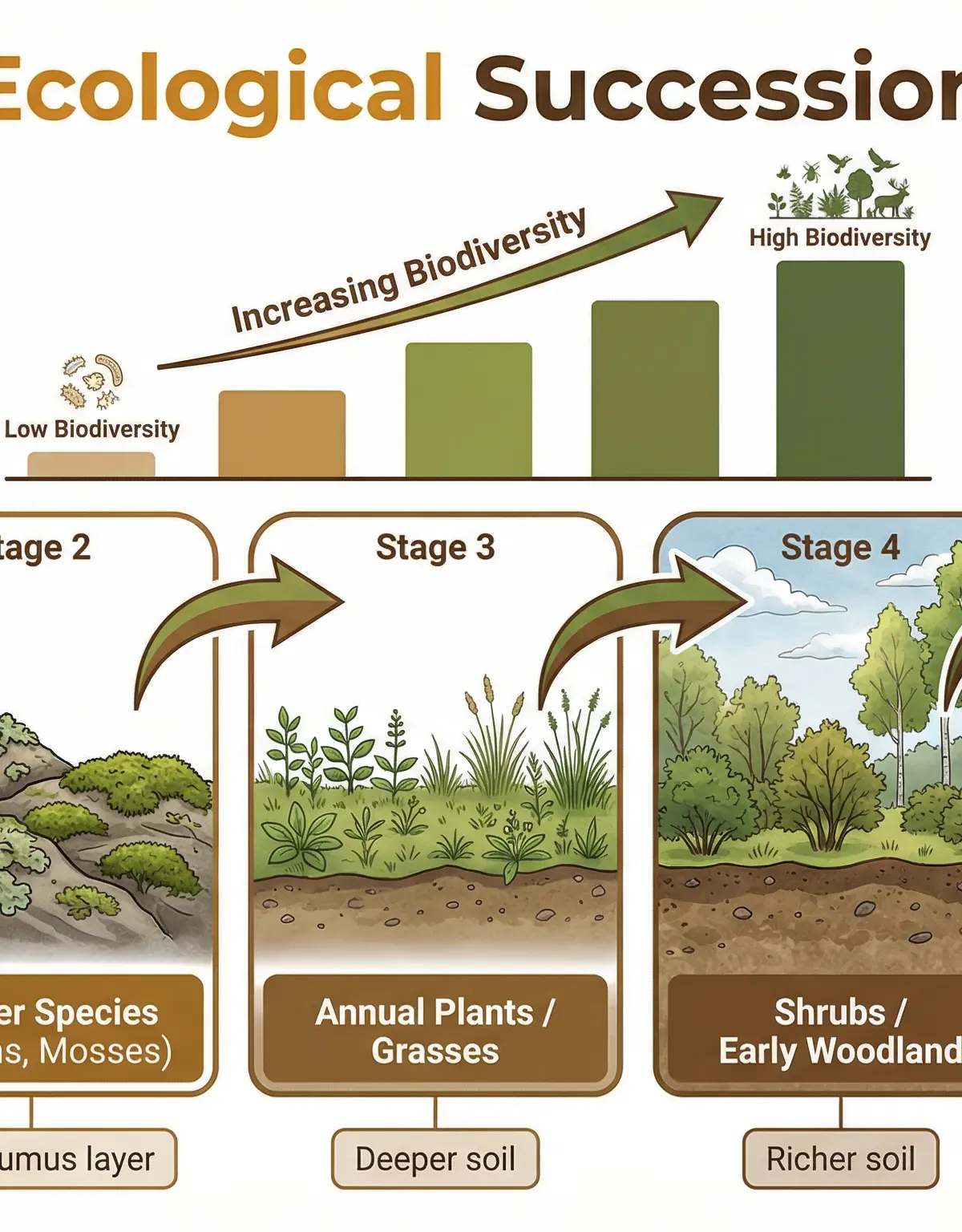
There are two main types:
-
Primary Succession: Occurs on a newly formed or exposed land surface where no soil or organic material exists (e.g., bare rock after a volcanic eruption, sand dunes).
- Pioneer Species: The first organisms to colonise are pioneer species, such as lichens and mosses. They are highly adapted to hostile abiotic conditions.
- Environmental Change: Pioneers change the abiotic environment. For example, lichens secrete acids that weather the rock, and when they die, they decompose to form a thin, basic soil (humus). This process is called facilitation.
- New Colonisers: This makes the environment less hostile and suitable for other species, like grasses and ferns, to colonise. These new species further improve the soil and outcompete the pioneers.
- Increasing Biodiversity: As the soil deepens and becomes more fertile, larger plants like shrubs and then trees can establish. This increases the number of available habitats and food sources, leading to an increase in species diversity.
- Climax Community: The process continues until a stable, self-perpetuating community is formed, known as the climax community. In the UK, this is typically oak woodland. It has high biodiversity and is in equilibrium with the prevailing climate.
-
Secondary Succession: Occurs on land where a previous community has been cleared, but the soil remains intact (e.g., a field left fallow, a forest after a fire). It is much faster than primary succession because soil is already present.
Conservation and Succession: Conservation often involves deliberately managing and preventing succession to preserve specific habitats. For example, grazing by sheep on chalk downlands prevents the growth of shrubs and trees, maintaining the grassland habitat required by rare butterfly species. This is a common theme in AQA 'Suggest' questions.
Mathematical/Scientific Relationships
The Lincoln Index (Mark-Release-Recapture)
This is a required practical skill used to estimate the population size of motile organisms.
Formula: N = (n₁ × n₂) / m₂ (This formula must be memorised)
- N: Estimated total population size.
- n₁: Number of individuals captured, marked, and released in the first sample.
- n₂: Total number of individuals captured in the second sample.
- m₂: Number of marked individuals recaptured in the second sample.
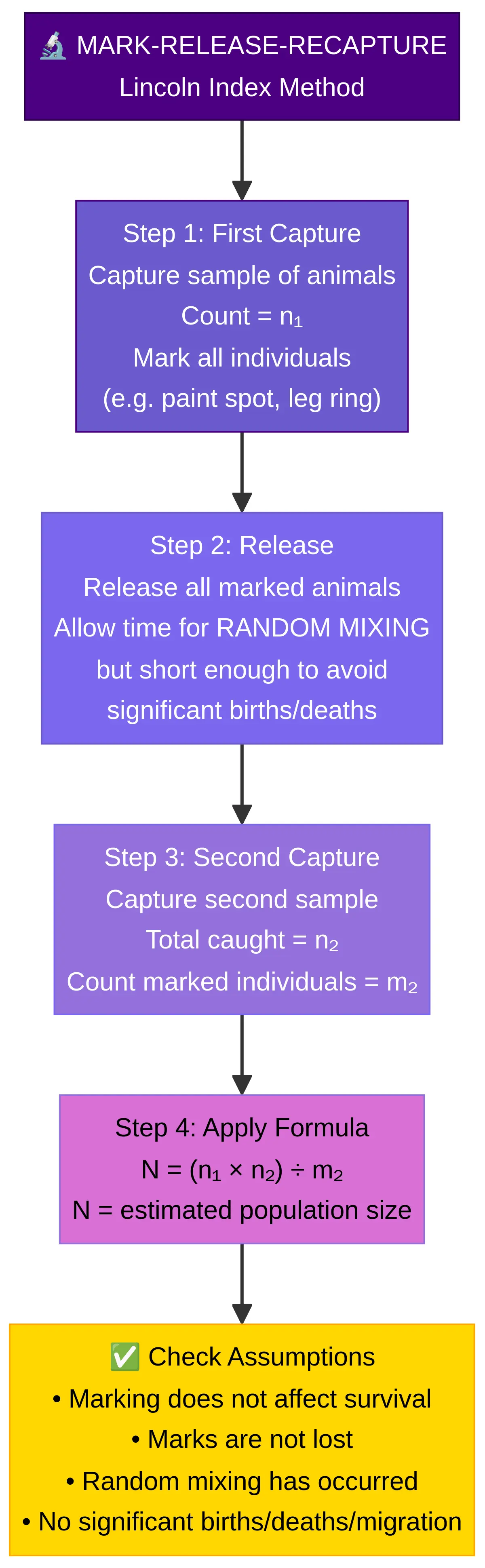
Crucial Assumptions: For the estimate to be valid, several assumptions must hold true. AQA loves to ask candidates to evaluate these.
- The marking method must not harm the animal or affect its survival (e.g., making it more visible to predators).
- The mark must not be lost or rub off during the investigation.
- There is sufficient time for the marked individuals to mix randomly and fully reintegrate with the rest of the population.
- There are no significant changes in population size between the two samples due to births, deaths, immigration, or emigration.
- The sampling methods used are identical for both captures.
Practical Applications
- Conservation: Understanding population dynamics is fundamental to conservation biology. It allows scientists to manage endangered species, control invasive species, and design effective nature reserves by managing succession.
- Fisheries Management: The concept of carrying capacity is used to set fishing quotas to ensure that fish stocks are not over-exploited and can replenish themselves, a concept known as maximum sustainable yield.
- Pest Control: Farmers and health officials use knowledge of population growth to control pests and disease vectors, often by introducing a limiting factor (e.g., a biological control agent).
- Required Practical 12 (AQA): Investigation into the effect of a named environmental factor on the distribution of a given species. This often involves using random sampling with quadrats (for plants) or systematic sampling along a transect to measure how the abundance of a species changes in relation to an abiotic factor (e.g., light intensity, soil pH). While mark-release-recapture is not a full required practical, the principles of sampling are tested under this umbrella."
Worked Examples
3 worked examples — open one to explore the question and available guidance.
Practice Questions
Test your understanding — click to reveal model answers
Explain why the biomass of a climax community, such as an oak woodland, is typically stable over time. (3 marks)
Hint: Think about the balance between energy input and output in a stable ecosystem.
A student used the mark-release-recapture method to estimate the number of woodlice in a log pile. They suggested that leaving the captured woodlice for only 10 minutes before starting the second sample would be appropriate. Evaluate this suggestion. (4 marks)
Hint: Consider the key assumptions of the method. Does 10 minutes allow them to be met?
Describe the role of pioneer species in the first stage of primary succession. (3 marks)
Hint: How do they cope with the environment, and how do they change it?
Explain the difference between a fundamental niche and a realised niche, using the concept of interspecific competition. (4 marks)
Hint: One is the 'ideal' role, the other is the 'actual' role. What causes the difference?
In a predator-prey cycle, explain why the predator population cycle always lags behind the prey population cycle. (3 marks)
Hint: Think about the cause and effect. What needs to happen before the predator population can respond?