AQA · GCSE · Biology
Ecology
Master the complex interactions of the natural world with this comprehensive guide to Ecology. From food webs and the 10% biomass rule to the carbon cycle and human impacts, this resource provides the precise terminology and examiner insights you need to secure top marks.
- 6 min read
- 3 worked examples
- 5 practice questions
- 6 key terms
Study Notes
Overview
Ecology is the study of how living organisms interact with each other and their non-living environment. It's a cornerstone of GCSE Biology because it connects the micro-level processes you've learned (like photosynthesis and respiration) to macro-level global systems. Examiners love this topic because it allows them to test your ability to apply knowledge to new contexts, interpret complex data (like predator-prey graphs), and evaluate the real-world consequences of human actions.
You'll need to master precise terminology—confusing abiotic and biotic factors is a common trap. Questions range from simple recall of definitions to complex 6-mark evaluations of environmental issues.
Key Concepts
Concept 1: Ecosystems and Interdependence
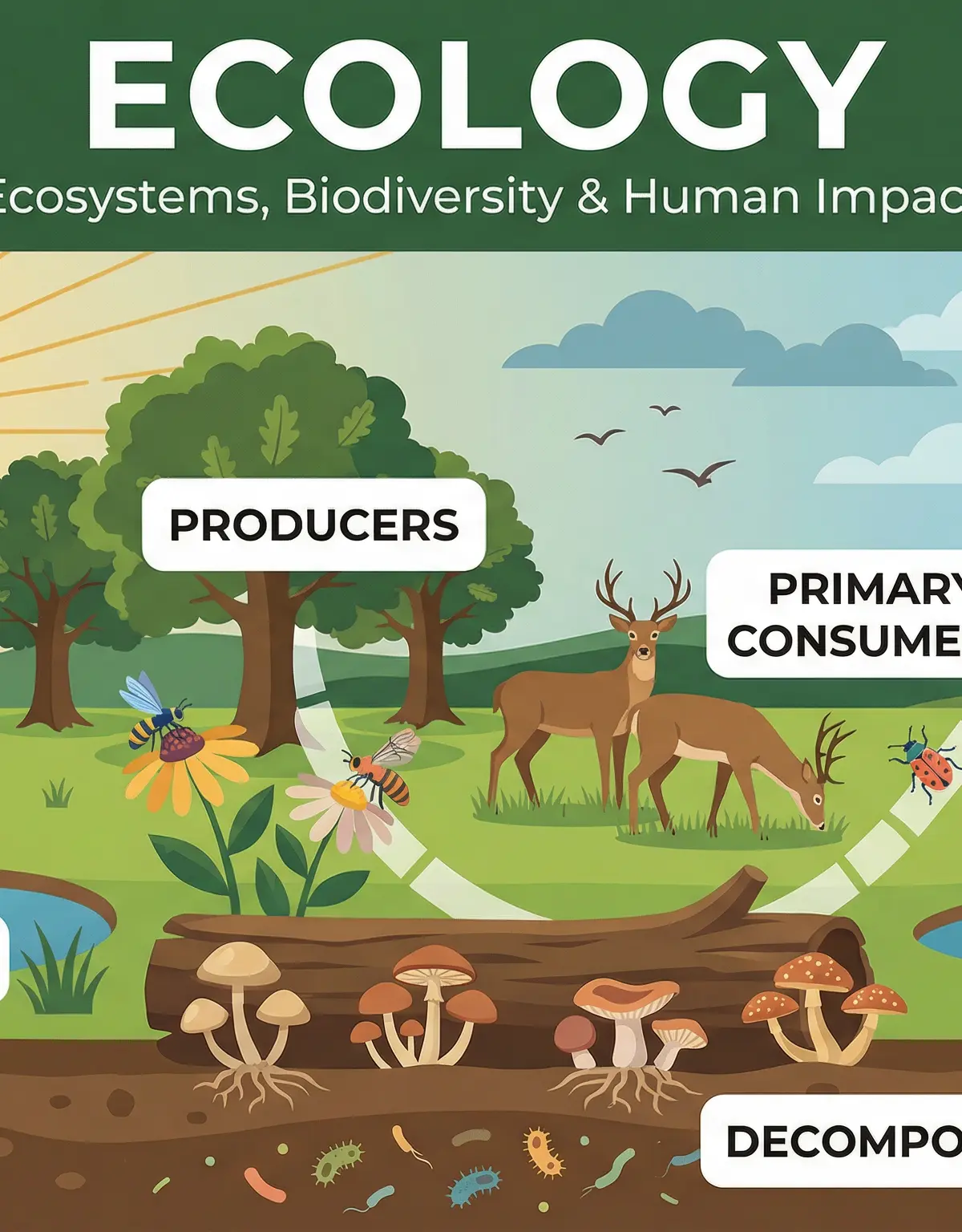
An ecosystem is the interaction of a community of living organisms (biotic) with the non-living (abiotic) parts of their environment.
To survive and reproduce, organisms require a supply of materials from their surroundings and from the other living organisms there. This leads to interdependence: within a community, each species depends on other species for food, shelter, pollination, seed dispersal, etc. If one species is removed, it can affect the whole community.
Example: In a woodland ecosystem, rabbits depend on grass for food. Foxes depend on rabbits. If a disease wipes out the rabbits, the fox population will decline (lack of food), and the grass population may overgrow.
Concept 2: Abiotic and Biotic Factors
Examiners frequently ask you to categorize factors affecting communities.
- Abiotic (non-living) factors include: Light intensity, temperature, moisture levels, soil pH and mineral content, wind intensity and direction, carbon dioxide levels for plants, and oxygen levels for aquatic animals.
- Biotic (living) factors include: Availability of food, new predators arriving, new pathogens, and one species outcompeting another so the numbers are no longer sufficient to breed.
Examiner Tip: Never just say "weather" or "animals". Be specific: "temperature" or "new predators".
Concept 3: Adaptations
Organisms have features (adaptations) that enable them to survive in the conditions in which they normally live. These can be:
- Structural: Physical features of an organism's body (e.g., thick white fur on a polar bear for insulation and camouflage).
- Behavioural: The way an organism behaves (e.g., swallows migrating to warmer climates during winter to find food).
- Functional: Processes that happen within an organism's body (e.g., desert animals producing very concentrated urine to conserve water).
Concept 4: Trophic Levels and Biomass
Feeding relationships within a community can be represented by food chains. All food chains begin with a producer which synthesises molecules. This is usually a green plant or alga which makes glucose by photosynthesis.
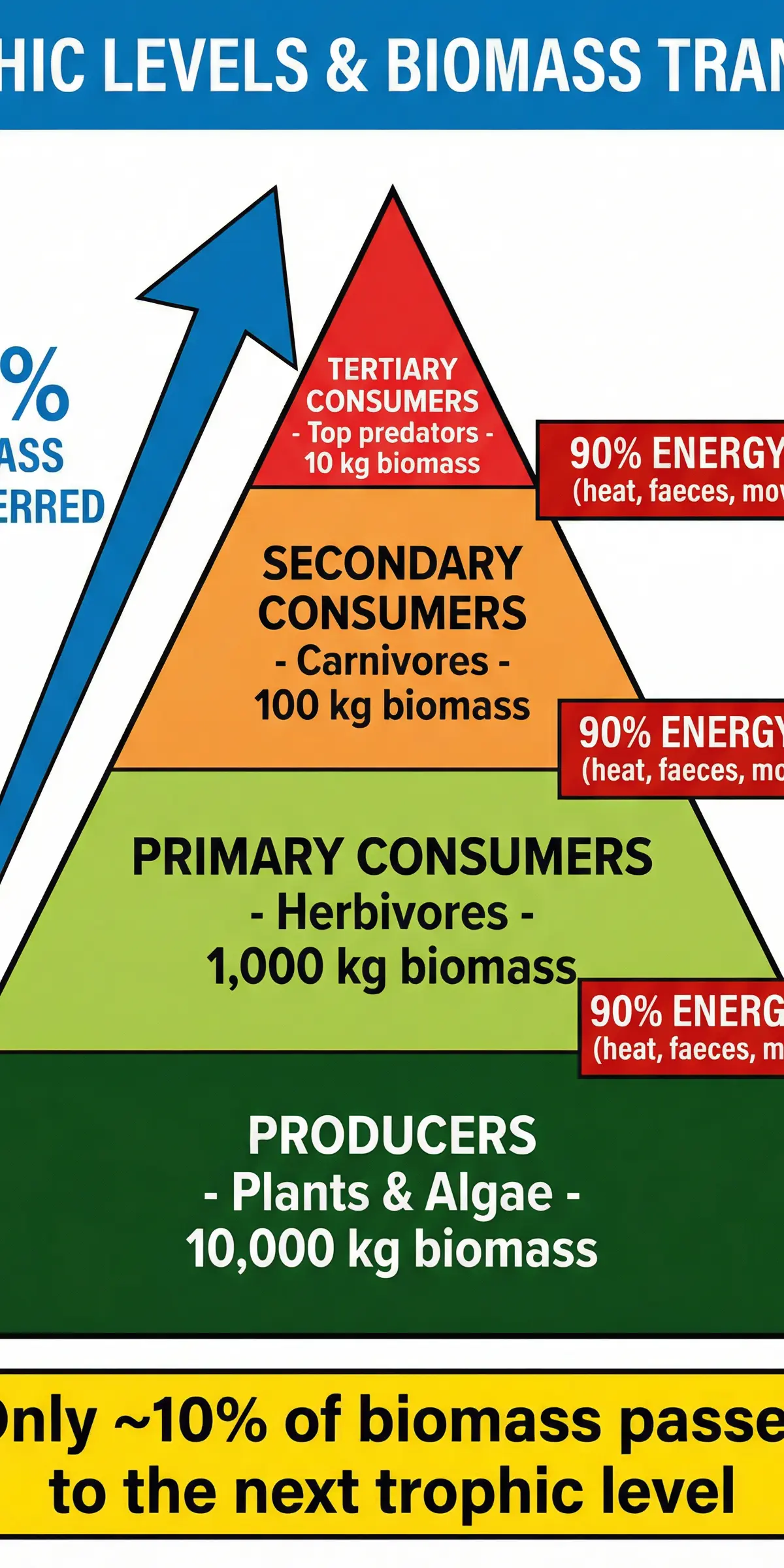
Organisms are divided into trophic levels:
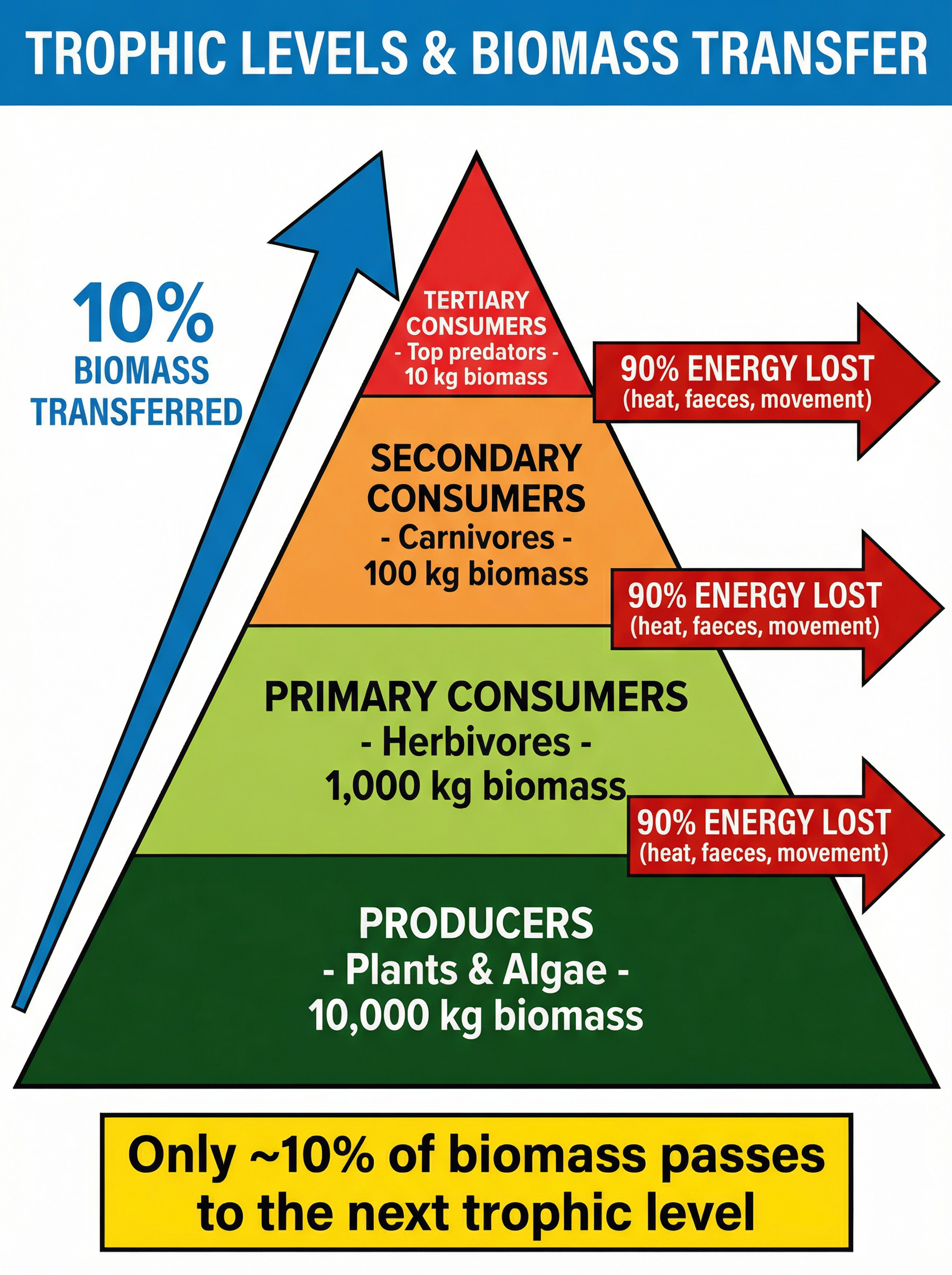
- Level 1: Producers
- Level 2: Primary consumers (herbivores)
- Level 3: Secondary consumers (carnivores)
- Level 4: Tertiary consumers (top predators)
The 10% Rule: Only approximately 10% of the biomass from each trophic level is transferred to the level above it. Losses occur because:
- Not all the ingested material is absorbed (some is egested as faeces).
- Some absorbed material is lost as waste (e.g., carbon dioxide and water in respiration, water and urea in urine).
- Large amounts of glucose are used in respiration to release energy for movement and keeping warm (in mammals and birds).
Concept 5: Material Cycling
Materials are constantly cycled through the abiotic and biotic components of an ecosystem.
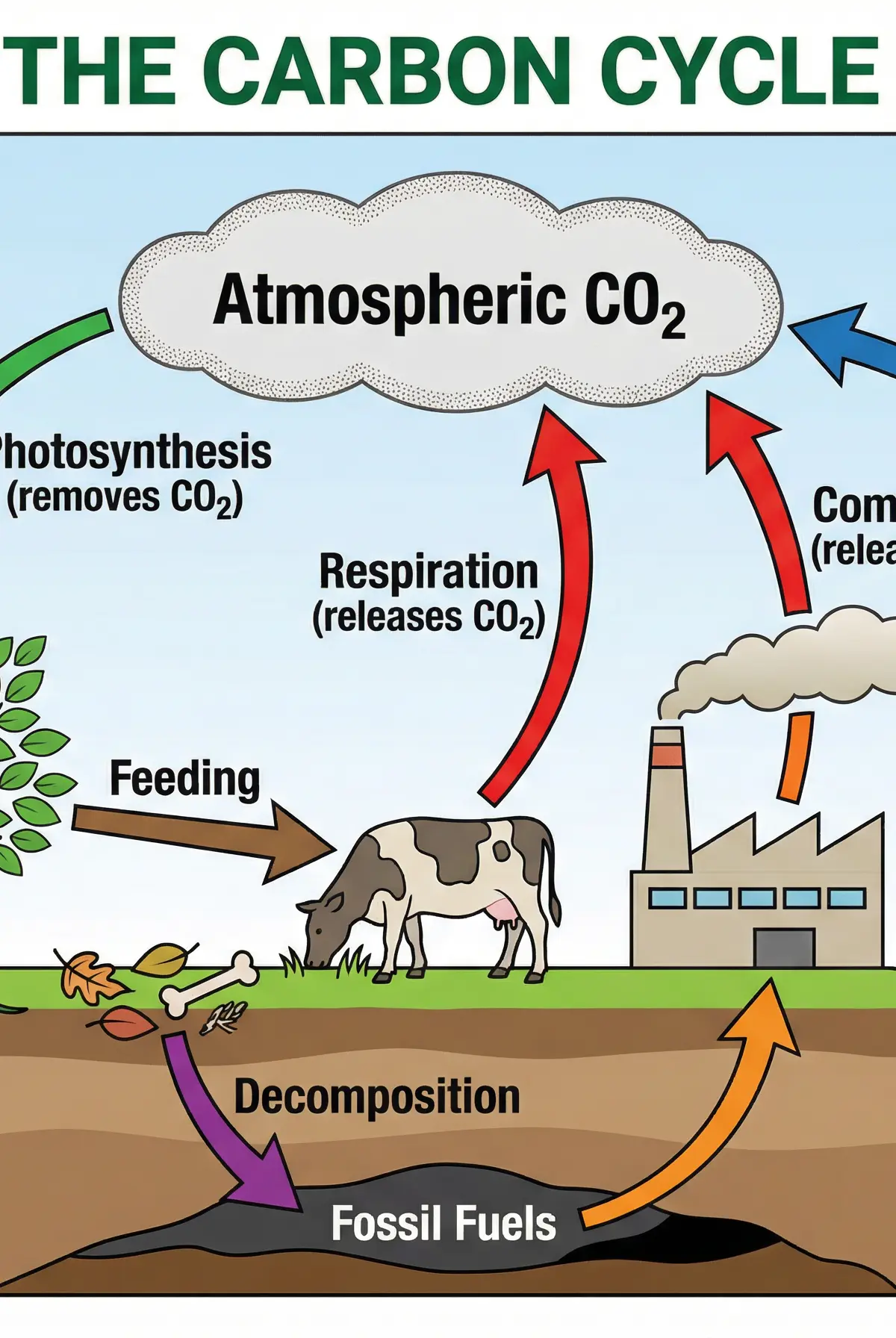
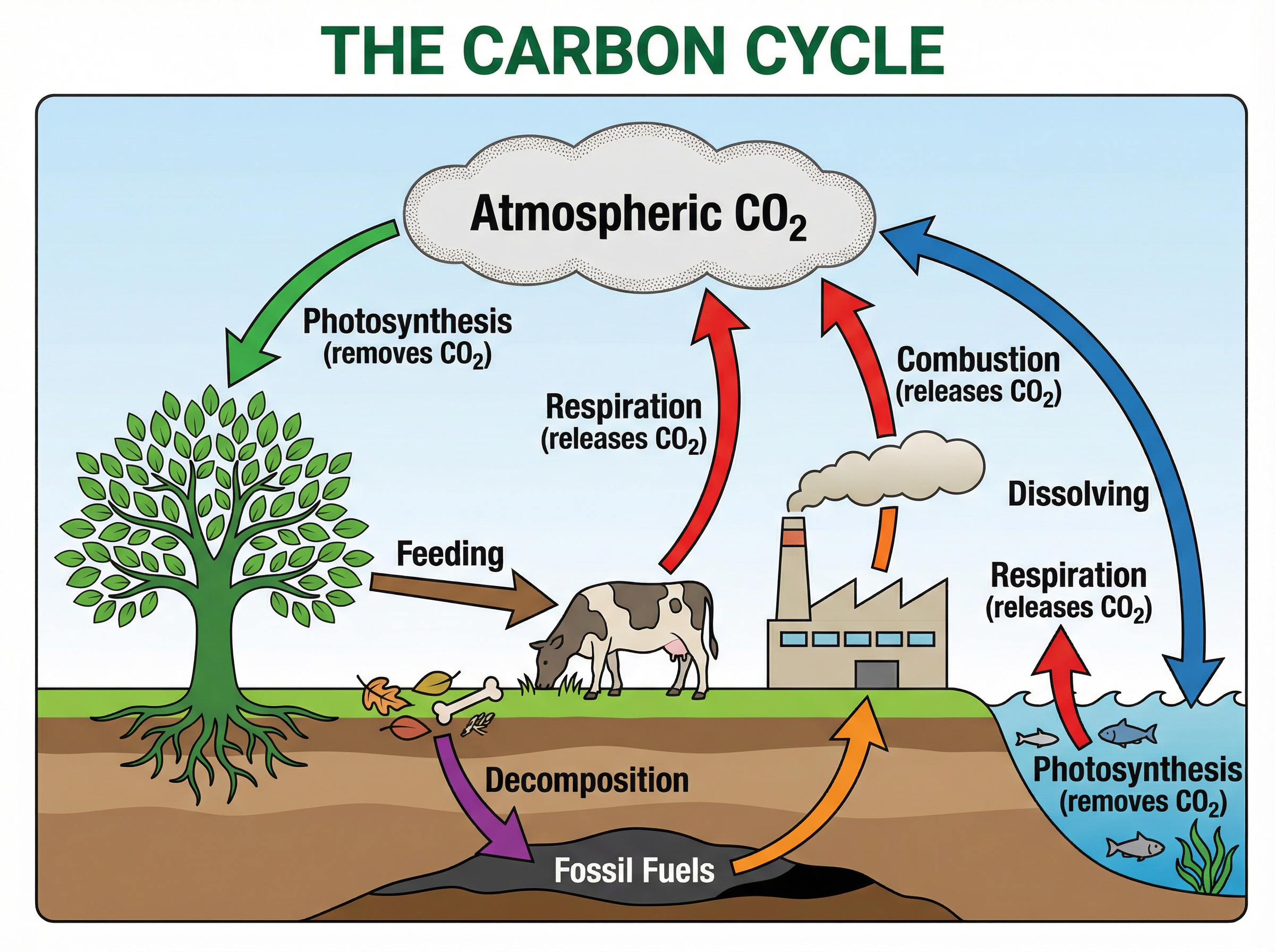
The Carbon Cycle: Returns carbon from organisms to the atmosphere as carbon dioxide to be used by plants in photosynthesis.
- Photosynthesis: Removes CO₂ from the atmosphere.
- Respiration: Releases CO₂ into the atmosphere (plants, animals, AND microorganisms do this).
- Combustion: Burning fossil fuels and wood releases CO₂.
- Decomposition: Microorganisms break down dead matter and respire, releasing CO₂.
The Water Cycle: Provides fresh water for plants and animals on land before draining into the seas. Water is continuously evaporated and precipitated.
Concept 6: Biodiversity and Human Impact
Biodiversity is the variety of all the different species of organisms on earth, or within an ecosystem. A great biodiversity ensures the stability of ecosystems by reducing the dependence of one species on another for food, shelter, and the maintenance of the physical environment.
Human activities are reducing biodiversity through:
- Waste management: Pollution in water (sewage, fertiliser), in air (smoke, acidic gases), and on land (landfill, toxic chemicals).
- Land use: Humans reduce the amount of land available for other animals and plants by building, quarrying, farming, and dumping waste.
- Deforestation: To provide land for cattle and rice fields, and to grow crops for biofuels.
- Global warming: Increasing levels of carbon dioxide and methane contribute to the greenhouse effect.
Listen to the Revision Podcast
Reinforce your learning by listening to our 10-minute audio summary of Ecology, featuring core concepts, common mistakes, and a quick-fire quiz!
Mathematical/Scientific Relationships
- Efficiency of biomass transfer (%) = (Biomass transferred to the next level / Biomass available at the previous level) × 100
- Must memorise: You will need to recall this formula and apply it to data provided in the exam.
- Estimating Population Size (Quadrats) = (Total area / Area of one quadrat) × Mean number of individuals per quadrat
- Must memorise: Used in the required practical for population estimation.
Practical Applications
Required Practical: Measuring Population SizeExaminers frequently test your understanding of sampling techniques using quadrats and transects.
- Random Sampling (Quadrats): Used to estimate the population size of a species in a given area. You must place quadrats randomly (e.g., using a random number generator for coordinates) to avoid bias.
- Systematic Sampling (Transects): Used to investigate the effect of a factor on the distribution of a species. A tape measure is laid out, and quadrats are placed at regular intervals along it to see how plant distribution changes (e.g., moving away from a tree where light intensity changes).
Interactive Diagrams
2 interactive diagrams to visualise key concepts
Conceptual Flow Outline
Flow of energy and biomass through trophic levels, illustrating the 10% rule.
Conceptual Flow Outline
The cyclical relationship between predator and prey populations in a stable community.
Worked Examples
3 worked examples — open one to explore the question and available guidance.
Practice Questions
Test your understanding — click to reveal model answers
State two abiotic factors that can affect a community of plants.
Hint: Think about the non-living physical conditions plants need to grow.
A student used a 0.5m x 0.5m quadrat to sample a field measuring 100m x 50m. They counted a mean of 3 dandelions per quadrat. Calculate the estimated population of dandelions in the field.
Hint: First calculate the total area of the field, then the area of one quadrat.
Explain why pyramids of biomass are usually pyramid-shaped, with the largest tier at the bottom.
Hint: Think about the 10% rule and what happens to the rest of the material.
Describe the difference between a structural adaptation and a functional adaptation, giving one example of each.
Hint: Structural is about how an organism is built; functional is about how its internal chemistry works.
Evaluate the use of intensive farming methods (such as battery farming of chickens) to provide food for a growing human population.
Hint: You need pros, cons, and a justified conclusion. Consider efficiency, animal welfare, and disease.