AQA · GCSE · Biology
Inheritance, variation and evolution
Master the blueprint of life! This topic uncovers how traits are passed down, why we are all unique, and how species evolve over time. It's a high-mark area in the exam, testing everything from Punnett square probabilities to the mechanism of natural selection.
- 6 min read
- 3 worked examples
- 5 practice questions
- 6 key terms
Study Notes
Overview
Welcome to Inheritance, Variation and Evolution. This is arguably the most fundamental topic in Biology because it explains the instructions that build every living organism on Earth. In this topic, we explore how genetic information is stored in DNA, how it is passed from parents to offspring through reproduction, and how this leads to the incredible variation we see in populations.
This topic is crucial for your GCSE exam because it bridges the microscopic world of cells and molecules with the macroscopic world of entire ecosystems and species evolution. Examiners love to test this area because it requires you to apply knowledge — you won't just be recalling facts; you'll be predicting genetic outcomes using Punnett squares and explaining complex mechanisms like natural selection.
Expect a mix of calculation questions (probabilities and ratios), short factual recall (definitions of key terms), and extended 6-mark responses where you must logically explain processes like selective breeding or evolution.
Listen to our comprehensive audio guide for a complete walkthrough of the topic:
Key Concepts
Concept 1: DNA and the Genome
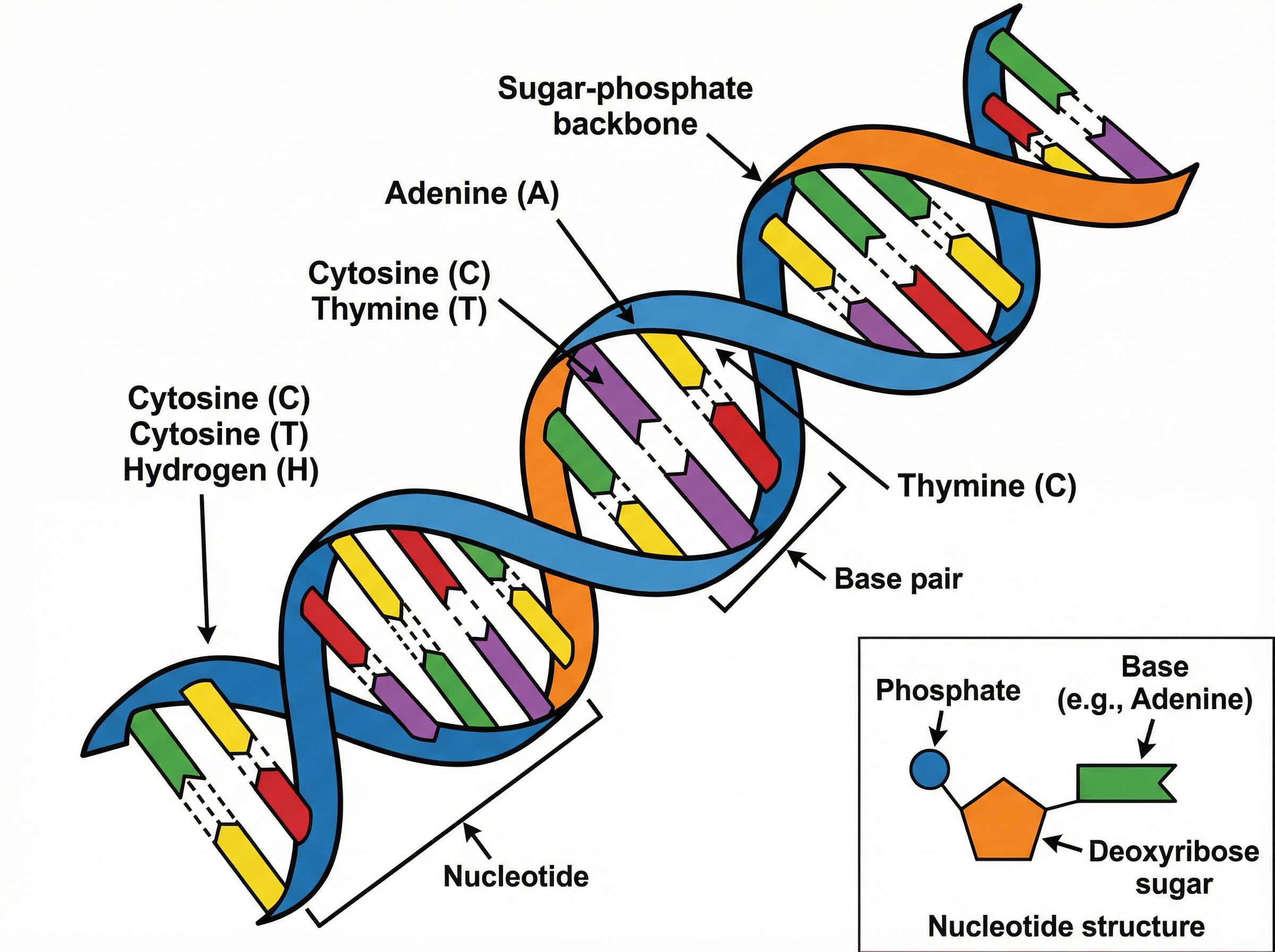
DNA (deoxyribonucleic acid) is the chemical that makes up our genetic material. It is a polymer made of two strands coiled together to form a double helix. DNA is found in the nucleus of animal and plant cells, packaged into structures called chromosomes.

The genome is the entire genetic material of an organism. Understanding the human genome is incredibly important for medicine in the future. It allows scientists to search for genes linked to different types of disease, understand and treat inherited disorders, and trace human migration patterns from the past.
Concept 2: Reproduction and Meiosis
There are two types of reproduction: sexual and asexual.
Sexual reproduction involves the joining (fusion) of male and female gametes (sperm and egg cells in animals, pollen and egg cells in flowering plants). Because there is a mixing of genetic information, it leads to variety in the offspring. The formation of gametes involves a special type of cell division called meiosis.
Asexual reproduction involves only one parent and no fusion of gametes. There is no mixing of genetic information, leading to genetically identical offspring (clones). Only mitosis is involved.
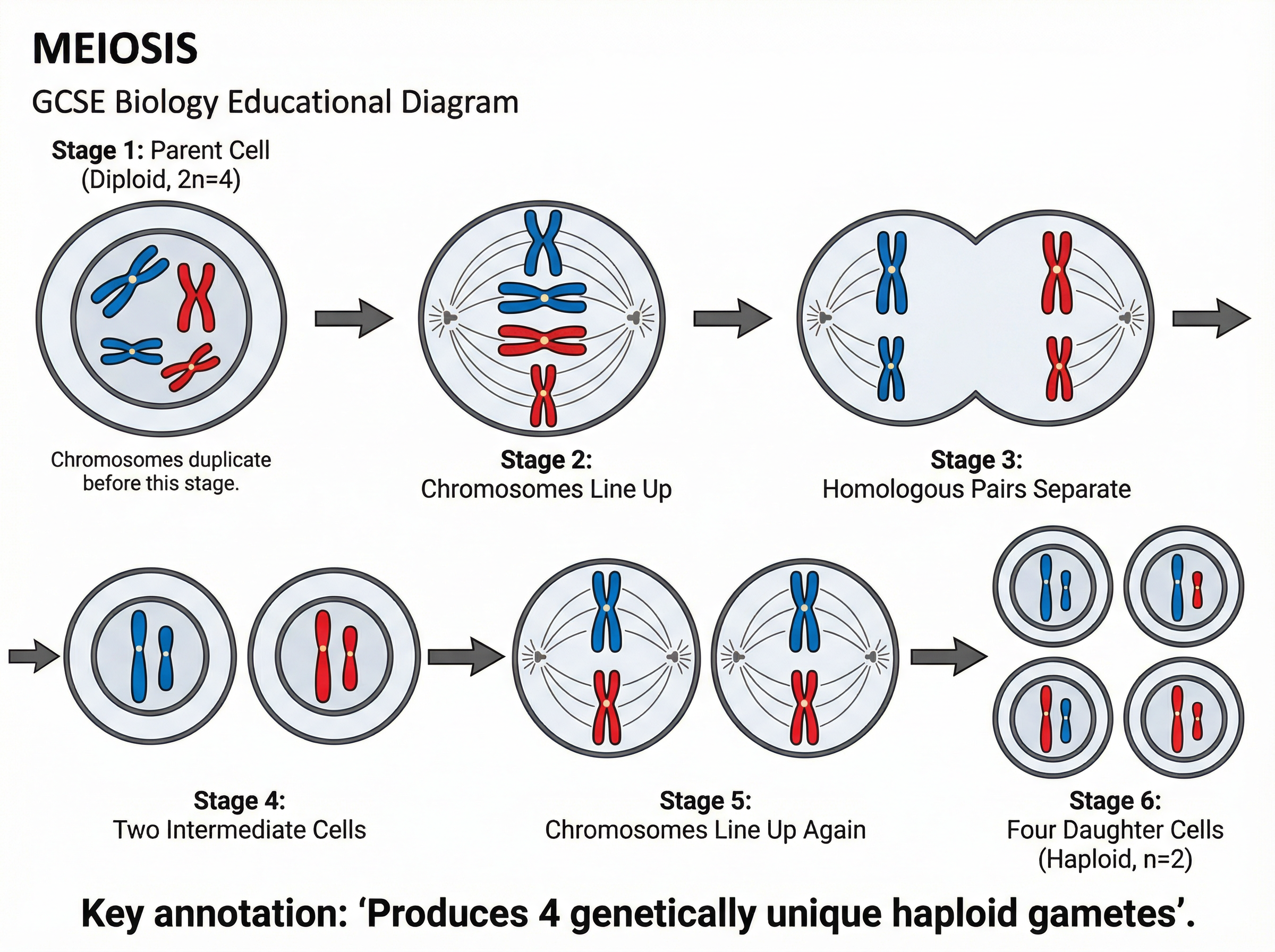
Meiosis halves the number of chromosomes to make gametes. When a cell divides to form gametes:
- Copies of the genetic information are made.
- The cell divides twice to form four gametes, each with a single set of chromosomes.
- All gametes are genetically different from each other.
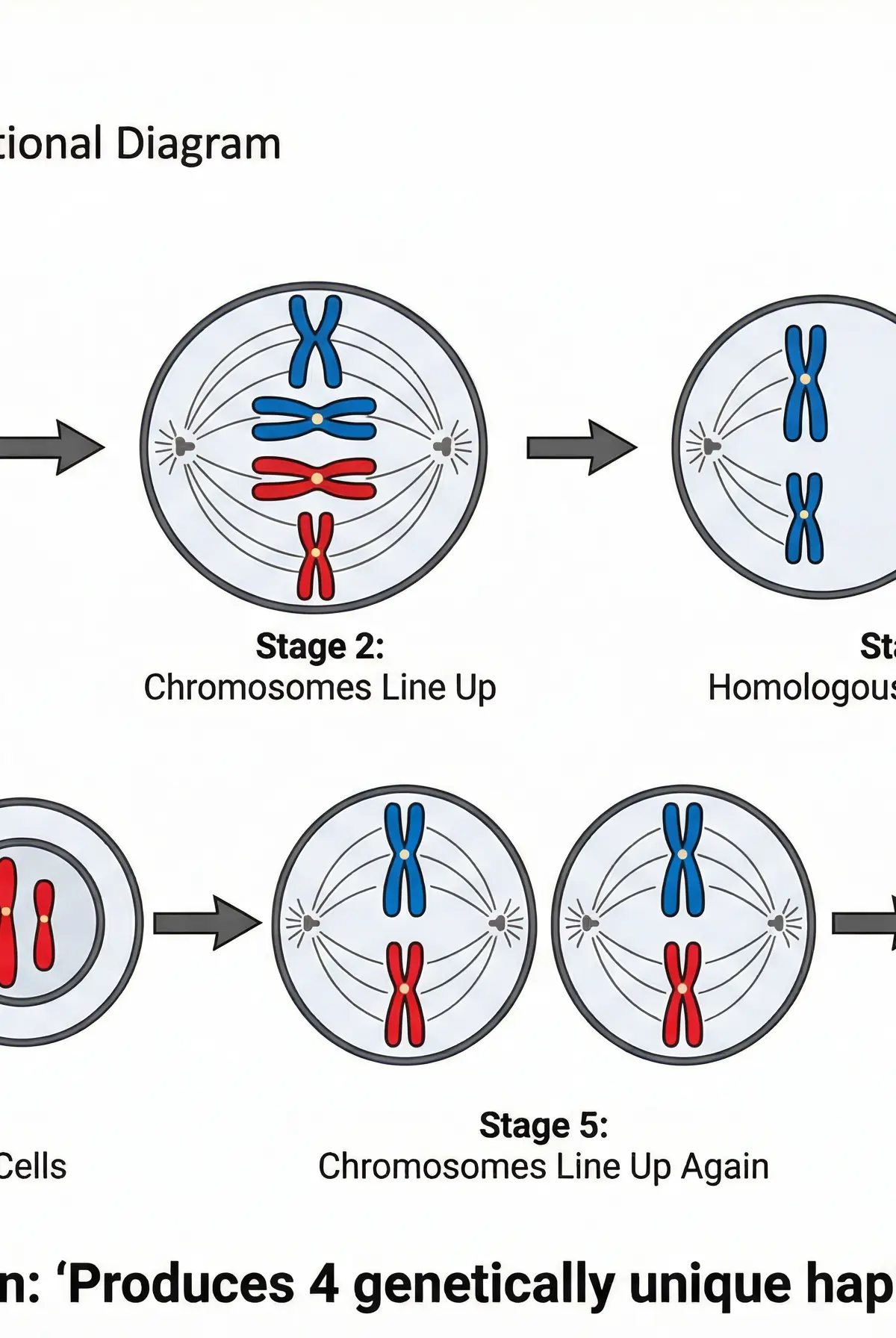
At fertilisation, gametes join to restore the normal number of chromosomes. The new cell divides by mitosis. The number of cells increases. As the embryo develops, cells differentiate.
Concept 3: Genetic Inheritance
Some characteristics are controlled by a single gene, such as fur colour in mice or red-green colour blindness in humans. Each gene may have different forms called alleles.
The alleles present, or genotype, operate at a molecular level to develop characteristics that can be expressed as a phenotype.
A dominant allele is always expressed, even if only one copy is present. A recessive allele is only expressed if two copies are present (therefore no dominant allele is present).
If the two alleles present are the same the organism is homozygous for that trait, but if the alleles are different they are heterozygous.
Example: Predicting inheritance using a Punnett square.
Let's look at a cross between two heterozygous parents (Bb) for brown eyes (B is dominant, b is recessive blue).
| B | b | |
|---|---|---|
| B | BB | Bb |
| b | Bb | bb |
The probability of a blue-eyed child (bb) is 1 in 4, or 25%.
Concept 4: Variation and Evolution
Differences in the characteristics of individuals in a population is called variation. This can be due to genetic causes (the genes they have inherited), environmental causes (the conditions in which they have developed), or a combination of both.
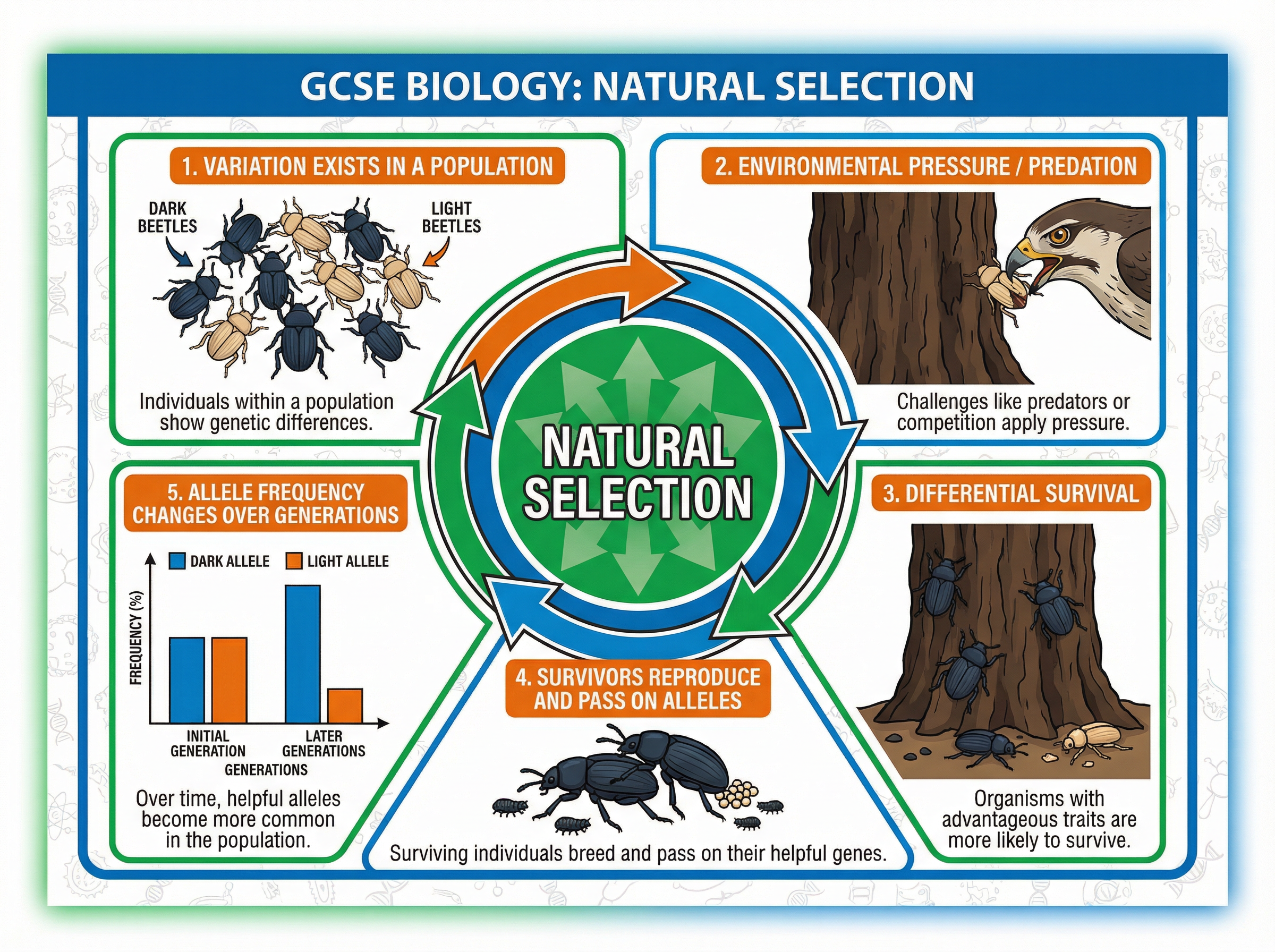
Evolution is a change in the inherited characteristics of a population over time through a process of natural selection which may result in the formation of a new species.
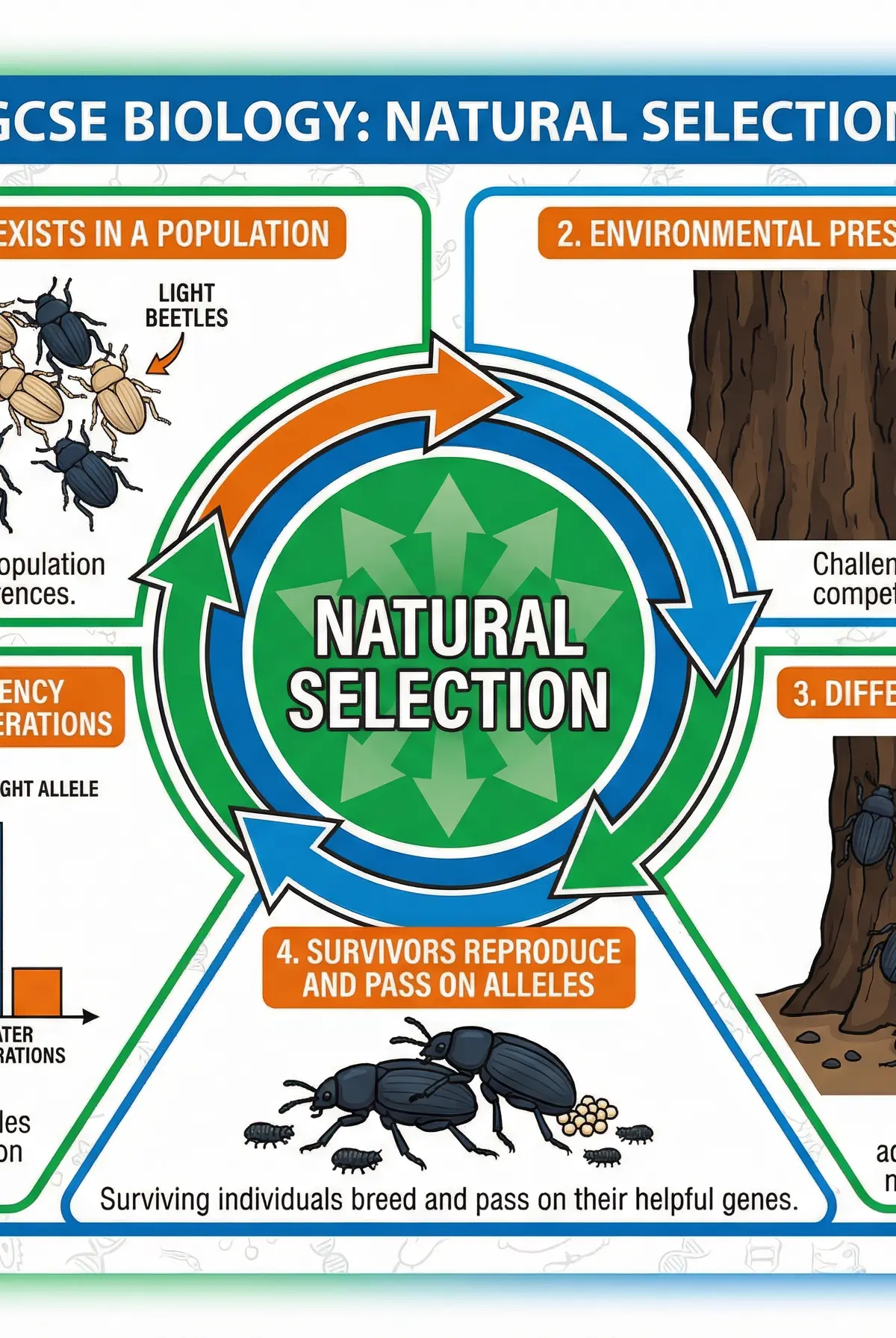
The theory of evolution by natural selection states that all species of living things have evolved from simple life forms that first developed more than three billion years ago.
Concept 5: Selective Breeding and Genetic Engineering
Selective breeding (artificial selection) is the process by which humans breed plants and animals for particular genetic characteristics. Humans have been doing this for thousands of years since they first bred food crops from wild plants and domesticated animals.
Genetic engineering is a process which involves modifying the genome of an organism by introducing a gene from another organism to give a desired characteristic.
Plant crops have been genetically engineered to be resistant to diseases or to produce bigger better fruits. Bacterial cells have been genetically engineered to produce useful substances such as human insulin to treat diabetes.
Mathematical/Scientific Relationships
In genetic crosses, you must be able to express outcomes as:
- Fractions: e.g., 1/4 chance of homozygous recessive.
- Decimals: e.g., 0.25 probability.
- Percentages: e.g., 25% chance.
- Ratios: e.g., 3:1 phenotypic ratio (3 dominant : 1 recessive).
Remember that probabilities in genetic crosses are independent for each offspring. If parents have a 25% chance of having a child with a recessive condition, and their first child has the condition, the chance for their second child is still 25%.
Practical Applications
Understanding genetics has massive real-world applications. Genetic engineering is currently used to produce human insulin for diabetics using bacteria. This is much safer and more efficient than the old method of extracting insulin from pigs or cows.
In agriculture, crops are genetically modified to be resistant to herbicides or insects, increasing yield to feed a growing global population. However, this raises ethical and ecological questions about the long-term impact on wild plant populations and food chains.
Visual Resources
3 diagrams and illustrations
Interactive Diagrams
2 interactive diagrams to visualise key concepts
Conceptual Flow Outline
The sequence of events in meiosis leading to gamete formation.
Conceptual Flow Outline
The cycle of selective breeding (artificial selection).
Worked Examples
3 worked examples — open one to explore the question and available guidance.
Practice Questions
Test your understanding — click to reveal model answers
State what is meant by the term 'genome'.
Hint: Think about 'all' the genetic material.
A plant with red flowers (Rr) is crossed with a plant with white flowers (rr). Red is dominant. Predict the percentage of offspring that will have white flowers. Show your working.
Hint: Draw a Punnett square. White flowers must have the genotype 'rr'.
Describe how the process of meiosis results in genetic variation.
Hint: Think about what happens to the chromosomes before the cell divides.
Evaluate the use of genetic engineering in agriculture. You should include a conclusion.
Hint: Provide pros, cons, and a final judgement.
Explain why sexual reproduction is an advantage for a species if the environment changes.
Hint: Link variation to survival.