Pearson Edexcel · GCSE · Biology
Topic 6 – Plant structures and their functions
This topic covers the fascinating biology of plant structures, from the microscopic layers of a leaf to the transport systems that keep plants alive. Understanding how plants are adapted for photosynthesis, gas exchange, and water transport is crucial, as these concepts frequently appear in high-mark exam questions.
- 8 min read
- 3 worked examples
- 5 practice questions
- 6 key terms
Study Notes
Overview

Welcome to Topic 6: Plant Structures and Their Functions. While animals can move to find food and water, plants must be highly adapted to survive and thrive right where they are rooted. This topic explores the incredible biological engineering that makes this possible.
In this section, we will investigate how the structure of a leaf is perfectly suited to its function in photosynthesis and gas exchange. We will also explore the plant's transport systems—xylem and phloem—and understand the vital processes of transpiration and translocation. Finally, we will look at how plants respond to their environment using hormones like auxins.
Examiners love to test this topic because it links structure to function, a core theme in Biology. You can expect questions asking you to explain how a specific cell or tissue is adapted for its role, or to interpret data on the factors affecting transpiration rates. Let's dive in.
Key Concepts
Concept 1: Leaf Structure and Adaptations
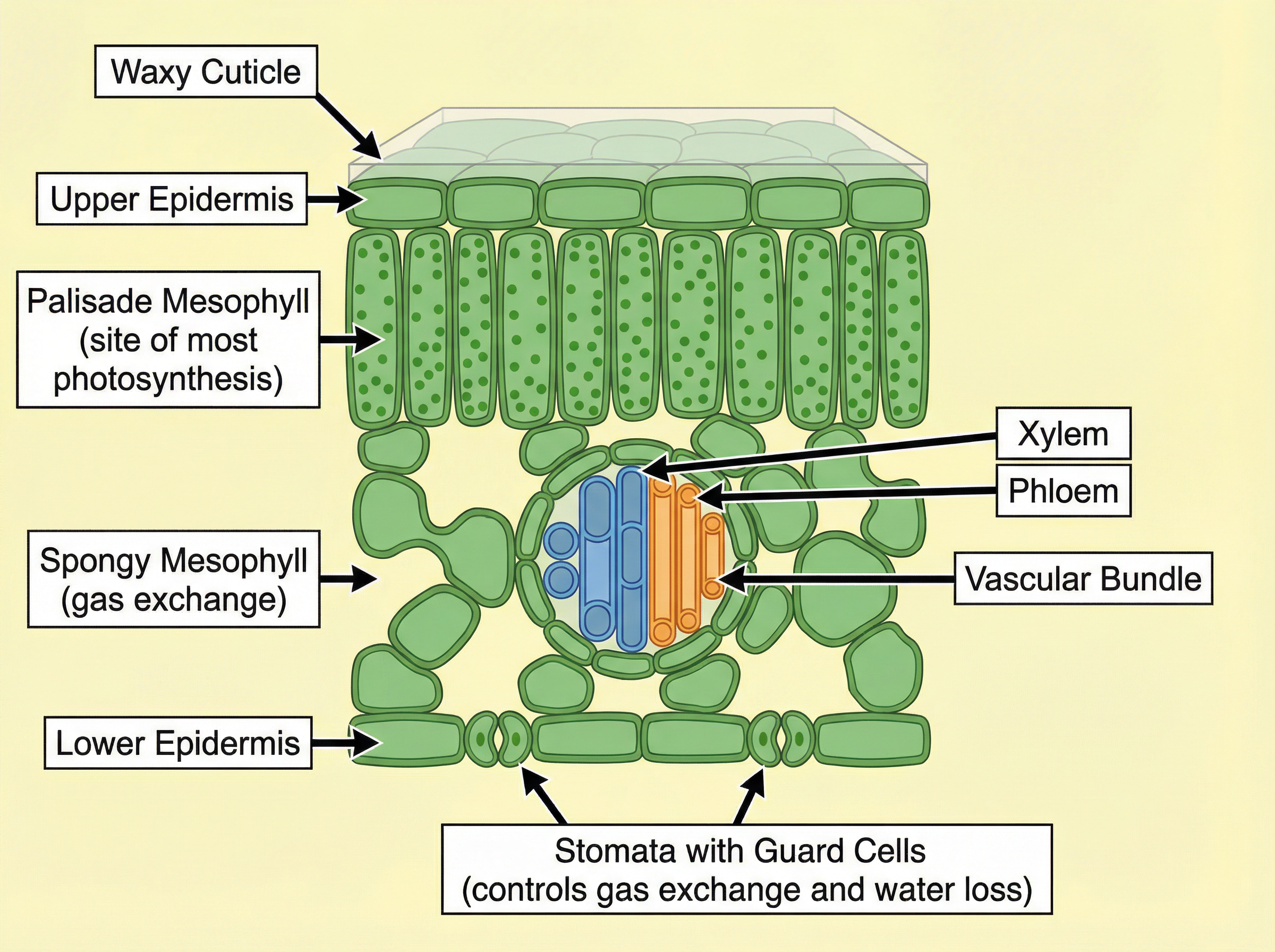
The leaf is the main organ of photosynthesis in most plants. If you cut a cross-section of a leaf, you will see it is made up of several distinct layers, each adapted for a specific purpose.

- Waxy Cuticle: A thin, transparent, waterproof layer at the top of the leaf. It reduces water loss by evaporation while allowing light to pass through to the photosynthetic cells below.
- Upper Epidermis: A single layer of transparent cells with no chloroplasts. Its main function is to protect the leaf and allow light to reach the palisade layer.
- Palisade Mesophyll: This is the primary site of photosynthesis. These tall, column-shaped cells are packed tightly together near the upper surface of the leaf to absorb maximum light. They contain numerous chloroplasts, which house the green pigment chlorophyll.
- Spongy Mesophyll: Located below the palisade layer, these cells are loosely arranged with large air spaces between them. This structure provides a large surface area for the efficient diffusion of carbon dioxide into the cells and oxygen out of the cells during gas exchange.
- Lower Epidermis: The bottom layer of the leaf, containing numerous tiny pores called stomata.
- Stomata and Guard Cells: Stomata (singular: stoma) allow carbon dioxide to diffuse into the leaf and oxygen to diffuse out. They also allow water vapour to escape. Each stoma is flanked by two guard cells, which control the opening and closing of the pore depending on the plant's water status.
Examiner Tip: When asked to explain leaf adaptations, always link the structure (e.g., "palisade cells are near the top") to the function (e.g., "to absorb maximum light for photosynthesis").
Concept 2: Transport Systems (Xylem and Phloem)
Plants have two main transport systems to move substances around their bodies: the xylem and the phloem.
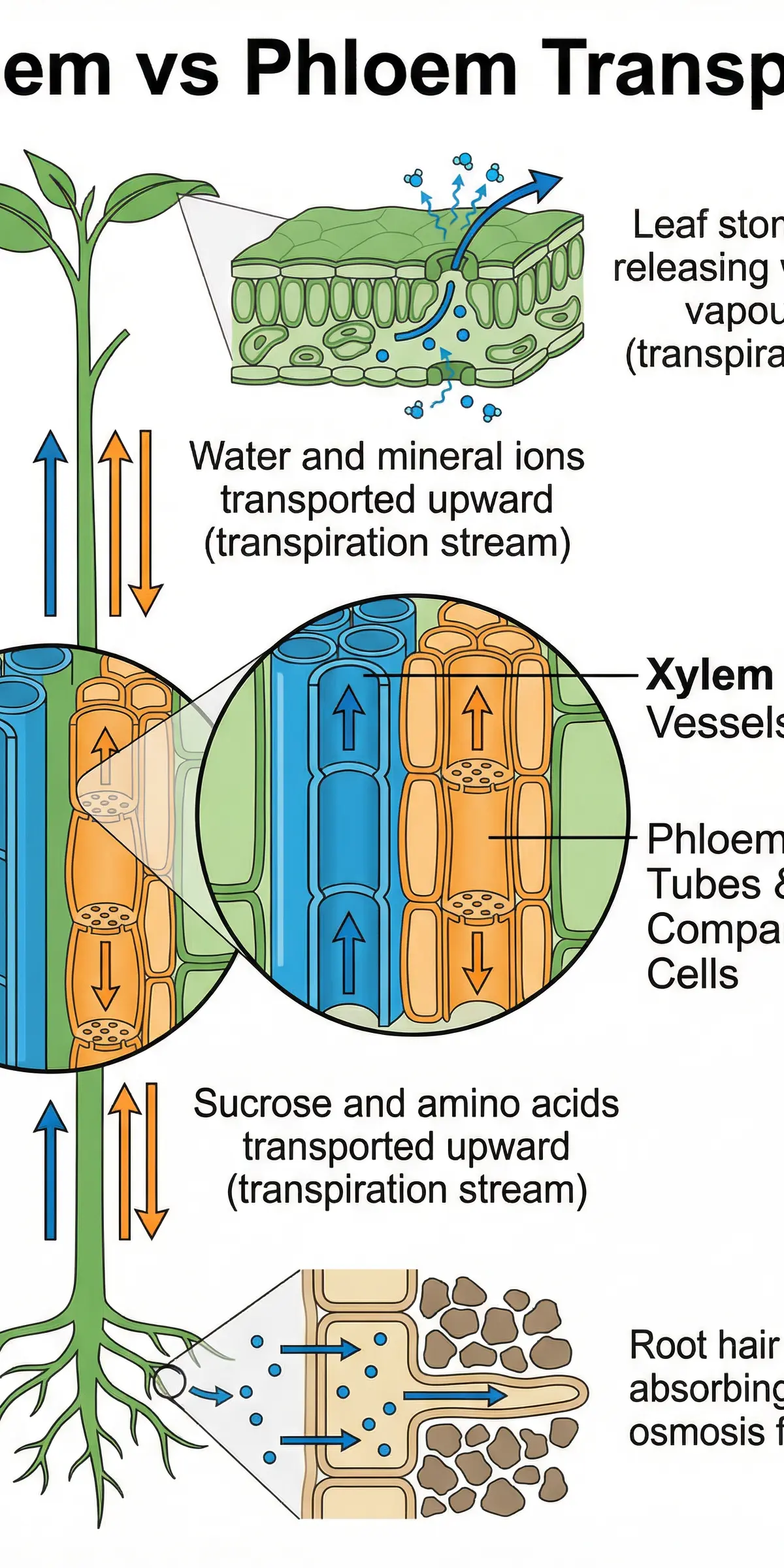
Xylem and Transpiration
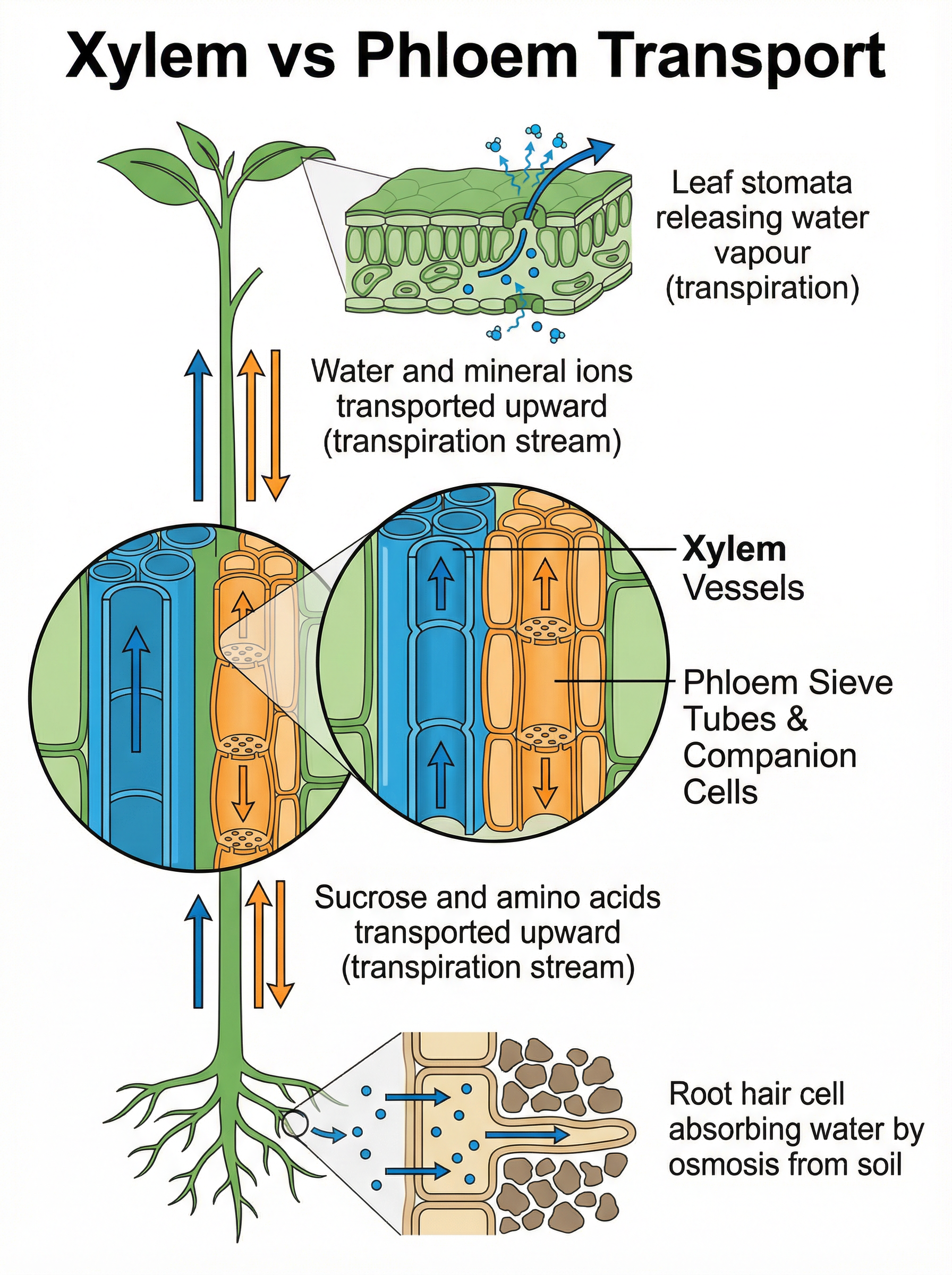
The xylem transports water and dissolved mineral ions from the roots, up the stem, and into the leaves.
- Structure: Xylem vessels are made of dead cells joined end-to-end with no cross walls, forming a continuous hollow tube. The walls are strengthened with a tough substance called lignin, which provides support and prevents the vessels from collapsing under the pressure of water movement.
- Function: The movement of water through the xylem is driven by transpiration—the loss of water vapour from the leaves. As water evaporates from the spongy mesophyll cells and diffuses out of the stomata, it creates a pulling force (transpiration pull) that draws more water up the xylem from the roots. This continuous flow of water is called the transpiration stream.
Phloem and Translocation
The phloem transports dissolved sugars (mainly sucrose) and amino acids from the leaves (where they are made during photosynthesis) to the rest of the plant (for immediate use in respiration or for storage).
- Structure: Phloem consists of living cells arranged in tubes. The ends of the cells have pores (sieve plates) to allow cell sap to flow through. Phloem vessels are supported by companion cells, which provide the energy needed for transport.
- Function: The movement of food substances through the phloem is called translocation. Unlike transpiration, translocation requires energy and can occur in both directions (up and down the stem).
Concept 3: Factors Affecting Transpiration
The rate of transpiration is affected by several environmental factors. Examiners frequently ask you to explain these relationships.
- Light Intensity: Higher light intensity increases the rate of transpiration. This is because stomata open wider in bright light to allow more carbon dioxide in for photosynthesis, which also allows more water vapour to escape.
- Temperature: Higher temperatures increase the rate of transpiration. The water molecules have more kinetic energy, so they evaporate from the mesophyll cells and diffuse out of the stomata more rapidly.
- Air Movement (Wind): Increased air movement increases the rate of transpiration. Wind blows away the water vapour that accumulates just outside the stomata, maintaining a steep concentration gradient for diffusion.
- Humidity: Higher humidity decreases the rate of transpiration. If the air outside the leaf is already saturated with water vapour, the concentration gradient is shallower, so diffusion occurs more slowly.
Concept 4: Root Hair Cells and Absorption
Roots are adapted to absorb water and mineral ions from the soil.
- Root Hair Cells: These specialised cells have long, thin projections that greatly increase the surface area for absorption.
- Water Absorption: Water enters the root hair cells by osmosis. The soil water has a higher water potential (is more dilute) than the cell sap inside the root hair cell, so water moves down the concentration gradient through the partially permeable cell membrane.
- Mineral Ion Absorption: Mineral ions (like nitrates and magnesium) are often in lower concentration in the soil than inside the root hair cells. Therefore, they must be absorbed by active transport, moving against the concentration gradient. This process requires energy from respiration, which is why root hair cells contain many mitochondria.
Concept 5: Plant Hormones (Auxins)
Plants respond to stimuli such as light and gravity to ensure they grow in the best possible direction. These responses are called tropisms and are controlled by plant hormones called auxins.
- Phototropism: The growth response to light. Auxins are produced in the shoot tip. If light shines from one side, the auxin diffuses to the shaded side of the shoot. In the shoot, a higher concentration of auxin promotes cell elongation. The cells on the shaded side grow faster, causing the shoot to bend towards the light (positive phototropism).
- Gravitropism (Geotropism): The growth response to gravity. In a horizontal root, gravity causes auxin to accumulate on the lower side. However, in roots, a higher concentration of auxin inhibits cell growth. The cells on the upper side grow faster, causing the root to bend downwards (positive gravitropism).
Practical Applications
Listen to our 10-minute podcast for a comprehensive review of these concepts, including a quick-fire recall quiz!
Required Practical: Investigating the rate of transpiration using a potometerA potometer is a piece of apparatus used to estimate the rate of transpiration by measuring the rate of water uptake by a plant shoot.
- Method: A leafy shoot is cut underwater (to prevent air bubbles entering the xylem) and fitted into the potometer. An air bubble is introduced into the capillary tube. As the plant transpires, it takes up water, and the air bubble moves along the tube.
- Measurement: The distance moved by the bubble in a set time is recorded. The rate of transpiration can be estimated by calculating the volume of water taken up per minute.
- Variables: You can investigate the effect of different factors by changing one variable (e.g., placing a fan near the plant to increase wind speed, or a lamp to increase light intensity) while keeping all other factors constant.
Visual Resources
2 diagrams and illustrations
Interactive Diagrams
2 interactive diagrams to visualise key concepts
Conceptual Flow Outline
The pathway of water through a plant (The Transpiration Stream)
Conceptual Flow Outline
The mechanism of positive phototropism in a plant shoot
Worked Examples
3 worked examples — open one to explore the question and available guidance.
Practice Questions
Test your understanding — click to reveal model answers
State the function of the waxy cuticle in a leaf. (1 mark)
Hint: Think about what wax does to water.
Explain how the spongy mesophyll layer is adapted for its function. (2 marks)
Hint: What process happens here, and what structural feature makes it efficient?
A student set up a potometer to measure the rate of transpiration in a plant shoot. Explain why the rate of transpiration decreased when a plastic bag was placed over the shoot. (3 marks)
Hint: Think about which environmental factor the plastic bag affects and how this alters the concentration gradient.
Describe the role of active transport in plant roots. (2 marks)
Hint: What substances are moved, and why is active transport necessary?
Explain the mechanism of gravitropism in a plant root. (4 marks)
Hint: Where does auxin accumulate, and what effect does it have in roots compared to shoots?