Pearson Edexcel · GCSE · Biology
Topic 9 – Ecosystems and material cycles
Master the flow of energy and materials through the natural world. This topic covers the vital carbon, nitrogen, and water cycles, alongside food webs and the crucial role of decomposers—all essential knowledge for securing high marks in your Biology exam.
- 6 min read
- 3 worked examples
- 5 practice questions
- 6 key terms
Study Notes
Overview
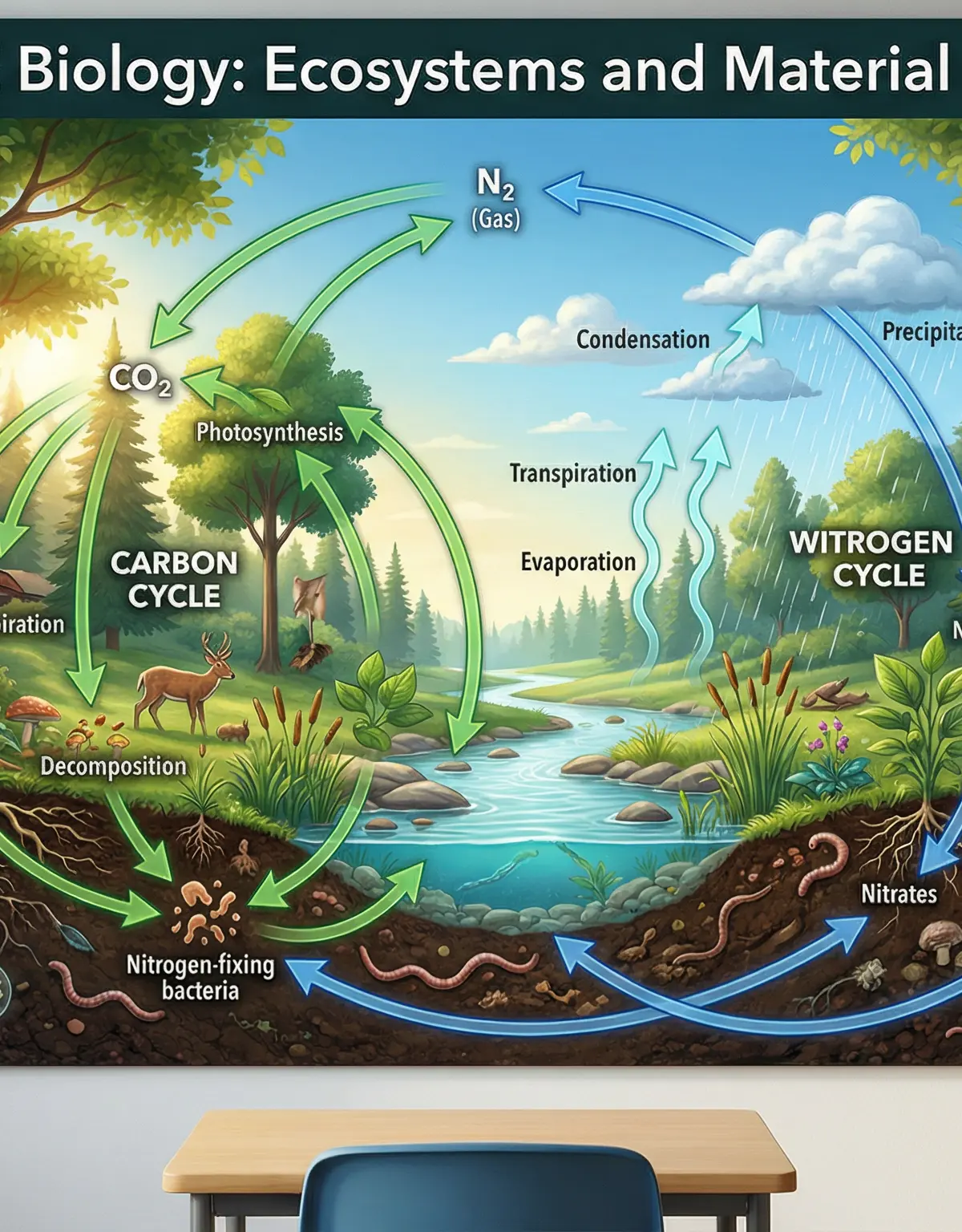
Welcome to Topic 9: Ecosystems and Material Cycles. This section of the GCSE Biology specification is fundamental to understanding how the natural world sustains itself. It explores the delicate balance between biotic (living) and abiotic (non-living) factors, and how essential elements like carbon and nitrogen are continuously recycled.
This topic is heavily tested in exams, often appearing as extended 6-mark questions where you must logically describe a cycle or explain the impact of human activities, such as eutrophication. It connects closely to other biological concepts like photosynthesis, respiration, and human impact on the environment. By mastering these cycles, you'll not only boost your exam grade but also gain a deeper appreciation for the intricate systems that keep our planet alive.
Listen to the audio guide below for a comprehensive overview:
Key Concepts
Concept 1: Ecosystems and Interdependence
An ecosystem encompasses all the organisms living in a particular area (the community) and all the non-living (abiotic) conditions, such as temperature, soil pH, and water availability. Organisms within an ecosystem are highly interdependent. For example, animals depend on plants for oxygen and food, while plants depend on animals for carbon dioxide and pollination.
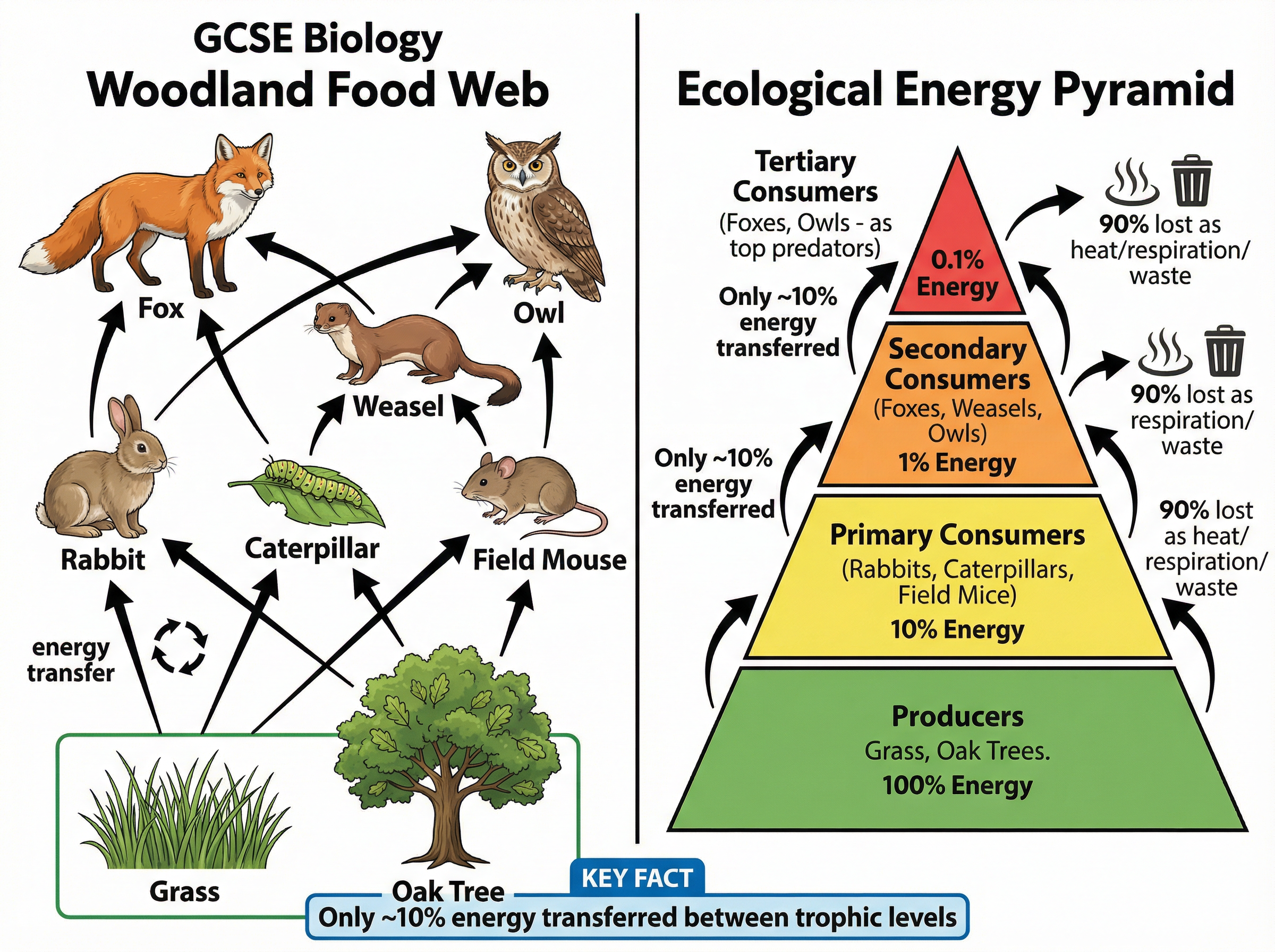
Example: In a woodland ecosystem, if a disease wipes out the rabbit population, the fox population (which preys on rabbits) will decrease due to lack of food, while the grass population (which rabbits eat) may temporarily overgrow.
Concept 2: Trophic Levels and Energy Flow
Feeding relationships are represented by food chains and food webs. Each stage in a food chain is a trophic level.
- Producer: Organisms (usually plants or algae) that produce their own biomass using energy from the sun via photosynthesis.
- Primary Consumer: Herbivores that eat producers.
- Secondary Consumer: Carnivores that eat primary consumers.
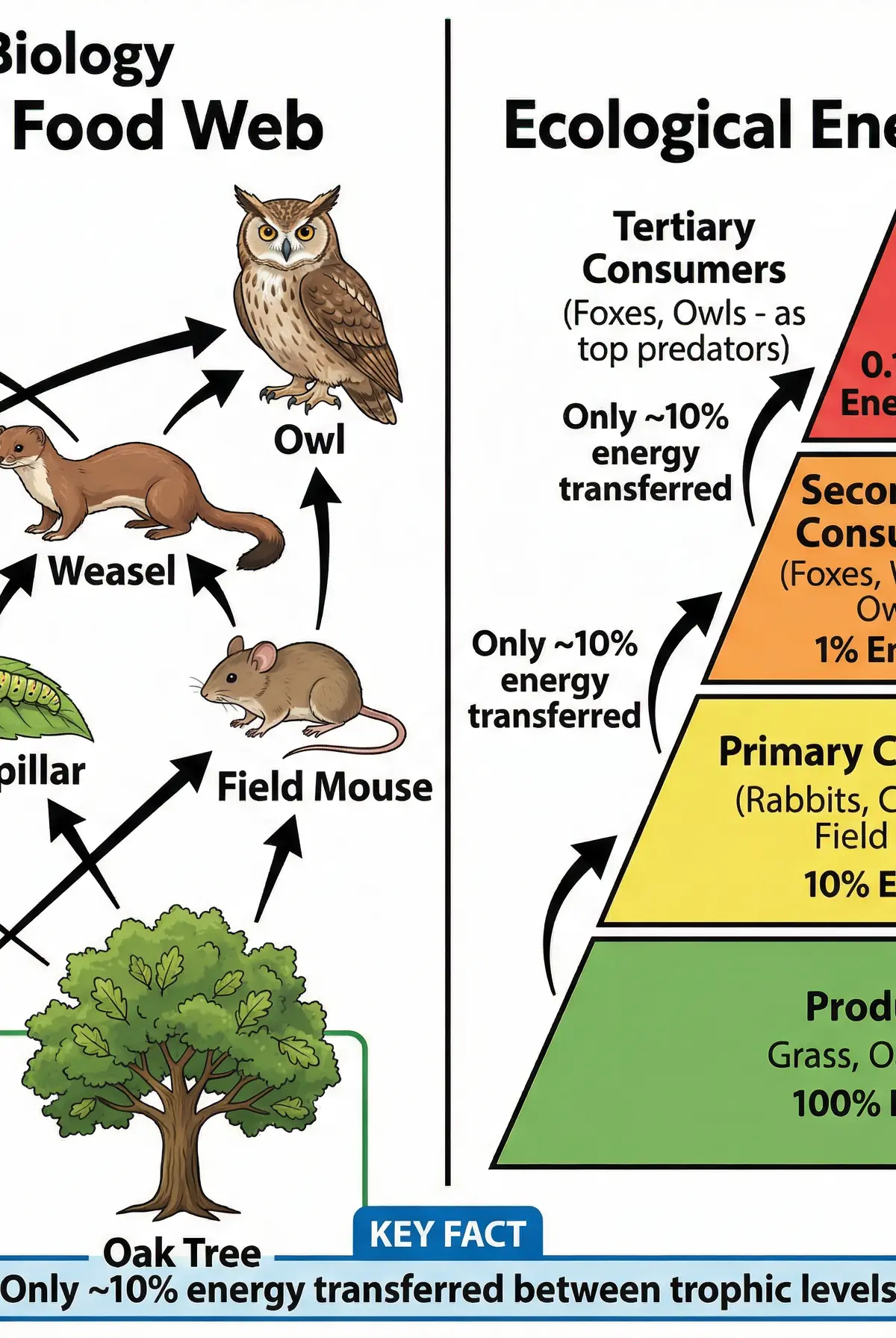
A critical rule in biology is that energy is lost at each trophic level. When a consumer eats an organism, it only retains about 10% of the energy. The remaining 90% is lost through:
- Heat generated by respiration
- Movement
- Excretion (urine and faeces)
- Inedible parts (bones, roots)
This inefficiency explains why food chains rarely exceed four or five levels—there simply isn't enough energy left to sustain top predators.
Concept 3: The Carbon Cycle
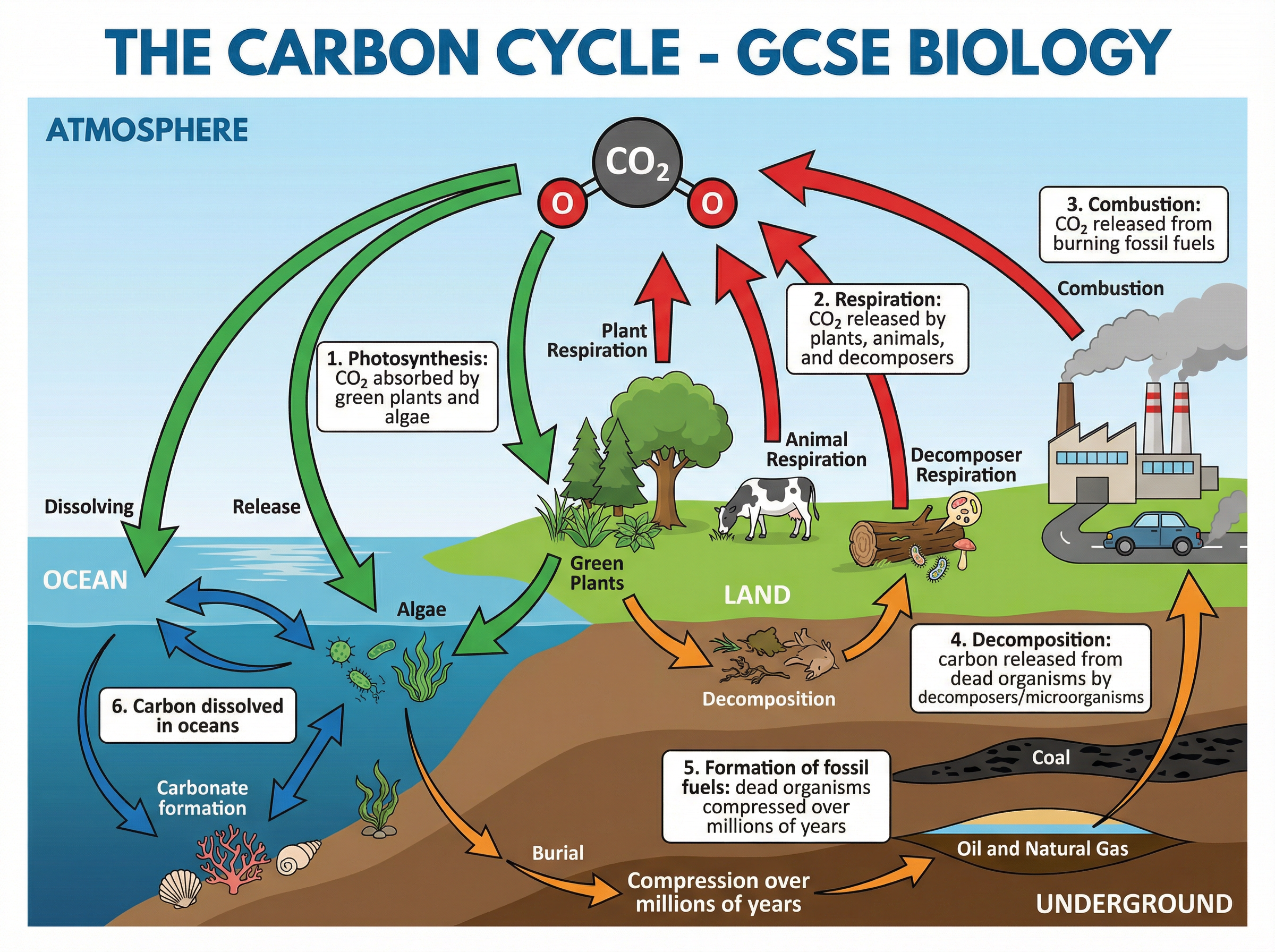
Carbon is the fundamental building block of life. The carbon cycle describes how carbon moves between the atmosphere, living organisms, and the earth.
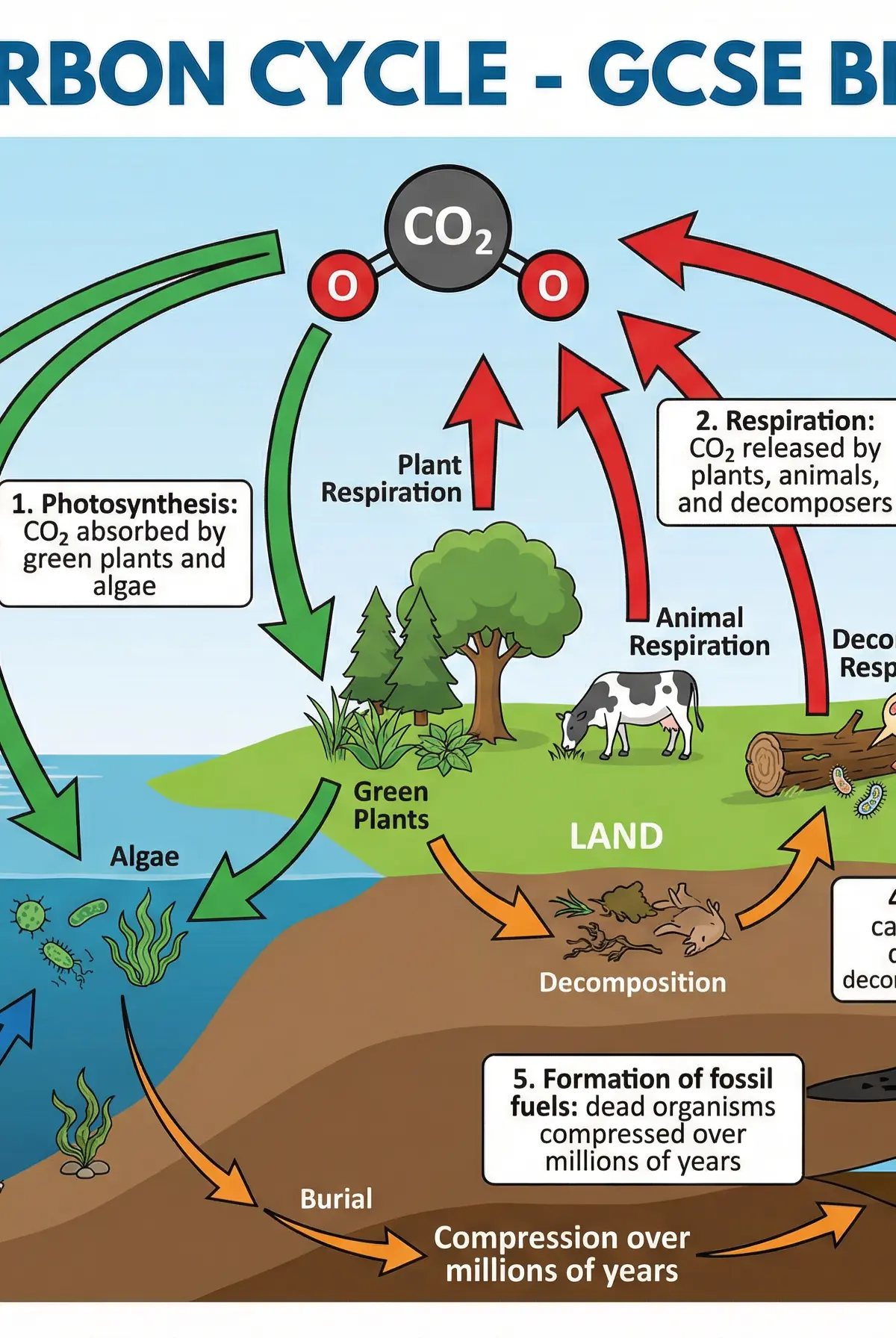
- Photosynthesis: Green plants and algae remove CO2 from the atmosphere, converting it into glucose and other carbon compounds (biomass).
- Feeding: Carbon is passed along the food chain as animals eat plants and other animals.
- Respiration: All living organisms (plants, animals, and decomposers) respire, releasing CO2 back into the atmosphere.
- Decomposition: When organisms die or produce waste, decomposers (bacteria and fungi) break down the carbon compounds. The decomposers respire, releasing CO2.
- Combustion: Burning fossil fuels (which are compressed dead organisms formed over millions of years) releases stored carbon back into the atmosphere as CO2.
Concept 4: The Nitrogen Cycle
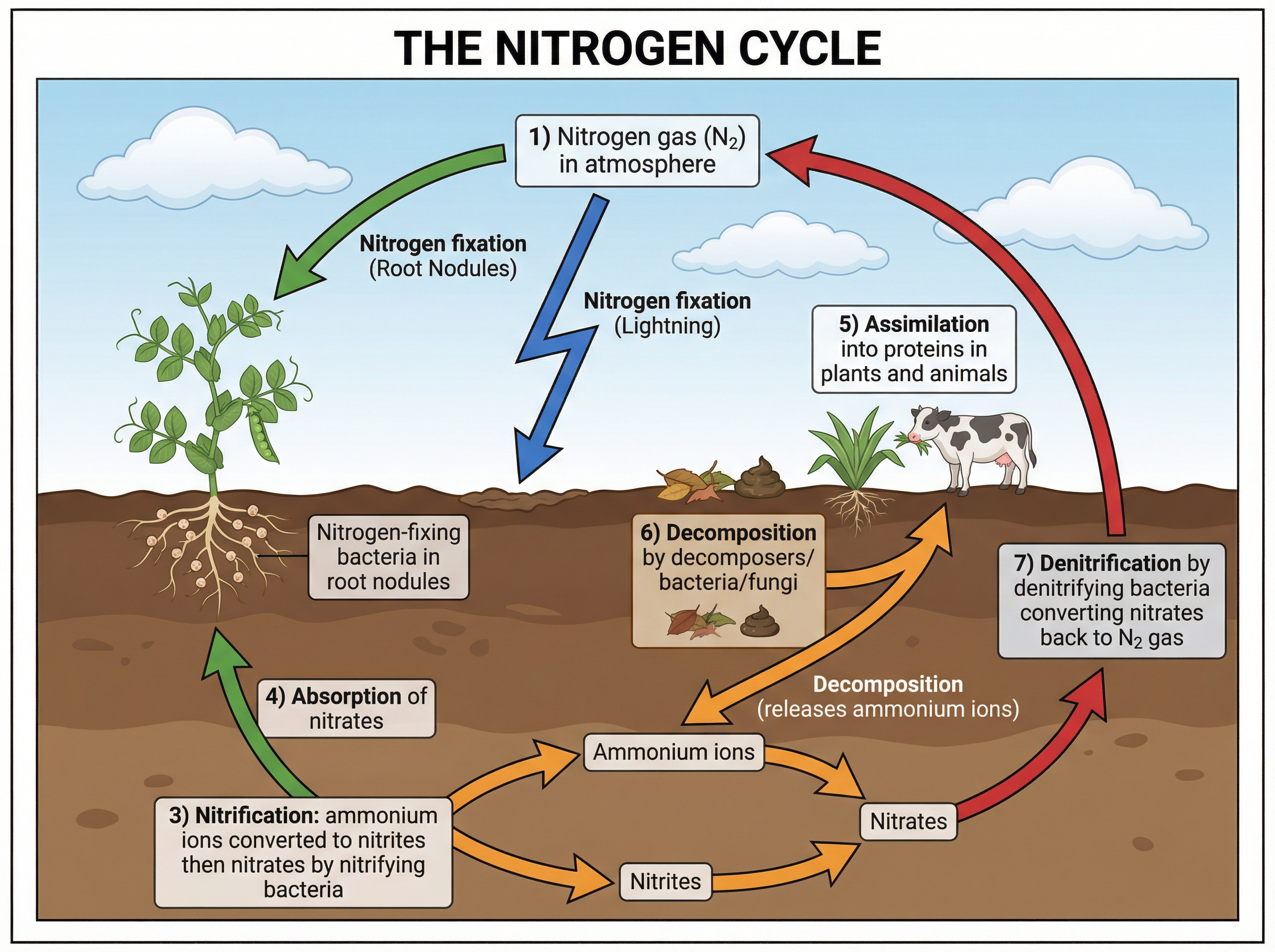
Nitrogen is essential for making proteins and DNA. Although the atmosphere is 78% nitrogen gas (N2), most organisms cannot use it directly. It must be converted into nitrates.
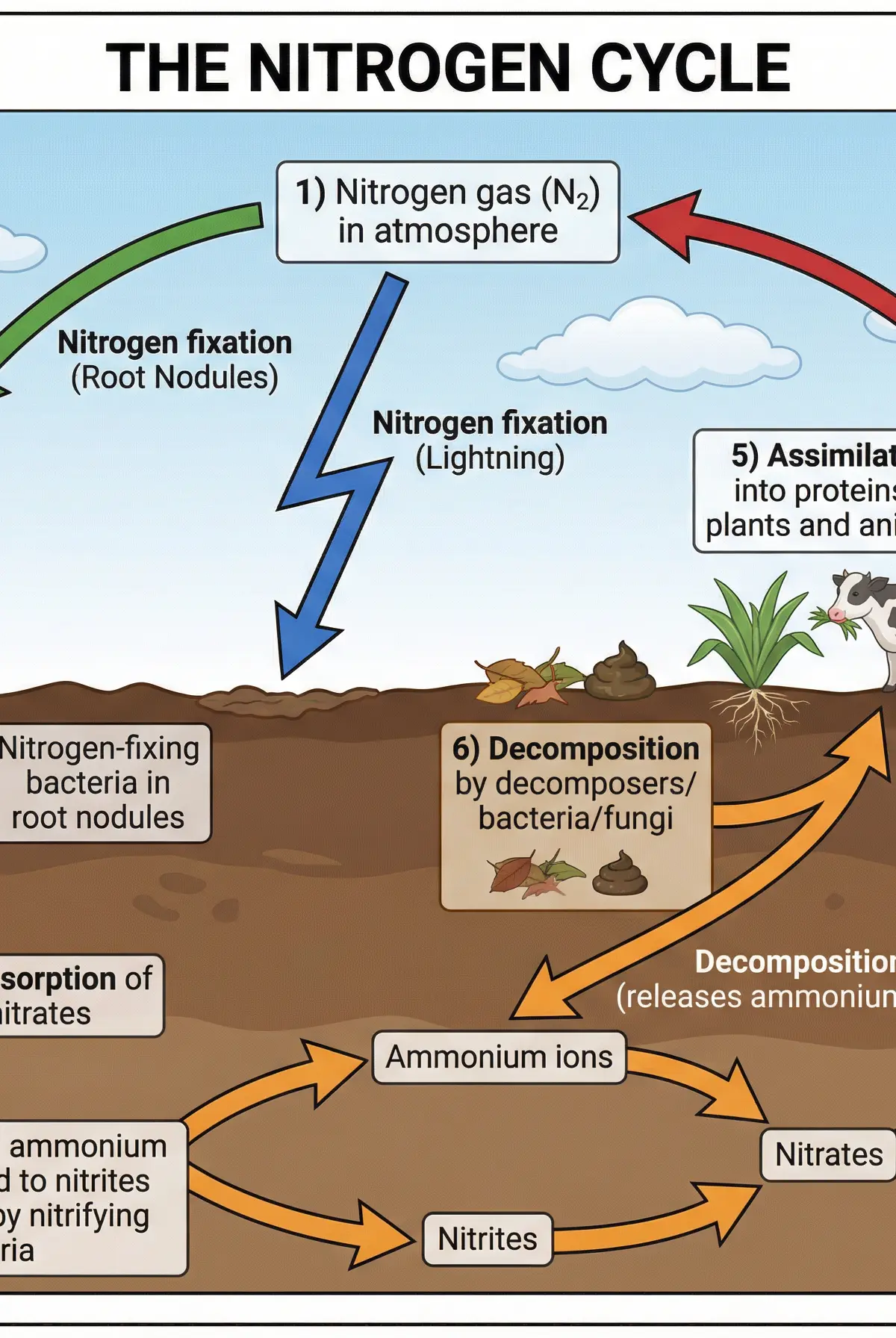
- Nitrogen Fixation: Converting N2 gas into nitrogen compounds (like ammonia) in the soil. This is done by lightning or nitrogen-fixing bacteria (found free in the soil or in root nodules of leguminous plants like peas).
- Nitrification: Nitrifying bacteria convert ammonium ions into nitrites, and then into nitrates, which plants can absorb through their roots.
- Assimilation: Plants use nitrates to make amino acids and proteins. Animals eat the plants to get nitrogen.
- Decomposition: Decomposers break down dead organisms and urea, returning ammonium ions to the soil.
- Denitrification: In waterlogged, oxygen-poor soil, denitrifying bacteria convert nitrates back into nitrogen gas, returning it to the atmosphere.
Concept 5: Decomposers and Rate of Decay
Decomposers (bacteria and fungi) are nature's recyclers. They secrete enzymes externally onto dead matter to break it down into smaller soluble molecules, which they then absorb. The rate of decay depends on three main abiotic factors:
- Temperature: Decay is faster in warm conditions because the enzymes work at their optimum rate. If it's too hot, enzymes denature; if too cold, the process slows down.
- Moisture: Microorganisms need water to survive and carry out biological processes.
- Oxygen Availability: Most decomposers respire aerobically, so decay is faster when oxygen is plentiful (e.g., in an aerated compost heap).
Mathematical/Scientific Relationships
Calculating Efficiency of Biomass TransferEfficiency = (Biomass transferred to next level / Biomass available at previous level) * 100
Note: This formula is not given on the formula sheet; you must memorise it.
Practical Applications
Eutrophication: When farmers apply excess nitrate fertilisers, rain can wash the nitrates into nearby lakes or rivers (leaching). This causes a rapid growth of algae (algal bloom). The algae block sunlight, preventing plants below from photosynthesising, so they die. Decomposers break down the dead plants, multiplying rapidly and using up all the dissolved oxygen in the water for aerobic respiration. Consequently, fish and other aquatic organisms suffocate and die.
Compost Heaps: Gardeners use knowledge of decay to make compost. They ensure the heap is warm, moist, and well-aerated (often by turning it with a fork) to provide optimum conditions for decomposers, rapidly producing nutrient-rich compost for their crops.
Visual Resources
3 diagrams and illustrations
Interactive Diagrams
2 interactive diagrams to visualise key concepts
Conceptual Flow Outline
The sequence of events in Eutrophication.
Conceptual Flow Outline
Simplified roles of bacteria in the Nitrogen Cycle.
Worked Examples
3 worked examples — open one to explore the question and available guidance.
Practice Questions
Test your understanding — click to reveal model answers
Explain why food chains rarely have more than five trophic levels. (3 marks)
Hint: Think about what happens to energy as it moves from one consumer to the next.
Describe the role of nitrogen-fixing bacteria in the nitrogen cycle. (2 marks)
Hint: What do they take from the air, and what do they turn it into?
A farmer notices that the rate of decay in his compost heap is very slow during winter. Explain why. (3 marks)
Hint: How does temperature affect the microorganisms causing the decay?
Evaluate the use of artificial nitrate fertilisers by farmers. (4 marks)
Hint: Provide both advantages (for the crop) and disadvantages (for the environment).
Waterlogged soils lack oxygen. Explain how this affects the nitrogen cycle and plant growth. (4 marks)
Hint: Which bacteria thrive in anaerobic conditions, and what do they do to nitrates?