OCR · A-Level · Biology
Gene Technologies
Master the complex interactions of life from DNA to entire ecosystems in Module 6. This crucial topic connects inheritance patterns with evolutionary pressures and energy flow, testing your ability to apply mathematical models to biological systems.
- 5 min read
- 3 worked examples
- 5 practice questions
- 6 key terms
Study Notes
Overview
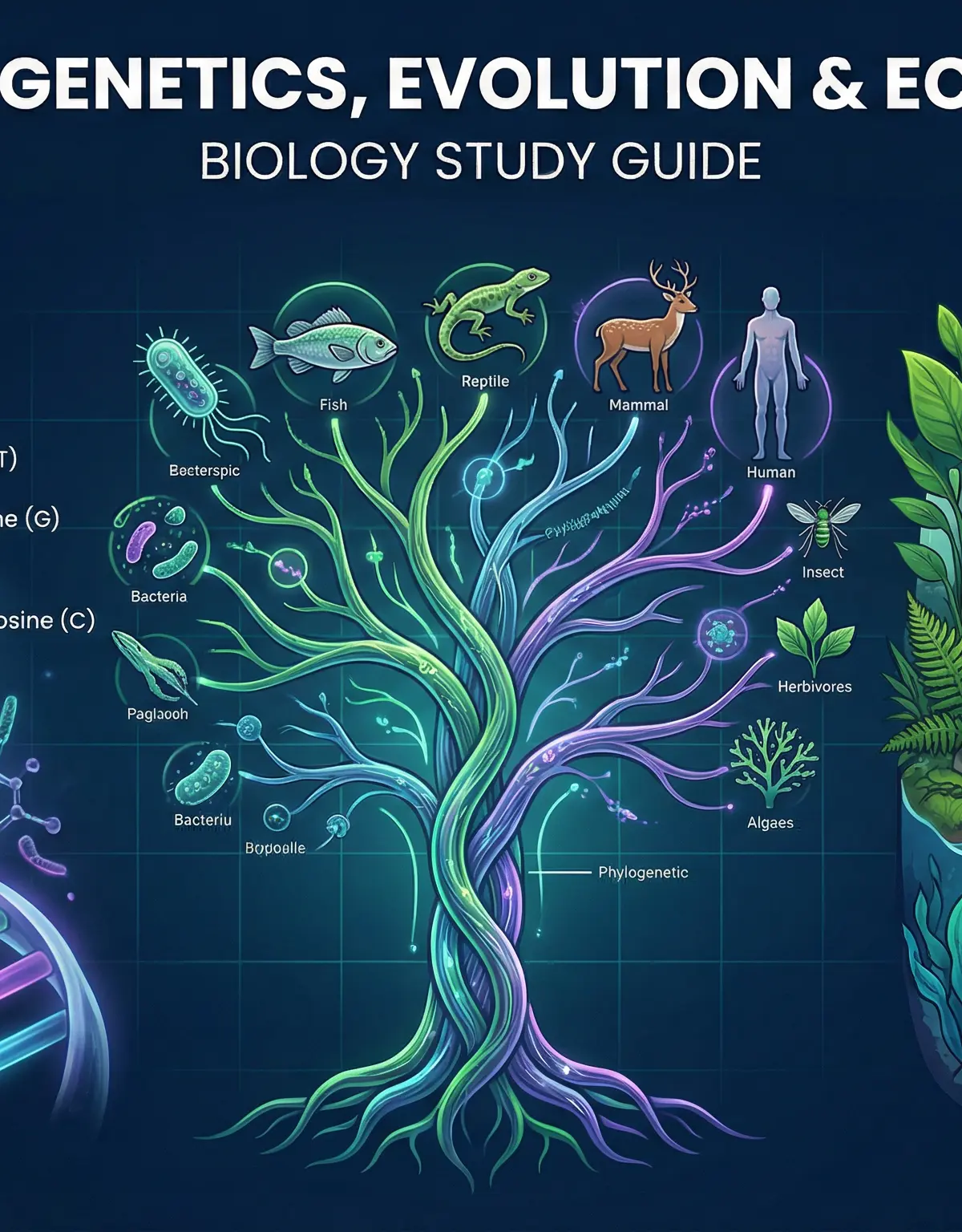
Welcome to Module 6: Genetics, Evolution and Ecosystems. This is a synoptic module, meaning it draws together everything you've learned about cellular biology, biochemistry, and physiology to explain how life functions on a grand scale. Examiners love this topic because it tests your ability to think critically across different biological levels—from the molecular structure of DNA up to the complex food webs of an entire ecosystem.
You'll need to master the mathematics of inheritance (Mendelian genetics), understand the statistical tools used to measure population changes (Hardy-Weinberg), and explain the flow of energy and matter through ecosystems. Expect multi-part questions where you must calculate a genetic ratio, explain the evolutionary advantage of a phenotype, and then discuss how that species interacts within its habitat. This guide will give you the precise terminology and step-by-step methods needed to secure top marks.
Key Concepts
Concept 1: Mendelian Inheritance and Genetic Crosses
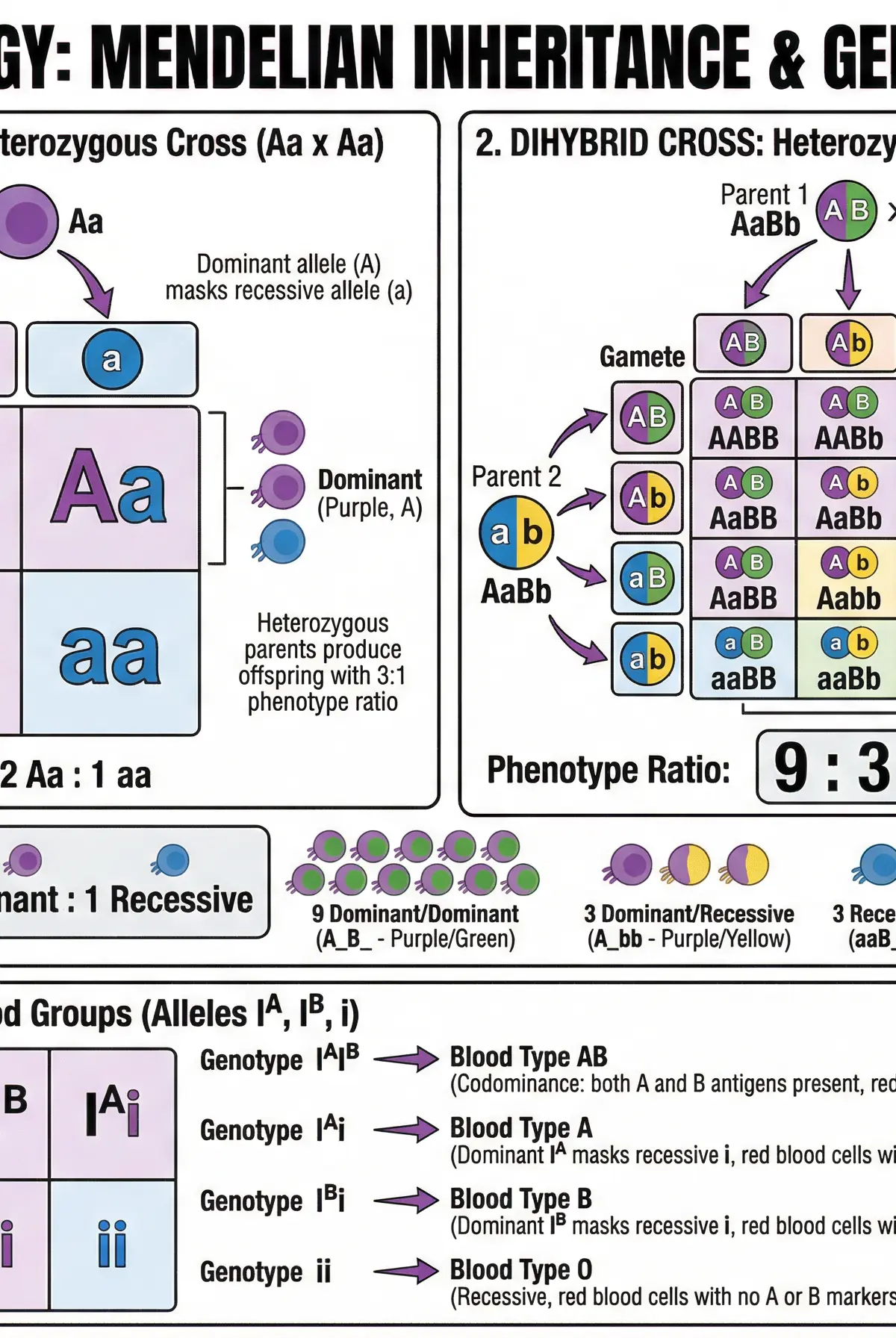
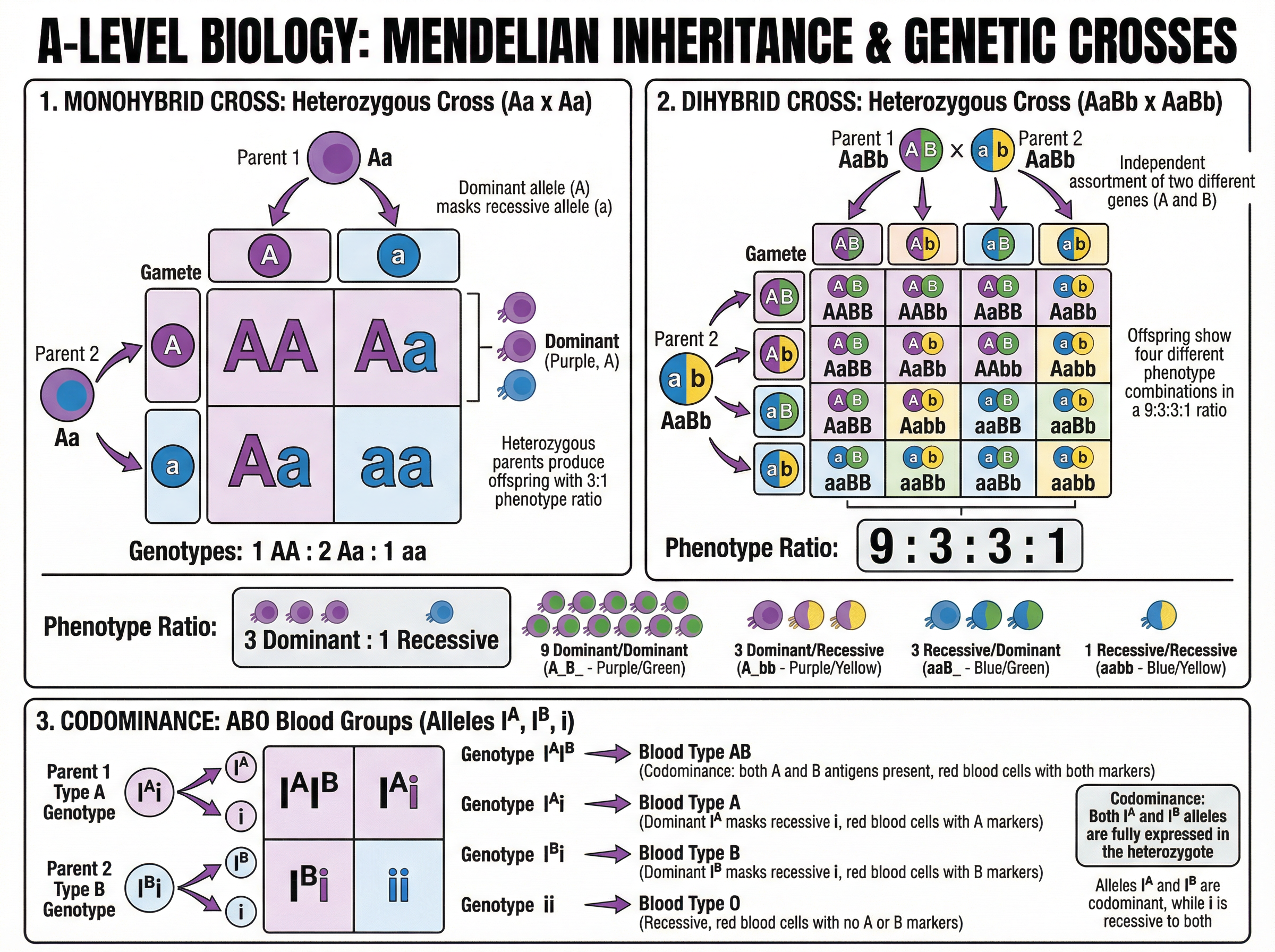
Inheritance is all about probability. When organisms reproduce sexually, they pass on alleles (different versions of a gene) to their offspring. The combination of alleles an organism possesses is its genotype, while the observable physical trait is its phenotype.
Examiners frequently test your ability to construct and interpret Punnett squares. A monohybrid cross looks at the inheritance of a single gene. If you cross two heterozygous individuals (Aa x Aa), you will always see a 3:1 phenotypic ratio (assuming complete dominance). A dihybrid cross looks at two genes simultaneously. A cross between two double heterozygotes (AaBb x AaBb) yields the classic 9:3:3:1 ratio.
Crucial Examiner Tip: You must always clearly define your alleles at the start of your answer (e.g., 'Let A = dominant tall allele, a = recessive short allele'). Marks are often lost because candidates write out a perfect Punnett square but fail to explicitly state the resulting phenotypes and their ratio.
Concept 2: Evolution and Natural Selection
Evolution is the change in allele frequencies in a population over time. Natural selection is the mechanism driving this change. When answering questions on natural selection, you must use a highly structured approach to ensure you hit all the marking points.
Never write that an organism 'adapted to its environment' or 'mutated to survive'. Mutations are random and occur before the selection pressure is applied.
The V-S-R-A-S Framework for Full Marks:
- Variation exists in the population due to random mutations.
- Selection pressure (e.g., a new predator, disease, or climate change) acts on the population.
- Organisms with advantageous alleles have a survival advantage and are more likely to Reproduce.
- They pass on the Advantageous alleles to their offspring.
- Over many generations, the frequency of these alleles increases in the population (Shift in allele frequency).
Concept 3: Ecosystems and Energy Flow
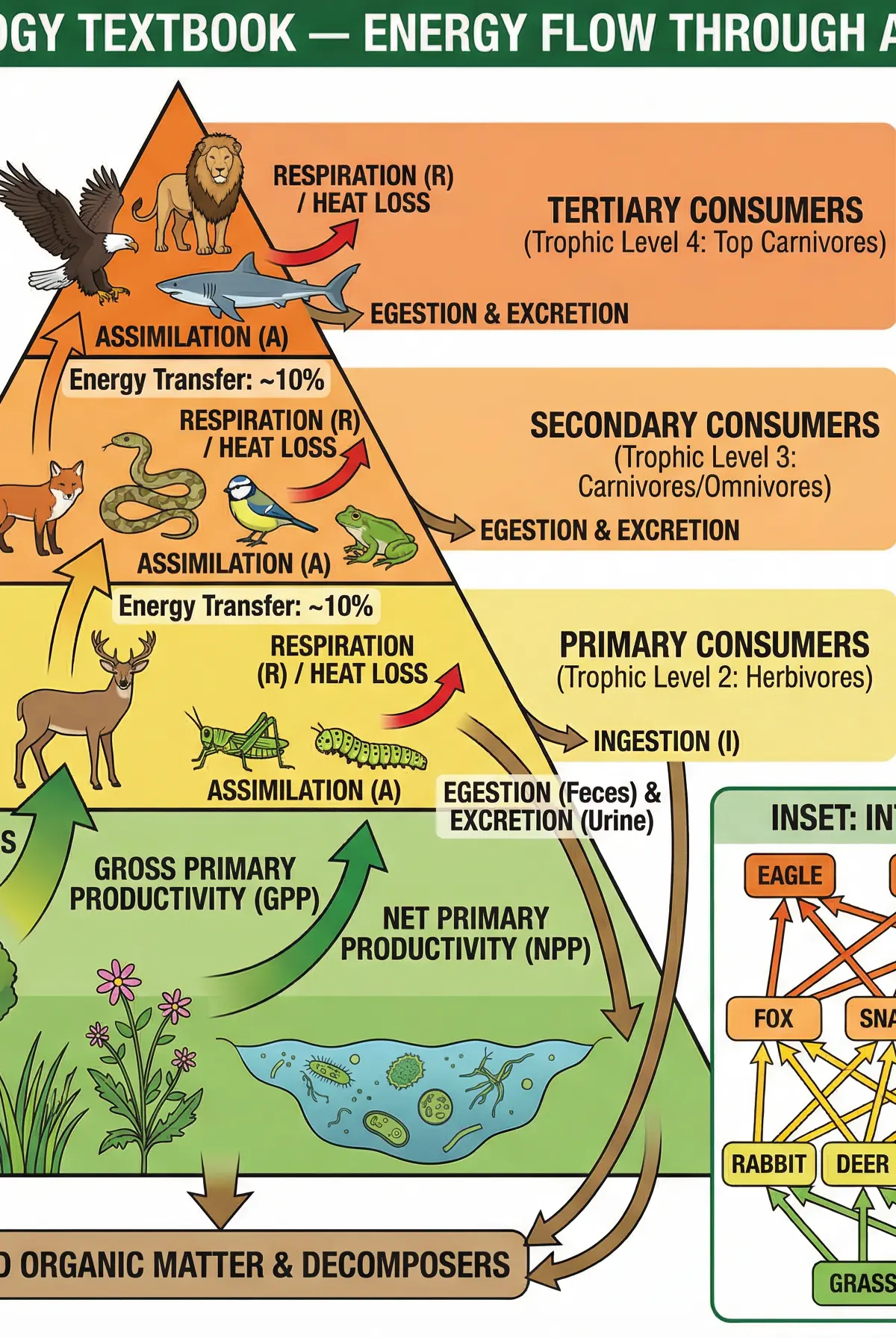
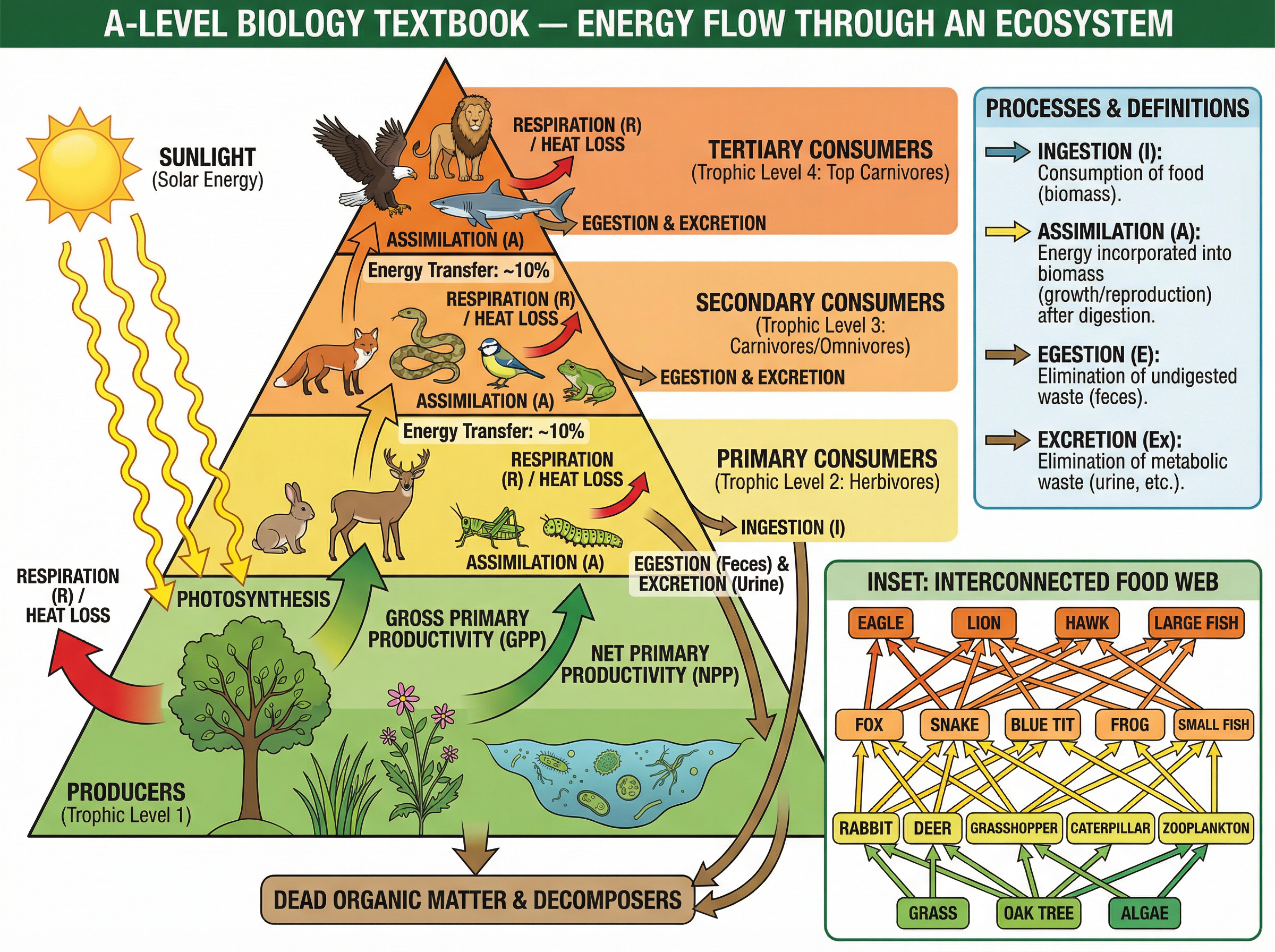
An ecosystem consists of all the interacting living organisms (biotic factors) and non-living conditions (abiotic factors) in an area. Energy flows through ecosystems, entering via photosynthesis in producers and transferring through trophic levels (feeding levels) to consumers.
Energy transfer is highly inefficient. Typically, only about 10% of the energy at one trophic level is passed to the next. Examiners will ask you why this happens. You must provide specific biological reasons: energy is lost as heat during respiration, not all parts of the organism are eaten (e.g., bones, roots), and some parts are indigestible and lost in faeces (egestion).
Mathematical/Scientific Relationships
The Hardy-Weinberg Principle
This mathematical model calculates allele frequencies in a population, assuming the population is stable (no mutations, random mating, large population, no selection pressure).
- p + q = 1 (The sum of the frequencies of the dominant allele 'p' and recessive allele 'q' equals 1)
- p² + 2pq + q² = 1 (The sum of the frequencies of the homozygous dominant genotype 'p²', heterozygous genotype '2pq', and homozygous recessive genotype 'q²' equals 1)
Examiner Advice: Always start by finding 'q²' (the frequency of the homozygous recessive phenotype), as this is the only genotype you can be certain of just by looking at the population. Then square root it to find 'q', and use p = 1 - q to find 'p'.
Ecological Efficiency
Ecological Efficiency (%) = (Energy available after the transfer / Energy available before the transfer) × 100
Practical Applications
Understanding these concepts is vital for modern agriculture and conservation. For example, farmers use artificial selection (selective breeding) to increase crop yields, applying the principles of Mendelian genetics. Conservationists use Hardy-Weinberg calculations to monitor the genetic diversity of endangered species, ensuring populations don't become too inbred.
Visual Resources
2 diagrams and illustrations
Interactive Diagrams
2 interactive diagrams to visualise key concepts
Conceptual Flow Outline
Flowchart detailing the processes of Allopatric and Sympatric Speciation.
Conceptual Flow Outline
Simplified energy flow diagram showing transfers and losses in an ecosystem.
Worked Examples
3 worked examples — open one to explore the question and available guidance.
Practice Questions
Test your understanding — click to reveal model answers
A student investigated the inheritance of flower colour in sweet peas. They crossed two heterozygous plants (Rr). Purple (R) is dominant to red (r). Draw a genetic diagram to show the expected genotypes and phenotypes of the offspring, and state the expected ratio. (4 marks)
Hint: Start by clearly defining your alleles and the parental genotypes before drawing the Punnett square.
Explain why the efficiency of energy transfer between secondary consumers and tertiary consumers is usually higher than the efficiency of energy transfer between producers and primary consumers. (3 marks)
Hint: Think about the digestibility of plant matter (cellulose) versus animal tissue (protein).
Define the term 'epistasis'. (2 marks)
Hint: It involves the interaction between two different genes, not two alleles of the same gene.
A population of insects is sprayed with a new insecticide. Most die, but a few survive and reproduce. Explain how this leads to a resistant population. (4 marks)
Hint: Use the V-S-R-A-S framework.
State the Hardy-Weinberg equation used to calculate genotype frequencies. (1 mark)
Hint: It's the longer equation, not the one for allele frequencies.