OCR · GCSE · Biology
Cell Specialisation
Unlock top marks in OCR GCSE Biology by mastering Cell Specialisation (1.2). This guide breaks down how cells adapt for specific jobs, from sperm to xylem, giving you the examiner's perspective on how to link structure to function and avoid common pitfalls.
- 7 min read
- 3 worked examples
- 5 practice questions
- 6 key terms
Study Notes
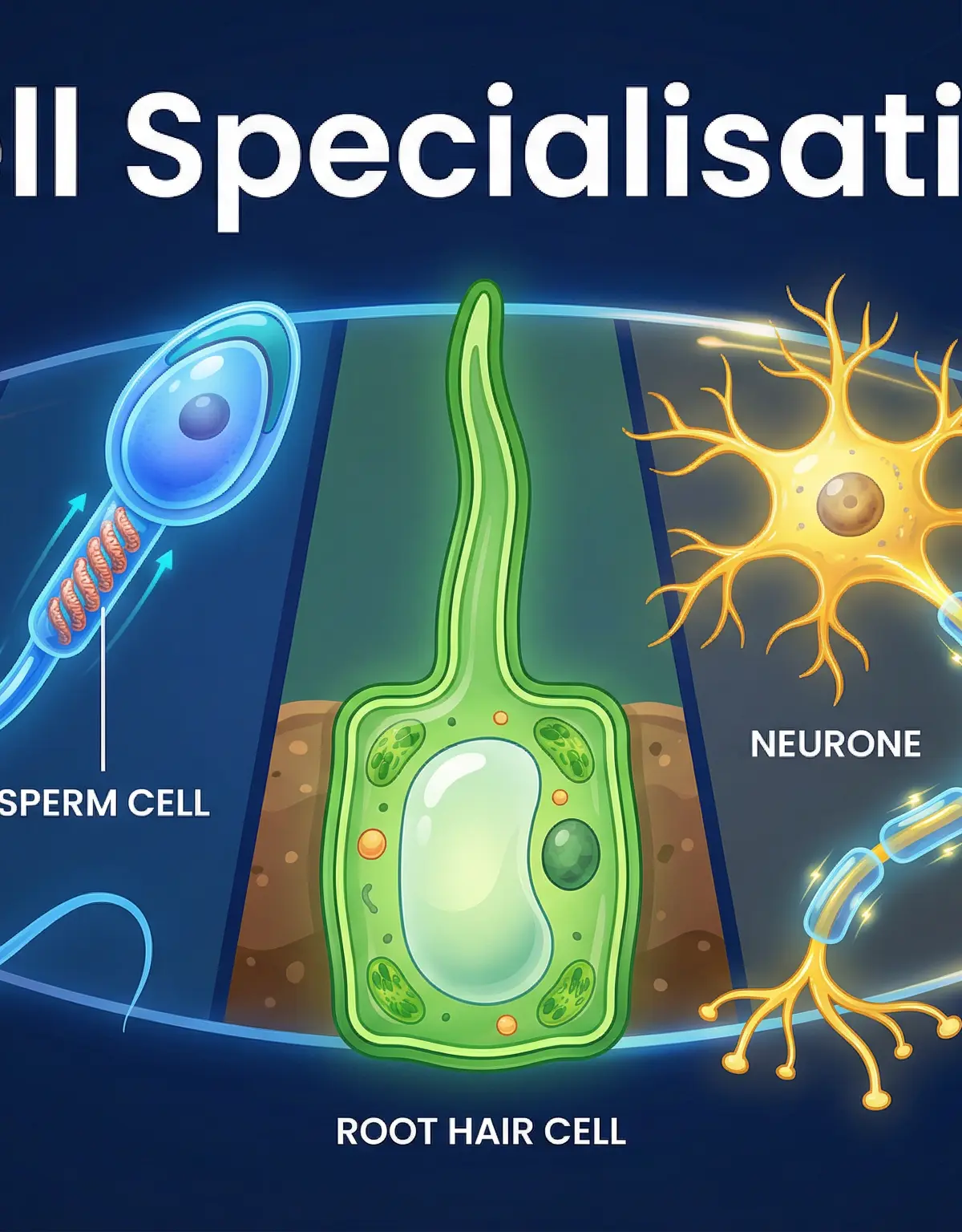
Overview
Cell specialisation is a fundamental concept in biology, explaining the incredible diversity of life. It's the process by which generic, unspecialised cells develop into cells with specific structures to carry out particular functions. In your OCR GCSE exam, this topic (specification reference 1.2) is a cornerstone of cell biology, frequently tested through questions that ask you to link a cell's features to its job (AO2) and recall the specific adaptations (AO1). Candidates who can clearly explain why a structural adaptation is important, using precise scientific language, will be awarded the highest marks. This topic connects directly to understanding tissues, organs, and organ systems, as well as processes like transport in plants and animals. Expect to see a mix of short-answer questions asking you to 'State' an adaptation, and longer 'Explain' or 'Compare' questions requiring more detailed analysis.
Key Concepts
Concept 1: Differentiation - The Path to Specialisation
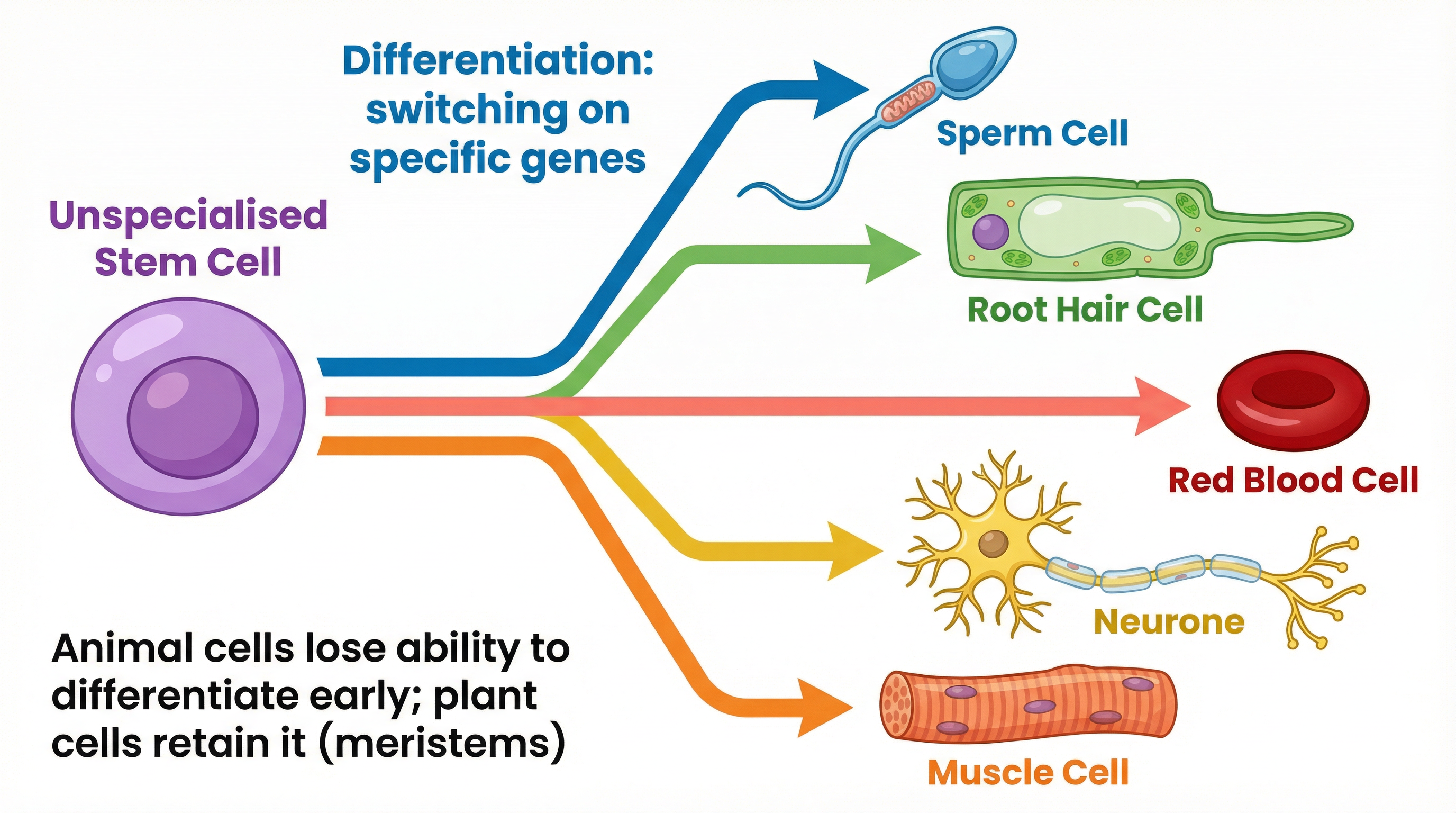
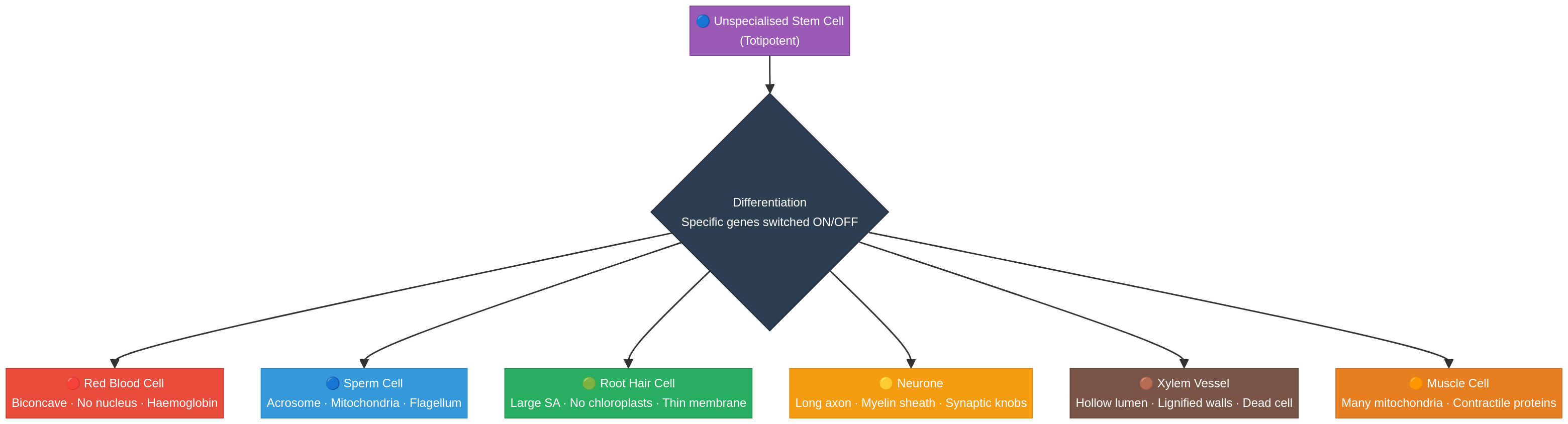
All multicellular organisms begin as a single, unspecialised cell. Through a process called differentiation, these cells divide and change to become specialised. This happens when specific genes in the cell's DNA are switched on or off, which dictates the cell's structure and function. Think of it like a library full of instruction books (the DNA); differentiation is the process of choosing to read only the books on, say, 'how to be a muscle cell' and ignoring all the others.
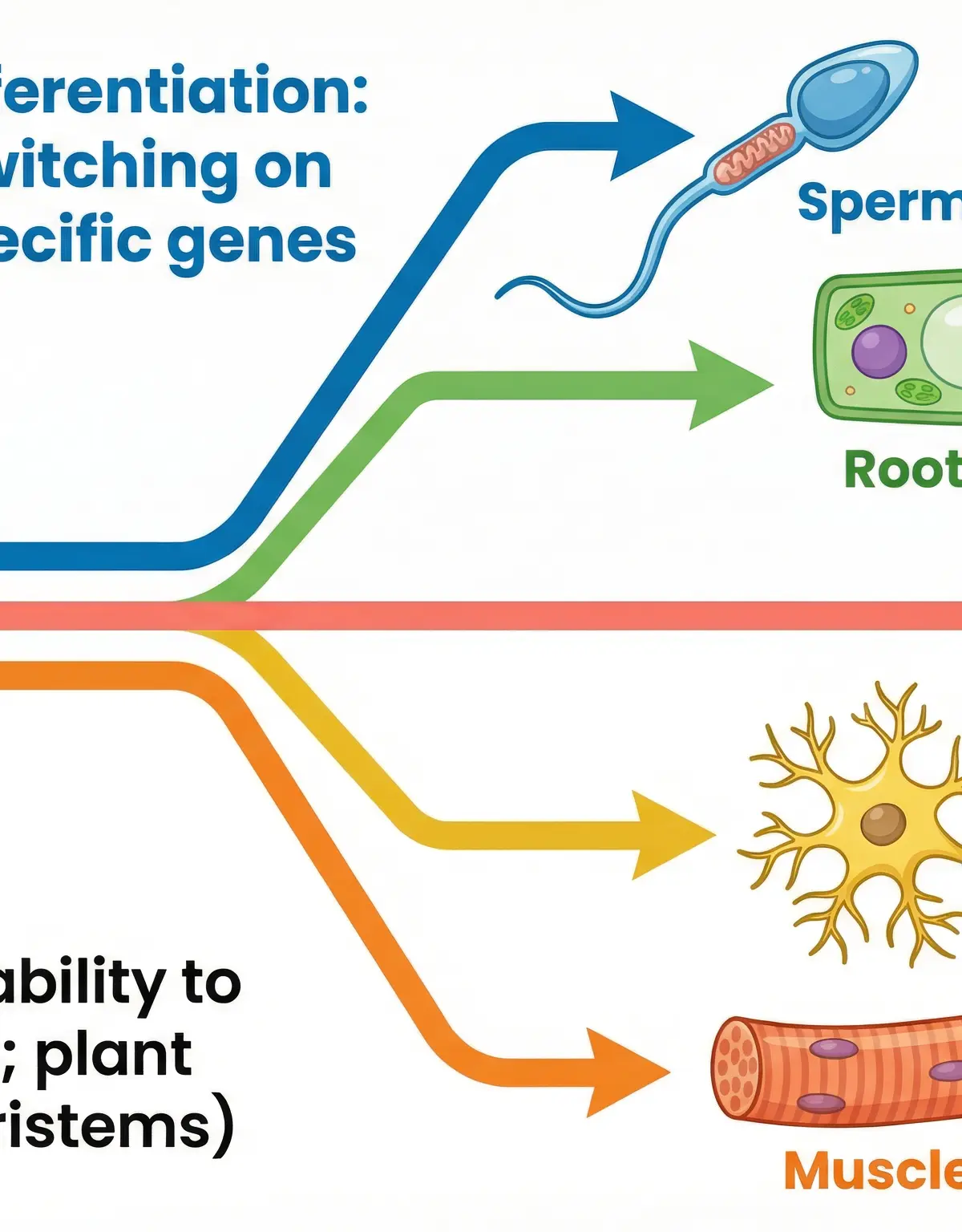
In animals, most cells differentiate at an early stage of development and then lose this ability. This is why we can't just regrow a lost limb. However, we retain some adult stem cells which can differentiate to replace worn-out cells, for example in our bone marrow to make new blood cells.
In contrast, many plant cells retain the ability to differentiate throughout their life. These unspecialised cells are found in regions called meristems (e.g., at the tips of roots and shoots). This is why a gardener can take a cutting from a plant and grow a completely new one – the meristem cells in the stem can differentiate to form roots, leaves, and flowers.
Concept 2: Animal Cell Specialisation
Candidates must be familiar with several key animal cells. For each, you must be able to link its structure to its function.
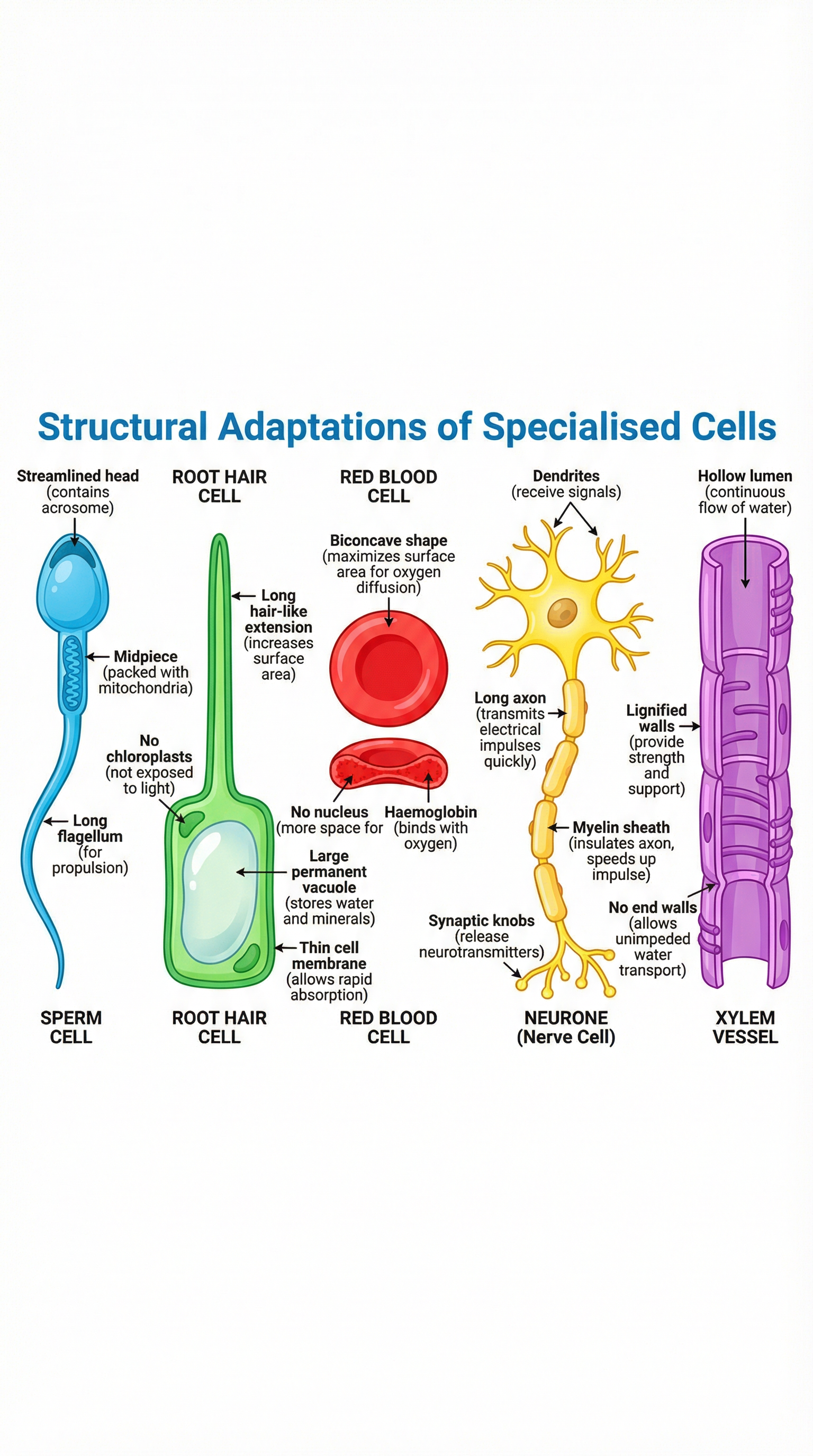
**Sperm Cells:**The function is to fertilise an ovum (egg cell). To do this, it must travel a long distance and penetrate the egg.
- Flagellum: A long tail that rotates to propel the sperm cell forward.
- Mitochondria: The mid-piece is packed with mitochondria to release energy via aerobic respiration for the journey.
- Acrosome: The head contains a specialised lysosome called an acrosome, which holds digestive enzymes to break down the outer layers of the egg cell.
- Haploid Nucleus: Contains half the genetic material (23 chromosomes in humans) for fertilisation.
**Nerve Cells (Neurones):**Function is to transmit electrical impulses around the body.
- Long Axon: The cell is very long to carry impulses over long distances quickly.
- Dendrites: Branched endings that form connections with other neurones.
- Myelin Sheath (Higher Tier): An insulating layer that surrounds the axon, speeding up the electrical impulse.
**Muscle Cells:**Function is to contract to cause movement.
- Many Mitochondria: To release large amounts of energy for contraction.
- Glycogen Stores: A store of glucose that can be quickly broken down during respiration.
- Contractile Proteins: Special proteins (actin and myosin) that slide over each other, causing the cell to shorten (contract).
Concept 3: Plant Cell Specialisation
Plant cells also show a high degree of specialisation, particularly for transport and absorption.
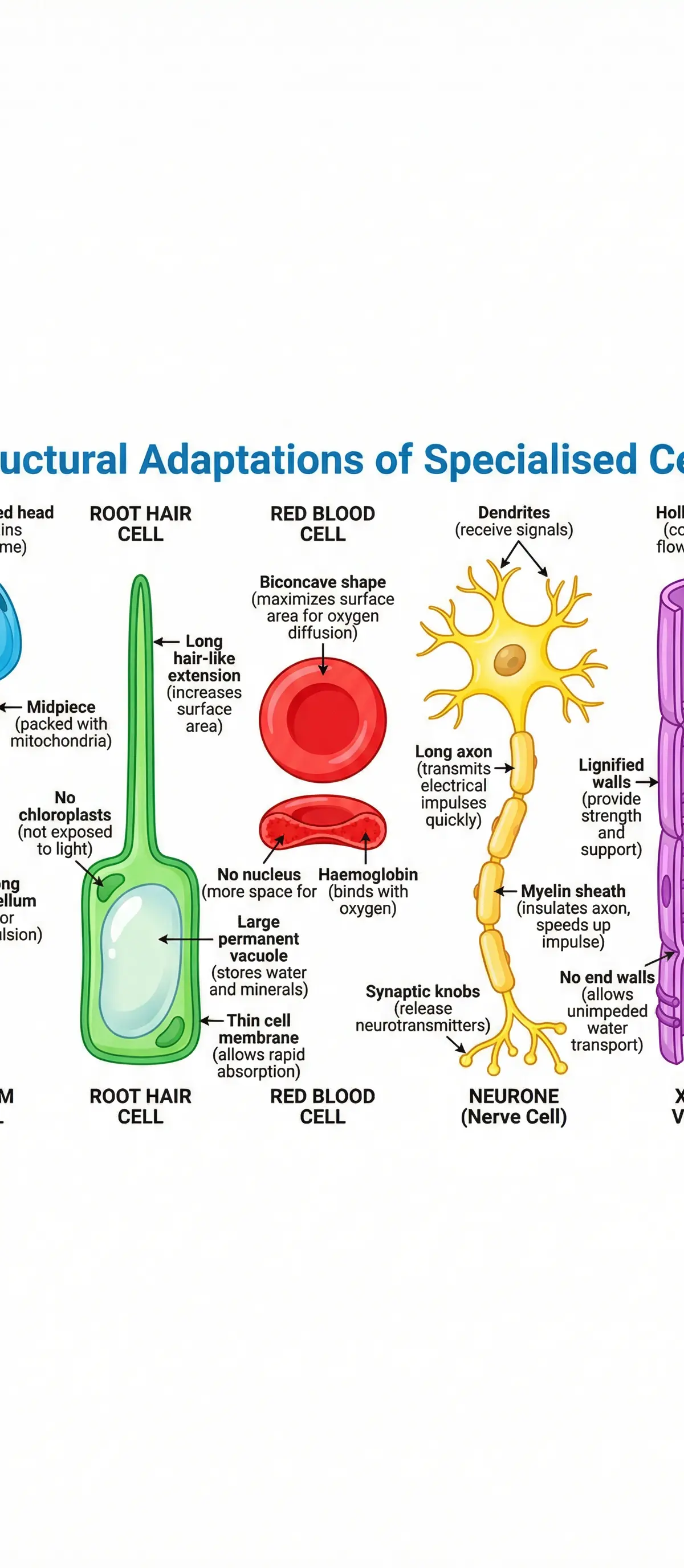
**Root Hair Cells:**Function is to absorb water by osmosis and mineral ions by active transport from the soil.
- Large Surface Area: A long 'hair-like' extension dramatically increases the surface area available for absorption.
- Thin Cell Wall & Membrane: Provides a short diffusion pathway.
- Many Mitochondria: To release energy for the active transport of mineral ions against their concentration gradient.
- No Chloroplasts: A key point examiners look for. Since the cells are underground, there is no light for photosynthesis, so chloroplasts are absent.
**Xylem Vessels:**Function is to transport water and dissolved mineral ions from the roots to the rest of the plant, and to provide structural support.
- Hollow Lumen: The cells are dead at maturity and have no cytoplasm, nucleus, or vacuole. Their end walls have also broken down, forming a continuous, hollow tube for unimpeded water flow.
- Lignified Walls: The cell walls are thickened and strengthened with a tough, waterproof substance called lignin. This prevents the vessel from collapsing and makes it waterproof. It also helps support the plant stem.
**Phloem Vessels:**Function is to transport dissolved sugars (translocation) from the leaves to other parts of the plant for use in respiration or for storage.
- Sieve Tubes: Composed of living cells with end walls that have pores (sieve plates), allowing sugars to flow through.
- Companion Cells: Each sieve tube element has a companion cell next to it, which contains a nucleus and many mitochondria. The companion cell provides the energy needed for loading sugars into the phloem.
Mathematical/Scientific Relationships
**Magnification Calculation:**This is a common mathematical skill tested alongside this topic. You must memorise this formula.
Magnification = Size of Image / Size of Real Object
- Units: It is crucial to ensure the units for image size and real object size are the same before you calculate. Examiners often give one in millimetres (mm) and the other in micrometres (µm). You must convert them.
- Conversion: 1 mm = 1000 µm. To convert mm to µm, multiply by 1000. To convert µm to mm, divide by 1000.
Example: An image of a red blood cell is 7mm wide in a textbook. The actual width of the cell is 7µm. Calculate the magnification.
- Convert units: 7 mm = 7000 µm.
- Apply formula: Magnification = 7000 µm / 7 µm.
- Final answer: Magnification = x1000.
Practical Applications
This topic is often linked to the required practical involving microscopy. Candidates should be able to:
- Prepare a slide (e.g., an onion epidermis peel).
- Use a light microscope to view cells.
- Identify subcellular structures.
- Draw and label a scientific diagram of the cells observed.
- Calculate the magnification of their drawing.
Understanding cell specialisation is also critical in medicine. For example, knowledge of stem cells and differentiation is the basis of regenerative medicine, which aims to repair or replace damaged tissues and organs.
Visual Resources
4 diagrams and illustrations
Interactive Diagrams
2 interactive diagrams to visualise key concepts
Conceptual Flow Outline
Flowchart showing how an unspecialised stem cell undergoes differentiation to form various specialised cells in animals and plants.
Conceptual Flow Outline
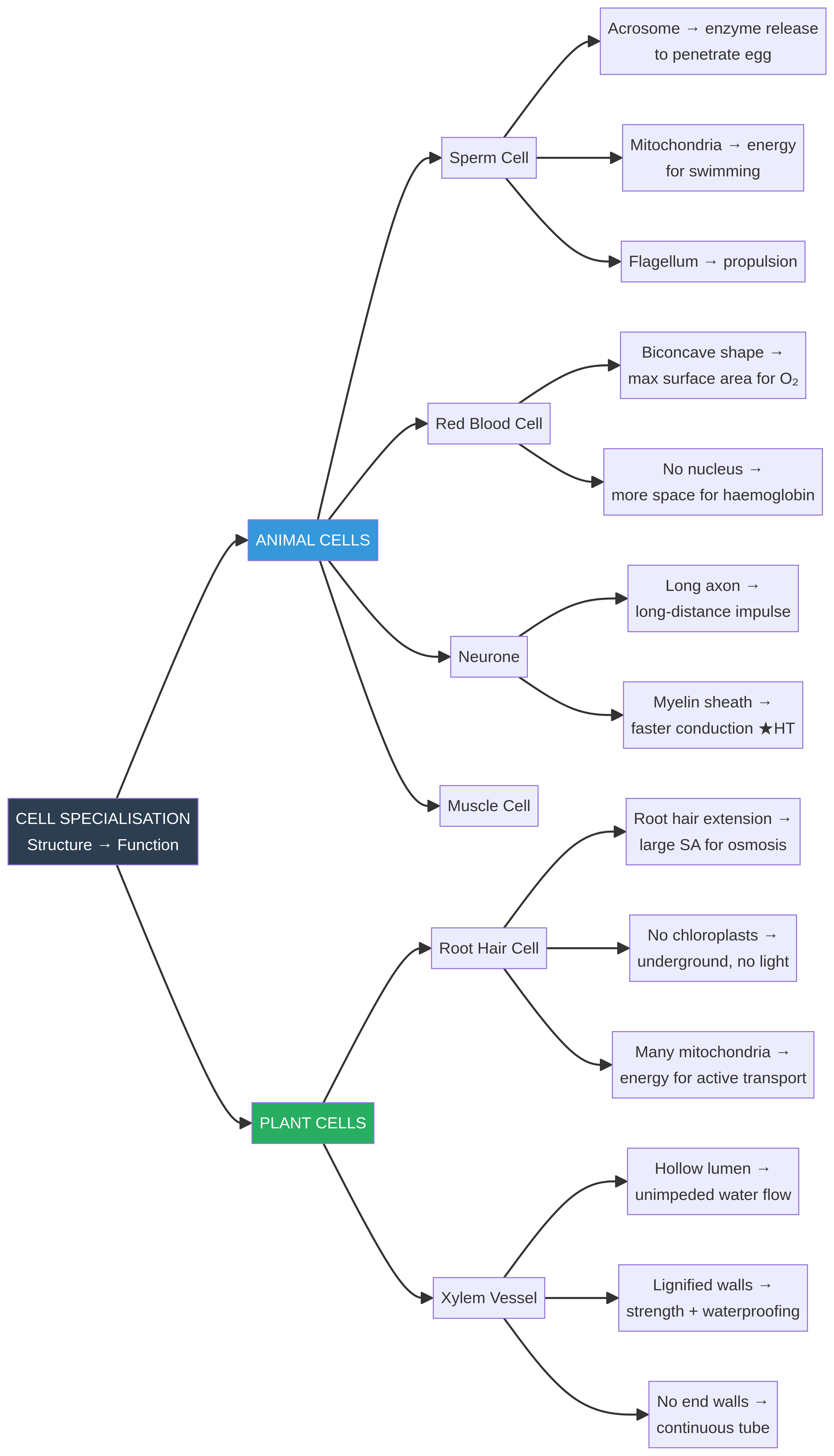
Concept map illustrating the core principle of 'Structure leads to Function' for key specialised animal and plant cells.
Worked Examples
3 worked examples — open one to explore the question and available guidance.
Practice Questions
Test your understanding — click to reveal model answers
State two ways in which a red blood cell is adapted to transport oxygen. (2 marks)
Hint: Think about what's inside the cell and its overall shape.
Explain why a root hair cell does not contain chloroplasts. (2 marks)
Hint: Where in the plant is this cell found? What process happens in chloroplasts?
Explain how the structure of xylem tissue is adapted for its functions. (6 marks)
Hint: Xylem has two main functions. Aim to give three clear points with explanations.
Describe the process of differentiation. (3 marks)
Hint: Start with an unspecialised cell. What happens to it? What controls the process?
A scientist is studying muscle cells and sperm cells. Describe one structural similarity and one structural difference between these two cells. (2 marks)
Hint: Think about the organelles they both need for energy, and the structures they have for movement.