OCR · GCSE · Biology
Global Warming
This guide provides a comprehensive, exam-focused breakdown of Global Warming (OCR GCSE Biology 7.8). It covers the core science, from the natural greenhouse effect to the human activities driving climate change, and equips you with the specific knowledge and exam technique needed to secure top marks.
- 6 min read
- 3 worked examples
- 5 practice questions
- 6 key terms
Study Notes
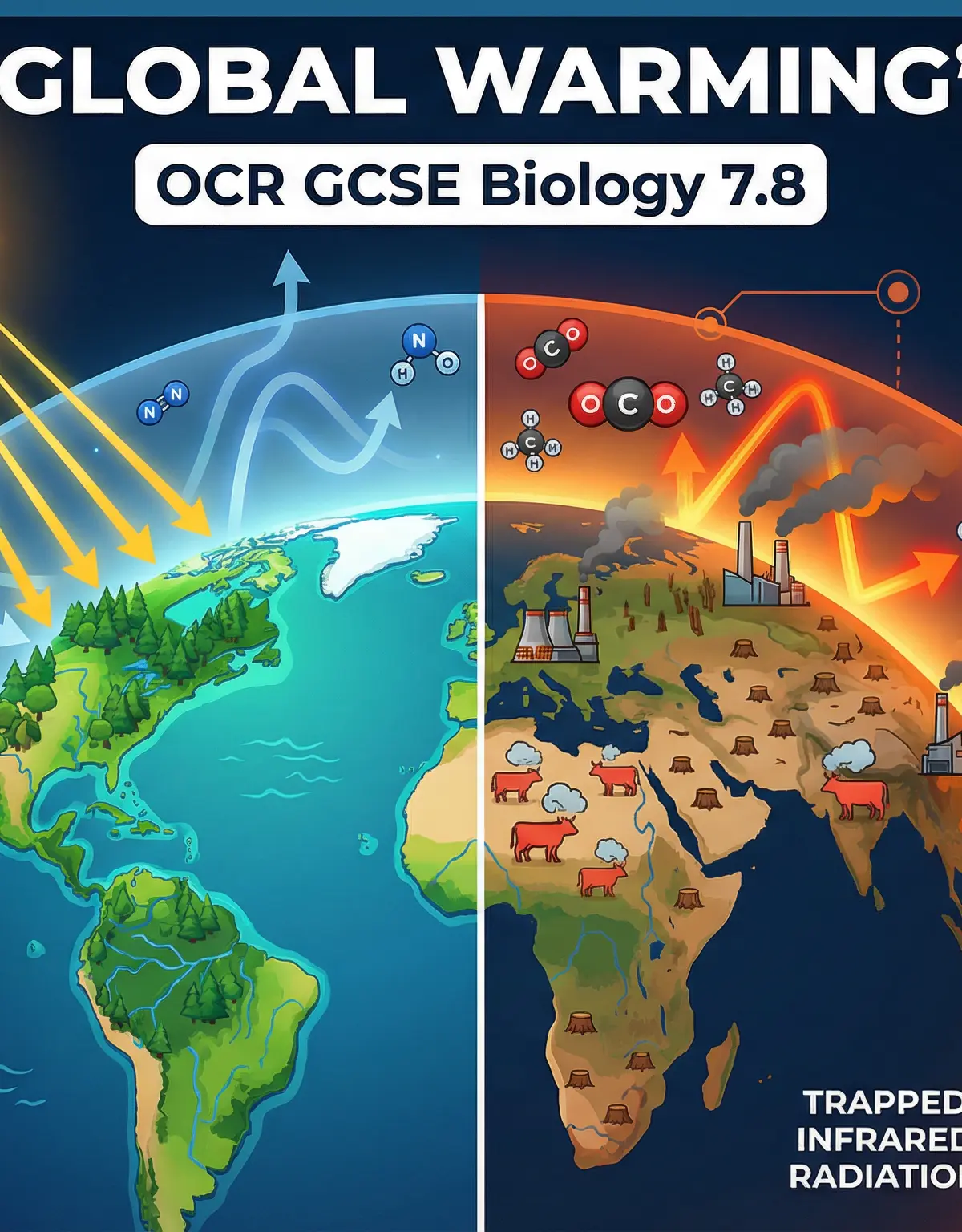
Overview
Global Warming is a critical component of the 'Global Challenges' topic in your OCR GCSE Biology specification. This guide will dissect the science behind the headlines, focusing on the precise details examiners look for. We will distinguish between the essential natural greenhouse effect and the problematic enhanced greenhouse effect, detailing how specific types of radiation interact with atmospheric gases. A significant portion of marks in this area are awarded for applying knowledge, particularly in interpreting data that links human activity to climate change. You will learn to analyse graphs, explain the dual impact of deforestation, and describe the consequences of rising global temperatures with the scientific precision required for higher-tier marks. This topic frequently links to others, such as photosynthesis and decay, so a firm grasp here will strengthen your understanding across the syllabus.
Key Concepts
Concept 1: The Natural Greenhouse Effect - Earth's Central Heating
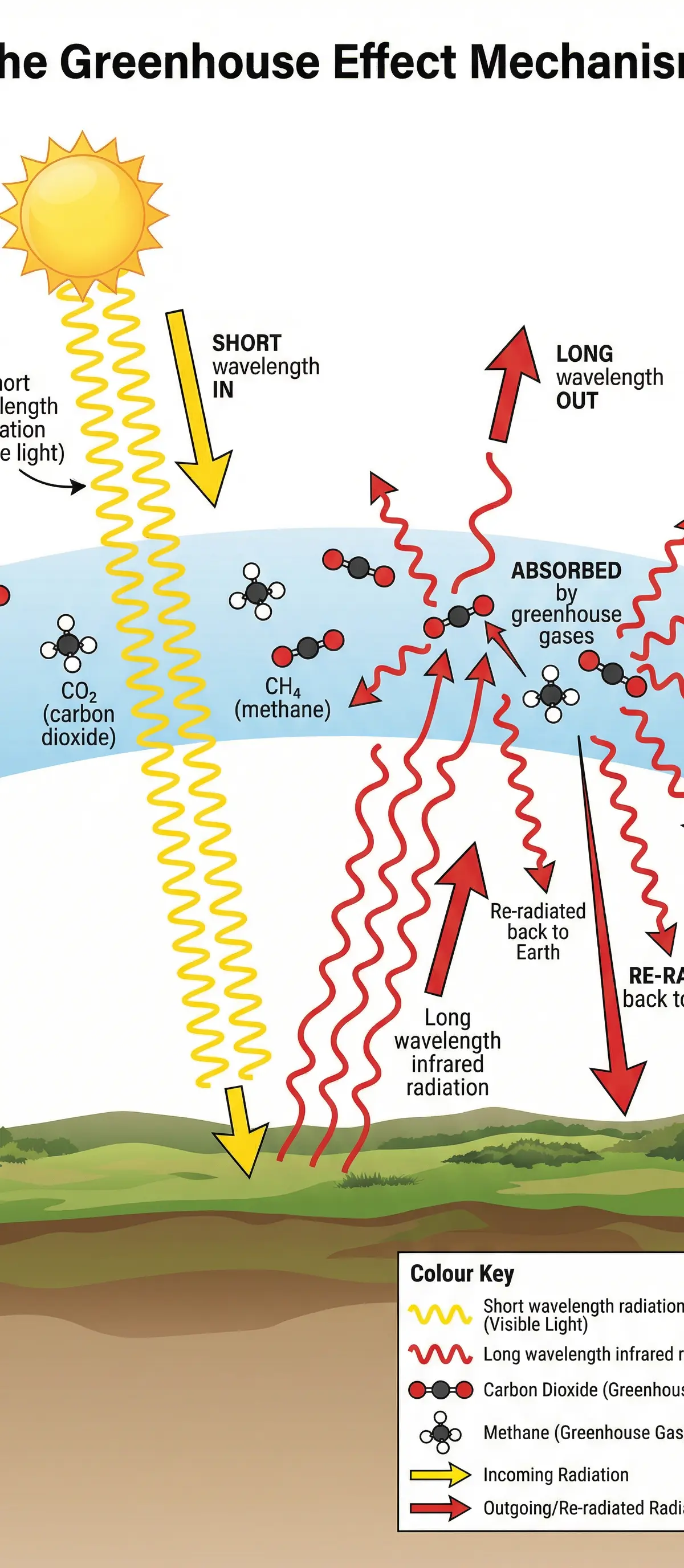
The greenhouse effect is a naturally occurring process that is essential for life on Earth. Without it, the planet's average temperature would be a frigid -18°C. It works by regulating the Earth's temperature, much like a planet-sized central heating system.
- Incoming Solar Radiation: The Sun emits energy that travels to Earth in the form of short-wavelength radiation, including visible light and ultraviolet (UV) radiation.
- Atmospheric Transparency: This short-wavelength radiation passes largely unobstructed through the gases in the Earth's atmosphere.
- Surface Absorption: The Earth's surface (land and oceans) absorbs this energy, causing it to warm up.
- Outgoing Infrared Radiation: The warmed Earth re-emits this energy as long-wavelength infrared (IR) radiation, which we feel as heat.
- Absorption by Greenhouse Gases: Unlike the incoming short-wave radiation, this outgoing long-wave IR radiation is absorbed by greenhouse gas molecules (like CO2 and CH4) in the atmosphere.
- Re-radiation: After absorbing the energy, the greenhouse gas molecules re-radiate it in all directions. Some escapes into space, but a significant amount is directed back towards the Earth's surface, further warming it.
This process of absorption and re-radiation is what maintains a habitable average global temperature. It is crucial for candidates to use the terms 'absorb and re-radiate' rather than 'reflect' or 'trap', as the latter are imprecise and will not be credited in an exam.
Concept 2: The Enhanced Greenhouse Effect & Global Warming
This is the concept that is often, and incorrectly, used interchangeably with the greenhouse effect. The enhanced greenhouse effect refers to the amplification of the natural effect due to human activities increasing the concentration of greenhouse gases in the atmosphere. This enhancement leads to global warming—the observed century-scale rise in the average temperature of the Earth's climate system.
Key Greenhouse Gases:
- Carbon Dioxide (CO₂): The primary driver of the enhanced effect. Its concentration has risen dramatically since the Industrial Revolution.
- Methane (CH₄): A more potent greenhouse gas than CO₂ over a shorter timescale, but present in lower concentrations.
An increase in the concentration of these gases means that more of the outgoing long-wavelength infrared radiation is absorbed and re-radiated back to Earth, leading to a net increase in global average temperatures.
Concept 3: Human Activities and Their Impact
Examiners require candidates to link specific human activities to the release of specific greenhouse gases. Vague terms like 'pollution' will not earn marks.
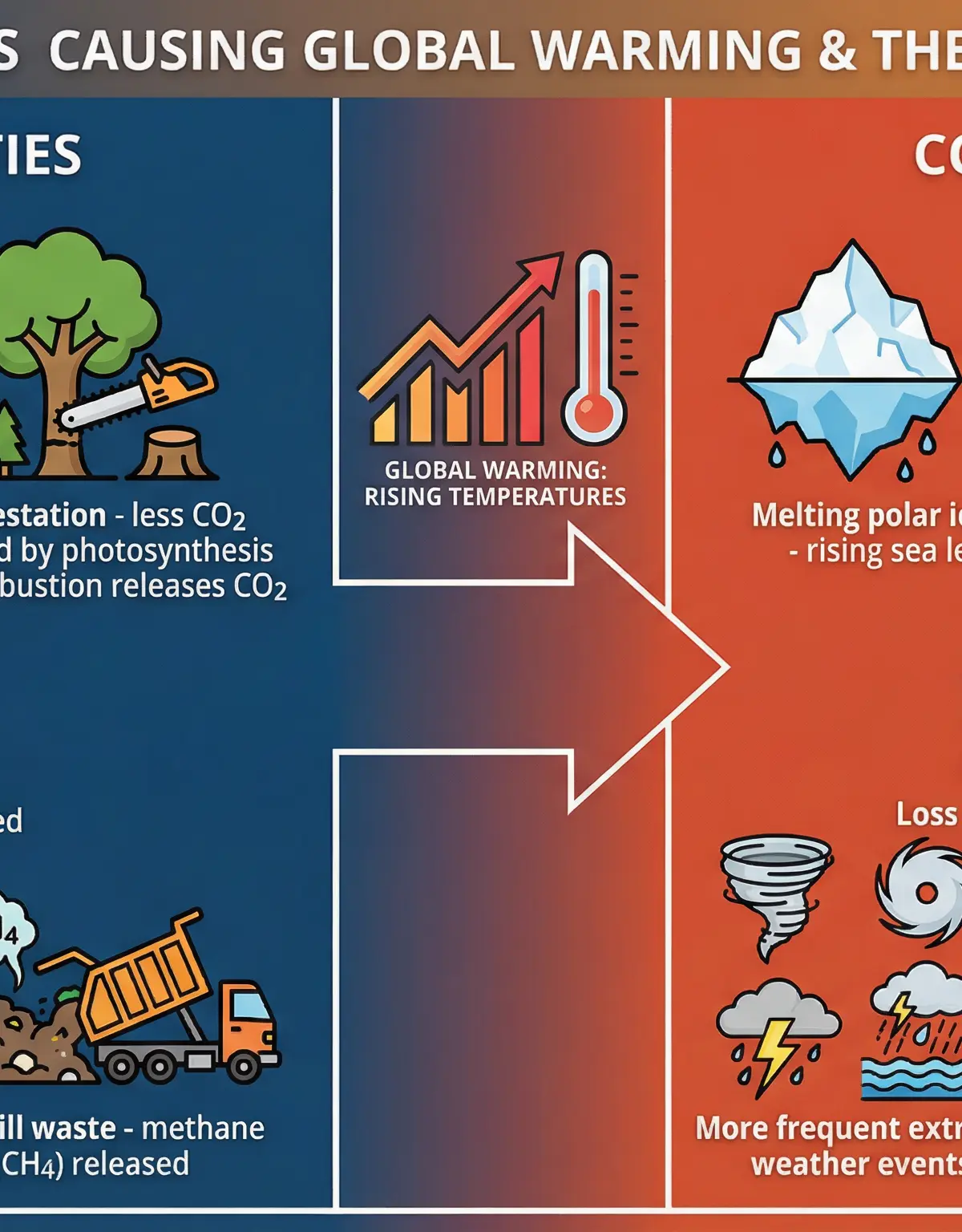
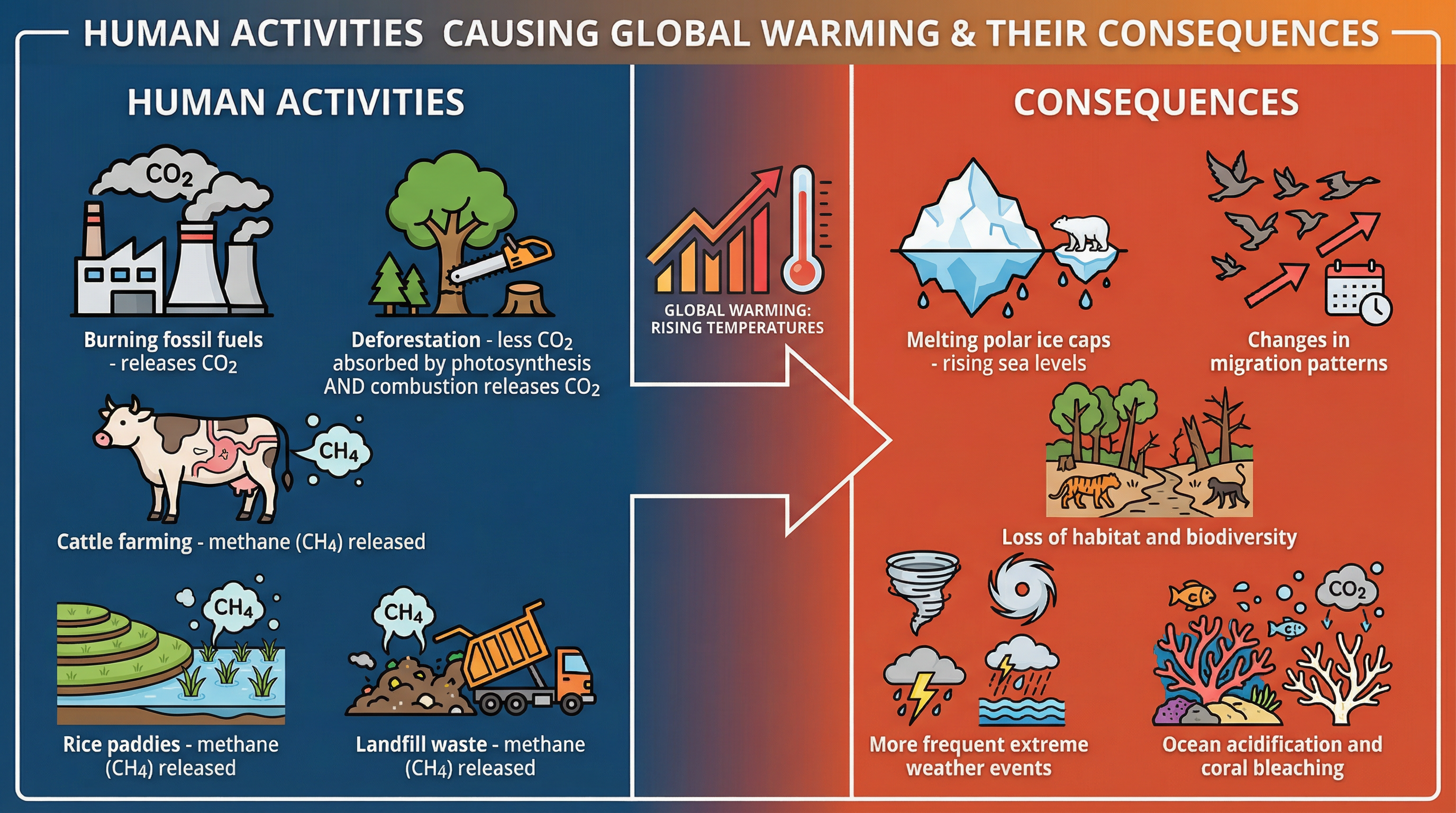
- Burning Fossil Fuels (for electricity, transport, industry): This is the largest source of anthropogenic CO₂. The combustion of coal, oil, and natural gas releases vast quantities of carbon that were previously locked away underground.
- Deforestation: This has a critical two-fold impact that is often tested. Firstly, the act of clearing forests, often by burning, releases large amounts of stored carbon as CO₂ (combustion). Secondly, and just as importantly, the removal of trees reduces the planet's capacity to absorb atmospheric CO₂ through photosynthesis.
- Agriculture: Modern farming practices are a major source of methane. Cattle farming produces methane through the digestive processes of livestock (enteric fermentation). Rice paddies, where flooded fields prevent oxygen from penetrating the soil, lead to anaerobic decomposition of organic matter, which releases methane.
- Waste Decomposition in Landfills: Similar to rice paddies, organic waste decomposing in landfills under anaerobic conditions produces methane.
Concept 4: Consequences of Global Warming
Candidates must describe specific biological and environmental consequences, not just state that the planet is getting warmer.
- Rising Sea Levels: Higher temperatures cause thermal expansion of seawater and the melting of polar ice caps and glaciers, leading to a rise in global sea levels. This threatens low-lying coastal areas with flooding and habitat loss.
- Loss of Biodiversity: As climates change, habitats are altered faster than many species can adapt. This can lead to extinction. For example, the loss of sea ice affects polar bears that rely on it for hunting.
- Changes in Migration and Distribution: Species may move to different areas to find suitable climates. Birds may migrate earlier or shift their ranges northwards. This can disrupt food webs and introduce new diseases to areas.
- Ocean Acidification & Coral Bleaching: Increased atmospheric CO₂ dissolves in seawater, forming carbonic acid and lowering the ocean's pH. This acidification damages marine ecosystems, particularly coral reefs, which undergo 'bleaching' (expelling their symbiotic algae) and die in response to both warmer temperatures and lower pH.
Visual Resources
2 diagrams and illustrations
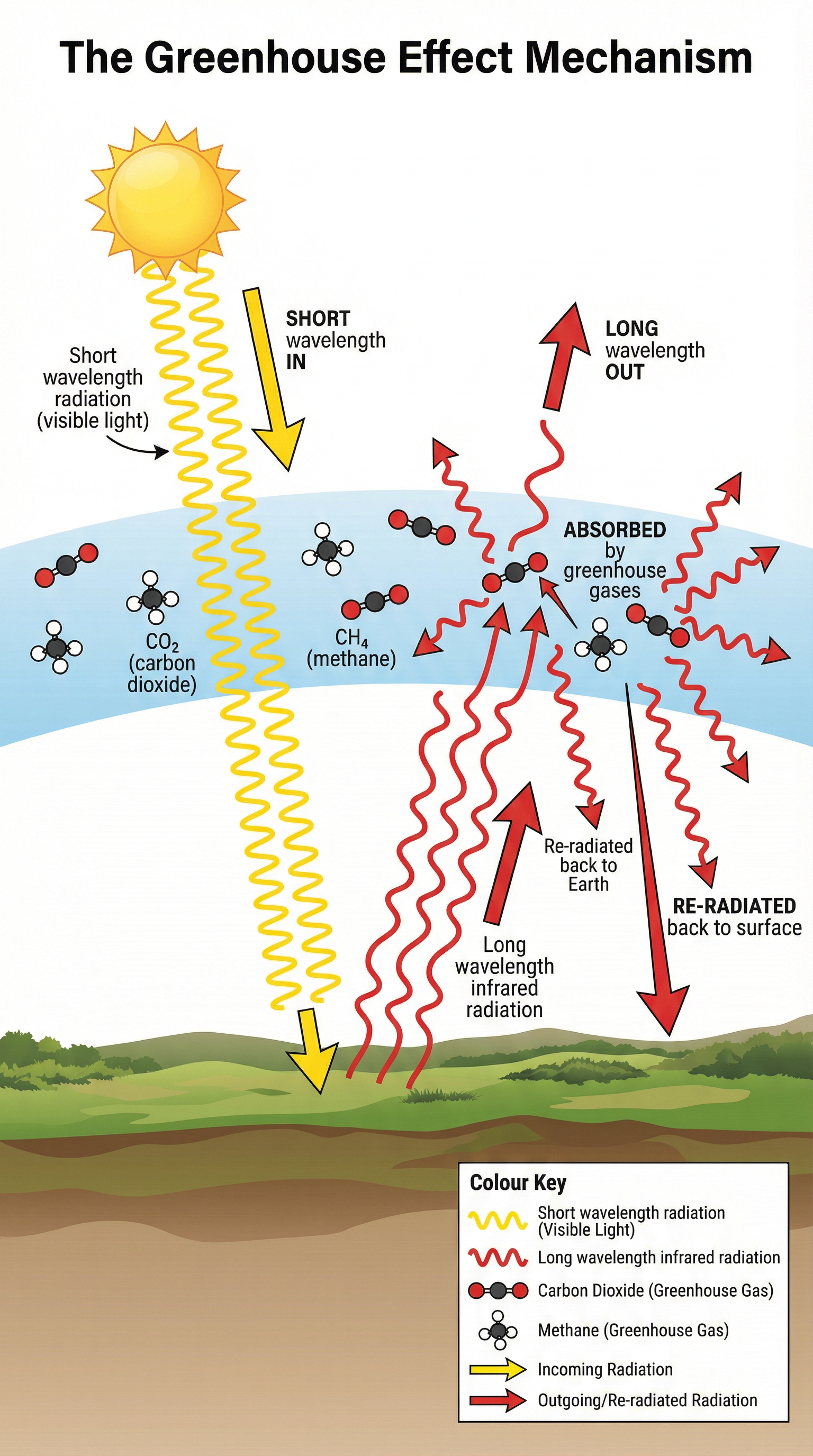
Interactive Diagrams
2 interactive diagrams to visualise key concepts
Conceptual Flow Outline
A flowchart showing the sequence of events in the greenhouse effect, from incoming solar radiation to the warming of the Earth's surface.
Conceptual Flow Outline
A concept map linking specific human activities to the greenhouse gases they produce and the ultimate consequences of global warming.
Worked Examples
3 worked examples — open one to explore the question and available guidance.
Practice Questions
Test your understanding — click to reveal model answers
State two greenhouse gases linked to human activities. (2 marks)
Hint: Think about what is released when we burn things, and what is released by farm animals.
Describe how the burning of fossil fuels contributes to the enhanced greenhouse effect. (3 marks)
Hint: Name the gas, explain where it goes, and what it does to radiation.
Explain why a farmer planting new forests on their land could help to reduce global warming. (4 marks)
Hint: Think about the life processes of plants and what they take in from the atmosphere.
Scientists have recorded a significant increase in the atmospheric concentration of methane since the year 1800. Evaluate the evidence for and against agriculture being a primary cause of this increase. (5 marks)
Hint: For an 'evaluate' question, you need to present both sides of the argument before making a conclusion.
Explain the difference between the greenhouse effect and global warming. (3 marks)
Hint: Think about which one is natural and which one is caused by humans.