OCR · GCSE · Biology
The Digestive System
The digestive system is one of the highest-yield topics in OCR GCSE Biology, appearing in virtually every exam series across both Foundation and Higher tiers. This guide covers the physical and chemical breakdown of food, the lock and key mechanism of enzyme action, the critical role of bile, and the structural adaptations of villi for nutrient absorption — giving you everything you need to access top-band marks on 1-mark recall questions right through to 6-mark Level of Response answers.
- 10 min read
- 4 worked examples
- 5 practice questions
- 9 key terms
Study Notes

Overview
The digestive system is one of the most reliably examined topics across the entire OCR GCSE Biology specification, appearing in virtually every exam series at both Foundation and Higher tier. It sits within Topic B3 (Living and Growing) and requires candidates to demonstrate understanding across all three Assessment Objectives: recalling factual knowledge (AO1, 40%), applying that knowledge to unfamiliar contexts (AO2, 40%), and analysing and evaluating data (AO3, 20%).
At its core, this topic is about one elegant problem: the food you eat is made of large, insoluble molecules that cannot cross cell membranes. Your digestive system's job is to convert those molecules into small, soluble ones that can be absorbed into the bloodstream and transported to every cell in your body. Understanding how this happens — through both physical and chemical means — and where it happens — in specific organs with specific enzymes — is the key to unlocking full marks.
This topic connects directly to cell biology (diffusion and active transport across membranes), transport systems (the circulatory system carries absorbed nutrients), and biochemistry (the structure and function of carbohydrates, proteins, and lipids). Examiners frequently set synoptic questions that bridge these areas, particularly in the 6-mark Level of Response questions that appear at the end of each paper. Typical question styles include: short-answer recall of enzyme names and products, explain questions about enzyme denaturation, describe questions about villi adaptations, and extended writing questions requiring a full account of digestion from ingestion to absorption.
Key Concepts
Concept 1: Physical vs Chemical Digestion
Digestion occurs by two fundamentally different mechanisms, and distinguishing between them is a consistent source of marks in OCR exams.
Physical digestion is the mechanical breakdown of food into smaller pieces. It does not change the chemical composition of food molecules — it simply increases their surface area, making them more accessible to digestive enzymes. Examples include chewing (mastication) in the mouth, the churning action of the stomach, and — critically for Higher tier — the emulsification of fats by bile. Emulsification is a form of physical digestion: bile breaks large fat globules into tiny fat droplets, dramatically increasing the surface area available for lipase enzymes to act upon.
Chemical digestion involves the enzymatic hydrolysis of large food molecules, breaking covalent chemical bonds to produce smaller molecules. This is an irreversible chemical change. Carbohydrates are broken down into simple sugars (e.g., glucose), proteins into amino acids, and lipids into fatty acids and glycerol.
Examiner's note: Candidates who conflate these two processes — for example, stating that bile 'digests' fat — will not be credited. Bile is an emulsifier that facilitates physical breakdown; lipase performs the chemical digestion.
Concept 2: Enzymes and the Lock and Key Mechanism
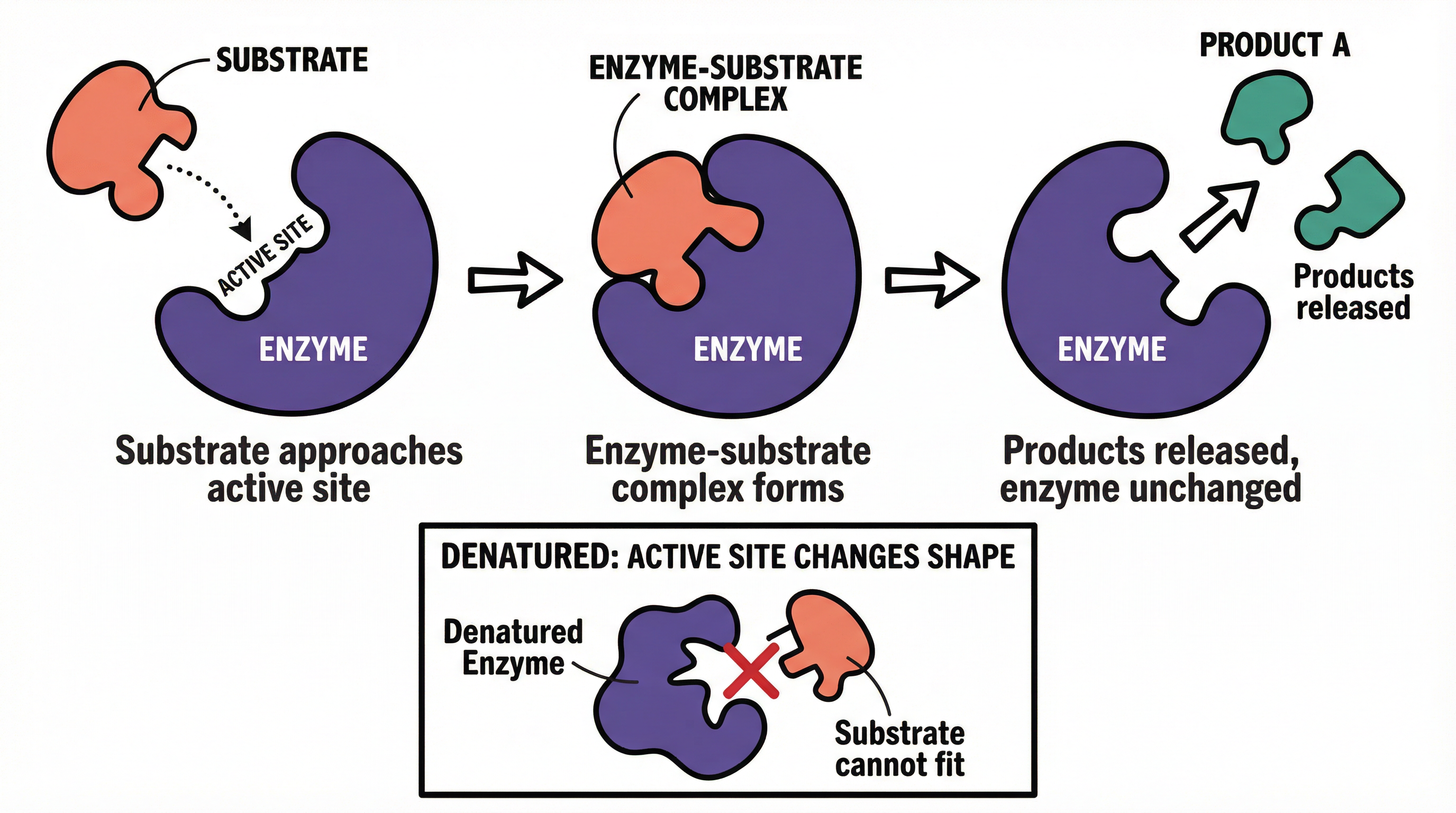
Enzymes are biological catalysts — proteins that increase the rate of metabolic reactions without being consumed in the process. Each enzyme molecule has a specific three-dimensional region called the active site, whose shape is determined by the enzyme's amino acid sequence.
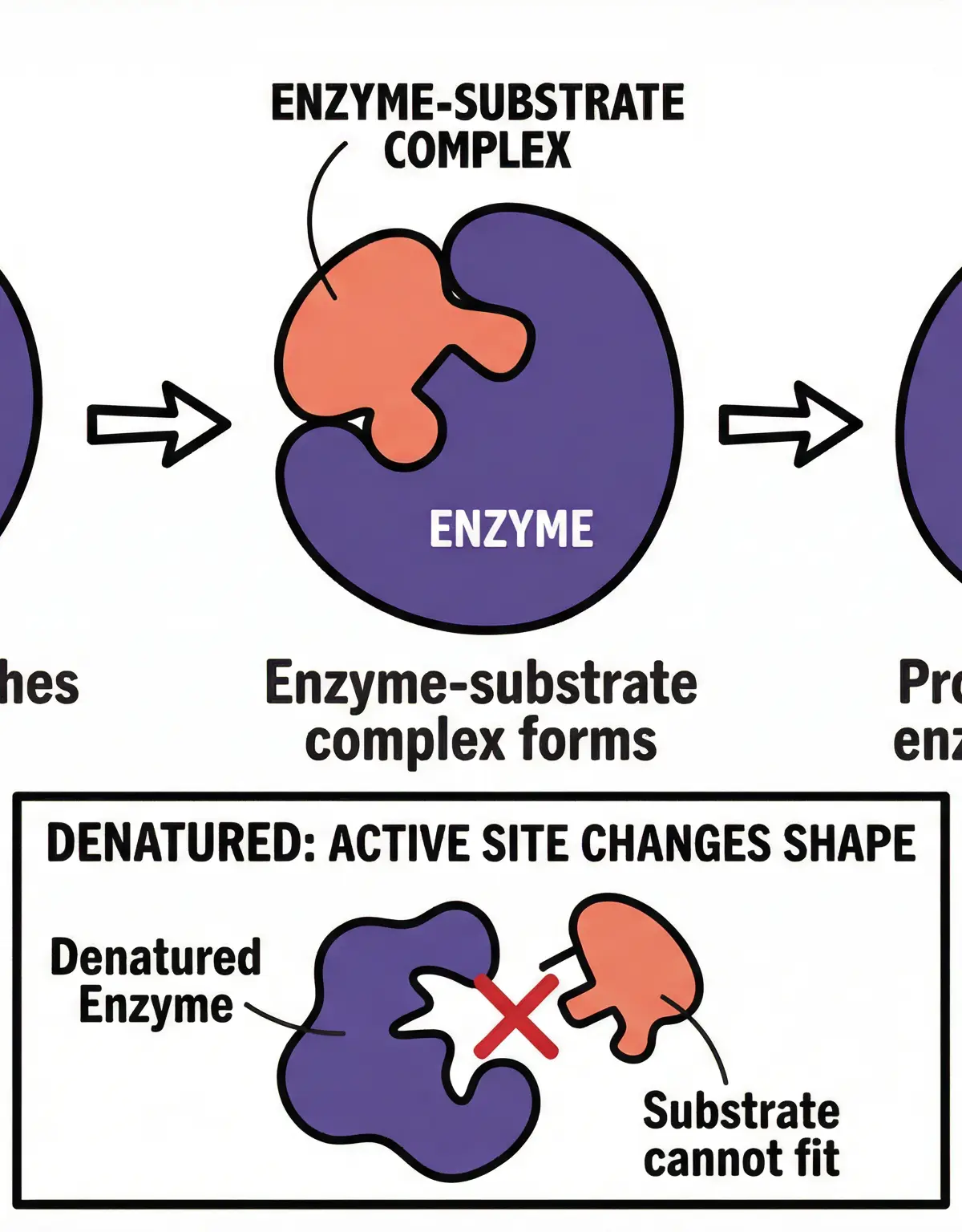
The lock and key model describes enzyme specificity. The substrate molecule has a shape that is complementary to the active site — it fits like a key into a lock. When the substrate binds to the active site, an enzyme-substrate complex forms. The reaction proceeds, products are released, and the enzyme is unchanged and available to catalyse further reactions.
This specificity explains why different enzymes are needed for different substrates: amylase acts only on starch (breaking it into maltose), protease acts only on proteins (breaking them into amino acids), and lipase acts only on lipids (breaking them into fatty acids and glycerol).
Effect of temperature: As temperature increases, molecules have more kinetic energy, collisions between enzyme and substrate are more frequent, and the rate of reaction increases. However, above the optimum temperature (approximately 37°C for most human digestive enzymes), the bonds maintaining the enzyme's three-dimensional shape begin to break. The active site changes shape — it is no longer complementary to the substrate. The enzyme is said to be denatured. This is a permanent, irreversible change. At low temperatures, enzymes are not denatured — they are simply less active due to reduced molecular kinetic energy.
Effect of pH: Each enzyme has an optimum pH at which its active site shape is maintained and activity is greatest. Stomach protease (pepsin) has an optimum of approximately pH 2, consistent with the acidic environment created by hydrochloric acid. Salivary amylase has an optimum of approximately pH 7. Significant deviation from the optimum pH also causes denaturation by disrupting the bonds that maintain the active site's shape.
Higher Tier — Collision Theory Application: The increase in reaction rate with temperature can be explained using collision theory. Higher temperatures increase the kinetic energy of both enzyme and substrate molecules, increasing the frequency and energy of collisions between substrate molecules and active sites. This increases the rate of enzyme-substrate complex formation, and therefore the overall reaction rate — up to the point of denaturation.
Concept 3: The Digestive Organs and Their Functions
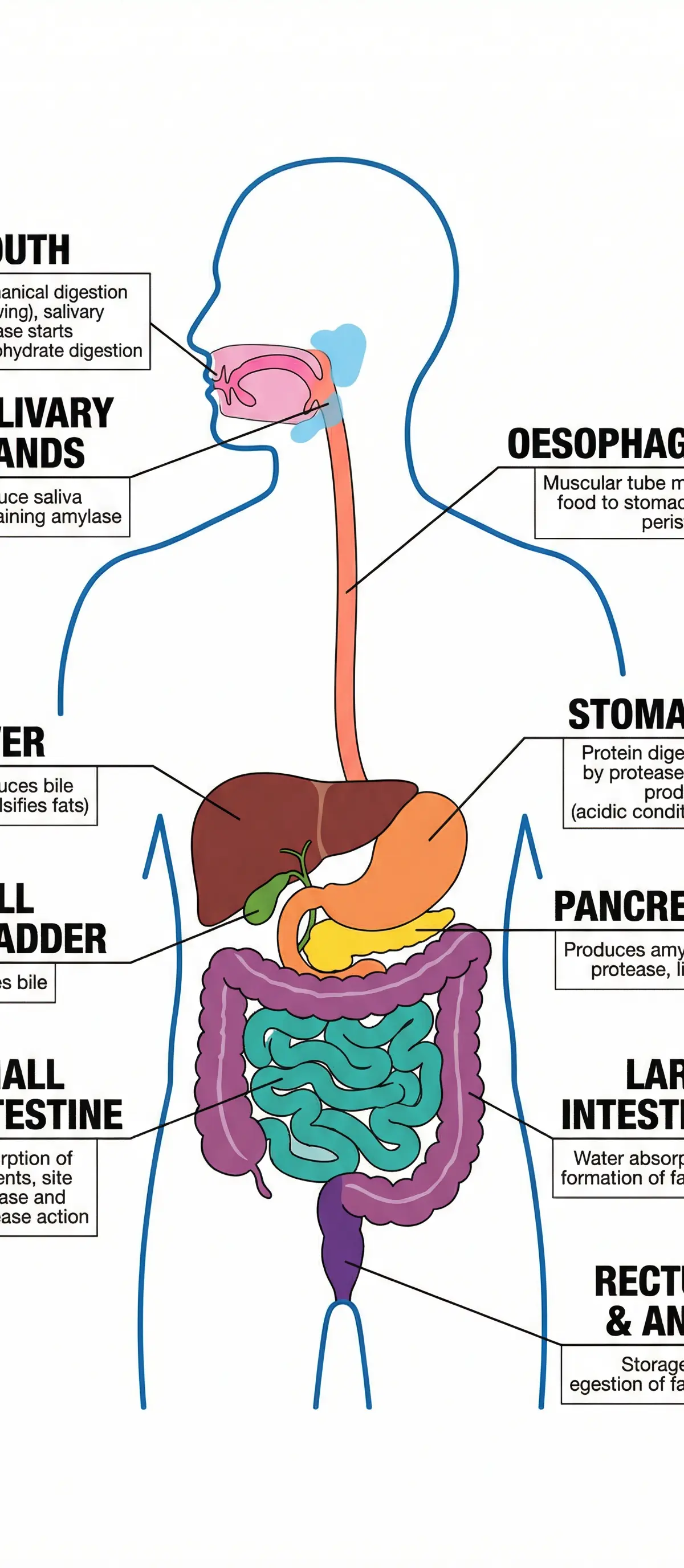
Candidates must know the specific function of each organ and which enzymes are produced where.
| Organ | Physical Digestion | Chemical Digestion | Key Enzymes/Secretions |
|---|---|---|---|
| Mouth | Chewing (teeth) | Starch → maltose | Salivary amylase (pH ~7) |
| Oesophagus | Peristalsis (movement) | None | None |
| Stomach | Churning | Protein → polypeptides | Protease (pepsin), HCl (pH ~2) |
| Liver | None | None | Produces bile |
| Gall bladder | None | None | Stores bile |
| Pancreas | None | None | Secretes amylase, protease, lipase |
| Small intestine | Emulsification (bile) | All three food groups completed | Amylase, protease, lipase (pH ~7–8) |
| Large intestine | None | None | Water absorption |
Concept 4: The Role of Bile
Bile is one of the most misunderstood substances in this topic, and examiners exploit this consistently. Bile is not an enzyme. It is an alkaline fluid produced by the liver, stored in the gall bladder, and released into the small intestine via the bile duct.
Bile has two key functions:
- Emulsification of fats: Bile breaks large fat globules into many small fat droplets. This is physical digestion — it increases the surface area available for lipase to act upon, dramatically increasing the rate of fat digestion.
- Neutralisation of stomach acid: Bile neutralises the hydrochloric acid arriving from the stomach, creating the slightly alkaline conditions (pH 7–8) that are optimal for the enzymes of the small intestine.
Concept 5: Absorption in the Small Intestine — Villi Adaptations
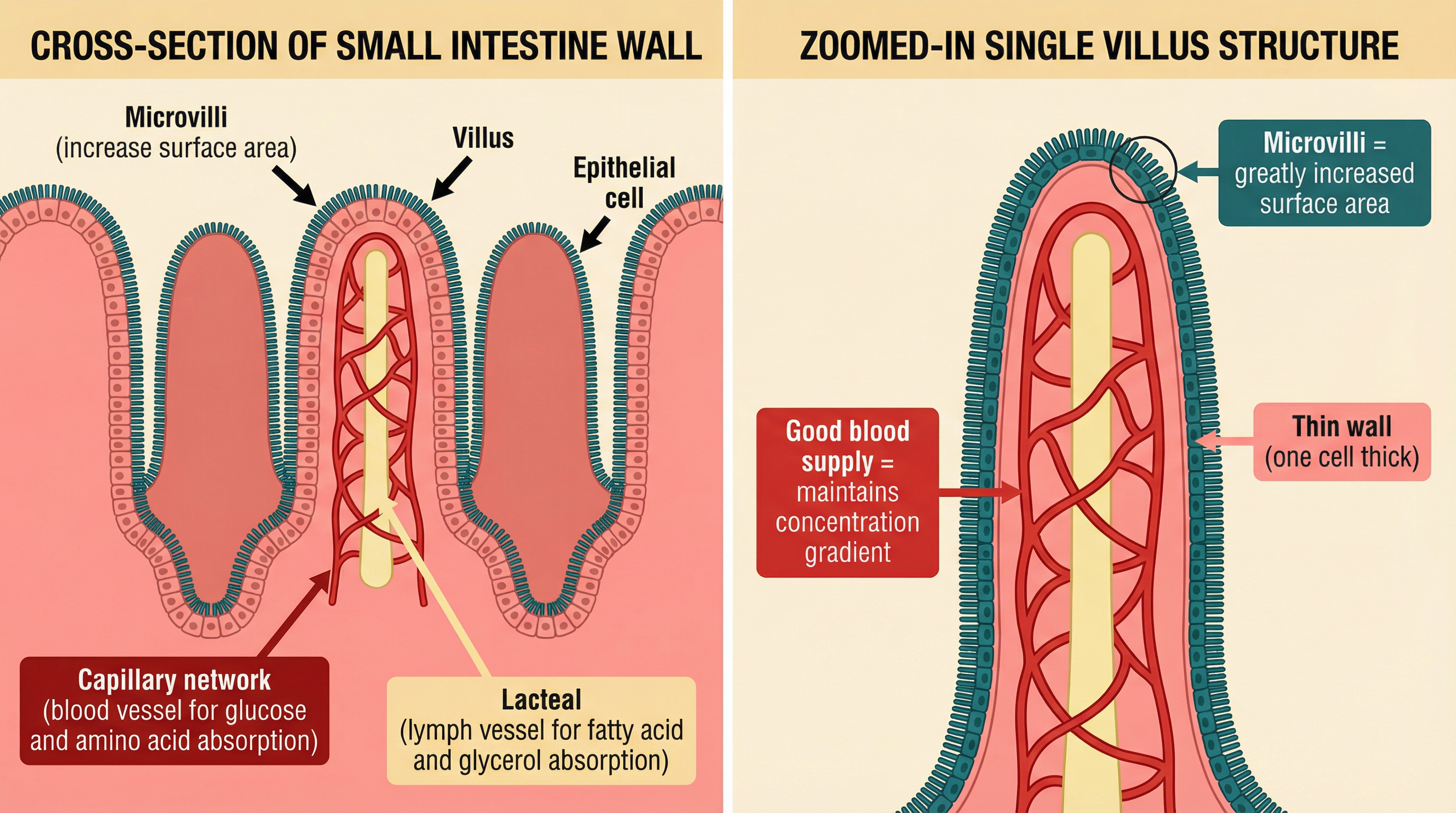
Once digestion is complete, the small, soluble products must be absorbed into the bloodstream. The small intestine is exquisitely adapted for this purpose through the presence of villi — finger-like projections that line its inner wall.
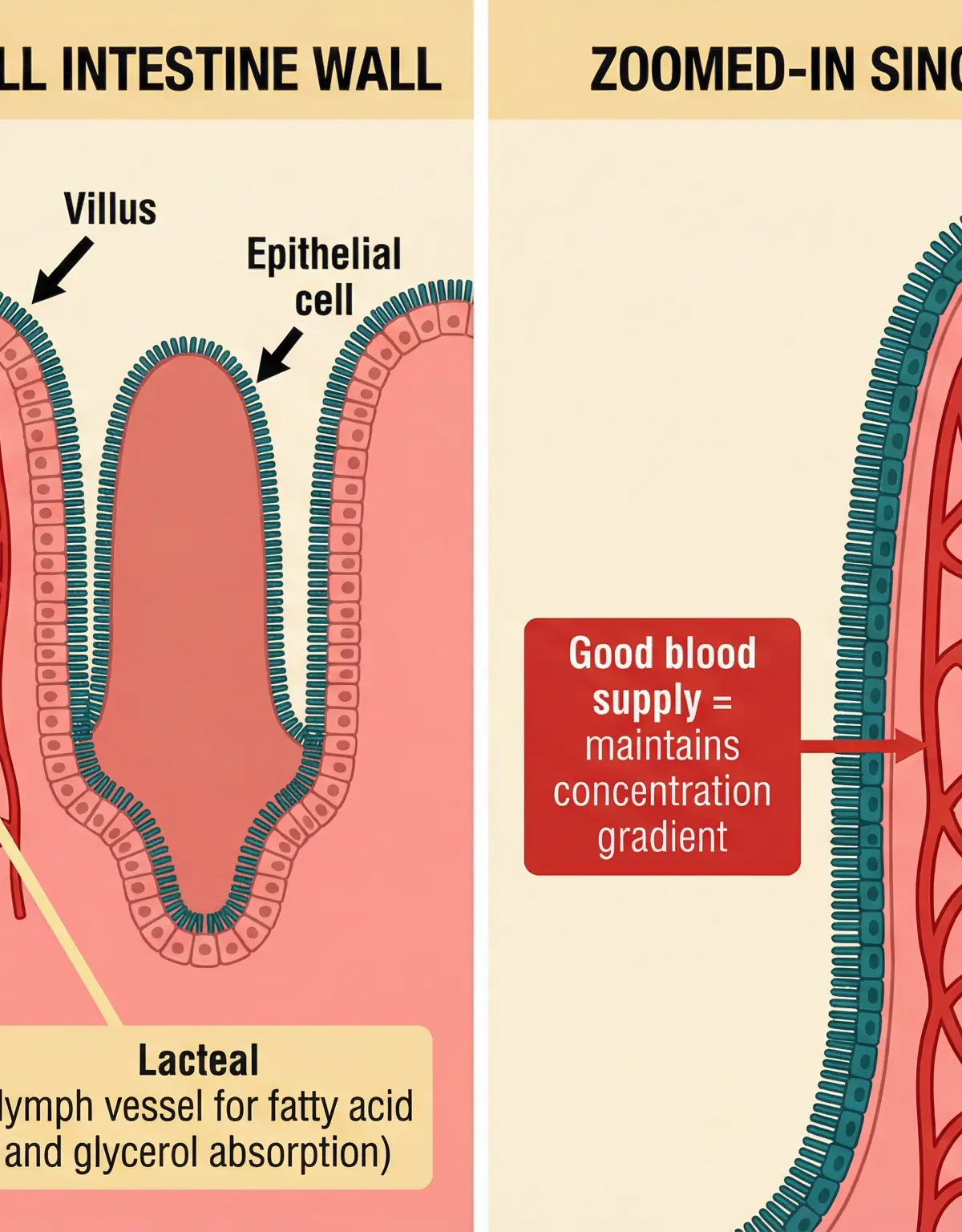
Each villus is itself covered in microscopic microvilli (the 'brush border'), which collectively give the small intestine a total surface area of approximately 200 m² — roughly the size of a tennis court. The key adaptations and their functional significance are:
| Adaptation | Functional Significance |
|---|---|
| Large surface area (villi + microvilli) | Increases rate of diffusion and active transport of soluble molecules |
| Thin epithelial wall (one cell thick) | Short diffusion distance — molecules cross quickly |
| Rich capillary blood supply | Maintains steep concentration gradient by rapidly removing absorbed molecules |
| Lacteals (lymph vessels) | Absorb fatty acids and glycerol into the lymphatic system |
Glucose and amino acids are absorbed into the capillaries (blood vessels) and transported to the liver via the hepatic portal vein. Fatty acids and glycerol are absorbed into the lacteals (lymph vessels).
Mathematical and Scientific Relationships
Rate of reaction formula — Must memorise:
Rate = 1 ÷ time (when measuring time for a reaction to complete)
For example, if an enzyme takes 50 seconds to digest a starch solution: Rate = 1 ÷ 50 = 0.02 s⁻¹Units: if time is in seconds, rate is in s⁻¹. If time is in minutes, rate is in min⁻¹.
Surface area and rate of digestion: Increasing surface area (by physical digestion or emulsification) increases the rate of chemical digestion because more enzyme molecules can simultaneously access substrate molecules. This is a direct application of collision theory.
Practical Applications — Required Practical: Food Tests
OCR requires candidates to be able to carry out food tests. Examiners test this in structured questions — typically 4–6 marks — using the format: reagent → method → positive result.
| Food Molecule | Reagent | Method | Positive Result |
|---|---|---|---|
| Starch | Iodine solution | Add a few drops | Blue-black colour |
| Reducing sugars (e.g., glucose) | Benedict's reagent | Heat in water bath | Brick-red precipitate |
| Protein | Biuret reagent | Add to sample | Purple/violet colour |
| Lipid | Sudan III / Ethanol emulsion test | Add Sudan III or dissolve in ethanol then add water | Red layer (Sudan III) / milky emulsion |
Common practical errors: Using iodine to test for glucose (it tests for starch only). Forgetting to heat Benedict's solution. Not stating the colour change — 'colour change' alone earns no marks; you must specify the colour.
Visual Resources
3 diagrams and illustrations
Interactive Diagrams
3 interactive diagrams to visualise key concepts
Conceptual Flow Outline
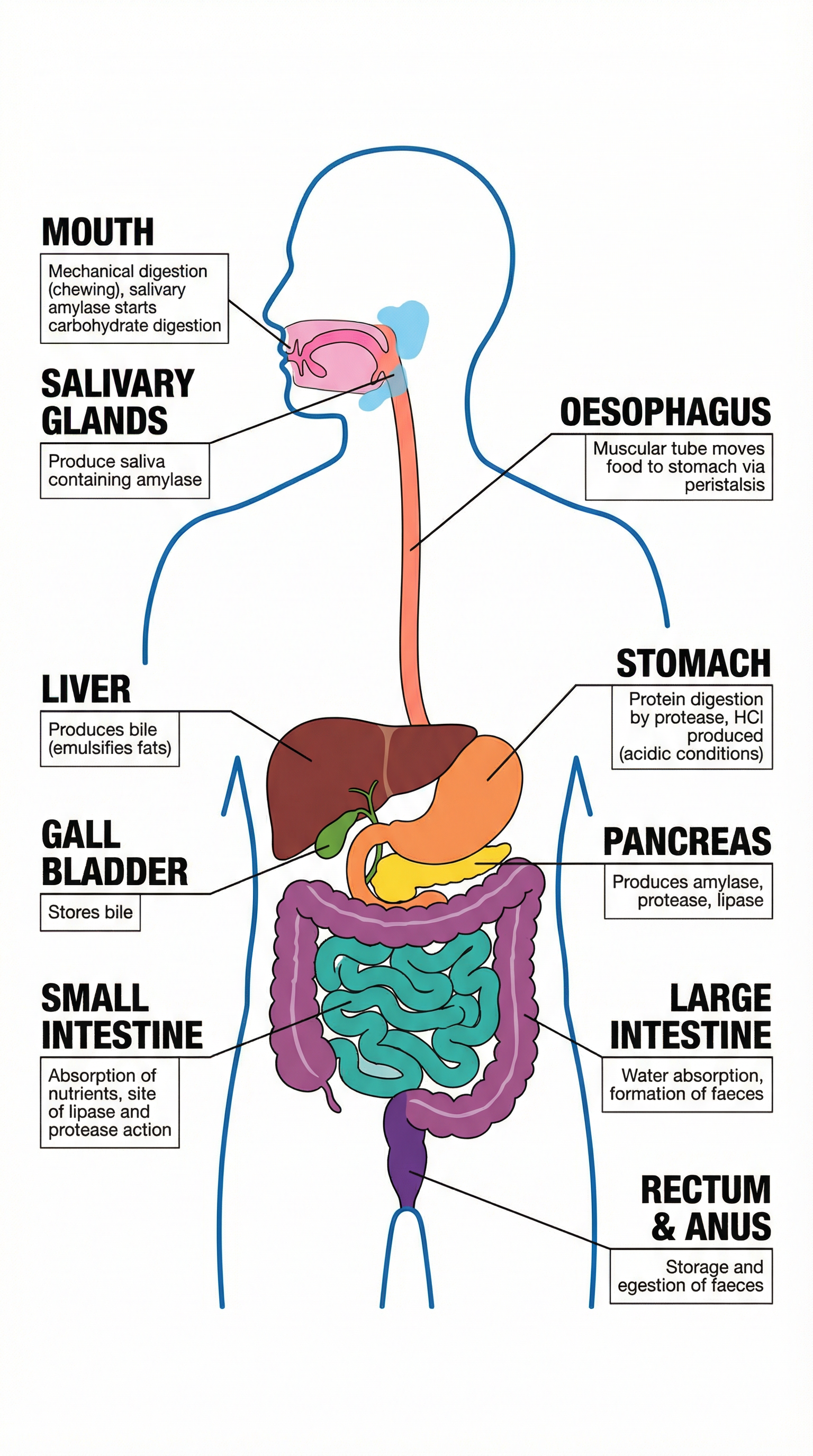
Complete pathway of digestion and absorption: from ingestion in the mouth to egestion via the large intestine, showing the site, enzyme, and product of each stage of chemical digestion.
Conceptual Flow Outline
The lock and key mechanism under normal conditions (cyclic, top) versus denaturation by high temperature or extreme pH (bottom). Note that denaturation is permanent — the enzyme cannot recover.
Conceptual Flow Outline
The dual role of bile: emulsification of fats (increasing surface area for lipase) and neutralisation of stomach acid (providing optimum pH for intestinal enzymes).
Worked Examples
4 worked examples — open one to explore the question and available guidance.
Practice Questions
Test your understanding — click to reveal model answers
State the name of the enzyme produced in the mouth and identify its substrate and product. [3 marks]
Hint: Think about what food molecule is broken down when you chew bread or pasta.
Explain why the rate of enzyme activity decreases when the temperature is raised above the optimum. [3 marks]
Hint: Think about what happens to the three-dimensional shape of the enzyme protein at high temperatures. What specific part of the enzyme is affected?
A student investigates the digestion of starch by amylase at different temperatures. She measures the time taken for the blue-black colour of iodine to disappear (indicating starch has been fully digested). At 20°C the reaction takes 120 seconds. At 37°C it takes 40 seconds.
(a) Calculate the rate of reaction at 37°C. Give your answer to 3 significant figures and include units. [2 marks]
(b) Suggest why the reaction at 20°C is slower than at 37°C. [2 marks]
Hint: For part (a), remember rate = 1 ÷ time. For part (b), think about kinetic energy and how often enzyme and substrate molecules collide.
Describe and explain two structural features of a villus that make it well adapted for the absorption of amino acids into the blood. [4 marks]
Hint: For each feature, state what it is AND explain how it increases the rate of absorption. Think about surface area, diffusion distance, and concentration gradient.
Higher Tier: A student claims that bile is the most important substance in the digestion of fat because without it, fat cannot be digested. Evaluate this claim. [6 marks — Level of Response]
Hint: To evaluate, you need to consider evidence both for AND against the claim. Think about what bile actually does, what lipase does, and whether fat could still be digested (more slowly) without bile.