OCR · GCSE · Biology
The Eye
This guide provides a comprehensive, exam-focused breakdown of The Eye for OCR GCSE Biology (Topic 5.4). It covers everything from the fundamental structures and their functions to the complex mechanics of accommodation and vision correction, complete with multi-modal assets to accelerate your learning.
- 6 min read
- 3 worked examples
- 5 practice questions
- 6 key terms
Study Notes
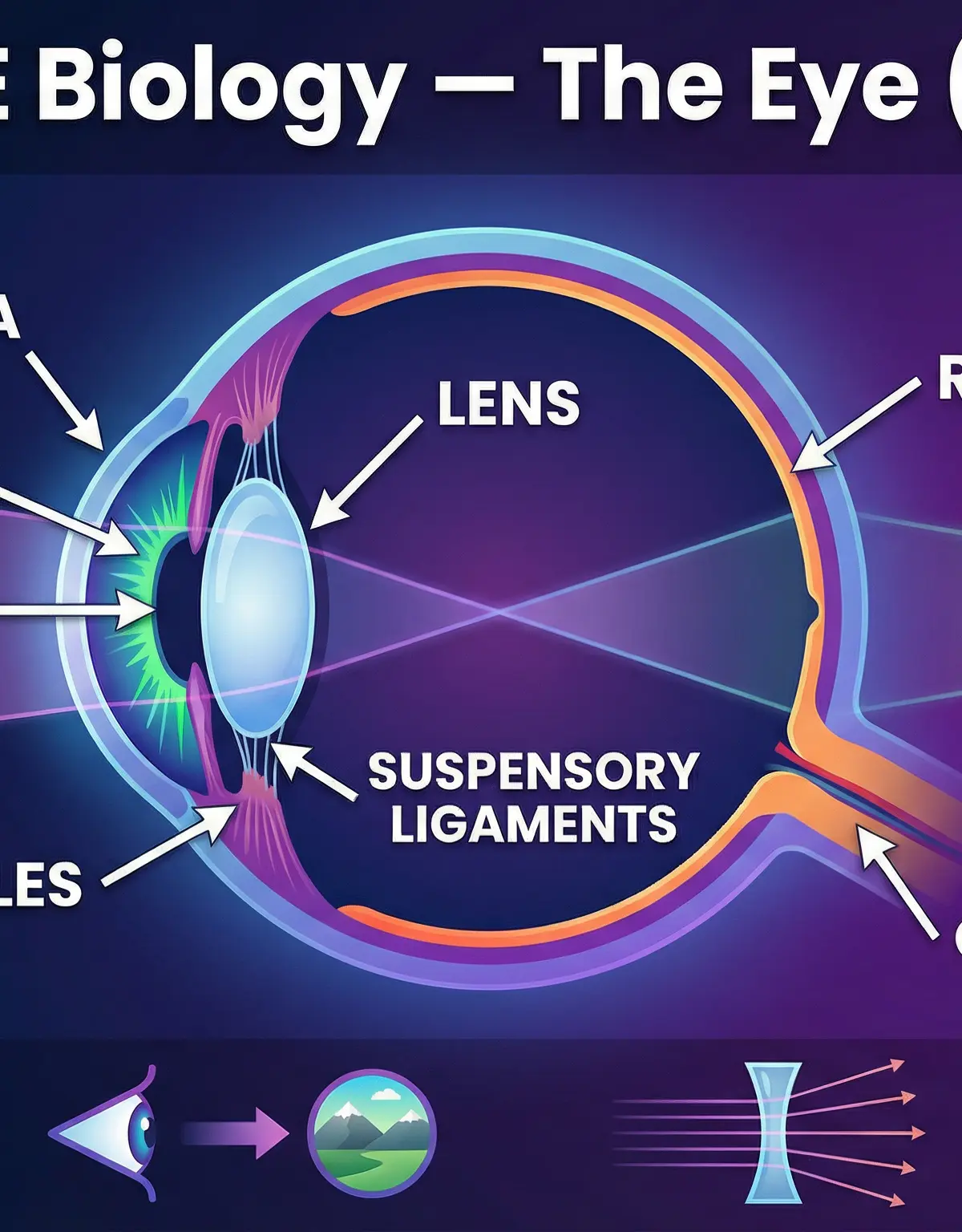
Overview
The human eye is a remarkable sensory organ, and understanding its structure and function is a cornerstone of the OCR GCSE Biology specification. This topic, part of the broader Coordination and Control module (B3), explores how the eye acts as a photoreceptor, detecting light and converting it into neural signals the brain can interpret. Examiners frequently test candidates' ability to not only label the parts of the eye but also to explain, in detail, the reflex actions that control light entry and focusing. For Higher Tier candidates, this extends to the precise mechanics of accommodation and the application of physics principles to correct common vision defects. A strong grasp of this topic is crucial as it often forms the basis for synoptic questions linking to nerves, hormones, and homeostasis.
Key Concepts
Concept 1: Structure and Function
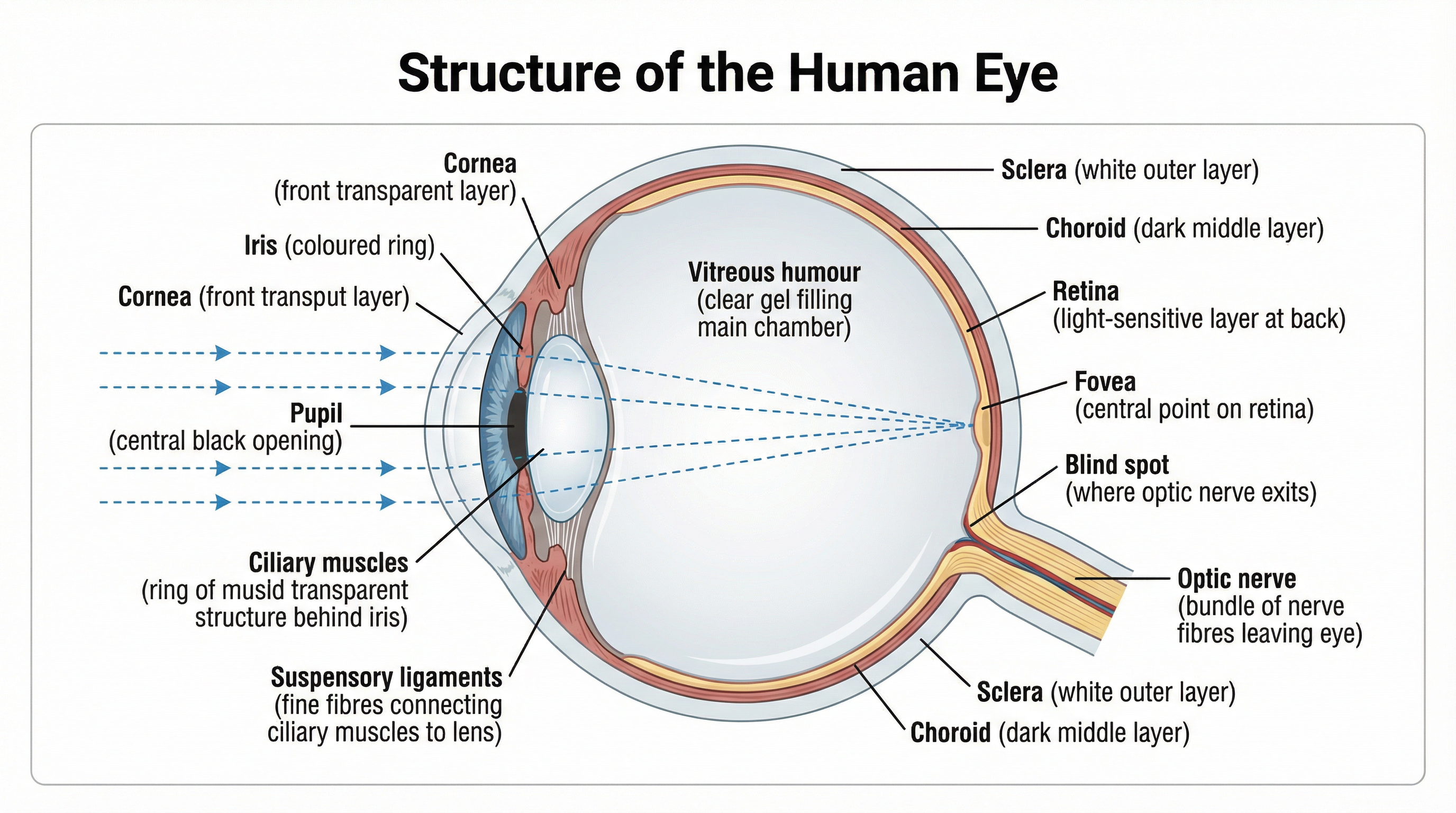
The eye is a complex organ with several key parts that work in concert. For the exam, you must be able to identify these structures and describe their roles. Think of it as a biological camera.
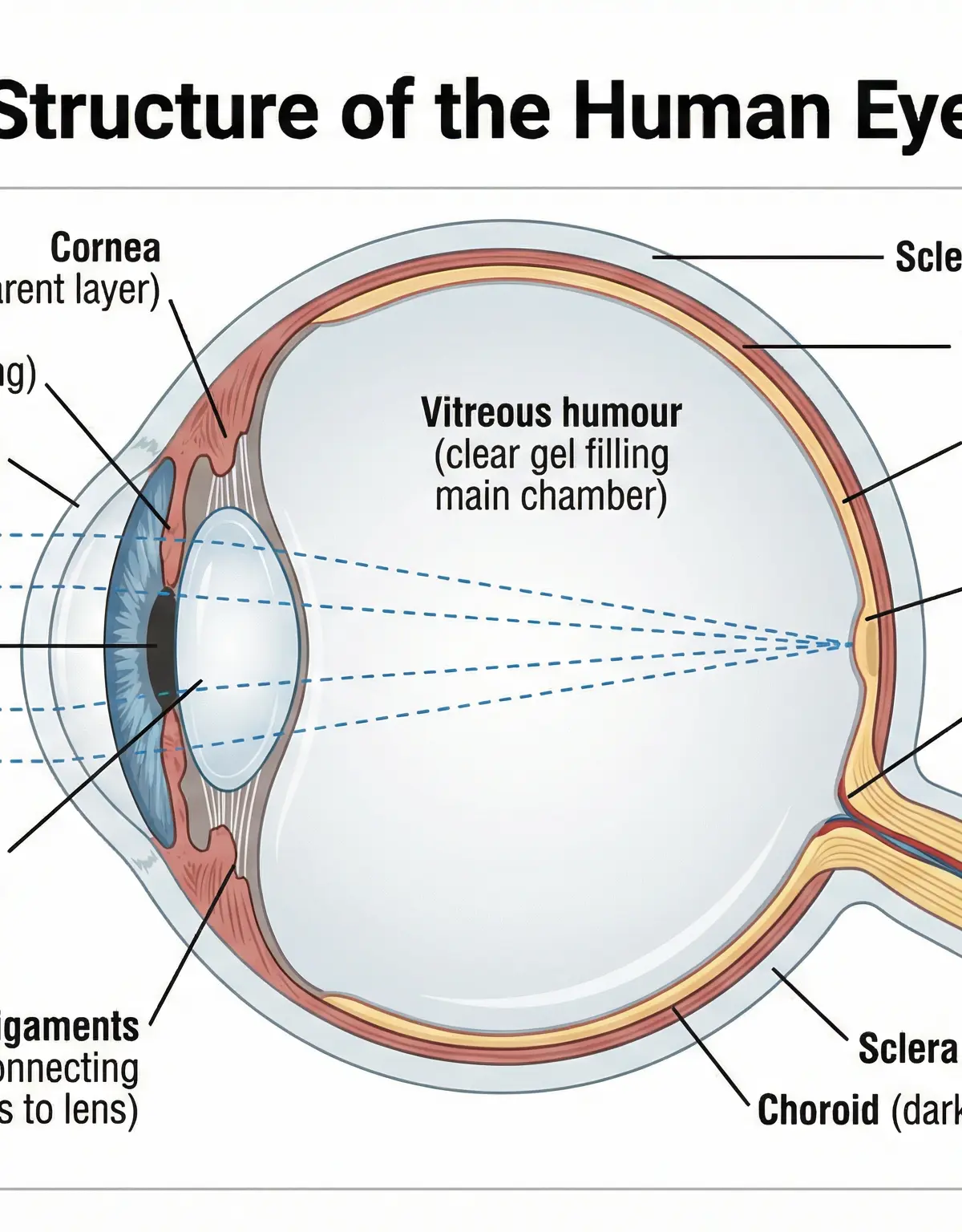
- Cornea: The transparent outer layer at the very front of the eye. It is curved and responsible for the majority of the light refraction (bending) that occurs.
- Iris: The coloured part of the eye. It contains a pair of antagonistic muscles (circular and radial) that control the size of the pupil.
- Pupil: The hole in the centre of the iris that allows light to enter the eye. Its size is not fixed.
- Lens: A transparent, biconvex structure located behind the iris. Its job is to fine-tune the focusing of light onto the retina by changing its shape.
- Retina: The light-sensitive layer at the back of the eye. It contains photoreceptor cells called rods (for dim light/monochrome vision) and cones (for bright light/colour vision).
- Optic Nerve: A bundle of sensory neurones that transmits electrical impulses from the retina to the brain.
- Ciliary Muscles & Suspensory Ligaments: These structures work together to control the shape of the lens. The ciliary muscles are a ring of muscle, and the suspensory ligaments are fibres that connect them to the lens.
Concept 2: The Pupil Reflex
This is an involuntary reflex that protects the retina from damage by regulating the amount of light entering the eye. It is a classic example of an antagonistic muscle pair in action.
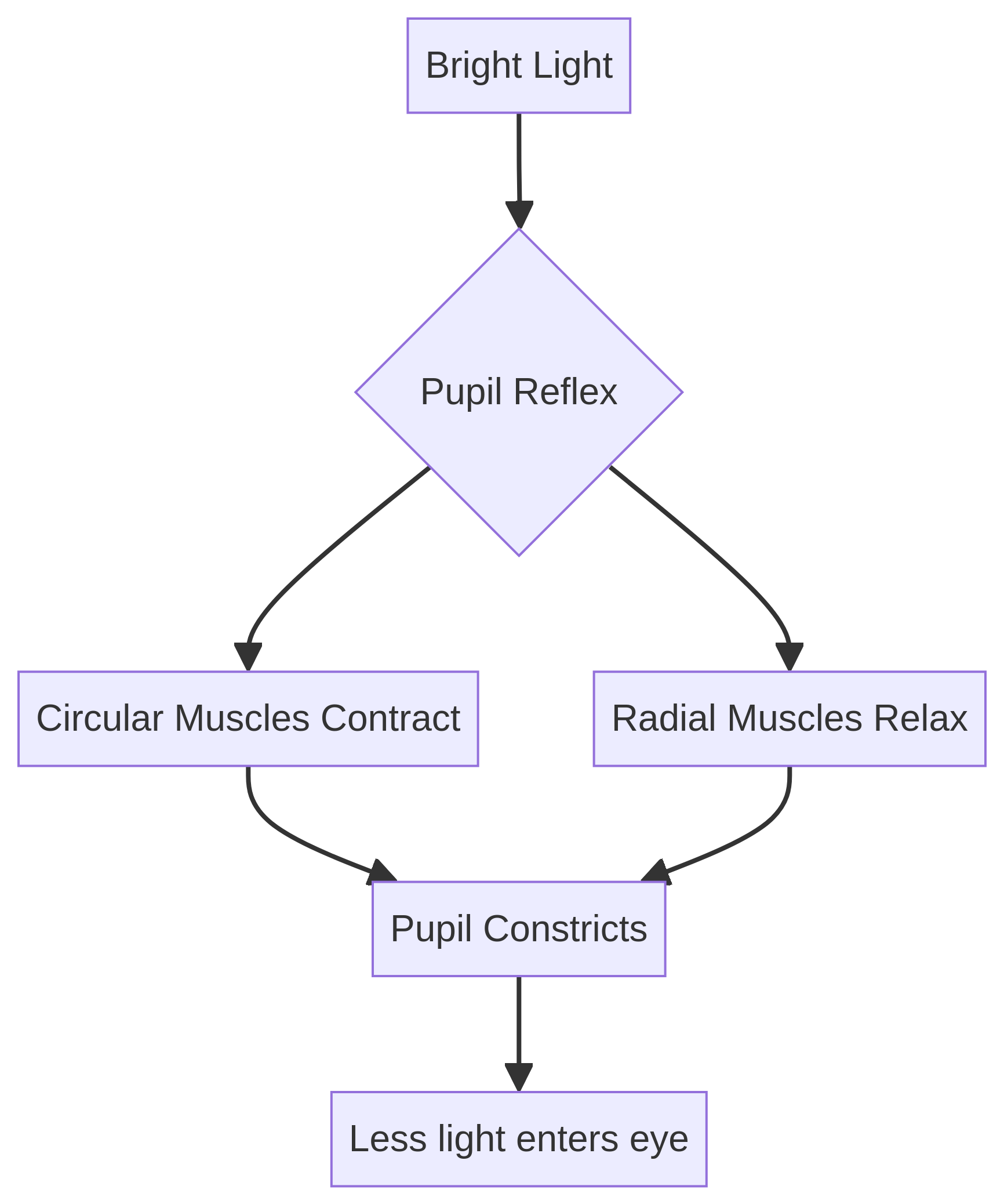
- In Bright Light: To prevent over-stimulation of the retina, the pupil must be made smaller (constricted). The circular muscles in the iris contract, while the radial muscles relax. This narrows the pupil.
- In Dim Light: To allow as much light in as possible, the pupil must be made larger (dilated). The radial muscles in the iris contract, while the circular muscles relax. This widens the pupil.
Examiners award marks for correctly identifying which muscle contracts in each scenario.
Concept 3: Accommodation (Focusing)
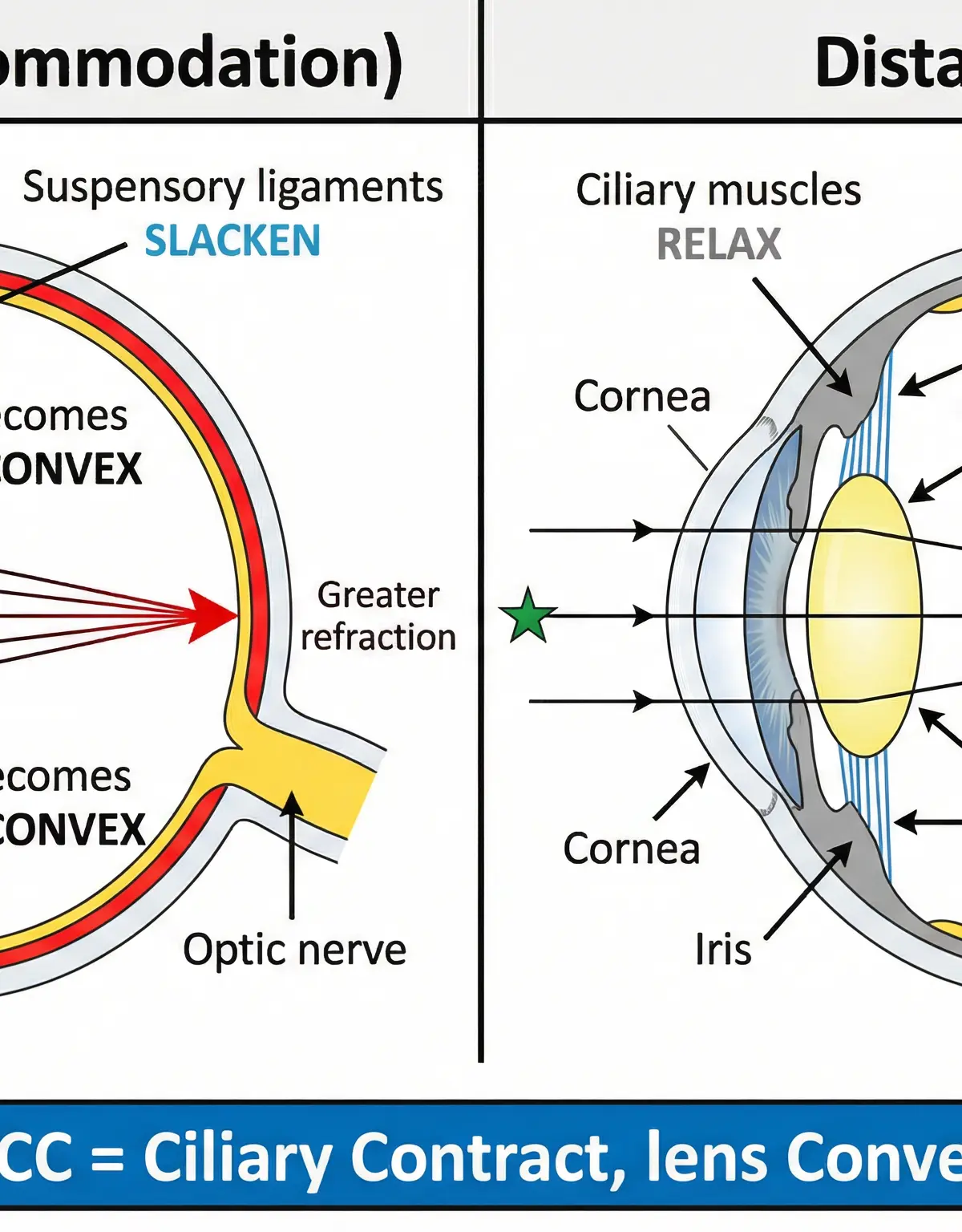
Accommodation is the process of changing the shape of the lens to focus on objects at different distances. This is a key area, especially for Higher Tier candidates.
-
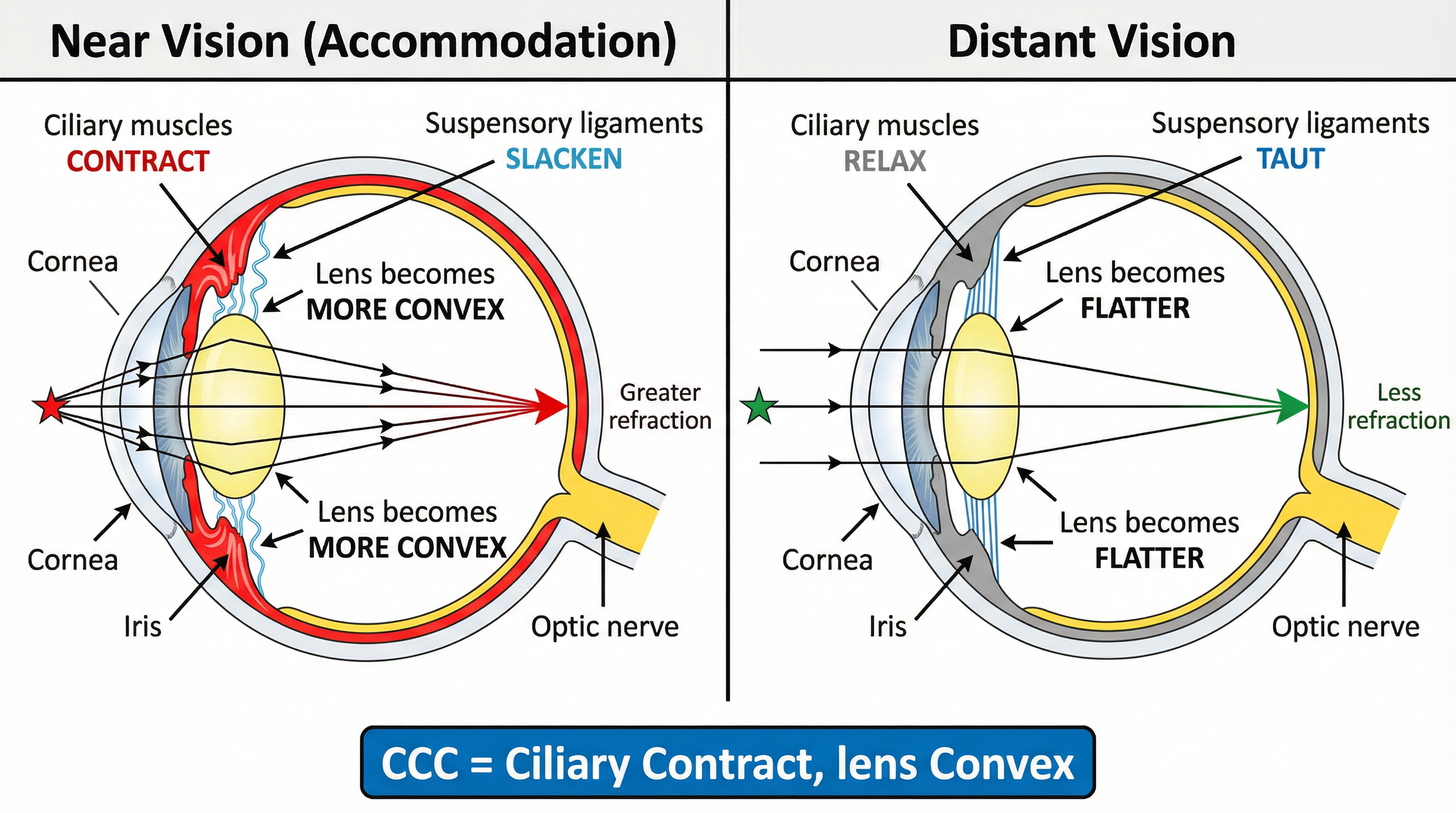
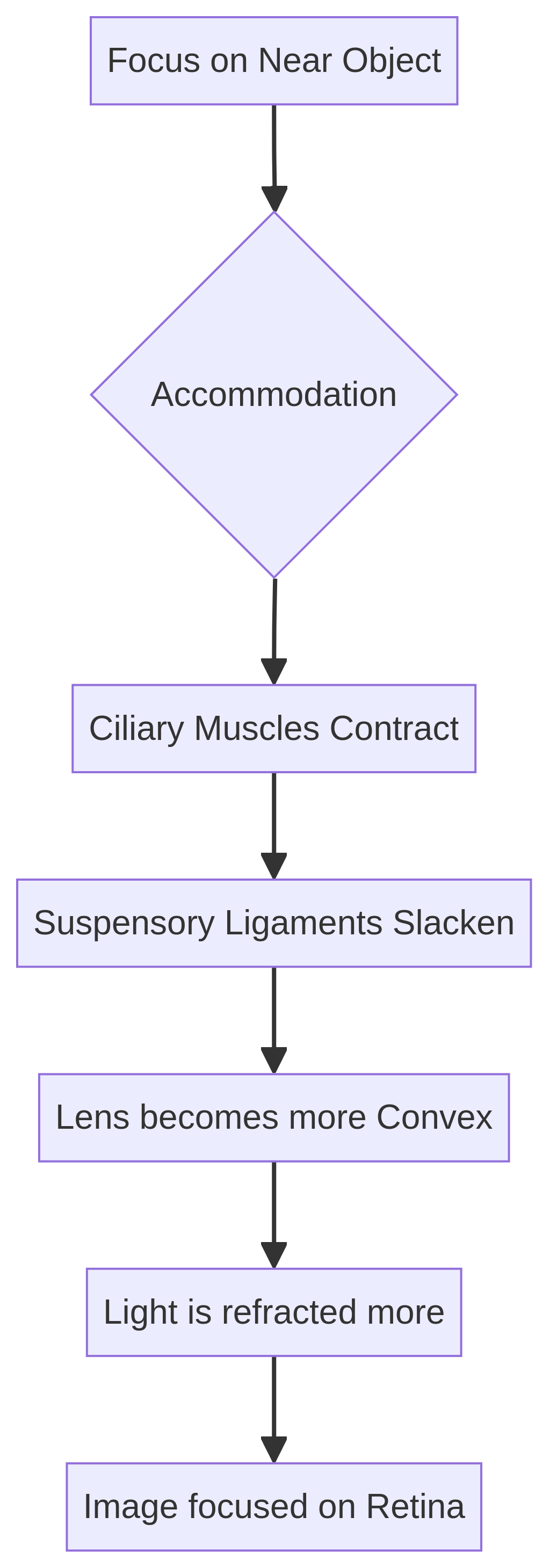
Focusing on a Near Object: Light rays from a near object are diverging (spreading out), so the lens needs to become more powerful (more convex) to refract them strongly onto the retina.
- The ciliary muscles contract.
- This causes the suspensory ligaments to slacken (go loose).
- The lens, being elastic, bulges into a fatter, more convex shape.
- This increases the refractive power of the lens, focusing the light on the retina.
-
Focusing on a Distant Object: Light rays from a distant object are nearly parallel, so they require less refraction.
- The ciliary muscles relax.
- This causes the suspensory ligaments to become taut (pulled tight).
- The ligaments pull on the lens, causing it to be stretched into a thinner, flatter shape.
- This decreases the refractive power of the lens, focusing the light correctly on the retina.
Concept 4: Vision Defects (Higher Tier Only)
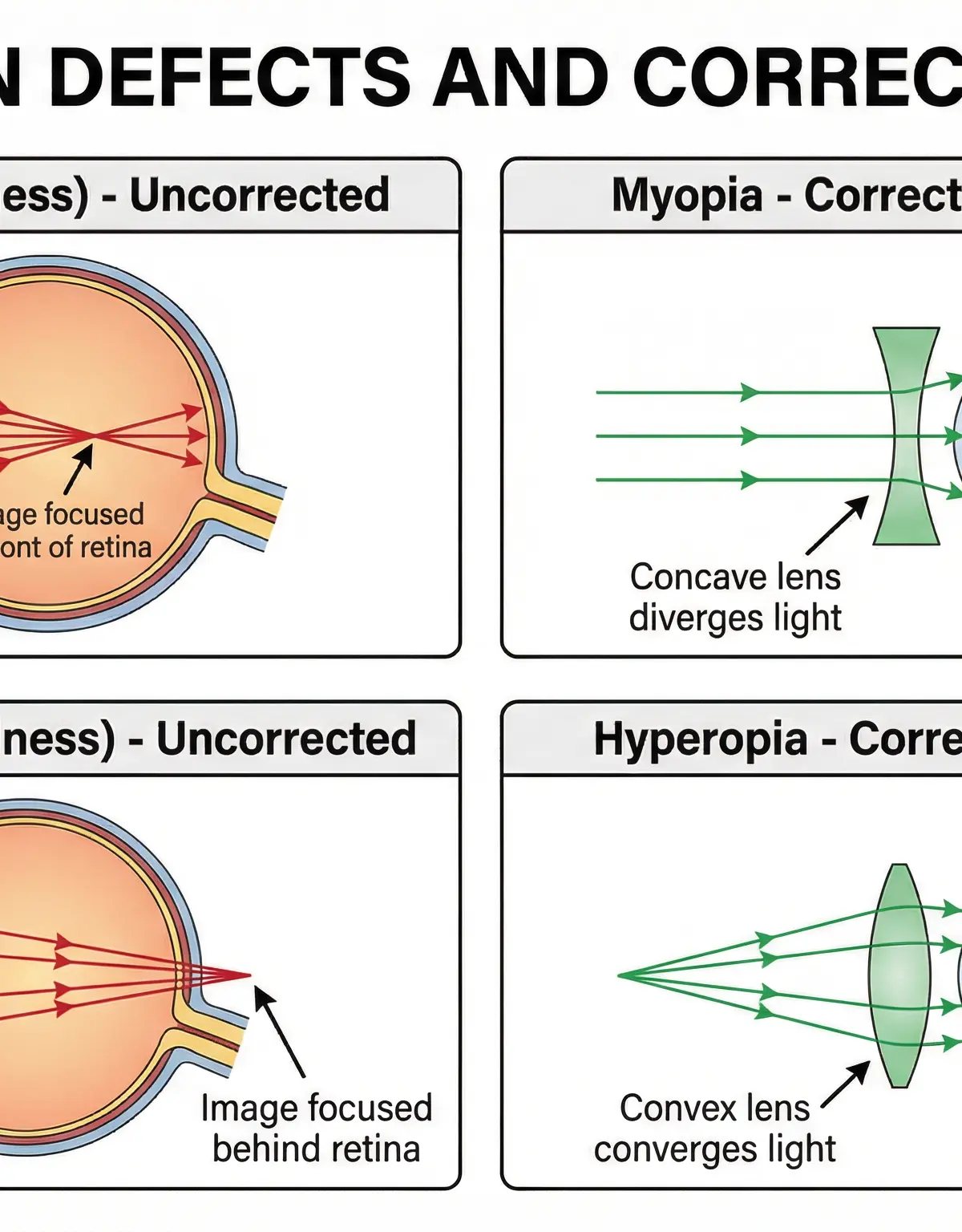
Sometimes, the eye cannot focus light correctly onto the retina, leading to blurred vision. You need to understand two common defects and how they are corrected.
-
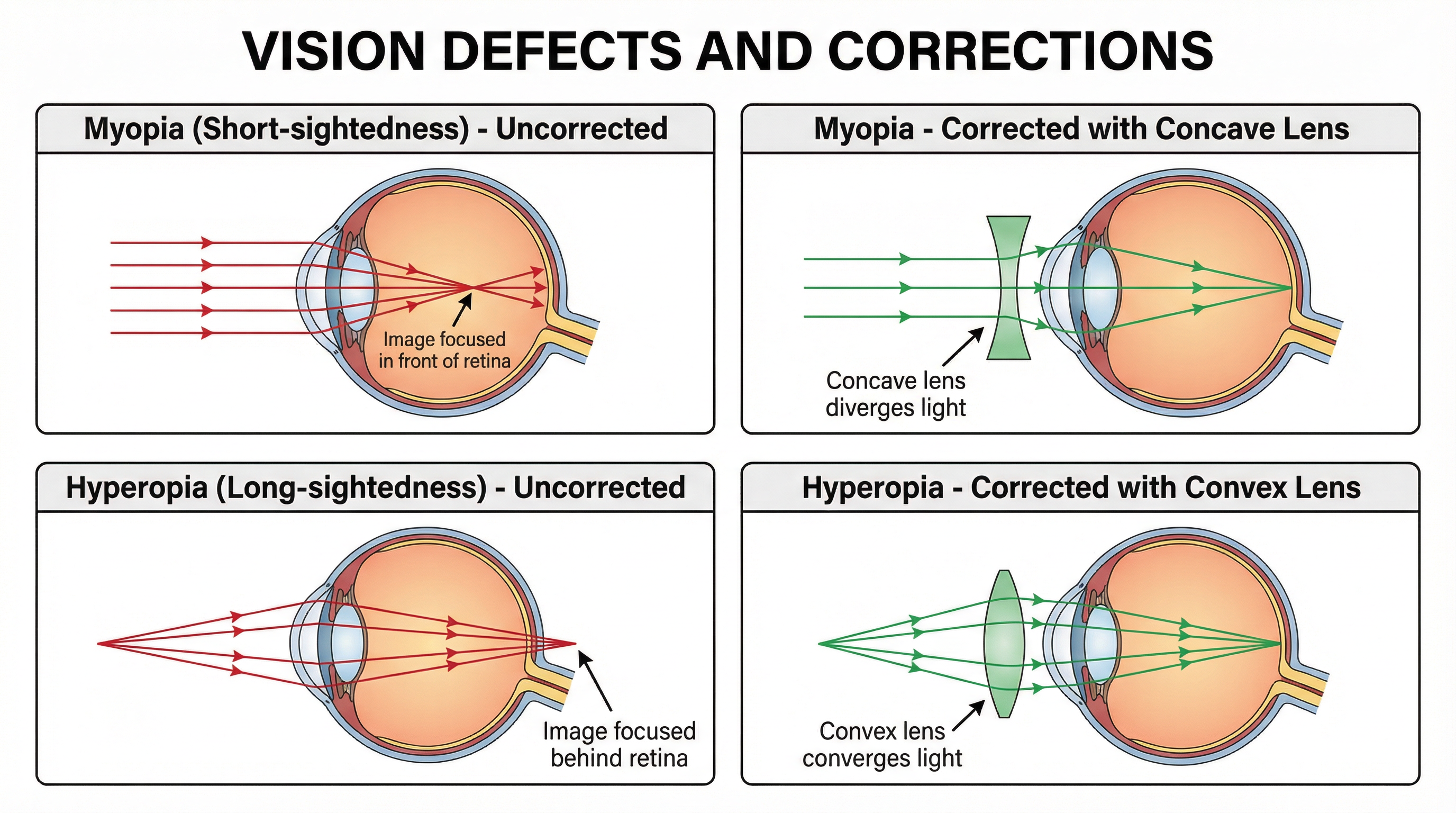
Myopia (Short-sightedness): The person can see near objects clearly, but distant objects are blurred. This occurs because the eyeball is too long, or the lens is too powerful (too convex). As a result, light from distant objects is focused in front of the retina.
- Correction: A concave lens (which is thinner in the middle) is used. This lens diverges the light rays slightly before they enter the eye, effectively moving the focal point backwards onto the retina.
-
Hyperopia (Long-sightedness): The person can see distant objects clearly, but near objects are blurred. This is caused by the eyeball being too short, or the lens being too weak (too flat). Light from near objects is focused behind the retina.
- Correction: A convex lens (which is thicker in the middle) is used. This lens converges the light rays slightly before they enter the eye, moving the focal point forwards onto the retina.
Mathematical/Scientific Relationships
There are no complex mathematical formulas to memorise for this topic at GCSE level. However, you must understand the qualitative relationships:
- Lens Shape and Refractive Power: A more convex (fatter) lens has a shorter focal length and higher refractive power. A less convex (flatter) lens has a longer focal length and lower refractive power.
- Object Distance and Required Refraction: Nearer objects require more refraction to be focused than distant objects.
Practical Applications
This topic does not have a specific required practical. However, understanding the eye is fundamental to the field of optometry and the design of corrective lenses (glasses and contact lenses) and technologies like laser eye surgery, which reshapes the cornea to alter its refractive power.
Visual Resources
5 diagrams and illustrations
Interactive Diagrams
2 interactive diagrams to visualise key concepts
Conceptual Flow Outline
Flowchart showing the sequence of the pupil reflex in response to bright light.
Conceptual Flow Outline
Flowchart summarising the process of accommodation for near vision.
Worked Examples
3 worked examples — open one to explore the question and available guidance.
Practice Questions
Test your understanding — click to reveal model answers
State two differences between rod and cone cells. (2 marks)
Hint: Think about what kind of light each cell works best in, and what kind of information it detects.
Describe how the shape of the lens is changed to allow the eye to focus on a distant object. (3 marks)
Hint: This is the reverse of focusing on a near object. Start with the ciliary muscles.
A person with hyperopia has difficulty reading a book. Explain why, in terms of the eye's structure and the path of light. (4 marks)
Hint: This is a Higher Tier question. Where does the light focus in relation to the retina, and why?
Compare the pupil reflex and accommodation. (4 marks)
Hint: A 'compare' question needs similarities and differences. What is the stimulus for each? What part of the eye is involved?
Explain why a person with myopia would not be able to see a distant sign clearly. (3 marks)
Hint: Think about the shape of the eyeball or lens in a myopic person.