OCR · GCSE · Biology
Topic B2: Scaling up
Master the essential transport mechanisms—diffusion, osmosis, and active transport—that keep organisms alive. This topic bridges the gap between single cells and complex systems, explaining exactly why humans need hearts and plants need roots.
- 7 min read
- 3 worked examples
- 5 practice questions
- 6 key terms
Study Notes
Overview
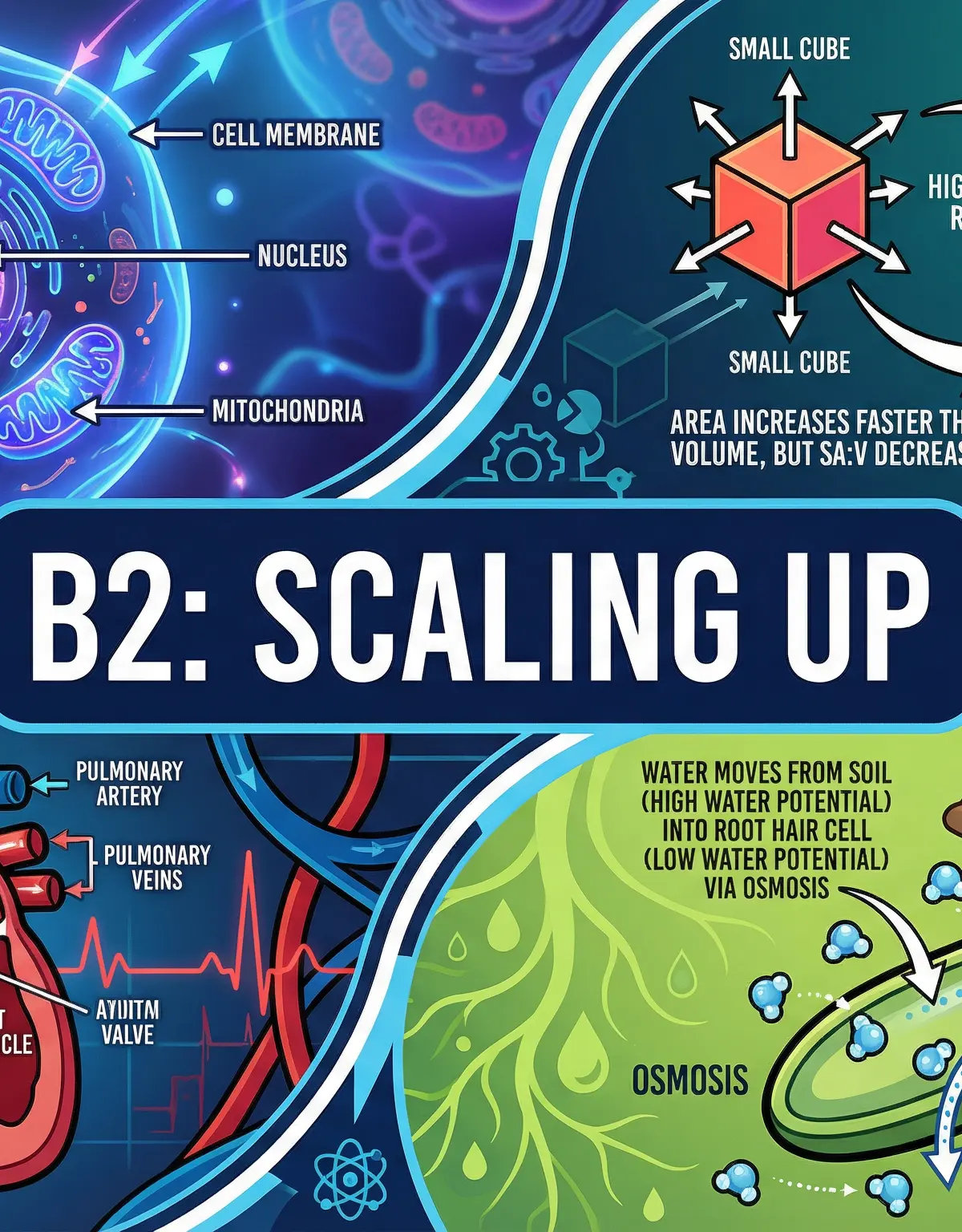
Welcome to Topic B2: Scaling Up. This topic is fundamentally about logistics in biology: how do organisms move the things they need (like oxygen and glucose) to where they are needed, and how do they get rid of waste (like carbon dioxide)?
In this topic, you will learn the three core transport mechanisms: diffusion, osmosis, and active transport. You will then scale up to understand why single-celled organisms can rely on these basic mechanisms, while multicellular organisms—like humans and oak trees—require specialised transport systems such as the heart, blood vessels, xylem, and phloem. This is a high-yield topic in the exam; examiners frequently test your understanding of the Surface Area to Volume (SA:V) ratio and your ability to link cell structure to organ function.
Listen to the full revision podcast here:
Key Concepts
Concept 1: The Three Transport Mechanisms
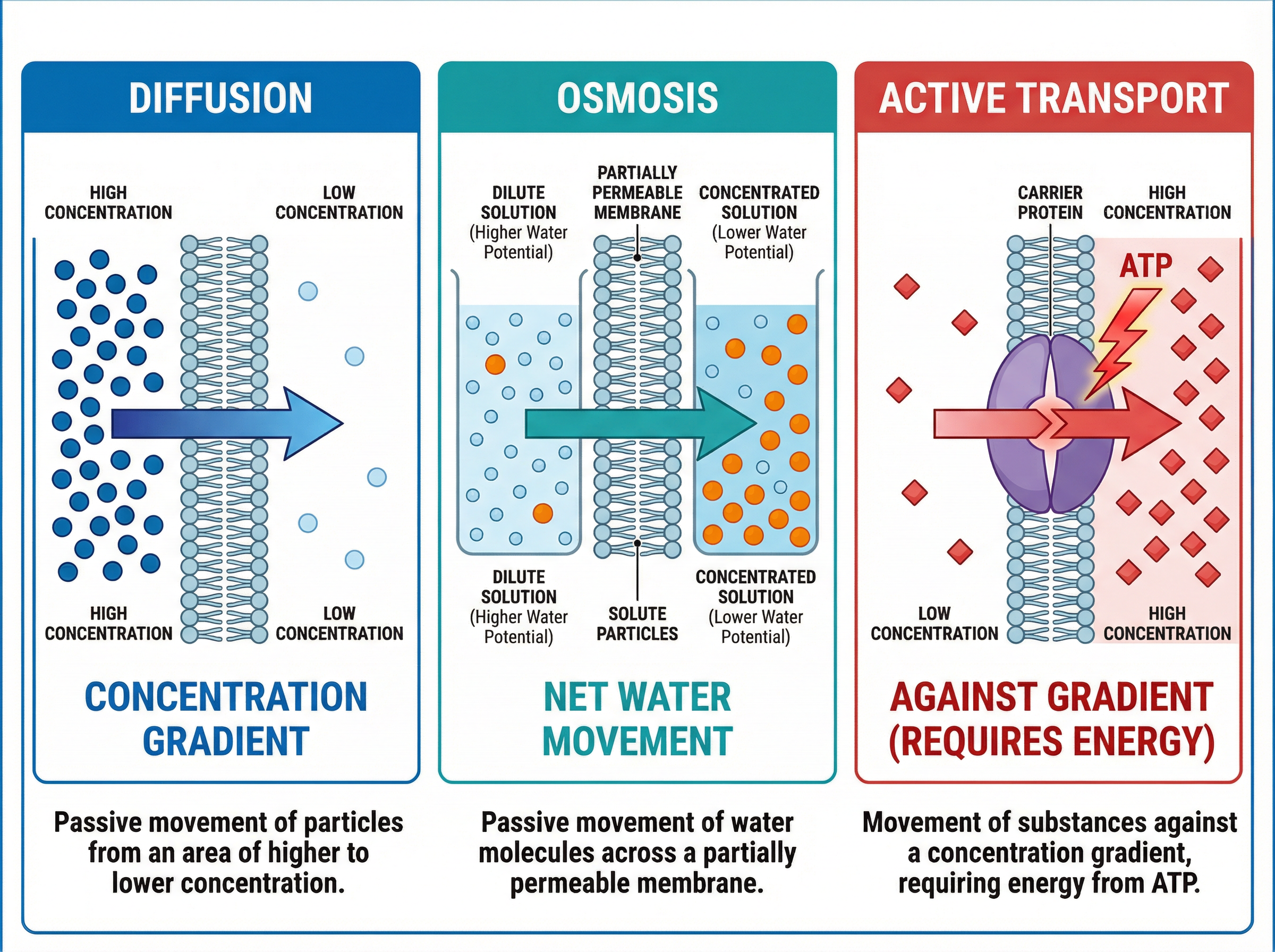
To survive, cells must constantly exchange substances with their environment. They do this via three main processes.
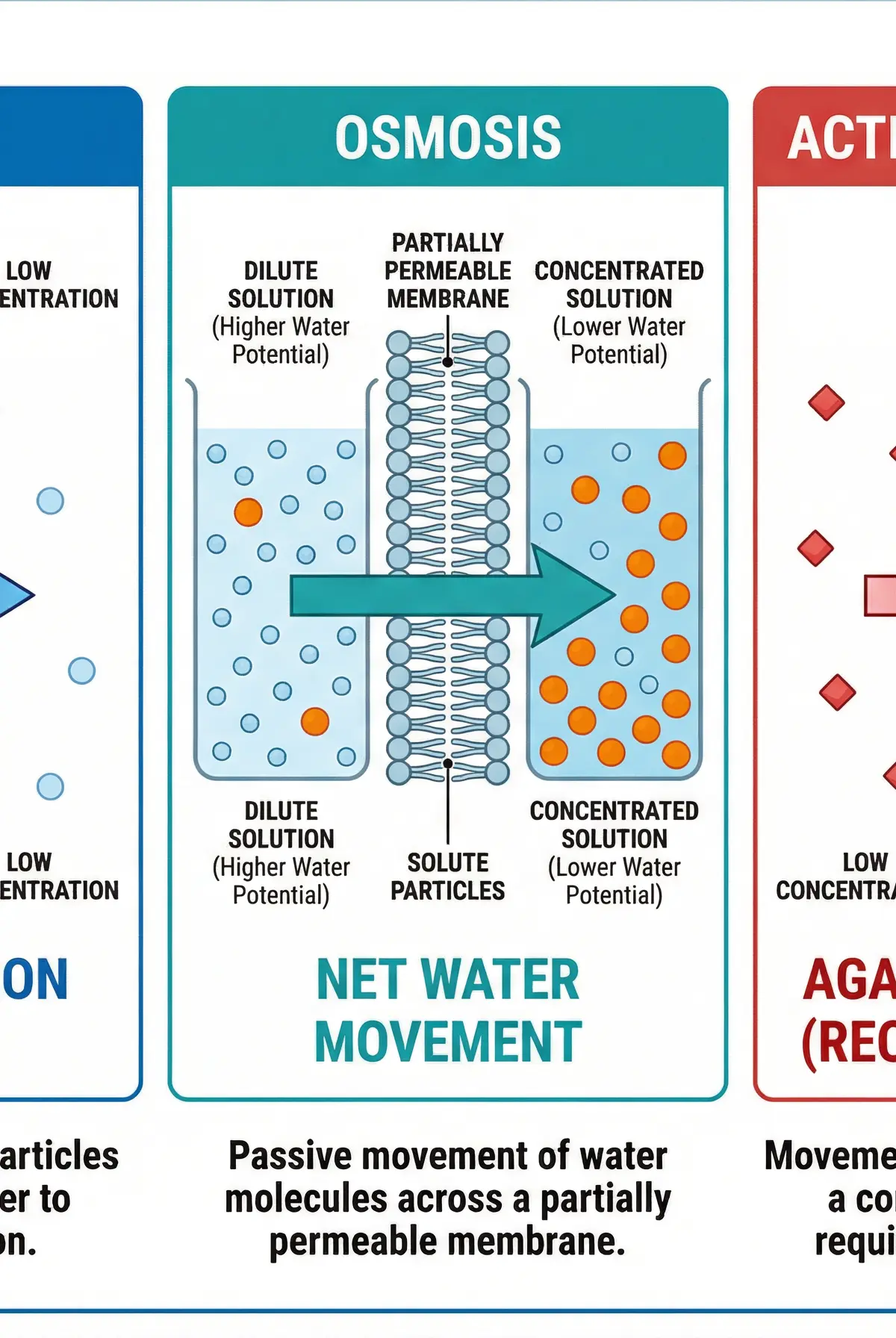
1. DiffusionDiffusion is the net movement of particles from an area of higher concentration to an area of lower concentration, down a concentration gradient. It is a passive process, meaning it does not require energy from respiration. For example, oxygen diffuses from the alveoli in the lungs into the blood capillaries, while carbon dioxide diffuses in the opposite direction.
2. OsmosisOsmosis is a specific type of diffusion. It is the net movement of water molecules from a region of higher water potential (a dilute solution) to a region of lower water potential (a concentrated solution) through a partially permeable membrane.
Example: If you place a piece of potato in pure water (high water potential), water will move into the potato cells by osmosis, causing them to swell and become turgid. If placed in concentrated sugar solution (low water potential), water moves out, and the cells become flaccid or plasmolysed.
3. Active TransportUnlike diffusion and osmosis, active transport moves substances against the concentration gradient—from an area of lower concentration to an area of higher concentration. Because it works against the natural flow, it requires energy (ATP) released by respiration, and it relies on carrier proteins in the cell membrane.
Synoptic Link: This is why cells that carry out a lot of active transport, such as root hair cells, contain many mitochondria.
Concept 2: Surface Area to Volume Ratio (SA:V)
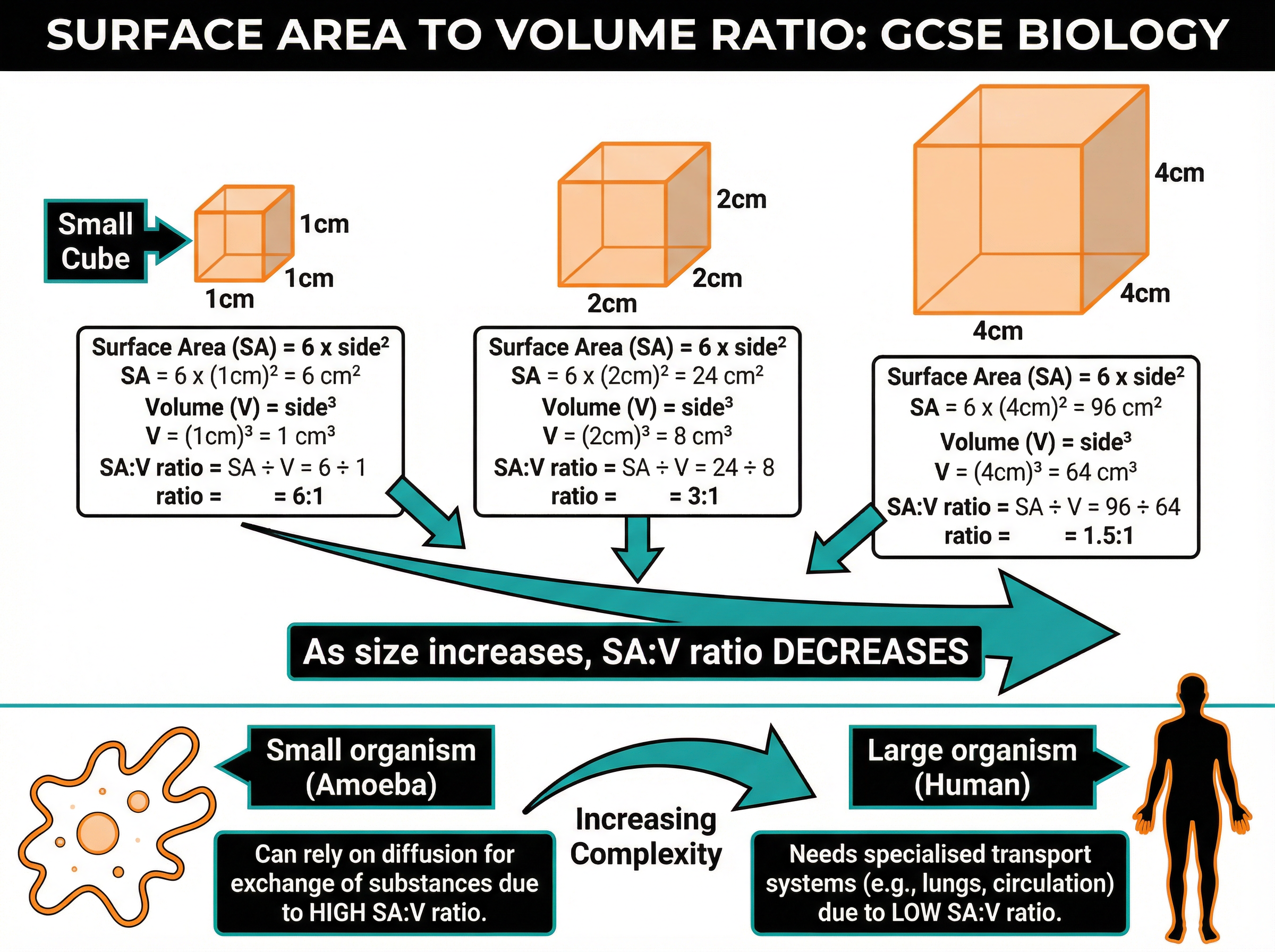
As an organism gets larger, its volume increases much faster than its surface area.
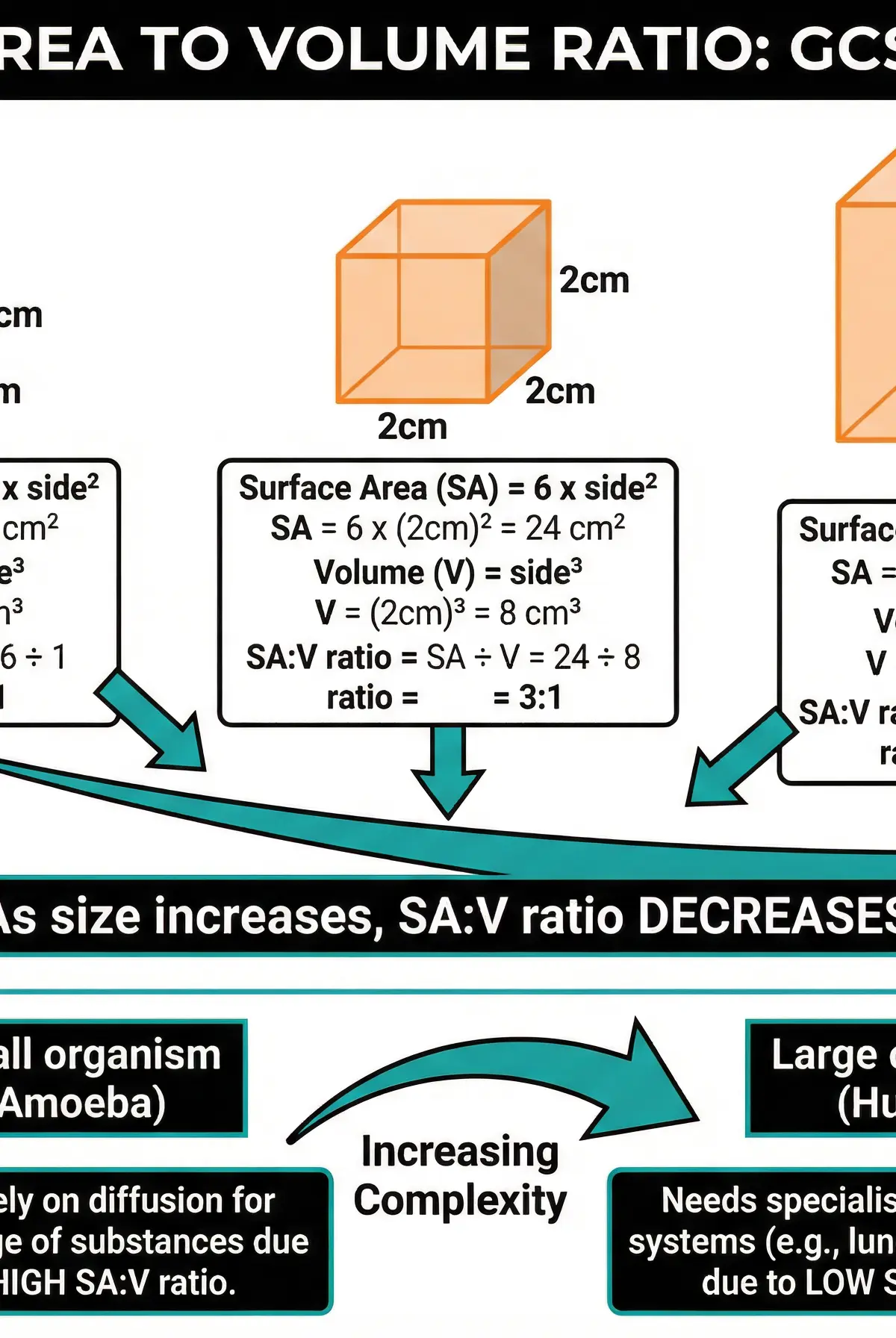
Single-celled organisms like amoebas have a very large SA:V ratio. This means they have enough surface area to supply their small volume with oxygen simply by diffusion across their cell membrane.
However, in multicellular organisms, the SA:V ratio is too small. Diffusion alone is too slow to supply all the cells deep inside the body. To solve this, large organisms have evolved specialised exchange surfaces (like lungs and intestines) and transport systems (like the circulatory system) to move substances efficiently.
Concept 3: The Cell Cycle and Mitosis
Growth and repair in multicellular organisms require the production of new cells. This happens via the cell cycle, which culminates in mitosis.
- Interphase: The cell grows, increases its number of sub-cellular structures (like ribosomes and mitochondria), and replicates its DNA to form two copies of each chromosome.
- Mitosis: One set of chromosomes is pulled to each end of the cell, and the nucleus divides.
- Cytokinesis: The cytoplasm and cell membrane divide to form two genetically identical daughter cells.
Concept 4: The Human Circulatory System
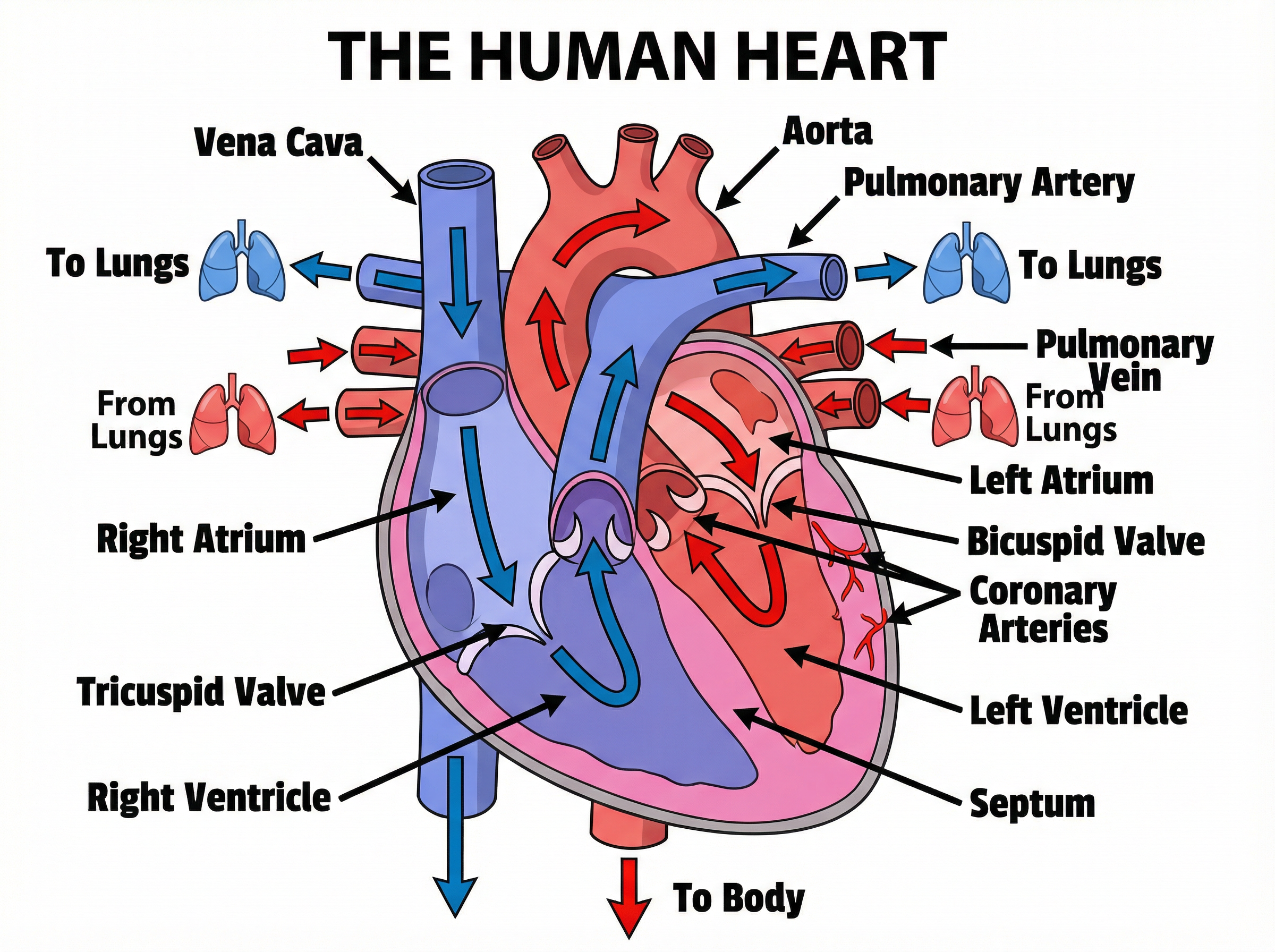
The human heart is a double pump that drives blood through the circulatory system.
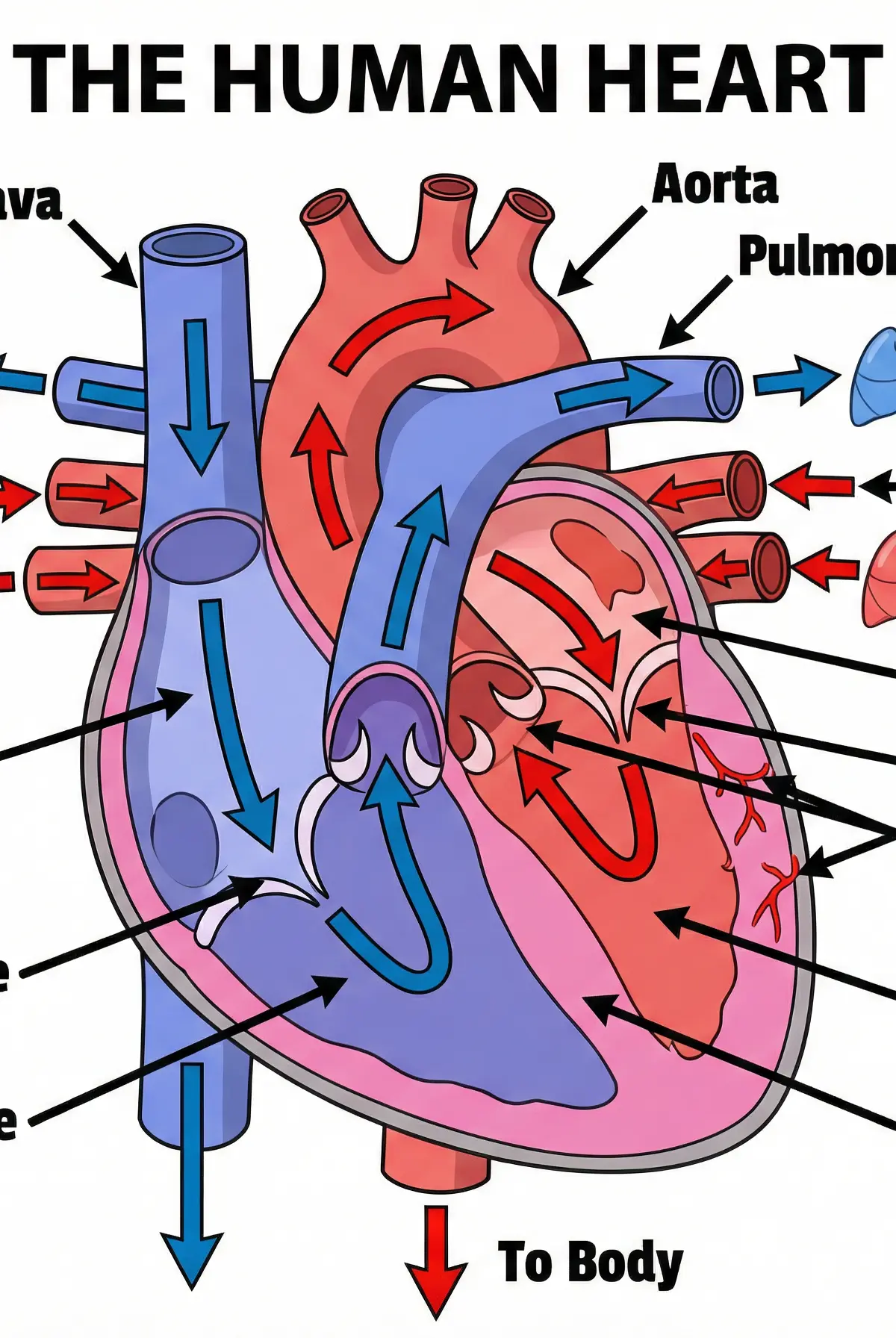
- The right ventricle pumps deoxygenated blood to the lungs for gas exchange.
- The left ventricle pumps oxygenated blood around the rest of the body. The muscular wall of the left ventricle is much thicker because it must pump blood at a higher pressure to reach all extremities.
Blood flows through three main types of vessels:
- Arteries: Carry blood away from the heart. They have thick muscular and elastic walls to withstand high pressure.
- Veins: Carry blood back to the heart. They have thinner walls, a larger lumen, and valves to prevent the backflow of blood.
- Capillaries: Huge networks of tiny vessels. Their walls are only one cell thick, providing a short diffusion pathway for the exchange of substances between the blood and tissues.
Concept 5: Plant Transport Systems
Plants also need to move substances. They rely on two main tissues:
- Xylem: Transports water and dissolved mineral ions from the roots to the stem and leaves. This upward movement is called the transpiration stream. Xylem vessels are made of dead cells strengthened by lignin.
- Phloem: Transports dissolved sugars produced during photosynthesis from the leaves to the rest of the plant for immediate use or storage. This process is called translocation.
Water enters the plant through root hair cells. These cells have long projections that greatly increase their surface area for the absorption of water (by osmosis) and mineral ions (by active transport).
Mathematical/Scientific Relationships
Surface Area of a Cube: SA = 6 \times side^2
Volume of a Cube: V = side^3
SA:V Ratio: Calculate SA and V separately, then express as a ratio simplified to X:1 (by dividing both sides by the volume).
Rate of Transpiration: Often measured using a potometer.
Rate = \frac{Distance ; moved ; by ; bubble}{Time ; taken}
Practical Applications
Required Practical: Investigating OsmosisStudents must investigate the effect of a range of concentrations of salt or sugar solutions on the mass of plant tissue (usually potato cylinders).
- Method: Cut identical potato cylinders, measure their initial mass, place them in different concentrations of sugar solution for 24 hours, dry them gently, and measure their final mass.
- Calculation: Percentage change in mass = \frac{Final ; Mass - Initial ; Mass}{Initial ; Mass} \times 100
- Examiner Tip: Examiners love to ask why you must dry the potato cylinders before the final weighing (to remove excess surface fluid which would artificially inflate the mass).
Visual Resources
3 diagrams and illustrations
Interactive Diagrams
2 interactive diagrams to visualise key concepts
Conceptual Flow Outline
The Cell Cycle and Mitosis
Conceptual Flow Outline
The pathway of water through a plant
Worked Examples
3 worked examples — open one to explore the question and available guidance.
Practice Questions
Test your understanding — click to reveal model answers
Compare the processes of diffusion and active transport. (4 marks)
Hint: Think about concentration gradients and energy requirements.
Explain why a person with a faulty heart valve may feel breathless and tired during exercise. (4 marks)
Hint: What is the function of a valve? What happens to blood flow if it fails?
Describe the route taken by oxygenated blood from the lungs to the body tissues. (3 marks)
Hint: Start at the lungs, name the blood vessel to the heart, the chamber it enters, and the vessel it leaves through.
Explain how root hair cells are adapted for their function. (3 marks)
Hint: Think about surface area and cellular organelles.
A student investigates the effect of temperature on transpiration rate. State two variables the student should control. (2 marks)
Hint: What other environmental factors affect transpiration?