OCR · GCSE · Biology
Topic B7: Practical skills
Mastering Practical Skills (Topic B7) is your golden ticket to exam success, as these questions appear on every single GCSE Biology paper. This guide breaks down the essential techniques, variable types, and data analysis skills you need to secure top marks.
- 4 min read
- 3 worked examples
- 5 practice questions
- 6 key terms
Study Notes
Overview

Topic B7: Practical Skills is arguably the most crucial area of your GCSE Biology specification. Unlike other topics that focus on specific biological systems, practical skills are synoptic — they weave through every single module, from cell biology to ecology. Examiners use practical questions to test your understanding of how science actually works.
You will be assessed on your ability to design valid experiments, identify variables, record data accurately, and evaluate methods. This guide covers the core principles you need, whether you are analyzing the rate of photosynthesis, conducting food tests, or sampling a field with quadrats.
Listen to the audio guide below for a comprehensive overview of the topic:
Key Concepts
Concept 1: Experimental Variables
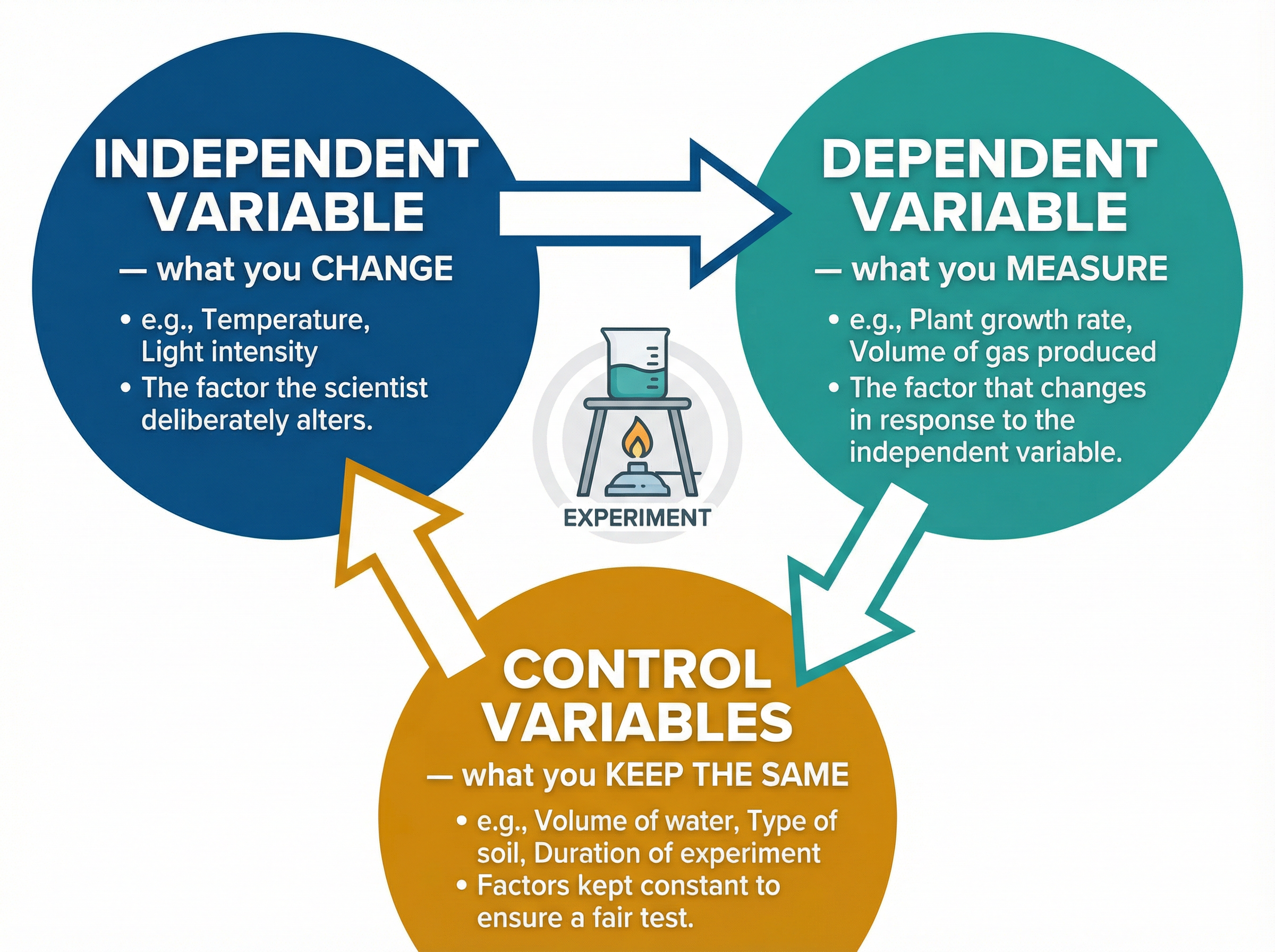
Every scientific investigation relies on understanding variables. To ensure an experiment is a 'fair test' (a valid investigation), you must carefully control specific factors while changing only one.
- Independent Variable: The factor the scientist deliberately alters.
- Dependent Variable: The factor that changes in response (what you measure).
- Control Variables: Factors kept constant to ensure they do not affect the dependent variable.
Example: In an experiment investigating the effect of temperature on enzyme activity, the independent variable is the temperature (e.g., 20°C, 30°C, 40°C). The dependent variable is the rate of reaction (e.g., volume of gas produced per minute). The control variables must include the pH, the concentration of the enzyme, and the concentration of the substrate.
Concept 2: Accuracy vs. Precision
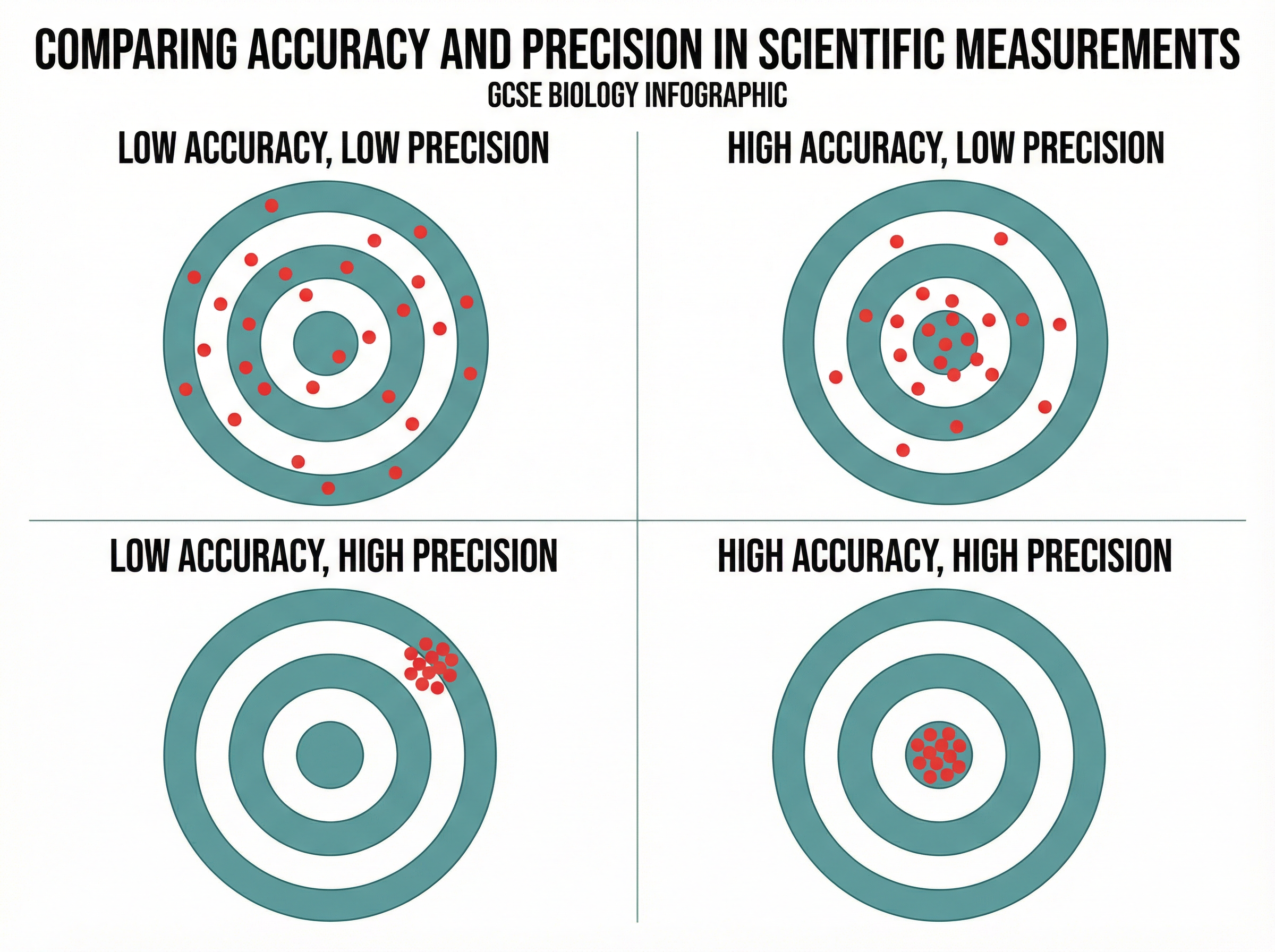
Candidates frequently confuse accuracy and precision, leading to lost marks in evaluation questions.
- Accuracy: How close a measurement is to the true or accepted value.
- Precision: How close repeated measurements are to each other, regardless of whether they are accurate.
Example: If the true boiling point of a liquid is 100°C, and your thermometer reads 95.1°C, 95.2°C, and 95.1°C, your results are highly precise (they are grouped tightly together) but not accurate (they are far from the true value of 100°C).
Concept 3: Repeatability vs. Reproducibility
These terms describe the reliability of an experiment.
- Repeatability: If the original experimenter repeats the investigation using the same method and equipment and obtains the same results.
- Reproducibility: If a different person, or a person in a different laboratory using different equipment, repeats the investigation and obtains the same results.
Mathematical/Scientific Relationships
Calculating Means
When calculating a mean from repeated data, you must exclude anomalous results (outliers that do not fit the pattern).
\text{Mean} = \frac{\text{Sum of valid results}}{\text{Number of valid results}}
Rate of Reaction
Rate calculations are essential across multiple practicals (e.g., enzyme activity, photosynthesis).
\text{Rate} = \frac{\text{Change in quantity}}{\text{Time taken}}
Estimated Population Size (Ecology)
Used when sampling with quadrats.
\text{Estimated Population} = \frac{\text{Total area}}{\text{Area sampled}} \times \text{Number of organisms in sample}
Practical Applications
The eight Practical Activity Groups (PAGs) form the core of this topic. You must be familiar with the apparatus, techniques, and safety precautions for each. For instance, knowing that a water bath provides safer, more uniform heating than a Bunsen burner when working with flammable substances like ethanol is a common marking point.
Visual Resources
2 diagrams and illustrations
Interactive Diagrams
2 interactive diagrams to visualise key concepts
Conceptual Flow Outline
A logical flow for answering 6-mark 'Design an Experiment' questions.
Conceptual Flow Outline
The process for handling experimental data and calculating means.
Worked Examples
3 worked examples — open one to explore the question and available guidance.
Practice Questions
Test your understanding — click to reveal model answers
A student investigated the effect of pH on amylase activity. Describe how the student could have maintained a constant temperature during the investigation. [2 marks]
Hint: Think about the apparatus used to keep liquids at a steady temperature.
Explain why it is necessary to calculate a mean when analyzing experimental data. [2 marks]
Hint: What does repeating an experiment help you identify?
A student is using a light microscope to observe onion epidermal cells. The eyepiece lens has a magnification of x10 and the objective lens has a magnification of x40. Calculate the total magnification. [1 mark]
Hint: How do you combine the magnifications of two lenses?
A student is asked to investigate the energy content of two different types of biscuit. Design a suitable method for this investigation. [6 marks]
Hint: Use the CORMMSS structure. How will you measure the energy released?
A student measured the length of 5 leaves. The results in mm were: 45, 47, 46, 62, 45. Calculate the mean length of a typical leaf. [2 marks]
Hint: Look closely at the data set before you calculate.