OCR · GCSE · Biology
Water Cycle
Master the OCR GCSE Biology Water Cycle (7.4) with this comprehensive guide. We break down every key process, from evaporation to transpiration, explain the crucial role of living organisms, and provide examiner-level tips to help you secure maximum marks.
- 5 min read
- 3 worked examples
- 5 practice questions
- 6 key terms
Study Notes
Overview
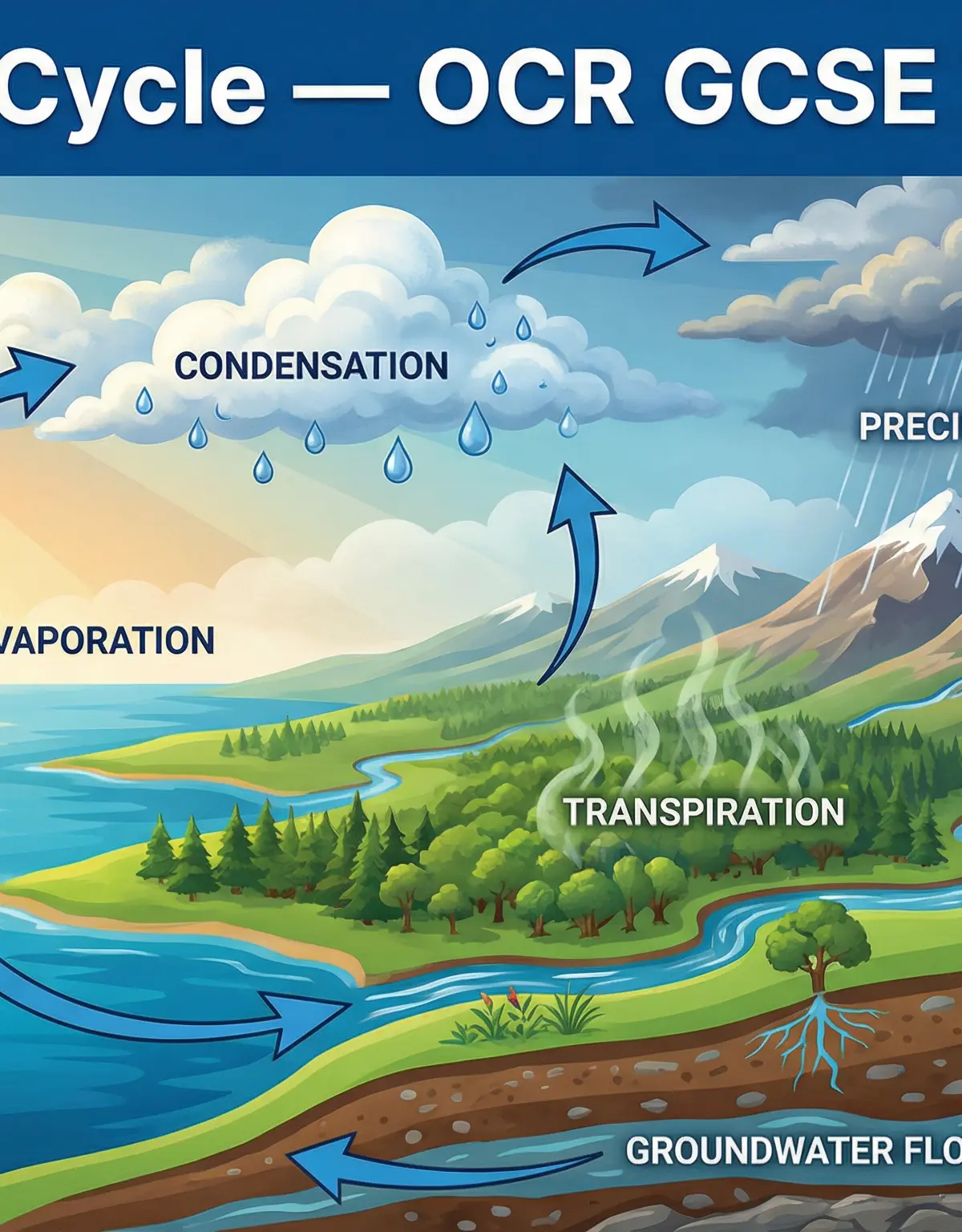
The water cycle is the continuous journey water takes as it circulates from the land and oceans to the atmosphere and back again. For your OCR GCSE Biology exam, it is crucial to understand this not just as a physical process, but as one deeply integrated with living organisms. This topic, 7.4, requires you to trace water's movement through both abiotic (non-living) and biotic (living) components of an ecosystem. Examiners will expect you to use precise terminology for state changes (evaporation, condensation) and biological processes (transpiration, respiration). Typical exam questions involve describing the cycle, explaining the impact of human activities like deforestation, and applying your knowledge to unfamiliar data. This guide will equip you with the detailed knowledge and exam technique needed to tackle any question with confidence.
Key Concepts
Concept 1: Evaporation & Condensation
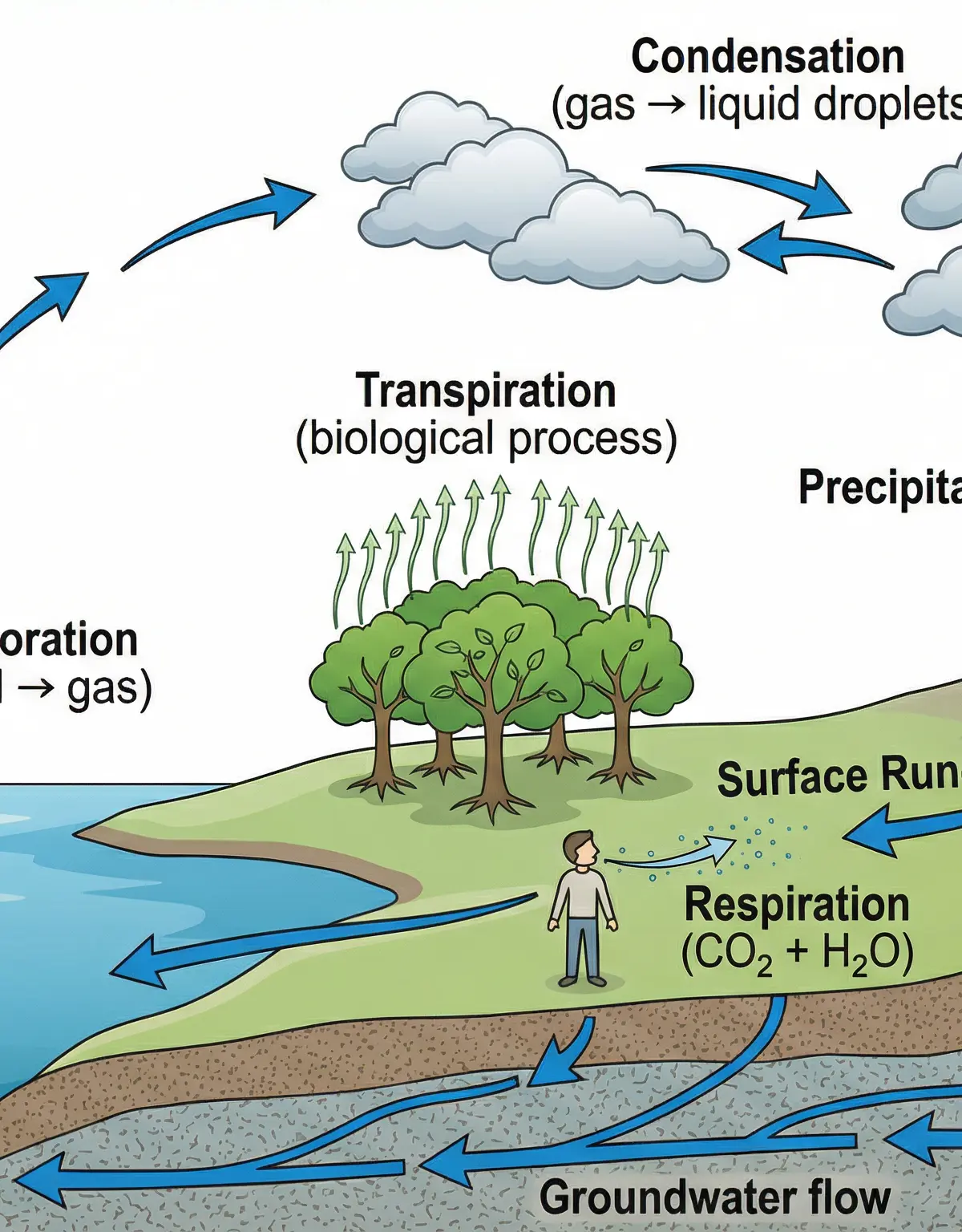
The engine of the water cycle is the Sun. Solar energy heats the surface of large bodies of water like oceans and lakes. This gives water molecules at the surface enough kinetic energy to overcome the forces holding them together and escape into the atmosphere as an invisible gas called water vapour. This is evaporation, a physical process involving a state change from liquid to gas. For full marks, you must state this change.
As the warm, moist air rises, it cools. The water vapour molecules lose energy, slow down, and convert back into tiny liquid water droplets. This is condensation, a state change from gas to liquid. These droplets gather to form clouds. A common mistake is to call clouds 'water vapour'; they are collections of liquid droplets.
Concept 2: Precipitation & Collection
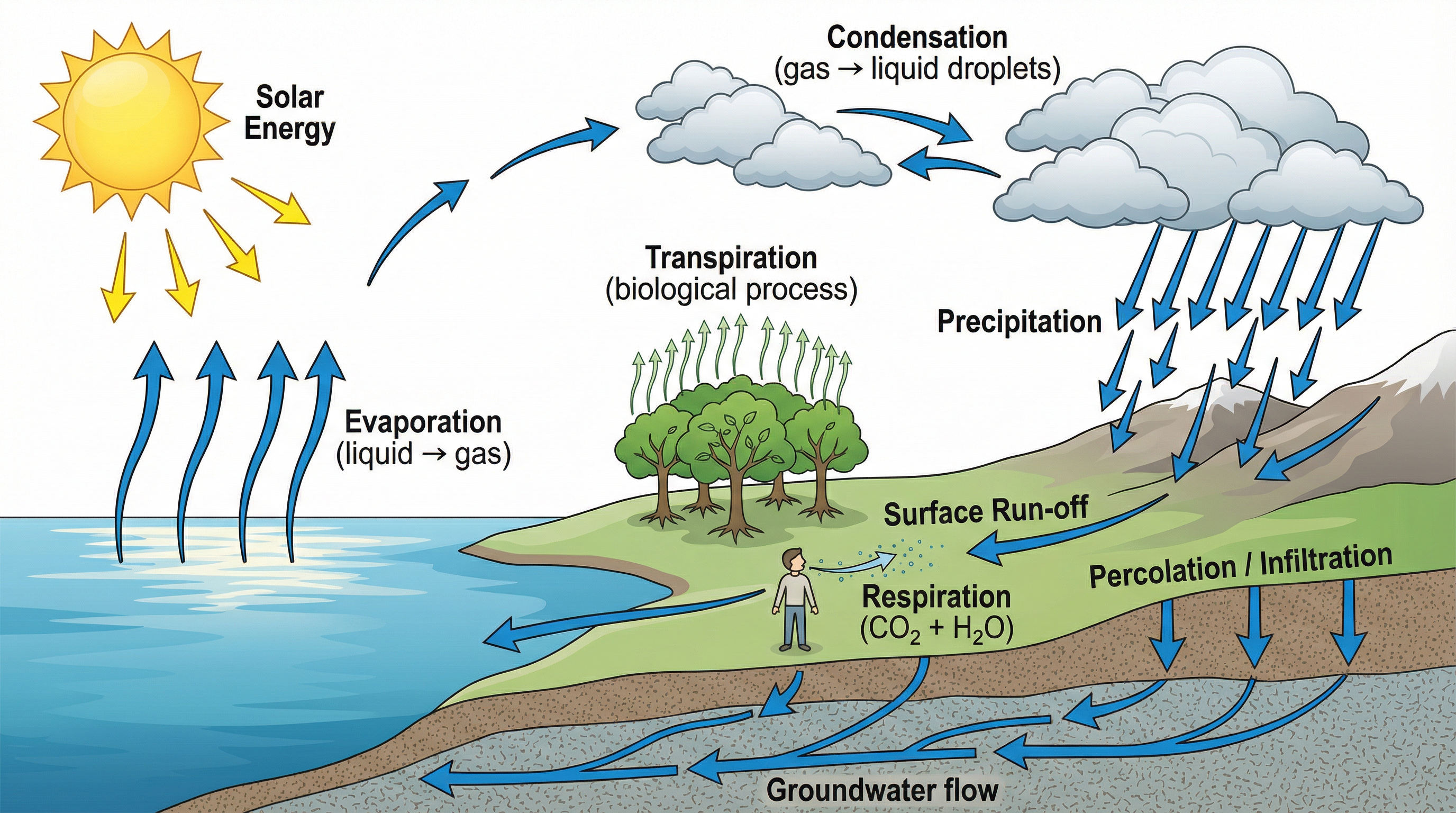
When water droplets in clouds coalesce and become too heavy to remain suspended in the air, they fall back to Earth as precipitation. This can be in the form of rain, snow, sleet, or hail. Once on the ground, water can follow several paths. It may flow over the land as surface run-off, collecting in rivers and streams that eventually lead back to the ocean. Alternatively, it can soak into the ground in a process called infiltration or percolation, where it becomes groundwater. This groundwater flows slowly through rock and soil, also eventually returning to the sea.
Concept 3: The Role of Living Organisms (Biotic Factors)
This is the core biology of the topic. Living things play a vital role in moving water.
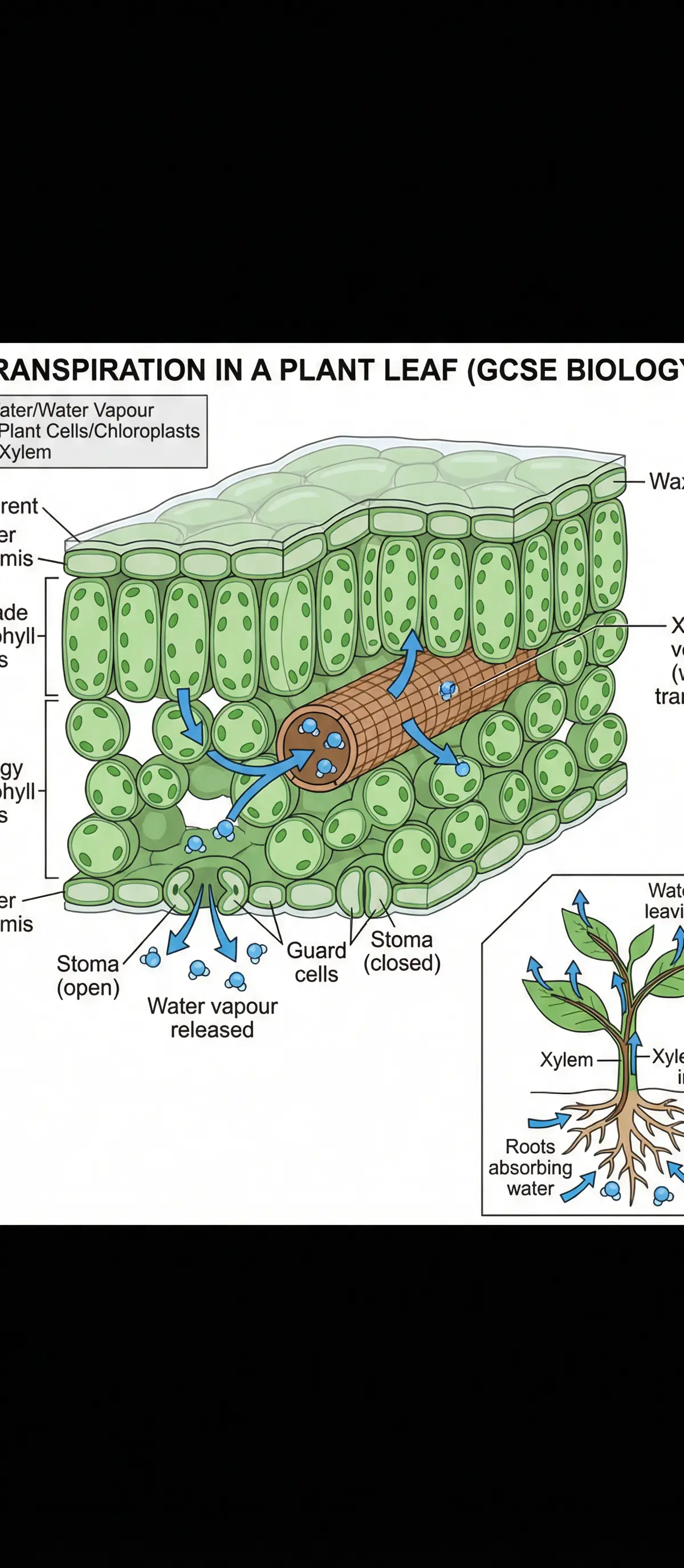
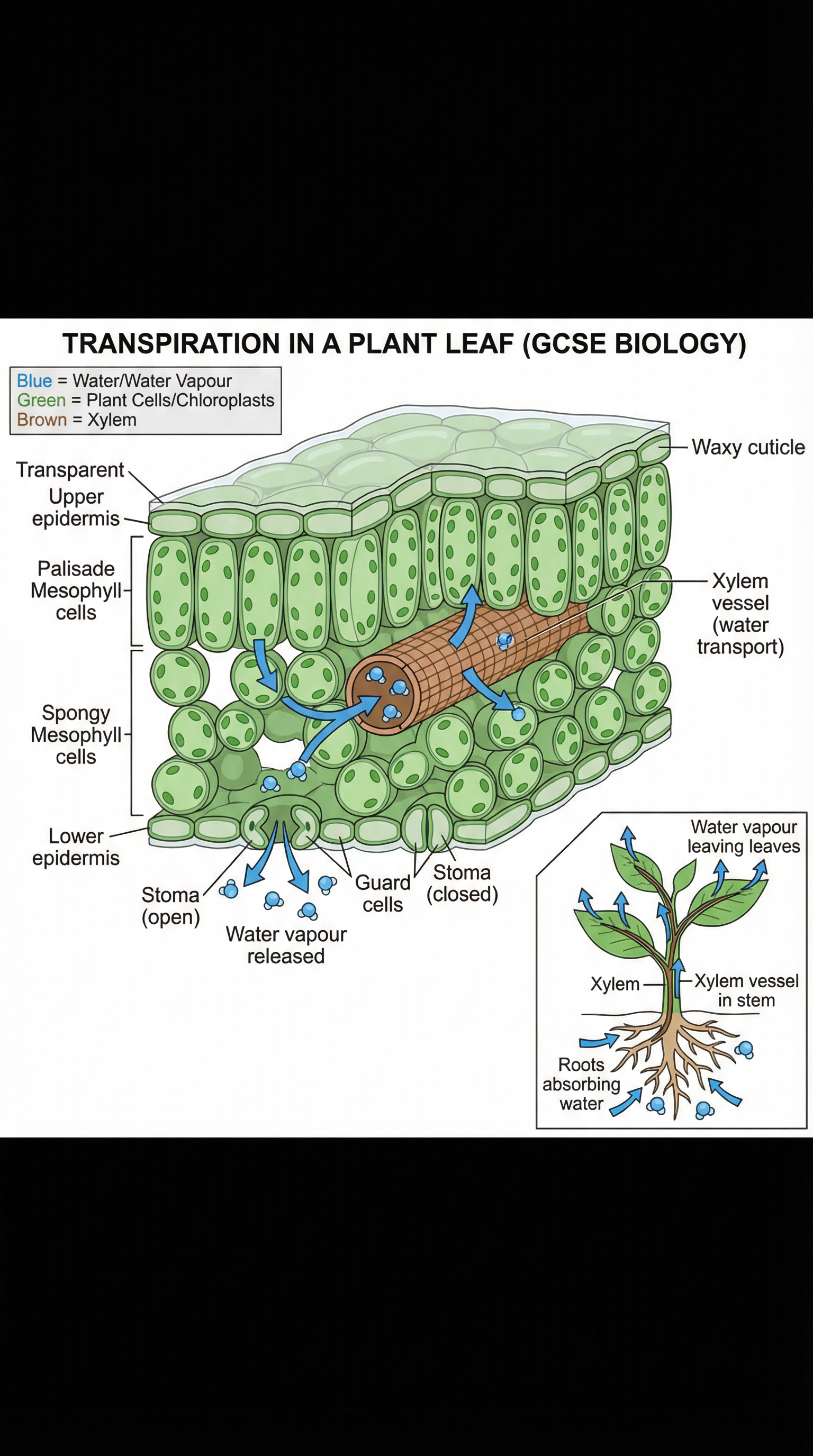
Transpiration: This is the most significant biological process in the water cycle. Plants absorb water from the soil through their roots. This water is transported up the stem in xylem vessels to the leaves. Some water is used for photosynthesis, but most of it evaporates from the surface of cells within the leaf and then diffuses out into the atmosphere through tiny pores called stomata. This process of water vapour loss from plants is called transpiration. It is a biological process, distinct from the physical process of evaporation.
Respiration: All living organisms, including plants and animals, respire to release energy from their food. The word equation for aerobic respiration is: Glucose + Oxygen → Carbon Dioxide + Water. This metabolic water is released into the environment. For example, when you breathe out on a cold day and see your breath, you are seeing condensed water vapour that was produced during respiration in your cells.
Mathematical/Scientific Relationships
There are no complex formulas to memorise for this topic. The key relationships are conceptual:
- Rate of Transpiration: This is affected by environmental factors. It increases with higher temperature, stronger wind, and lower humidity, as these factors all increase the rate of evaporation from the leaf surface.
- Water Availability: The amount of water available in an ecosystem is a balance between precipitation (input) and the combined loss from evaporation and transpiration (output), plus run-off.
Practical Applications
Understanding the water cycle is essential for managing water resources. For example, water companies build reservoirs to store fresh water collected from precipitation and run-off. Understanding transpiration rates helps farmers decide when and how much to irrigate their crops. The impact of deforestation on the water cycle is a major area of ecological research, linking directly to climate change and biodiversity loss.
Visual Resources
2 diagrams and illustrations
Interactive Diagrams
2 interactive diagrams to visualise key concepts
Conceptual Flow Outline
A flowchart showing the key processes of the water cycle and how they are interconnected. Note the three inputs into the atmosphere: Evaporation, Transpiration, and Respiration.
Conceptual Flow Outline
A concept map comparing the impact of a forested area versus a deforested area on the local water cycle and rainfall patterns.
Worked Examples
3 worked examples — open one to explore the question and available guidance.
Practice Questions
Test your understanding — click to reveal model answers
State the main source of energy for the water cycle. (1 mark)
Describe the difference between evaporation and transpiration. (3 marks)
Explain how water from the soil can become part of a cloud. (4 marks)
A student wrote: 'Clouds are made of water vapour that has risen from the sea.' Explain why this statement is incorrect. (2 marks)
Hint: Think about the state of matter of water vapour versus a cloud.
Suggest two reasons why a farmer might be concerned about a long period of dry, windy weather. (4 marks)