WJEC · A-Level · Biology
Inheritance
Master WJEC A-Level Inheritance (7.1) by decoding genetic diagrams, conquering the Chi-squared test, and tackling complex linkage and epistasis questions. This guide provides examiner insights and multi-modal resources to help you secure top marks."
- 5 min read
- 3 worked examples
- 5 practice questions
Study Notes
Overview
Inheritance is the cornerstone of genetics, exploring how traits are passed from one generation to the next. For WJEC A-Level Biology, this topic is not just about memorising definitions; it's about application. You will be expected to construct and interpret complex genetic diagrams, analyse data using statistical tests, and explain deviations from expected Mendelian ratios. This unit connects directly to fundamental concepts in cell biology (meiosis), evolution (natural selection), and gene technology. Exam questions are typically structured problems requiring you to work through a scenario, often worth a high number of marks. Mastering the methodical approach outlined in this guide is therefore essential for exam success.
Key Concepts
Concept 1: Monohybrid and Dihybrid Inheritance
Monohybrid inheritance involves the study of a single gene. The fundamental tool for predicting outcomes is the Punnett square, which requires a systematic layout that examiners look for. You must be ableto predict phenotypic and genotypic ratios from crosses involving dominant, recessive, and codominant alleles. Codominance is a situation where both alleles are expressed in the phenotype of a heterozygote, such as in human ABO blood groups or roan cattle.
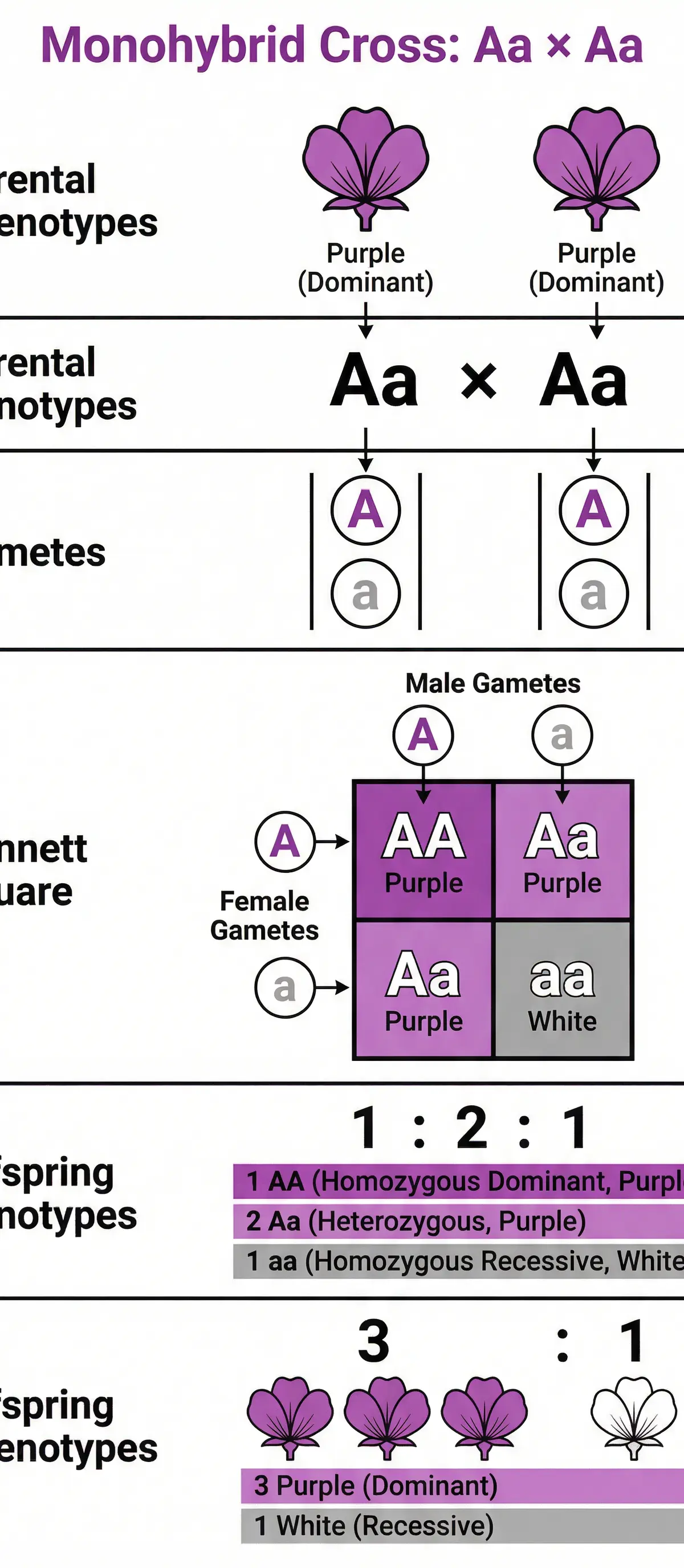
Dihybrid inheritance follows the inheritance of two different genes simultaneously. When these genes are on different chromosomes, they assort independently during meiosis. A cross between two parents heterozygous for both genes (e.g., AaBb x AaBb) produces the classic 9:3:3:1 phenotypic ratio. Recognising this ratio is a key skill, but more importantly, recognising when the ratio deviates from this is a trigger to consider linkage or epistasis.
Concept 2: Linkage (Autosomal and Sex-Linked)
Autosomal linkage occurs when two or more genes are located on the same autosome (non-sex chromosome). Because they are physically linked, they do not assort independently and are often inherited together. This drastically alters the expected 9:3:3:1 dihybrid ratio, resulting in a much higher proportion of offspring with the parental phenotypes and a much lower proportion of recombinant phenotypes. The frequency of recombination is a measure of the distance between the two linked genes.
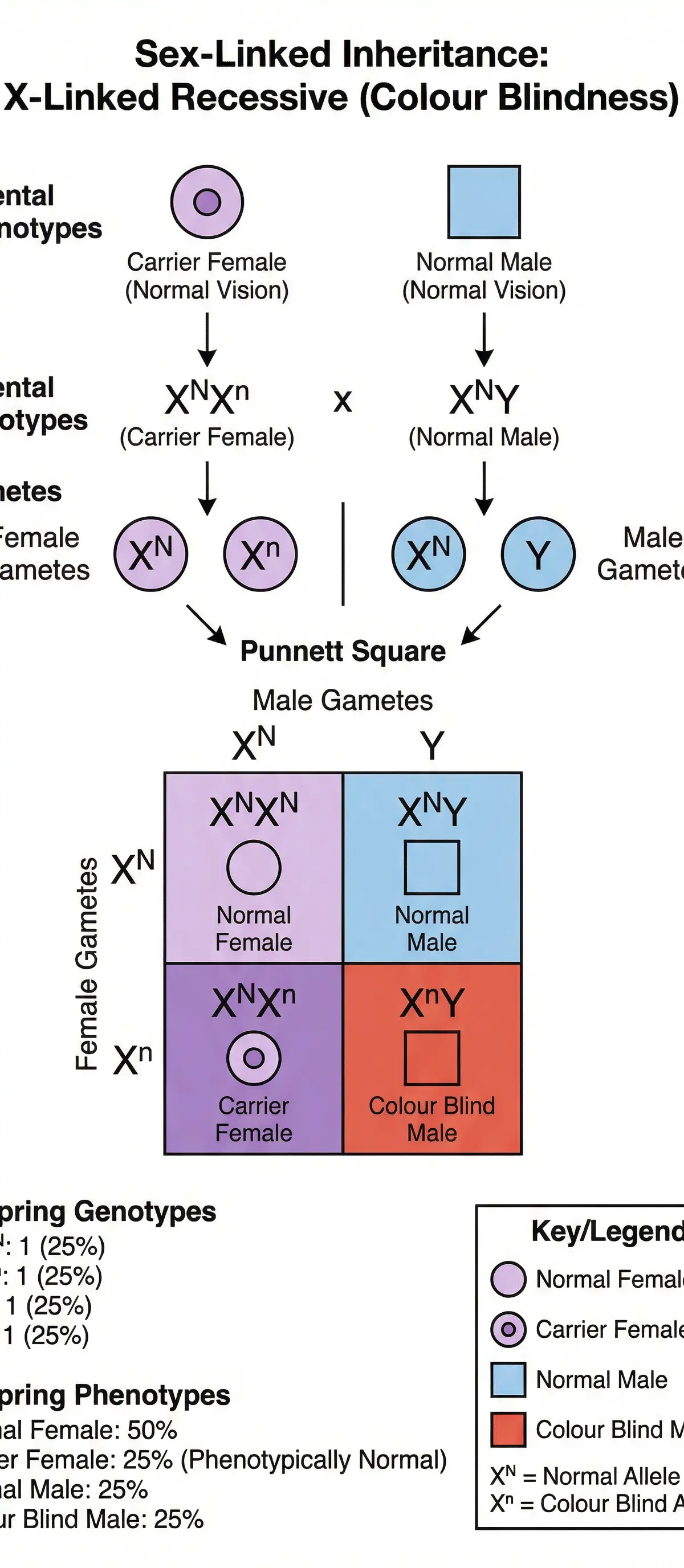
Sex linkage refers to genes located on the sex chromosomes (X or Y). Most are X-linked. Since males (XY) have only one X chromosome, they will express a recessive X-linked allele even if they only have one copy. This is why conditions like haemophilia and red-green colour blindness are far more common in males. For exam questions, it is critical to use the correct notation, showing the alleles as superscripts on the X and Y chromosomes (e.g., X^H, X^h, Y).
Concept 3: Epistasis
Epistasis is a form of gene interaction where one gene masks or suppresses the expression of another gene at a different locus. This is a common source of modified dihybrid ratios. You need to be familiar with two main types:
- Recessive Epistasis (9:3:4 ratio): The homozygous recessive genotype at one locus (e.g., ee) masks the expression of alleles at a second locus (e.g., B/b). A classic example is coat colour in Labrador retrievers.
- Dominant Epistasis (12:3:1 ratio): A dominant allele at one locus (e.g., A) masks the expression of alleles at a second locus (e.g., B/b). An example is fruit colour in summer squash.
Concept 4: The Chi-Squared (X²) Test
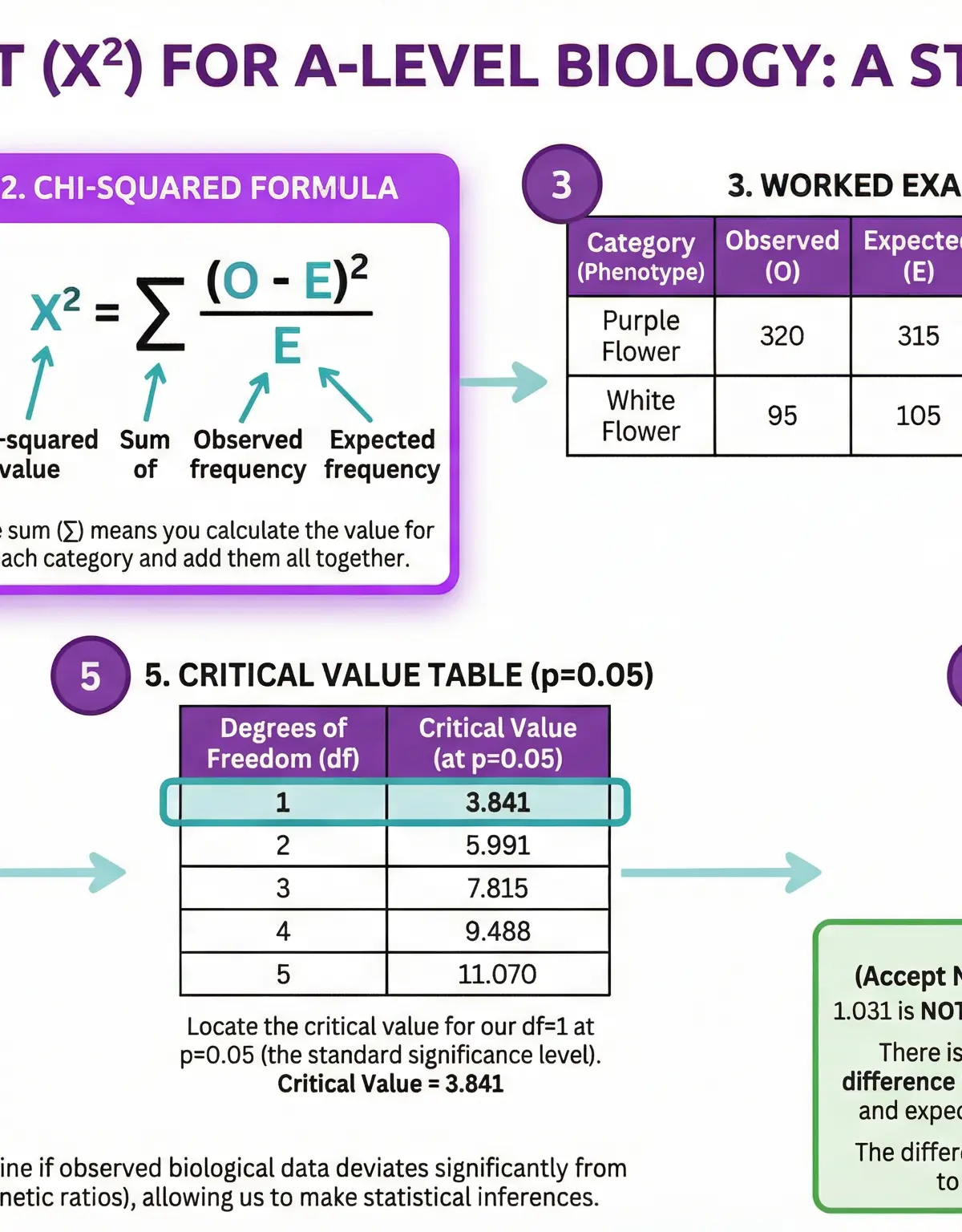
The Chi-squared test is a statistical tool used to determine if the difference between observed and expected results in an investigation is statistically significant or simply due to chance. In genetics, it is used to test the 'goodness of fit' between your observed phenotypic ratios and the expected Mendelian ratios. A non-significant result supports your genetic hypothesis (e.g., that the genes assort independently), while a significant result suggests your hypothesis is incorrect and other factors (like linkage or epistasis) are at play.
Mathematical/Scientific Relationships
**1. The Chi-Squared Formula (Must memorise)**O - E
X² = Σ (-------)²
E
- X²: The Chi-squared value.
- Σ: The sum of.
- O: Observed frequency for a category.
- E: Expected frequency for a category.
2. Degrees of Freedom (df)
df = n - 1
- n: The number of phenotype categories.
Practical Applications
This topic is fundamental to modern medicine and agriculture. It is used for:
- Genetic Counselling: Assessing the risk of couples passing on inherited disorders like cystic fibrosis or Huntington's disease.
- Selective Breeding: Improving crop yields and livestock by selecting for desirable traits based on an understanding of their inheritance patterns.
- Conservation: Managing the genetic diversity of endangered species in captive breeding programmes to avoid inbreeding depression."
Worked Examples
3 worked examples — open one to explore the question and available guidance.
Practice Questions
Test your understanding — click to reveal model answers
In fruit flies, the gene for body colour has two alleles: grey body (G) is dominant to black body (g). The gene for wing length has two alleles: long wings (L) is dominant to short wings (l). A student crossed a fly heterozygous for both genes with a fly with a black body and short wings. The results were:
- Grey body, long wings: 965
- Black body, short wings: 944
- Grey body, short wings: 206
- Black body, long wings: 185
What do these results suggest about the location of these two genes? (3 marks)
Hint: First, determine the expected ratio if the genes were on different chromosomes. Then compare this to the observed results.
Explain why a man with an X-linked recessive condition cannot pass it on to his sons. (2 marks)
Hint: Consider which sex chromosome a father passes to his son.
In a population, the frequency of the allele for cystic fibrosis (a recessive condition) is 1 in 50. Use the Hardy-Weinberg equation to calculate the percentage of the population who are carriers. (4 marks)
Hint: The Hardy-Weinberg equations are p + q = 1 and p² + 2pq + q² = 1. Carriers are represented by 2pq.
State what is meant by codominant alleles. (1 mark)
Hint: Think about what happens in the heterozygote.
A genetic cross produced 76 purple-flowered plants and 24 white-flowered plants. The expected ratio was 3:1. Calculate the Chi-squared value for this cross. (3 marks)
Hint: First, calculate the total number of plants to work out your expected values.