Eduqas · GCSE · Biology
Coordination and control
Master the fascinating ways your body and plants respond to their environment. This crucial GCSE Biology topic covers everything from the lightning-fast reflex arcs to the slower, long-lasting effects of hormones like insulin and adrenaline.
- 7 min read
- 3 worked examples
- 5 practice questions
- 6 key terms
Study Notes
Overview
Welcome to Coordination and Control, one of the most fundamental topics in GCSE Biology. This section explores how organisms detect changes in their environment and respond to them in order to survive. You will delve into the rapid-response network of the human nervous system, including the structure of the eye and reflex arcs, and contrast it with the slower, chemical-based hormonal system.
Understanding homeostasis—the maintenance of a constant internal environment—is crucial here. Examiners frequently test your ability to explain negative feedback loops, particularly concerning blood glucose regulation, water balance (osmoregulation), and temperature control. You will also need to understand how plant hormones like auxin control growth responses (tropisms).
This topic links heavily with cell biology (receptors are cells), bioenergetics (respiration requires glucose and oxygen), and inheritance (hormones in reproduction). Exam questions often require you to apply your knowledge to unfamiliar contexts or interpret data from graphs, so a solid grasp of the underlying principles is essential.
Listen to our comprehensive revision podcast to solidify your understanding:
Key Concepts
Concept 1: The Nervous System and Reflex Arcs
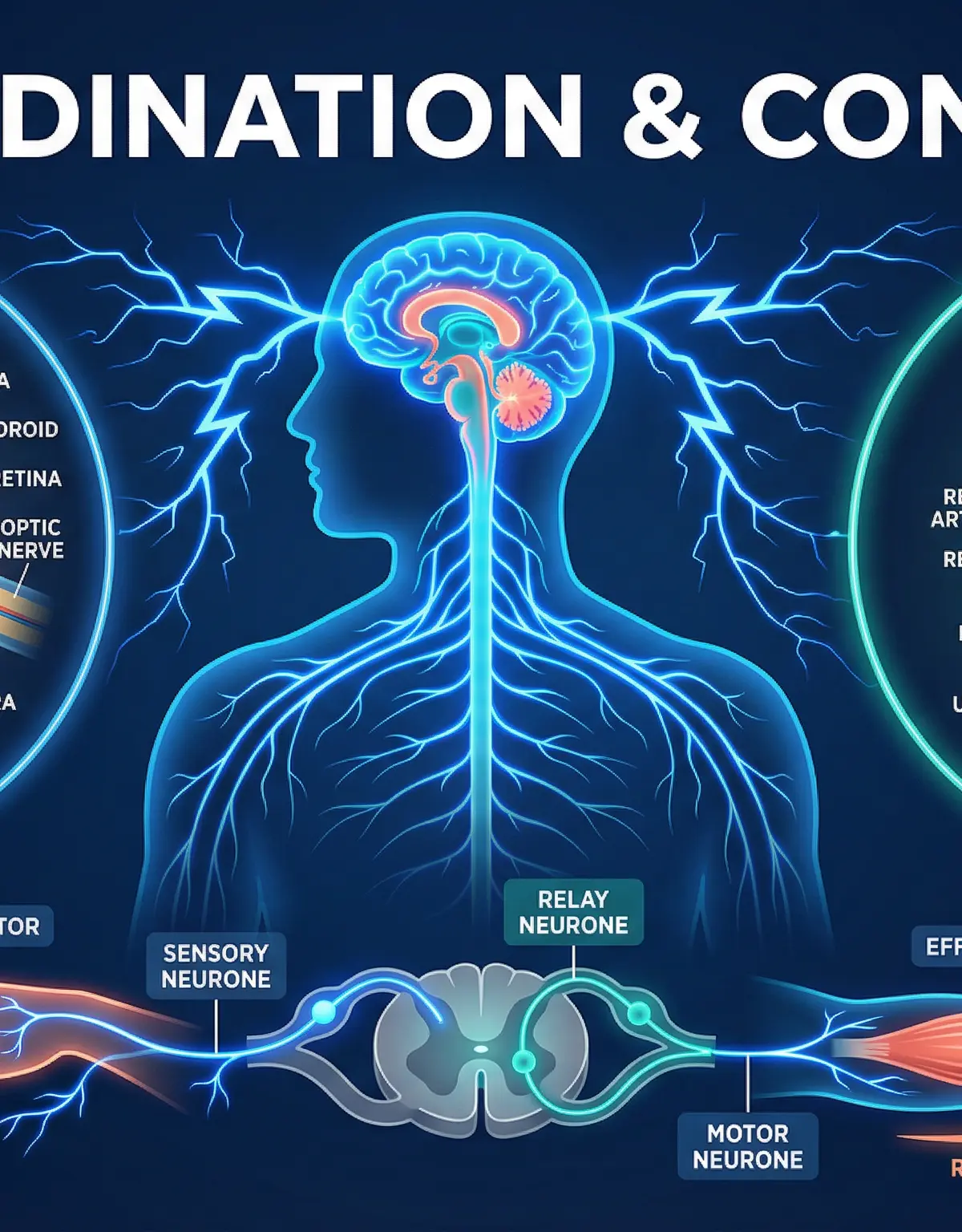
The human nervous system enables us to react to our surroundings and coordinate our behaviour. It consists of the Central Nervous System (CNS)—the brain and spinal cord—and a network of nerves. Information is sent as electrical impulses along cells called neurones.
A reflex action is an automatic and rapid response to a stimulus, which minimises any damage to the body from potentially harmful conditions, such as touching something hot. Reflex actions do not involve the conscious part of the brain. The pathway of an electrical impulse in a reflex action is called a reflex arc.
The sequence is always: Stimulus \rightarrow Receptor \rightarrow Sensory Neurone \rightarrow Relay Neurone \rightarrow Motor Neurone \rightarrow Effector \rightarrow Response.
Between each neurone is a small gap called a synapse. Electrical impulses cannot jump this gap. Instead, the electrical signal triggers the release of chemical neurotransmitters, which diffuse across the synapse and bind to receptors on the next neurone, setting off a new electrical impulse. This ensures signals only travel in one direction.
Concept 2: The Eye
The eye is a highly specialised sense organ containing receptors sensitive to light intensity and colour. You must be able to identify and explain the functions of its main structures:
- Cornea: Transparent front part that refracts (bends) light.
- Iris: Controls the diameter of the pupil and how much light enters.
- Lens: Focuses the light onto the retina.
- Retina: Contains the light receptor cells.
- Optic Nerve: Carries impulses from the retina to the brain.
The process of changing the shape of the lens to focus on near or distant objects is called accommodation. To focus on a near object, the ciliary muscles contract, the suspensory ligaments loosen, and the lens becomes thicker and refracts light rays strongly. To focus on a distant object, the ciliary muscles relax, the suspensory ligaments are pulled tight, and the lens is pulled thin and only slightly refracts light rays.
Concept 3: The Endocrine System and Homeostasis
The endocrine system is composed of glands which secrete chemicals called hormones directly into the bloodstream. The blood carries the hormone to a target organ where it produces an effect. Compared to the nervous system, the effects are slower but act for longer.
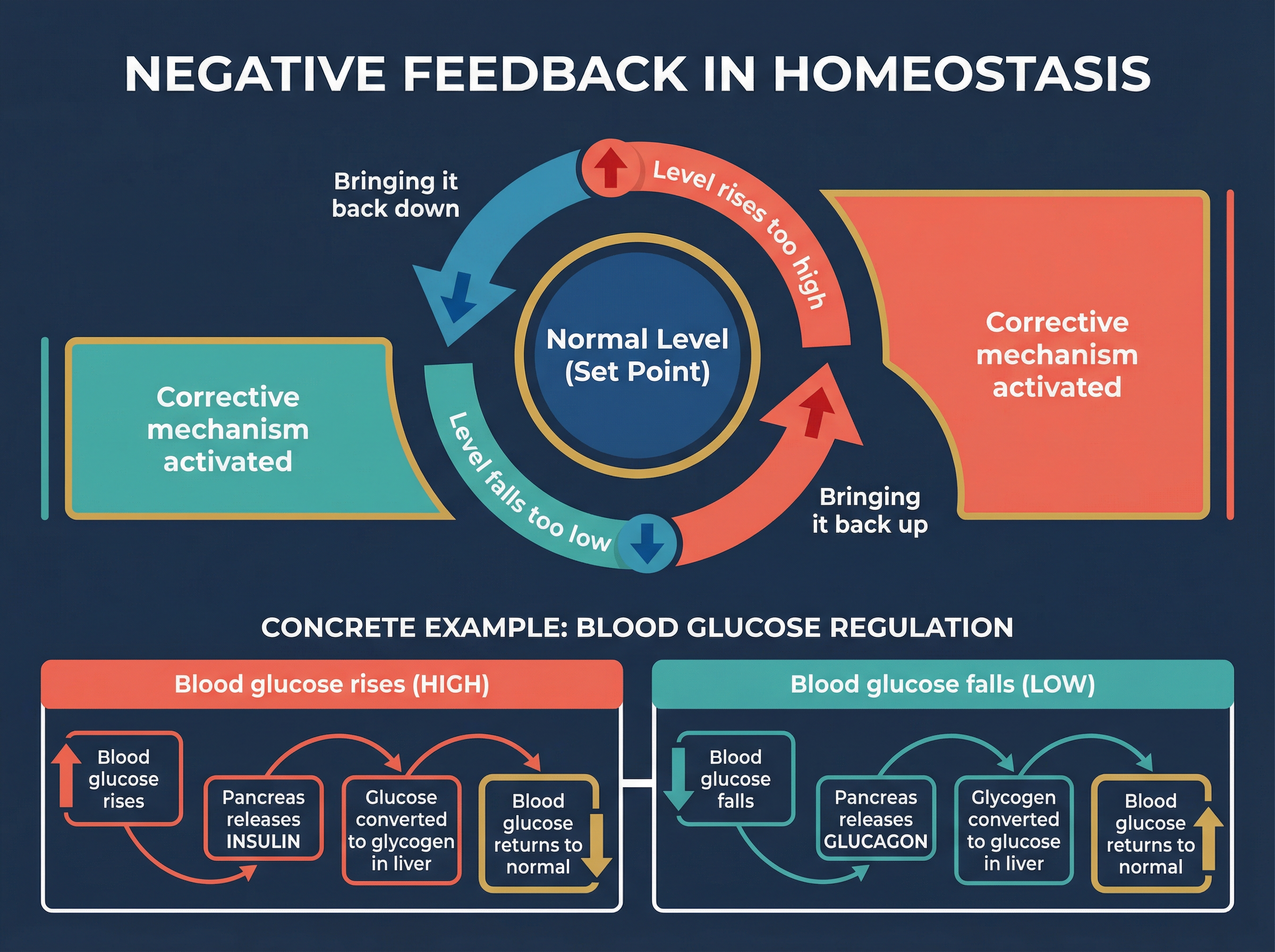
Homeostasis is the regulation of the internal conditions of a cell or organism to maintain optimum conditions for function in response to internal and external changes. It relies on negative feedback: if a factor (like blood glucose) rises or falls, a receptor detects the change, and an effector produces a response to restore the optimum level.
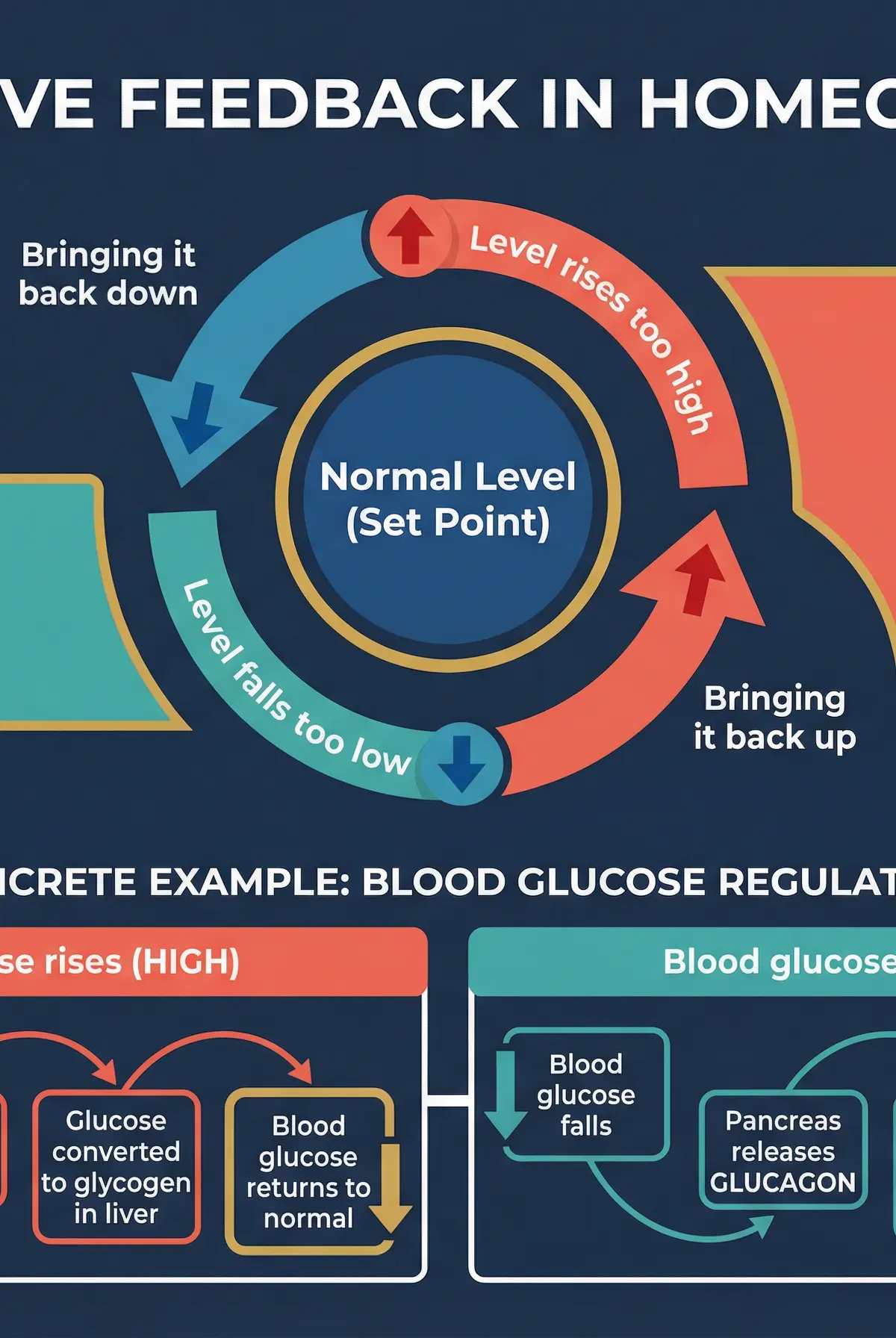
Blood Glucose Regulation: Controlled by the pancreas. If blood glucose is too high, the pancreas releases insulin, causing glucose to move from the blood into cells. In liver and muscle cells, excess glucose is converted to glycogen for storage. If blood glucose is too low, the pancreas releases glucagon, causing glycogen to be converted into glucose and released into the blood.
Diabetes: Type 1 diabetes is a disorder in which the pancreas fails to produce sufficient insulin. It is characterised by uncontrolled high blood glucose levels and is normally treated with insulin injections. Type 2 diabetes is a disorder where the body cells no longer respond to insulin produced by the pancreas. A carbohydrate-controlled diet and an exercise regime are common treatments. Obesity is a risk factor for Type 2 diabetes.
Concept 4: Plant Hormones
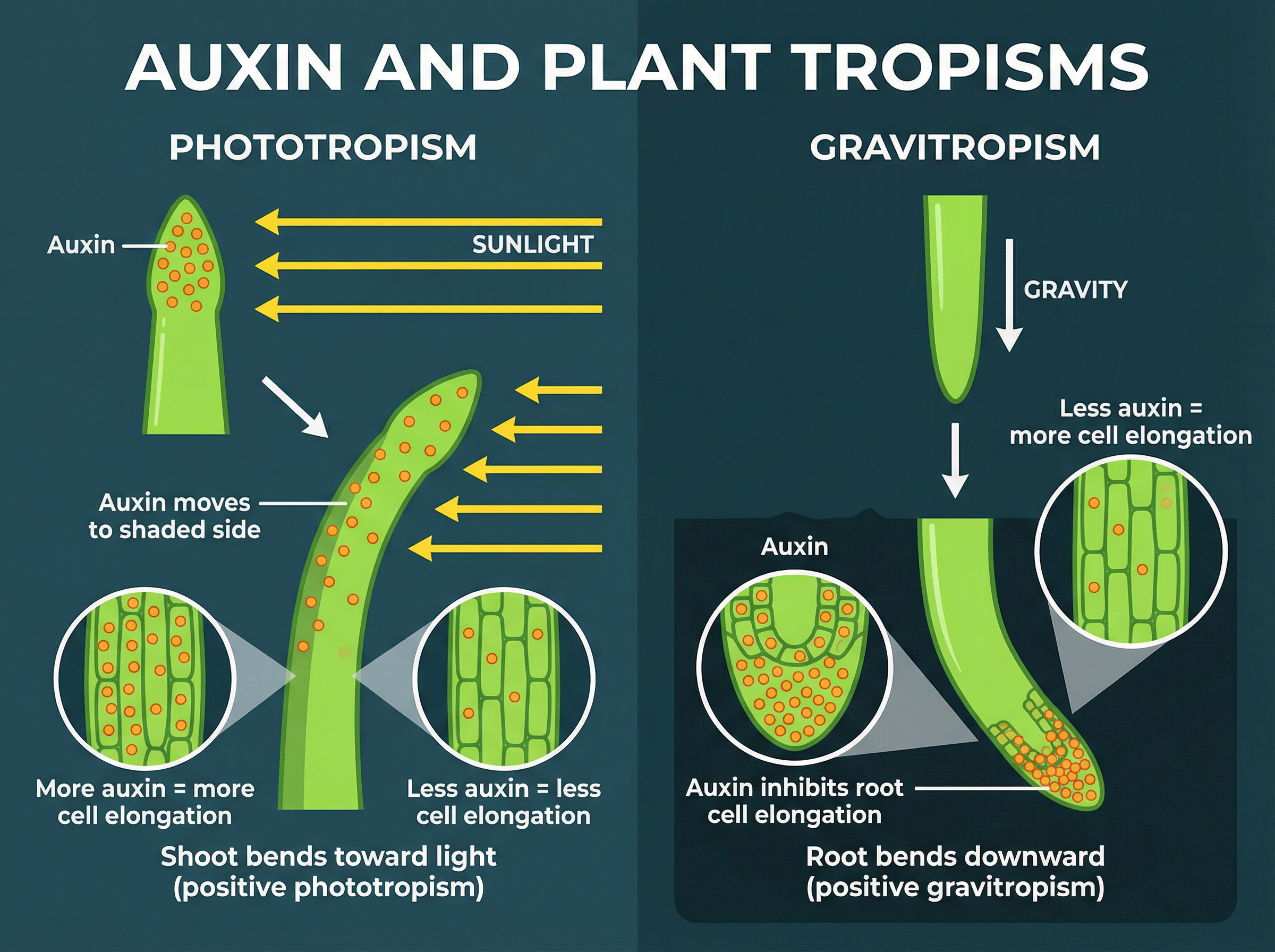
Plants also produce hormones to coordinate and control growth and responses to light (phototropism) and gravity (gravitropism or geotropism). Unequal distributions of auxin cause unequal growth rates in plant roots and shoots.
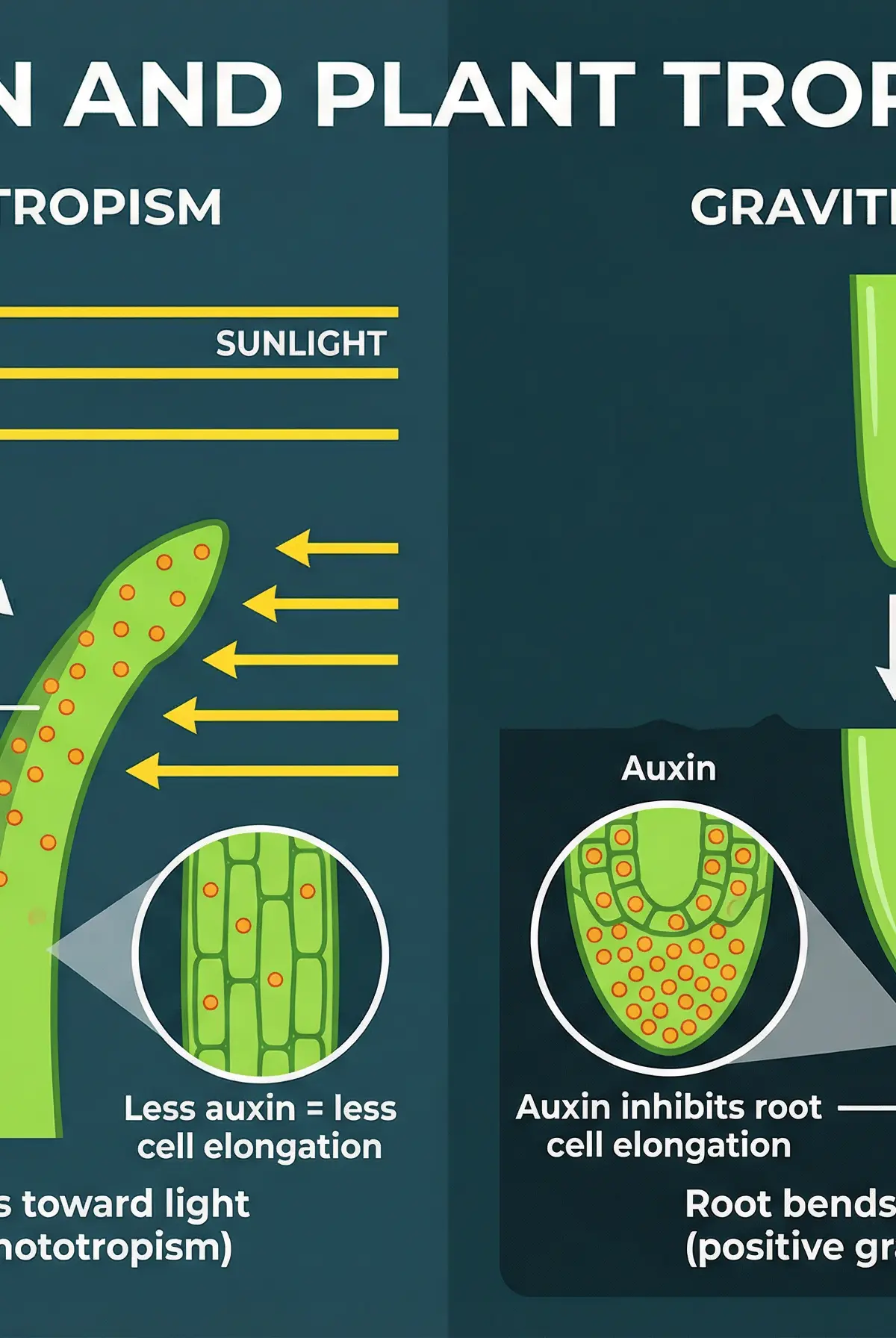
In a shoot, auxin accumulates on the shaded side. Auxin promotes cell elongation in shoots, so the shaded side grows faster, causing the shoot to bend towards the light (positive phototropism). In a root, auxin accumulates on the lower side due to gravity. However, in roots, auxin inhibits cell elongation, so the upper side grows faster, causing the root to bend downwards (positive gravitropism).
Mathematical/Scientific Relationships
While this topic is less calculation-heavy than physics, you may need to calculate the speed of a nerve impulse or reaction time from practical data.
Speed = Distance \div Time
- Distance must be in metres (m)
- Time must be in seconds (s)
- Speed will be in metres per second (m/s)
You may also need to calculate means, medians, and modes from reaction time practical data, and identify anomalous results.
Practical Applications
Required Practical: Reaction Time
Objective: Plan and carry out an investigation into the effect of a factor on human reaction time.
Method: The ruler drop test. Person A holds a ruler just above Person B's open hand. Person A drops the ruler without warning, and Person B catches it as quickly as possible. The distance on the ruler where it was caught is recorded and converted to a reaction time. The independent variable could be the effect of practice, or the effect of a mild stimulant like caffeine (e.g., cola).
Examiner Tip: Always mention that the person dropping the ruler should drop it without warning, and the person catching it should rest their arm on a desk to stop them moving their arm up to catch it. Ensure you discuss control variables (e.g., same hand used, same background noise).
Visual Resources
2 diagrams and illustrations
Interactive Diagrams
2 interactive diagrams to visualise key concepts
Conceptual Flow Outline
The sequence of components in a reflex arc.
Conceptual Flow Outline
Negative feedback loop for high blood glucose.
Worked Examples
3 worked examples — open one to explore the question and available guidance.
Practice Questions
Test your understanding — click to reveal model answers
Compare the nervous system and the endocrine system. (4 marks)
Hint: Think about the type of signal, how it travels, the speed of the response, and how long the response lasts.
Explain how a synapse ensures that nerve impulses only travel in one direction. (3 marks)
Hint: Think about where the neurotransmitters are released from and where they bind.
A student touches a hot pan and immediately pulls their hand away. Name the effector in this reflex action and state its response. (2 marks)
Hint: What part of the body actually does the moving?
Explain the role of ADH in regulating water balance in the body. (4 marks)
Hint: Where is ADH released from? What is its target organ? What exactly does it do there?
Describe the changes that occur in the eye when focusing on a near object. (3 marks)
Hint: Think about the ciliary muscles, suspensory ligaments, and the shape of the lens.