Eduqas · GCSE · Biology
Growth and development of cells
Master the fundamentals of cell growth and development, from the precision of mitosis for growth and repair to the genetic variation introduced by meiosis. This essential GCSE Biology topic also covers the incredible potential of stem cells and the dangerous consequences of uncontrolled cell division in cancer.
- 5 min read
- 3 worked examples
- 5 practice questions
- 6 key terms
Study Notes
Overview
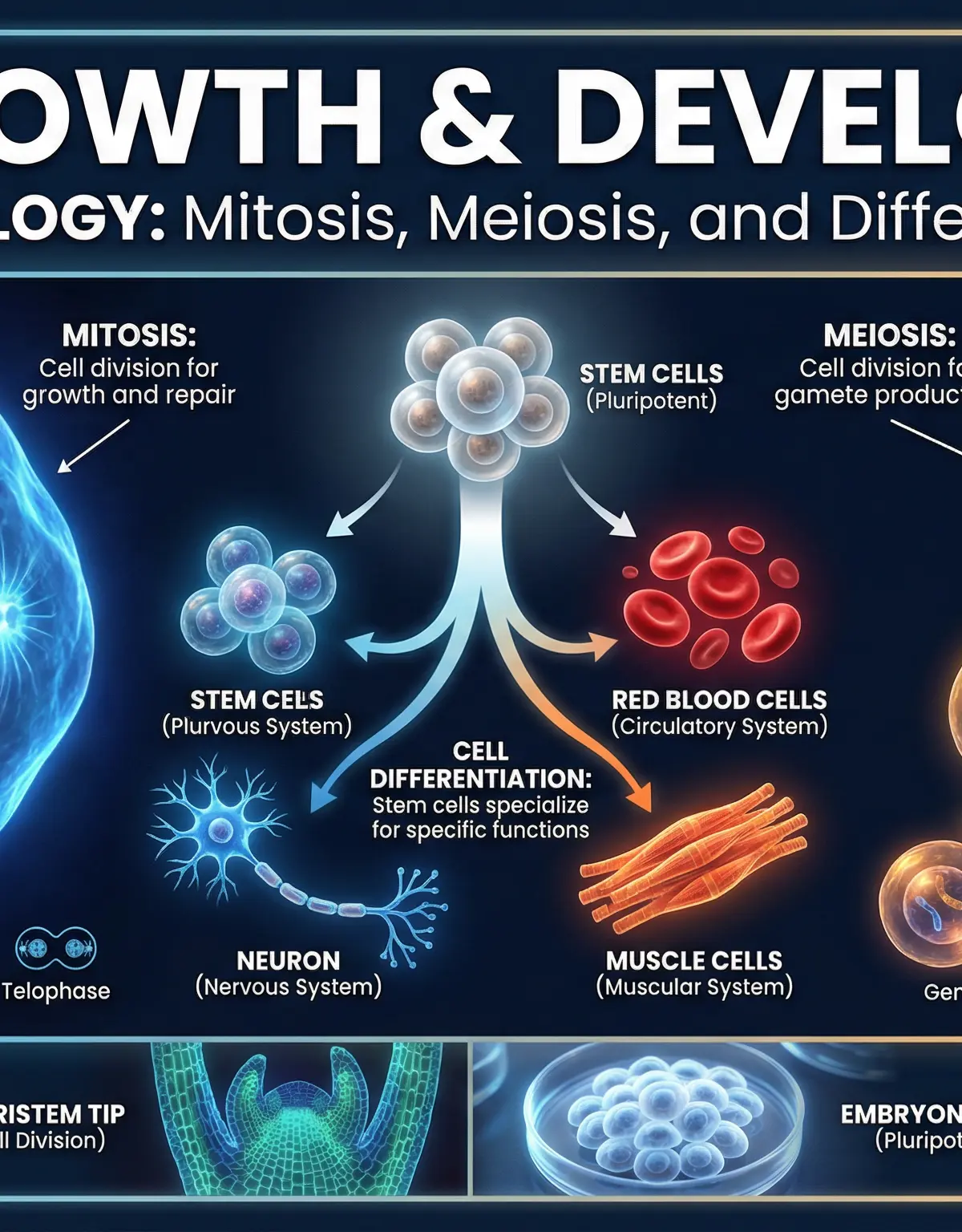
Welcome to Topic 1.2: Cell Growth and Development. This is a foundational topic in GCSE Biology that explains how you grew from a single fertilised egg into a complex organism made of trillions of specialised cells. It covers the mechanisms of cell division—mitosis and meiosis—and how undifferentiated stem cells become the specialised cells that make up your tissues and organs.
Understanding this topic is critical because it connects directly to genetics, reproduction, and human health. Examiners frequently test your ability to compare mitosis and meiosis, explain how a cell's structure relates to its function, and evaluate the ethical implications of stem cell research. Questions often range from simple recall to extended 6-mark evaluations.
Listen to the companion podcast for a comprehensive review of this topic:
Key Concepts
Concept 1: Mitosis and the Cell Cycle
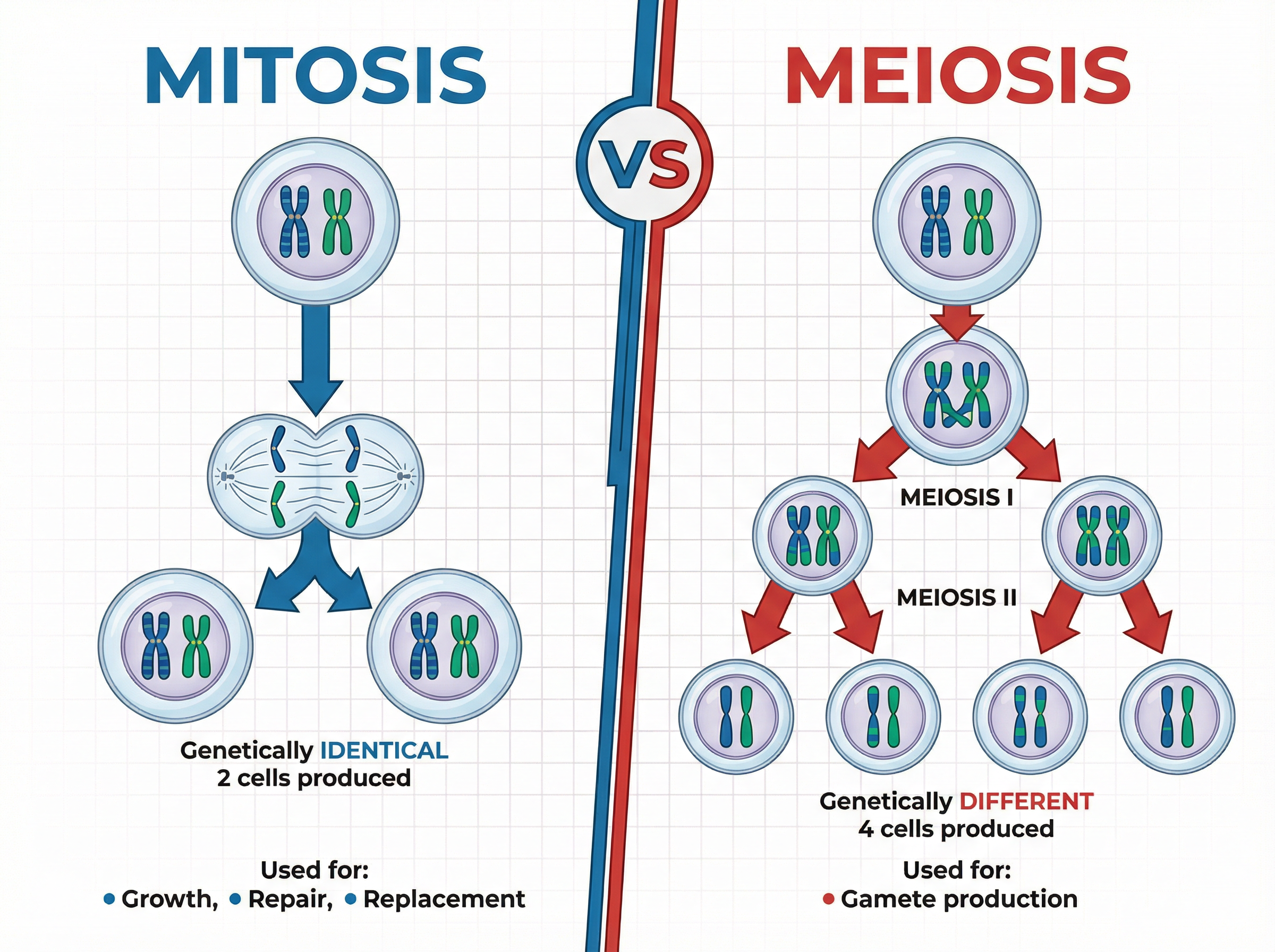
Mitosis is the process of cell division that results in two genetically identical daughter cells. It is essential for growth, repair of damaged tissues, and replacement of worn-out cells.
Before a cell can divide, it must undergo the cell cycle. First, the cell grows and increases the number of sub-cellular structures such as ribosomes and mitochondria. Crucially, the DNA replicates to form two copies of each chromosome. During mitosis, one set of chromosomes is pulled to each end of the cell, and the nucleus divides. Finally, the cytoplasm and cell membranes divide to form two identical cells.
Example: If a human skin cell with 46 chromosomes undergoes mitosis, it produces two new skin cells, each containing exactly 46 chromosomes.
Concept 2: Meiosis and Gamete Production
Unlike mitosis, meiosis is a type of cell division used exclusively to produce gametes (sperm and egg cells in animals, pollen and egg cells in plants). Meiosis occurs in the reproductive organs.
Meiosis involves two rounds of division and produces four daughter cells. These cells are genetically different from each other due to the reshuffling of genetic material. Furthermore, they are haploid, meaning they contain half the number of chromosomes of the parent cell (23 in humans). This ensures that when fertilisation occurs, the normal diploid number of chromosomes (46) is restored.
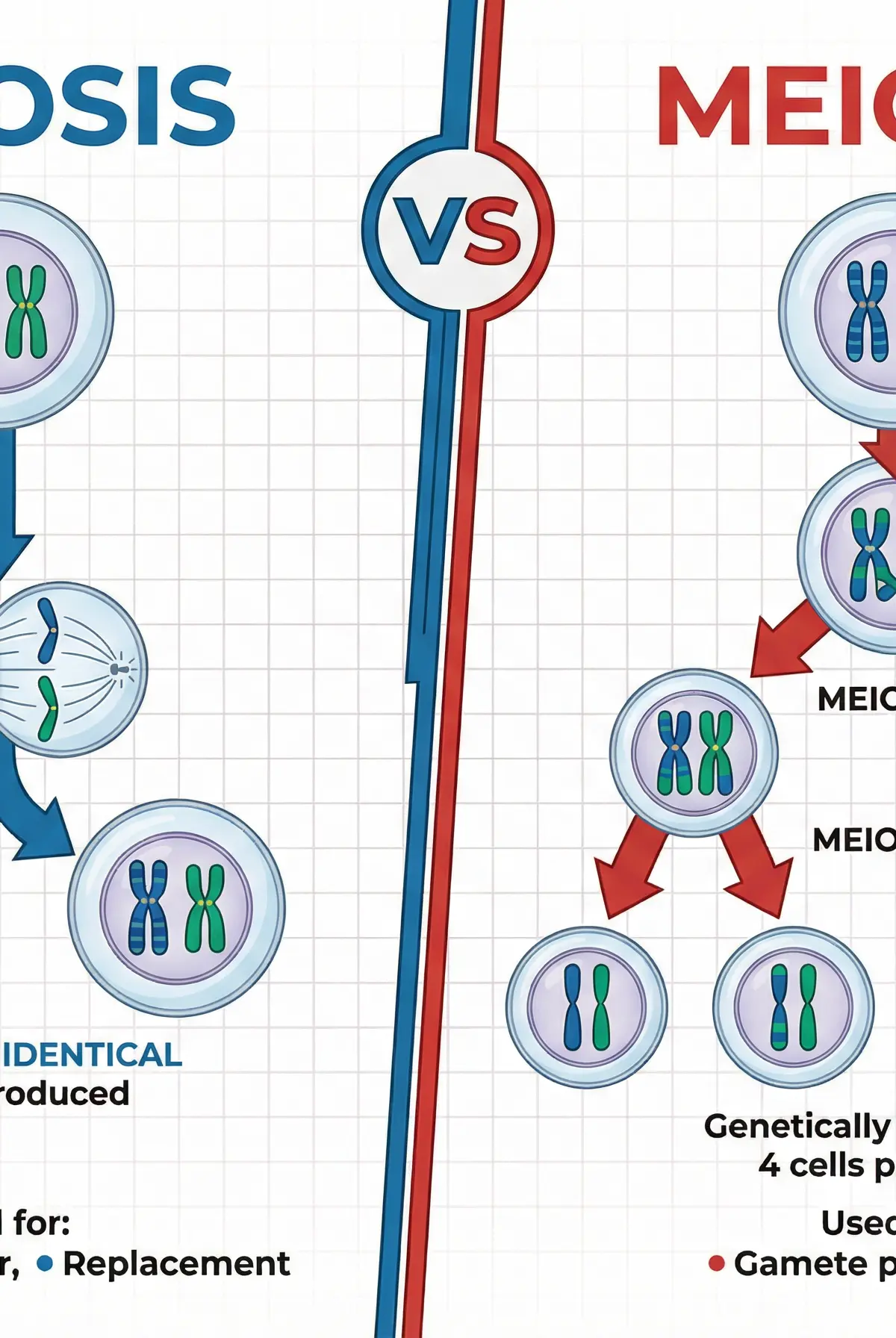
Concept 3: Cell Differentiation and Specialisation
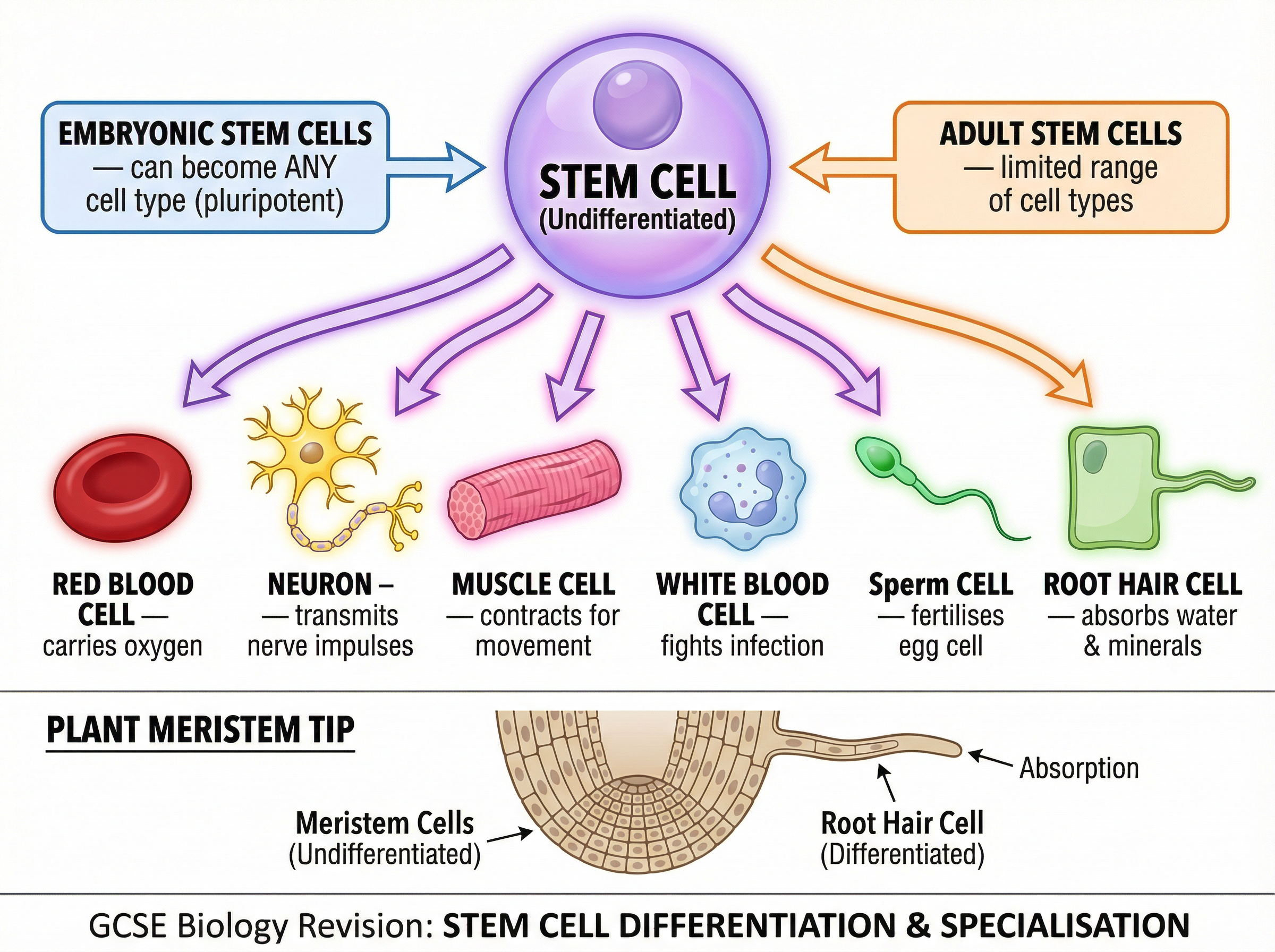
As an organism develops, cells differentiate to form different types of cells. Differentiation is the process by which a cell changes to become specialised for its job. Having specialised cells allows an organism to function more efficiently.
For example, a sperm cell has a tail for swimming and is packed with mitochondria to provide energy. A nerve cell (neuron) has a long axon to carry electrical impulses over long distances. In mature animals, cell division is mainly restricted to repair and replacement, but many plant cells retain the ability to differentiate throughout life.
Concept 4: Stem Cells
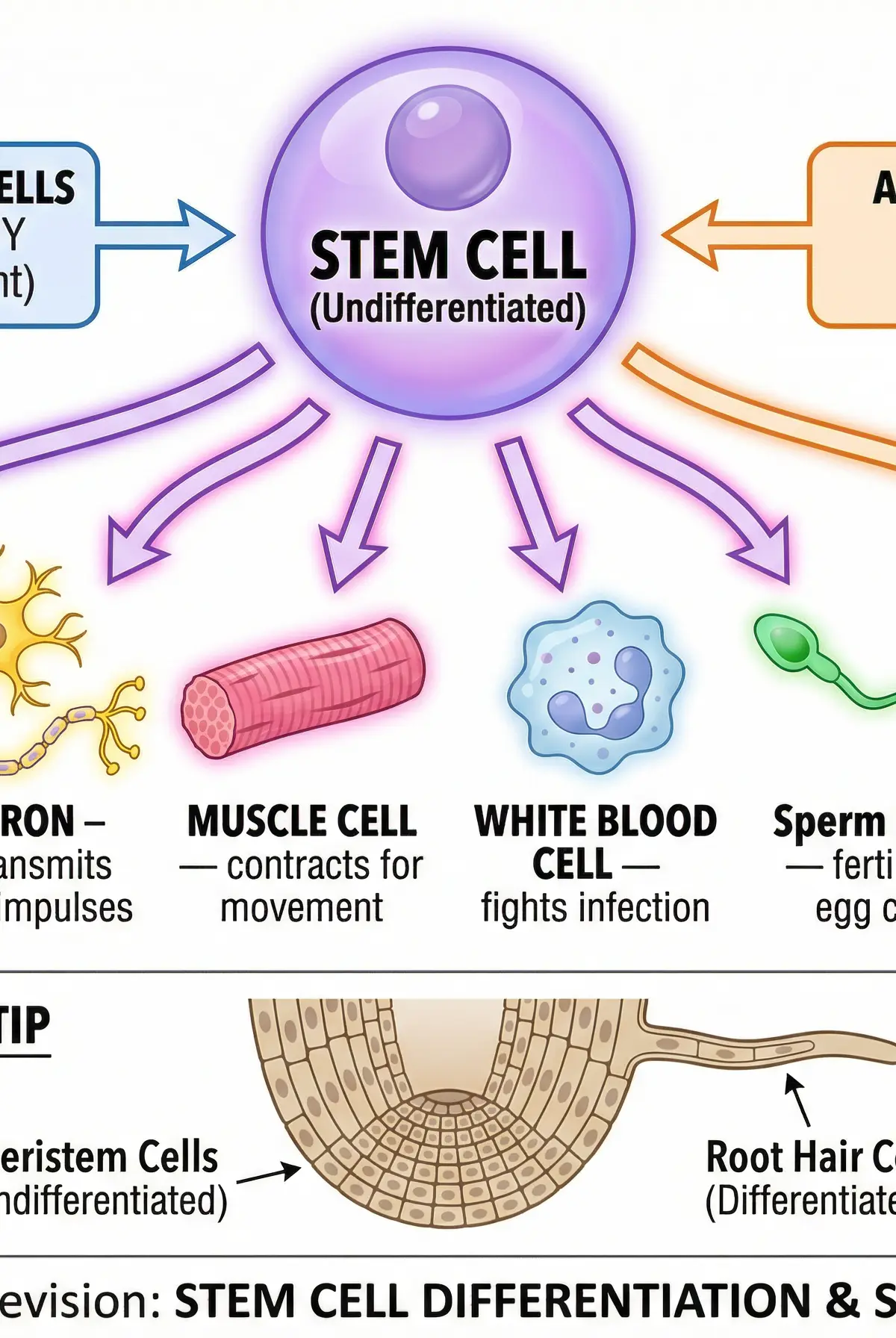
Stem cells are undifferentiated cells that can divide to produce many more undifferentiated cells, or differentiate into various specialised cell types.
- Embryonic stem cells are found in early human embryos and are pluripotent—they can differentiate into almost any type of human cell. This makes them highly valuable for medical research and potential treatments for conditions like diabetes and paralysis.
- Adult stem cells are found in specific tissues, such as bone marrow. They are more limited and can only differentiate into certain types of cells, such as blood cells.
- Plant meristems contain stem cells that can differentiate into any type of plant cell throughout the life of the plant, allowing for continuous growth and the cloning of plants.
Concept 5: Cancer
Cancer is a non-communicable disease caused by changes in cells that lead to uncontrolled growth and division. This uncontrolled division results in the formation of a tumour (a mass of cells). Not all tumours are cancerous; benign tumours stay in one place, whereas malignant tumours invade neighbouring tissues and can spread to different parts of the body in the blood, forming secondary tumours.
Mathematical/Scientific Relationships
- Length of time in a cell cycle stage = \frac{\text{observed number of cells in stage}}{\text{total number of cells observed}} \times \text{total length of cell cycle}
- Examiners may ask you to calculate the number of cells produced after a certain number of divisions. Remember that the number of cells doubles with each mitotic division: 2^n, where n is the number of divisions.
Practical Applications
- Stem Cell Therapy: Using embryonic stem cells to grow new tissues for transplant, such as new insulin-producing cells for people with Type 1 diabetes.
- Plant Cloning: Using meristem tissue to quickly and cheaply produce clones of plants with desirable features, such as disease resistance.
- Cancer Screening: Identifying abnormal, rapidly dividing cells in tissue samples.
Visual Resources
2 diagrams and illustrations
Interactive Diagrams
2 interactive diagrams to visualise key concepts
Conceptual Flow Outline
Flowchart showing the outcome of Mitosis in a human cell.
Conceptual Flow Outline
Process of stem cell differentiation into specialised cells.
Worked Examples
3 worked examples — open one to explore the question and available guidance.
Practice Questions
Test your understanding — click to reveal model answers
State the number of chromosomes in a normal human body cell and a human gamete.
Hint: Remember the rule: diploid for body cells, haploid for gametes.
Explain how a sperm cell is adapted for its function.
Hint: Think about its journey and what it needs to do when it reaches the egg.
Compare the processes of mitosis and meiosis. (4 marks)
Hint: Use comparative words like 'whereas'. Think about number of divisions, number of cells, genetic variation, and purpose.
Define the term 'cancer'.
Hint: What happens to the cell cycle?
Describe where stem cells are found in plants and explain their function.
Hint: Think about the tips of the plant.