Eduqas · GCSE · Biology
Inheritance
Discover the fascinating mechanics behind why we look the way we do. This topic unpacks the secrets of genetic inheritance, Punnett squares, and sex determination—essential concepts that examiners test heavily every year.
- 6 min read
- 3 worked examples
- 5 practice questions
- 8 key terms
Study Notes
Overview
Welcome to the study of Genetic Inheritance. This topic explores the mechanisms by which characteristics are passed from parents to their offspring. It is a cornerstone of Biology because it explains the diversity of life and the foundational principles of genetics that drive evolution and modern medicine.
In your exam, you will frequently encounter questions requiring you to define key terms precisely, complete genetic crosses using Punnett squares, and explain historical developments, particularly the work of Gregor Mendel. Examiners are looking for your ability to apply logical rules to predict outcomes and to use scientific vocabulary accurately. This topic links closely with cell biology (specifically meiosis) and evolution, making it highly synoptic.
Listen to the companion podcast below for a comprehensive walk-through of the topic, complete with exam tips and a quick-fire recall quiz.
Key Concepts
Concept 1: The Language of Genetics
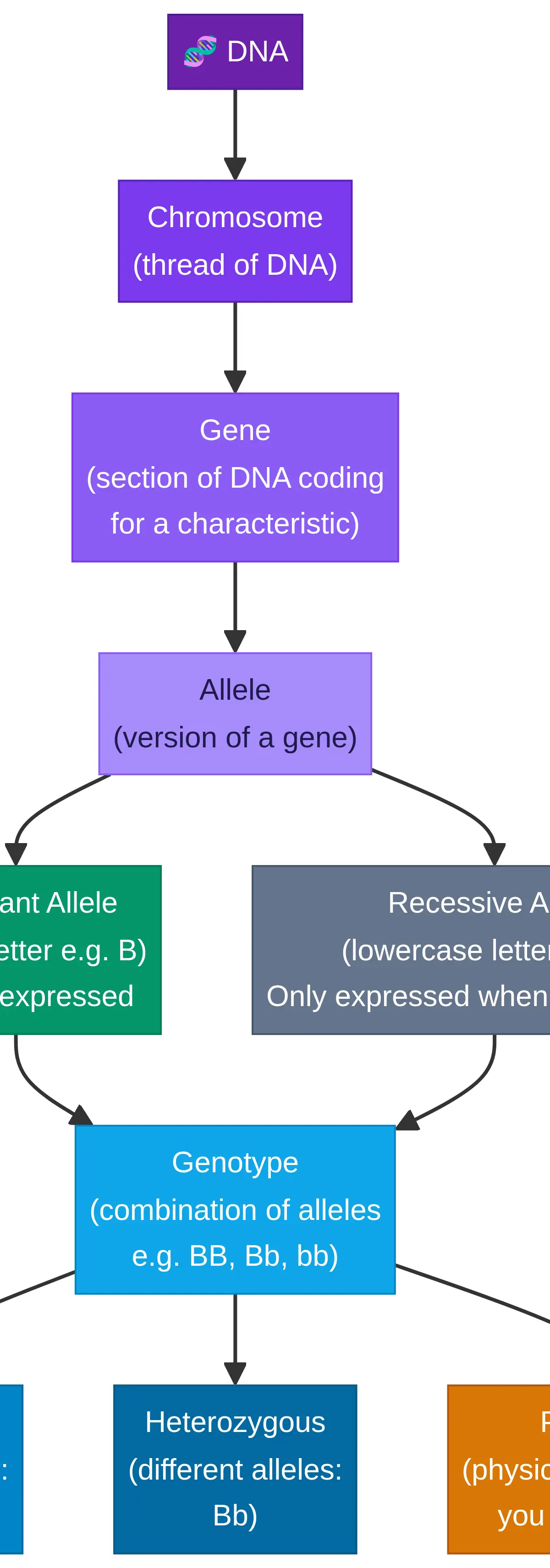
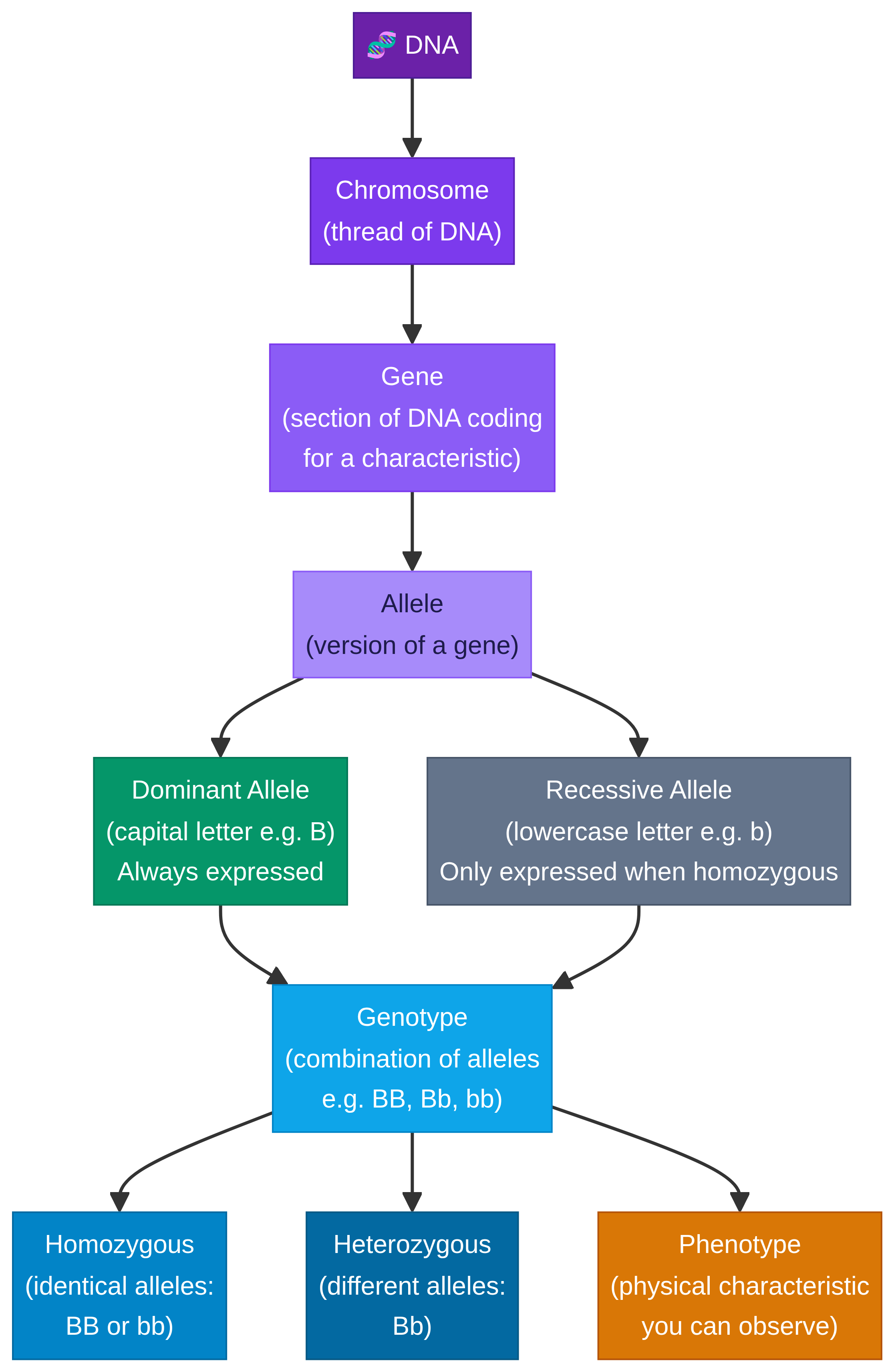
To succeed in inheritance questions, you must speak the language of genetics fluently. A gene is a short section of DNA that codes for a specific sequence of amino acids, which in turn makes a specific protein. These proteins determine our characteristics. However, genes can exist in different versions, which we call alleles (or variants).
For example, there is a gene that determines whether you can roll your tongue. The allele for tongue rolling is dominant, while the allele for non-rolling is recessive. A dominant allele is always expressed in the phenotype (your physical appearance) even if you only have one copy of it. We represent dominant alleles with capital letters (e.g., T). A recessive allele is only expressed if you have two copies of it, meaning no dominant allele is present to mask it. We represent recessive alleles with lowercase letters (e.g., t).
Your genotype is the specific combination of alleles you possess (e.g., TT, Tt, or tt). If your two alleles are identical (TT or tt), you are homozygous. If your two alleles are different (Tt), you are heterozygous. Your phenotype is the physical characteristic that results from this genotype (e.g., being able to roll your tongue).
Concept 2: Monohybrid Crosses and Punnett Squares
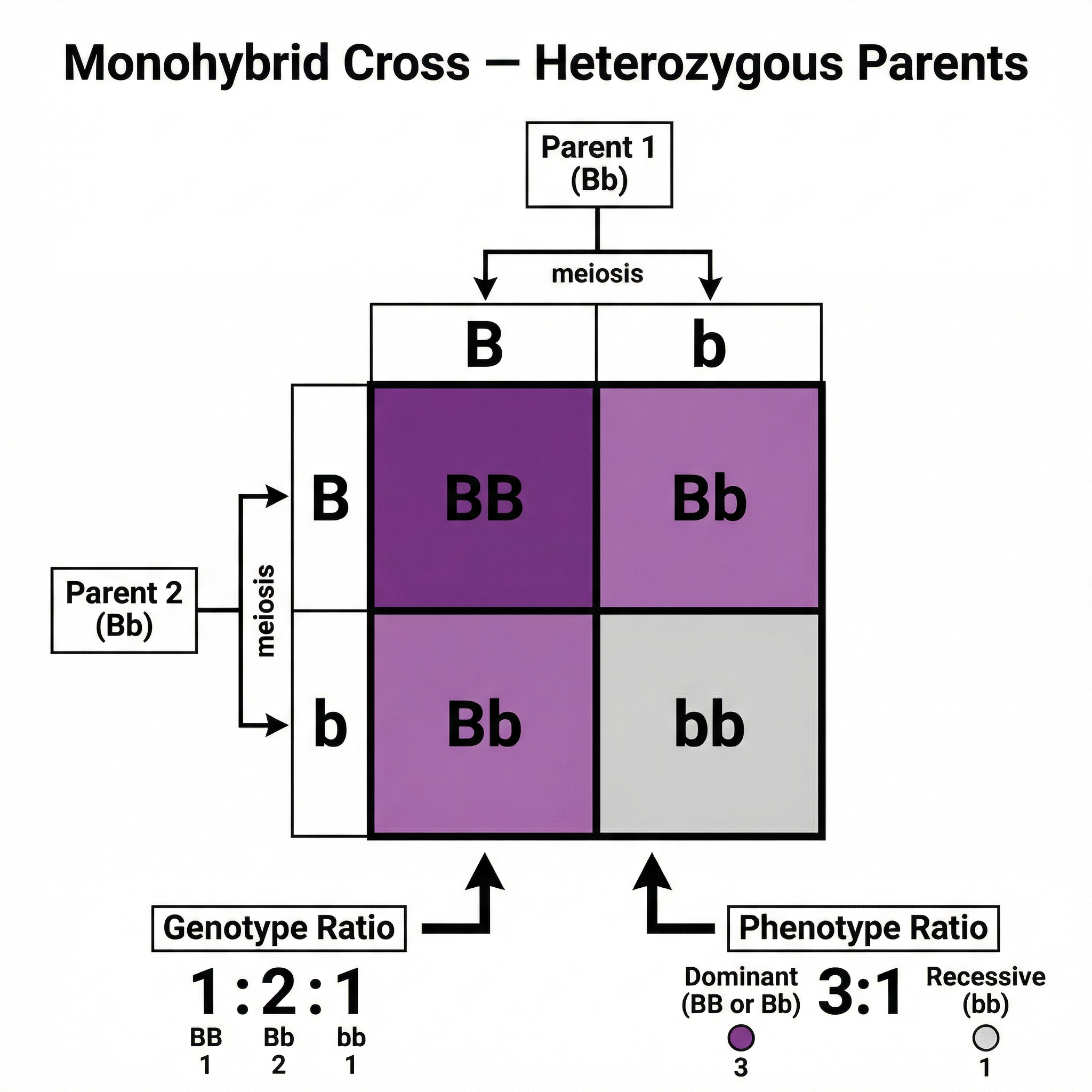
A monohybrid cross is the study of the inheritance of a single characteristic. We use Punnett squares to predict the possible genotypes and phenotypes of offspring.
When creating a Punnett square, it is vital to remember that during meiosis, the chromosome pairs separate. Therefore, each gamete (sperm or egg cell) receives only one allele for each gene.
Let's look at a cross between two heterozygous individuals (Tt x Tt).
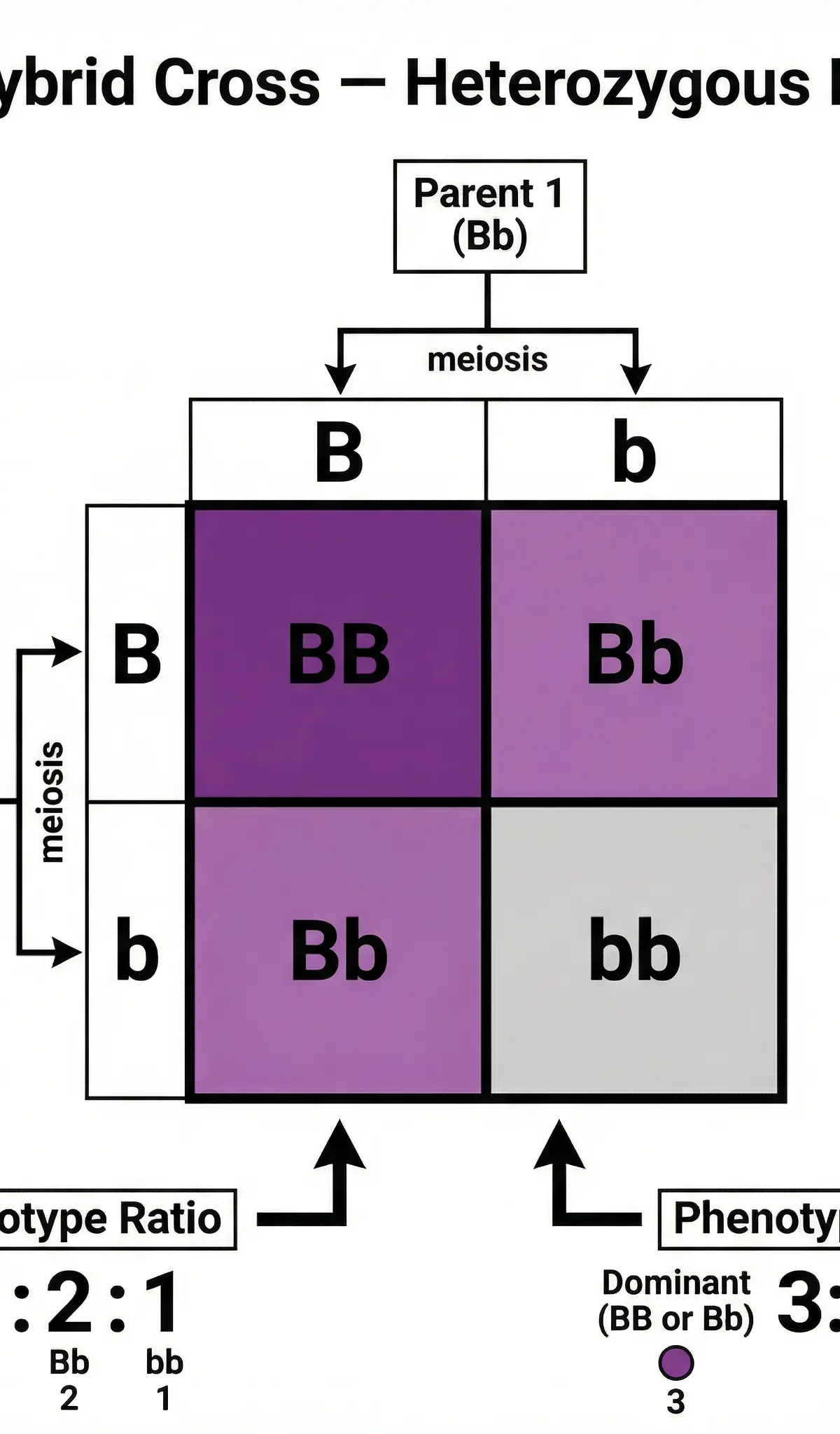
Notice that the predicted genotype ratio is 1 TT : 2 Tt : 1 tt. The predicted phenotype ratio is 3 tongue rollers : 1 non-roller. Examiners often ask for these ratios or the percentage probability (e.g., 75% chance of being a tongue roller).
Concept 3: Sex Determination
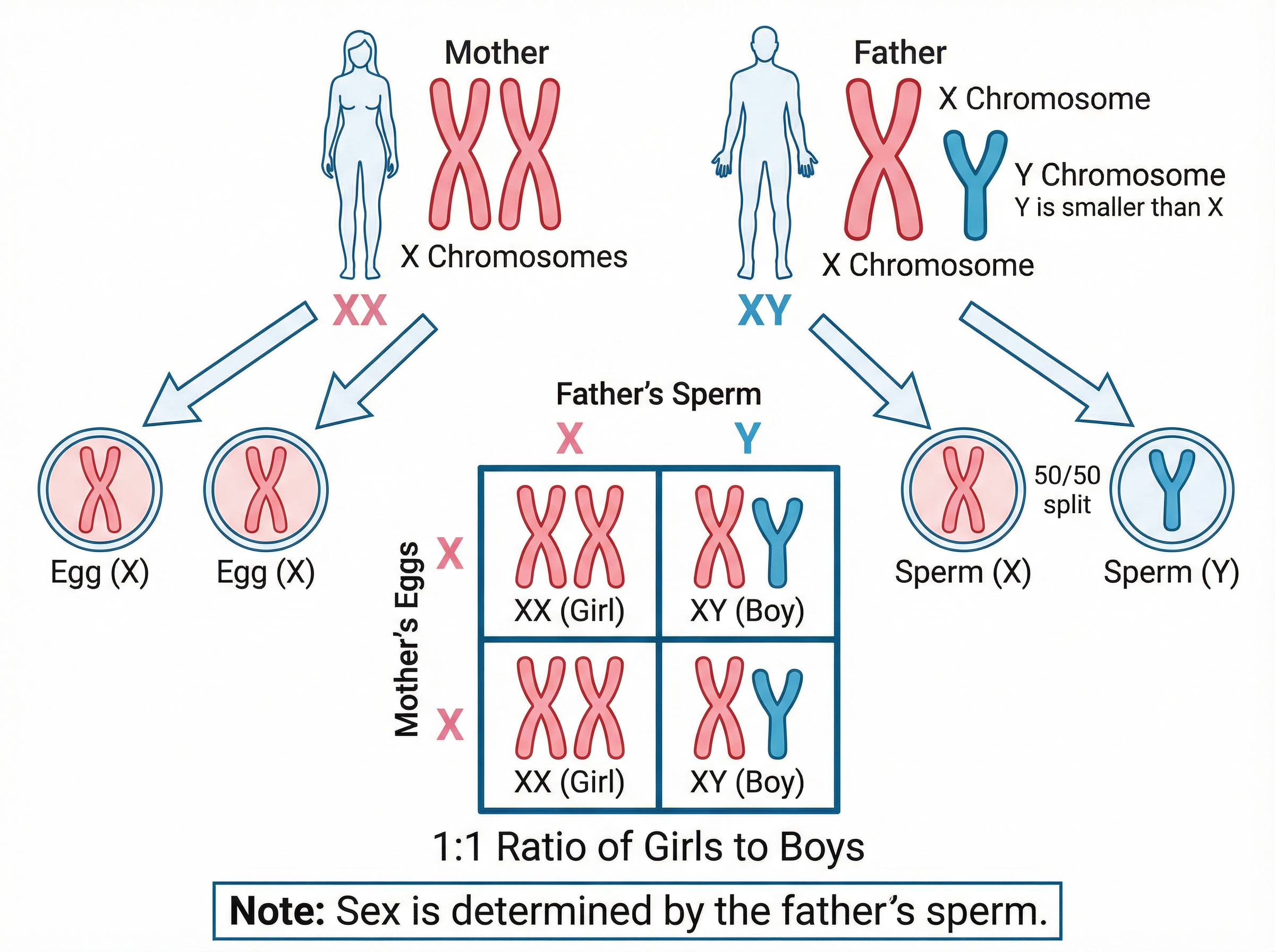
In humans, biological sex is determined by the 23rd pair of chromosomes, known as the sex chromosomes. Females possess two X chromosomes (XX), while males possess one X and one Y chromosome (XY).
During gamete formation, females produce egg cells that all contain an X chromosome. Males produce sperm cells where approximately half contain an X chromosome and half contain a Y chromosome. The biological sex of the offspring is therefore determined entirely by the father's sperm.
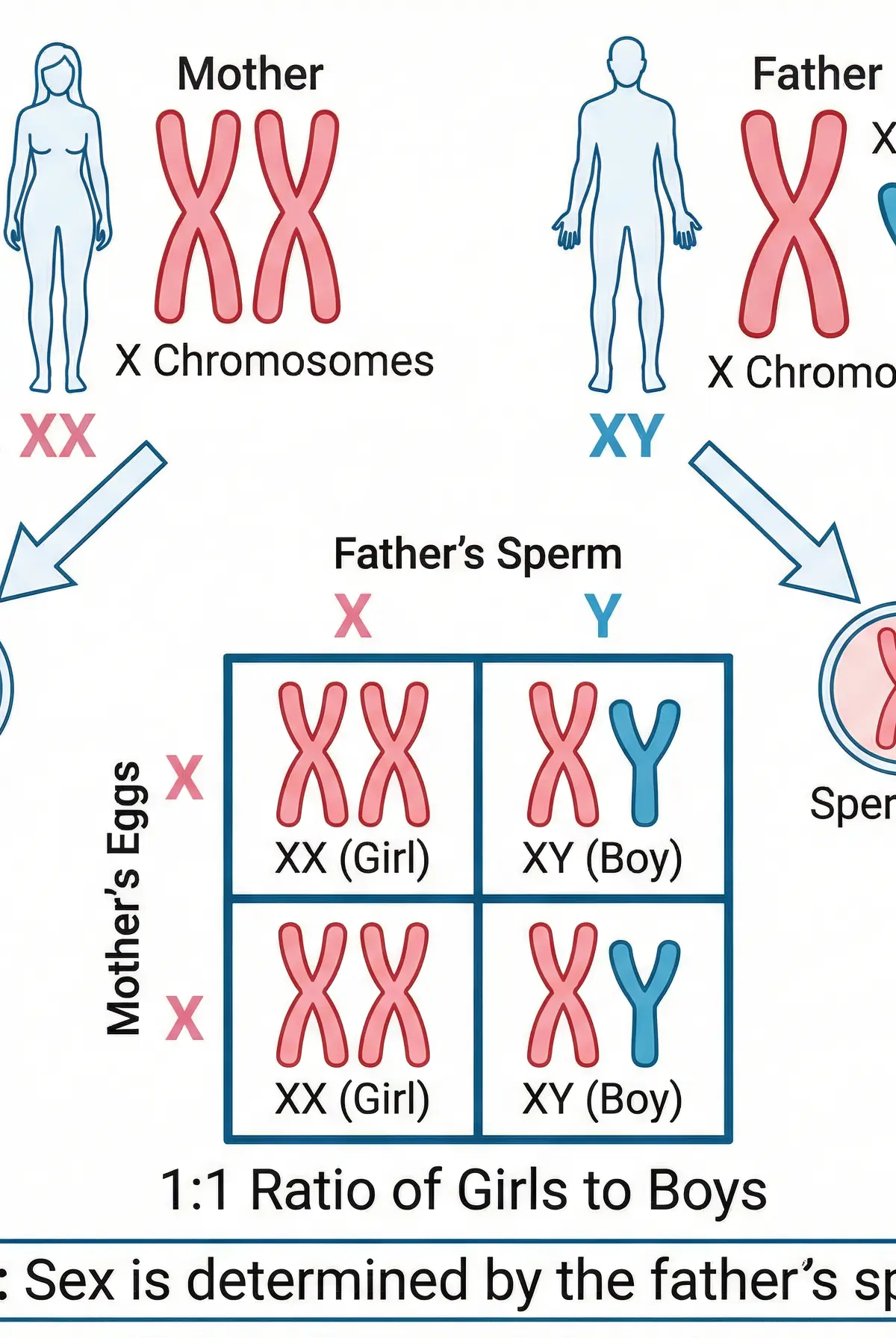
As the diagram shows, there is always a 50% (or 1:1) chance of having a male or female child. The Y chromosome is physically smaller than the X chromosome and carries fewer genes.
Concept 4: Gregor Mendel and the History of Genetics
Gregor Mendel was a 19th-century Austrian monk who carried out breeding experiments on pea plants. He observed that characteristics were inherited in clear, predictable ratios. He proposed the idea of 'hereditary units' that were passed on unchanged from parents to offspring.
However, the scientific community did not accept Mendel's work during his lifetime. Examiners frequently ask you to explain why. There are three main reasons:
- He was not a professional scientist, so his peers did not take his work seriously.
- He published his findings in an obscure journal that few scientists read.
- The concept of genes and chromosomes had not yet been discovered; microscopes were not powerful enough to see chromosomes separating during cell division. Therefore, there was no known mechanism to explain his results.
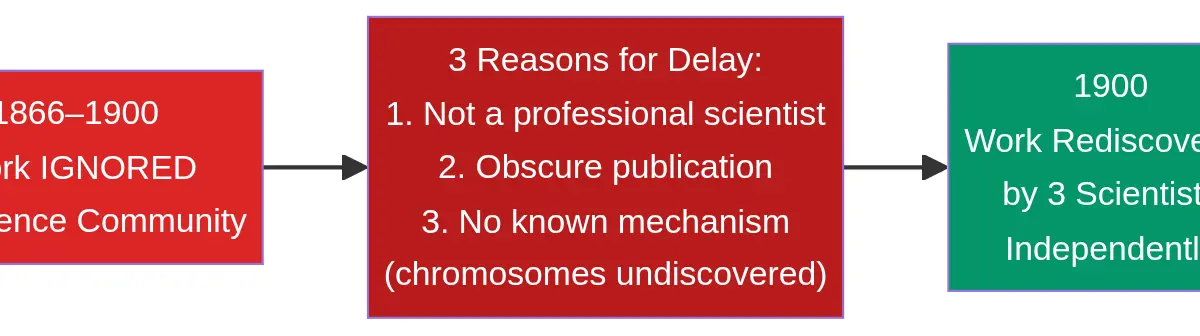
It was only in the early 20th century, after chromosomes were observed, that Mendel's work was rediscovered and his 'hereditary units' were identified as genes.
Concept 5: Polygenic Inheritance
While we often study single-gene inheritance (like tongue rolling or certain genetic disorders) because it is easy to model with Punnett squares, it is crucial to understand that most characteristics are polygenic. This means they are controlled by multiple genes interacting together, often alongside environmental factors. Examples include human height, skin colour, and eye colour. Examiners will award marks for recognising that single-gene traits are the exception rather than the rule.
Mathematical/Scientific Relationships
When calculating probabilities from a Punnett square:
- Probability = (Number of desired outcomes / Total number of outcomes)
- Percentage = Probability × 100
- Always simplify ratios (e.g., 2:2 must be written as 1:1).
Visual Resources
4 diagrams and illustrations

Interactive Diagrams
2 interactive diagrams to visualise key concepts
Conceptual Flow Outline
Concept map showing the relationship between key genetic terminology.
Conceptual Flow Outline
Timeline of Gregor Mendel's work and the reasons for its delayed acceptance.
Worked Examples
3 worked examples — open one to explore the question and available guidance.
Practice Questions
Test your understanding — click to reveal model answers
Define the term 'allele'.
Hint: Think about the different versions of a characteristic.
Cystic fibrosis is caused by a recessive allele (c). A healthy person has the dominant allele (C). Two healthy parents have a child with cystic fibrosis. Deduce the genotypes of the parents. Explain your answer.
Hint: If the child has the disease, what must their genotype be? Where did they get those alleles from?
In mice, black fur (B) is dominant to white fur (b). A homozygous black mouse is crossed with a white mouse. Predict the percentage of offspring that will have black fur. You must show a genetic cross.
Hint: What is the genotype of a white mouse if white is recessive?
Explain why Gregor Mendel's theories were not accepted by scientists at the time.
Hint: Think about his profession, where he published, and what hadn't been discovered yet.
A couple already have three boys. The mother is pregnant with their fourth child. State the probability that the fourth child will be a boy, and explain why.
Hint: Does previous offspring affect the next fertilisation event?