Eduqas · GCSE · Biology
Nervous coordination and control in humans
Master the body's electrical communication network, from lightning-fast reflex arcs to the complex anatomy of the eye and brain. This topic is heavily tested and rewards precise terminology and clear understanding of pathways.
- 6 min read
- 3 worked examples
- 5 practice questions
- 6 key terms
Study Notes
Overview
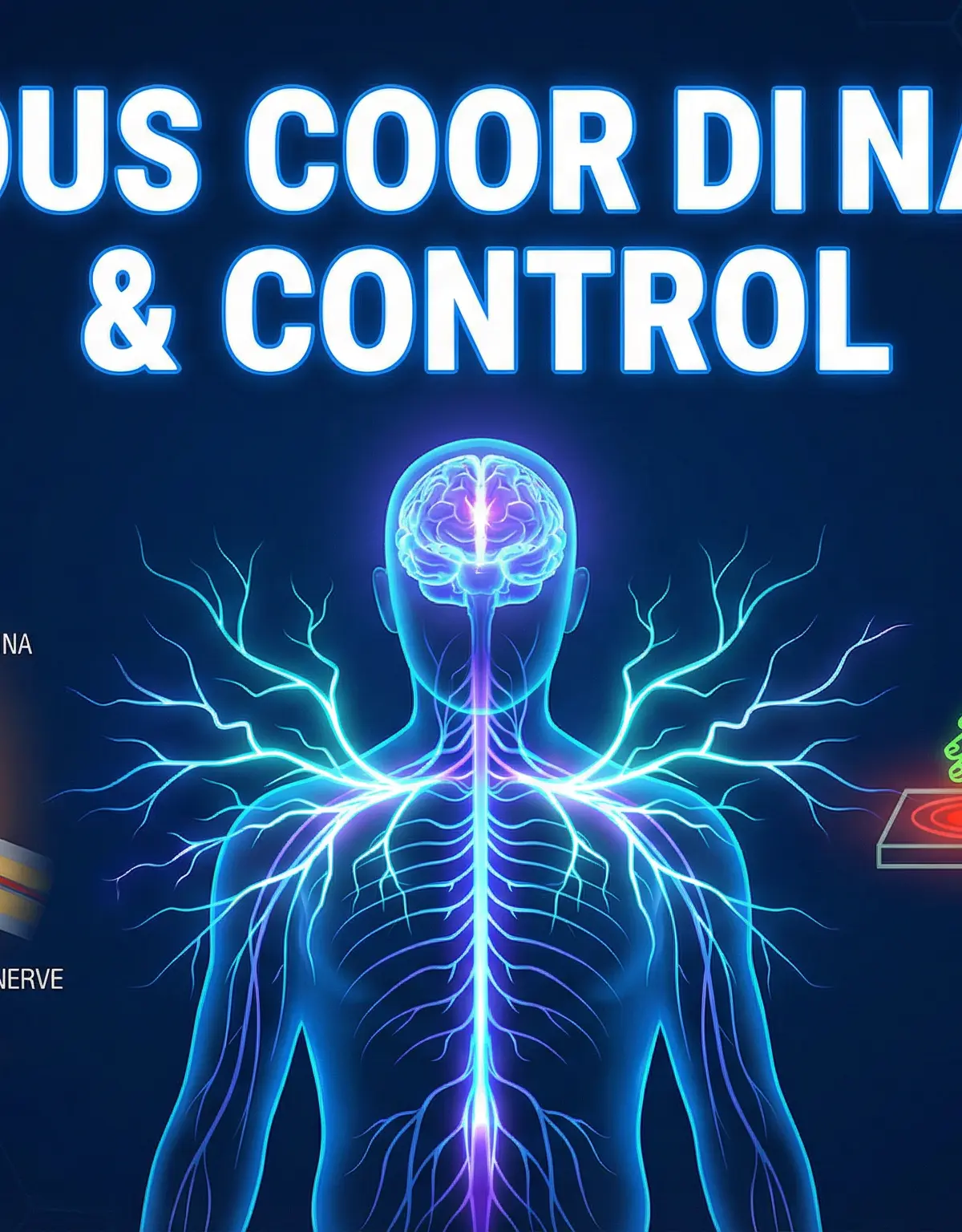
Nervous coordination and control is a fundamental GCSE Biology topic that explores how humans detect and respond to changes in their environment. It covers the rapid, automatic responses that protect us from harm, as well as the intricate workings of the eye and the brain.
This topic is crucial because it links cellular biology (like specialised cells) to whole-organism physiology. Examiners frequently test this area using a mix of short recall questions and extended 6-mark descriptions of processes like the reflex arc or eye accommodation.
To succeed, candidates must master the precise terminology—confusing the iris with the lens, or a sensory neurone with a motor neurone, are common pitfalls that cost marks. This guide will walk you through the key concepts, ensuring you can secure maximum credit.
Podcast Episode
Listen to our 10-minute revision podcast covering the essential concepts, common exam mistakes, and a quick-fire recall quiz.
Key Concepts
Concept 1: The Structure of the Nervous System
The human nervous system is divided into two main parts:
- Central Nervous System (CNS): Consists ONLY of the brain and the spinal cord. It coordinates the response of effectors.
- Peripheral Nervous System (PNS): All the other nerve cells (neurones) that connect the CNS to the rest of the body.
Information is sent through the nervous system as electrical impulses—electrical signals that pass along neurones.
Concept 2: Receptors and Effectors
- Receptors are specialised cells that detect stimuli (changes in the environment). For example, light receptors in the eye, sound receptors in the ear, or temperature receptors in the skin.
- Effectors bring about a response to a stimulus to restore optimum levels. Effectors are always either muscles (which respond by contracting) or glands (which respond by secreting chemical hormones).
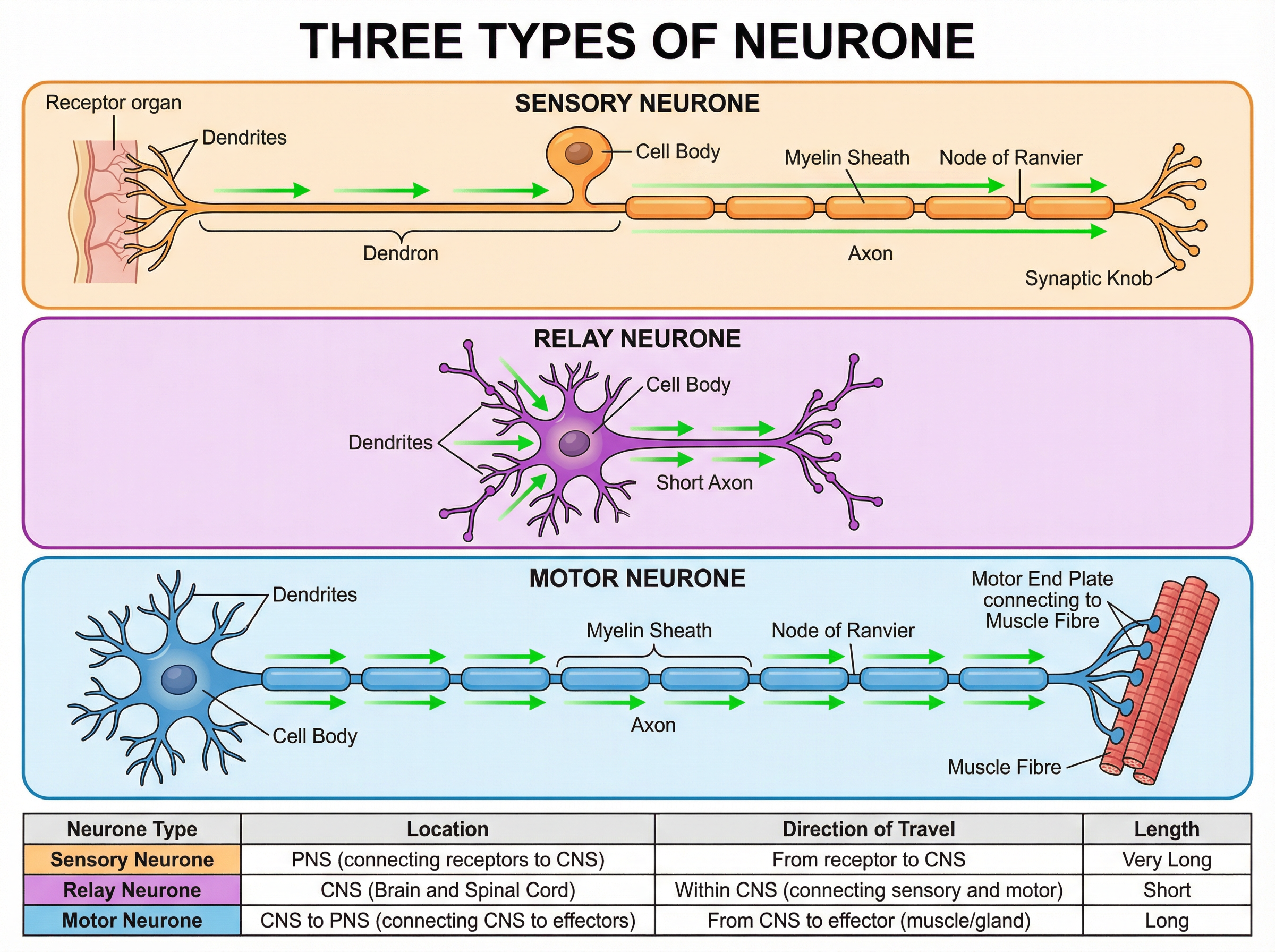
Concept 3: The Three Types of Neurones
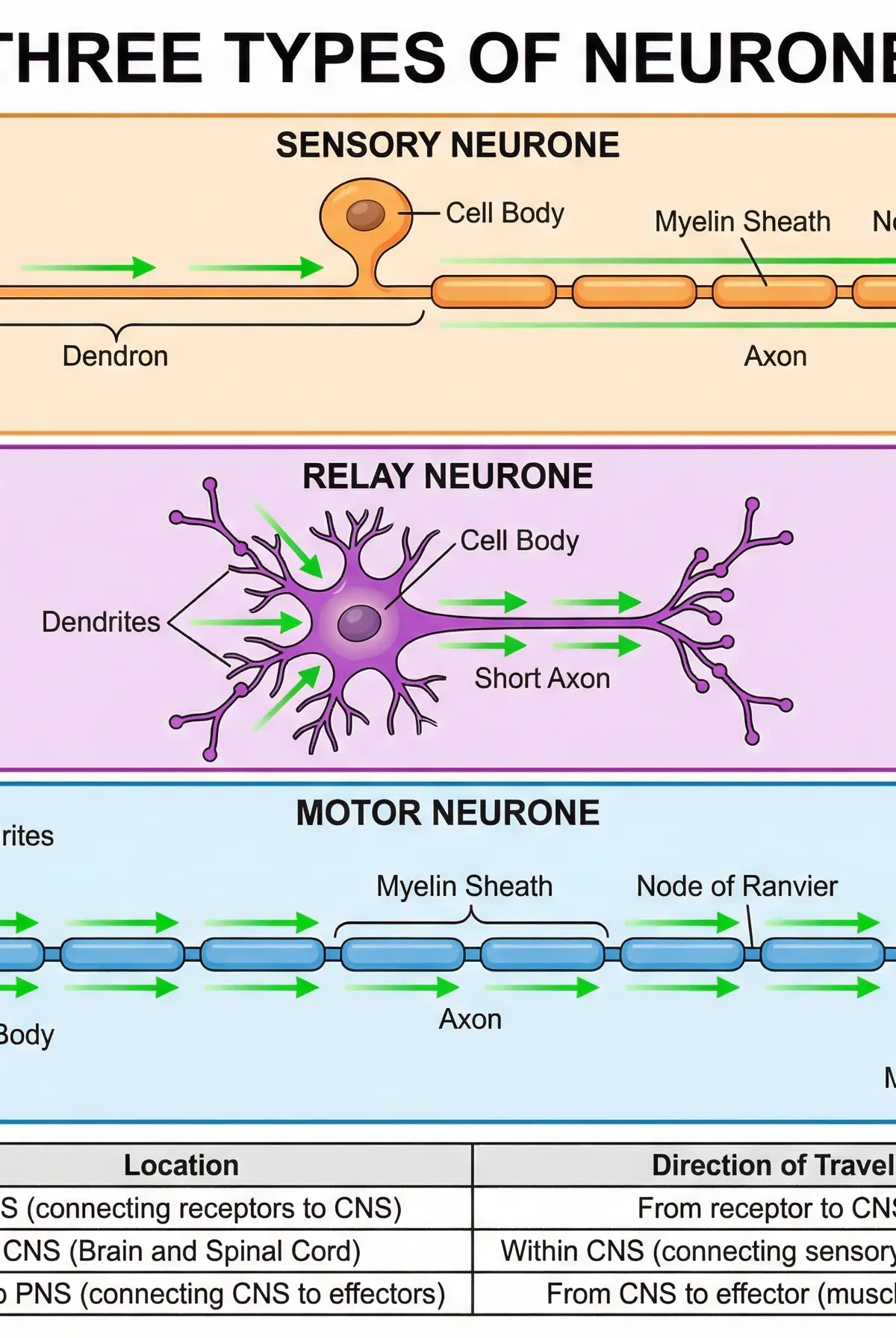
Candidates must be able to distinguish between the three types of neurones:
- Sensory Neurones: Carry electrical impulses FROM receptors TO the CNS.
- Relay Neurones: Found entirely within the CNS. They connect sensory neurones to motor neurones.
- Motor Neurones: Carry electrical impulses FROM the CNS TO effectors.
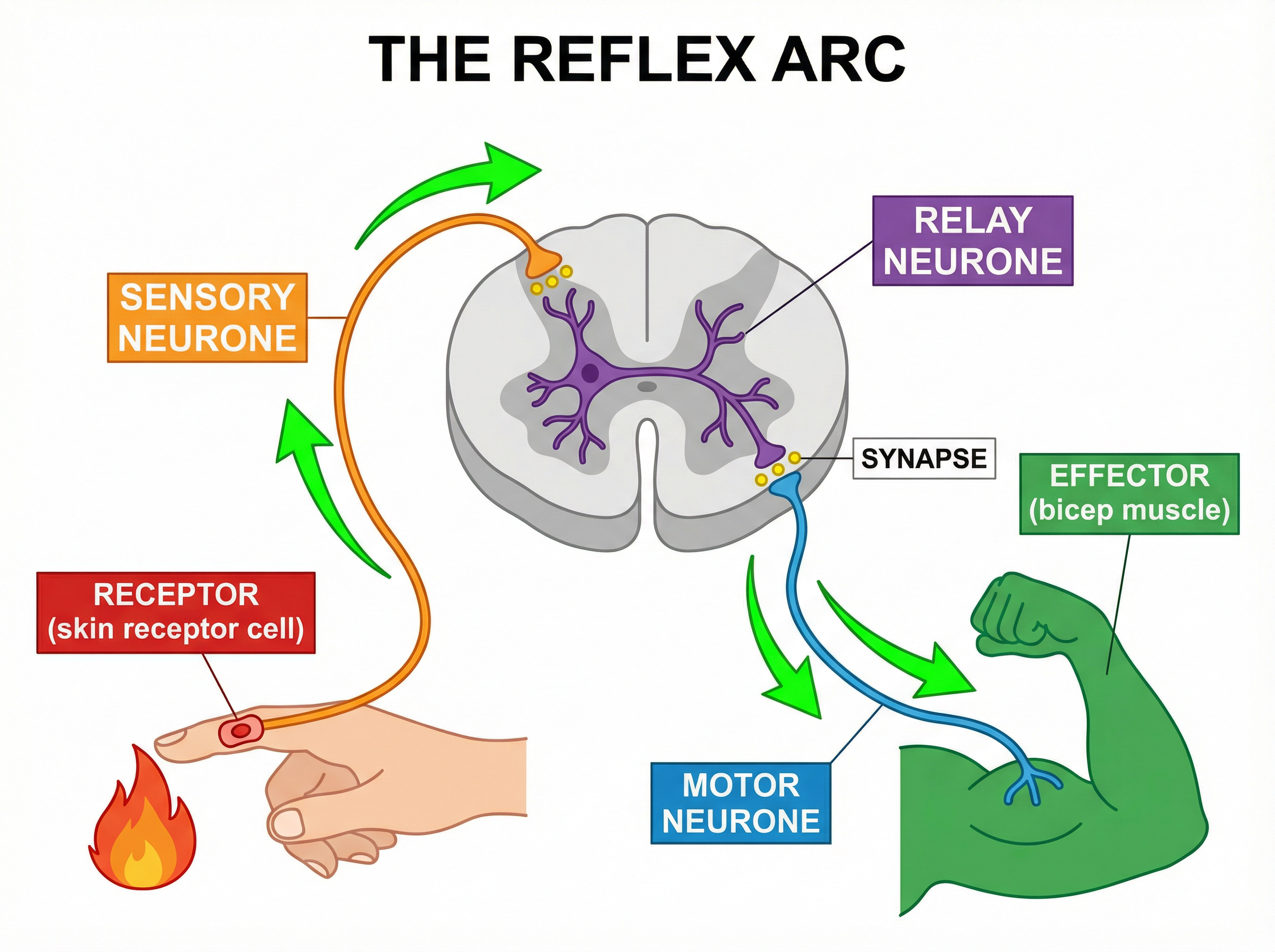
Concept 4: The Reflex Arc
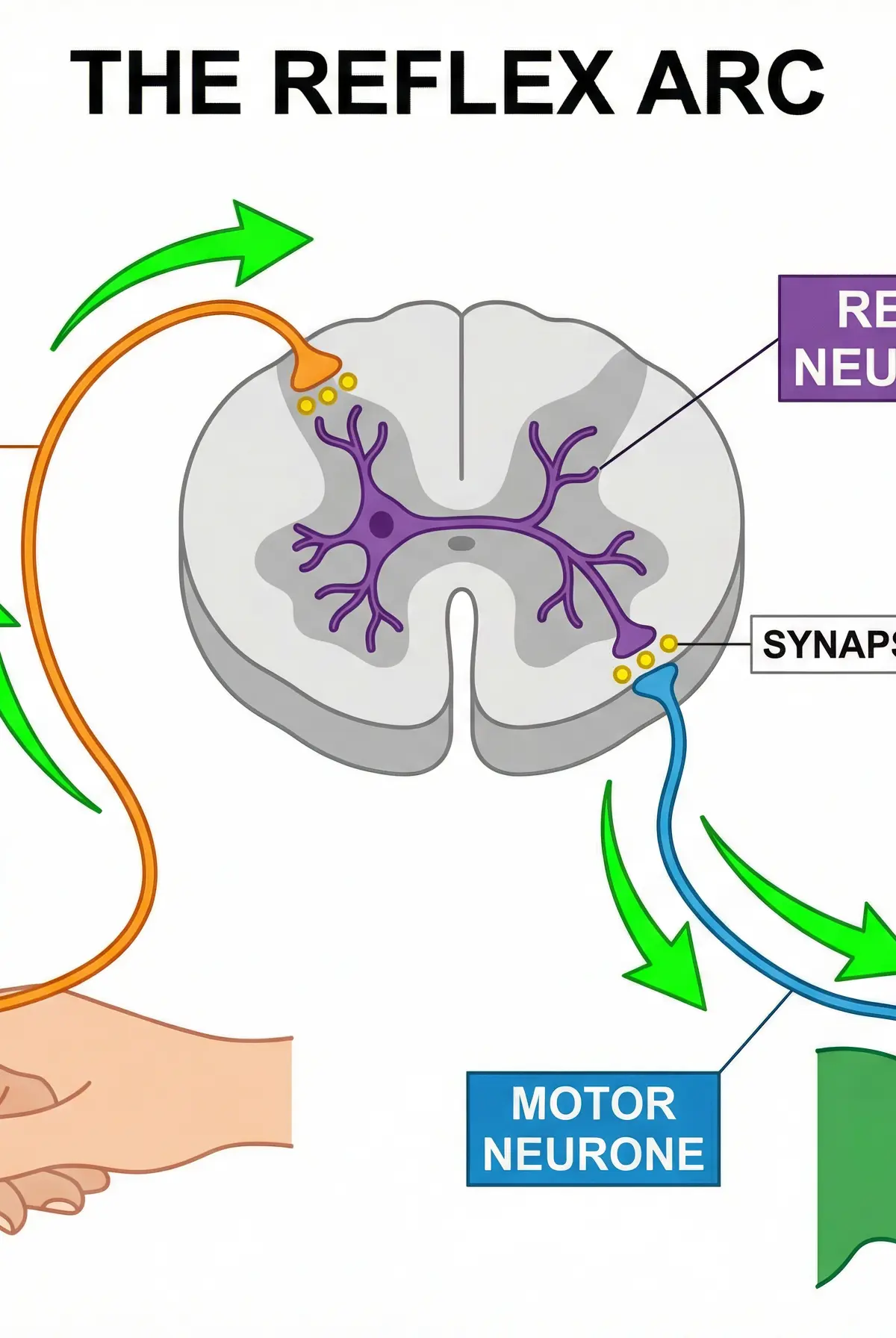
A reflex action is a rapid, automatic response to a stimulus that does not involve the conscious part of the brain. This makes them much faster than voluntary actions, which is vital for protecting the body from harm.
The pathway of an electrical impulse in a reflex action is called a reflex arc. The correct sequence is:
Stimulus → Receptor → Sensory Neurone → Relay Neurone → Motor Neurone → Effector → Response
Examiner Tip: When describing a reflex arc, candidates often forget to mention the relay neurone in the spinal cord. Always include it to secure full marks.
Concept 5: Synapses
A synapse is the junction (gap) between two neurones. Electrical impulses cannot cross this gap. Instead, the signal is transmitted chemically.
- An electrical impulse arrives at the end of the first neurone.
- This triggers the release of chemical messengers called neurotransmitters.
- The neurotransmitters diffuse across the synapse.
- They bind to receptor molecules on the membrane of the second neurone.
- This stimulates a new electrical impulse in the second neurone.
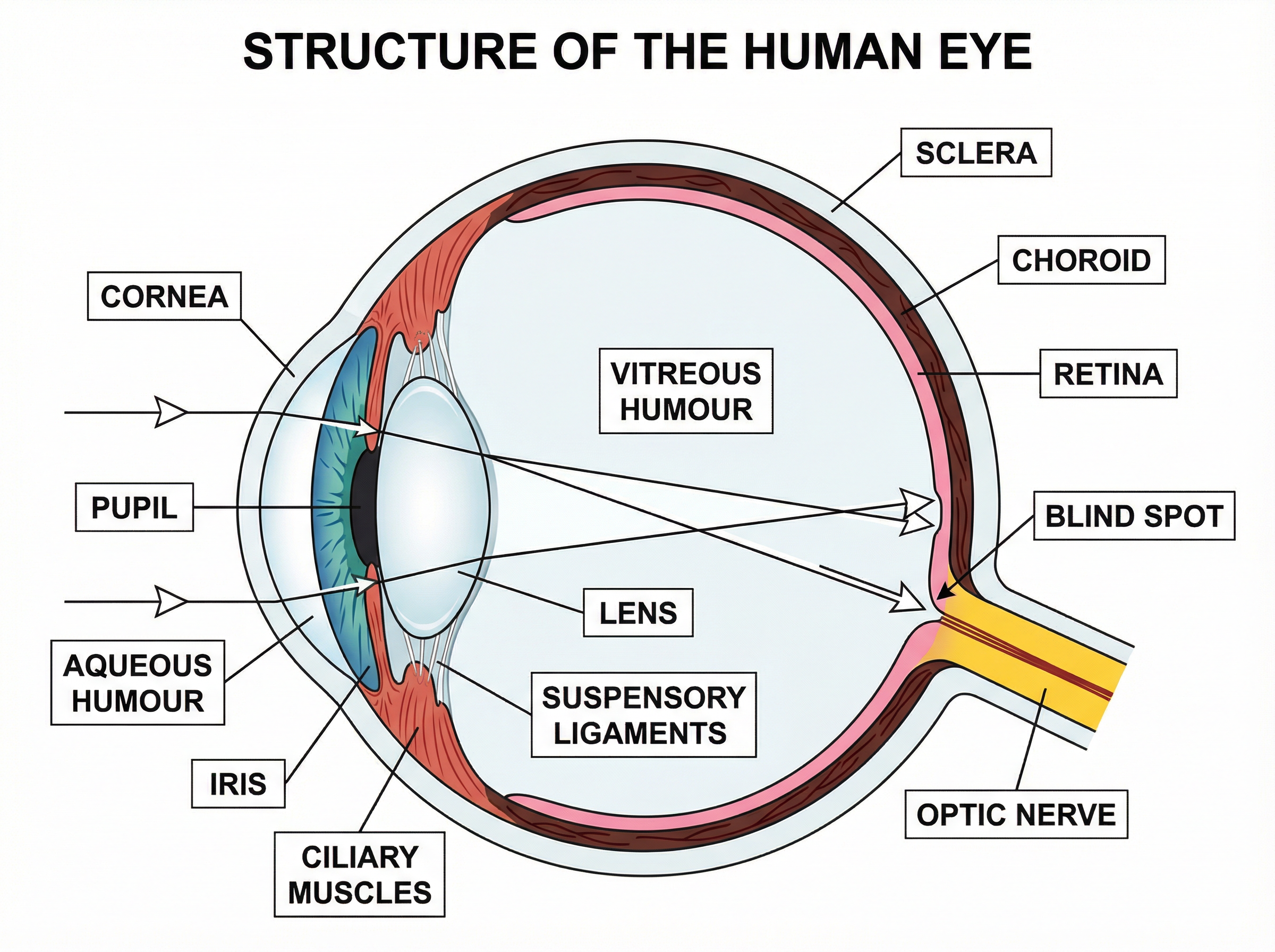
Concept 6: Structure and Function of the Eye
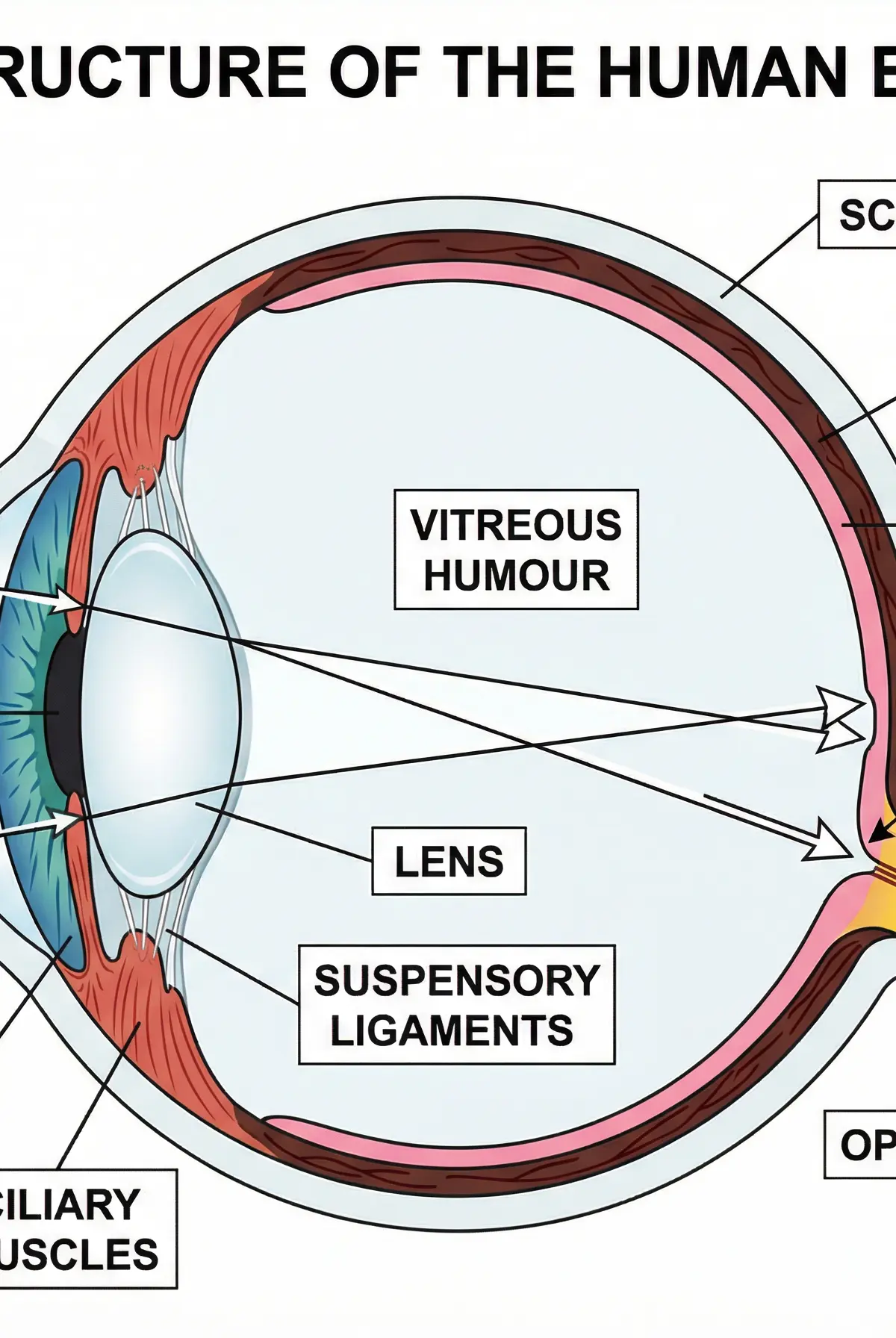
The eye is a highly specialised sense organ containing receptors sensitive to light intensity and colour. You must be able to identify and state the function of its key parts:
- Sclera: The tough, white outer layer that protects the eye.
- Cornea: The transparent front part of the sclera that refracts (bends) light as it enters.
- Iris: Contains muscles that control the size of the pupil, regulating how much light enters the eye.
- Lens: A transparent, biconvex structure that further refracts light to focus it onto the retina.
- Retina: The layer at the back of the eye containing light receptor cells (rods and cones).
- Optic Nerve: Carries electrical impulses from the retina to the brain.
Accommodation is the process of changing the shape of the lens to focus on near or distant objects.
- To focus on a near object: The ciliary muscles contract, the suspensory ligaments loosen, and the lens becomes thicker and more curved (refracting light more strongly).
- To focus on a distant object: The ciliary muscles relax, the suspensory ligaments are pulled tight, and the lens is pulled thin and less curved (refracting light slightly).
Concept 7: Studying the Brain (Higher Tier)
The brain controls complex behaviour and is made of billions of interconnected neurones. Studying the brain is extremely difficult due to its complexity and delicate nature. Scientists use several methods:
- Studying patients with brain damage: By matching the damaged area to the loss of function.
- Electrical stimulation: Stimulating different parts of the brain with weak electrical currents and observing the effects.
- MRI Scans: Magnetic Resonance Imaging produces highly detailed pictures of brain structure and activity.
Treating brain damage and disease is challenging because the brain is complex, delicate, and protected by the skull. Interventions carry significant risks of unintended damage.
Practical Applications
Required Practical: Reaction TimeStudents often investigate the effect of a specific factor (like practice, caffeine, or distraction) on human reaction time using the ruler-drop test.
- Method: Person A holds a ruler vertically. Person B places their thumb and index finger level with the 0cm mark. Person A drops the ruler without warning. Person B catches it as quickly as possible. The distance fallen is recorded and converted to a reaction time.
- Control Variables: Same person dropping/catching, same hand used, same height of dropping, same lighting conditions.
- Expected Results: Stimulants like caffeine generally decrease reaction time (make it faster), while depressants or distractions increase it.
Visual Resources
3 diagrams and illustrations
Interactive Diagrams
2 interactive diagrams to visualise key concepts
Conceptual Flow Outline
The general pathway of the nervous system.
Conceptual Flow Outline
Transmission of a signal across a synapse.
Worked Examples
3 worked examples — open one to explore the question and available guidance.
Practice Questions
Test your understanding — click to reveal model answers
State the two parts of the central nervous system. (2 marks)
Hint: Think about the main control centres located in the head and down the back.
A student touches a sharp pin and immediately pulls their hand away. Describe the pathway taken by the nerve impulse from the receptor to the effector. (4 marks)
Hint: Remember the mnemonic for the three neurones involved.
Explain why reflex actions are important for human survival. (2 marks)
Hint: Think about speed and what they prevent.
Describe how the eye focuses on an object that is far away. (4 marks)
Hint: Consider the state of the ciliary muscles and the resulting shape of the lens.
Explain how a nerve impulse is transmitted across a synapse. (3 marks)
Hint: Electrical signals cannot cross the gap. What is used instead?