Eduqas · GCSE · Biology
Plant hormones
Master the chemical messengers that control plant growth and responses. This topic covers the vital mechanisms of phototropism and gravitropism, plus the commercial applications of auxins, gibberellins, and ethene that frequently appear in 6-mark questions.
- 6 min read
- 3 worked examples
- 5 practice questions
- 6 key terms
Study Notes
Overview
Plants may appear stationary, but they are highly responsive organisms capable of detecting and reacting to environmental stimuli such as light, gravity, and moisture. This topic, Plant Hormones (4.4), explores the chemical messengers that coordinate these crucial growth responses. Understanding plant hormones is fundamental to Biology because it demonstrates how multicellular organisms communicate internally without a nervous system.
This topic connects strongly with your prior knowledge of cell structure, osmosis, and human endocrinology. Examiners frequently use plant hormones to test your ability to apply scientific principles to novel contexts, particularly in agriculture and horticulture. You can expect a mix of short recall questions on specific hormones, diagram-based questions requiring you to predict plant growth, and extended 6-mark questions evaluating the commercial uses of these chemicals.
Key Concepts
Concept 1: Auxins and Tropisms
Tropisms are directional growth responses to environmental stimuli. Phototropism is the response to light, while gravitropism (or geotropism) is the response to gravity. These responses are controlled by auxins, a family of plant hormones produced in the tips of shoots and roots (the apical meristems).
Auxins work by controlling cell elongation. However, the crucial point that examiners test is that auxins have opposite effects in different parts of the plant:
- In shoots, a high concentration of auxin promotes cell elongation.
- In roots, a high concentration of auxin inhibits cell elongation.
Phototropism in Shoots
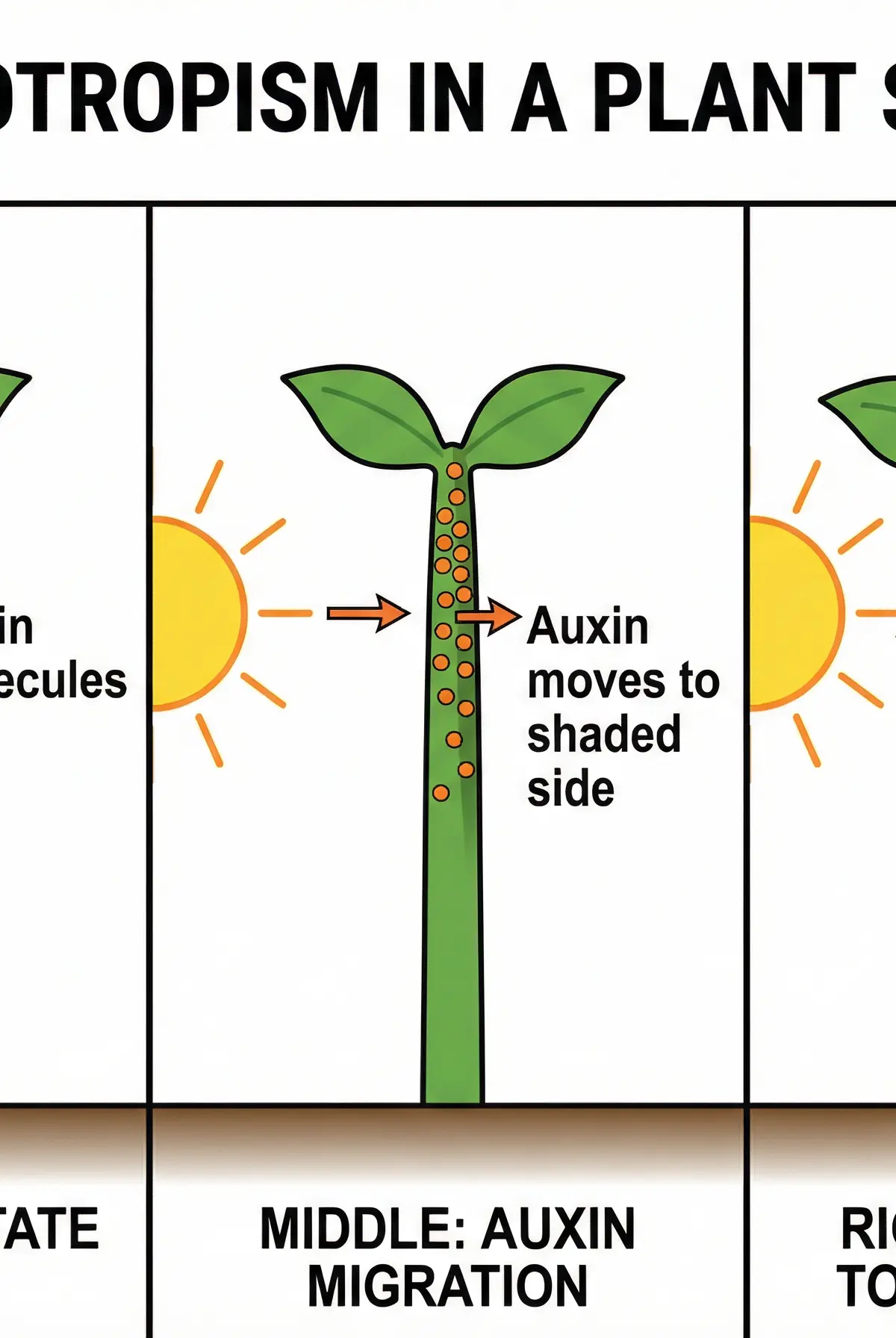
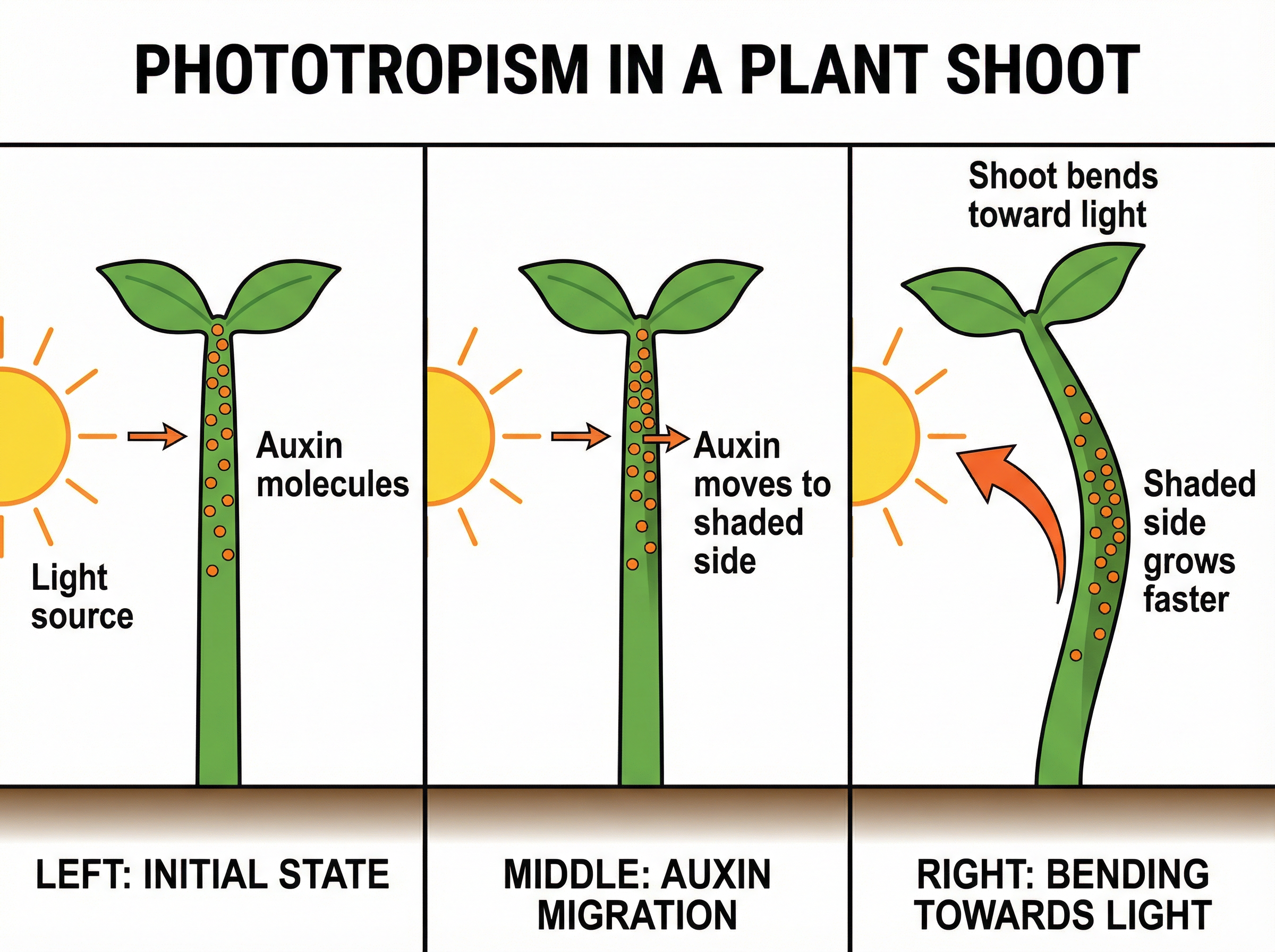
When light shines on a shoot from one side, auxin produced at the tip diffuses down the stem and accumulates on the shaded side. Because auxin promotes elongation in shoots, the cells on the shaded side grow faster and longer than those on the illuminated side. This unequal growth causes the shoot to bend towards the light (positive phototropism). This adaptation ensures the plant's leaves receive maximum light for photosynthesis.
Gravitropism in Roots
When a root is growing horizontally, gravity causes auxin to accumulate on the lower side. Because auxin inhibits elongation in roots, the cells on the lower side grow more slowly than those on the upper side. This unequal growth causes the root to bend downwards, towards the pull of gravity (positive gravitropism). This ensures roots grow deeply into the soil to anchor the plant and access water and mineral ions.
Concept 2: Gibberellins
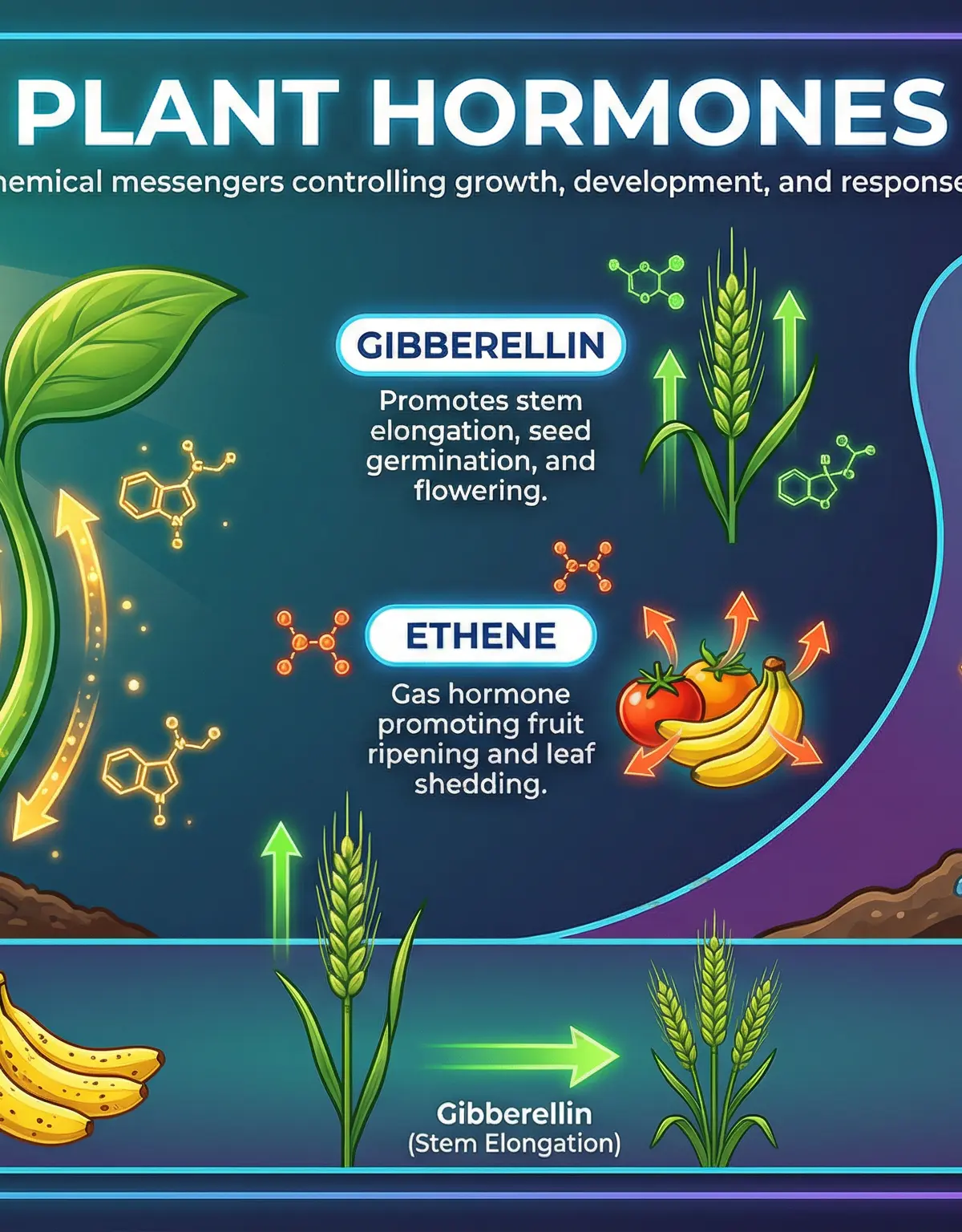
Gibberellins are another important group of plant hormones. They are primarily responsible for initiating seed germination, promoting stem elongation, and triggering flowering.
When a seed is exposed to the correct conditions (water, oxygen, and suitable temperature), it releases gibberellins. These hormones stimulate the breakdown of starch reserves in the seed into glucose, providing the energy required for the embryo to grow. In mature plants, gibberellins work alongside auxins to control the lengthening of stems between leaves (internodes).
Concept 3: Ethene
Unlike other plant hormones, ethene is a hydrocarbon gas (C₂H₄). It is produced by aging leaves and ripening fruit. Ethene controls two main processes:
- Fruit Ripening: It stimulates the conversion of starch to sugars and the breakdown of cell walls, making fruit softer and sweeter.
- Abscission (Leaf Fall): It stimulates enzymes that digest the cell walls at the base of the leaf stalk, causing the leaf to detach from the plant in autumn.
Mathematical/Scientific Relationships
While there are no specific equations to memorize for plant hormones, you must understand the proportional relationship in tropisms:
- Rate of bending \propto Difference in auxin concentration between the two sidesThe greater the concentration gradient of auxin across a stem or root, the more pronounced the unequal growth, and the sharper the angle of bending.
Practical Applications
The commercial application of plant hormones is a major focus for examiners. You must be able to describe these uses and evaluate their advantages and disadvantages in agriculture.
Uses of Auxins:
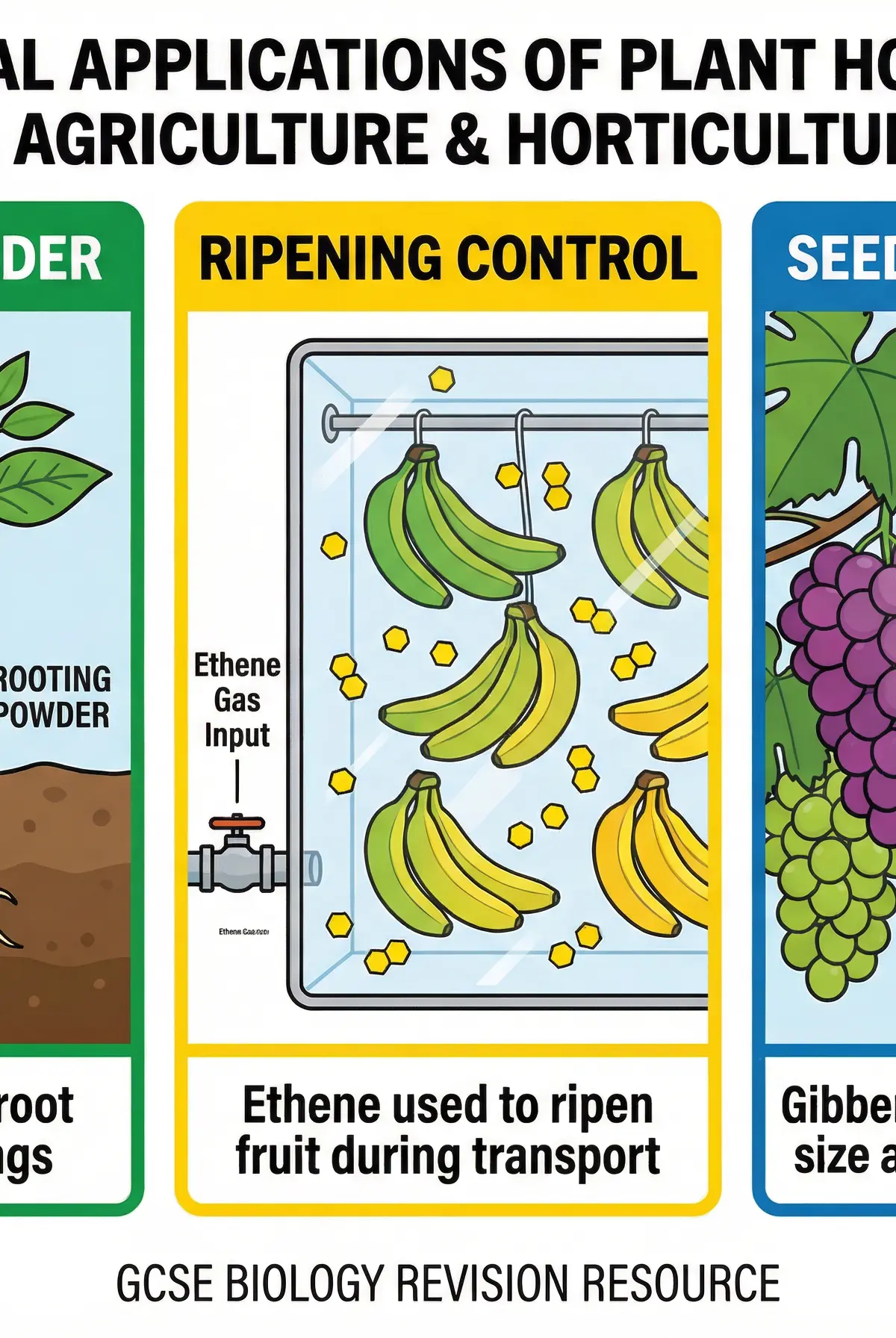
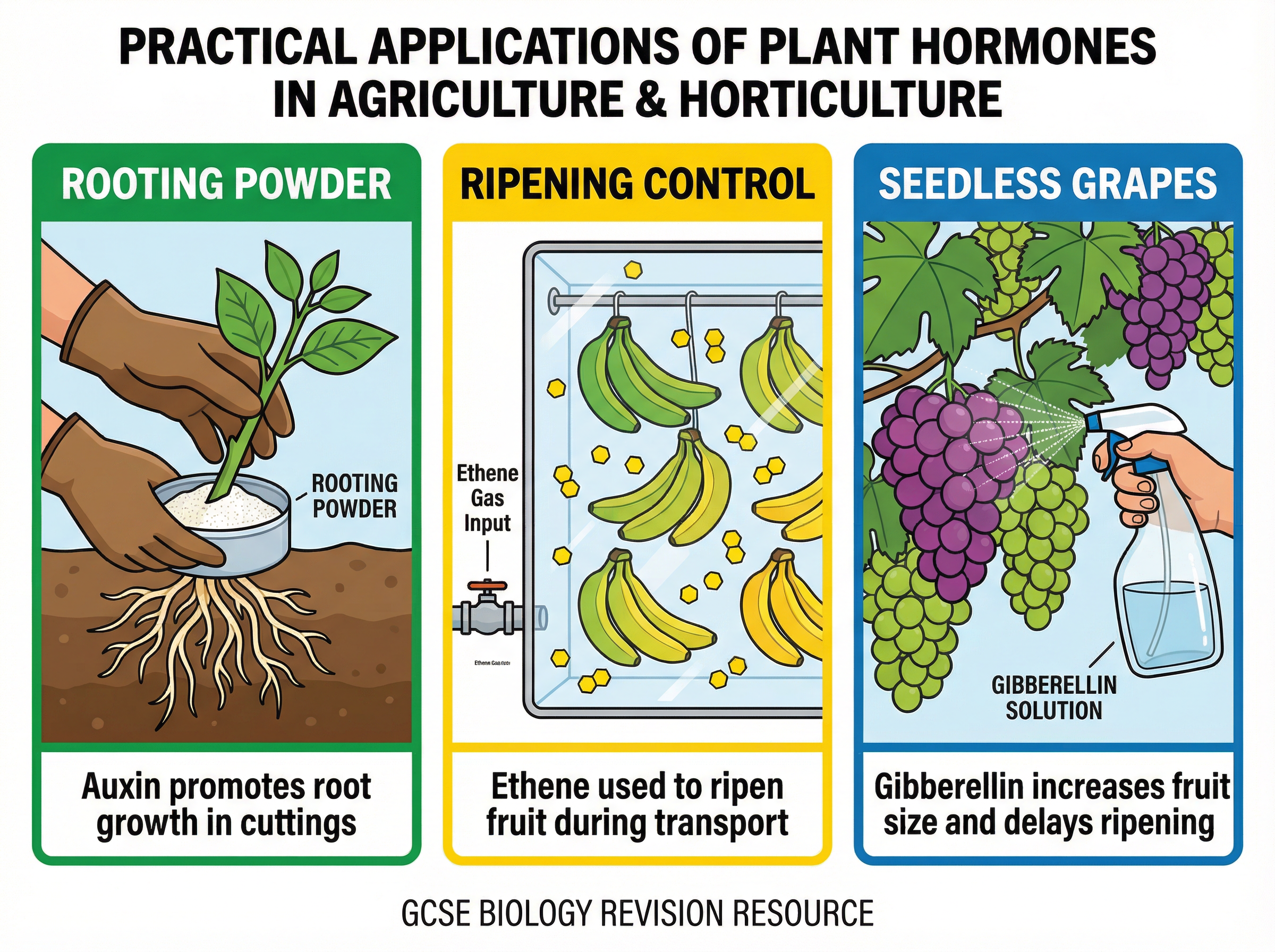
- Rooting Powders: Plant cuttings are dipped in rooting powder containing synthetic auxins. This stimulates rapid root development, allowing growers to produce large numbers of identical plants (clones) quickly.
- Selective Weedkillers: Broad-leaved weeds absorb large quantities of synthetic auxins, causing them to grow uncontrollably and die. Narrow-leaved crop plants (like wheat and grass) are unaffected, increasing crop yields.
- Tissue Culture: Auxins are added to the growth medium in tissue culture to stimulate the division of cells and the formation of roots in plantlets.
Uses of Gibberellins:
- Ending Seed Dormancy: Seeds can be treated with gibberellins to make them germinate earlier than they normally would, or to ensure all seeds in a batch germinate simultaneously.
- Promoting Flowering: Gibberellins can induce flowering in plants regardless of the environmental conditions (e.g., day length), allowing growers to supply flowers year-round.
- Increasing Fruit Size: Spraying gibberellins on crops like seedless grapes causes the stems to elongate, giving the grapes more space to grow larger.
Uses of Ethene:
- Controlling Ripening: Fruit is often picked while unripe and firm, making it less easily damaged during transport. Once it reaches its destination, ethene gas is pumped into the storage chambers to trigger rapid, synchronized ripening just before sale.
Visual Resources
2 diagrams and illustrations
Interactive Diagrams
2 interactive diagrams to visualise key concepts
Conceptual Flow Outline
Flowchart showing the mechanism of positive phototropism in a plant shoot.
Conceptual Flow Outline
Flowchart showing the mechanism of positive gravitropism in a plant root.
Worked Examples
3 worked examples — open one to explore the question and available guidance.
Practice Questions
Test your understanding — click to reveal model answers
Name the plant hormone that is a gas at room temperature. [1 mark]
Hint: Think about the hormone used to ripen bananas during transport.
A gardener wants to grow new plants from cuttings of an existing plant. Explain how they can use plant hormones to ensure the cuttings grow successfully. [3 marks]
Hint: What needs to grow from the bottom of a cut stem for it to survive? Which hormone causes this?
Some weedkillers contain synthetic plant hormones. Explain how these weedkillers increase crop yield. [4 marks]
Hint: Think about the difference between the weeds and the crop plants, and what the hormone does to the weeds.
A student investigates the effect of light on the growth of seedlings. They place one seedling in a box with light coming from all directions, and another in a box with light coming only from a hole on the right side. Compare the growth of the two seedlings after 3 days. [3 marks]
Hint: Describe what happens to both seedlings, not just the one with the hole.
Explain why a root placed horizontally in the soil will eventually grow downwards. You must refer to the role of hormones in your answer. [5 marks]
Hint: Think about gravity, where the auxin goes, and how auxin affects root cells differently to shoot cells.