Eduqas · GCSE · Biology
Prokaryotic and eukaryotic cells
Master the foundational building blocks of biology: prokaryotic and eukaryotic cells. This guide covers everything from sub-cellular structures and their functions to the development of microscopy, ensuring you can confidently tackle diagrams, comparisons, and magnification calculations.
- 5 min read
- 3 worked examples
- 5 practice questions
- 6 key terms
Study Notes

Overview
Welcome to Topic 1.1: Prokaryotic and Eukaryotic Cells. This is the foundation of all biology. Understanding the fundamental units of life is essential, as every living organism—from the smallest bacterium to the largest blue whale—is made of cells. This topic explores the two main categories of cells: the simpler, older prokaryotic cells (like bacteria) and the more complex eukaryotic cells (like those in animals and plants).
This topic is crucial because it connects to almost every other area of the specification, including cell division, infection and response, and bioenergetics. Examiners frequently ask candidates to compare these cell types, identify sub-cellular structures from diagrams, and explain how specific organelles are adapted to their functions. You will also need to understand how the development of microscopy has allowed us to see these microscopic structures in greater detail, and be able to perform magnification calculations.
Key Concepts
Concept 1: Prokaryotic Cells
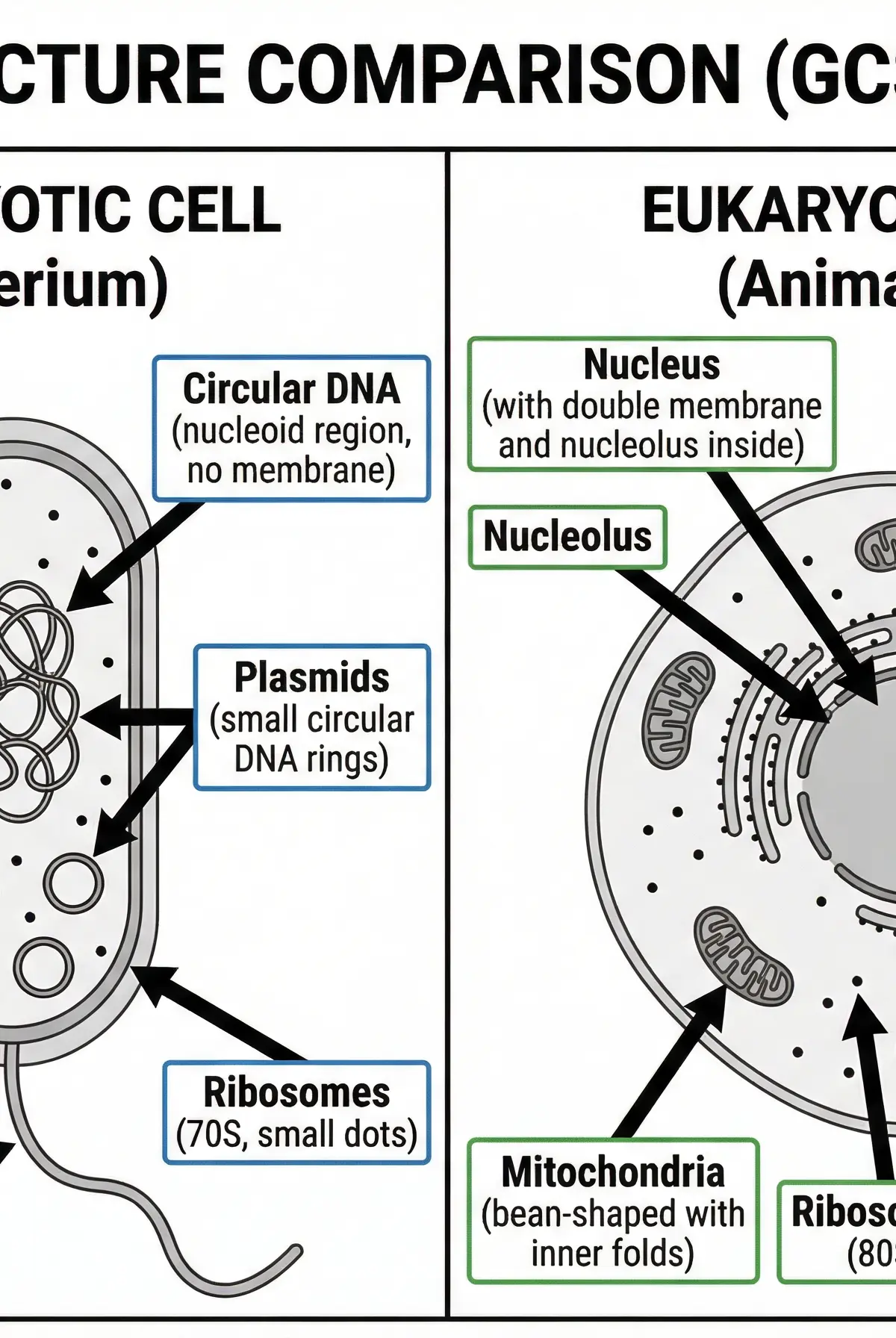
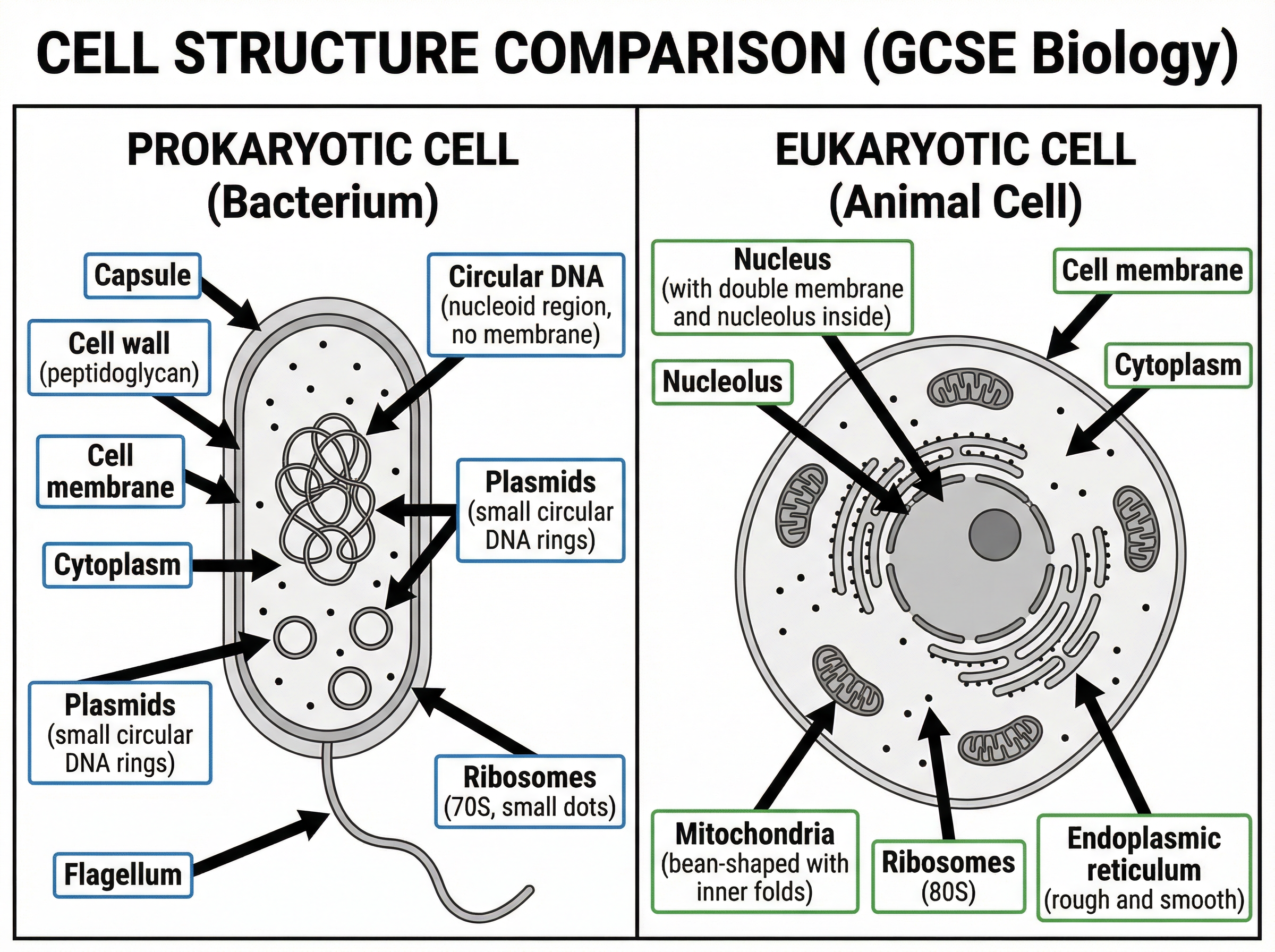
Prokaryotic cells are small (typically 0.1 - 5.0 µm) and simple. The defining feature of a prokaryotic cell is that its genetic material is not enclosed in a nucleus. Instead, it consists of a single loop of circular DNA free in the cytoplasm.
Key structures include:
- Cell Wall: Made of peptidoglycan (not cellulose), providing structure and preventing bursting.
- Cell Membrane: Controls the movement of substances in and out.
- Cytoplasm: Where metabolic reactions occur.
- Ribosomes (70S): The site of protein synthesis. They are smaller than those in eukaryotic cells.
- Plasmids: Small, extra rings of DNA that can carry beneficial genes (e.g., antibiotic resistance).
- Flagellum (optional): A tail-like structure for movement.
Concept 2: Eukaryotic Cells
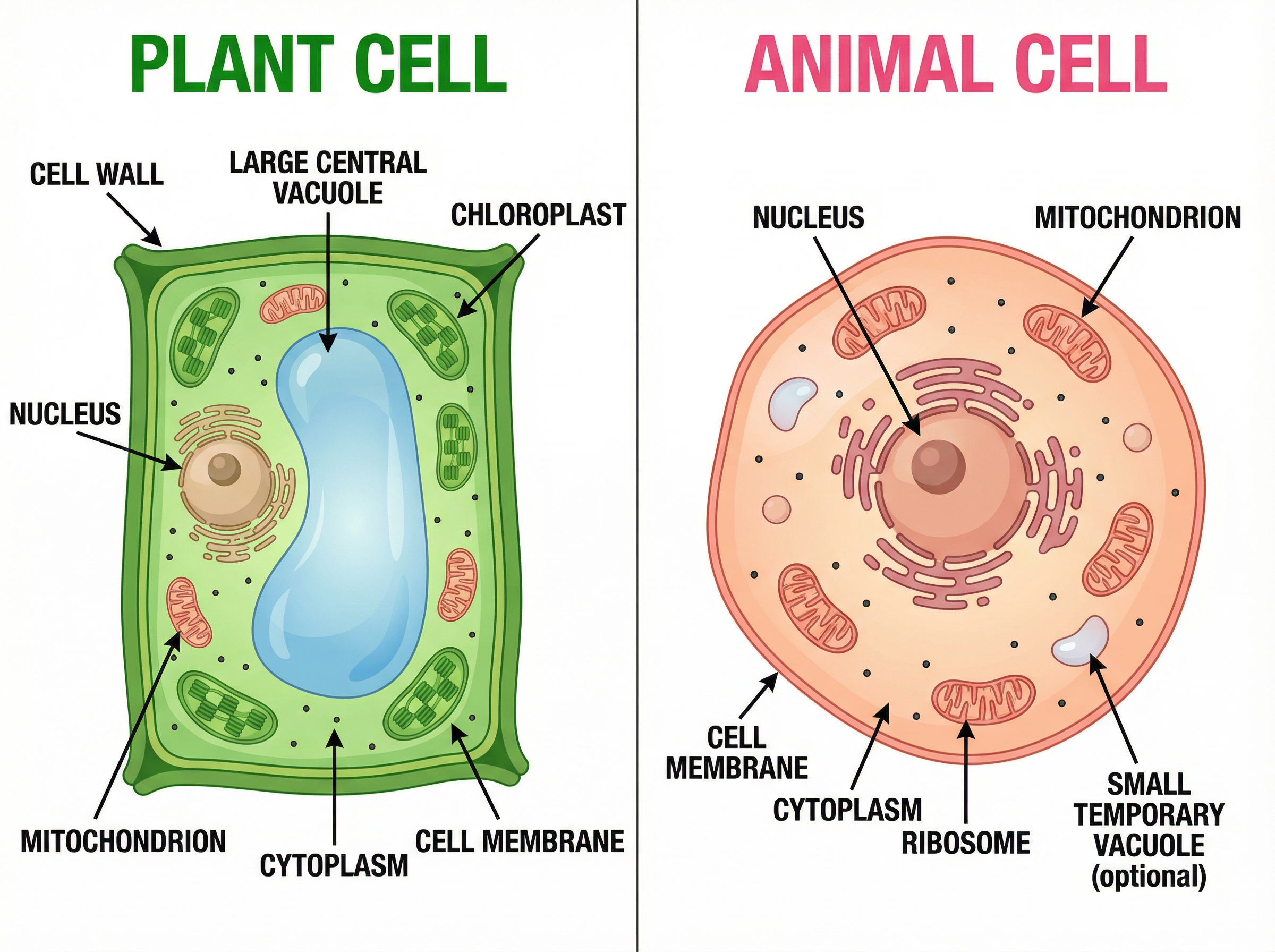
Eukaryotic cells are larger (10 - 100 µm) and more complex. Their defining feature is that their genetic material (DNA) is enclosed within a true nucleus.
Animal Cells contain:
- Nucleus: Contains genetic material that controls the activities of the cell.
- Cytoplasm: Gel-like substance where most chemical reactions take place, containing enzymes.
- Cell Membrane: Holds the cell together and controls what goes in and out.
- Mitochondria: Where most of the reactions for aerobic respiration take place. Respiration transfers energy that the cell needs to work.
- Ribosomes (80S): Where proteins are made in the cell.
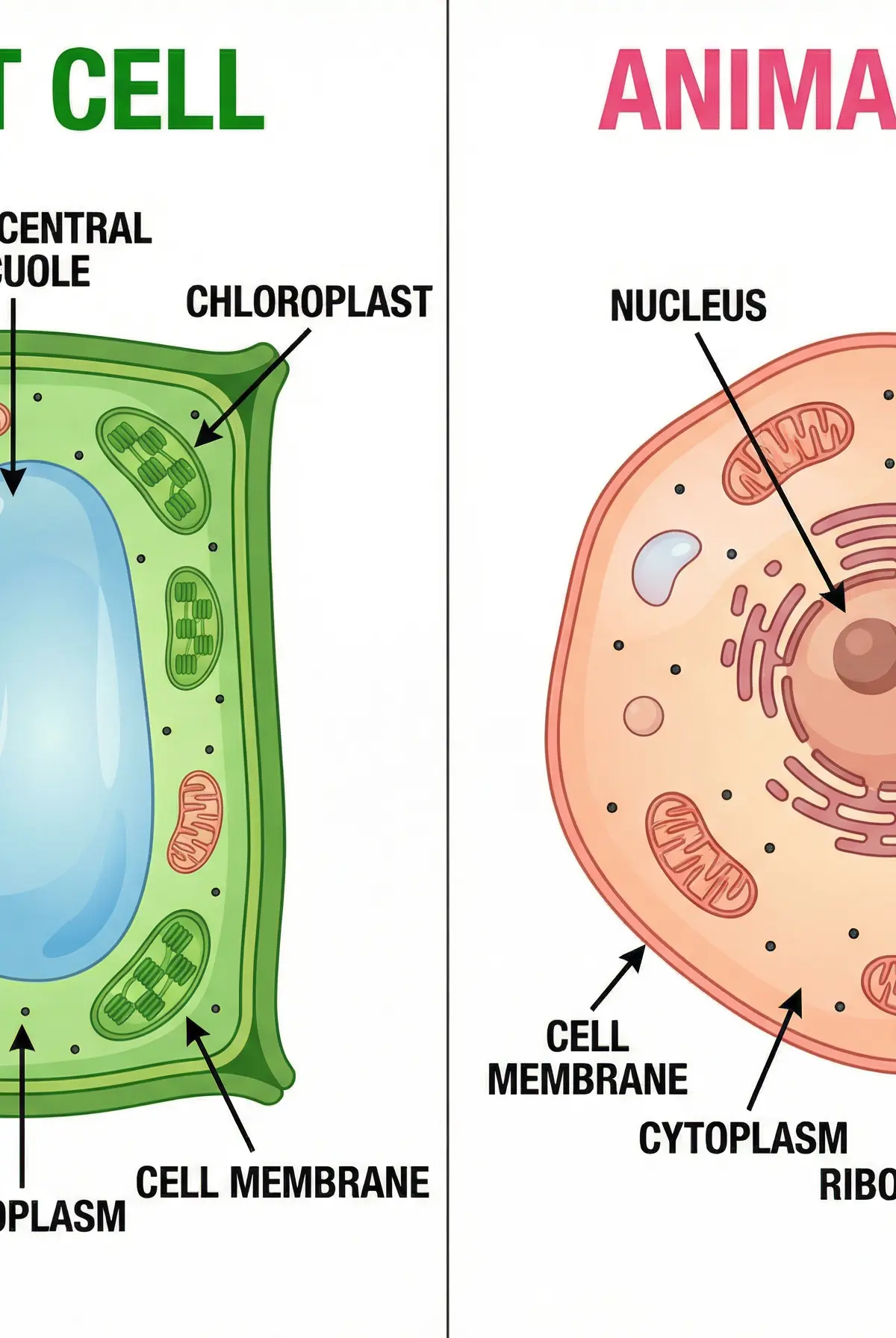
Plant Cells usually have all the bits that animal cells have, plus a few extra things that plant cells need:
- Rigid Cell Wall: Made of cellulose. It supports the cell and strengthens it.
- Permanent Vacuole: Contains cell sap, a weak solution of sugar and salts. It helps maintain turgor pressure.
- Chloroplasts: Where photosynthesis occurs, which makes food for the plant. They contain a green substance called chlorophyll, which absorbs the light needed for photosynthesis.
Concept 3: Microscopy
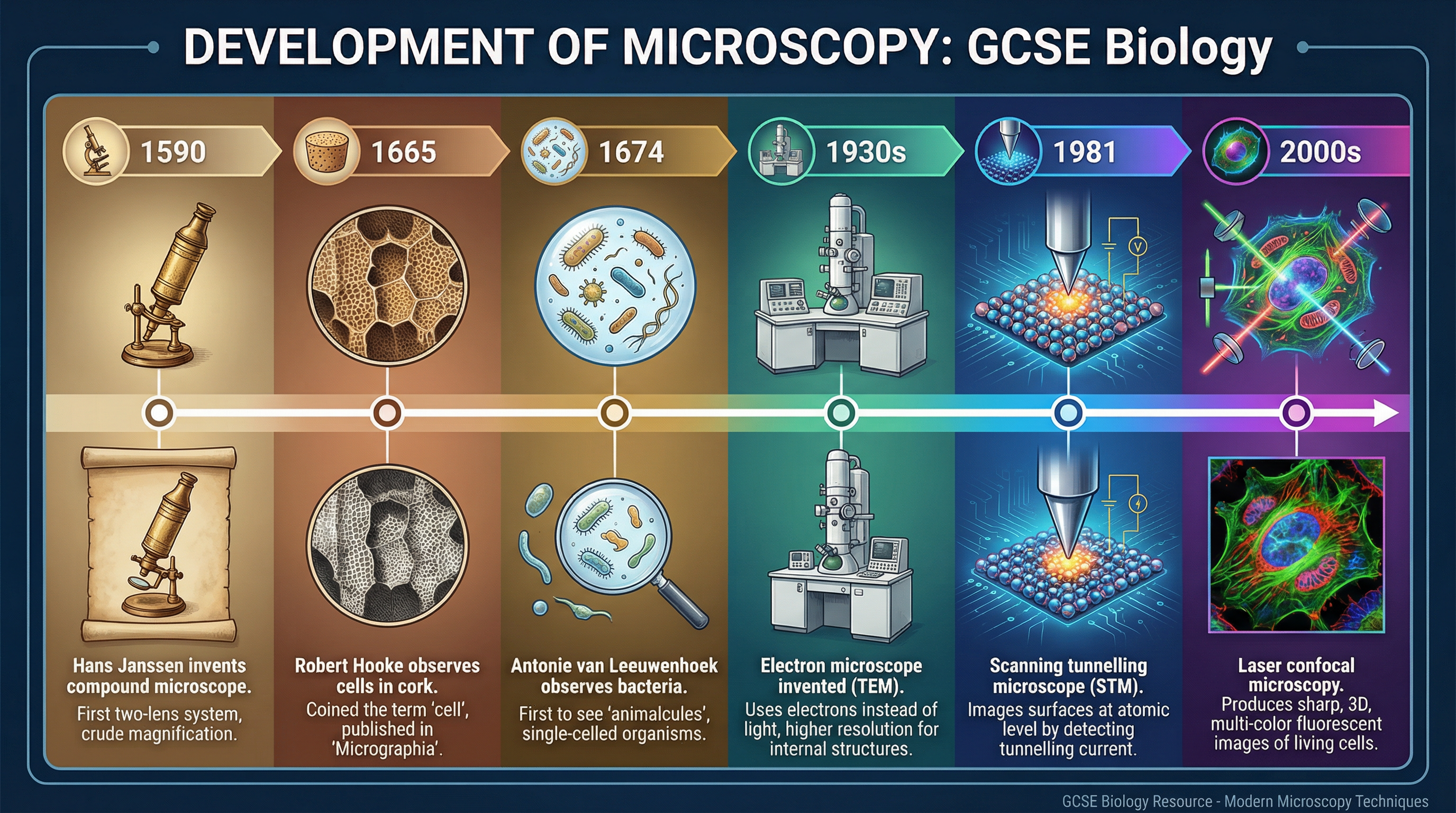
To see cells, we use microscopes. The technology has evolved significantly over time.
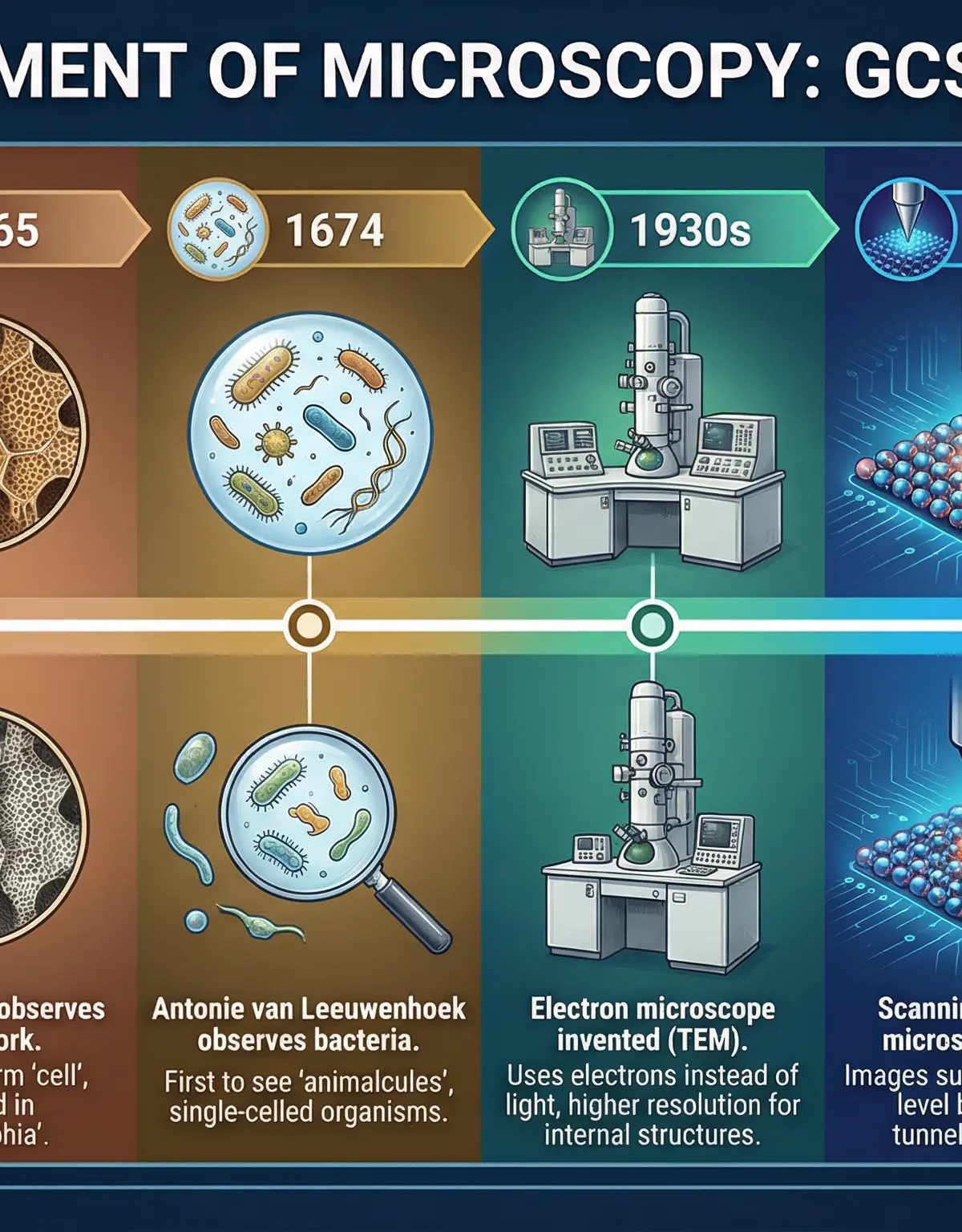
- Light Microscopes: Use light and lenses to form an image of a specimen and magnify it. They let us see individual cells and large subcellular structures, like nuclei. Resolution: ~200 nm. Magnification: up to x2000.
- Electron Microscopes: Use electrons instead of light to form an image. They have a much higher magnification and a much higher resolution (the ability to distinguish between two points, giving a sharper image). They let us see much smaller things in more detail, like the internal structure of mitochondria and chloroplasts. Resolution: ~0.1 nm. Magnification: up to x2,000,000.
Mathematical/Scientific Relationships
To calculate the magnification of an image, you must use the following formula:
Magnification = Image Size ÷ Actual Size
- Image Size (I): The size of the object as it appears in the drawing or photograph (usually measured with a ruler in mm or cm).
- Actual Size (A): The real-life size of the object (often given in µm or nm).
- Magnification (M): How many times larger the image is compared to the actual object.
Important: Ensure both Image Size and Actual Size are in the SAME units before calculating. 1 mm = 1000 µm. 1 µm = 1000 nm.
Practical Applications
Required Practical: Using a Light MicroscopeYou must know how to prepare a slide (e.g., using an onion epidermal layer), stain it (e.g., with iodine to make structures visible), and observe it using a light microscope. You must also be able to draw what you see accurately and calculate the magnification of your drawing.
Listen to the podcast for a full breakdown of the topic and a quick-fire recall quiz:
Visual Resources
3 diagrams and illustrations
Interactive Diagrams
2 interactive diagrams to visualise key concepts
Conceptual Flow Outline
Classification of cell types and their key organelles.
Conceptual Flow Outline
The relationship between Actual Size, Image Size, and Magnification.
Worked Examples
3 worked examples — open one to explore the question and available guidance.
Practice Questions
Test your understanding — click to reveal model answers
Name the substance that makes up the plant cell wall. [1 mark]
Hint: It starts with the letter C.
Describe the function of ribosomes and state where they are found in a cell. [2 marks]
Hint: Think about what important biological molecules are made here.
A bacterial cell has a length of 2 µm. Calculate its length in millimetres. Give your answer in standard form. [2 marks]
Hint: Divide by 1000 to convert micrometres to millimetres.
A student claims that all cells have a nucleus. Evaluate this claim using examples. [4 marks]
Hint: Think about the two main categories of cells. Are there any exceptions even within eukaryotic cells?
Explain how the development of the electron microscope has increased our understanding of sub-cellular structures. [3 marks]
Hint: Compare its capabilities to the light microscope and mention specific organelles.