Eduqas · GCSE · Biology
Some of the biological challenges of increasing food yields using fewer resources
This topic explores the tension between feeding a growing global population and protecting the environment. You will learn to evaluate the biological factors threatening food security and the biotechnological solutions, like GM crops, designed to solve them.
- 5 min read
- 3 worked examples
- 5 practice questions
- 6 key terms
Study Notes
Overview

Topic 6.4 is a crucial synoptic area in your Biology specification. It brings together concepts from ecology, genetics, and human biology to address one of the greatest challenges of the 21st century: food security.
This topic is fundamentally about balance. How do we produce enough food for a rapidly expanding human population without destroying the natural ecosystems that sustain us? You will need to understand the biological factors that limit food production—such as pests, pathogens, and climate change—and evaluate the modern biotechnological solutions designed to overcome them. Examiners love this topic because it tests your ability to think critically. You will frequently encounter 6-mark 'evaluate' questions where you must weigh the benefits of agricultural innovations against their environmental risks, using specific biological examples to justify your conclusions.
Listen to the podcast overview here:
Key Concepts
Concept 1: The Definition and Challenge of Food Security
Food security is not just about having 'enough food'. The precise biological definition you must use in exams is: the ability of human populations to access sufficient, safe, and nutritious food to maintain a healthy and active life.
The core biological challenge is that human population growth is exponential, but the land available for agriculture is finite. If we simply clear more land (deforestation) to grow crops, we destroy habitats, reduce biodiversity, and contribute to climate change—which in turn reduces future crop yields. Therefore, the goal is to increase the yield (food produced per unit area) using fewer resources (water, land, synthetic chemicals).
Concept 2: Biological Factors Threatening Food Security
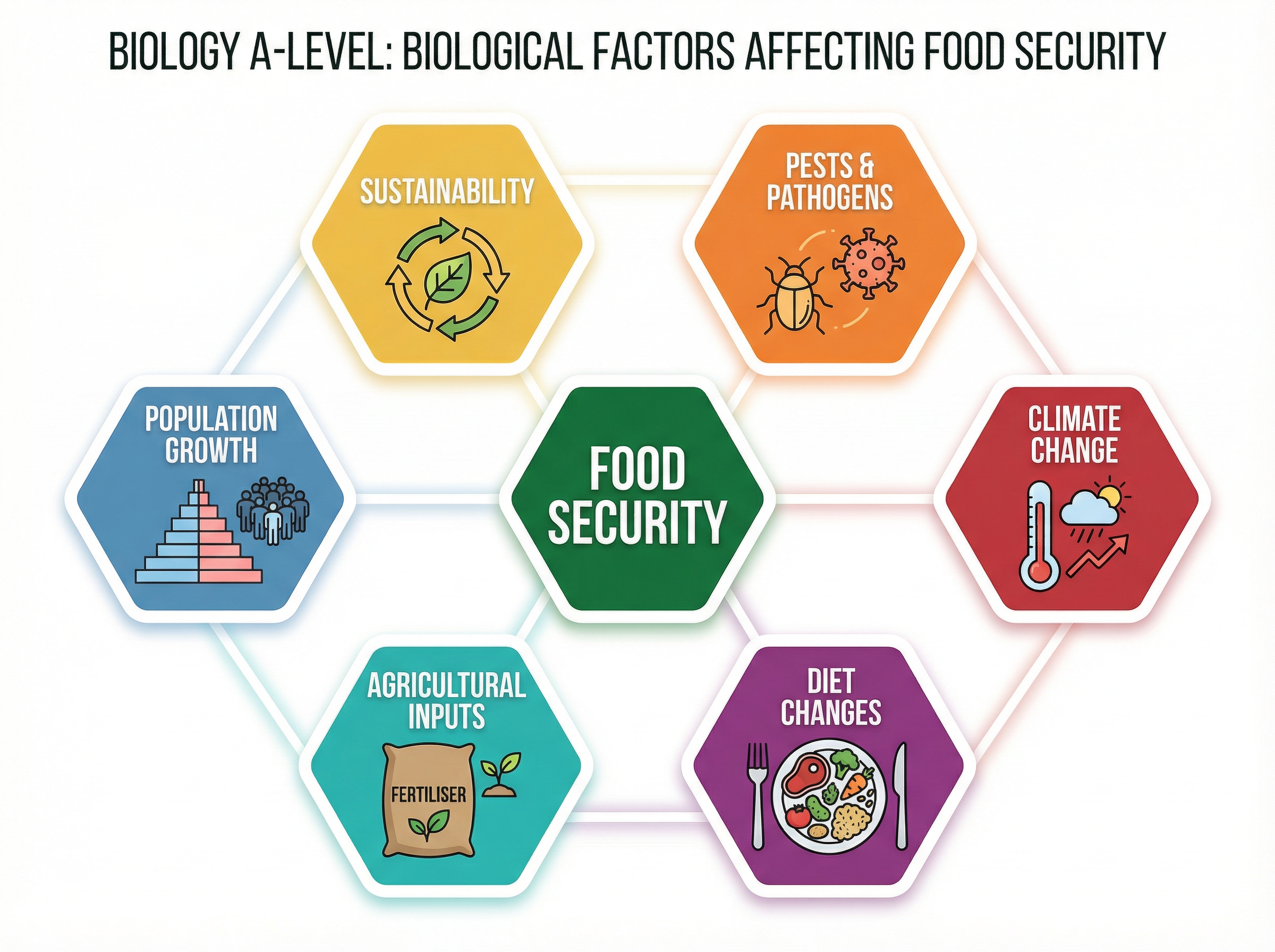
There are six key biological factors you need to be able to discuss. Use the acronym PPDCAS to remember them.
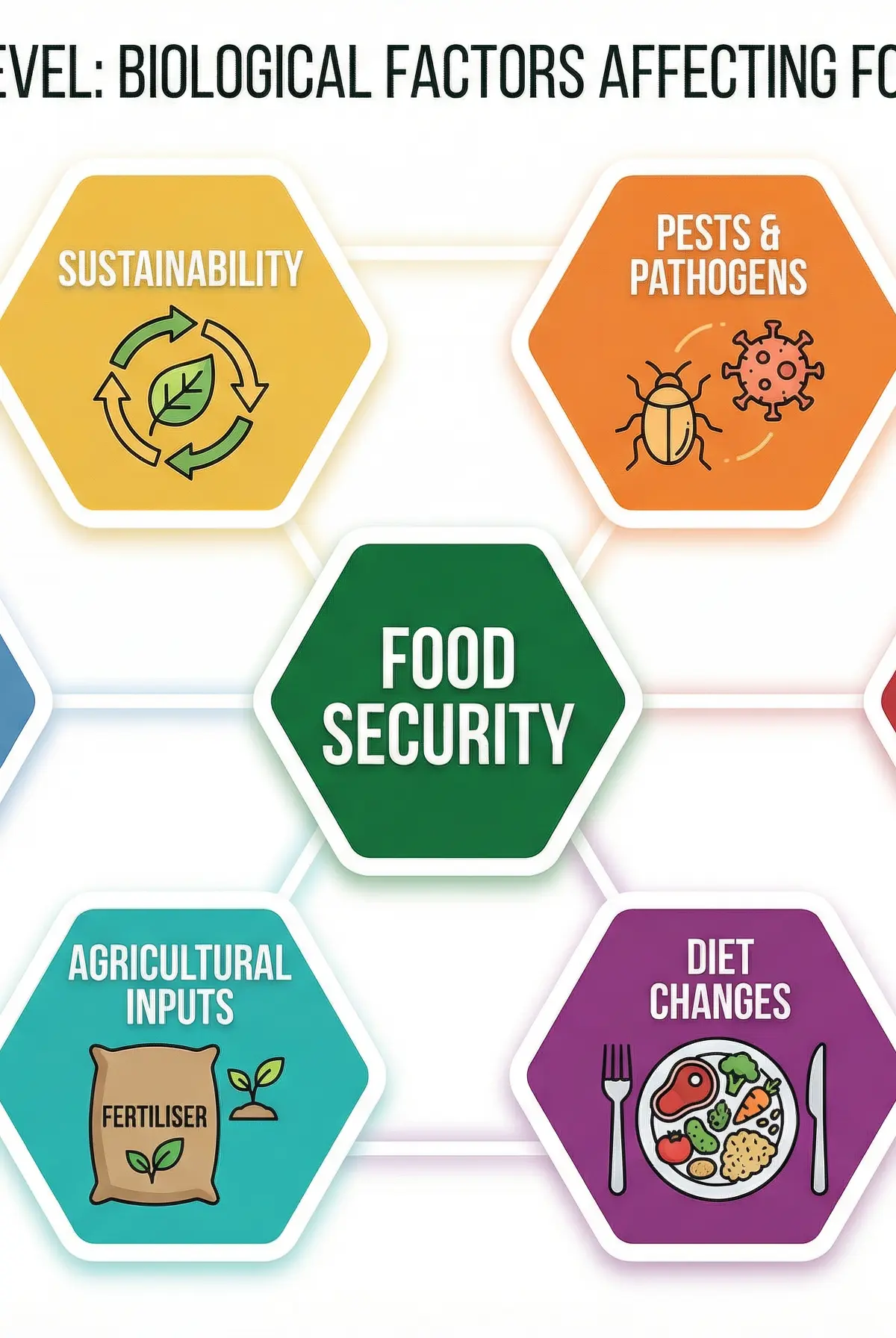
- Population Growth: The global population is approaching 10 billion. This increases the absolute demand for calories and protein.
- Pathogens and Pests: Fungal pathogens (e.g., Puccinia graminis causing wheat rust) and insect pests (e.g., aphids) reduce the net productivity of crops. They damage photosynthetic tissue or consume the crop directly.
- Diet Changes: As countries develop economically, diets often shift to include more meat. Biologically, this is highly inefficient due to energy loss between trophic levels. It takes roughly 7kg of grain to produce 1kg of beef.
- Climate Change: Altered temperatures and rainfall patterns affect enzyme activity in crops, altering photosynthetic rates and reducing yields in many regions.
- Agricultural Inputs: The heavy use of synthetic fertilisers and pesticides causes environmental damage, such as eutrophication and the decline of pollinator populations.
- Sustainability: Farming practices that deplete soil nutrients or water tables cannot be maintained long-term, threatening future food security.
Concept 3: Biotechnological Solutions (Genetic Modification)
To increase yields without using more land, scientists use genetic modification (GM). This involves transferring a beneficial gene from one organism into the genome of a crop plant.
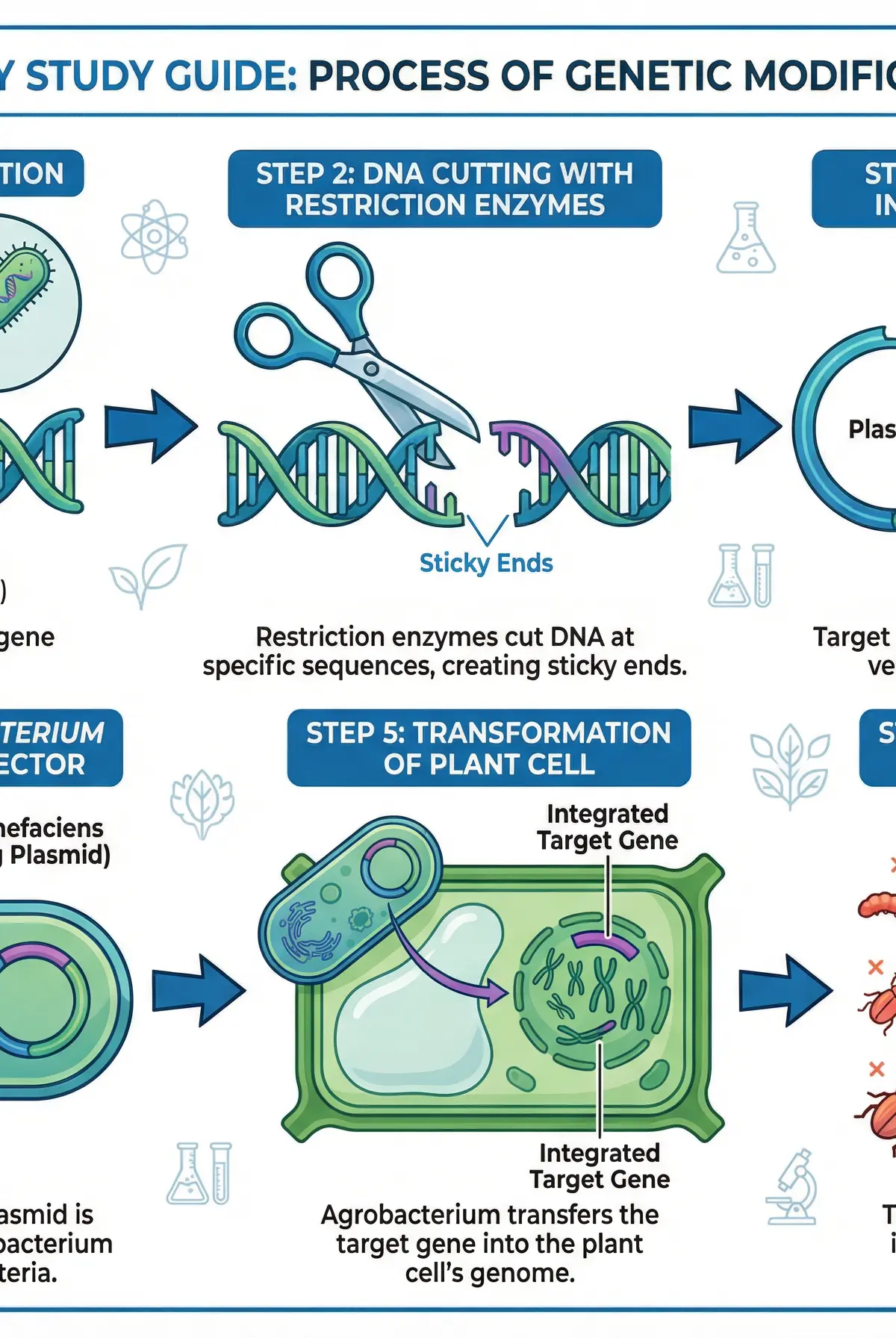
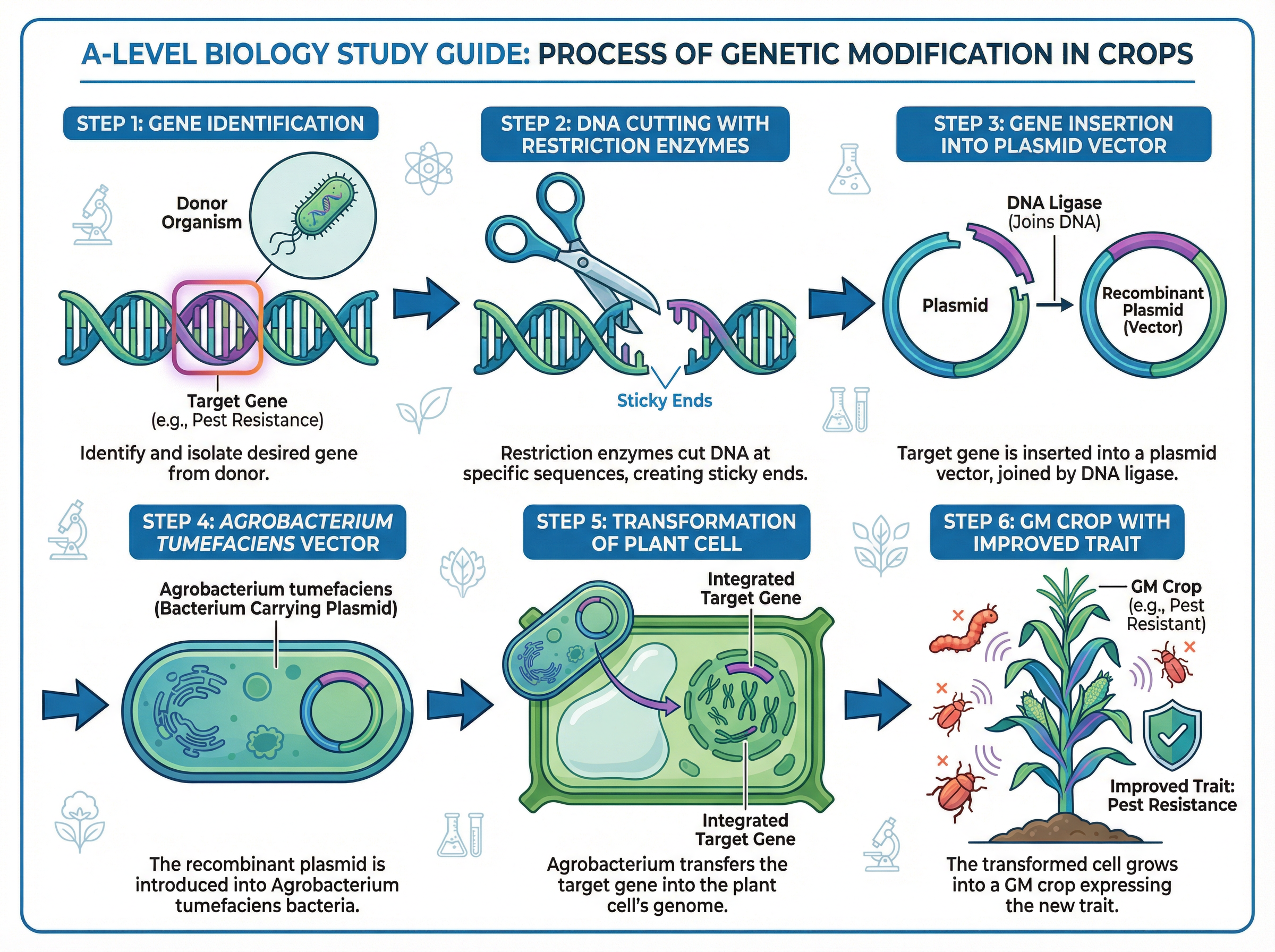
The Process of GM:
- The target gene (e.g., for pest resistance) is identified and isolated using restriction enzymes.
- The gene is inserted into a vector, typically a bacterial plasmid.
- The vector is introduced into the plant cell, often using the bacterium Agrobacterium tumefaciens.
- The plant cell incorporates the gene into its own DNA and expresses the new trait.
Examples:
- Bt Cotton/Maize: Contains a gene from the bacterium Bacillus thuringiensis that produces a toxin lethal to specific insect pests, reducing the need for chemical pesticides.
- Golden Rice: Engineered to produce beta-carotene to combat Vitamin A deficiency.
**Evaluation for Exams:**When evaluating GM crops, you must balance the benefits (higher yields, reduced chemical pesticide use, improved nutritional value) against the risks (potential cross-pollination with wild relatives creating 'superweeds', reduction in genetic diversity, and unknown long-term ecological impacts).
Concept 4: The Role of Scientific Monitoring
Organisations like the Environment Agency monitor the environment to provide data that informs management decisions. For example, they monitor nitrate levels in rivers to detect agricultural run-off, and survey indicator species to assess biodiversity. This scientific data is essential for creating policies that balance food production with conservation.
Mathematical/Scientific Relationships
- Trophic Efficiency: Energy transfer between trophic levels is typically only about 10%.
- Efficiency = (Energy available after the transfer / Energy available before the transfer) × 100
- This explains why meat-based diets require significantly more land and resources than plant-based diets.
Practical Applications
Understanding these concepts is vital for modern agronomy. Precision farming now uses drone technology and GPS to apply fertilisers only exactly where needed, reducing waste and environmental impact. Meanwhile, researchers are developing crops that can fix their own nitrogen, potentially eliminating the need for synthetic fertilisers altogether.
Visual Resources
2 diagrams and illustrations
Interactive Diagrams
2 interactive diagrams to visualise key concepts
Conceptual Flow Outline
Flowchart showing the biological and environmental consequences of dietary shifts towards meat consumption.
Conceptual Flow Outline
The sequence of events in the genetic modification of a crop plant.
Worked Examples
3 worked examples — open one to explore the question and available guidance.
Practice Questions
Test your understanding — click to reveal model answers
State two biological factors that can decrease crop yields. (2 marks)
Hint: Think about living things that might attack the crop.
Explain why food chains are rarely longer than four or five trophic levels. (3 marks)
Hint: Think about the 10% rule and what happens to energy as it moves through the chain.
Describe the role of the Environment Agency in managing the conflict between food production and conservation. (3 marks)
Hint: Do they make the laws, or do they gather the evidence?
A farmer is considering switching from growing wheat to raising cattle on their land. Discuss the implications of this change for global food security. (4 marks)
Hint: Consider the efficiency of energy transfer and land use.
Evaluate the use of artificial fertilisers to increase crop yields. (5 marks)
Hint: You need pros, cons, and a conclusion.