Eduqas · GCSE · Biology
Transport in cells
Master the essential mechanisms of how substances move in and out of cells. This topic covers diffusion, osmosis, active transport, and why large organisms need specialised exchange surfaces—concepts that appear in almost every Biology exam paper.
- 7 min read
- 3 worked examples
- 5 practice questions
- 6 key terms
Study Notes
Overview

Transport in cells is a fundamental topic in GCSE Biology that explores how essential substances enter cells and how waste products are removed. Every cell in a living organism needs resources like oxygen and glucose for respiration, and must eliminate metabolic waste like carbon dioxide and urea.
Understanding these mechanisms is crucial because they underpin many other biological systems you will study, from gas exchange in the lungs to the absorption of nutrients in the digestive system and water uptake by plant roots. Examiners frequently test your ability to distinguish between the three main transport processes: diffusion, osmosis, and active transport. You will often be asked to apply these concepts to novel situations, interpret experimental data (such as the classic potato chip osmosis practical), and explain why larger multicellular organisms have evolved complex transport systems while single-celled organisms have not.
Key Concepts
Concept 1: Diffusion
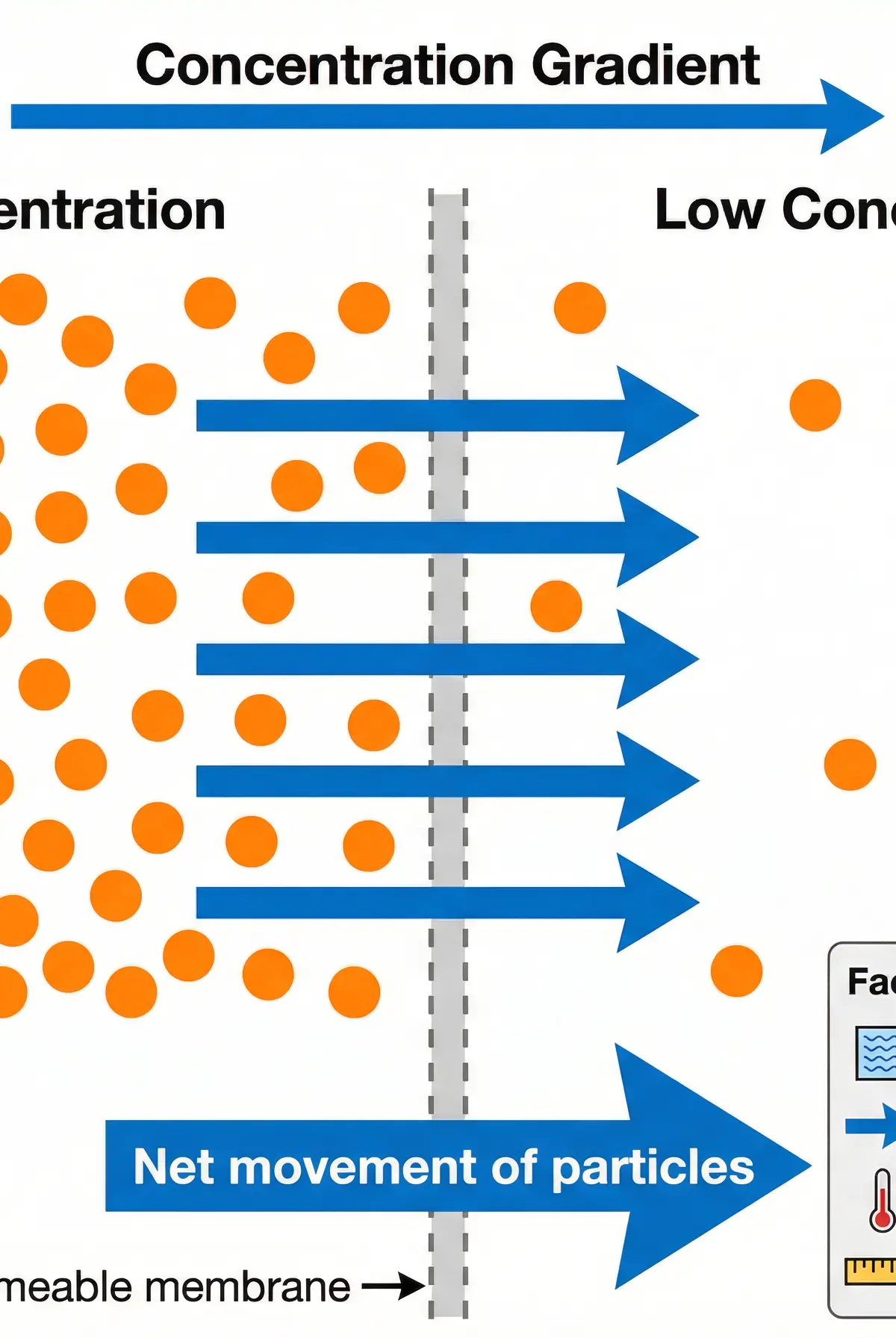
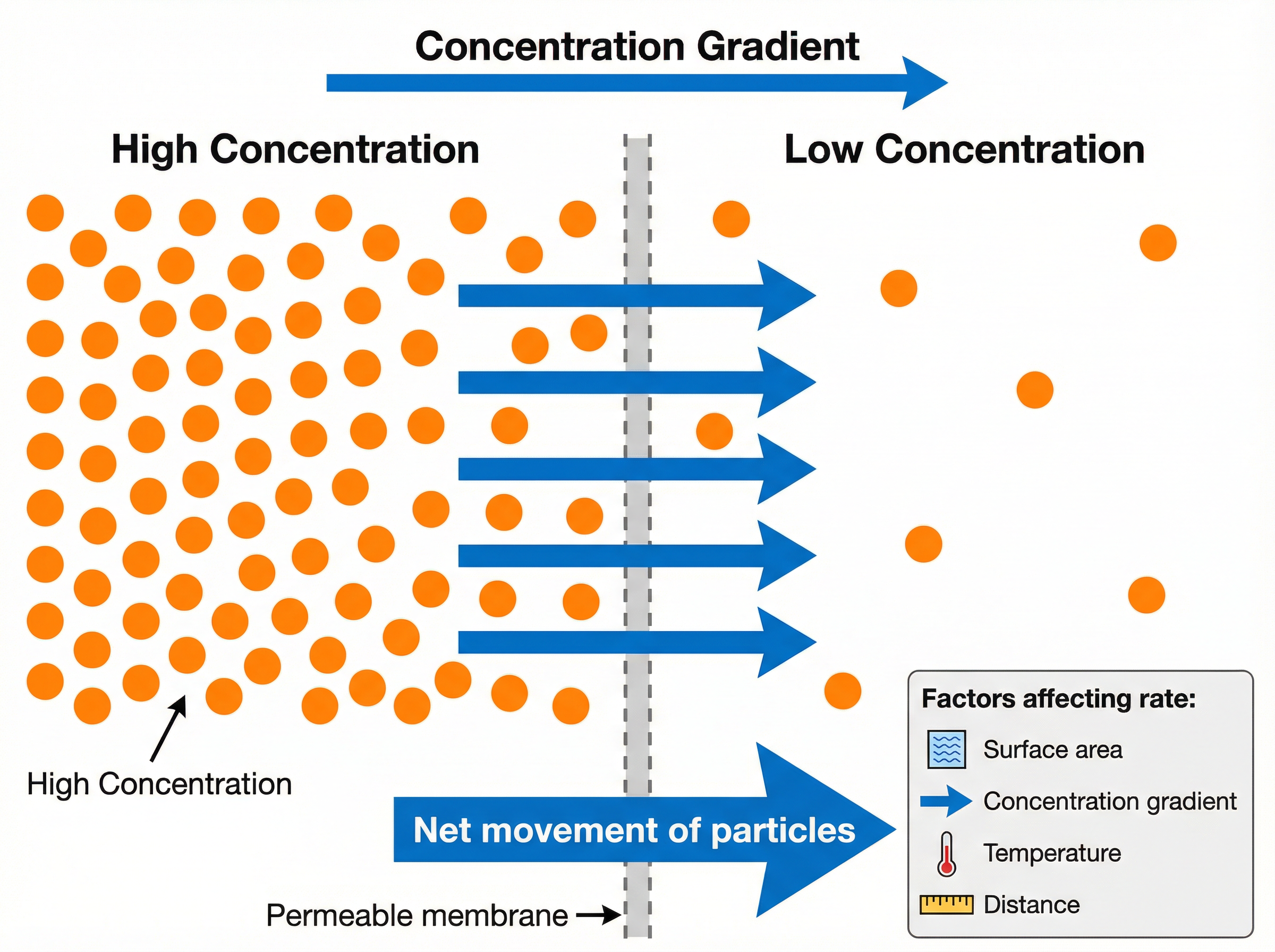
Diffusion is the net movement of particles from an area of higher concentration to an area of lower concentration. It is a passive process, meaning it does not require energy from the cell. The movement is driven entirely by the random kinetic motion of particles.
In a biological context, diffusion happens across cell membranes. For example, oxygen diffuses from the alveoli in the lungs (where its concentration is high) into the blood (where its concentration is low).
Examiners often ask about the factors that affect the rate of diffusion. There are three main factors to remember:
- Concentration Gradient: The steeper the gradient (the larger the difference in concentration), the faster the rate of diffusion.
- Temperature: Higher temperatures give particles more kinetic energy, causing them to move faster and increasing the rate of diffusion.
- Surface Area: A larger surface area of the cell membrane provides more space for particles to cross, increasing the rate of diffusion.
Concept 2: Osmosis
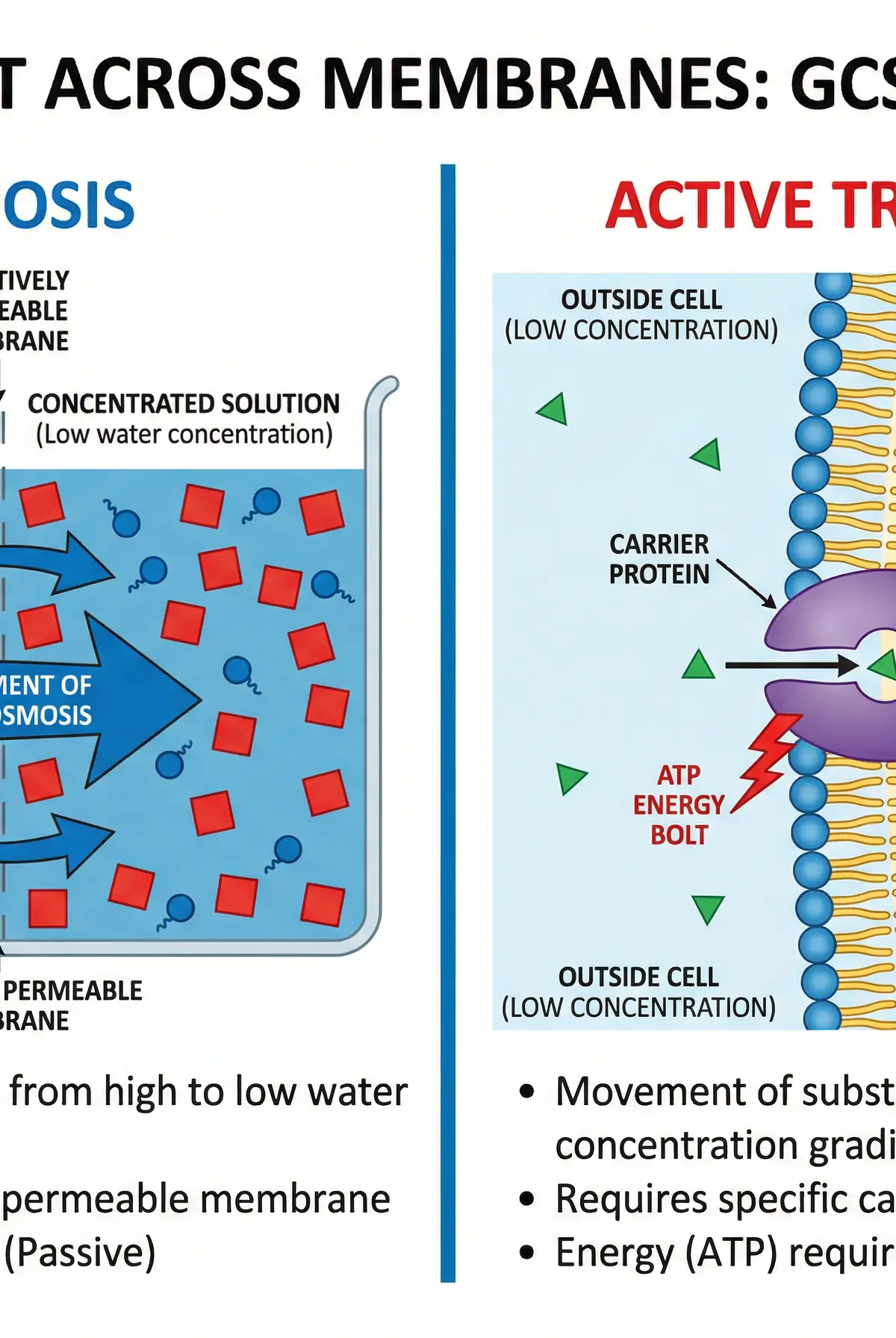
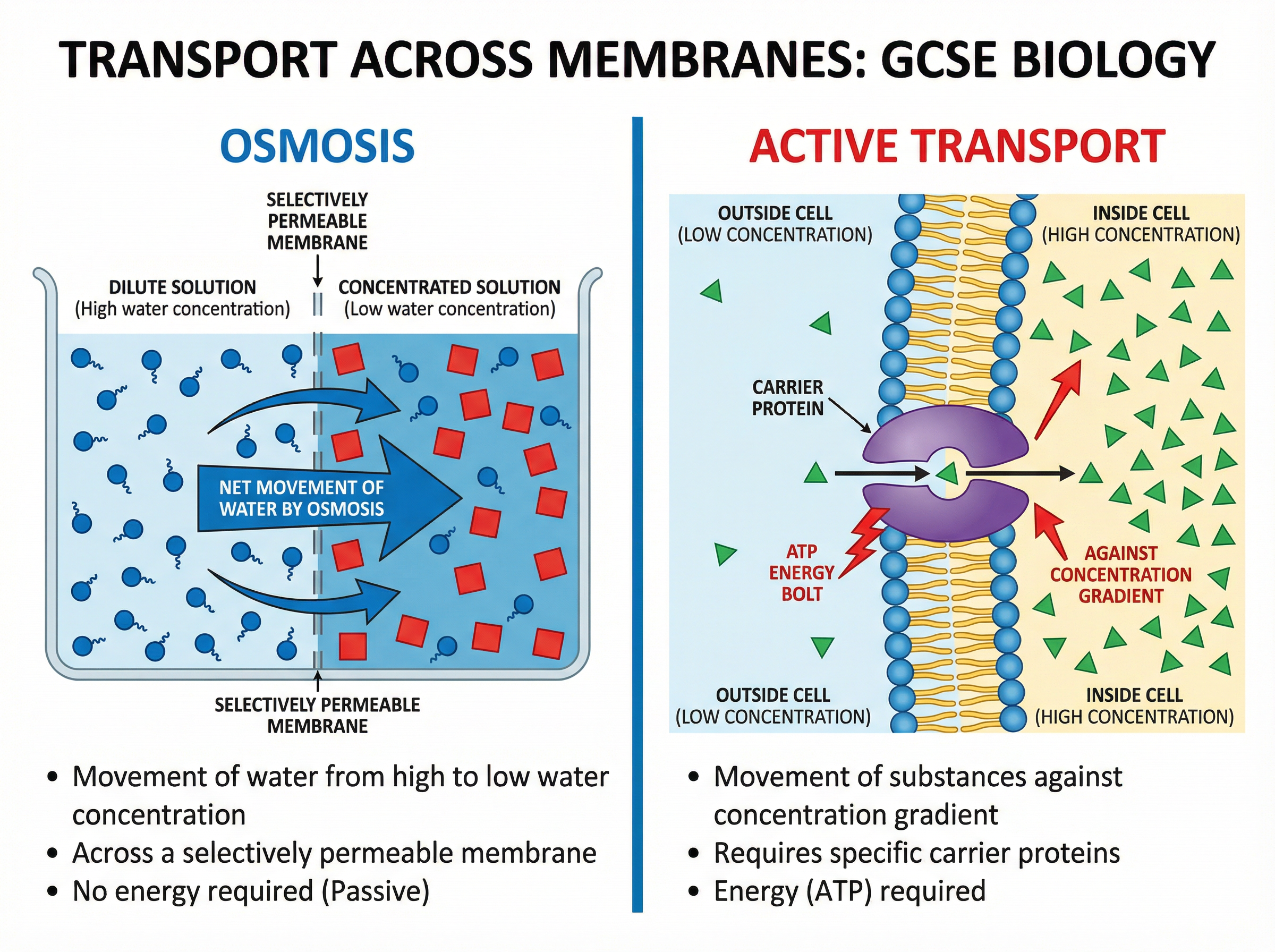
Osmosis is a specific type of diffusion. It is defined as the diffusion of water molecules from a dilute solution (high water concentration) to a concentrated solution (low water concentration) across a selectively permeable membrane.
This concept frequently trips candidates up. The key is to focus on the water molecules. A dilute solution has a high concentration of water molecules and a low concentration of solute (like sugar or salt). A concentrated solution has a low concentration of water molecules and a high concentration of solute. Water always moves down its own concentration gradient.
In exams, you must explicitly mention the selectively permeable membrane and refer to water concentration or water potential, rather than just 'concentration'. A classic example is plant root hair cells absorbing water from the soil.
Concept 3: Active Transport
Unlike diffusion and osmosis, active transport is an active process. It is the movement of substances from a more dilute solution to a more concentrated solution (against a concentration gradient). Because this movement is against the natural flow, it requires energy released from respiration.
Active transport relies on specific carrier proteins embedded in the cell membrane. These proteins use ATP (energy) to change shape and pump molecules across the membrane.
Examiners love to ask for examples of active transport. You should know two key ones:
- In plants: Root hair cells use active transport to absorb mineral ions (like nitrates) from the soil, where they are in very low concentrations, into the cell, where they are in higher concentrations.
- In humans: Sugar molecules (glucose) are absorbed from lower concentrations in the gut into the blood, which has a higher sugar concentration.
Concept 4: Surface Area to Volume Ratio (SA:V)

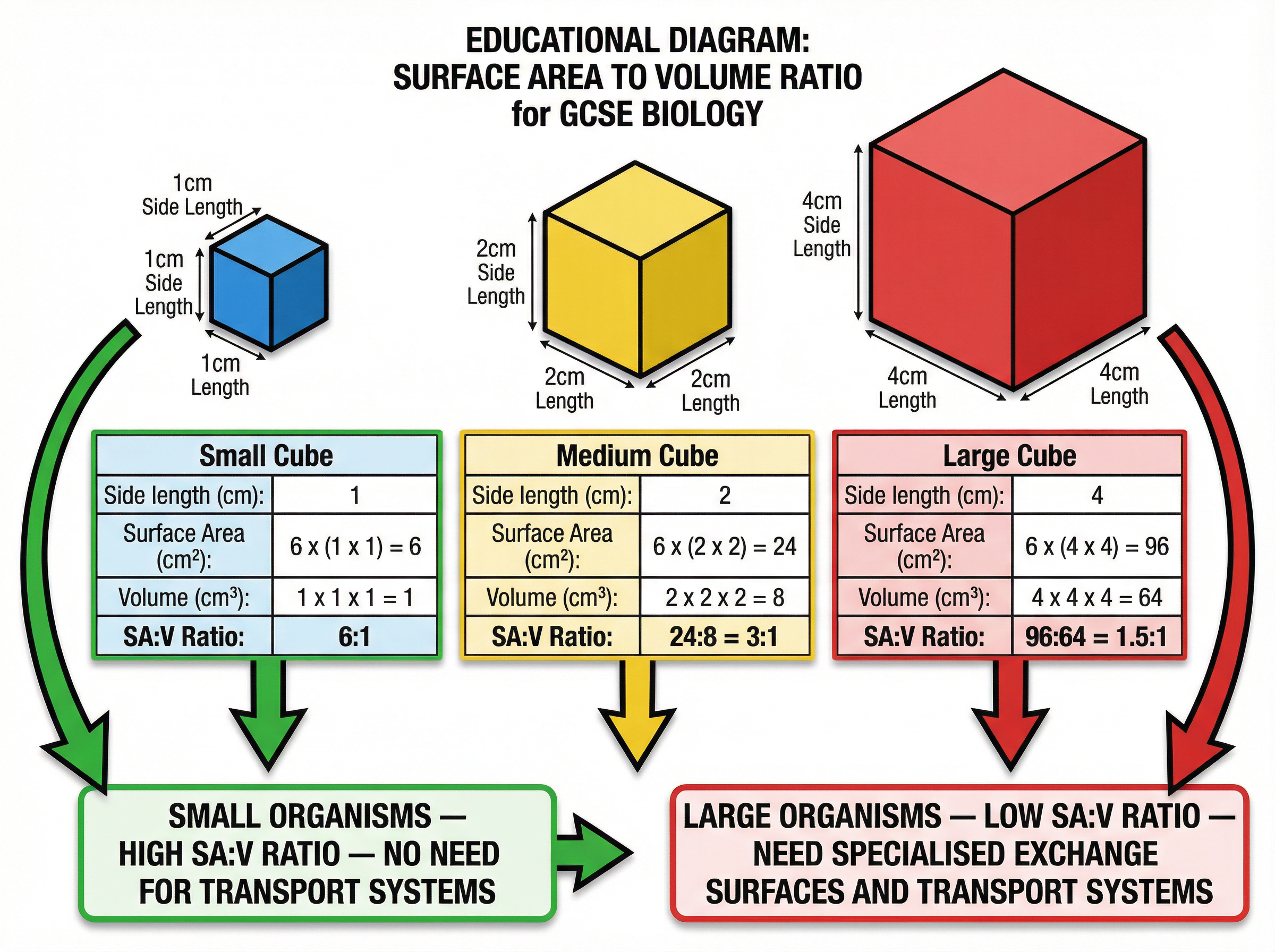
Single-celled organisms, like bacteria, have a very large surface area to volume ratio. This means their cell membrane has enough surface area to supply all the volume inside the cell with oxygen and nutrients via simple diffusion.
However, as organisms get larger, their volume increases much faster than their surface area. Multicellular organisms have a small surface area to volume ratio. Simple diffusion is no longer sufficient to meet the needs of all the cells deep inside the body.
To solve this, large organisms have evolved specialised exchange surfaces (like lungs, gills, or leaves) and transport systems (like the circulatory system or xylem/phloem) to move substances efficiently around the body.
Mathematical/Scientific Relationships
**Percentage Change in Mass (Osmosis Practical)**Examiners frequently ask you to calculate the percentage change in mass of potato tissue in osmosis experiments. This allows for a fair comparison when the starting masses of the potato cylinders are different.
[ \text{Percentage Change} = \frac{\text{Final Mass} - \text{Initial Mass}}{\text{Initial Mass}} \times 100 ]
- A positive result indicates a gain in mass (water moved IN by osmosis).
- A negative result indicates a loss in mass (water moved OUT by osmosis).
Practical Applications
Required Practical: Investigating Osmosis in Plant TissueYou must know how to investigate the effect of a range of concentrations of salt or sugar solutions on the mass of plant tissue (usually potato cylinders).
- Cut identical cylinders of potato using a cork borer.
- Measure and record the initial mass of each cylinder.
- Place each cylinder in a different concentration of sugar/salt solution (including one in distilled water as a control).
- Leave them for a set amount of time (e.g., 30 minutes).
- Remove the cylinders, blot them dry gently with a paper towel (to remove excess surface water which would affect the mass reading), and measure their final mass.
- Calculate the percentage change in mass.
Examiners often ask why you must blot the potato dry (to ensure changes in mass are only due to osmosis inside the tissue, not water sitting on the outside) and how to identify the concentration of the potato cells (it is the concentration on the graph where the line of best fit crosses the x-axis, i.e., where there is 0% change in mass).
Audio Lesson
Listen to the complete podcast covering all key concepts, common mistakes, and a quick-fire recall quiz:
Visual Resources
3 diagrams and illustrations
Interactive Diagrams
2 interactive diagrams to visualise key concepts
Conceptual Flow Outline
Decision tree for identifying the correct transport mechanism.
Conceptual Flow Outline
Factors affecting the rate of diffusion.
Worked Examples
3 worked examples — open one to explore the question and available guidance.
Practice Questions
Test your understanding — click to reveal model answers
State three factors that increase the rate of diffusion.
Hint: Think about what gives particles more energy, and what gives them more space to move across.
A piece of potato is placed in distilled water. Explain what will happen to the mass of the potato.
Hint: Identify where the water concentration is highest, which way the water will move, and by what process.
Compare the processes of diffusion and active transport.
Hint: You need to give similarities AND differences. Think about energy requirements and concentration gradients.
Explain why single-celled organisms do not need complex transport systems like humans do.
Hint: Think about the relationship between their size, surface area, and volume.
In an experiment, a student dried the potato cylinders with a paper towel before weighing them for their final mass. Explain why this step was necessary.
Hint: Think about what the student is trying to measure, and what might interfere with that measurement.