Eduqas · GCSE · Biology
Transport systems in plants
Master the intricate transport networks of plants. This topic covers how water, minerals, and sugars move through xylem and phloem, the critical roles of osmosis and active transport, and the environmental factors driving transpiration—essential knowledge for high-mark exam questions.
- 8 min read
- 3 worked examples
- 5 practice questions
- 6 key terms
Study Notes
Overview
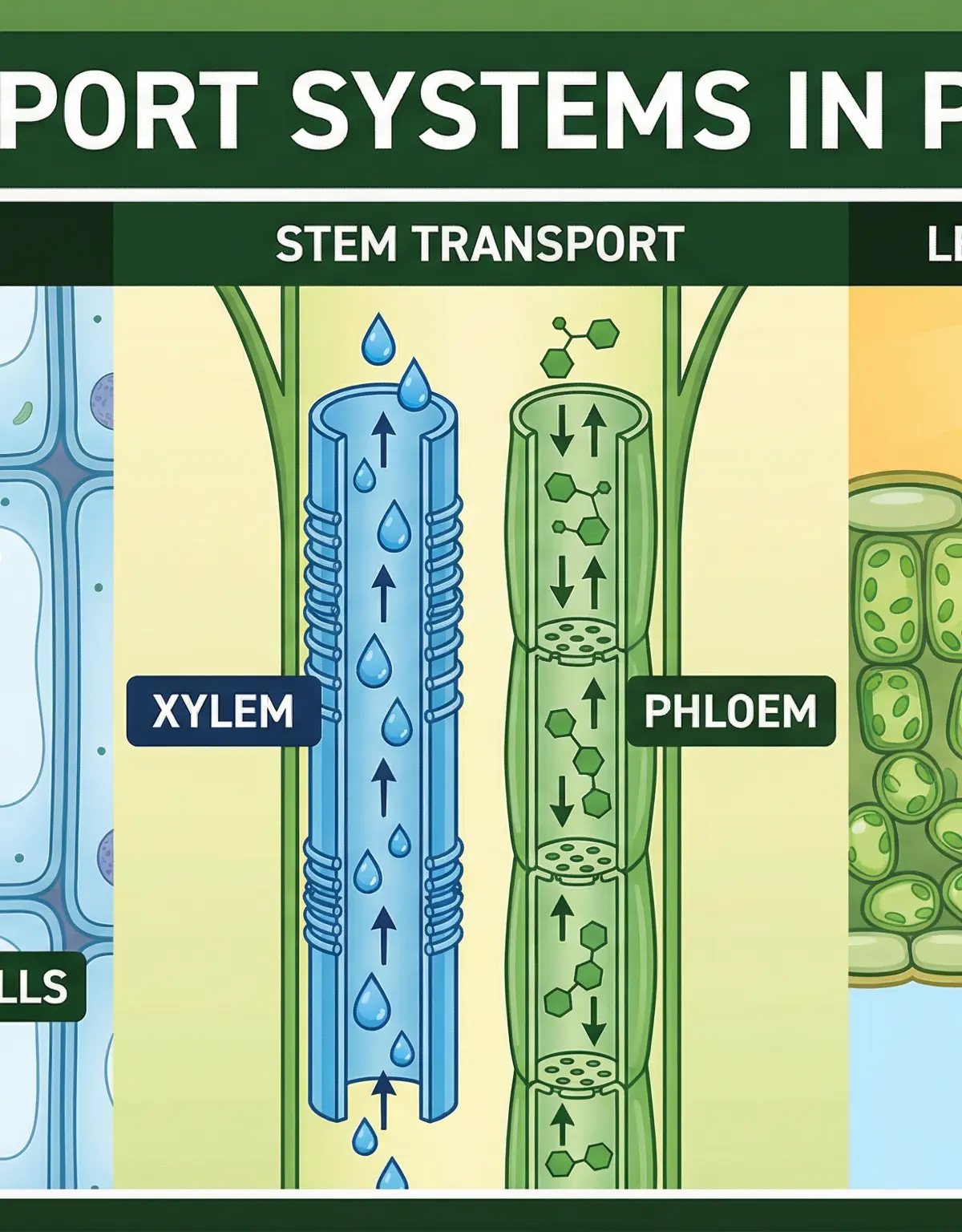
Plants may appear stationary, but inside they operate a remarkably sophisticated, continuous transport network. This topic explores how plants move essential substances—water, mineral ions, and sugars—from where they are absorbed or produced to where they are needed. You will learn about the specialized tissues involved, namely xylem and phloem, and the physical processes that drive this movement, such as osmosis, active transport, and transpiration.
Understanding plant transport is crucial because it links fundamental cellular processes to whole-organism survival. It frequently connects with other major topics like photosynthesis (which requires the water and produces the sugars being transported) and bioenergetics (respiration requires the transported sugars). In exams, you can expect a mix of short recall questions on tissue structure, calculation questions involving transpiration rates (often using potometer data), and longer 6-mark questions requiring you to explain how environmental factors affect water loss or to compare the functions of xylem and phloem.
Key Concepts
Concept 1: Uptake at the Roots
The journey begins in the soil. Plant roots are adapted for maximum absorption through the presence of root hair cells. These cells have long, thin extensions that dramatically increase the surface area to volume ratio, allowing for efficient uptake of water and minerals.
**Water Uptake via Osmosis:**Water enters the root hair cells by osmosis. The soil water typically has a higher water concentration (higher water potential) than the cytoplasm inside the root hair cell. Therefore, water moves down the concentration gradient, across the partially permeable cell membrane, and into the cell. This is a passive process requiring no energy.
**Mineral Uptake via Active Transport:**Unlike water, mineral ions (such as nitrates needed for proteins, and magnesium needed for chlorophyll) are usually found in lower concentrations in the soil than inside the root cells. To absorb them, the plant must use active transport. This process moves ions against their concentration gradient and requires energy released from respiration in the root cells.
Example: If an exam question asks why waterlogged or compacted soil (which lacks oxygen) causes plants to turn yellow and stunt their growth, the answer lies in active transport. Less oxygen means less aerobic respiration, meaning less energy is available for the active transport of essential mineral ions like nitrates and magnesium.
Concept 2: The Xylem and Transpiration Stream
Once inside the root, water and minerals must travel upward to the leaves. This is the job of the xylem tissue.
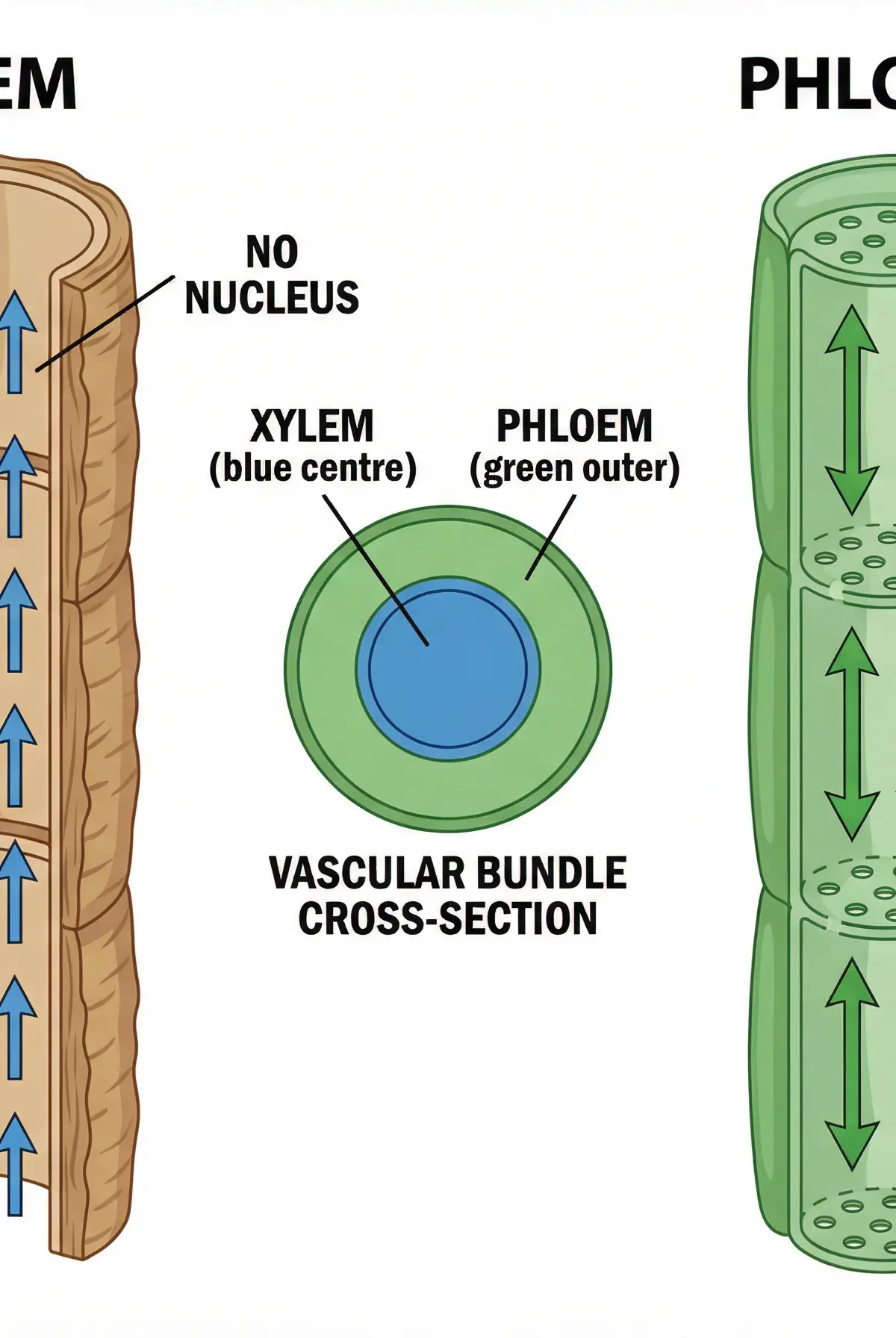
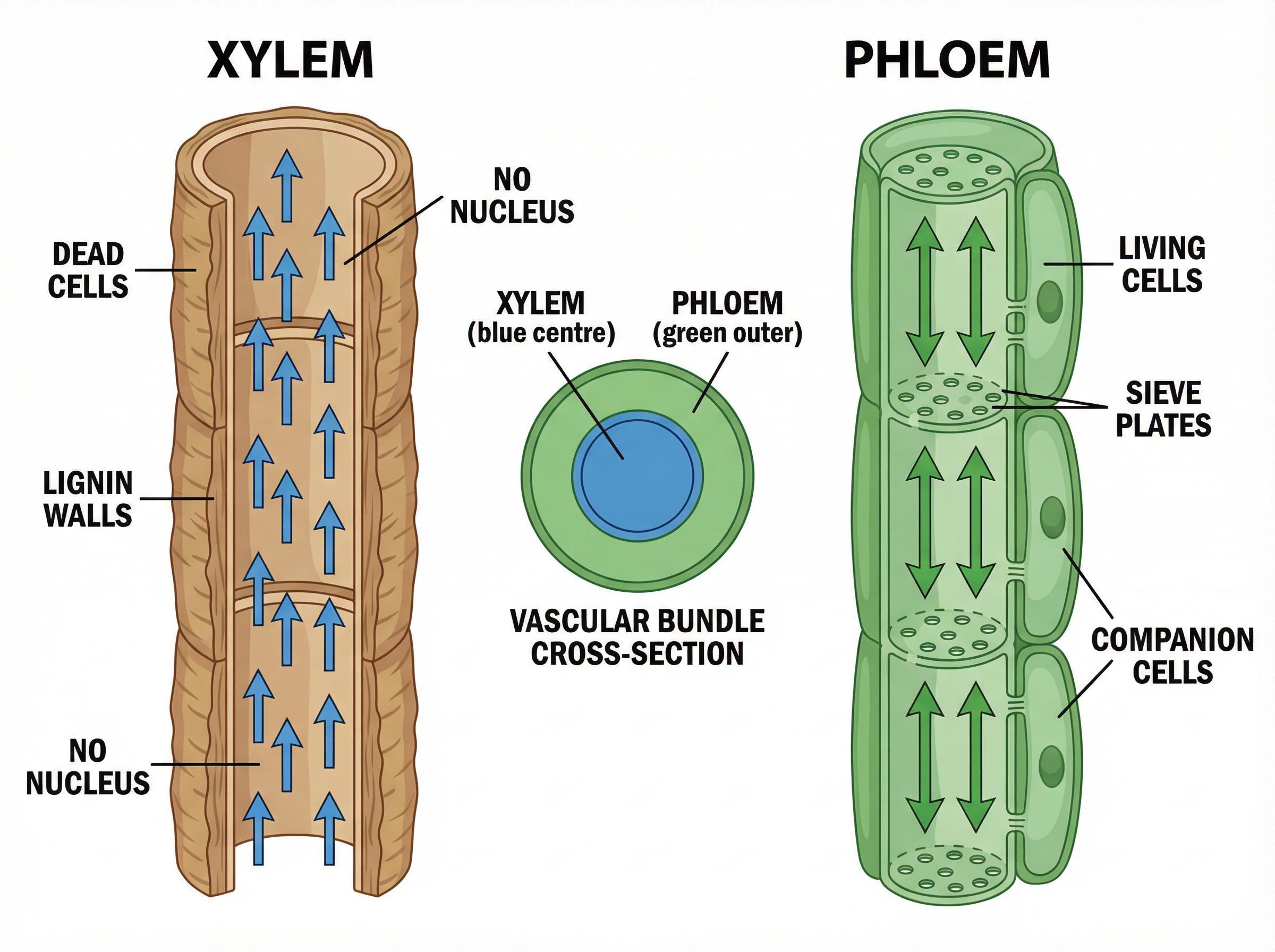
**Structure of Xylem:**Xylem vessels are highly specialized for their function. They are composed of dead cells. During their formation, the end walls between the cells break down, creating a continuous, hollow tube. They have no cytoplasm or nucleus to obstruct the flow of water. Furthermore, the walls of the xylem vessels are strengthened with a woody substance called lignin. This lignin provides structural support, preventing the vessels from collapsing under the tension created by the pulling force of water.
**The Transpiration Stream:**The movement of water through the xylem is driven by transpiration—the loss of water vapour from the leaves. As water evaporates from the mesophyll cells in the leaf and diffuses out through the stomata, it creates a slight shortage of water in the leaf. Because water molecules are cohesive (they stick together), this evaporation pulls more water up through the xylem from the roots to replace what was lost. This continuous upward flow of water and dissolved minerals is known as the transpiration stream.
Concept 3: The Role of Stomata and Guard Cells
Stomata (singular: stoma) are tiny pores, typically found on the lower epidermis of leaves, that allow for gas exchange (carbon dioxide in, oxygen out) for photosynthesis. However, when stomata are open, water vapour also escapes—this is transpiration.
Each stoma is flanked by two guard cells, which control the opening and closing of the pore. When the plant has abundant water and light is present, the guard cells take up water by osmosis, become turgid (swollen), and bend outward, opening the stoma. When water is scarce or it is dark, the guard cells lose water, become flaccid, and the stoma closes. This mechanism is a vital adaptation to prevent excessive water loss and wilting.
Concept 4: Environmental Factors Affecting Transpiration
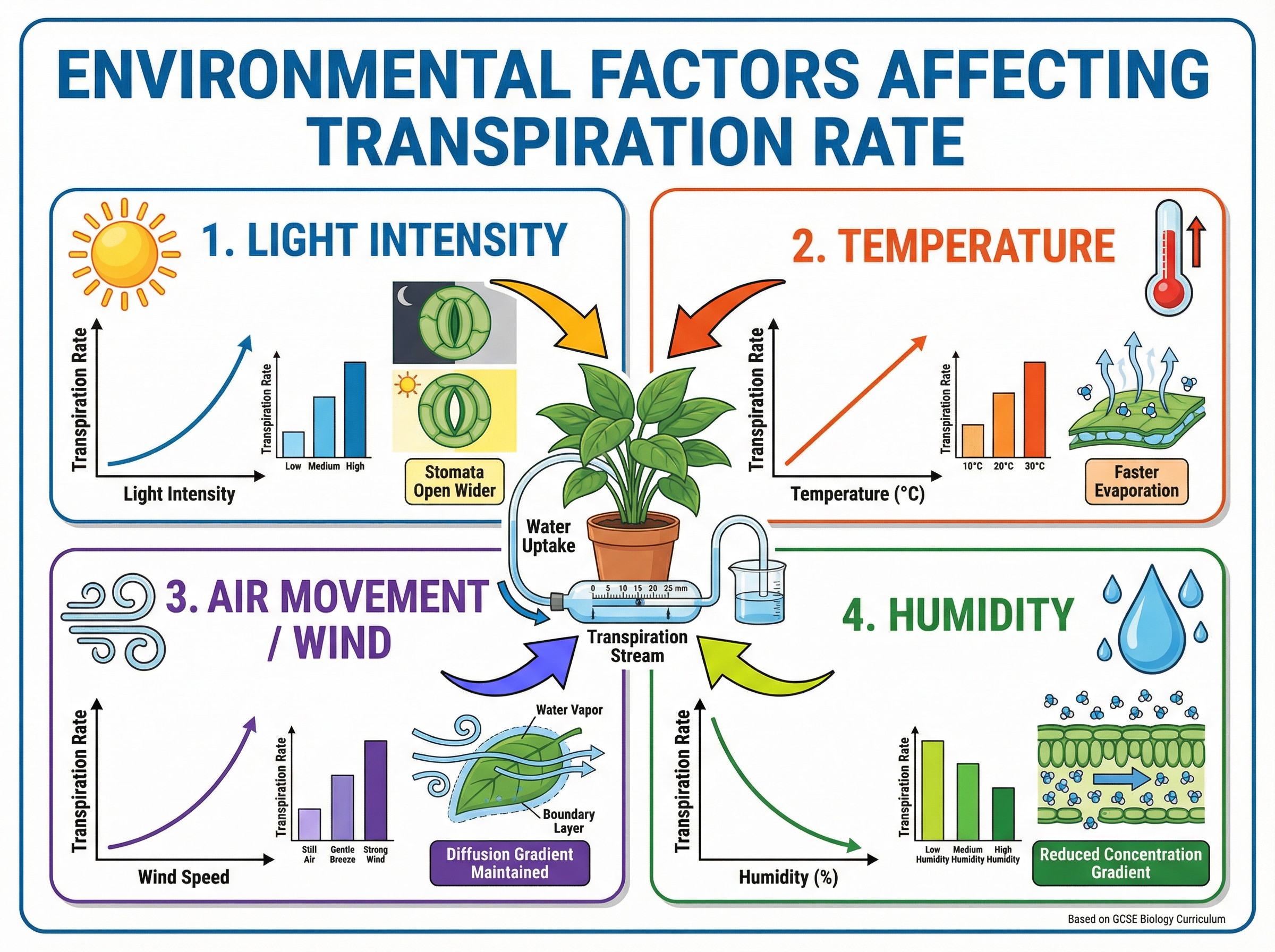
The rate at which a plant loses water is not constant; it is heavily influenced by the environment. Examiners frequently test your understanding of these four factors:
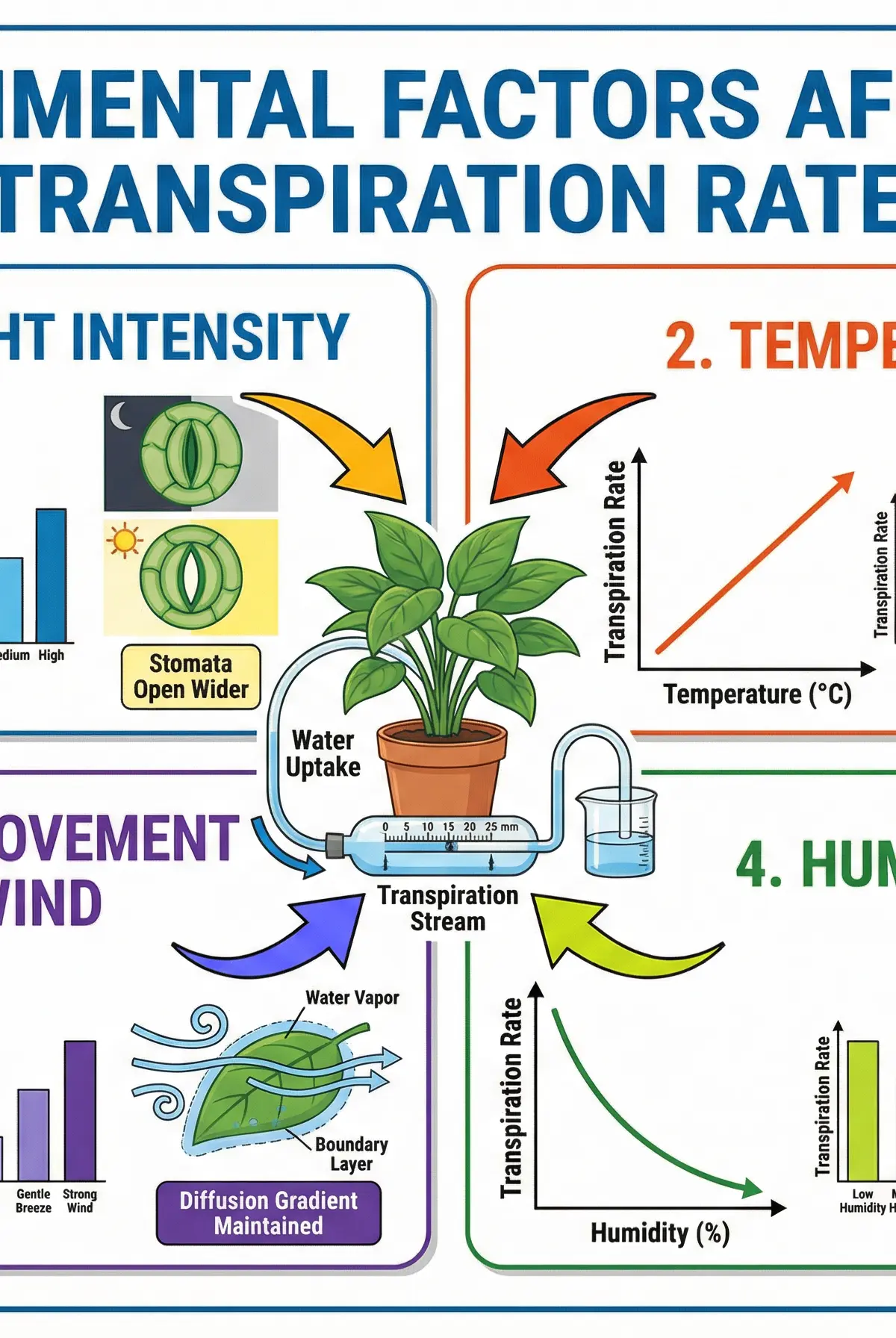
- Light Intensity: Higher light intensity increases the transpiration rate. In bright light, stomata open wider to allow more carbon dioxide in for photosynthesis, which consequently allows more water vapour to diffuse out.
- Temperature: Higher temperatures increase the transpiration rate. The water molecules gain more kinetic energy, causing them to evaporate from the mesophyll cells faster and diffuse out of the stomata more rapidly.
- Air Movement (Wind): Increased air movement increases the transpiration rate. Wind blows away the water vapour that has just diffused out of the leaf. This maintains a steep concentration gradient between the humid inside of the leaf and the drier air outside, promoting faster diffusion.
- Humidity: Higher humidity decreases the transpiration rate. If the air surrounding the leaf is already saturated with water vapour, the concentration gradient between the inside and outside of the leaf is reduced, slowing down the rate of diffusion.
Concept 5: The Phloem and Translocation
While the xylem transports water and minerals upwards, the phloem tissue transports dissolved sugars (primarily sucrose) and amino acids. This transport process is called translocation.
**Structure of Phloem:**Unlike xylem, phloem vessels are composed of living cells. They consist of elongated cells with pores in their end walls, known as sieve plates, which allow the cell sap containing dissolved sugars to flow through. Because these sieve tube elements lose many of their organelles to allow flow, they are supported by companion cells, which provide the energy required for the active transport processes involved in loading and unloading sugars.
**Direction of Flow:**A crucial distinction for exams is the direction of transport. While xylem only transports upwards, phloem can transport substances in both directions—up and down the plant. Translocation moves sugars from 'sources' (regions of production, like photosynthesizing leaves) to 'sinks' (regions of use or storage, such as growing shoot tips, developing fruits, or storage roots like potatoes).
Mathematical/Scientific Relationships
While there isn't a specific equation to memorize for the rate of transpiration, you must be able to calculate a rate from given data, typically from a potometer experiment.
Rate of Transpiration (or Water Uptake) = Distance moved by bubble / Time taken
- Distance: Usually measured in mm or cm.
- Time: Usually measured in minutes or hours.
- Units: mm/min, cm/hour, etc.
Important Note: A potometer technically measures the rate of water uptake, not the exact rate of transpiration. However, because approximately 99% of the water taken up is lost via transpiration, it is used as a valid estimate.
Practical Applications
Investigating Transpiration with a PotometerThis is a classic required practical context. A cut shoot is attached to a capillary tube containing water and a single air bubble. As the shoot transpires, it takes up water, pulling the air bubble along the tube.
- Independent Variable: The environmental factor you change (e.g., light intensity using a lamp at different distances, or wind using a fan).
- Dependent Variable: The distance the bubble moves in a set time (used to calculate the rate).
- Control Variables: Temperature (if testing light), leaf surface area (use the same shoot), time allowed for acclimatization.
- Crucial Setup Step: The shoot must be cut underwater to prevent air from entering the xylem and breaking the continuous water column, which would stop the transpiration stream.
Visual Resources
2 diagrams and illustrations
Interactive Diagrams
2 interactive diagrams to visualise key concepts
Conceptual Flow Outline
The pathway of water and minerals from the soil to the atmosphere (The Transpiration Stream).
Conceptual Flow Outline
Flowchart showing the mechanism by which light intensity increases transpiration rate.
Worked Examples
3 worked examples — open one to explore the question and available guidance.
Practice Questions
Test your understanding — click to reveal model answers
State the name of the process by which water enters a root hair cell. [1 mark]
Hint: Think about the movement of water across a membrane.
Describe the structure of xylem tissue. [2 marks]
Hint: Are the cells alive or dead? What makes them strong?
Explain why the rate of transpiration increases on a windy day. [3 marks]
Hint: Think about what the wind does to the water vapour just outside the leaf and how that affects the concentration gradient.
A student investigated the effect of light intensity on transpiration using a potometer. Explain why the student must cut the plant shoot underwater before inserting it into the potometer. [2 marks]
Hint: What is inside the xylem pulling the water up, and what would break it?
Explain how the structure of root hair cells, xylem, and phloem are adapted to their specific functions in plant transport. [6 marks]
Hint: Structure your answer into three paragraphs, one for each tissue type. State the adaptation and explain how it helps.