Eduqas · GCSE · Biology
Variation and evolution
This topic uncovers the mechanisms driving life's diversity, from random genetic mutations to the powerful force of natural selection. It is essential for understanding how species adapt, survive, or face extinction, and forms the basis for many high-mark extended response questions.
- 3 min read
- 3 worked examples
- 5 practice questions
- 6 key terms
Study Notes
Overview
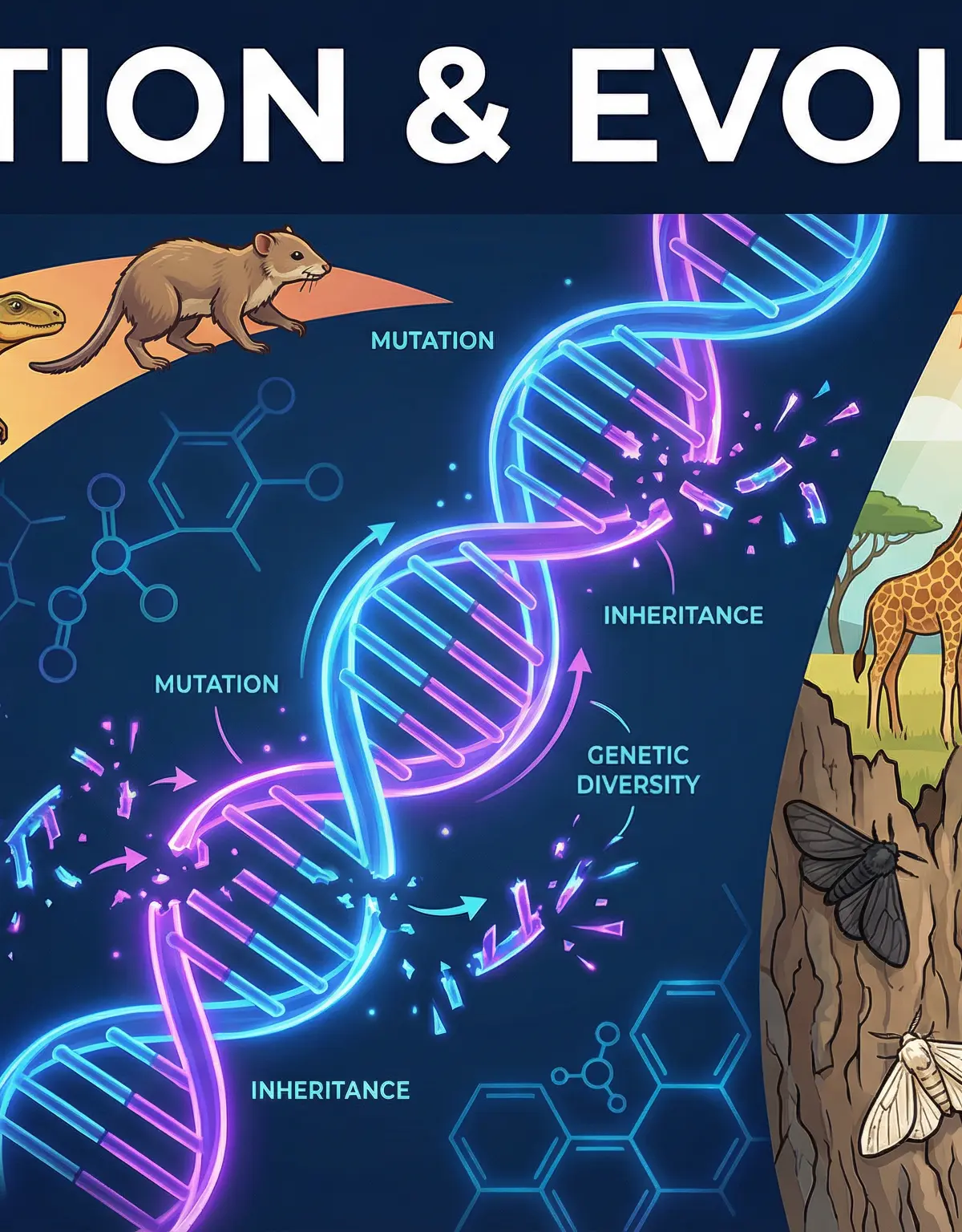
Welcome to Variation and Evolution. This topic is the cornerstone of biology, explaining not just how we differ from one another, but how entire species adapt to survive in a constantly changing world. It connects deeply with genetics, ecology, and reproduction. In your exams, you can expect to see data interpretation questions on variation, as well as extended 6-mark questions asking you to apply the principles of natural selection to novel scenarios.
Key Concepts
Concept 1: Types of Variation
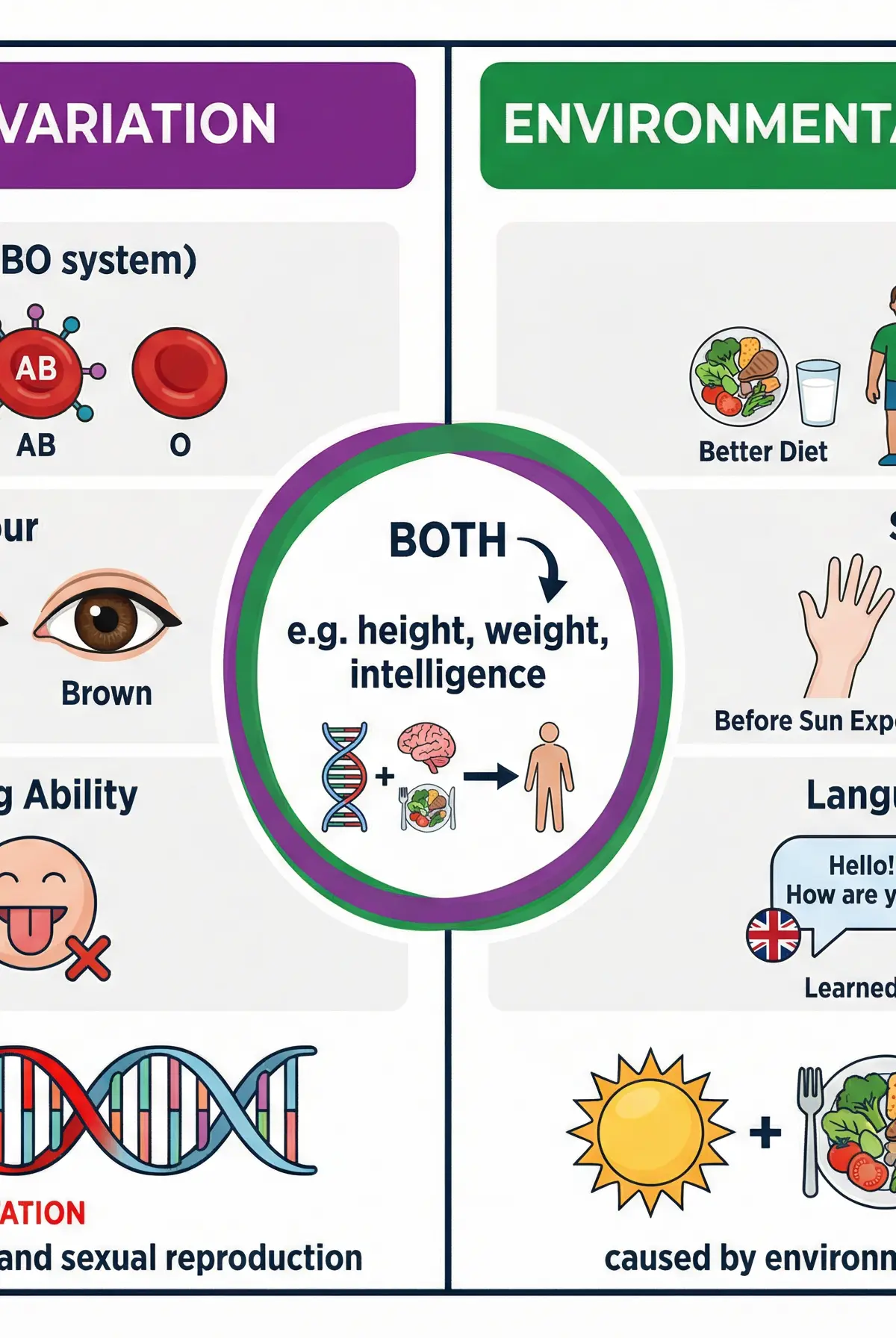
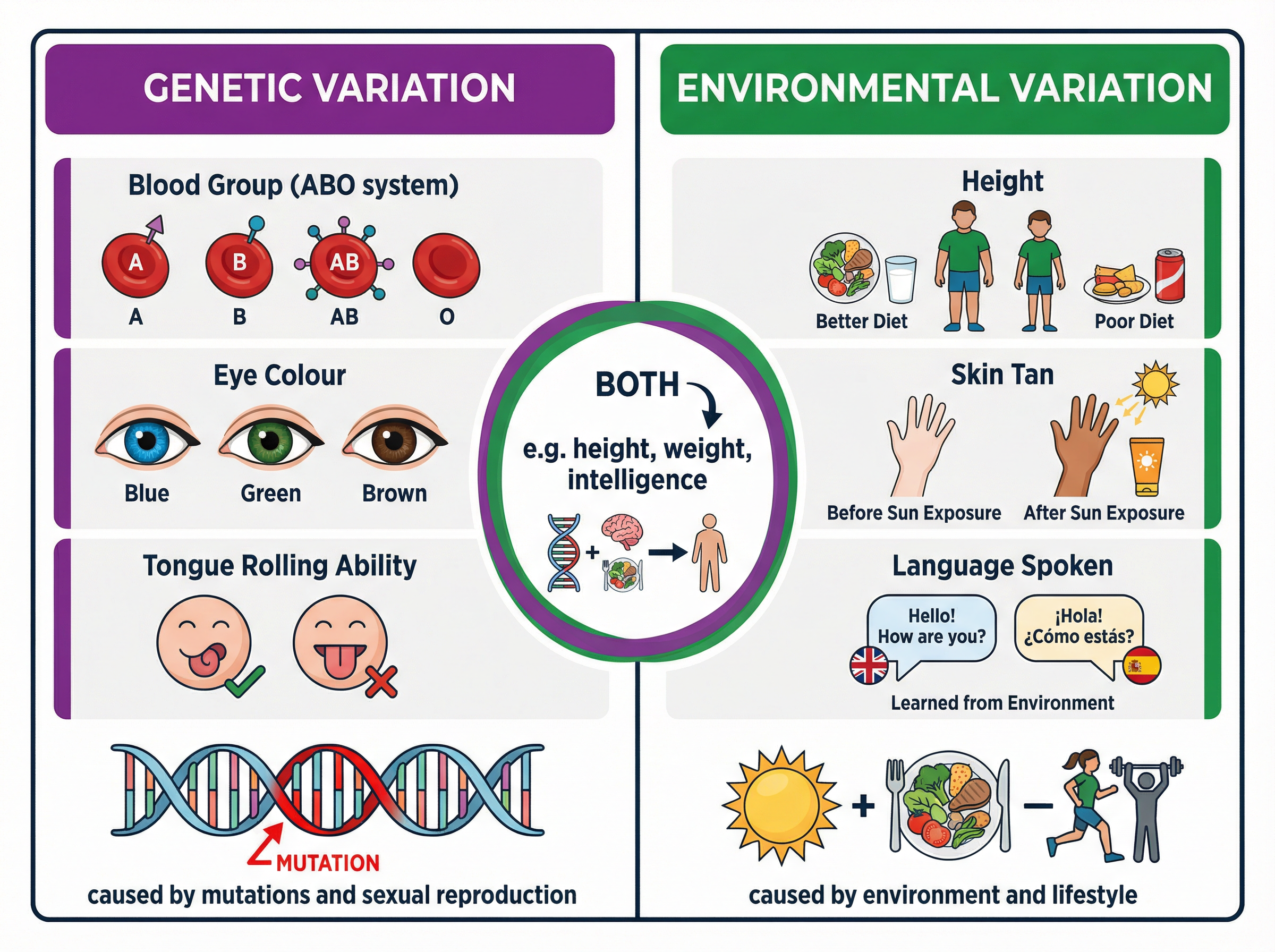
Variation refers to the differences in the characteristics of individuals within a population. Examiners expect you to distinguish between two main causes:
- Genetic Variation: Differences caused by the genes inherited from parents. Examples include blood group and eye colour. These are fixed and unaffected by the environment.
- Environmental Variation: Differences caused by the conditions in which an organism develops. Examples include language spoken or a scar.
Crucially, many characteristics are influenced by both. For example, your genes determine your maximum potential height, but your diet (environment) determines whether you reach it.
Concept 2: Mutations
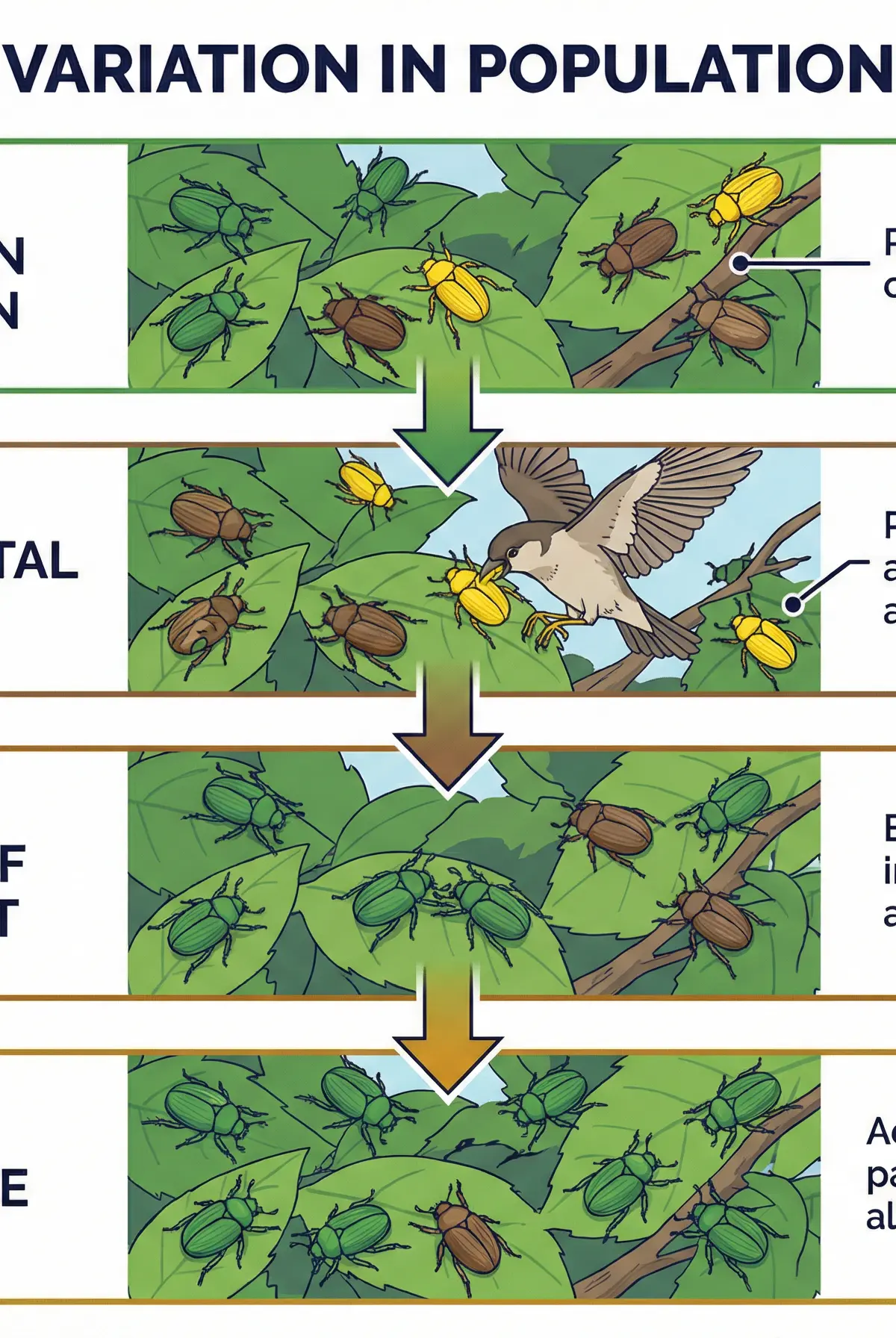
Mutations are random changes in the DNA sequence. This is the ultimate source of all new genetic variation. Most mutations have no effect on the phenotype. Some are harmful, but occasionally, a mutation produces a new phenotype that is beneficial to the organism in its environment.
Concept 3: Natural Selection
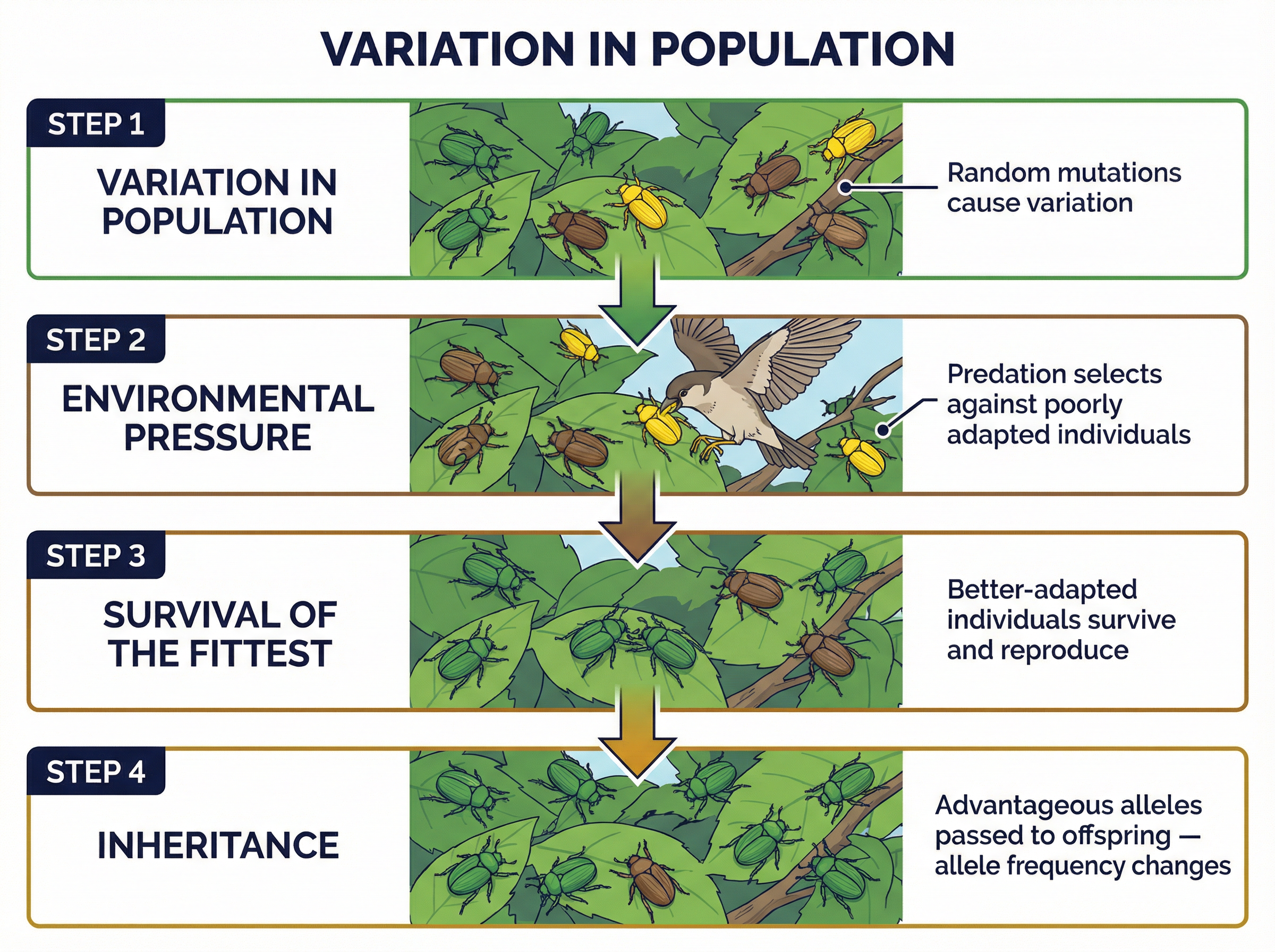
This is the mechanism of evolution proposed by Charles Darwin. You must learn the step-by-step sequence to secure full marks:
- Variation: There is natural variation within a population due to random mutations.
- Selection Pressure: An environmental factor (like a predator or disease) acts on the population.
- Survival of the Fittest: Individuals with advantageous alleles are better adapted and more likely to survive.
- Reproduction: The survivors breed and pass on their advantageous alleles to their offspring.
- Change over generations: The frequency of the advantageous allele increases in the population.
Concept 4: Speciation and Extinction
If two populations of one species become isolated, different mutations and selection pressures will act upon them. Over time, they may become so genetically different that they can no longer interbreed to produce fertile offspring. This is speciation.
Conversely, if an environment changes too rapidly and a species lacks the genetic variation to adapt, it will die out. This is extinction.
Mathematical/Scientific Relationships
While there are no complex formulas to memorise for this specific topic, you must be able to interpret allele frequencies. If an advantageous allele is present in 5% of the population initially, and 45% after ten generations, this quantitative data is evidence of natural selection occurring.
Interactive Diagrams
2 interactive diagrams to visualise key concepts
Conceptual Flow Outline
Flowchart showing the pathway of a mutation subject to natural selection.
Conceptual Flow Outline
The process of speciation due to geographical isolation.
Worked Examples
3 worked examples — open one to explore the question and available guidance.
Practice Questions
Test your understanding — click to reveal model answers
State two causes of genetic variation. (2 marks)
Hint: Think about what happens to DNA and what happens during reproduction.
Explain how a population of insects could become resistant to a new pesticide. (4 marks)
Hint: Use the V.S.S.R.A sequence.
Describe the difference between continuous and discontinuous variation, giving an example of each. (4 marks)
Hint: Which one can take any value in a range, and which one fits into distinct categories?
Two populations of a mouse species are separated by a new river. Explain how this could lead to the formation of two different species. (6 marks)
Hint: Think about speciation. What happens when environments differ?
Explain why sexual reproduction is advantageous for a species facing a changing climate. (3 marks)
Hint: What does sexual reproduction create that asexual doesn't?