AQA · A-Level · Business
Corporate Objectives and Strategy
Corporate Objectives and Strategy sits at the heart of AQA A-Level Business, demanding that candidates move beyond simple definitions to critically evaluate how businesses translate a mission into measurable goals and then select the strategic path most likely to achieve them. Mastery of this topic — from Ansoff's Matrix and Porter's Generic Strategies to the Balanced Scorecard and Triple Bottom Line — is essential for accessing Levels 3 and 4 in 16 and 25-mark questions, where AO3 analysis and AO4 evaluation together account for 60% of available marks. Candidates who can apply these frameworks to a specific case study context, rather than reciting textbook theory, are the ones who consistently earn the highest grades.
- 13 min read
- 3 worked examples
- 5 practice questions
- 10 key terms
Study Notes
Overview
Corporate Objectives and Strategy is one of the most synoptic and heavily weighted topics across all three AQA A-Level Business papers. It requires candidates to understand how a business moves from a broad sense of purpose — expressed in a mission statement — through a hierarchy of objectives, down to the strategic choices that determine long-term direction. Examiners expect candidates to demonstrate not only knowledge of theoretical models such as Ansoff's Matrix, Porter's Generic Strategies, and the Balanced Scorecard, but also the ability to apply those models critically to a specific business context drawn from the pre-release case study or unseen data. The Assessment Objective weighting is particularly demanding: AO3 (analysis) and AO4 (evaluation) together account for 60% of marks in extended response questions. This means that candidates who merely define and describe models will be capped at Level 2, while those who construct logical chains of reasoning and reach supported, contextualised judgements will access the highest levels. This guide covers every major concept, model, and technique required, with worked examples, memory hooks, and exam-focused commentary throughout.
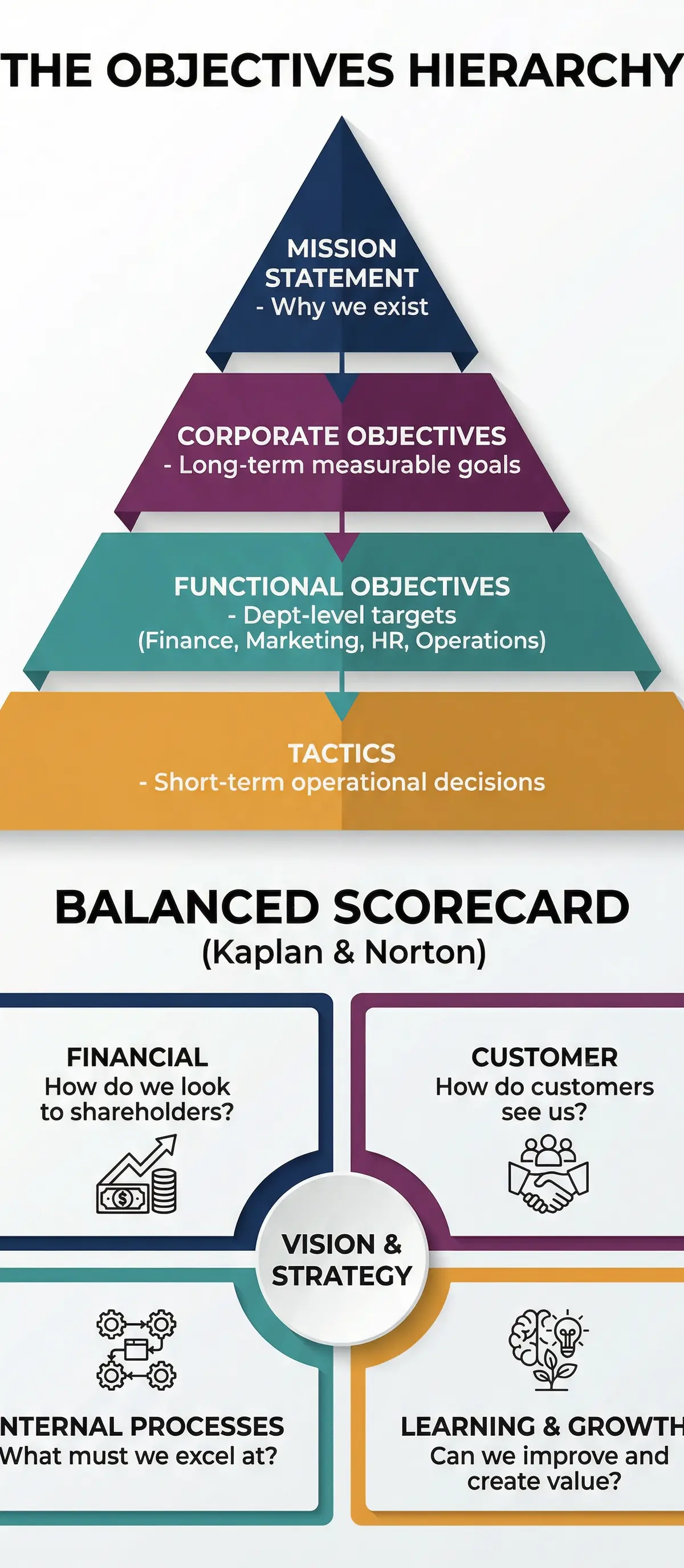
The Objectives Hierarchy
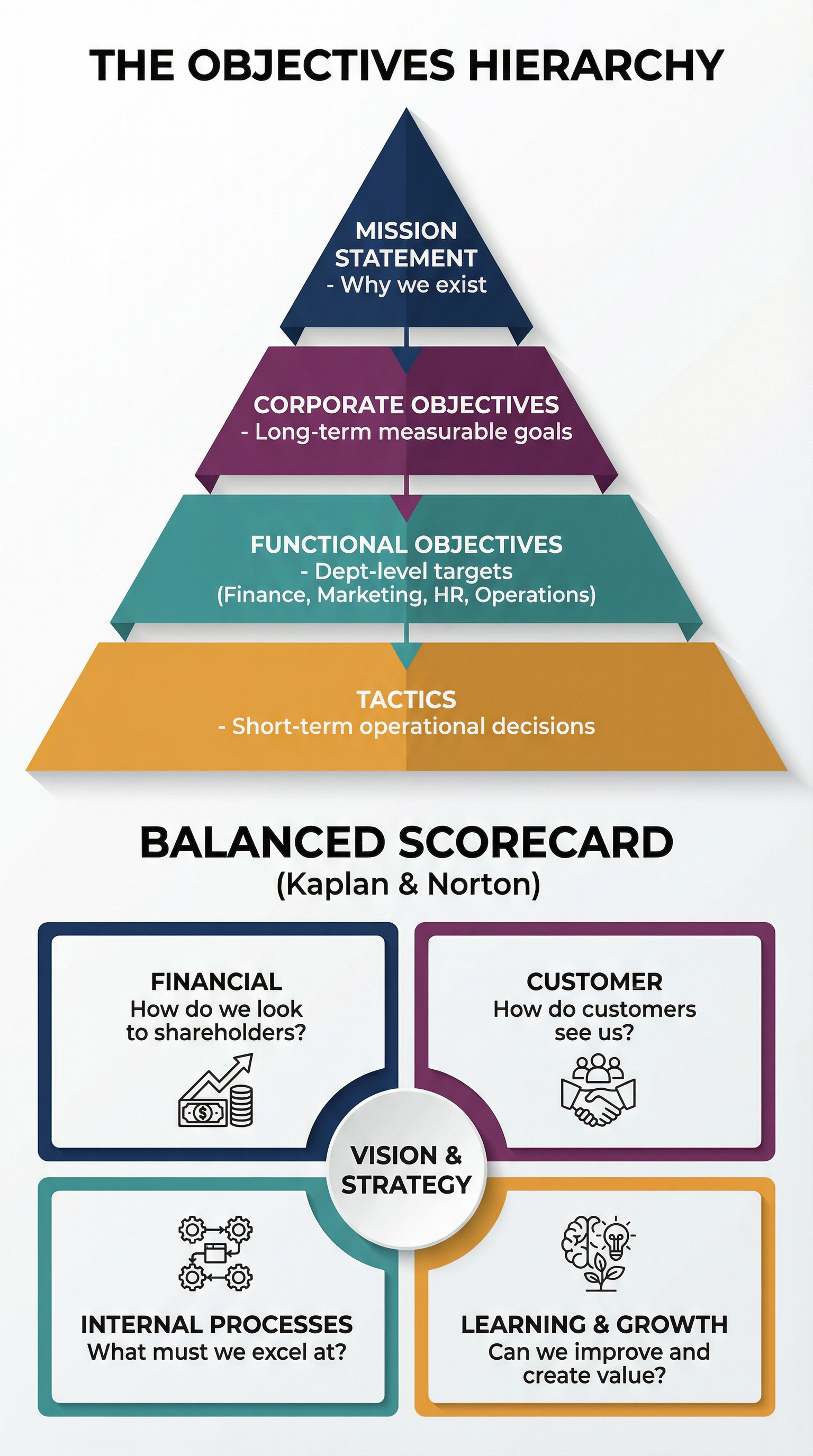
Mission Statements
What they are: A mission statement articulates the fundamental purpose of a business — why it exists beyond the simple pursuit of profit. It is broad, aspirational, and not directly measurable. Tesla's mission — 'to accelerate the world's transition to sustainable energy' — is a classic example: it communicates direction and values without specifying targets.
Why it matters for the exam: Candidates must distinguish clearly between a mission statement and a corporate objective. A mission statement is not SMART (Specific, Measurable, Achievable, Relevant, Time-bound). Examiners will credit responses that identify this distinction and explain how the mission provides the philosophical framework within which objectives are set.
Specific Knowledge: Patagonia's mission — 'We're in business to save our home planet' — demonstrates how a mission can directly shape strategic choices, including the company's decision to donate 1% of sales to environmental causes and its 'Don't Buy This Jacket' anti-consumerism campaign. This is a powerful named example for CSR-related evaluation questions.
Corporate Objectives
What they are: Corporate objectives are the long-term, measurable goals that translate the mission into concrete targets. They typically cover a 3–5 year horizon and address areas such as profitability, market share, growth, and shareholder returns. A well-formed corporate objective is SMART: 'Increase UK market share from 12% to 18% by 2027' is a corporate objective; 'grow the business' is not.
Why it matters for the exam: The relationship between corporate objectives and functional objectives is a frequent source of marks in analysis questions. Candidates should explain how corporate objectives cascade downward — a corporate objective of market development in Asia would require the marketing department to set a functional objective around brand awareness in target markets, HR to plan international recruitment, and Finance to model the capital requirements of overseas expansion.
Named Example: In 2023, Unilever announced a corporate objective to achieve €60 billion in turnover by 2025 while simultaneously reducing its plastic packaging by 50%. This dual objective — financial and environmental — reflects the growing influence of the Triple Bottom Line on corporate goal-setting.
Functional Objectives and Tactics
What they are: Functional objectives are department-level targets that support the corporate objective. Tactics are the short-term, operational decisions used to implement strategy on a day-to-day basis. The critical distinction — and one of the most common errors in the exam — is that strategy is long-term and directional, while tactics are short-term and reactive.
Specific Knowledge: When Tesco set a corporate objective to recover UK market share following the 2014 accounting scandal, its functional objectives included: Finance — reduce net debt from £8.5bn; Marketing — relaunch the 'Every Little Helps' brand positioning; Operations — close 43 unprofitable stores. Each tactic (e.g., a price-matching promotion) served the broader strategic direction.
Strategic Models
Ansoff's Matrix
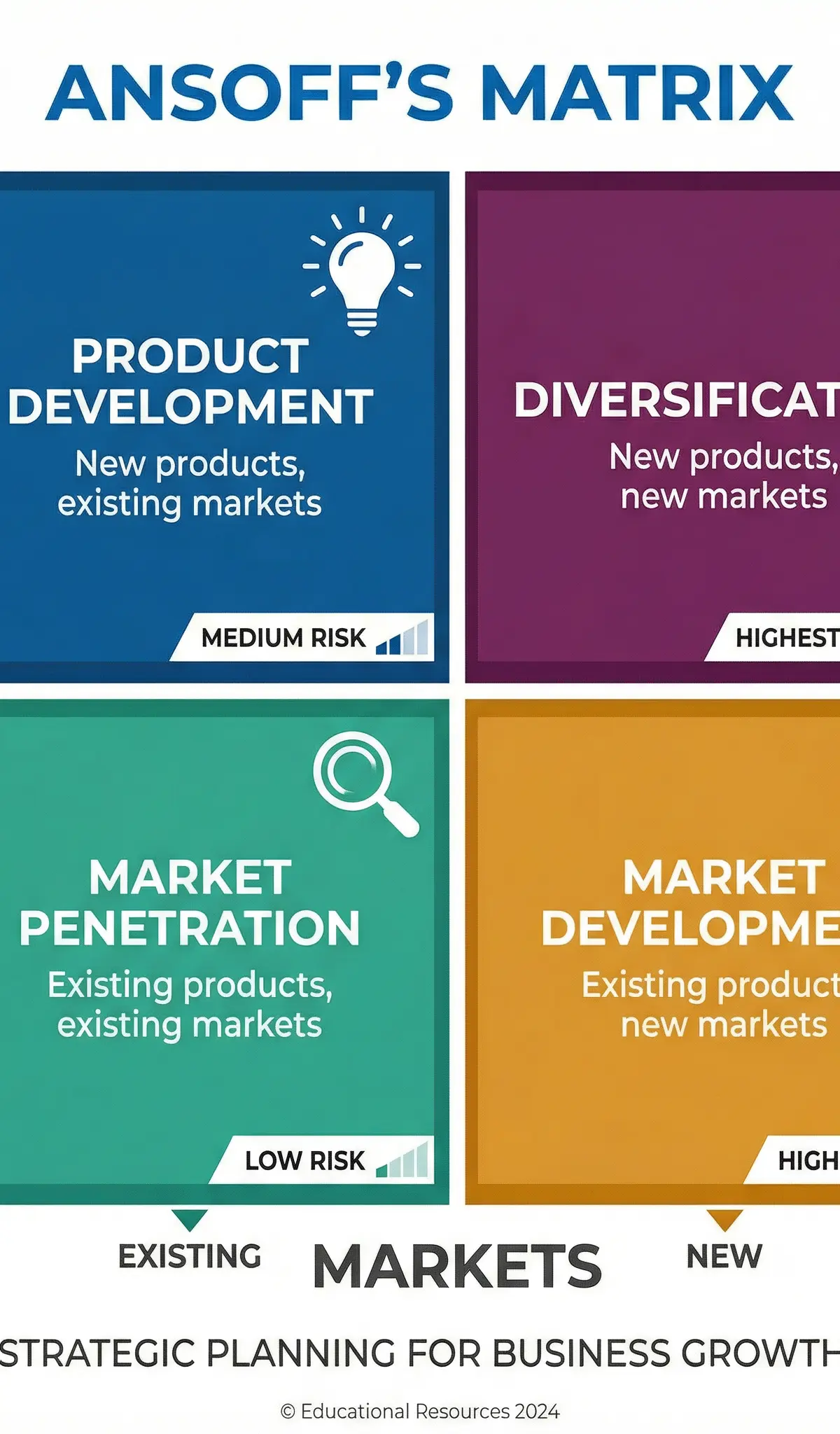
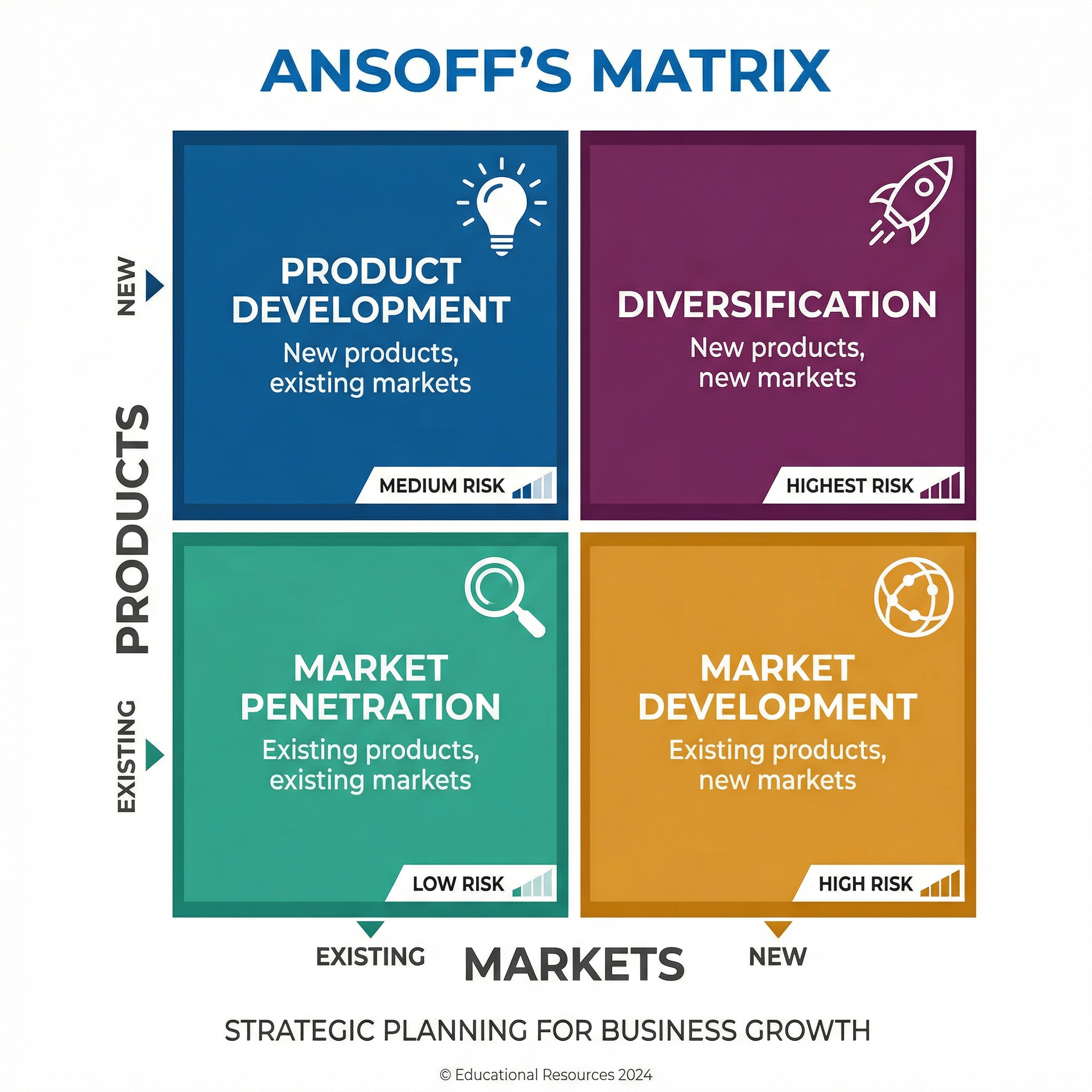
Igor Ansoff's Growth Vector Matrix (1957) provides a framework for evaluating four strategic growth options based on whether products and markets are existing or new. Risk increases as a business moves away from what it knows.
Market Penetration (existing products, existing markets) is the lowest-risk strategy. A business seeks to increase its share of a market it already operates in, using tactics such as price reductions, increased marketing spend, or loyalty schemes. Coca-Cola's aggressive promotional campaigns in the UK soft drinks market exemplify this approach. The risk is low because the business has established knowledge of both the product and the customer base, but growth potential may be limited in mature, saturated markets.
Product Development (new products, existing markets) involves creating new or improved products for an existing customer base. Apple's annual iPhone refresh cycle is the definitive example: each new model is sold to Apple's loyal, established customer base. R&D costs are significant and there is no guarantee of customer adoption, but the business benefits from existing brand equity and customer relationships. Candidates frequently confuse this with Diversification — the key test is whether the business is selling to customers it already has a relationship with.
Market Development (existing products, new markets) involves taking a proven product into a new geographic or demographic market. Greggs' expansion into drive-through locations and its international licensing agreements represent market development. The product formula is unchanged, but the business must navigate unfamiliar consumer behaviour, regulatory environments, and competitive landscapes.
Diversification (new products, new markets) is the highest-risk quadrant. Related diversification involves moving into a business with operational or technological links to existing activities — Amazon's move from e-commerce into cloud computing (AWS) is related diversification, leveraging existing server infrastructure. Unrelated (conglomerate) diversification — such as Virgin entering financial services — carries the greatest risk because the business has no prior expertise in either the product or the market.
Porter's Generic Strategies
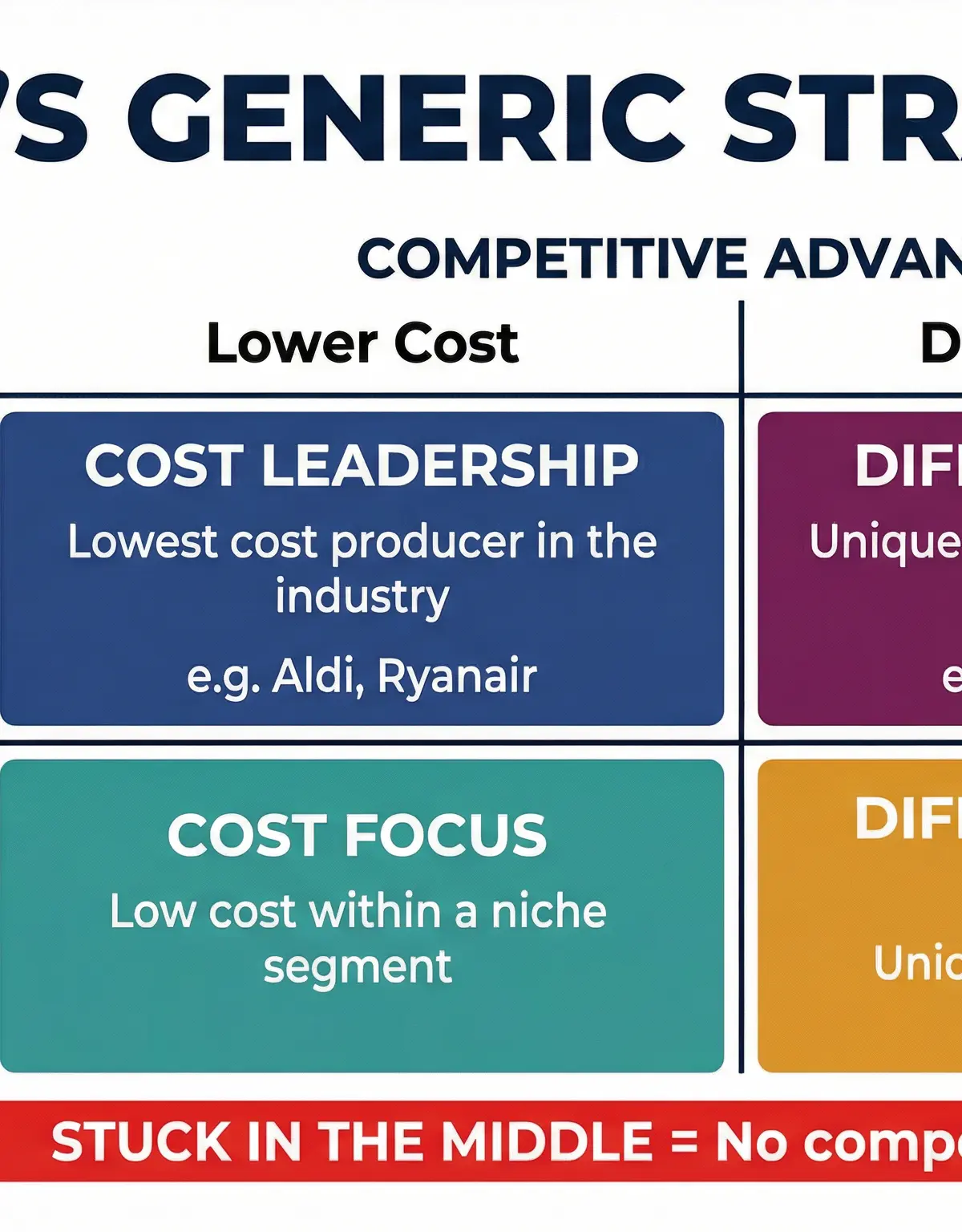
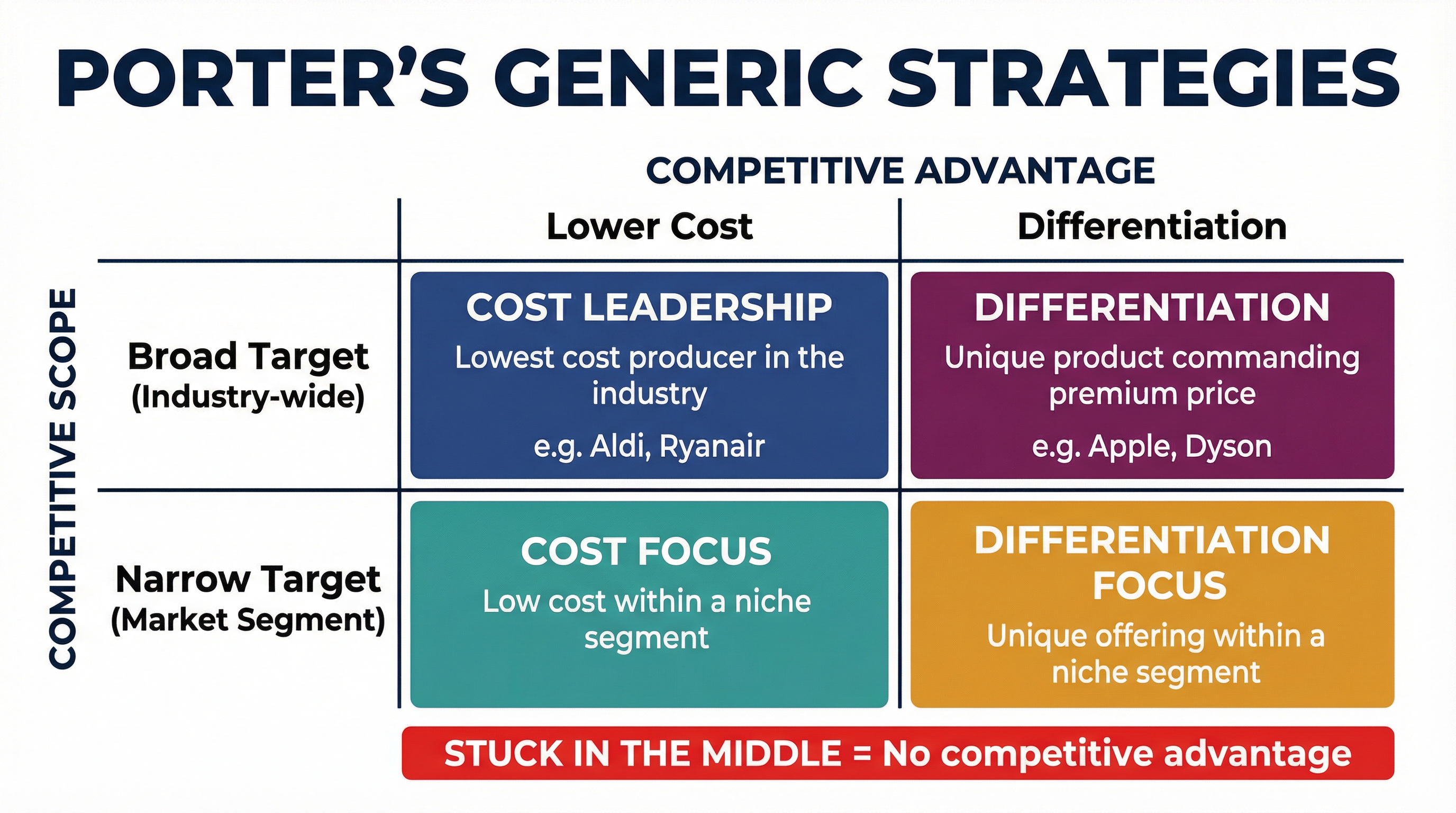
Michael Porter (1980) argued that sustainable competitive advantage can only be achieved through one of two fundamental approaches: being the lowest-cost producer in the industry, or offering a product or service that is perceived as unique and for which customers will pay a premium.
Cost Leadership requires a business to achieve the lowest cost base in its industry. This is not the same as charging the lowest price — a cost leader may charge market-average prices and enjoy superior margins. Aldi achieves cost leadership through a limited SKU range (approximately 1,500 products versus 30,000+ in a typical supermarket), own-brand products, and highly efficient logistics. Ryanair achieves it through secondary airport use, ancillary revenue streams, and maximum aircraft utilisation.
Differentiation requires a business to offer something that customers perceive as genuinely superior and worth a premium price. Apple's differentiation rests on ecosystem lock-in, design aesthetics, and brand prestige — not on having the most technically advanced hardware. Dyson differentiated the vacuum cleaner market through cyclone technology and industrial design, commanding prices three to four times higher than competitors.
Focus Strategies apply either cost leadership or differentiation within a narrow market segment. A boutique hotel chain pursuing Differentiation Focus targets affluent travellers with a premium, personalised experience that a mass-market hotel chain cannot replicate.
Stuck in the Middle: Porter's most powerful warning is that businesses which attempt to pursue both cost leadership and differentiation simultaneously risk achieving neither. They become 'stuck in the middle' — unable to compete on price with cost leaders or on quality with differentiators. This is a high-value evaluation point in any question asking candidates to assess a business's strategic position.
Kaplan and Norton's Balanced Scorecard (1992)
The Balanced Scorecard was developed in response to the limitations of purely financial performance measurement. Kaplan and Norton argued that financial metrics are lagging indicators — they tell you what has already happened, not what is likely to happen. The Balanced Scorecard adds three forward-looking perspectives.
| Perspective | Key Question | Example Metrics |
|---|---|---|
| Financial | How do we look to shareholders? | ROCE, profit margin, revenue growth |
| Customer | How do customers see us? | NPS, market share, customer retention rate |
| Internal Processes | What must we excel at? | Defect rate, order fulfilment time, innovation pipeline |
| Learning & Growth | Can we improve and create value? | Employee training hours, staff turnover, R&D spend |
For the exam, the Balanced Scorecard is most useful as an evaluative tool. When assessing a business's strategy, candidates can use it to argue that a strategy which improves financial performance but damages customer satisfaction or employee engagement may not be sustainable in the long term.
Elkington's Triple Bottom Line and Carroll's CSR Pyramid
John Elkington (1994) argued that businesses should report performance across three dimensions: Profit (economic value created), People (social impact on employees, communities, and supply chains), and Planet (environmental impact). This framework is directly relevant to evaluation questions about whether a business's strategy is genuinely sustainable or merely profit-maximising.
Archie Carroll's CSR Pyramid (1991) layers corporate responsibilities from base to apex: Economic (be profitable), Legal (obey the law), Ethical (do what is right and fair), and Philanthropic (contribute to the community). The pyramid implies a hierarchy — a business must first be economically viable before it can meaningfully fulfil higher-order responsibilities. This is a useful counter-argument when evaluating aggressive CSR strategies: if a business is loss-making, philanthropic spending may be unsustainable.
Strategy vs. Tactics: The Critical Distinction
This distinction is worth its own section because it is the single most common source of lost marks in this topic. Strategy is the long-term plan that determines the overall direction of a business in pursuit of its corporate objectives. It involves major resource allocation decisions and is typically set at board level. Tactics are the short-term, operational actions used to implement strategy. A business pursuing a Market Development strategy (Ansoff) might use the tactic of a social media campaign to build brand awareness in a new market — but the campaign is not the strategy.
Examiners will not award AO3 or AO4 marks to candidates who conflate the two. If a question asks you to 'evaluate the strategic options available to [Business X]', your answer must address long-term directional choices — not short-term promotional decisions.
Named Example Bank
| Business | Strategic Action | Model Applied | Key Data Point |
|---|---|---|---|
| Apple | iPhone annual refresh cycle | Ansoff: Product Development | iPhone revenue: $205.5bn (FY2023) |
| Aldi | Lean operations, limited SKU range | Porter: Cost Leadership | UK market share grew from 3.7% (2015) to 10.1% (2024) |
| Virgin Group | Entry into airlines, banking, broadband | Ansoff: Unrelated Diversification | 40+ companies across 35 countries |
| Unilever | Sustainable Living Plan | Triple Bottom Line / CSR | Target: net-zero emissions by 2039 |
| Tesco | Post-scandal recovery strategy | Objectives Hierarchy / Balanced Scorecard | Net debt reduced from £8.5bn to £2.8bn (2014–2020) |
| Patagonia | 'Don't Buy This Jacket' campaign | Carroll's CSR Pyramid / Differentiation | 1% of sales donated to environmental causes since 1985 |
| Greggs | Drive-through expansion | Ansoff: Market Development | UK store count exceeded 2,400 by 2023 |

Exam Technique: The AJIM Framework
For all 16 and 25-mark evaluation questions, use the AJIM framework:
- A — Answer: State your judgement directly in the opening sentence of your conclusion. Do not build up to it — examiners are looking for a clear, confident stance.
- J — Justify: Provide the strongest piece of evidence or reasoning that supports your judgement. Reference specific data from the case study or appendices.
- I — It Depends: Acknowledge the key contextual factor(s) that could change your conclusion. 'This conclusion would change if the business were operating in a highly competitive market where cost leadership is the only viable strategy.'
- M — Most Important Factor: Identify the single most decisive factor in your analysis and explain why it outweighs the others.
This framework directly addresses the AO4 descriptor at Level 4: 'a well-supported judgement is made, demonstrating a balanced and reasoned evaluation of evidence.'
Visual Resources
3 diagrams and illustrations
Interactive Diagrams
3 interactive diagrams to visualise key concepts
Conceptual Flow Outline
The Corporate Objectives Hierarchy: from Mission Statement to Tactics
Conceptual Flow Outline
Ansoff's Matrix with named business examples plotted by strategic position
Conceptual Flow Outline
The Strategic Decision-Making Process: from environmental analysis to performance measurement
Worked Examples
3 worked examples — open one to explore the question and available guidance.
Practice Questions
Test your understanding — click to reveal model answers
Analyse the factors that might influence a business's choice between a Cost Leadership strategy and a Differentiation strategy. (9 marks)
Hint: Consider the nature of the market (price sensitivity, consumer preferences), the business's internal capabilities (cost base, R&D capacity, brand equity), and the competitive environment (number of competitors, barriers to entry). Use Porter's Generic Strategies as your analytical framework.
To what extent does Ansoff's Matrix provide a useful framework for a business seeking to grow? (16 marks)
Hint: Evaluate the strengths of Ansoff's Matrix (clarity, risk calibration, strategic communication) against its limitations (static, binary, ignores competitive dynamics). Use specific business examples to support both sides. Reach a clear judgement using AJIM.
Assess the view that a business's corporate objectives should always prioritise profit maximisation over ethical and environmental considerations. (25 marks)
Hint: Use Carroll's CSR Pyramid and Elkington's Triple Bottom Line as your analytical frameworks. Consider the short-term vs. long-term implications of prioritising profit over ethics. Use Patagonia, Unilever, and Boohoo as named examples. Apply the AJIM framework in your conclusion.
Explain two reasons why a business might choose a Diversification strategy despite its high risk. (4 marks)
Hint: Think about what circumstances make high risk worthwhile — market saturation, declining core markets, spreading risk across multiple revenue streams. Each reason needs a brief explanation of the causal mechanism.
Evaluate the extent to which the Balanced Scorecard is a more effective performance measurement tool than traditional financial metrics alone. (16 marks)
Hint: Consider the limitations of purely financial metrics (lagging indicators, short-termism, ignoring non-financial value drivers). Evaluate the Balanced Scorecard's additional perspectives and their relevance to long-term strategy. Use specific business examples. Apply AJIM in your conclusion.