Analysing the financial performance of a business Revision Notes

    Subject: Business | Level: GCSE | Exam Board: AQA

    Mastering financial performance analysis is the key to unlocking top grades in GCSE Business. This guide demystifies the Income Statement and Statement of Financial Position, showing you exactly how to calculate profitability and interpret data like a senior examiner.

    Revision Notes & Key Concepts

    ## Overview ![Analysing Financial Performance](https://xnnrgnazirrqvdgfhvou.supabase.co/storage/v1/object/public/study-guide-assets/guide_1e2e3118-7531-449f-a19e-04ef62894b3c/header_image.png) Analysing the financial performance of a business is a core topic across all GCSE Business specifications. It is the bridge between raw numbers and strategic decision-making. Examiners expect candidates to not only calculate key profitability ratios but also interpret what those figures mean for different stakeholders. This topic tests your ability to handle data (AO2) and evaluate business performance (AO3). A strong grasp of the Income Statement and the Statement of Financial Position is essential, as these documents provide the foundation for all financial analysis. ## The Income Statement (Profit and Loss Account) ![Income Statement Structure](https://xnnrgnazirrqvdgfhvou.supabase.co/storage/v1/object/public/study-guide-assets/guide_1e2e3118-7531-449f-a19e-04ef62894b3c/income_statement_diagram.png) The Income Statement shows a business's financial performance over a specific period, usually a year. It tracks revenue coming in and costs going out, ultimately revealing whether the business made a profit or a loss. **Key Components**: - **Revenue (Sales Turnover)**: Total money generated from sales (Price × Quantity). - **Cost of Goods Sold (COGS)**: Direct costs of producing the goods sold. - **Gross Profit**: Revenue minus COGS. Shows the profit from core trading activities. - **Operating Expenses**: Indirect costs or overheads (e.g., rent, wages, insurance). - **Net Profit**: Gross Profit minus Operating Expenses. The final profit available for distribution or reinvestment. ## The Statement of Financial Position (Balance Sheet) ![Statement of Financial Position](https://xnnrgnazirrqvdgfhvou.supabase.co/storage/v1/object/public/study-guide-assets/guide_1e2e3118-7531-449f-a19e-04ef62894b3c/balance_sheet_diagram.png) Unlike the Income Statement, the Statement of Financial Position is a **snapshot** of a business's financial health on a specific date. It details what the business owns (Assets) and what it owes (Liabilities), alongside the owner's investment (Equity). **Key Components**: - **Non-Current Assets**: Long-term items owned by the business (e.g., machinery, premises). - **Current Assets**: Short-term items easily converted to cash (e.g., stock, debtors, cash in bank). - **Current Liabilities**: Short-term debts to be paid within a year (e.g., overdrafts, creditors). - **Non-Current Liabilities**: Long-term debts (e.g., mortgages, bank loans). - **Equity/Capital**: Funds invested by the owners plus retained profits. *Examiner Tip*: The fundamental equation is **Assets = Liabilities + Equity**. This must always balance. ## Profitability Ratios ![Profit Margin Formulas](https://xnnrgnazirrqvdgfhvou.supabase.co/storage/v1/object/public/study-guide-assets/guide_1e2e3118-7531-449f-a19e-04ef62894b3c/profit_margins_card.png) Profitability ratios measure how efficiently a business converts revenue into profit. You must know these formulas as they are not provided in the exam. **Gross Profit Margin (GPM)**: - Formula: `(Gross Profit ÷ Revenue) × 100` - Meaning: Shows the percentage of revenue kept as gross profit before overheads are paid. **Net Profit Margin (NPM)**: - Formula: `(Net Profit ÷ Revenue) × 100` - Meaning: Shows the percentage of revenue kept as net profit after all expenses are paid. ## Interpreting Financial Performance Calculating the ratios is only half the battle. To access top marks (AO3), you must interpret the results by comparing them against benchmarks: - **Historical Comparison**: Are margins improving or worsening compared to previous years? - **Competitor Comparison**: How does the business perform against rivals or the industry average? - **Stakeholder Perspectives**: Shareholders want high net profit margins for dividends. Suppliers look at current assets and liabilities to ensure they will be paid. Managers use both to make strategic decisions on pricing and cost control. ## Audio Revision Listen to our comprehensive 10-minute revision podcast covering all core concepts, exam tips, and a quick-fire recall quiz. ![Financial Performance Revision Podcast](https://xnnrgnazirrqvdgfhvou.supabase.co/storage/v1/object/public/study-guide-assets/guide_1e2e3118-7531-449f-a19e-04ef62894b3c/analysing_financial_performance_podcast.mp3)

    Revision Podcast Transcript

    Welcome to your GCSE Business revision podcast. I'm your tutor for today, and in this episode we're diving deep into one of the most important topics in your Business exam: Analysing the Financial Performance of a Business. Whether you're sitting AQA, Edexcel, OCR, or any other board, this topic appears in virtually every exam paper — and the good news is, once you understand the logic behind it, it becomes one of the most straightforward topics to score highly on. So grab a pen, get comfortable, and let's get started. SECTION ONE: CORE CONCEPTS Let's begin with the big picture. Why do businesses bother analysing their financial performance at all? The answer is simple: without understanding how well — or how badly — a business is doing financially, managers, owners, and investors simply cannot make good decisions. Financial statements are the scorecards of business. They tell you whether the business is making money, whether it owns more than it owes, and whether it's improving or declining over time. There are two key financial statements you need to know for your GCSE: the Income Statement, and the Statement of Financial Position. Let's look at each one in turn. First up: the Income Statement. You might also hear this called the Profit and Loss Account, and both names are acceptable in your exam. The income statement shows the financial performance of a business over a period of time — usually one year. It answers the question: did the business make a profit or a loss during this period? Here's how it works. At the top, you have Revenue — sometimes called Sales Turnover. This is the total amount of money the business earned from selling its goods or services. Revenue equals price multiplied by quantity sold. Simple enough. Next, we subtract the Cost of Goods Sold — often abbreviated to COGS. This is the direct cost of producing or buying the goods that were sold. For a manufacturer, this includes raw materials and direct labour. For a retailer, it's the wholesale cost of the stock they bought to resell. Revenue minus Cost of Goods Sold gives us Gross Profit. This is the profit made before any of the business's running costs are deducted. A high gross profit means the business is adding good value to its products. But we're not done yet. From gross profit, we then subtract Operating Expenses. These are the indirect costs of running the business — things like rent, wages for office staff, marketing costs, utility bills, and insurance. These are sometimes called overheads. After deducting operating expenses from gross profit, we arrive at Net Profit. This is the bottom line — the profit remaining after all costs have been paid. Net profit is what the business can use to pay taxes, reward shareholders with dividends, or reinvest back into the business. So the flow is: Revenue, minus Cost of Goods Sold, equals Gross Profit. Gross Profit, minus Operating Expenses, equals Net Profit. Make sure you can reproduce that flow from memory. Now let's move to the second financial statement: the Statement of Financial Position. This used to be called the Balance Sheet, and again, both terms are acceptable. Here's the crucial difference from the income statement: while the income statement covers a period of time, the statement of financial position is a snapshot in time. It shows what the business owns and what it owes on one specific date — usually the last day of the financial year. The statement of financial position is built around three categories: Assets, Liabilities, and Equity. Assets are things the business owns or is owed. We split these into two types. Non-Current Assets are long-term assets that the business will use for more than one year — things like property, machinery, vehicles, and equipment. Current Assets are short-term assets that will be converted into cash within one year — things like stock or inventory, money owed by customers called debtors or trade receivables, and cash itself. Liabilities are what the business owes to others. Again, we split these into two types. Current Liabilities are short-term debts due within one year — things like bank overdrafts and amounts owed to suppliers, called creditors or trade payables. Non-Current Liabilities are long-term debts due in more than one year — such as bank loans and mortgages. Finally, Equity — sometimes called Capital — represents the owner's interest in the business. It's what would be left for the owners if all the assets were sold and all the liabilities were paid off. The fundamental equation of the statement of financial position is: Assets equal Liabilities plus Equity. This equation must always balance — which is why it was historically called the Balance Sheet. Now let's talk about the ratios — and this is where the exam marks really start to flow. Profitability ratios measure how efficiently a business converts its revenue into profit. You need to know two: Gross Profit Margin and Net Profit Margin. Gross Profit Margin equals Gross Profit divided by Revenue, multiplied by 100. The answer is expressed as a percentage. For example, if a business has revenue of five hundred thousand pounds and a gross profit of two hundred thousand pounds, the gross profit margin is two hundred thousand divided by five hundred thousand, multiplied by one hundred, which equals forty percent. This means for every pound of sales, the business keeps forty pence as gross profit before paying its overheads. Net Profit Margin equals Net Profit divided by Revenue, multiplied by 100. Using the same business, if net profit is eighty thousand pounds and revenue is five hundred thousand pounds, the net profit margin is eighty thousand divided by five hundred thousand, multiplied by one hundred, which equals sixteen percent. This means the business keeps sixteen pence of every pound of sales as net profit after all costs. Here's a really important point: the gap between gross profit margin and net profit margin tells you about the business's overhead burden. If gross profit margin is forty percent but net profit margin is only sixteen percent, that gap of twenty-four percentage points represents the operating expenses. If this gap is widening over time, it suggests the business's overheads are growing faster than its revenue — a warning sign. SECTION TWO: INTERPRETING FINANCIAL PERFORMANCE Calculating ratios is only half the job. The other half — and where most marks are awarded in extended answer questions — is interpretation. You need to be able to say what the numbers actually mean. There are three benchmarks you should always consider when interpreting financial performance. First: comparison with previous years. Is the business improving or declining? A gross profit margin that has fallen from forty-five percent to forty percent over two years suggests the business's production costs are rising faster than its prices — perhaps due to rising raw material costs or supplier price increases. Second: comparison with competitors. A net profit margin of sixteen percent might sound good in isolation, but if the industry average is twenty-five percent, the business is actually underperforming. Context is everything. Third: different stakeholder perspectives. This is where many candidates lose marks — they forget that different people care about different things. Shareholders and investors focus on profitability ratios because they want returns on their investment. Managers use financial data to make operational decisions — should we cut costs? Should we raise prices? Lenders and banks look at the statement of financial position to assess whether the business can repay its debts. Employees might look at profitability to assess job security. Suppliers look at liquidity to assess whether the business can pay its bills. When a question asks you to evaluate financial performance from the perspective of a stakeholder, always identify who the stakeholder is, explain what they care about, and then apply the specific financial data to their perspective. SECTION THREE: EXAM TIPS AND COMMON MISTAKES Right, let's talk exam technique — because knowing the content is one thing, but performing under exam conditions is another. Tip one: memorise both formulas. No formula sheet is provided in the exam. Gross Profit Margin equals Gross Profit divided by Revenue times one hundred. Net Profit Margin equals Net Profit divided by Revenue times one hundred. Write these out ten times tonight. Seriously. Tip two: always show your working. In calculation questions, even if you get the final answer wrong, you can still earn method marks if your working is clear. Write out the formula first, substitute the numbers, then calculate. Never just write a final answer with no working shown. Tip three: don't confuse the two financial statements. A very common mistake is candidates describing the income statement when asked about the statement of financial position, or vice versa. Remember: income statement equals performance over time. Statement of financial position equals snapshot at a point in time. Tip four: when interpreting, always compare. A percentage figure on its own means very little. Always compare it to something — the previous year, a competitor, or an industry average. Examiners specifically reward comparative analysis. Tip five: use the command word to guide your answer. If the question says Calculate, just do the maths and show your working. If it says Analyse, you need to calculate and interpret. If it says Evaluate or Justify, you need to make a judgement — weigh up evidence and reach a conclusion. Tip six: the most common mistake in calculation questions is using the wrong profit figure. Make sure you use gross profit for the gross profit margin, and net profit for the net profit margin. Mixing these up is a very easy error to make under pressure. Tip seven: for the statement of financial position, remember it is a snapshot in time. If an exam question asks what the statement of financial position shows, always include this phrase — it's a marking point that candidates frequently miss. SECTION FOUR: QUICK-FIRE RECALL QUIZ Time for a quick-fire quiz! I'll ask the question, give you a few seconds to think, then give the answer. Question one: What is the formula for Gross Profit Margin? ... Gross Profit divided by Revenue, multiplied by one hundred. Question two: What does the statement of financial position show? ... A snapshot of what the business owns and owes at a specific point in time. Question three: Revenue is eight hundred thousand pounds and COGS is four hundred and eighty thousand pounds. What is the gross profit margin? ... Gross profit is three hundred and twenty thousand pounds. Gross profit margin is three hundred and twenty thousand divided by eight hundred thousand times one hundred, which equals forty percent. Question four: Name two examples of current assets. ... Stock or inventory, debtors or trade receivables, and cash. Question five: What is the difference between gross profit and net profit? ... Gross profit is revenue minus cost of goods sold. Net profit is gross profit minus operating expenses. Question six: Name two non-current liabilities. ... Long-term bank loans and mortgages. Question seven: Why might a shareholder be concerned if net profit margin falls from twenty percent to twelve percent? ... Because a lower net profit margin means less profit available for dividends, reducing their return on investment. SECTION FIVE: SUMMARY AND SIGN-OFF Let's bring it all together. In this episode, we've covered the two key financial statements: the income statement, which shows performance over a period of time, and the statement of financial position, which is a snapshot at a point in time. We've worked through the structure of each, and we've calculated and interpreted gross profit margin and net profit margin. The key things to take away are: know your formulas by heart; always show your working in calculations; always compare ratios against a benchmark; and always consider the stakeholder perspective when evaluating performance. For your revision, I'd suggest practising at least five calculation questions using different sets of financial data, and then writing a short paragraph interpreting each result from the perspective of a different stakeholder each time. You've got this. Financial performance is one of those topics that rewards practice — the more you do, the more confident you'll feel walking into that exam. Good luck, keep revising, and I'll see you in the next episode!

    Key Terms & Definitions

    Income Statement
    A financial document showing a business's revenue, costs, and profit or loss over a given period of time.
    Statement of Financial Position
    A financial document showing the assets, liabilities, and equity of a business at a specific point in time.
    Gross Profit
    Revenue minus the cost of goods sold.
    Net Profit
    Gross profit minus operating expenses.
    Assets
    Items of value owned by the business or money owed to it.
    Liabilities
    Money owed by the business to others.

    Worked Examples

    Practice Questions

    Analysing the financial performance of a business

    AQA
    GCSE
    Business

    Mastering financial performance analysis is the key to unlocking top grades in GCSE Business. This guide demystifies the Income Statement and Statement of Financial Position, showing you exactly how to calculate profitability and interpret data like a senior examiner.

    4
    Min Read
    3
    Examples
    5
    Questions
    6
    Key Terms
    🎙 Podcast Episode
    Analysing the financial performance of a business
    0:00-0:00

    Study Notes

    Overview

    Analysing Financial Performance

    Analysing the financial performance of a business is a core topic across all GCSE Business specifications. It is the bridge between raw numbers and strategic decision-making. Examiners expect candidates to not only calculate key profitability ratios but also interpret what those figures mean for different stakeholders. This topic tests your ability to handle data (AO2) and evaluate business performance (AO3). A strong grasp of the Income Statement and the Statement of Financial Position is essential, as these documents provide the foundation for all financial analysis.

    The Income Statement (Profit and Loss Account)
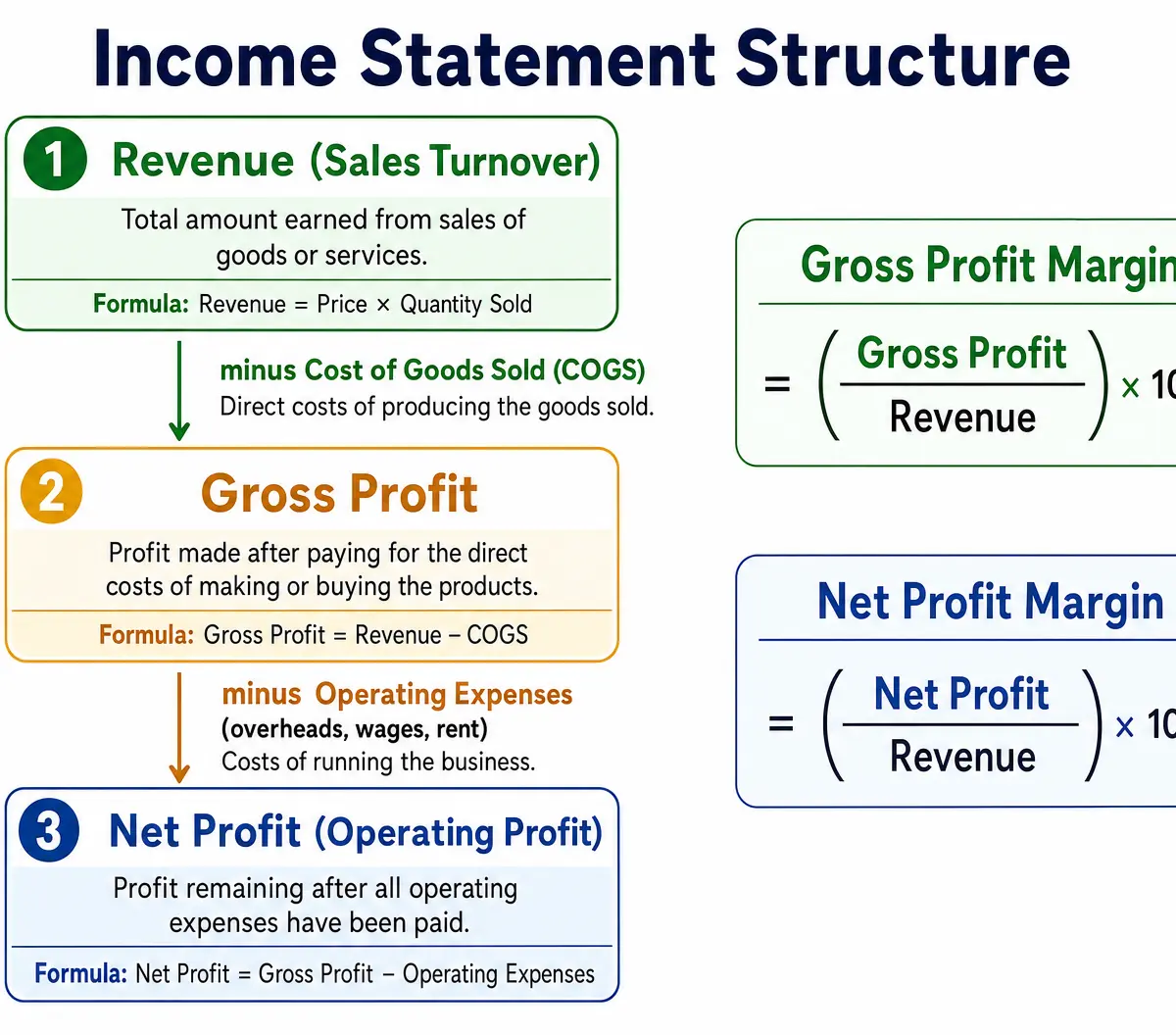
    Income Statement Structure

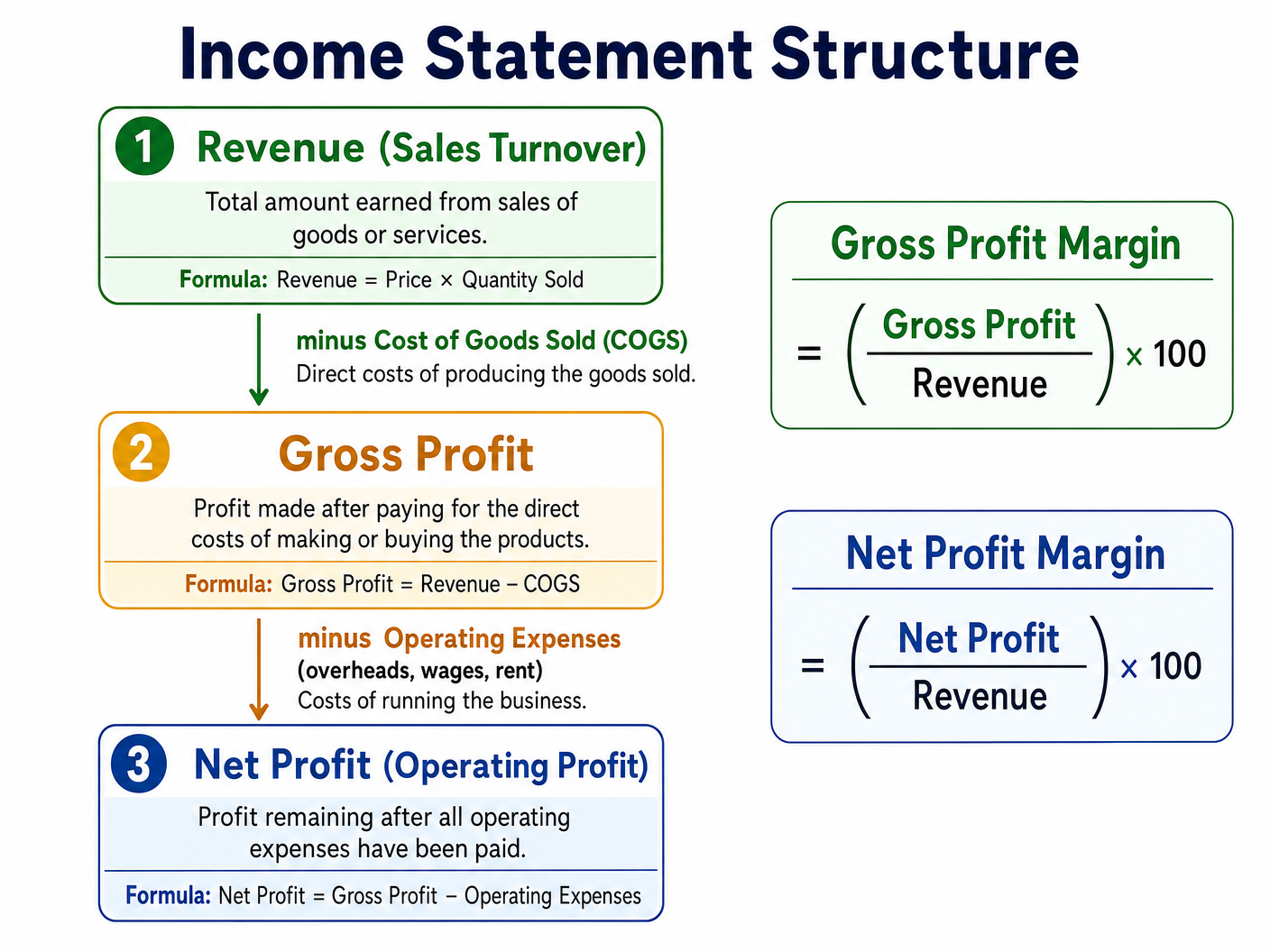
    The Income Statement shows a business's financial performance over a specific period, usually a year. It tracks revenue coming in and costs going out, ultimately revealing whether the business made a profit or a loss.

    Key Components:

    • Revenue (Sales Turnover): Total money generated from sales (Price × Quantity).
    • Cost of Goods Sold (COGS): Direct costs of producing the goods sold.
    • Gross Profit: Revenue minus COGS. Shows the profit from core trading activities.
    • Operating Expenses: Indirect costs or overheads (e.g., rent, wages, insurance).
    • Net Profit: Gross Profit minus Operating Expenses. The final profit available for distribution or reinvestment.

    The Statement of Financial Position (Balance Sheet)
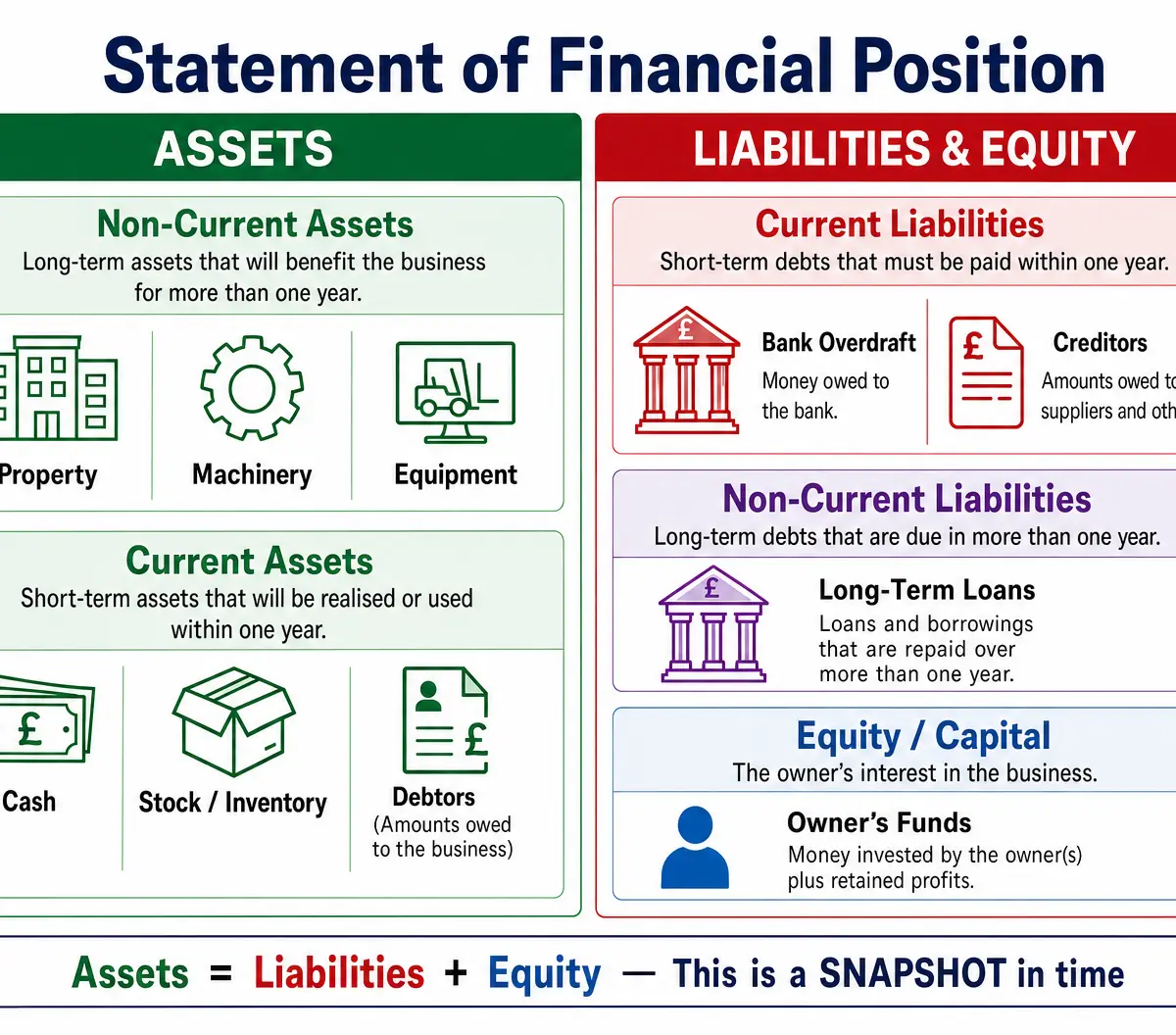
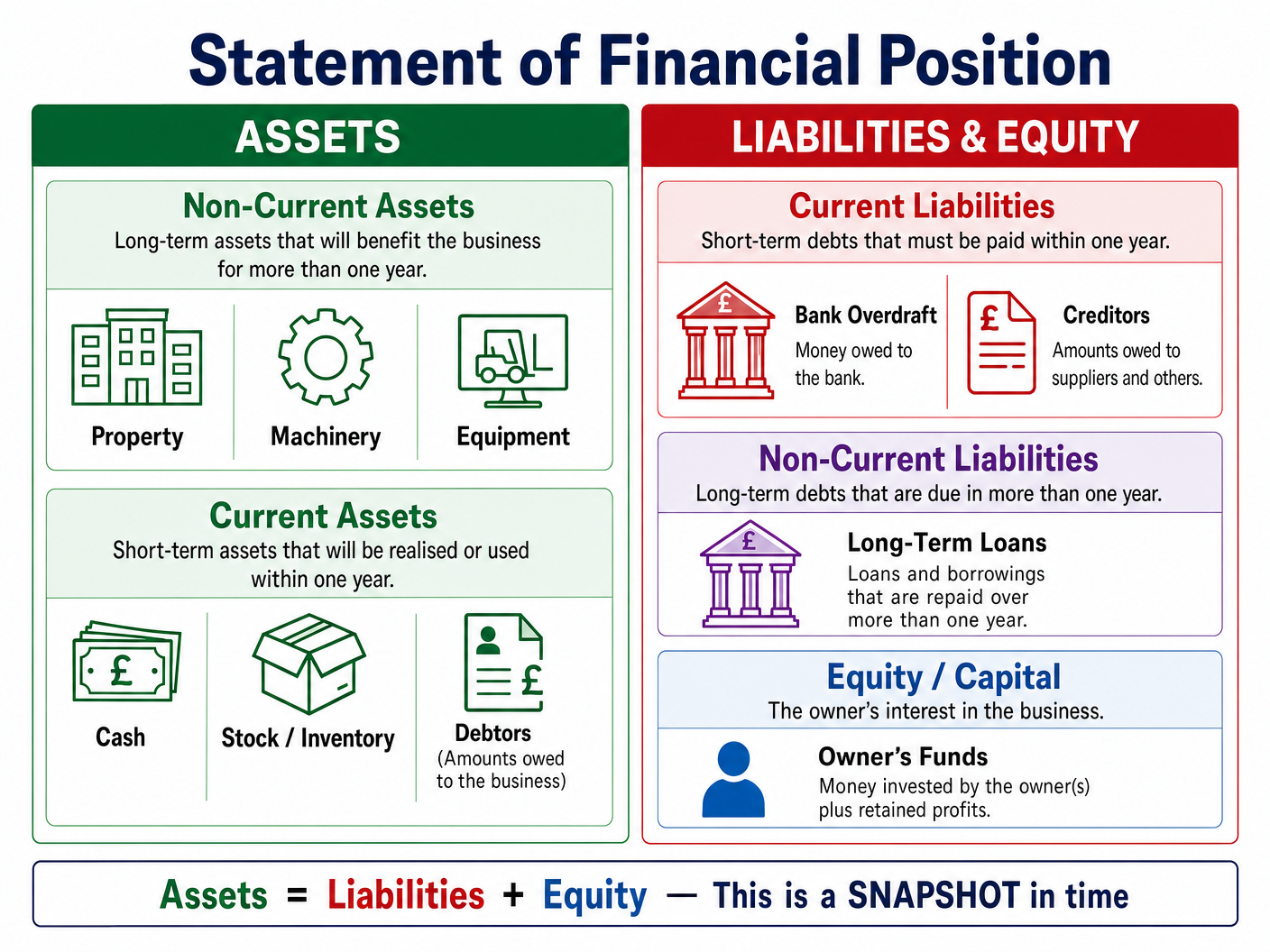
    Statement of Financial Position

    Unlike the Income Statement, the Statement of Financial Position is a snapshot of a business's financial health on a specific date. It details what the business owns (Assets) and what it owes (Liabilities), alongside the owner's investment (Equity).

    Key Components:

    • Non-Current Assets: Long-term items owned by the business (e.g., machinery, premises).
    • Current Assets: Short-term items easily converted to cash (e.g., stock, debtors, cash in bank).
    • Current Liabilities: Short-term debts to be paid within a year (e.g., overdrafts, creditors).
    • Non-Current Liabilities: Long-term debts (e.g., mortgages, bank loans).
    • Equity/Capital: Funds invested by the owners plus retained profits.

    Examiner Tip: The fundamental equation is Assets = Liabilities + Equity. This must always balance.

    Profitability Ratios
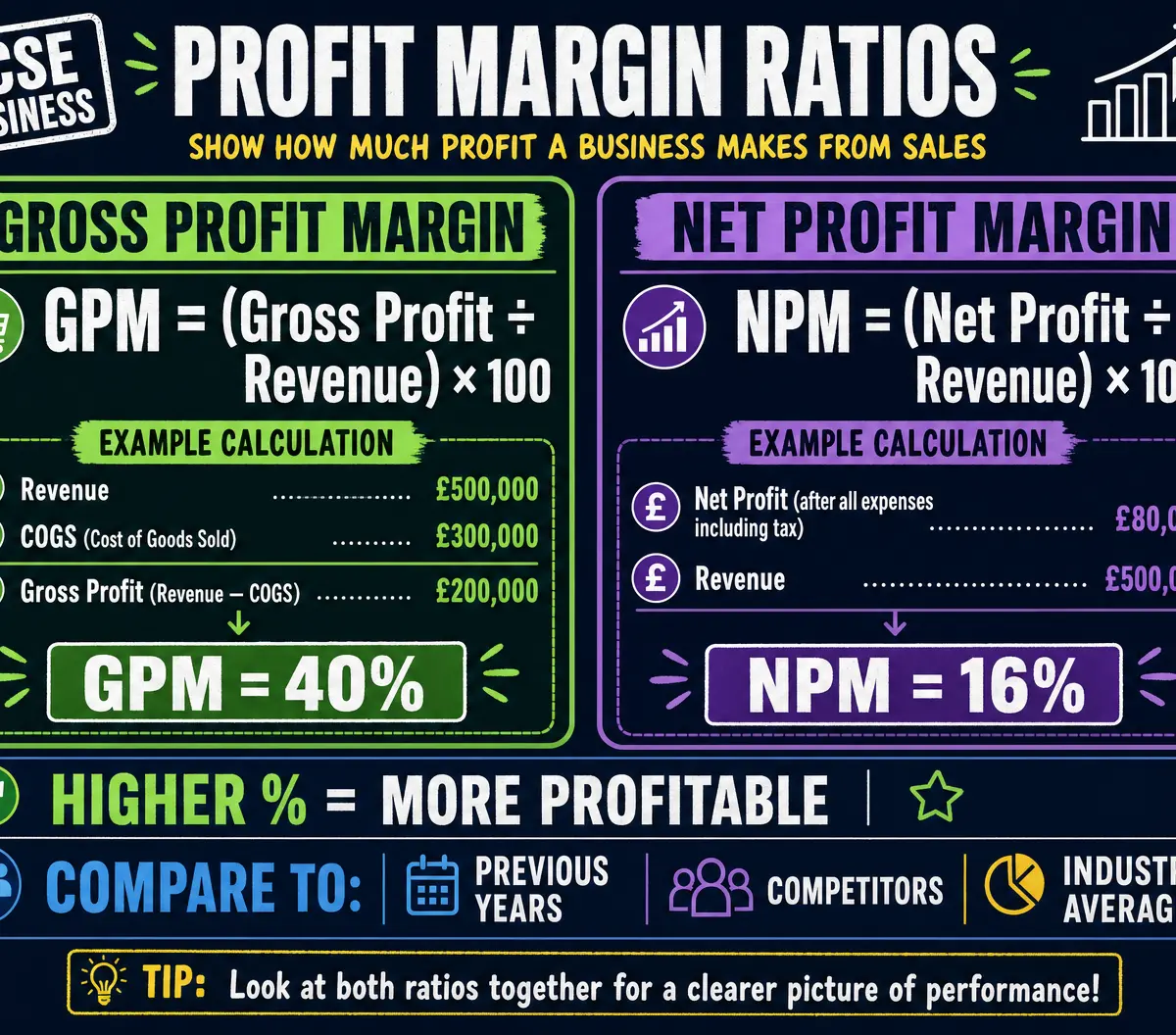
    Profit Margin Formulas

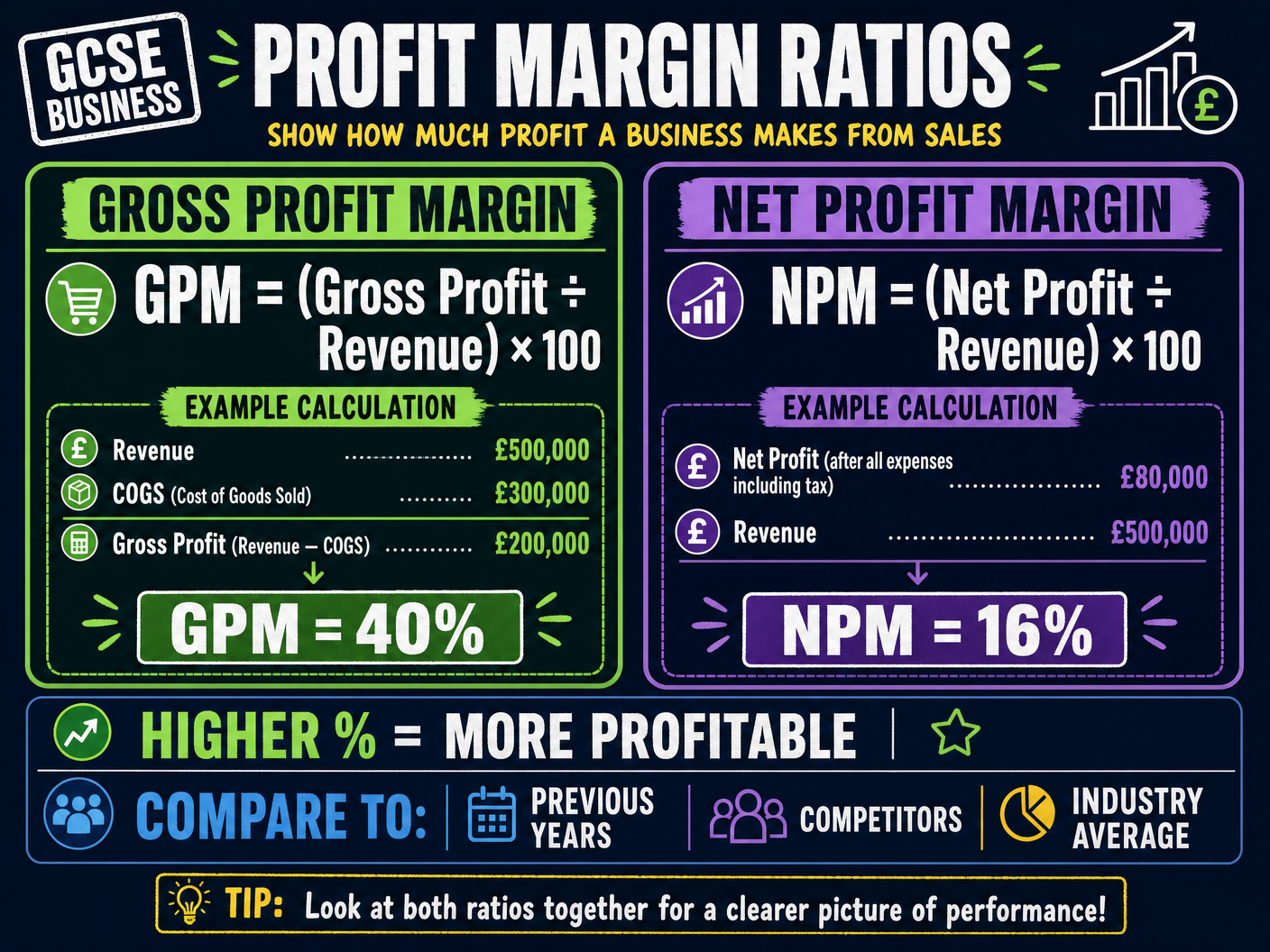
    Profitability ratios measure how efficiently a business converts revenue into profit. You must know these formulas as they are not provided in the exam.

    Gross Profit Margin (GPM):

    • Formula: (Gross Profit ÷ Revenue) × 100
    • Meaning: Shows the percentage of revenue kept as gross profit before overheads are paid.

    Net Profit Margin (NPM):

    • Formula: (Net Profit ÷ Revenue) × 100
    • Meaning: Shows the percentage of revenue kept as net profit after all expenses are paid.

    Interpreting Financial Performance

    Calculating the ratios is only half the battle. To access top marks (AO3), you must interpret the results by comparing them against benchmarks:

    • Historical Comparison: Are margins improving or worsening compared to previous years?
    • Competitor Comparison: How does the business perform against rivals or the industry average?
    • Stakeholder Perspectives: Shareholders want high net profit margins for dividends. Suppliers look at current assets and liabilities to ensure they will be paid. Managers use both to make strategic decisions on pricing and cost control.

    Audio Revision

    Listen to our comprehensive 10-minute revision podcast covering all core concepts, exam tips, and a quick-fire recall quiz.

    Financial Performance Revision Podcast

    Visual Resources

    3 diagrams and illustrations
    Income Statement Structure
    Income Statement Structure
    Statement of Financial Position
    Statement of Financial Position
    Profit Margin Formulas
    Profit Margin Formulas

    Interactive Diagrams

    1 interactive diagram to visualise key concepts

    The flow of the Income Statement

    Worked Examples

    3 detailed examples with solutions and examiner commentary

    Practice Questions

    Test your understanding — click to reveal model answers

    Q1

    Explain the difference between an asset and a liability. (2 marks)

    2 marks
    standard

    Hint: Think about 'owning' versus 'owing'.

    Q2

    A business has Revenue of £80,000, Gross Profit of £40,000, and Net Profit of £10,000. Calculate the Gross Profit Margin. (2 marks)

    2 marks
    standard

    Hint: You only need two of those three numbers for the GPM formula.

    Q3

    State two examples of current assets. (2 marks)

    2 marks
    standard

    Hint: Things the business owns that will turn into cash within a year.

    Q4

    Explain one way a business could improve its Net Profit Margin. (3 marks)

    3 marks
    hard

    Hint: Look at the formula. How can you make the top number bigger without changing the bottom number?

    Q5

    Analyse the importance of the Statement of Financial Position to a bank considering giving a loan to a business. (6 marks)

    6 marks
    hard

    Hint: What does a bank care about? Risk and repayment.

    Explore this topic further

    View Topic PageAll Business Topics

    Key Terms

    Essential vocabulary to know