AQA · GCSE · Business
Course version: 8132 · Version from Sept 2017
Marketing
Master the art of Marketing for your GCSE Business exam. This comprehensive guide covers everything from market research and segmentation to the crucial 4Ps, ensuring you understand how businesses identify and satisfy customer needs to achieve their objectives.
- 7 min read
- 3 worked examples
- 5 practice questions
- 6 key terms
Check what you remember
Read the wording for your board, then hide it and explain Market Orientation in your own words. Rough notes are fine. This is a self-check, with no mark or grade.
Reference: AQA
An approach where a business prioritises identifying and satisfying customer needs and wants before developing a product.
Study Notes
Overview
Marketing is far more than just advertising or selling; it is the fundamental process by which a business identifies, anticipates, and satisfies customer needs profitably. For your GCSE Business exam, examiners expect you to demonstrate a deep understanding of how a business becomes market-oriented rather than product-oriented. This means understanding the customer first through rigorous market research and segmentation, and then tailoring the entire business offering to meet those specific needs.
This study guide covers the essential components of the marketing syllabus. You will explore how to gather and interpret both qualitative and quantitative data, distinguish between primary and secondary research methods, and apply market segmentation. The core of this topic is the Marketing Mix (the 4Ps) — Product, Price, Place, and Promotion. Crucially, examiners reward candidates who understand that these four elements are integrated; a change in one must be reflected in the others. You will also master key analytical tools like the Product Life Cycle and the Boston Matrix, which are frequently tested in high-mark evaluation questions.
Listen to our comprehensive revision podcast to reinforce these concepts:
Market Research and Segmentation
Market Research Methods
Market research is the process of gathering data about customers, competitors, and market trends. It is divided into primary and secondary research.
Primary Research (Field Research): This is the collection of first-hand data that is directly related to a firm's specific needs. Methods include surveys, questionnaires, focus groups, and observation. While it provides highly relevant and up-to-date information, it is often expensive and time-consuming to collect.
Secondary Research (Desk Research): This involves using data that has already been collected by someone else. Sources include government statistics, market reports (e.g., Mintel), trade journals, and competitor websites. It is generally cheaper and quicker to obtain but may be outdated or not perfectly tailored to the business's specific question.
Examiners frequently test your ability to recommend and justify a research method for a specific scenario. Always link your choice back to the business's budget, time constraints, and specific information needs.
Qualitative vs. Quantitative Data
Quantitative Data: Numerical data that can be analysed statistically (e.g., "68% of customers prefer online shopping"). It is useful for identifying trends and patterns.
Qualitative Data: Opinion-based data that provides insight into the reasons behind customer behaviour (e.g., "Customers find the current packaging difficult to open"). It is crucial for understanding the 'why' behind the 'what'.
Market Segmentation
Segmentation is the process of dividing a broad target market into subsets of consumers who have common needs or characteristics. The main bases for segmentation are:
- Age: Targeting different age groups (e.g., toys for children, life insurance for adults).
- Gender: Products tailored specifically for men or women.
- Income: Segmenting based on socio-economic status (e.g., luxury brands vs. discount retailers).
- Location: Adapting products or marketing to regional preferences.
Segmentation allows a business to target its marketing mix more precisely, reducing wasted expenditure and increasing the likelihood of sales.
The Marketing Mix (The 4Ps)
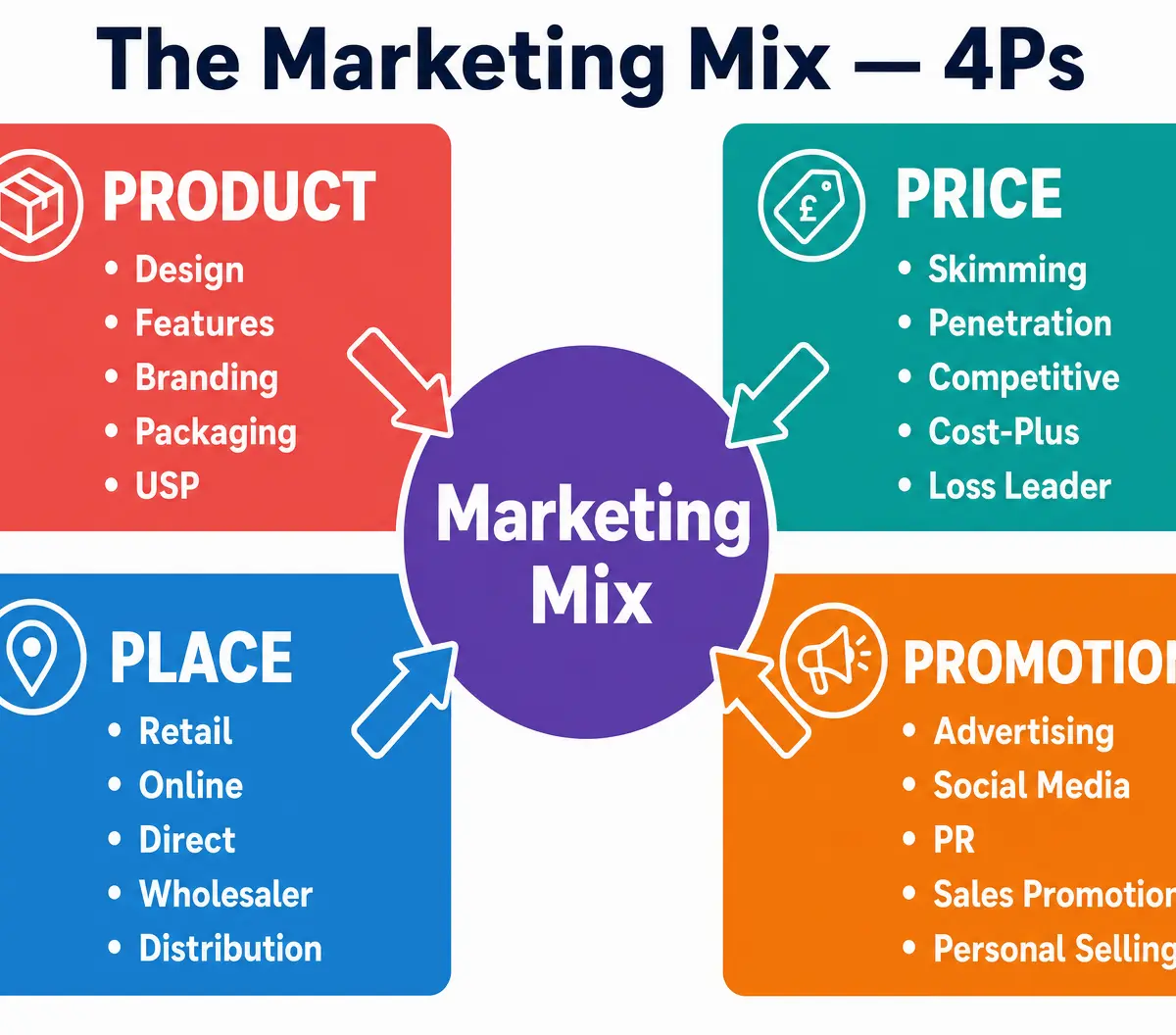
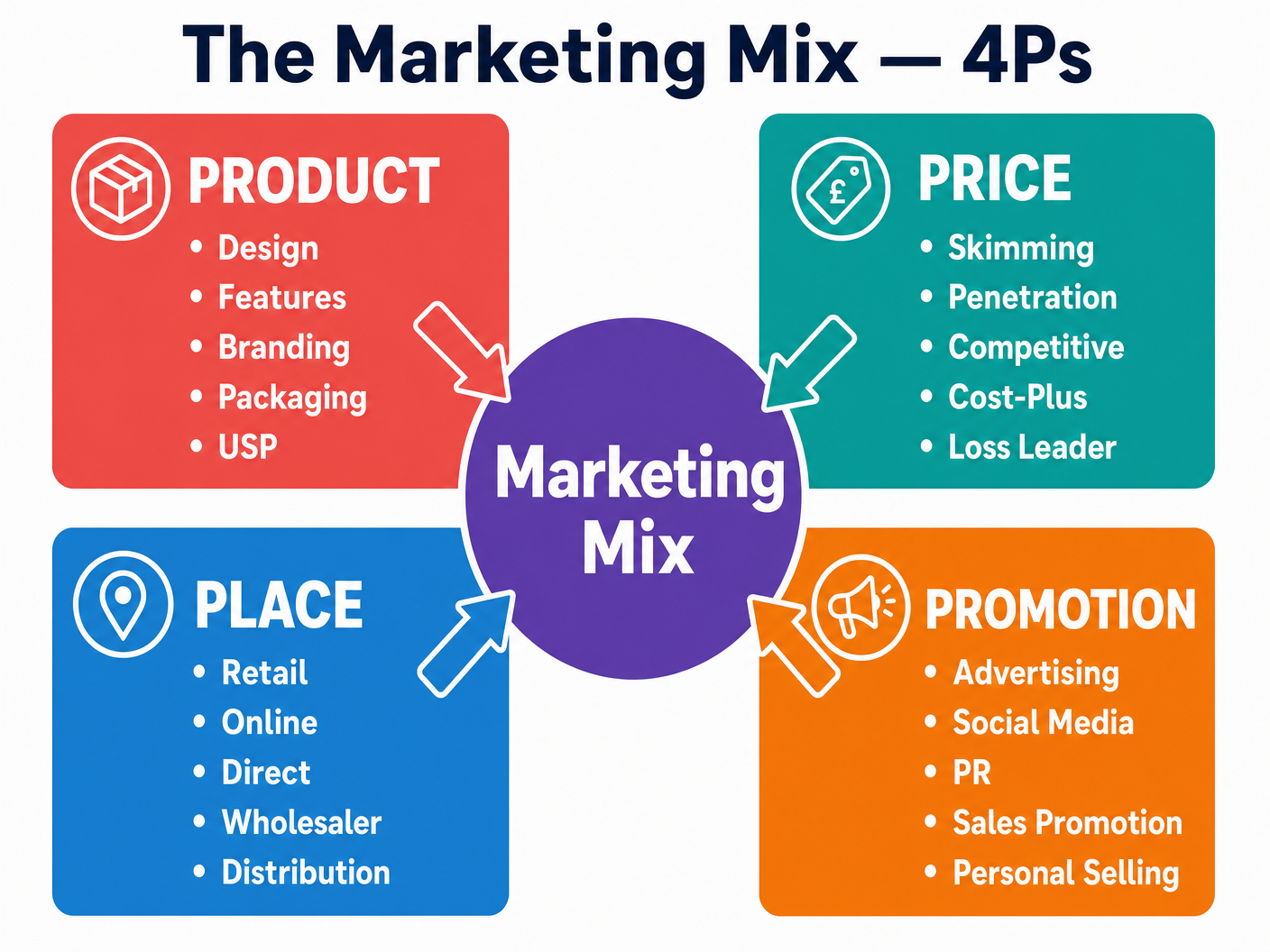
The Marketing Mix consists of four interrelated elements that a business must balance to successfully market a product. Examiners penalise candidates who treat these in isolation.
Product
The good or service being sold. Key considerations include the design, features, quality, and the Unique Selling Point (USP) — the feature that differentiates it from competitors. Branding and packaging are also crucial elements of the product offering, helping to build customer loyalty and justify premium pricing.
Price
The amount a customer pays for the product. You must be able to evaluate the following pricing strategies:
- Price Skimming: Setting a high initial price for a new, innovative product to maximise short-term profit before competitors enter the market.
- Penetration Pricing: Setting a low initial price to quickly gain market share and build a customer base, often used in highly competitive markets.
- Competitive Pricing: Setting prices in line with rivals, forcing the business to compete on other elements of the mix (like quality or customer service).
- Cost-Plus Pricing: Calculating the cost of production and adding a fixed percentage mark-up for profit.
- Loss Leader: Selling a product below its cost price to attract customers, expecting them to buy other profitable items while in-store.
Place
How the product is distributed to the customer. This includes physical retail stores, direct sales via e-commerce, or using intermediaries like wholesalers. The rise of e-commerce and m-commerce (mobile commerce) has significantly disrupted traditional distribution channels, offering businesses global reach but increasing competition.
Promotion
How the business communicates with its target market. Methods include advertising (TV, social media), sales promotion (discounts, BOGOF), public relations (PR), and personal selling. The choice of promotion must align with the target audience; for example, social media marketing is highly effective for younger demographics.
Product Portfolio Analysis
The Product Life Cycle
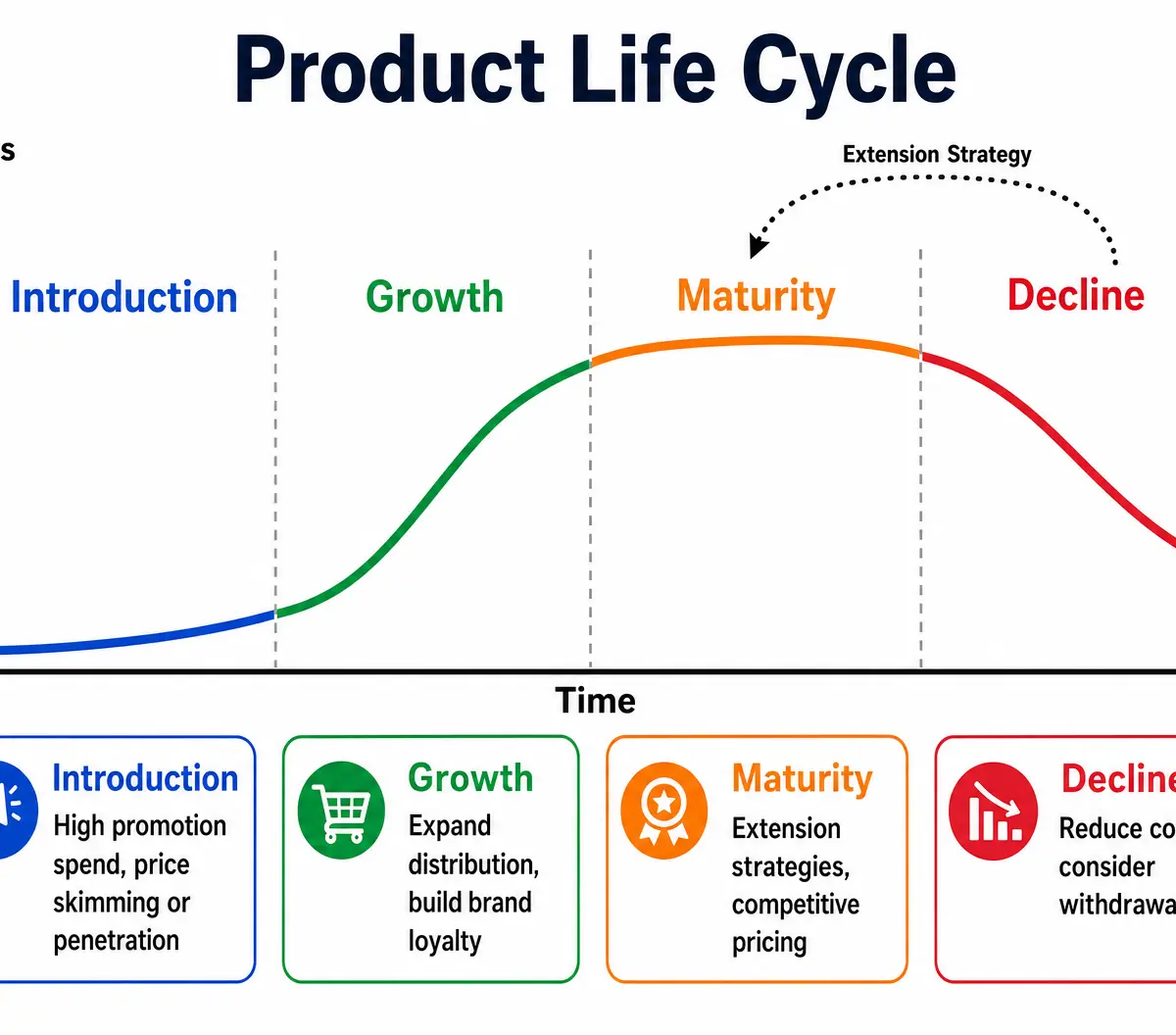
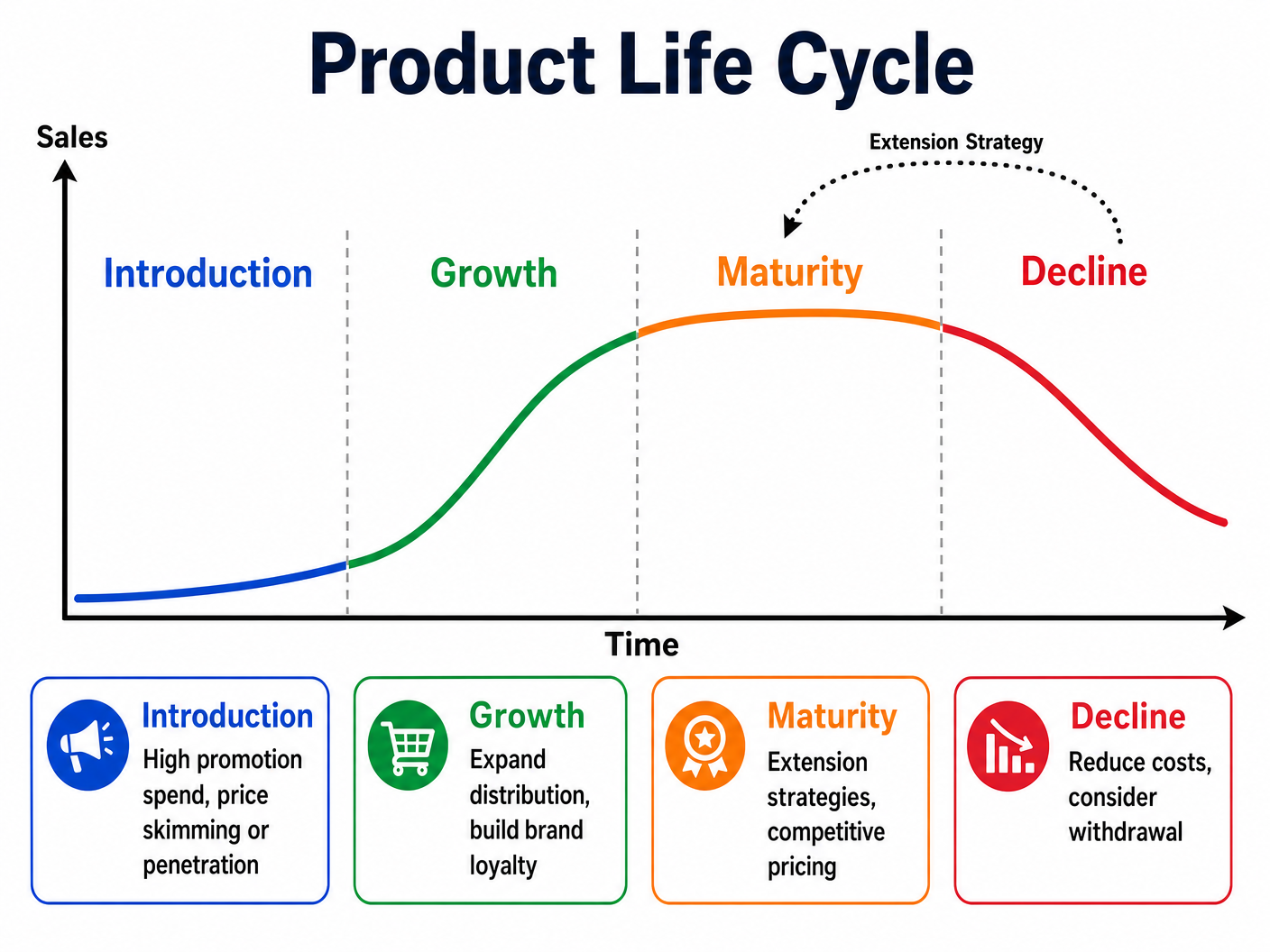
The Product Life Cycle shows the stages a product goes through from its introduction to its eventual decline.
- Introduction: Sales are low, costs are high (due to R&D and heavy promotion), and profits are negative.
- Growth: Sales rise rapidly, unit costs fall, and the product becomes profitable.
- Maturity: Sales peak and stabilise. The market may become saturated, requiring extension strategies.
- Decline: Sales fall due to changing tastes or new technology.
Extension Strategies: Actions taken to prolong the maturity stage, such as updating the product, finding new markets, or changing the packaging.
The Boston Matrix
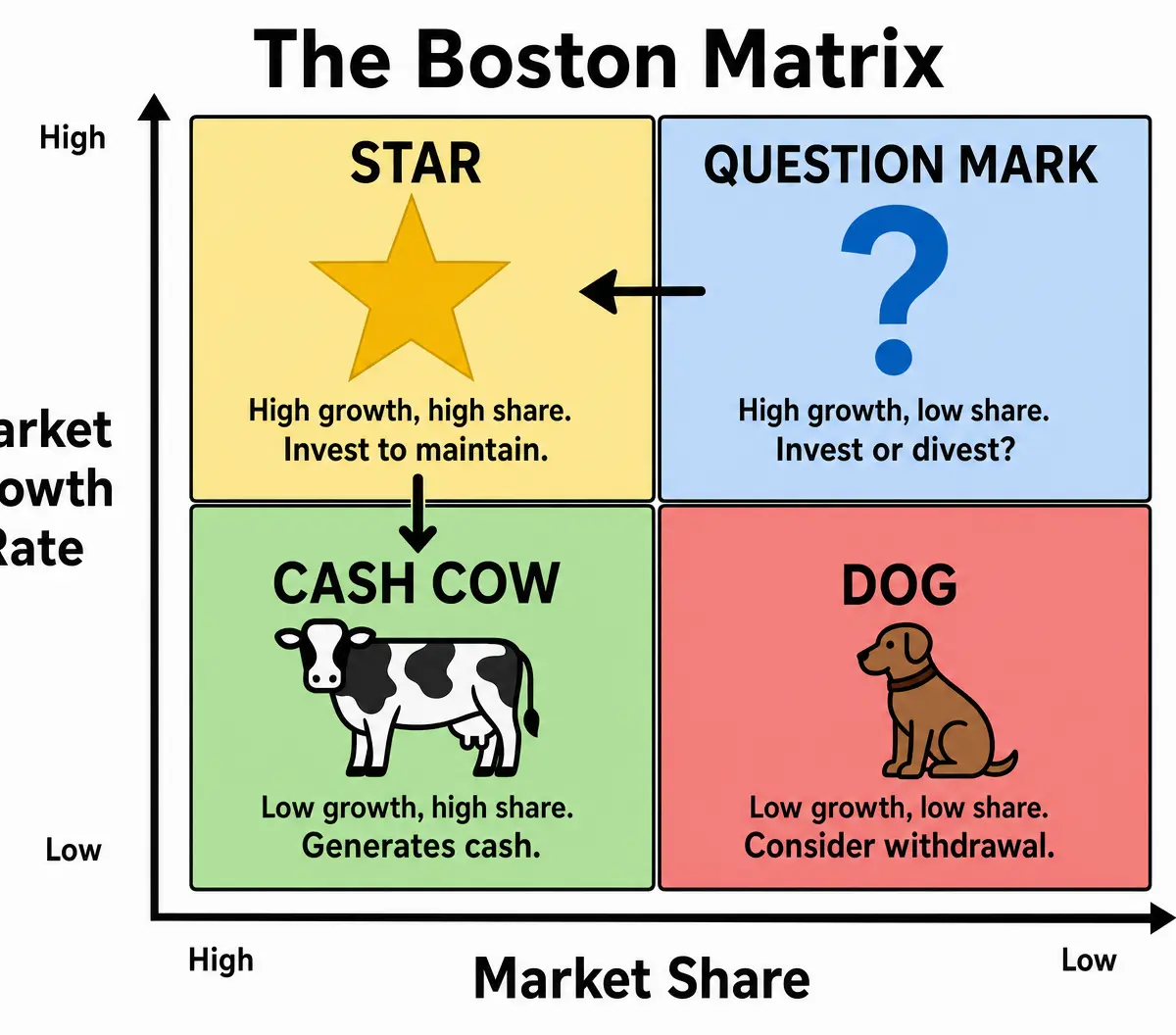
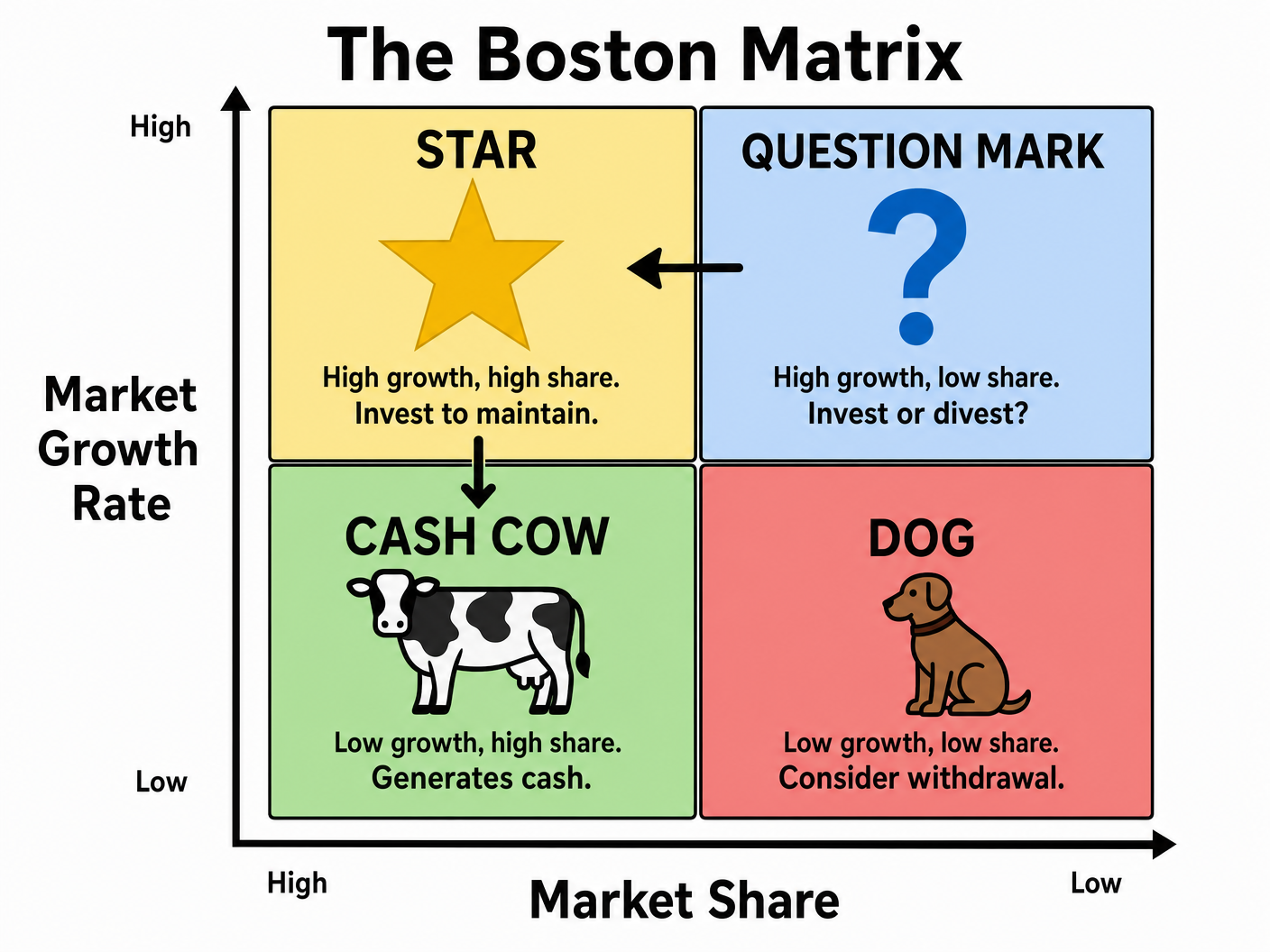
The Boston Matrix categorises products based on market share and market growth rate:
- Stars (High Growth, High Share): Require heavy investment to maintain their position but generate strong revenue.
- Cash Cows (Low Growth, High Share): Generate significant cash flow with little investment needed; used to fund other products.
- Question Marks (High Growth, Low Share): Require significant investment to turn into Stars; risky.
- Dogs (Low Growth, Low Share): Generate little profit; businesses often consider withdrawing these products.
Examiners expect you to use the Boston Matrix to make strategic recommendations for a business's product portfolio.
Worked Examples
3 worked examples — open one to explore the question and available guidance.
Practice Questions
Try the question, then reveal an answer plan or example response
State two bases a business could use to segment its market. (2 marks)
Hint: Think about the characteristics that make groups of people different from each other.
Explain how a business might use the Boston Matrix to manage its product portfolio. (6 marks)
Hint: Identify the categories and explain the actions a business takes for products in those categories.
A local gym is experiencing a decline in membership. Evaluate whether increasing its advertising budget or lowering its membership prices is the best way to attract new customers. (12 marks)
Hint: Consider the impact of both options on revenue, brand image, and the specific context of a local gym.
Explain one reason why a business might choose to use secondary market research instead of primary market research. (3 marks)
Hint: Focus on the resources required to conduct research.
Analyse the impact of e-commerce on a business's marketing mix. (6 marks)
Hint: Choose two elements of the 4Ps and explain how selling online changes them.
Exam technique
How to turn what you know into marks
How to approach the question
Always identify the command word, the specific business context, and the number of marks available before writing.
How to structure your answer
- Explain questions
- Use BLT (Because, Leading To, Therefore) or PEEL (Point, Evidence, Explain, Link) to build chains of reasoning.
- Evaluate questions
- Introduction → Argument For (in context) → Argument Against (in context) → Justified Conclusion (answering 'it depends on...').
Timing
Approximately 1 minute per mark, plus planning time for longer evaluation questions (9-12 marks).
Common pitfalls
- Giving generic answers that do not refer to the specific business in the case study.
- Confusing primary and secondary research.
- Treating the 4Ps as separate decisions rather than an integrated mix.
- Failing to provide a clear, justified conclusion in evaluation questions.
What the command words want
- Analyse
- Examine the impacts or consequences of a business decision in detail, in context. (6-9 marks)
- Explain
- Make a point and develop it with a chain of reasoning showing cause and effect. (3-6 marks)
- Identify/State
- Short, direct answer. No explanation needed. (1 mark)
- Evaluate/Recommend
- Look at both sides of an argument, apply it to the context, and make a final, justified judgement. (9-12 marks)
Watch or listen (optional)
Test your understanding of Marketing
Active recall beats re-reading. Take an instant quiz now to test what you’ve learned and lock it into long-term memory.
7 days Premium · Then the free plan continues · No card, no charge