AQA · GCSE · Business
Course version: 8132 · Version from Sept 2017
Production processes
Master the core production methods (job, batch, flow) and lean production techniques (like JIT) that businesses use to maximise efficiency. This topic is heavily examined because it links directly to business costs, quality, and competitiveness.
- 4 min read
- 3 worked examples
- 5 practice questions
- 6 key terms
Check what you remember
Read the wording for your board, then hide it and explain Job Production in your own words. Rough notes are fine. This is a self-check, with no mark or grade.
Reference: AQA
Producing a one-off item specially designed for the customer.
Study Notes
Overview
Production processes sit at the heart of operations management. Examiners expect candidates to not only define the different methods of production—job, batch, and flow—but to evaluate which method is most appropriate for a given business scenario. The choice of production method impacts everything from unit costs and quality to worker motivation and flexibility. Furthermore, modern businesses are increasingly adopting lean production techniques, such as Just-In-Time (JIT) manufacturing, to eliminate waste and boost efficiency. A strong answer in the exam will always link the chosen production method or lean technique to its impact on the business's bottom line and competitive advantage.
Production Methods
Job Production
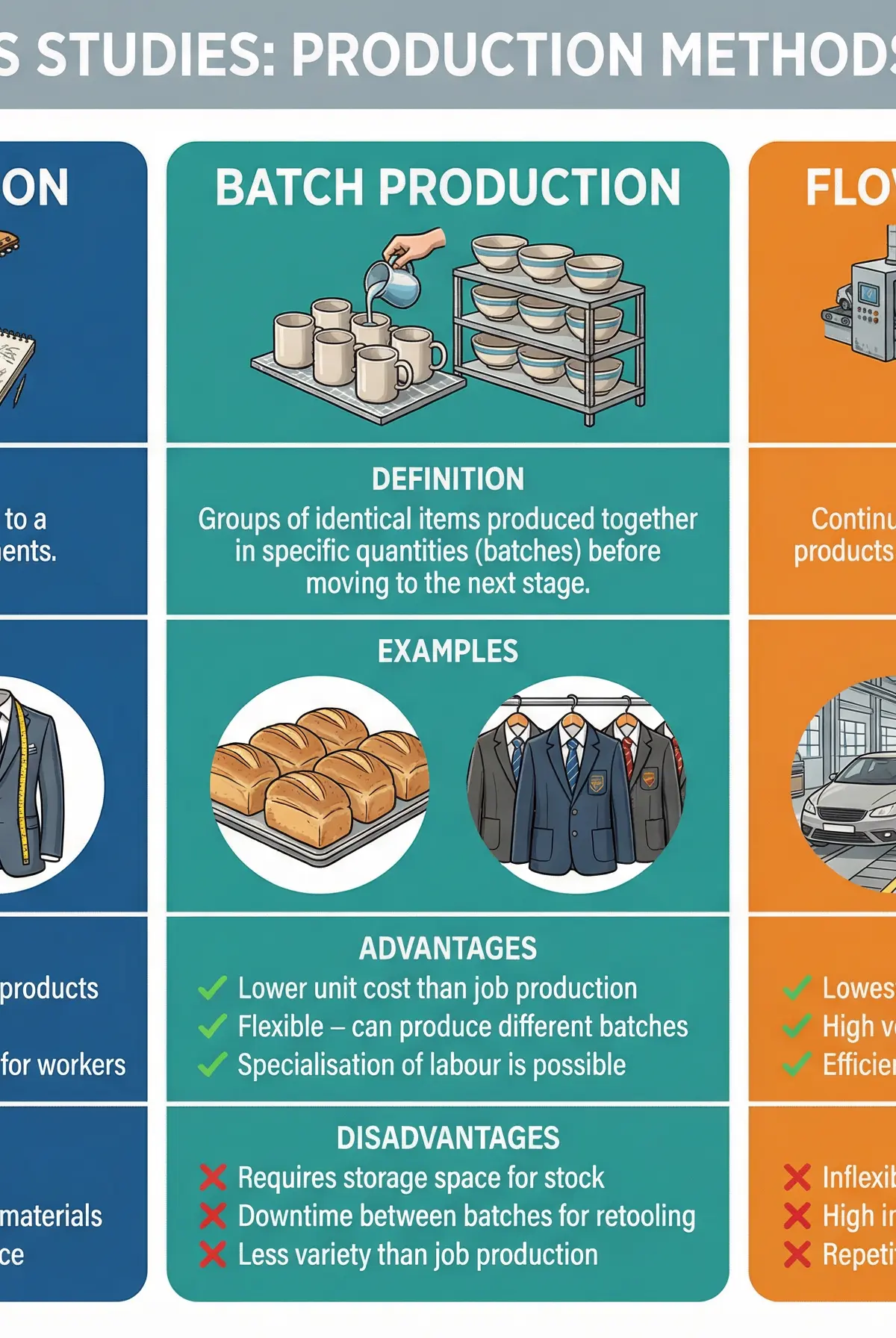
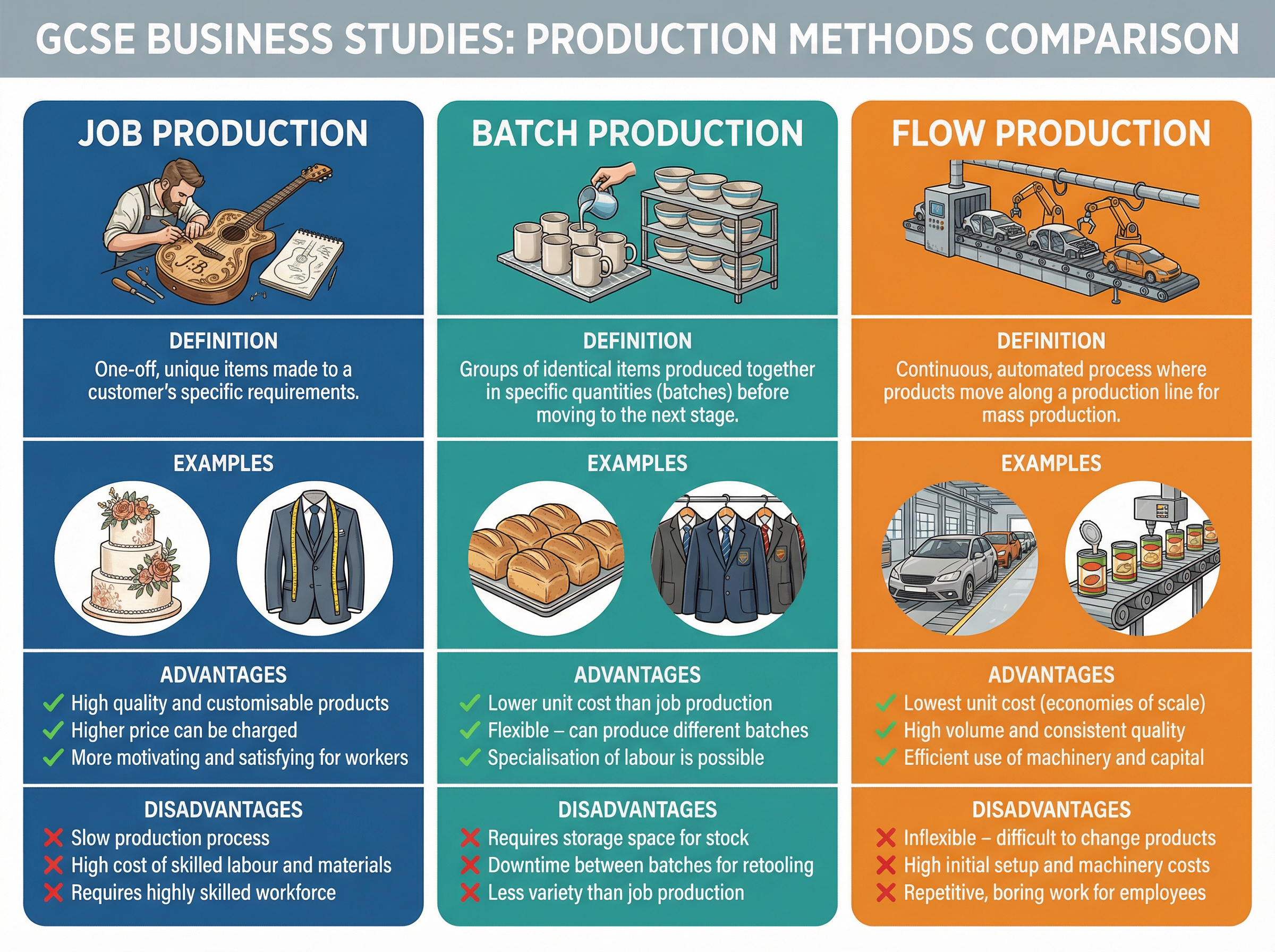
Definition: The production of a single, unique item from start to finish, usually to meet a specific customer's exact requirements.
Key Features: Highly skilled workforce, bespoke products, high profit margins.
Exam Focus: Examiners often test job production in the context of small businesses or luxury markets (e.g., bespoke tailors, custom cake makers). You must be able to explain that while it allows for high prices and premium quality, it suffers from slow production times and high unit costs due to a lack of economies of scale.
Batch Production
Definition: Producing a set number of identical items (a batch) together before moving on to produce a different batch.
Key Features: Flexibility to switch products, lower unit costs than job production, but requires storage for work-in-progress.
Exam Focus: Batch production is the 'middle ground'. Use examples like bakeries or clothing manufacturers. Examiners look for candidates who recognise the inefficiency of 'downtime'—the time wasted cleaning or retooling machinery between different batches.
Flow Production
Definition: A continuous, automated process where identical products move along an assembly line for mass production.
Key Features: Capital intensive (expensive machinery), massive economies of scale, low unit costs, 24/7 operation.
Exam Focus: Flow production is all about volume and efficiency. Examples include car manufacturing or soft drinks. You must be able to evaluate the trade-off: the massive initial setup costs and inflexibility versus the incredibly low cost per unit achieved once running.
Lean Production
The Philosophy of Lean
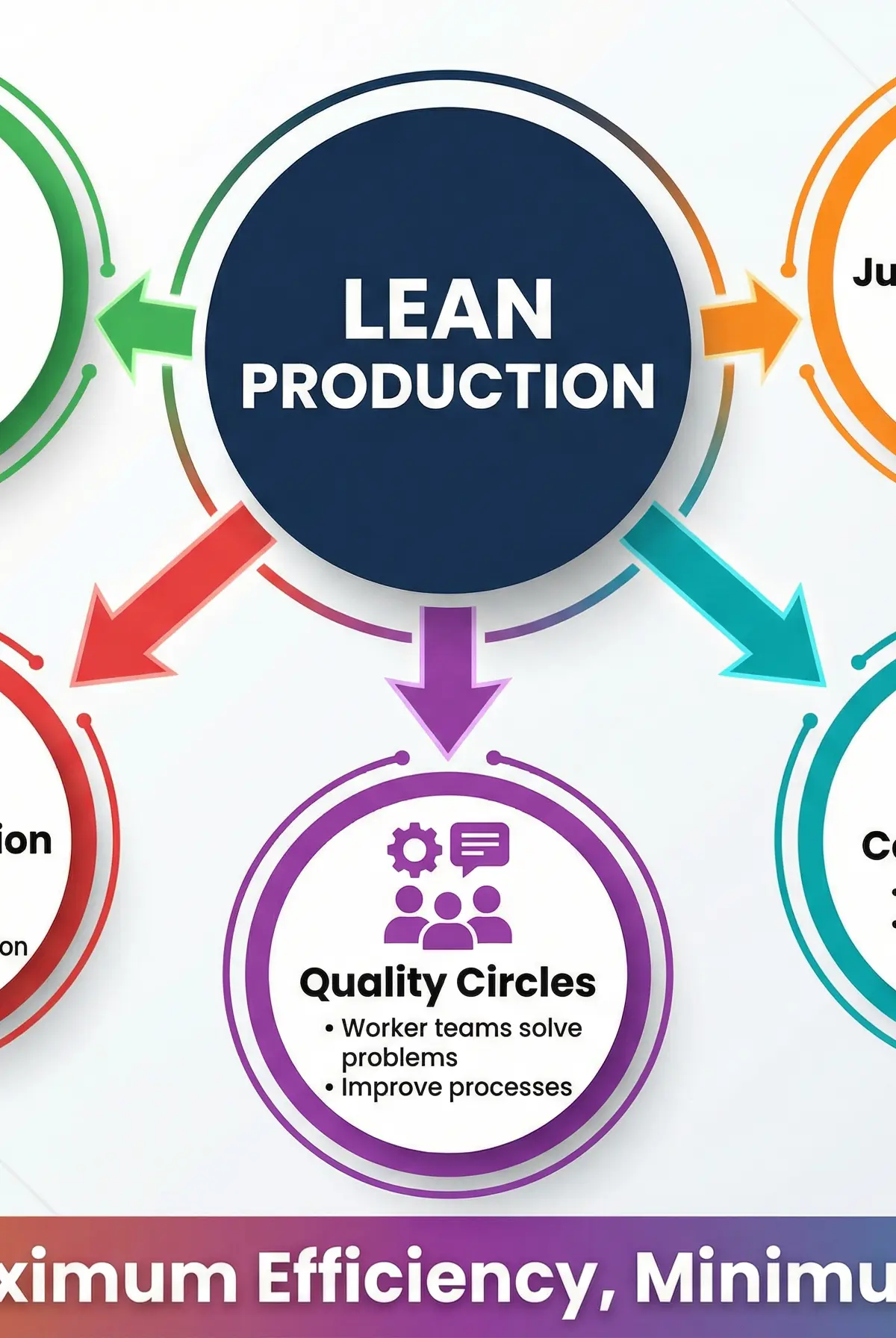
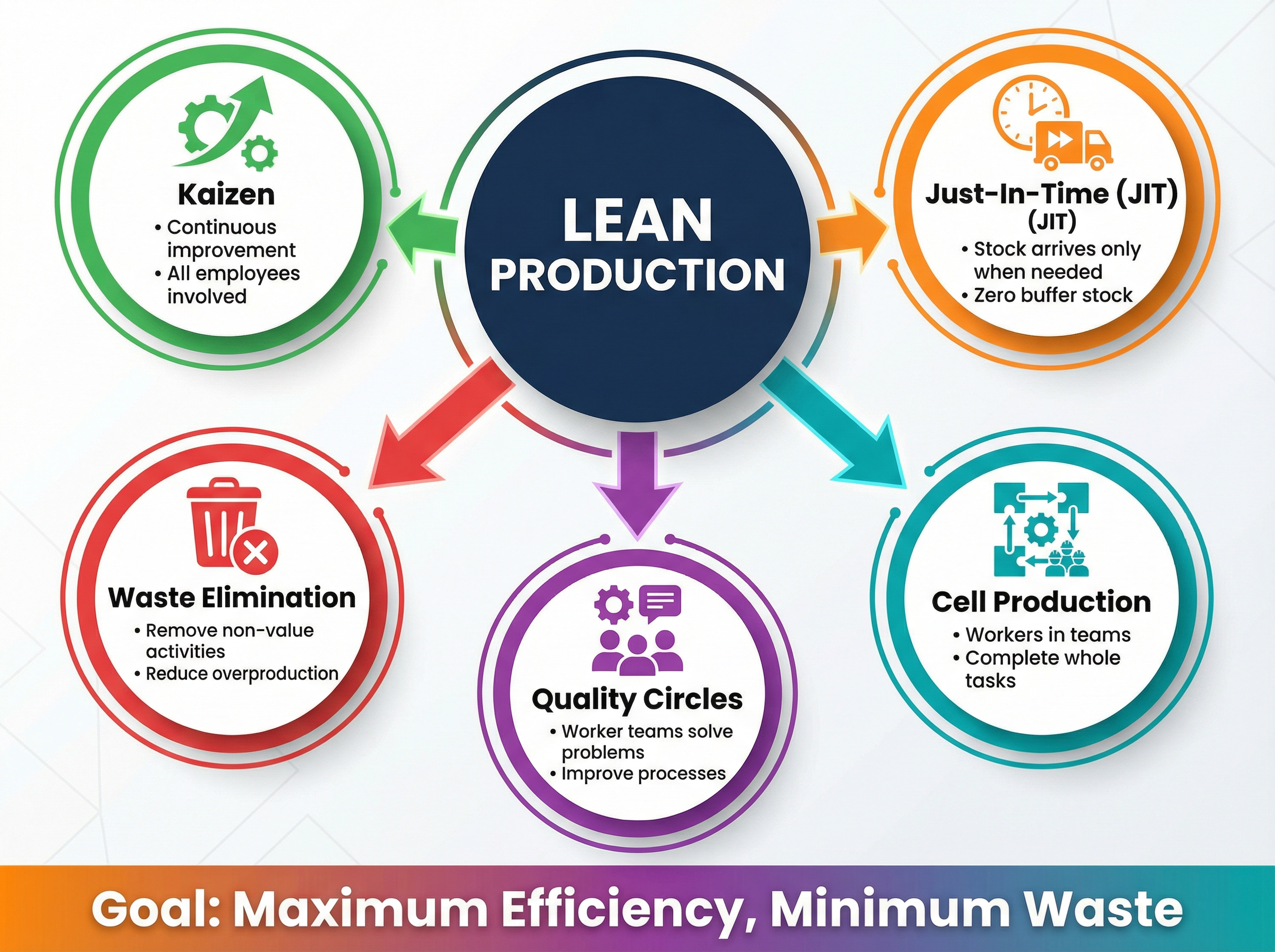
Lean production is a Japanese approach to management that focuses on cutting out waste (time, materials, space) whilst ensuring quality. If an activity does not add value for the customer, it is considered waste.
Just-In-Time (JIT)
Definition: A stock control and production method where materials arrive exactly when they are needed on the production line, eliminating the need for buffer stock.
Key Features: Zero buffer stock, strong supplier relationships, frees up cash flow.
Exam Focus: JIT is highly examinable. You must balance the cost-saving benefits (no warehouse costs, better cash flow) against the severe risks (if a delivery is delayed, production stops immediately). Examiners reward candidates who point out that JIT requires incredibly reliable suppliers.
Kaizen (Continuous Improvement)
Definition: An approach where all employees are encouraged to suggest small, regular improvements to the production process.
Key Features: Empowers workers, inexpensive to implement, relies on thousands of small changes adding up to major efficiency gains.
Exam Focus: Kaizen links well to human resources topics. Mention how it improves worker motivation because their ideas are valued, while simultaneously improving operational efficiency.
Podcast Lesson
Listen to the comprehensive audio guide for this topic:
Visual Resources
2 diagrams and illustrations
Interactive Diagrams
1 interactive diagram to visualise key concepts
Conceptual Flow Outline
Choosing a Production Method
Worked Examples
3 worked examples — open one to explore the question and available guidance.
Practice Questions
Try the question, then reveal an answer plan or example response
Explain two reasons why a manufacturer of luxury yachts would choose job production. (6 marks)
Hint: Think about what luxury customers want and the nature of building a yacht.
Evaluate the impact on a bakery of switching from batch production to flow production. (9 marks)
Hint: Consider economies of scale vs loss of flexibility and setup costs.
State two types of waste that lean production aims to eliminate. (2 marks)
Hint: Think about time, materials, and movement.
Explain one risk of using Just-In-Time (JIT) stock control. (3 marks)
Hint: What happens if a delivery truck breaks down?
Analyse how Kaizen can improve worker motivation. (6 marks)
Hint: Link Kaizen to theories of motivation like Maslow or Herzberg, focusing on empowerment.
Exam technique
How to turn what you know into marks
How to approach the question
Always highlight the name of the business and what they sell in the question stem. Your answer MUST relate to this.
How to structure your answer
- Essay questions
- Intro -> Benefit to the business -> Drawback to the business -> Conclusion (It depends on...)
- Source questions
- Use data from the case study to support your points. E.g., 'As seen in Appendix A, the business only has £5,000 cash...'
- Explain questions
- PEEL: Point, Evidence (context), Explain, Link to business objective (e.g., profit, survival).
Timing
Aim for 1 minute per mark. Spend 2-3 minutes planning 9-mark and 12-mark questions.
Common pitfalls
- Writing generic answers that don't mention the specific product the business makes.
- Confusing 'production' (making things) with 'productivity' (efficiency).
- Describing JIT without mentioning the severe risk of supply chain failure.
What the command words want
- Analyse
- Show a chain of reasoning. Cause -> Effect -> Business Impact.
- Explain
- Make a point and develop it with a consequence. Use 'This means that...'
- State/Identify
- One word or a short sentence. No explanation needed.
- Evaluate/Recommend
- Look at both sides of the argument and make a final, justified decision.
Watch or listen (optional)
Test your understanding of Production processes
Active recall beats re-reading. Take an instant quiz now to test what you’ve learned and lock it into long-term memory.
7 days Premium · Then the free plan continues · No card, no charge