AQA · GCSE · Business
Course version: 8132 · Version from Sept 2017
Sources of finance
Every business needs money to start, grow, and survive. This study guide covers the essential internal and external sources of finance, teaching you how to evaluate the best option for different business scenarios to secure top marks.
- 5 min read
- 3 worked examples
- 5 practice questions
- 6 key terms
Check what you remember
Read the wording for your board, then hide it and explain Internal Finance in your own words. Rough notes are fine. This is a self-check, with no mark or grade.
Reference: AQA
Money raised from within the business itself.
Study Notes
Overview
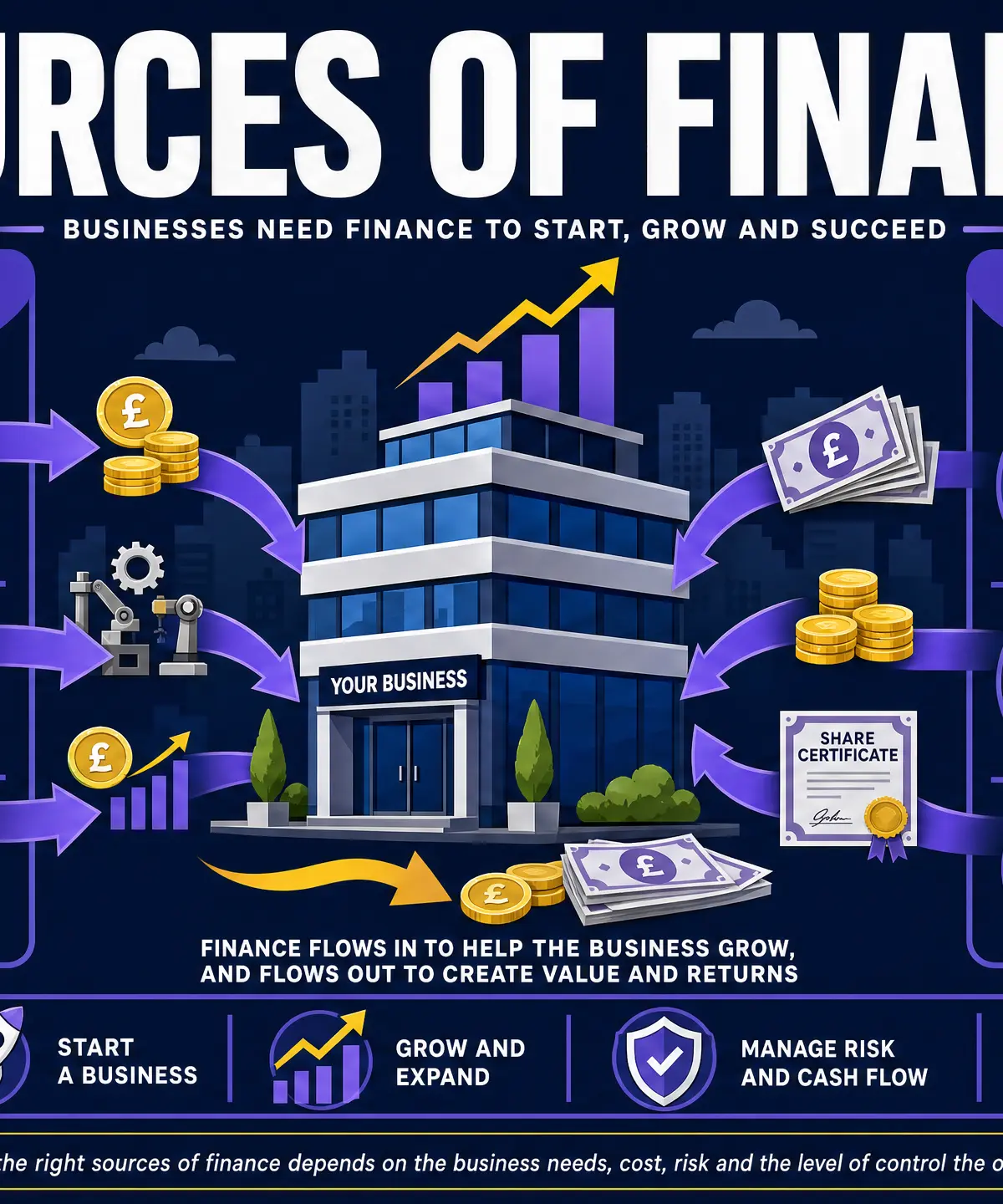
Finance is the lifeblood of any business. Without it, a start-up cannot purchase its initial assets, and an established business cannot expand or survive temporary cash flow shortages. This topic covers the various methods businesses use to raise capital. Examiners expect candidates to not only identify these sources but to analyse their costs (both financial and non-financial) and evaluate their suitability based on the specific context of the business (e.g., size, legal structure, age, and purpose of the finance).
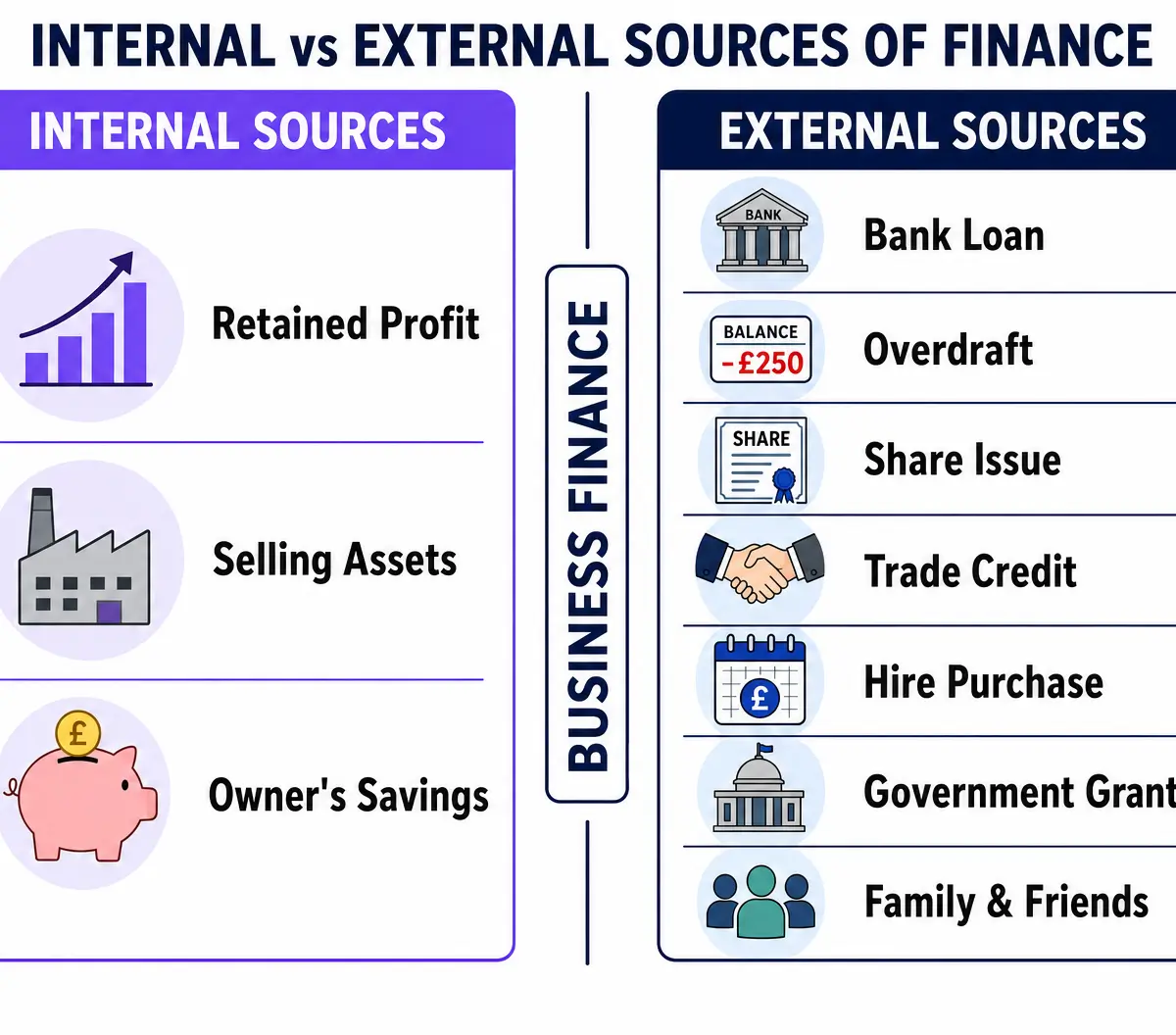
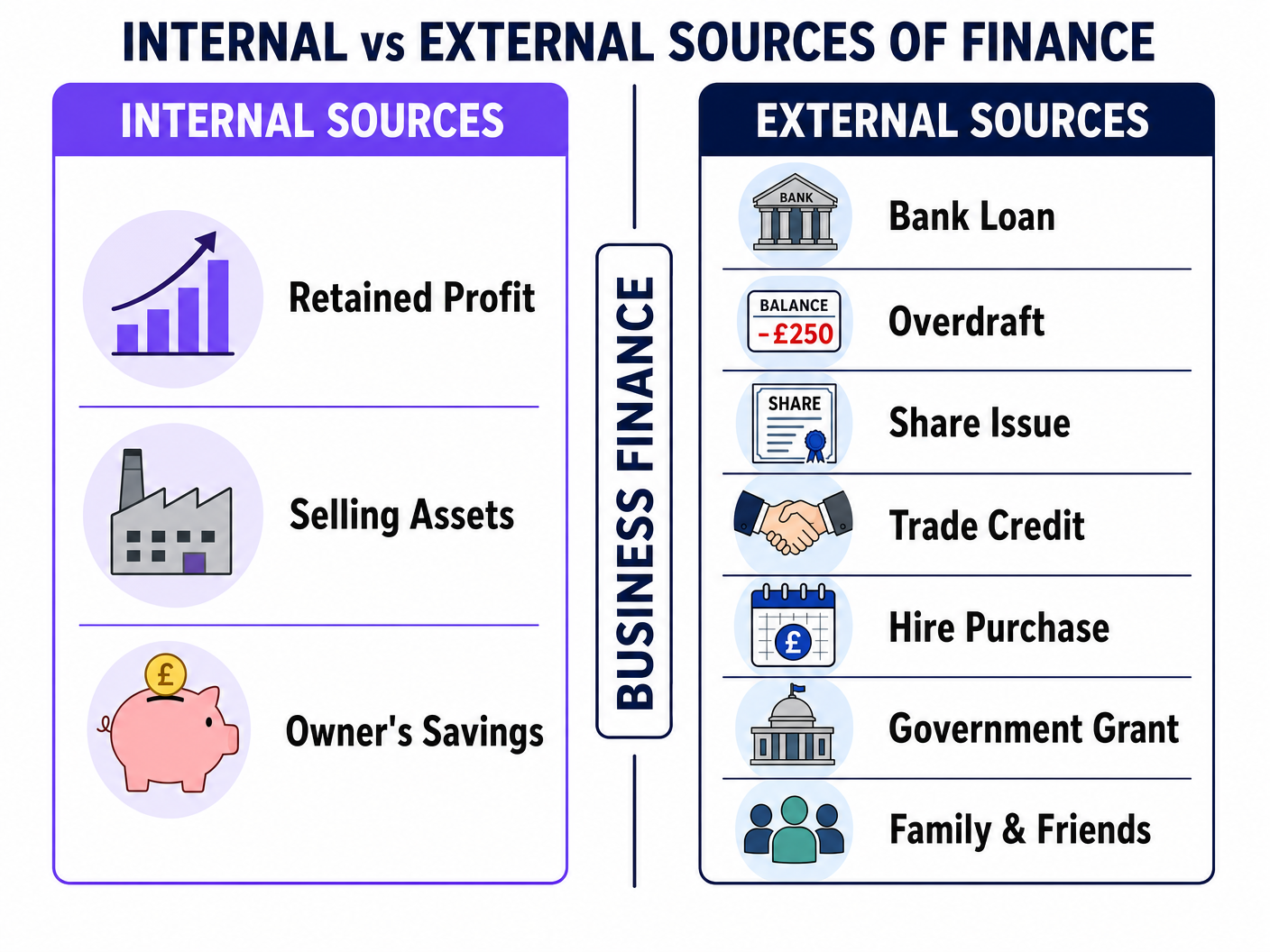
Internal Sources of Finance
Internal sources are funds found inside the business. They are generally preferred as they do not incur interest.
Retained Profit
Definition: Profit kept within the business after taxes and dividends have been paid, used for reinvestment.
Advantages: No interest to pay; no loss of control; does not need to be repaid.
Disadvantages: Only available to established, profitable businesses; once used, it is gone; shareholders may be unhappy if dividends are reduced.
Exam Relevance: A classic examiner trap is candidates recommending retained profit for a new start-up. Remember: start-ups have no retained profit!
Selling Assets
Definition: Selling items the business owns (e.g., old machinery, spare land) to raise cash.
Advantages: Quick way to raise cash; no interest payments.
Disadvantages: The business no longer has the asset; may not raise enough money; takes time to find a buyer.
Owner's Savings
Definition: The owner investing their own personal money into the business.
Advantages: No interest to pay; no loss of control.
Disadvantages: The owner risks losing their personal savings if the business fails; limited amount available.
External Sources of Finance
External sources are funds raised from outside the business. These often involve a cost, such as interest or loss of control.
Bank Loan
Definition: Borrowing a fixed sum of money from a bank, repaid over a set period with interest.
Advantages: Quick to arrange; owner keeps full control of the business.
Disadvantages: Interest must be paid; bank may require collateral (security) which could be lost if the loan is not repaid.
Overdraft
Definition: An agreement with the bank allowing the business to spend more money than is in its account, up to an agreed limit.
Advantages: Highly flexible; interest is only paid on the amount borrowed; excellent for short-term cash flow issues.
Disadvantages: Very high interest rates; the bank can demand repayment at any time.
Share Issue
Definition: Selling parts of the ownership of a limited company (Ltd or plc) to investors in exchange for capital.
Advantages: Can raise very large sums of money; does not need to be repaid; no interest to pay.
Disadvantages: Original owners lose some control; profits must be shared as dividends; only available to limited companies.
Trade Credit
Definition: Buying goods from suppliers now and paying for them later (e.g., 30 or 60 days).
Advantages: Helps with short-term cash flow; no interest if paid on time.
Disadvantages: Missing payments damages supplier relationships and credit rating; potential loss of early payment discounts.
Government Grants
Definition: Financial assistance from the government, often given to businesses in deprived areas or specific industries.
Advantages: Does not need to be repaid; no interest.
Disadvantages: Highly competitive; strict conditions on how the money is spent; time-consuming application process.
Evaluating Suitability
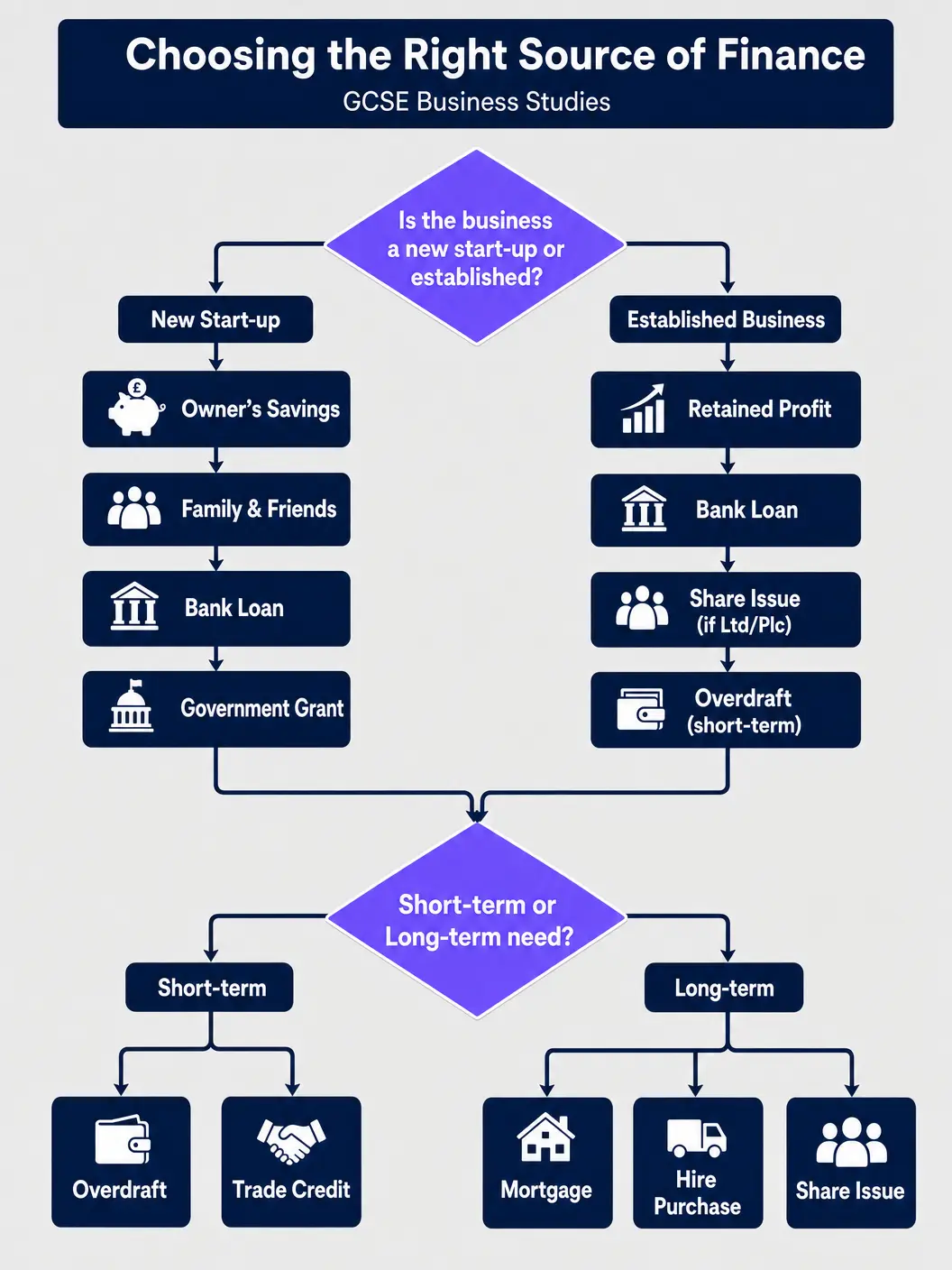
Examiners award the highest marks for evaluating the suitability of a source of finance. You must consider:
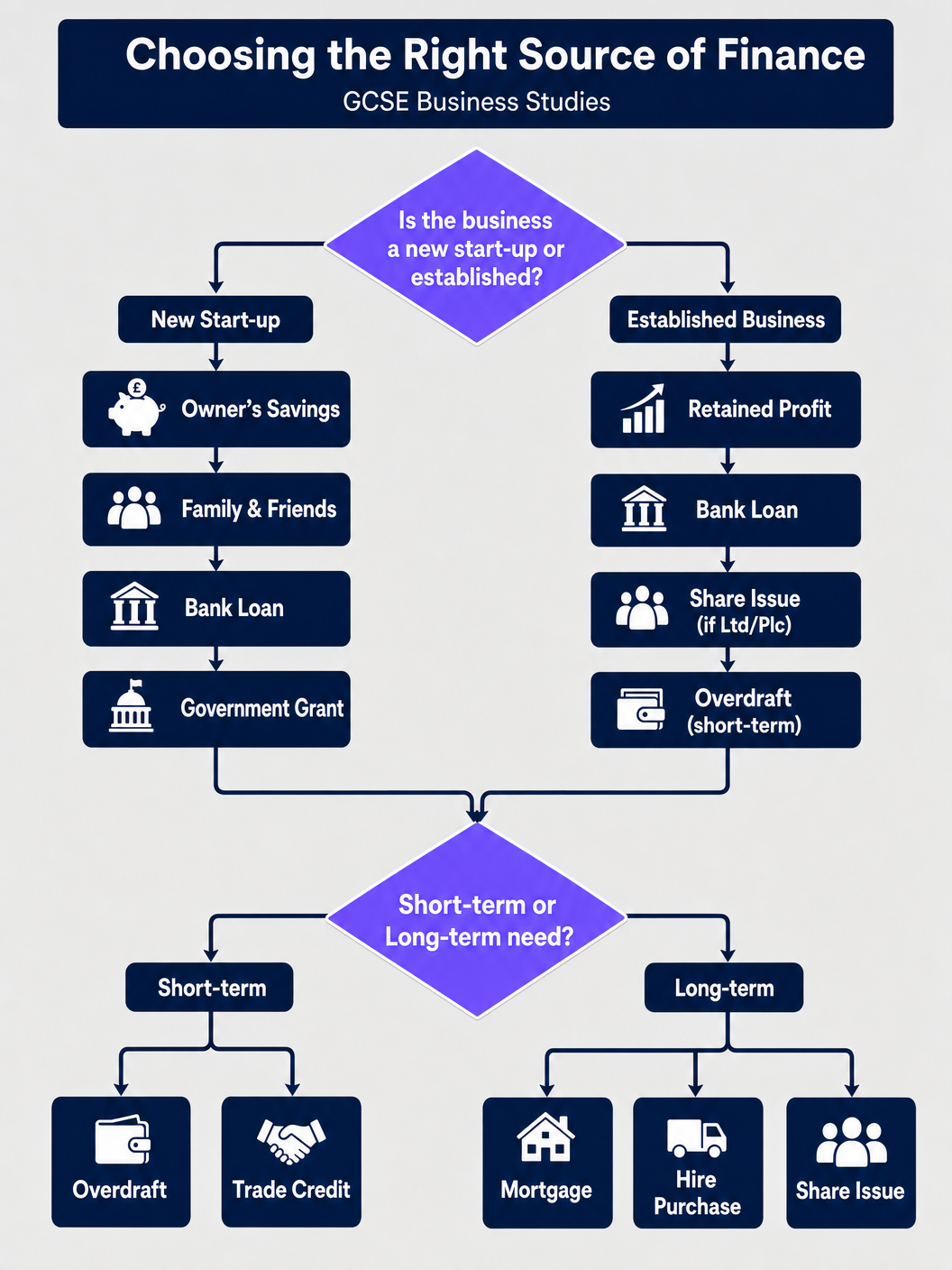
- Timeframe: Short-term need (e.g., paying wages) = Overdraft. Long-term need (e.g., buying a factory) = Mortgage/Loan.
- Business Type: Start-ups cannot use retained profit. Sole traders cannot issue shares.
- Amount Needed: Large amounts may require a share issue or mortgage; small amounts may be covered by an overdraft or owner's savings.
- Cost vs Control: Loans cost interest but maintain control. Shares have no interest but dilute control.
Visual Resources
2 diagrams and illustrations
Interactive Diagrams
1 interactive diagram to visualise key concepts
Conceptual Flow Outline
Decision tree for choosing finance
Worked Examples
3 worked examples — open one to explore the question and available guidance.
Practice Questions
Try the question, then reveal an answer plan or example response
Identify two external sources of finance. (2 marks)
Hint: Think of money coming from outside the business.
Explain one reason why a new start-up might struggle to get a bank loan. (3 marks)
Hint: What do banks look for when lending money? What does a start-up lack?
A private limited company (Ltd) wants to buy a new factory for £500,000. Evaluate whether they should use a mortgage or issue shares to fund this. (9 marks)
Hint: Compare the cost of interest vs the loss of control.
Explain how trade credit helps a business manage its cash flow. (3 marks)
Hint: Think about the timing of money going out vs money coming in.
State one advantage of using retained profit rather than a bank loan. (1 mark)
Hint: What is the main cost of a bank loan?
Exam technique
How to turn what you know into marks
How to approach the question
Always read the context first. Highlight the size, age, and legal structure of the business before choosing a source of finance.
How to structure your answer
- State questions
- Keep it brief. One word or a short phrase is enough.
- Explain questions
- State the point, then use 'This means that...' or 'As a result...' to develop the consequence.
- Evaluate questions
- Analyse Option 1 (Pros/Cons) -> Analyse Option 2 (Pros/Cons) -> Conclusion (It depends on...)
Timing
Approximately 1 minute per mark.
Common pitfalls
- Recommending retained profit for a start-up.
- Recommending a share issue for a sole trader or partnership.
- Suggesting a short-term source (like an overdraft) for a long-term need (like buying a building).
What the command words want
- Explain
- Give a reason and a consequence. Show the chain of events.
- State/Identify
- Give a simple fact or term. No explanation needed.
- Evaluate/Justify
- Look at both sides of the argument and make a final decision based on the context.
Watch or listen (optional)
Test your understanding of Sources of finance
Active recall beats re-reading. Take an instant quiz now to test what you’ve learned and lock it into long-term memory.
7 days Premium · Then the free plan continues · No card, no charge