Pearson Edexcel · GCSE · Business
Topic 2.3 Making operational decisions
Mastering operational decisions is the key to understanding how businesses turn inputs into profitable outputs. This topic covers production methods, quality management, and supply chains—essential knowledge for securing high marks in application and evaluation questions.
- 5 min read
- 3 worked examples
- 5 practice questions
- 6 key terms
Study Notes
Overview
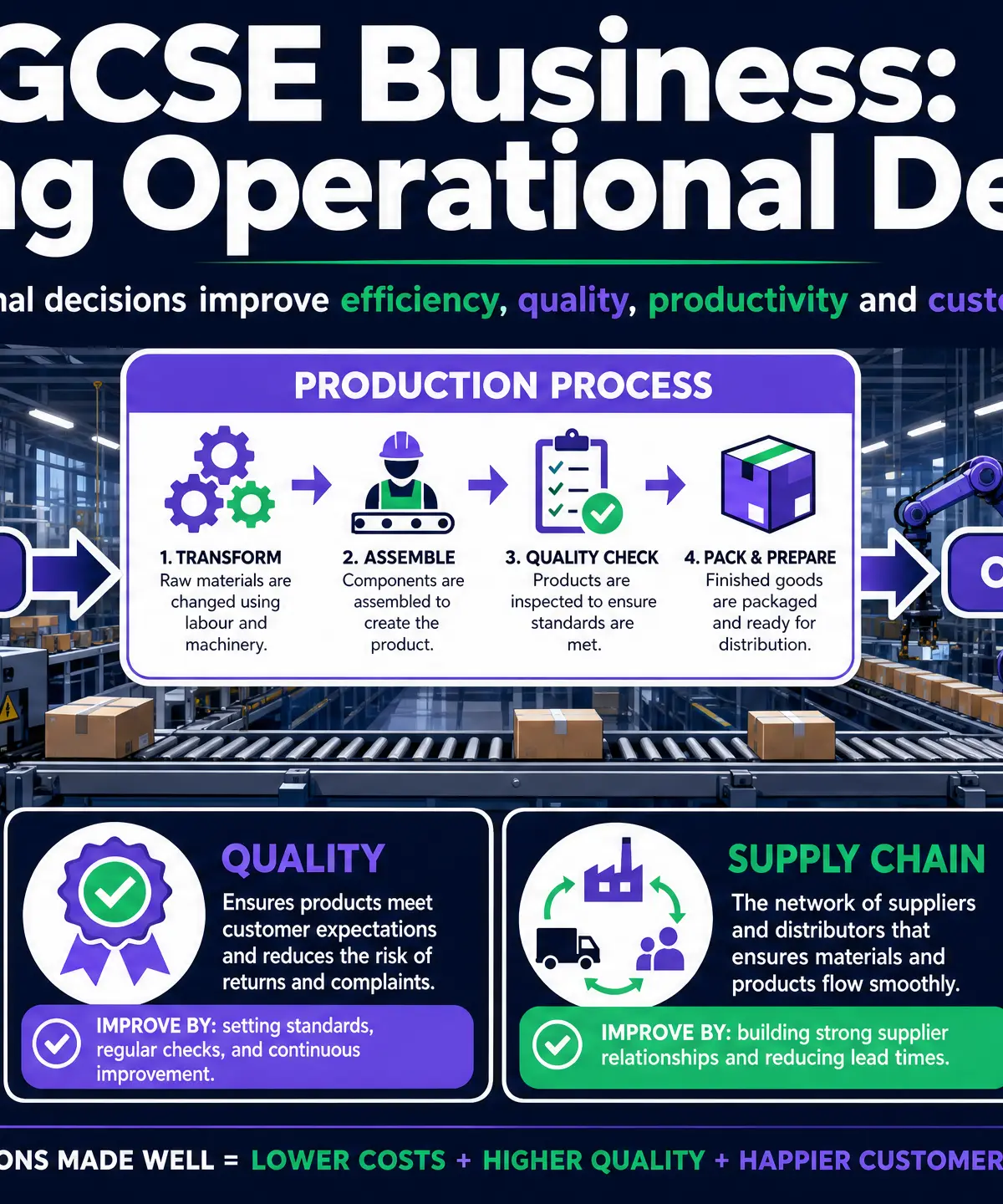
Topic 2.3 focuses on the engine room of any business: operations. Examiners expect candidates to understand that effective operational decisions directly impact a business's costs, quality, and ability to meet customer needs. You will need to evaluate different production methods, explain how businesses manage quality, and analyse the supply chain. The key to top marks in this section is application—you must link your operational recommendations to the specific context provided in the source material.
Listen to our comprehensive podcast summary of this topic here:

Production Methods
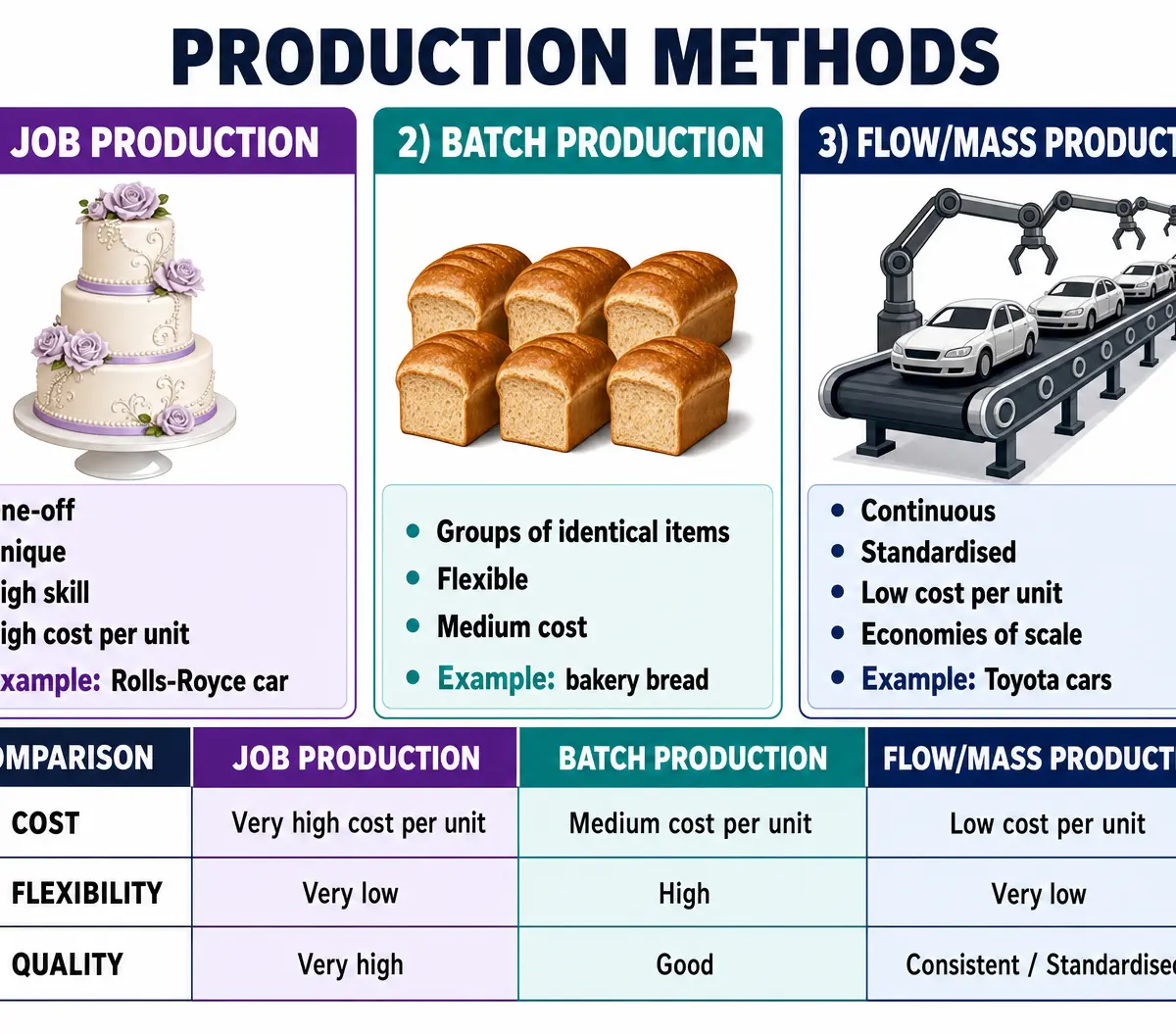
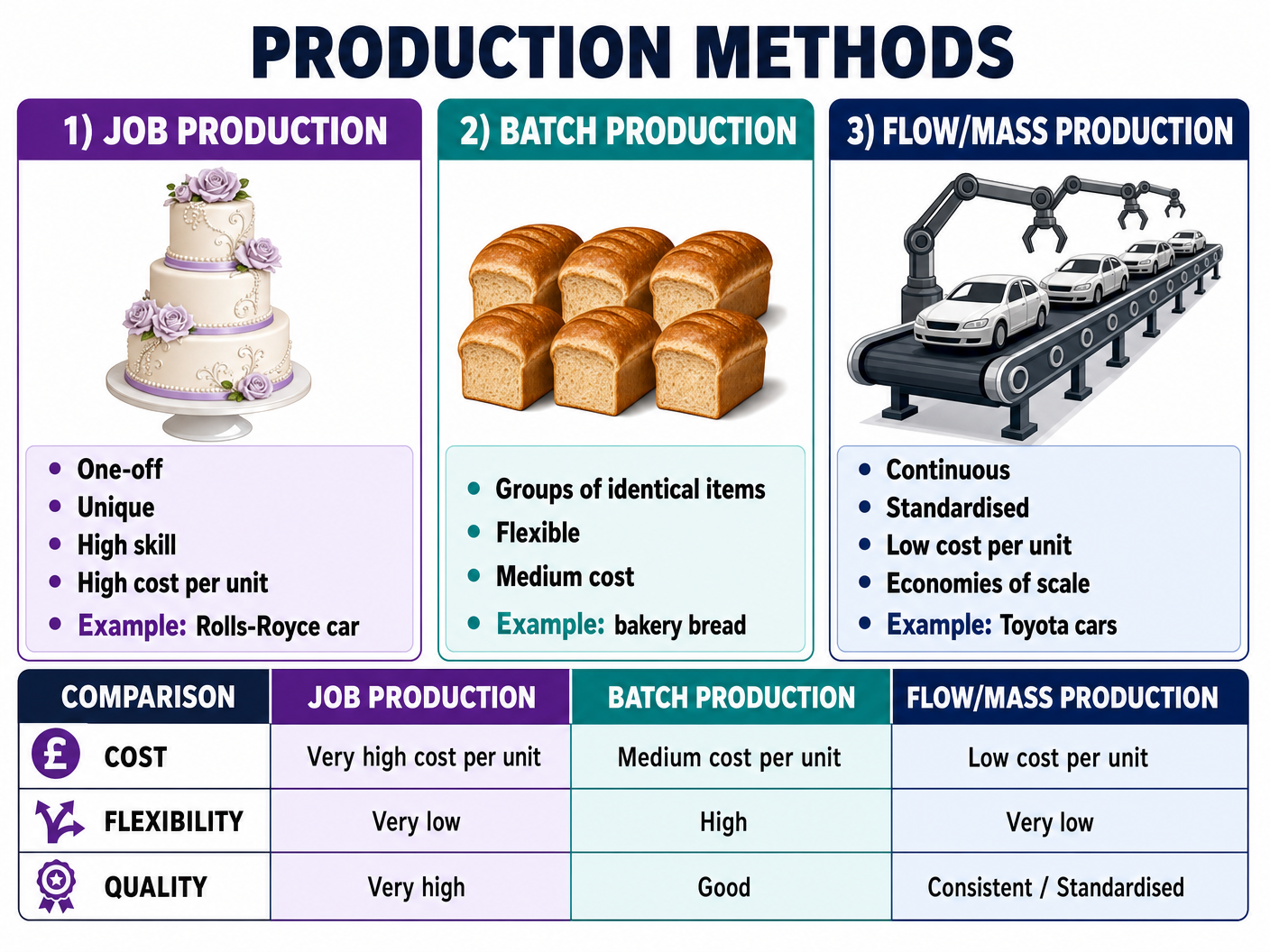
Businesses must choose the most appropriate way to manufacture their goods. The three main methods are Job, Batch, and Flow production.
Job Production
Definition: Producing a single, unique, or bespoke item tailored to a specific customer's requirements.
Characteristics: High skill level required, highly labour-intensive, high cost per unit.
Examples: Custom-built houses, bespoke wedding cakes, designer suits.
Exam Relevance: Often tested in the context of a small start-up or premium brand. Credit is given for identifying that while quality and customer satisfaction are high, the business loses out on economies of scale.
Batch Production
Definition: Producing a limited number of identical items at the same time.
Characteristics: More capital-intensive than job production, flexible (machinery can be reset for different batches), medium cost per unit.
Examples: Bakery bread, seasonal clothing lines, furniture.
Exam Relevance: Examiners frequently ask candidates to justify a switch from job to batch production as a business grows. You must discuss the trade-off between increased efficiency and potential loss of uniqueness.
Flow (Mass) Production
Definition: Continuous production of large quantities of highly standardised products.
Characteristics: Highly capital-intensive (automated machinery), low cost per unit due to massive economies of scale, inflexible.
Examples: Cars (e.g., Toyota), chocolate bars, mass-market electronics.
Exam Relevance: Usually tested in the context of large multinational corporations. Candidates must evaluate the high initial setup costs against the long-term reduction in average costs.
Quality Management
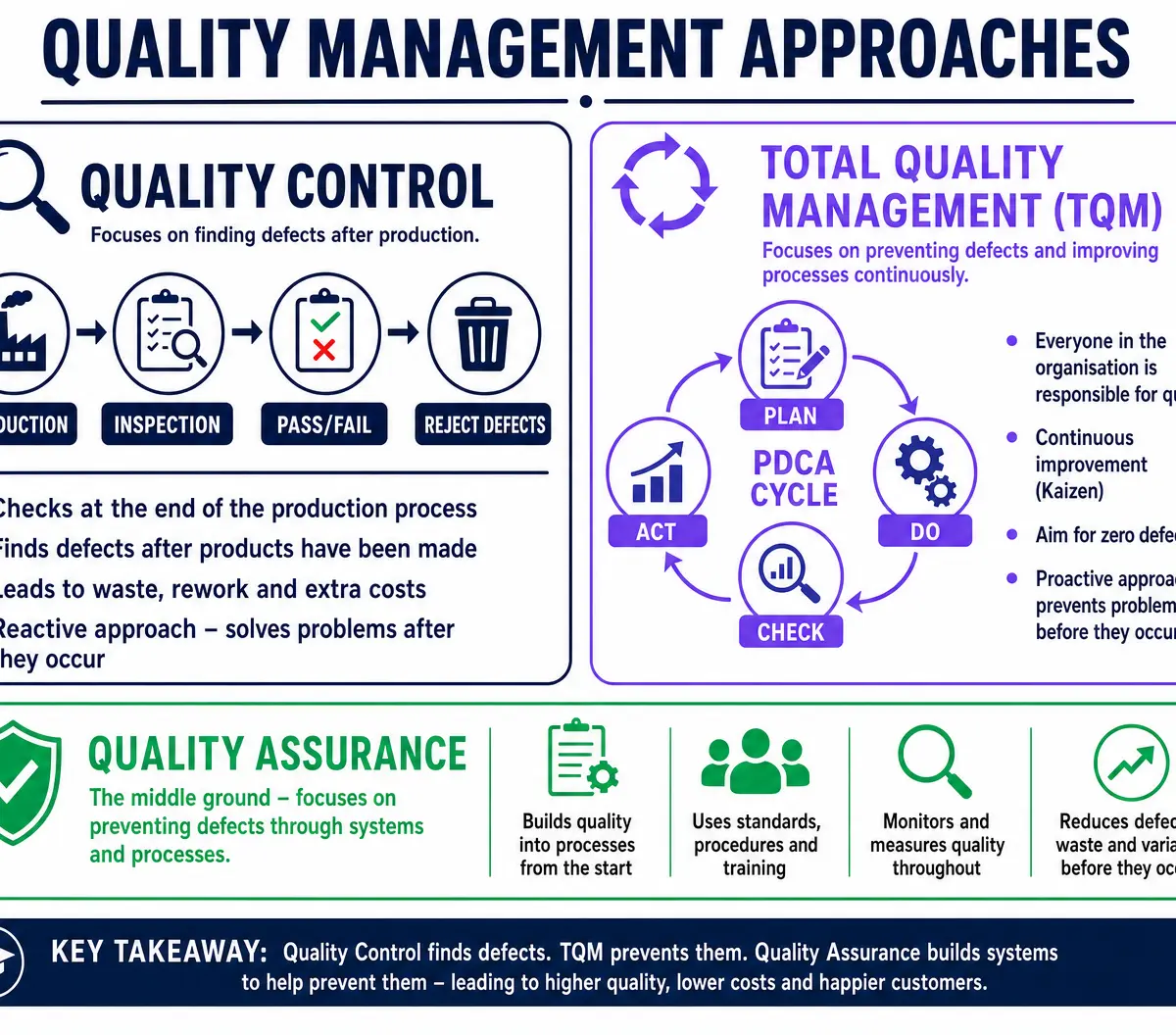
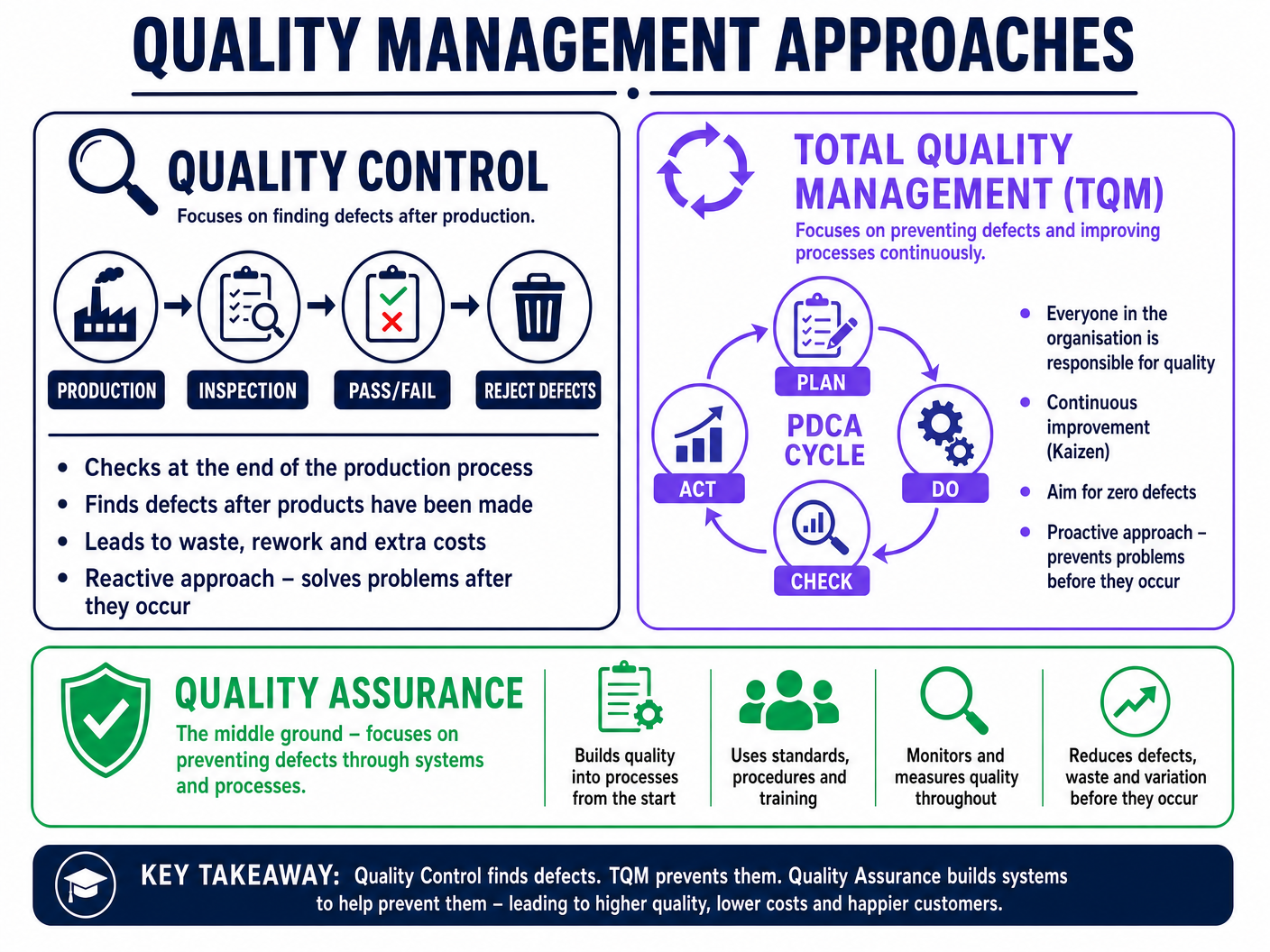
Quality is vital for customer satisfaction, brand reputation, and reducing waste. Examiners expect you to distinguish clearly between different approaches to quality.
Quality Control
Definition: Inspecting products at the end of the production process to ensure they meet standards.
Key Features: Reactive approach. Defective products are identified and discarded or reworked.
Impact: Can be wasteful as materials and time have already been used on faulty items. Often leads to an 'us vs them' culture between workers and inspectors.
Quality Assurance
Definition: Building checks into every stage of the production process to prevent errors from occurring.
Key Features: Proactive approach. Focuses on getting it right first time.
Impact: Reduces waste and costs in the long run, but requires significant training and clear procedures.
Total Quality Management (TQM)
Definition: A philosophy where every employee in the organisation is responsible for quality.
Key Features: Focuses on continuous improvement (Kaizen) and aiming for zero defects.
Impact: Highly motivating for staff and excellent for brand reputation, but very expensive and time-consuming to implement a TQM culture.
Productivity and Efficiency
Examiners frequently set calculation questions on productivity. You must know the formula and how to interpret the results.
Productivity Formula: Output / Number of Workers (or Hours Worked)
To improve productivity, a business can:
- Invest in new technology (automation)
- Train staff to be more skilled
- Introduce lean production techniques to reduce waste
- Improve worker motivation
The Supply Chain and Inventory Management
The supply chain is the network of suppliers, manufacturers, and distributors involved in getting a product to the customer. Managing inventory (stock) is a crucial operational decision.
Just-in-Time (JIT)
Definition: Ordering stock so that it arrives exactly when it is needed for production.
Impact: Drastically reduces storage costs and waste. However, it is highly risky—if a supplier is delayed, production stops entirely.
Just-in-Case (JIC)
Definition: Holding buffer stock in case of unexpected increases in demand or supply chain disruptions.
Impact: Safer and more reliable, but incurs high storage, security, and insurance costs.
Visual Resources
2 diagrams and illustrations
Interactive Diagrams
1 interactive diagram to visualise key concepts
Conceptual Flow Outline
The Basic Operations Process with Quality Control
Worked Examples
3 worked examples — open one to explore the question and available guidance.
Practice Questions
Test your understanding — click to reveal model answers
Explain one disadvantage to a furniture manufacturer of using job production. (3 marks)
Hint: Think about costs and the time it takes to make bespoke items.
A clothing retailer currently holds large amounts of buffer stock (Just-in-Case). It is considering switching to a Just-in-Time (JIT) stock management system. Evaluate this decision. (9 marks)
Hint: Balance the cost savings of JIT against the risks of supply chain disruption.
State the formula for calculating productivity. (1 mark)
Hint: How do you measure what comes out versus who put the work in?
Explain how implementing Total Quality Management (TQM) could improve employee motivation. (3 marks)
Hint: Think about responsibility, empowerment, and feeling valued.
A smartphone manufacturer produces 20,000 phones a week with 500 workers. They introduce new automated machinery, and output rises to 24,000 phones a week, but they reduce the workforce to 400 workers. Calculate the change in productivity per worker. (3 marks)
Hint: Calculate old productivity, then new productivity, then find the difference.