OCR · GCSE · Business
Course version: J204 · Version from Sept 2019
Business activity
Master the foundations of business activity, from the entrepreneurial mindset to legal structures and growth strategies. This comprehensive guide covers exactly what examiners want to see when assessing how businesses start, operate, and expand in the real world.
- 6 min read
- 3 worked examples
- 5 practice questions
- 6 key terms
Check what you remember
Read the wording for your board, then hide it and explain Entrepreneur in your own words. Rough notes are fine. This is a self-check, with no mark or grade.
Reference: OCR
A person who takes the financial risk of starting and managing a new business.
Study Notes
Overview
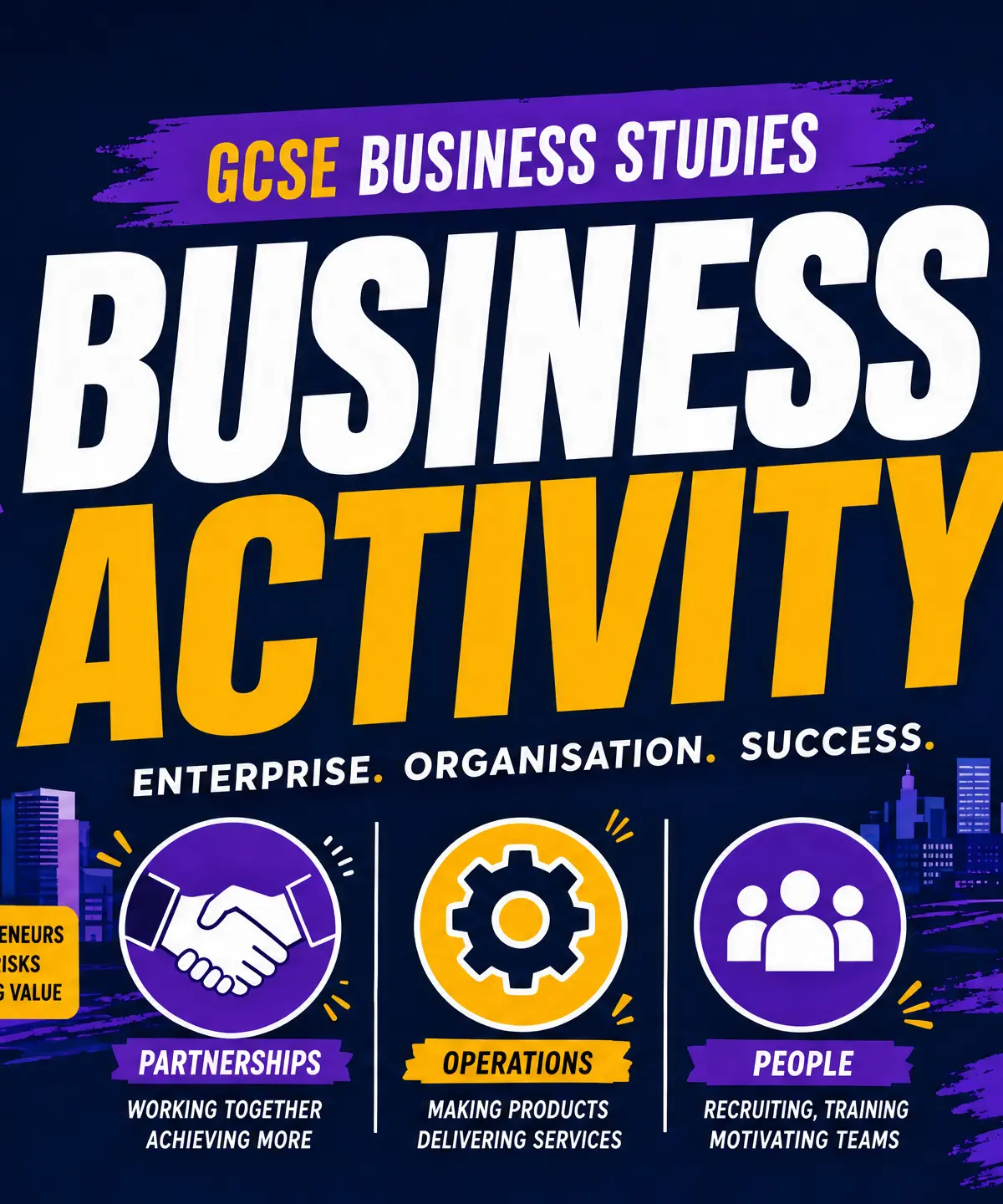
Business activity is the foundation of the entire GCSE Business specification. It explores why businesses exist, the role of the entrepreneur, how businesses are structured legally, and how they interact with their stakeholders. Examiners expect candidates to demonstrate a clear understanding of the risks and rewards of enterprise, and to accurately distinguish between different forms of business ownership.
Podcast Revision
Listen to our comprehensive 10-minute revision podcast covering all the key concepts in this topic:
The Purpose of Business Activity
Businesses exist to produce goods and services that satisfy the needs and wants of consumers. A need is something essential for survival (e.g., water, basic food, shelter), while a want is something desired but not essential (e.g., designer clothing, a smartphone).
To be successful, businesses must add value. This is the difference between the cost of the raw materials and the selling price of the finished product. Value can be added through branding, design, unique features, or convenience.
Enterprise and the Entrepreneur
An entrepreneur is an individual who takes a financial risk to start and manage a new business. They combine the factors of production (land, labour, capital, and enterprise) to create goods or services.
Characteristics of an Entrepreneur
- Creativity: The ability to come up with innovative ideas and solve problems.
- Risk-taking: The willingness to invest time and money with no guarantee of success.
- Determination: The resilience to keep going when faced with setbacks.
- Confidence: Belief in their own abilities and business idea.
Risk and Reward
Entrepreneurs face significant risks, including financial loss, lack of security, and business failure. However, the potential rewards include profit, independence, and the satisfaction of building something successful.
Business Ownership and Liability
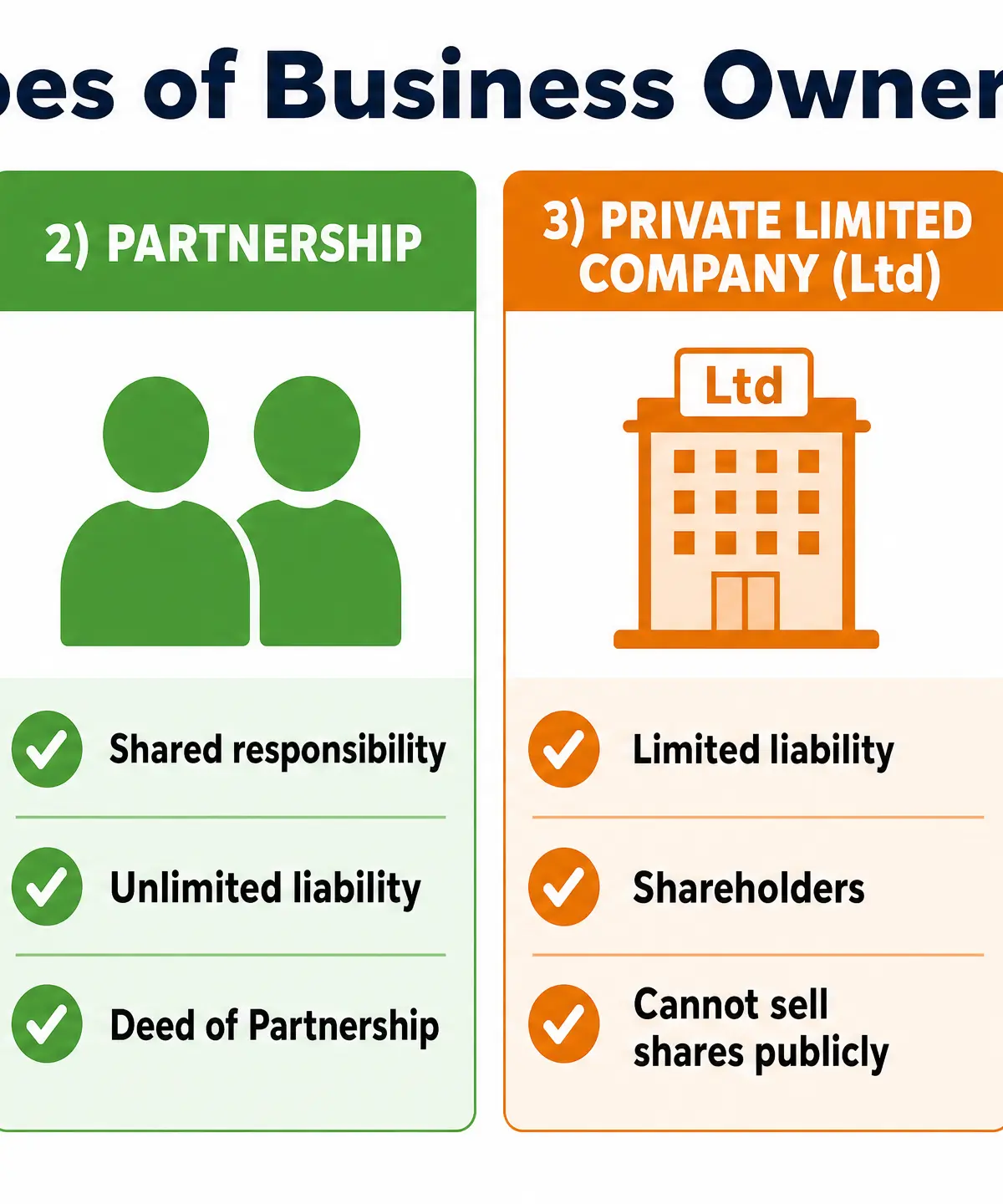
One of the most critical concepts in this topic is liability.
Unlimited Liability
This applies to sole traders and standard partnerships. The business and the owner are legally the same entity. If the business fails and owes money, the owners' personal assets (like their house or car) can be seized to pay the debts.
Limited Liability
This applies to Private Limited Companies (Ltd) and Public Limited Companies (PLC). The business is a separate legal entity from its owners (shareholders). The shareholders only risk losing the money they have invested in the business; their personal assets are protected.
Business Aims and Objectives
An aim is a long-term, overarching goal of the business. An objective is a specific, measurable target set to help achieve the aim.
Common objectives include:
- Survival: Often the primary objective for a new start-up or during an economic recession.
- Profit Maximisation: Aiming to make as much profit as possible, often the goal of established businesses.
- Growth: Expanding the business by increasing sales, opening new branches, or entering new markets.
- Market Share: Increasing the percentage of total sales in the market held by the business.
- Customer Service: Providing excellent service to build loyalty and a strong reputation.
Examiner Tip: Objectives change as a business evolves. A start-up focuses on survival, but as it becomes established, it will likely shift its focus to growth or profit maximisation.
Stakeholders
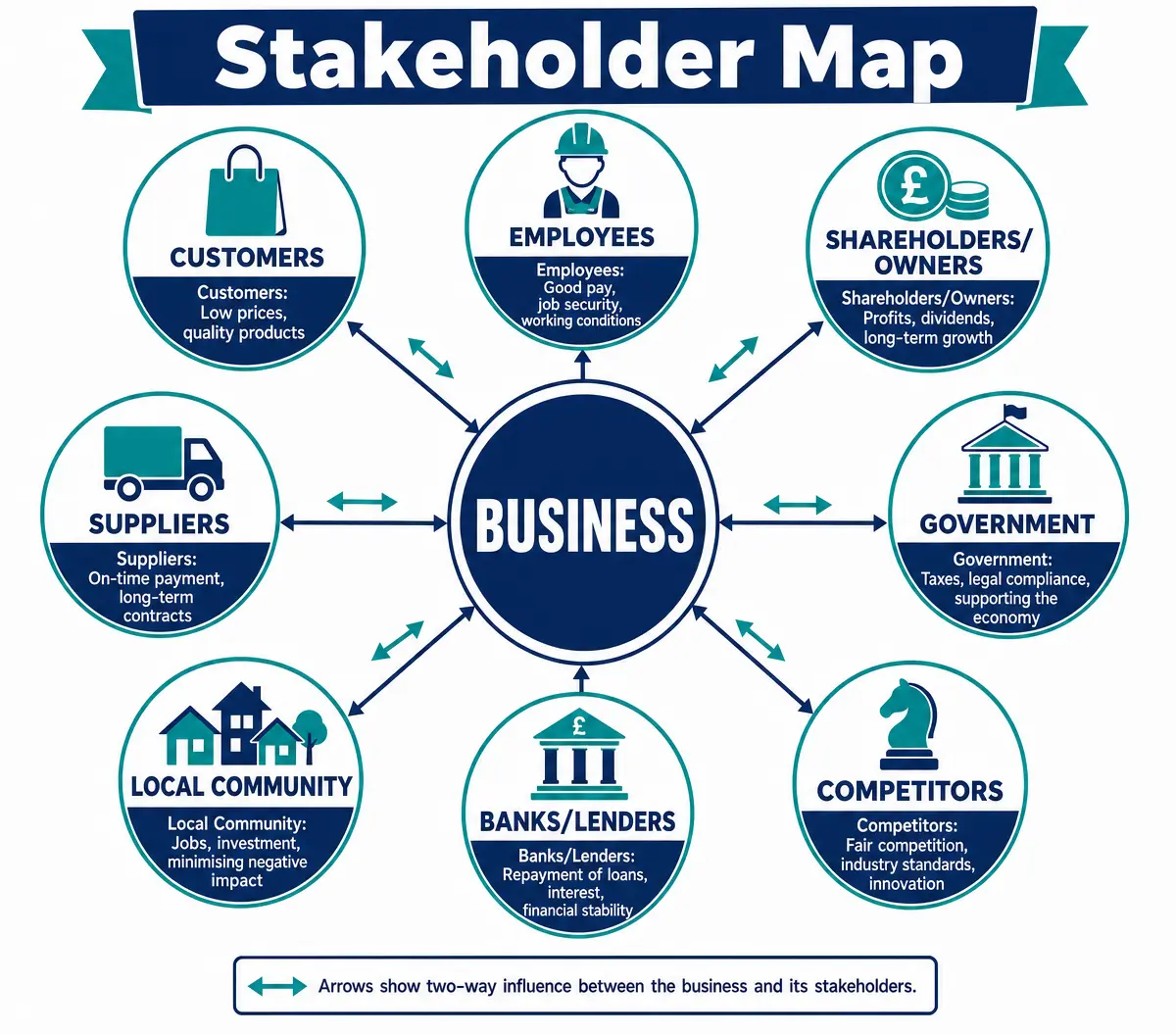
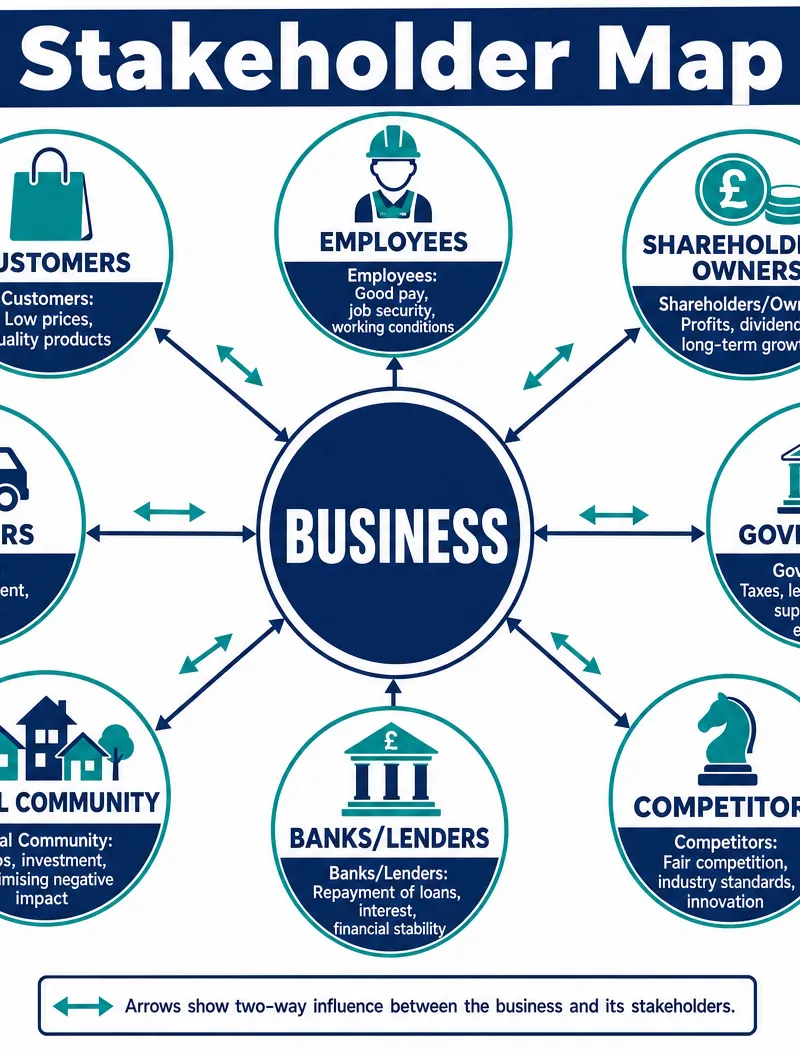
Stakeholders are individuals or groups who have an interest in, or are affected by, the activities of a business.
Internal Stakeholders
- Owners/Shareholders: Interested in profit, dividends, and business growth.
- Managers: Interested in career progression, salary, and business success.
- Employees: Interested in job security, fair wages, and good working conditions.
External Stakeholders
- Customers: Interested in high-quality products, low prices, and good service.
- Suppliers: Interested in regular orders and prompt payment.
- Local Community: Interested in local employment and minimizing environmental impact (e.g., noise, pollution).
- Government: Interested in tax revenue, job creation, and legal compliance.
Conflict: Stakeholder objectives often clash. For example, shareholders want higher profits (which might mean keeping wages low), while employees want higher wages (which reduces profit).
Business Growth
Businesses can grow in two main ways:
Organic (Internal) Growth
Growing from within the business. Examples include:
- Opening new stores or branches.
- Launching new products.
- Expanding into new geographical markets (e.g., exporting).
External Growth (Integration)
Growing by joining with another business. Examples include:
- Merger: Two businesses agree to join together to form a new, larger business.
- Takeover: One business buys enough shares in another to take control of it.
External growth can take different forms:
- Horizontal Integration: Joining with a business at the same stage of production in the same industry (e.g., two bakeries merging).
- Vertical Integration: Joining with a business at a different stage of production in the same industry. Backward vertical is buying a supplier (e.g., a bakery buying a wheat farm). Forward vertical is buying a customer (e.g., a bakery buying a chain of cafes).
- Conglomerate Integration (Diversification): Joining with a business in a completely different industry (e.g., a bakery buying a shoe shop).
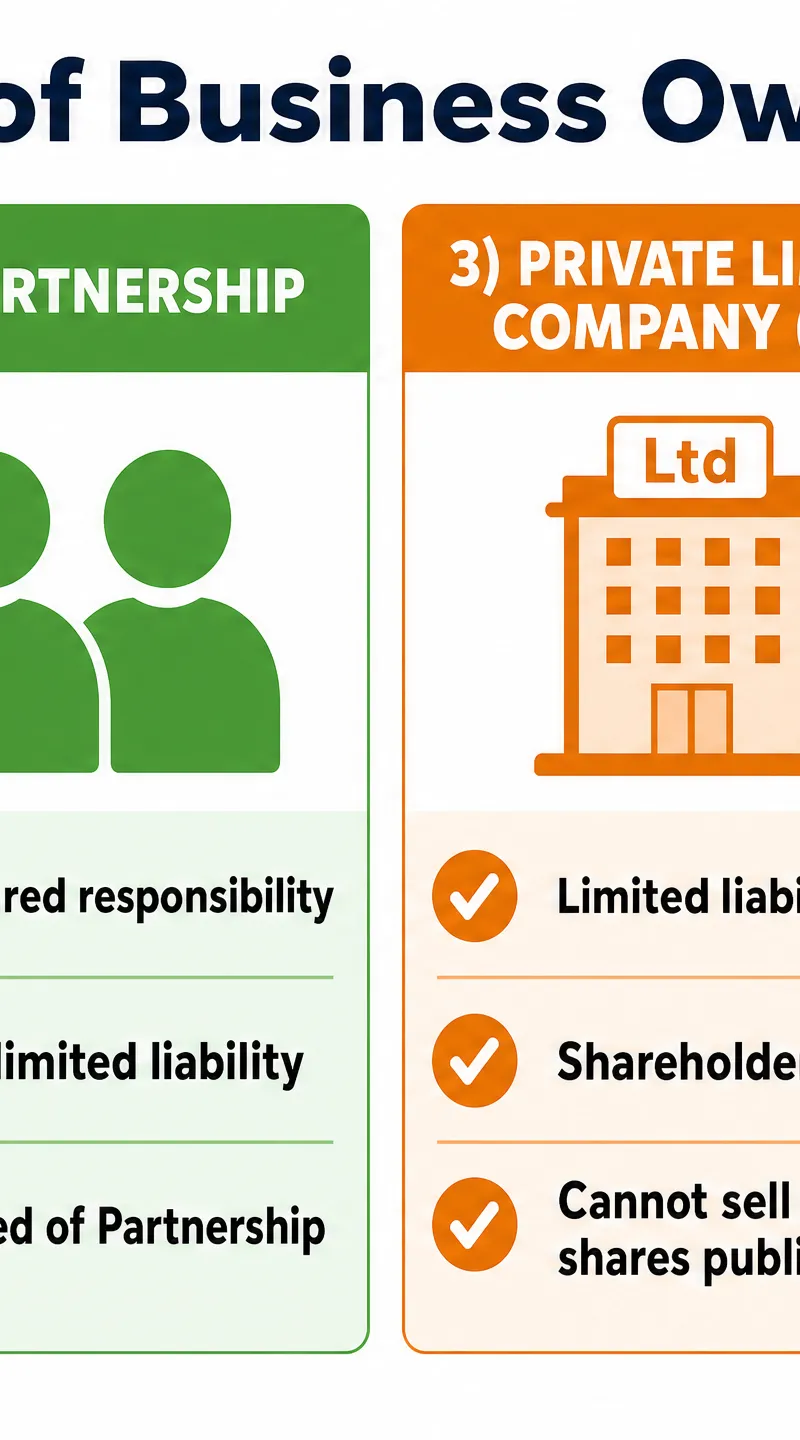
Interactive Diagrams
1 interactive diagram to visualise key concepts
Conceptual Flow Outline
Methods of Business Growth
Worked Examples
3 worked examples — open one to explore the question and available guidance.
Practice Questions
Try the question, then reveal an answer plan or example response
State two characteristics of an entrepreneur. (2 marks)
Hint: Think of the C-R-D-C mnemonic.
Explain one benefit to a business of setting objectives. (3 marks)
Hint: How do objectives help managers and employees know what to do?
A clothing manufacturer buys a chain of high street clothes shops. State the type of integration this represents. (1 mark)
Hint: They are in the same industry but at a different stage of production, moving closer to the consumer.
Evaluate whether a successful local restaurant should grow organically or externally by taking over a rival restaurant. (9 marks)
Hint: Compare the speed and risk of both methods.
Explain how the objectives of a business might change during an economic recession. (3 marks)
Hint: What happens to customer spending during a recession?
Exam technique
How to turn what you know into marks
How to approach the question
Always read the context carefully. If a business name or scenario is given, you MUST refer to it in your answer to gain application marks.
How to structure your answer
- Essay questions
- Introduction defining key terms. Paragraph 1: Point for. Paragraph 2: Point against. Conclusion: Judgement answering the specific question asked.
- Source questions
- Read the case study first, highlight key problems or opportunities, then read the questions.
- Explain questions
- Use the 'BLT' structure: Because, Leading to, Therefore. State your point, explain it (Because), show the consequence (Leading to), and link back to the question (Therefore).
Timing
Approximately 1 minute per mark, plus planning time for longer questions.
Common pitfalls
- Confusing Private Limited Companies (Ltd) with Public Limited Companies (PLC).
- Stating 'to make a profit' as the only purpose of business, ignoring adding value or providing goods/services.
- Listing stakeholders without explaining their specific interest or how a decision impacts them.
- Failing to apply the answer to the specific business scenario provided in the question.
What the command words want
- Explain
- Give a reason and develop it fully showing cause and effect.
- Describe
- Give two linked points or features. Do not just list them.
- Evaluate
- Look at both sides of an argument (advantages and disadvantages) and make a justified final decision.
- Calculate
- Show your working out. Even if the final answer is wrong, you can get marks for the correct method.
Watch or listen (optional)
Test your understanding of Business activity
Active recall beats re-reading. Take an instant quiz now to test what you’ve learned and lock it into long-term memory.
A week of Premium from your first lesson · Then the free plan continues · No card, no charge