OCR · GCSE · Business
Course version: J204 · Version from Sept 2019
Business location
Where a business chooses to locate can make or break its success. This study guide explores the critical factors behind location decisions—costs, market proximity, labour, and raw materials—giving you the analytical tools to evaluate business scenarios like a senior examiner.
- 5 min read
- 3 worked examples
- 5 practice questions
- 6 key terms
Check what you remember
Read the wording for your board, then hide it and explain Footfall in your own words. Rough notes are fine. This is a self-check, with no mark or grade.
Reference: OCR
The number of people passing by a particular location.
Study Notes
Overview
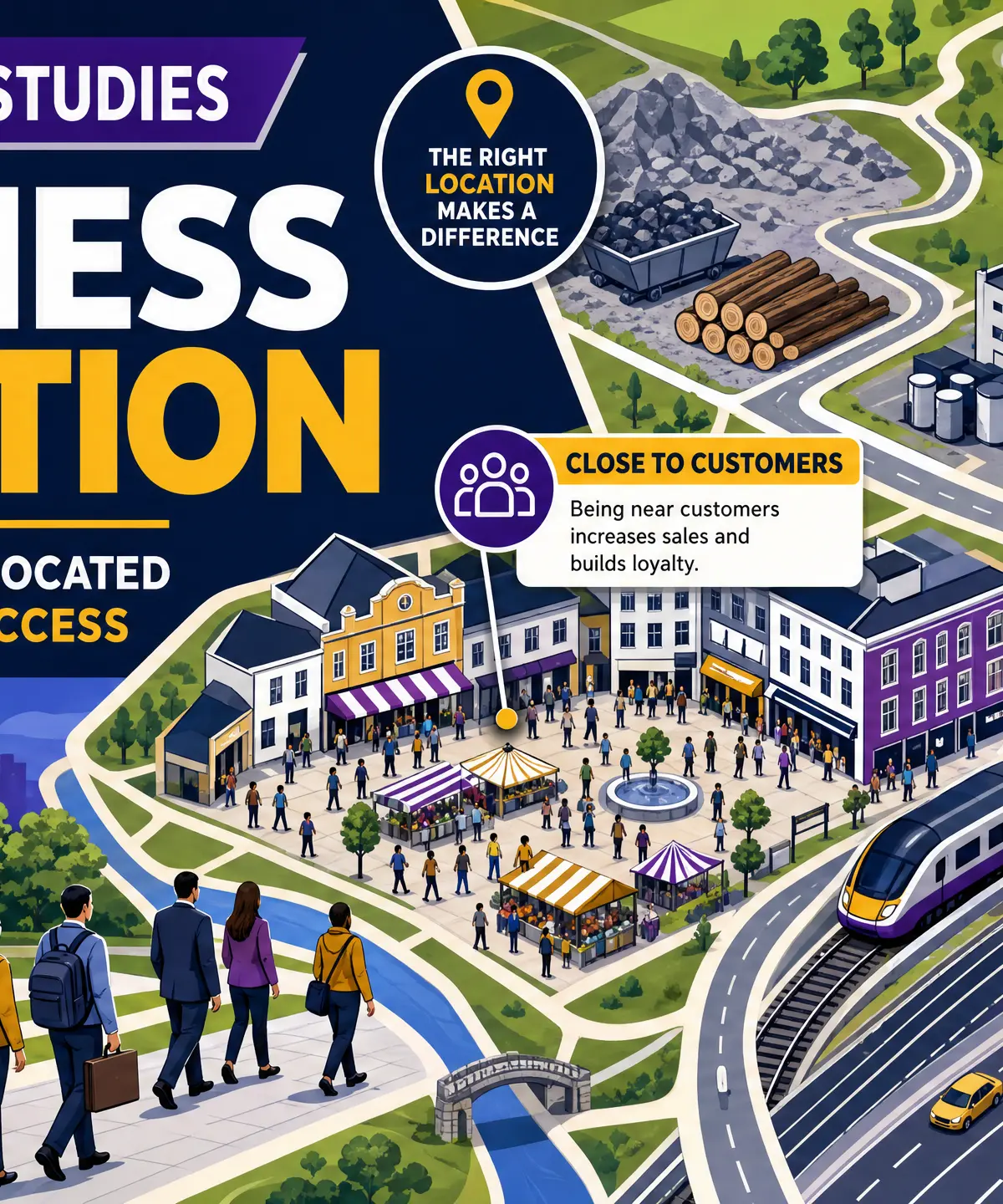
Location is one of the most critical strategic decisions a business can make. Once a business commits to a location by signing a lease or purchasing property, it is extremely difficult and expensive to change. This topic is heavily tested because it requires candidates to demonstrate synoptic thinking—linking location to operations, human resources, finance, and marketing.
Examiners expect candidates to go beyond simply stating that a location is "good" or "cheap." High marks are awarded for explaining how specific location factors impact a business's costs, revenues, and overall competitiveness. You must be able to apply the four main location factors (Costs, Proximity to Market, Labour, and Raw Materials) to different business contexts, from small independent retailers to large multinational manufacturers.
The Four Key Location Factors
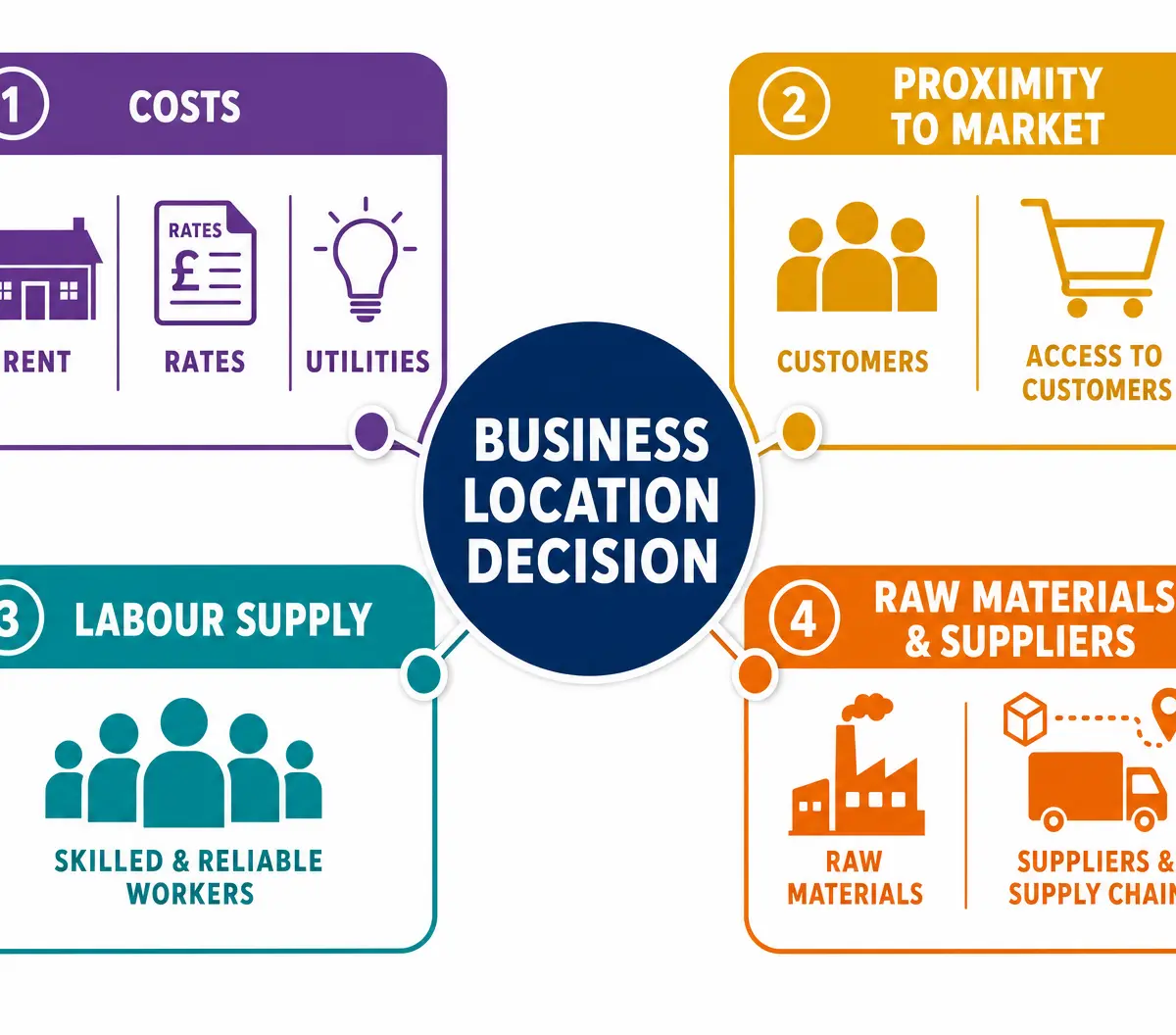
1. Costs
What it means: The financial burden associated with operating in a specific location.
Key Elements:
- Rent/Mortgage: Prime city centre locations command premium prices, whereas out-of-town industrial estates are significantly cheaper per square metre.
- Business Rates: A local tax paid by businesses, which varies depending on the location and value of the premises.
- Utilities & Transport: The cost of power, water, and moving goods to and from the site.
Exam Application: Examiners reward candidates who link higher costs to the need for higher revenue or higher profit margins. For example, a business paying high city-centre rent must generate high sales volume (footfall) to cover its fixed costs.
2. Proximity to Market (Customers)
What it means: How close the business is to its target customers.
Key Elements:
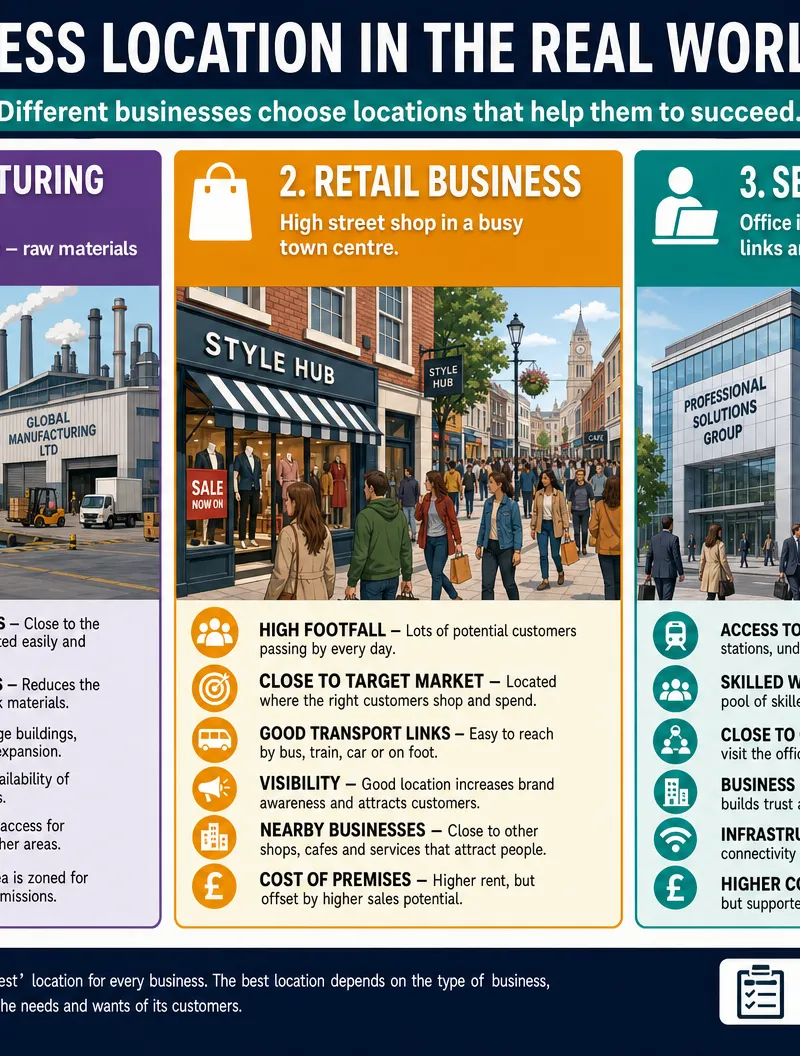
- Footfall: The number of potential customers passing by. Crucial for retail and service businesses.
- Convenience: Customers are unlikely to travel long distances for everyday items (convenience goods).
- E-commerce Impact: For online businesses, physical proximity to the customer is less important than having excellent transport links for rapid delivery.
Exam Application: When discussing retail businesses, always mention footfall. Explain that higher footfall increases the probability of sales, which can offset the higher fixed costs (rent) of a prime location.
3. Labour Supply
What it means: The availability, cost, and skill level of workers in the local area.
Key Elements:
- Availability: Is there a large pool of potential employees? Areas with higher unemployment may offer easier recruitment.
- Skills: Does the business require highly skilled workers (e.g., software developers) or unskilled/semi-skilled workers (e.g., warehouse staff)?
- Wage Costs: Average wages vary by region. Locating in an area with lower average wages can significantly reduce a business's variable costs.
Exam Application: Link labour supply to productivity and costs. A business locating near a university may benefit from a highly skilled workforce, leading to higher productivity and better quality output, justifying higher wage costs.
4. Raw Materials and Suppliers
What it means: How close the business is to the materials it needs to produce its goods.
Key Elements:
- Bulk-reducing industries: If raw materials are heavier or bulkier than the finished product (e.g., timber, steel), it is cheaper to locate near the raw materials to minimise transport costs.
- Perishability: Food processing businesses must locate near farms or ports to ensure ingredients remain fresh.
- Supply Chain Reliability: Being close to key suppliers reduces delivery times and the risk of disruption.
Exam Application: This factor is primarily relevant to manufacturing businesses. Examiners look for the explicit link between proximity to raw materials and the reduction of variable transport costs.
Applying Factors to Business Types
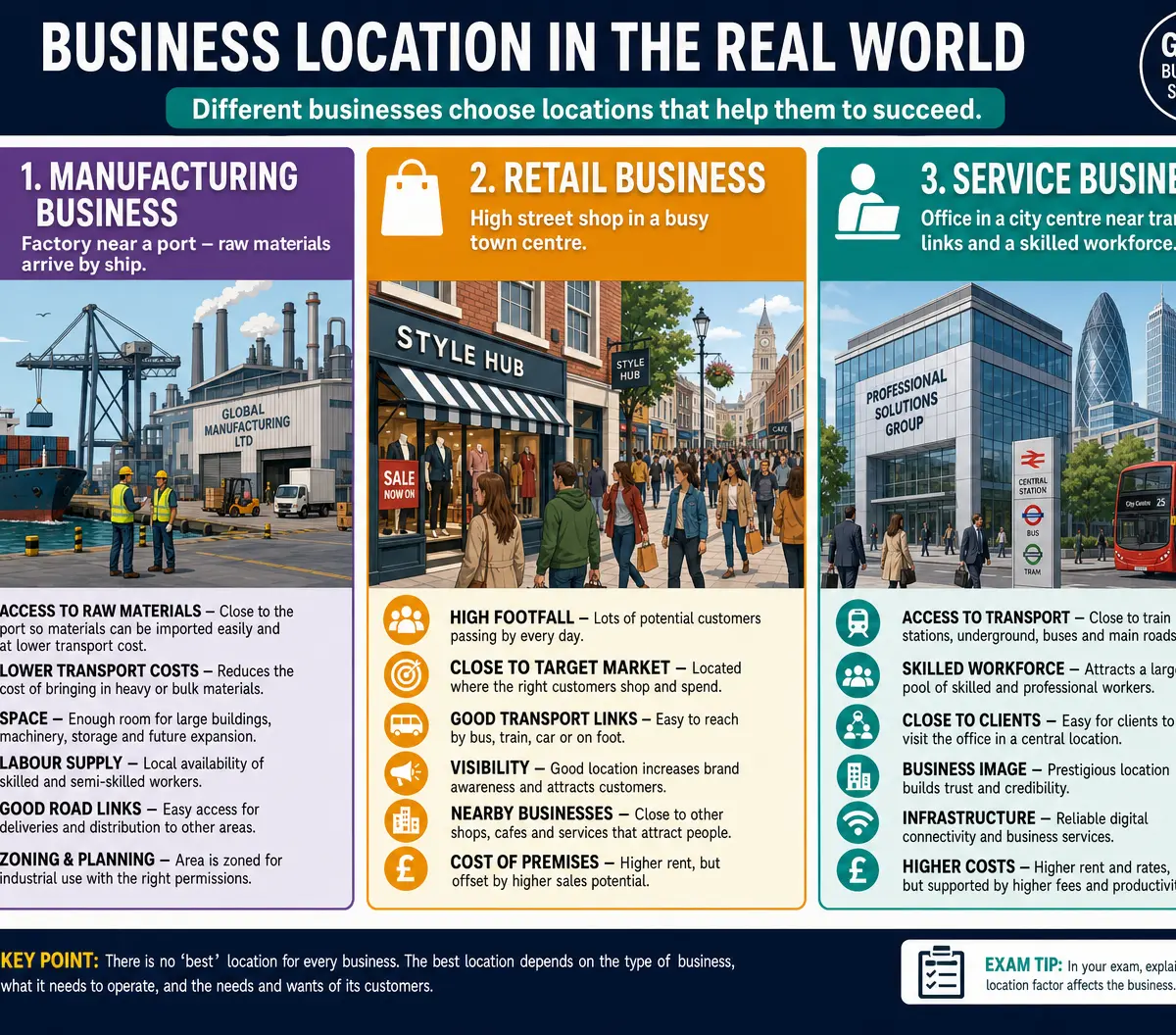
Retail Businesses
Primary Factor: Proximity to Market (Footfall)
Secondary Factors: Costs (Rent), Competitors (clustering near similar shops can attract more customers).
Manufacturing Businesses
Primary Factor: Raw Materials & Transport Links
Secondary Factors: Space/Costs (need large, cheap premises), Labour (availability of semi-skilled workers).
Service/Tech Businesses
Primary Factor: Labour (Skilled workforce)
Secondary Factors: Infrastructure (high-speed broadband), Proximity to Market (for B2B services).
Visual Resources
2 diagrams and illustrations
Interactive Diagrams
1 interactive diagram to visualise key concepts
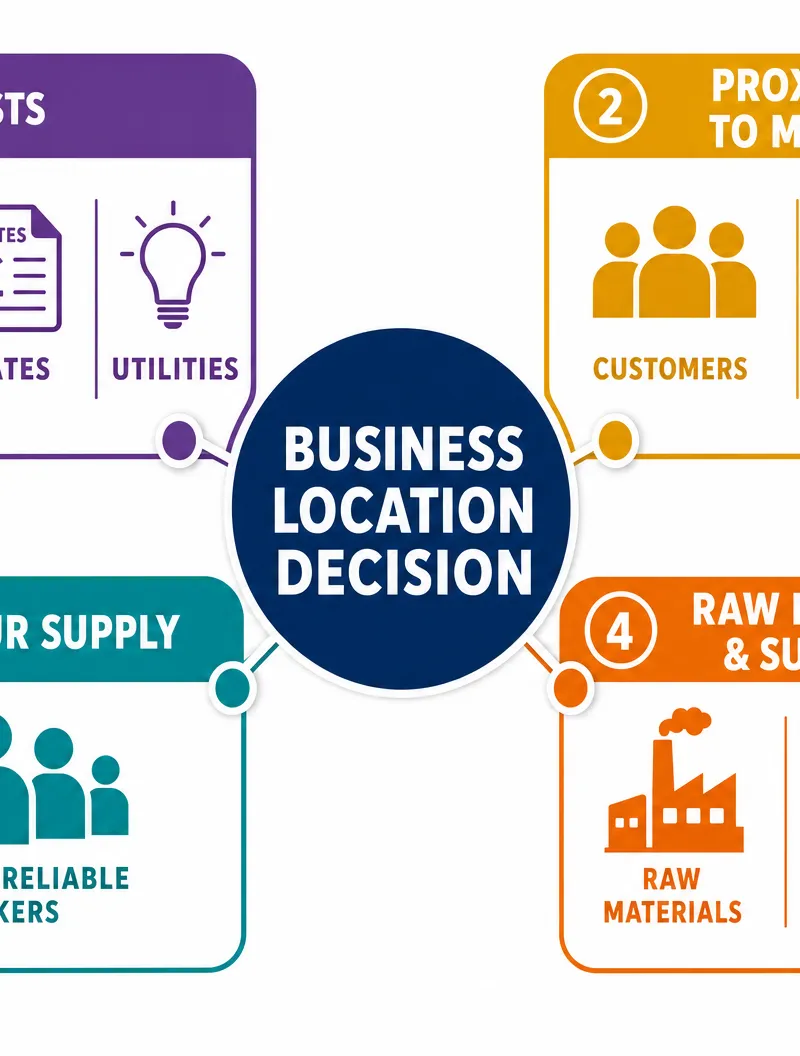
Conceptual Flow Outline
The four main factors influencing business location decisions.
Worked Examples
3 worked examples — open one to explore the question and available guidance.
Practice Questions
Try the question, then reveal an answer plan or example response
Explain two reasons why a tech start-up might choose to locate in a major city rather than a rural area. (6 marks)
Hint: Think about what a tech company needs most: people and connectivity.
An online clothing retailer is expanding and needs a new distribution centre. Analyse the impact of locating the centre near a major motorway network. (6 marks)
Hint: Focus on the speed of delivery and the cost of transport.
A small independent bakery is deciding between two locations: Location A is on a busy high street with high rent. Location B is on a quiet side street with low rent. Recommend which location the bakery should choose. Justify your answer. (9 marks)
Hint: Weigh up the benefit of footfall against the risk of high fixed costs.
State one reason why a manufacturing business might locate overseas. (1 mark)
Hint: Think about costs.
Explain how the availability of raw materials affects the location decision of a furniture manufacturer. (3 marks)
Hint: Timber is heavy. How does that affect transport?
Exam technique
How to turn what you know into marks
How to approach the question
Always identify the TYPE of business in the question first. Your answer must be tailored to whether it is a retailer, manufacturer, or service provider.
How to structure your answer
- Essay questions
- AJIM: Answer the question (Intro), Justify your view (Point 1), It depends on (Counter-argument/Point 2), Most importantly (Conclusion).
- Source questions
- Read the case study carefully and highlight specific constraints (e.g., 'the business has a small budget' or 'requires specialist programmers').
- Explain questions
- BLT: Because (state the factor), Leads to (explain the mechanism), Therefore (state the impact on costs/revenue/profit).
Timing
Approximately 1 minute per mark. A 12-mark question should take about 12-15 minutes, including 2 minutes of planning.
Common pitfalls
- Giving generic answers that could apply to any business, ignoring the case study context.
- Stating that a location is 'good' without explaining *why* (e.g., failing to link to costs or revenue).
- Confusing 'proximity to market' (being near customers) with 'transport links' (roads/railways).
What the command words want
- Analyse
- Examine the consequences of a decision in detail, linking multiple business areas together. (6 marks)
- Explain
- Make a point and develop it showing cause and effect. Use words like 'because' and 'therefore'. (3-4 marks)
- State/Identify
- Short, factual answers. No explanation needed. (1 mark)
- Evaluate/Justify
- Look at both sides of an argument, weigh them up, and make a final decision based on the evidence. (9-12 marks)
Watch or listen (optional)
Test your understanding of Business location
Active recall beats re-reading. Take an instant quiz now to test what you’ve learned and lock it into long-term memory.
A week of Premium from your first lesson · Then the free plan continues · No card, no charge