OCR · GCSE · Business
Course version: J204 · Version from Sept 2019
Business ownership
Mastering the different types of business ownership is essential for any GCSE Business student, as it forms the foundation of how enterprises operate and grow. Understanding the critical distinction between limited and unlimited liability will help you confidently evaluate the best legal structure for any given business scenario in the exam.
- 4 min read
- 3 worked examples
- 5 practice questions
- 8 key terms
Check what you remember
Read the wording for your board, then hide it and explain Sole Trader in your own words. Rough notes are fine. This is a self-check, with no mark or grade.
Reference: OCR
A business owned and operated by one person.
Study Notes
Overview
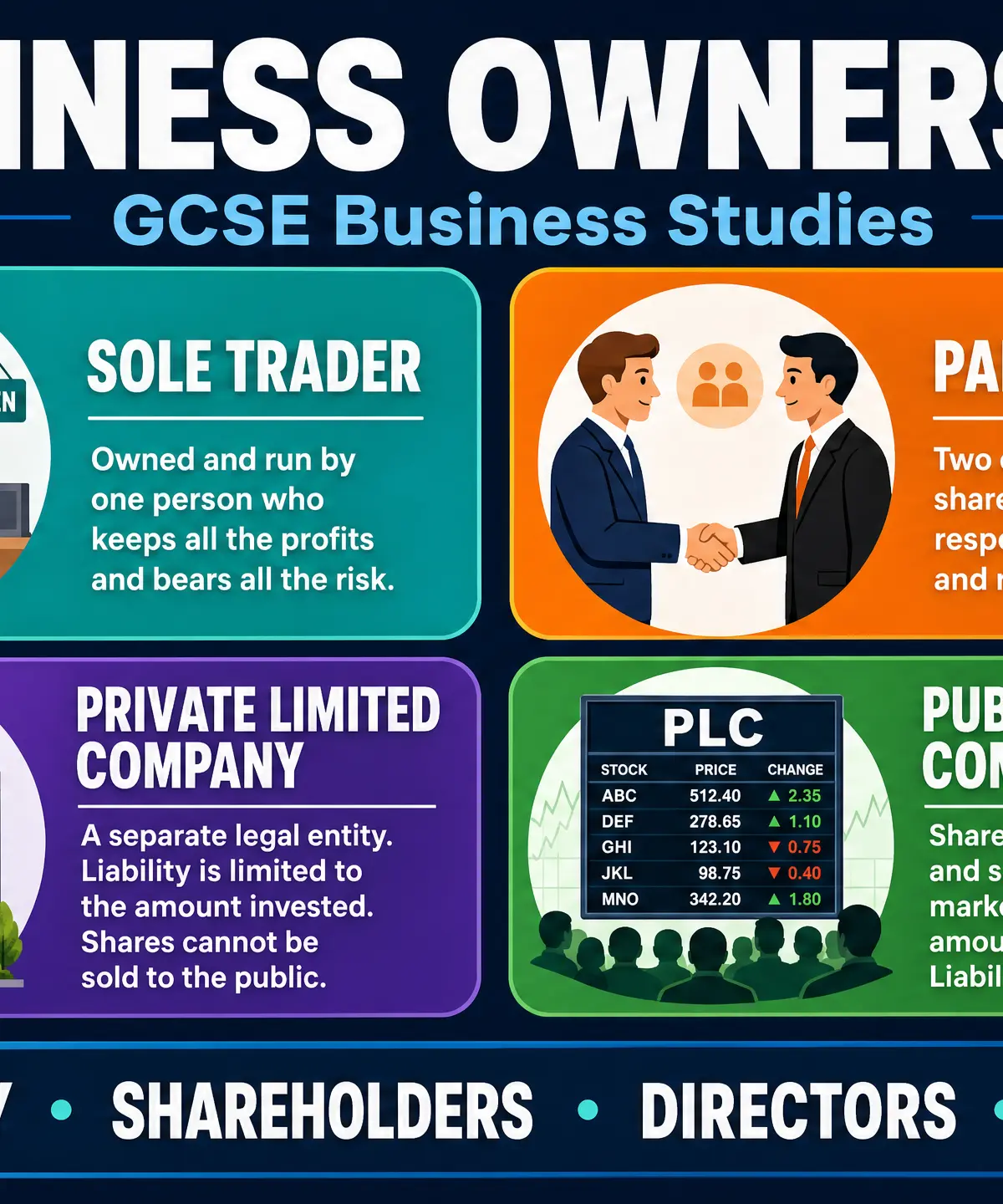
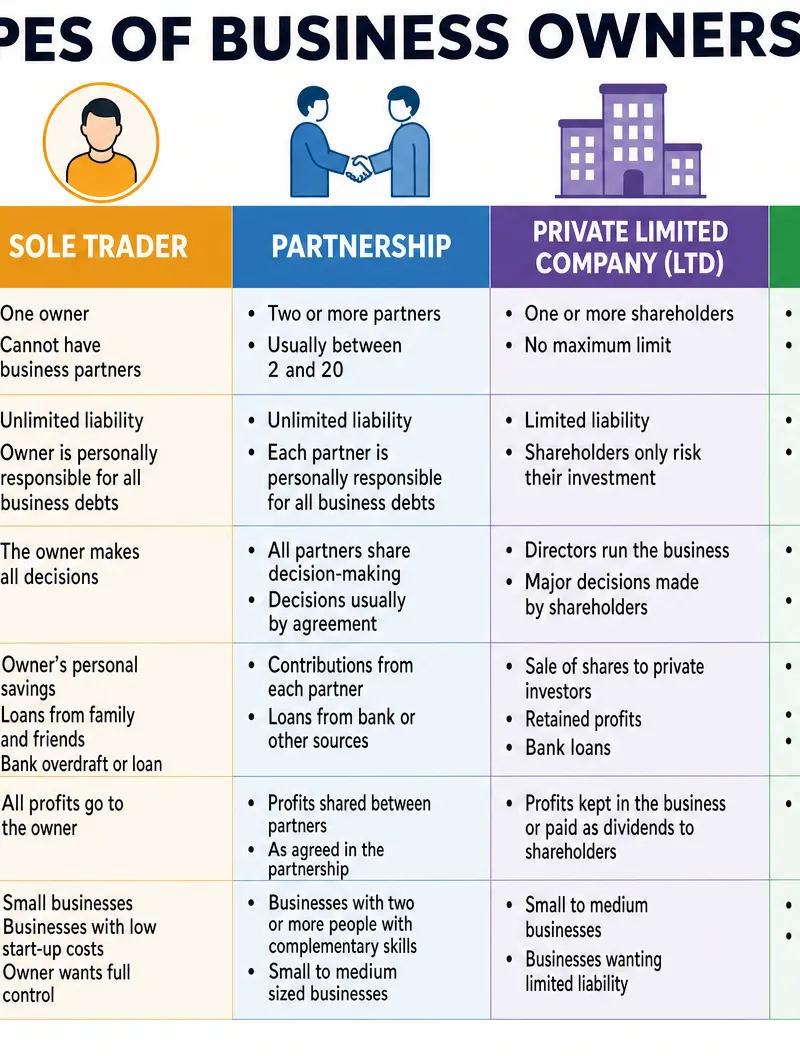
This study guide covers the four main legal structures of business ownership: sole traders, partnerships, private limited companies (Ltd), and public limited companies (PLC). It explores the crucial concept of limited versus unlimited liability and evaluates the suitability of these structures for various business contexts, from small start-ups to large established enterprises. Examiners expect candidates to not only define these terms but to apply them accurately to specific case studies, justifying why one form of ownership is more appropriate than another based on the owner's needs for control, finance, and risk management.
Key Concepts
Sole Traders
Definition: A business owned and run by one person.
Features: The owner makes all decisions, keeps all profits, and has unlimited liability.
Exam Relevance: Examiners frequently use sole traders as the starting point for a business in a case study. You must understand the risks involved, particularly unlimited liability, and why a sole trader might eventually choose to incorporate as the business grows.
Partnerships
Definition: A business owned by two or more people who share the responsibilities, risks, and profits.
Features: A Deed of Partnership usually outlines the rules. Like sole traders, partners typically have unlimited liability (joint and several liability).
Exam Relevance: Often tested in scenarios where a sole trader wants to expand but needs more capital or skills. You must be able to weigh the benefits of shared workload against the risk of disagreements and shared unlimited liability.
Private Limited Companies (Ltd)
Definition: An incorporated business that is a separate legal entity from its owners, with shares sold privately.
Features: Owners (shareholders) have limited liability. Shares cannot be sold on the stock market.
Exam Relevance: A very common topic for 'justify' or 'evaluate' questions. Candidates must explain how limited liability protects personal assets and why selling shares privately allows owners to retain control compared to a PLC.
Public Limited Companies (PLC)
Definition: A large incorporated business whose shares can be bought and sold by the general public on the stock market.
Features: Limited liability, minimum share capital of £50,000, and the ability to raise massive amounts of finance through an Initial Public Offering (IPO).
Exam Relevance: Usually tested in the context of a large, established business looking to fund major expansion. You must understand the trade-off between raising capital and the risk of a hostile takeover.
Limited vs Unlimited Liability
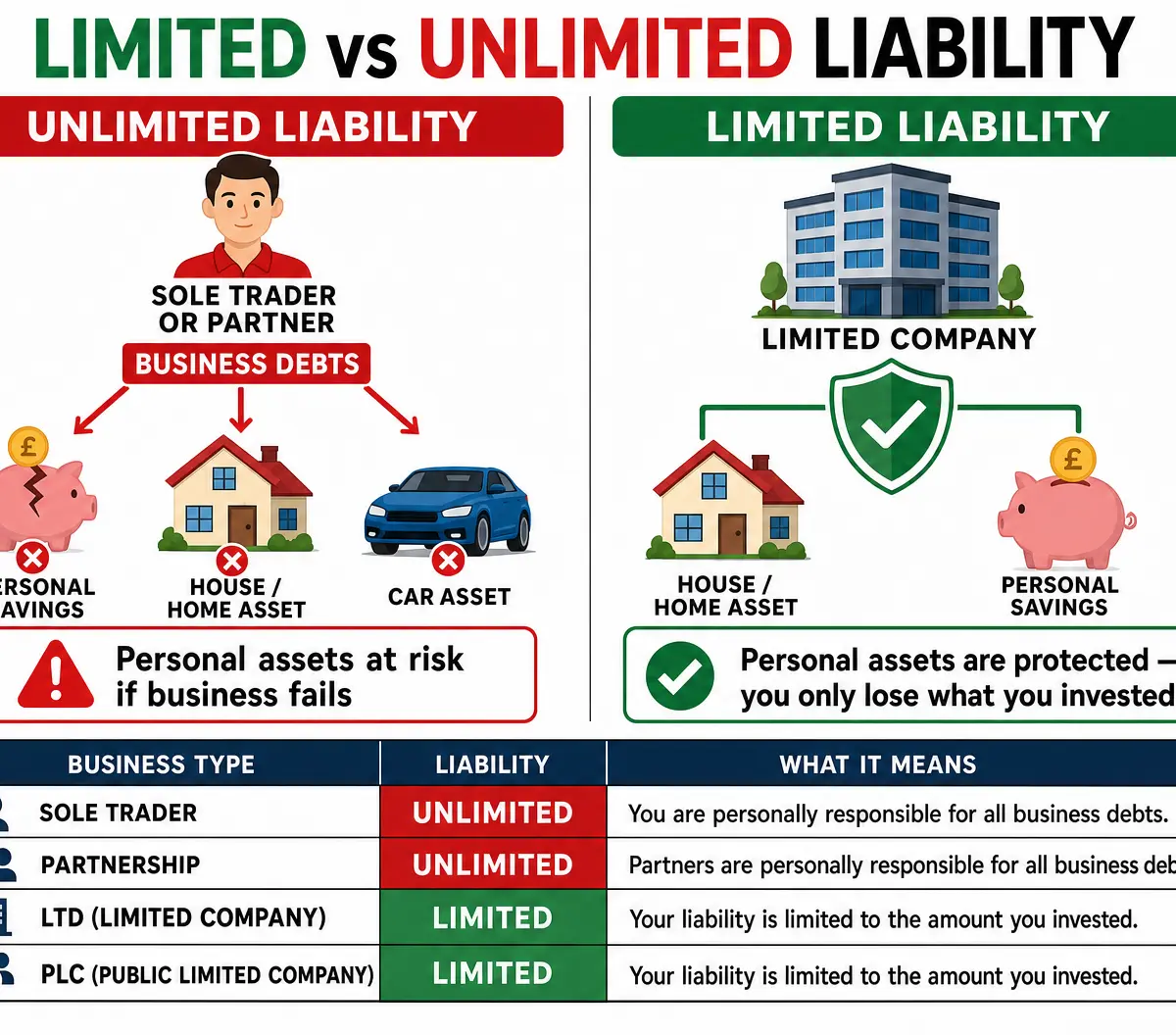
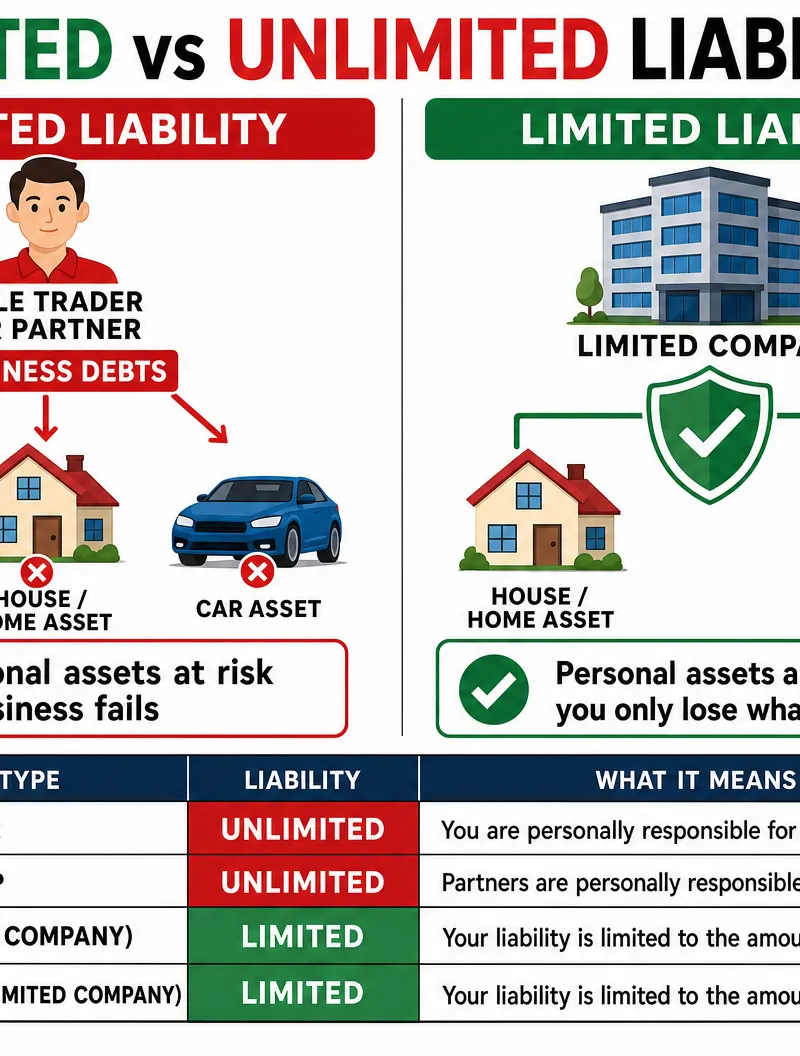
Limited Liability: The personal assets of the owners are protected. If the business fails, they only lose the money they invested in the business (applies to Ltd and PLC).
Unlimited Liability: The owners are personally responsible for all business debts. If the business fails, their personal assets (savings, house, car) can be seized to pay off the debts (applies to sole traders and partnerships).
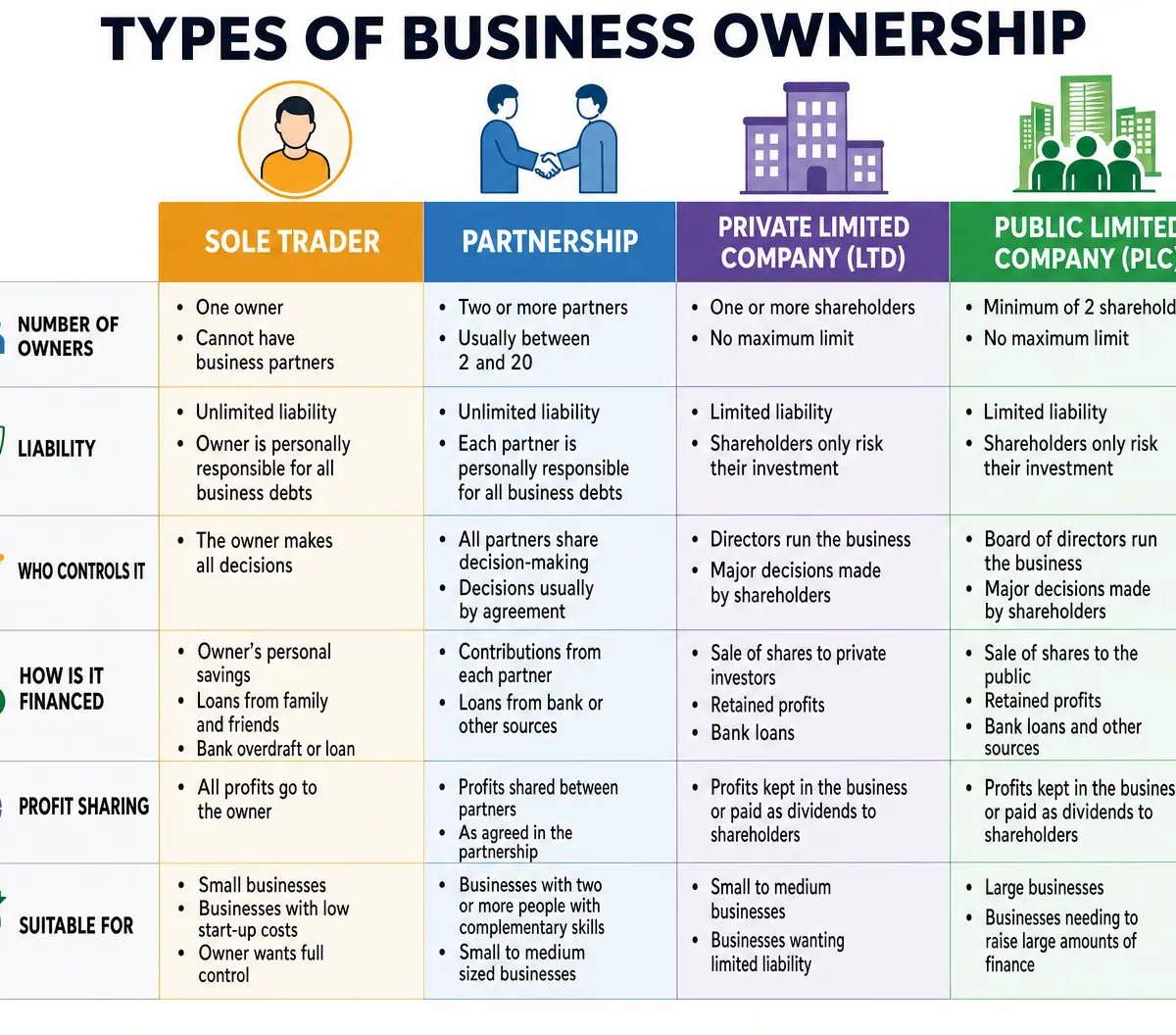
Ownership Comparison
Audio Revision
Listen to the podcast episode for this topic to reinforce your understanding of the key concepts and exam techniques:
Visual Resources
2 diagrams and illustrations
Interactive Diagrams
1 interactive diagram to visualise key concepts
Conceptual Flow Outline
Flowchart showing the relationship between liability and business ownership types.
Worked Examples
3 worked examples — open one to explore the question and available guidance.
Practice Questions
Try the question, then reveal an answer plan or example response
Explain one advantage to a business of operating as a partnership rather than a sole trader. (3 marks)
Hint: Think about what two people can bring to a business that one person cannot.
State the minimum share capital required to form a Public Limited Company (PLC). (1 mark)
Hint: It's a specific monetary figure.
Explain the concept of 'unlimited liability'. (2 marks)
Hint: What happens to the owner's personal belongings if the business fails?
A successful Private Limited Company (Ltd) is considering becoming a Public Limited Company (PLC) to fund a major international expansion. Evaluate this decision. (9 marks)
Hint: Balance the need for huge amounts of capital against the risk of losing control to unknown shareholders.
Explain one reason why a new business start-up might choose to be a sole trader. (3 marks)
Hint: Think about the ease of setting up and who gets the profits.
Exam technique
How to turn what you know into marks
How to approach the question
Always look for the business context in the scenario. Highlight the type of business, its current size, and its goals (e.g., expansion, survival).
How to structure your answer
- Explain questions
- Use the BLT structure: Because, Leading to, Therefore. Or PEEL: Point, Evidence, Explanation, Link.
- Justify questions
- Provide the benefits of the chosen option, the drawbacks of the alternative, and a concluding sentence explaining WHY it is the best choice for THAT specific business.
- Evaluate questions
- Introduction → Paragraph on Advantages (in context) → Paragraph on Disadvantages (in context) → Supported Conclusion/Judgement.
Timing
Approximately 1 minute per mark, plus planning time for longer questions
Common pitfalls
- Confusing 'limited liability' with 'limited company'. Liability is the concept of risk; a company is the legal structure.
- Giving generic advantages/disadvantages without applying them to the specific business in the case study.
- Stating that a PLC is 'owned by the government' (it is owned by private shareholders who are members of the public).
What the command words want
- Explain
- Make a point and develop it to show consequence or impact.
- Justify
- Give reasons why a particular decision is the best one, usually comparing it to an alternative.
- Evaluate
- Look at both sides of an argument (pros and cons) and reach a reasoned conclusion.
- State/Name
- Give a simple fact or term. No explanation needed.
Watch or listen (optional)
Test your understanding of Business ownership
Active recall beats re-reading. Take an instant quiz now to test what you’ve learned and lock it into long-term memory.
A week of Premium from your first lesson · Then the free plan continues · No card, no charge