OCR · GCSE · Business
Course version: J204 · Version from Sept 2019
Communication in business
Master the critical role of communication in business success. This guide covers the essential methods, the profound impact of digital technology, and why poor communication can cost a business everything.
- 6 min read
- 3 worked examples
- 5 practice questions
- 6 key terms
Check what you remember
Read the wording for your board, then hide it and explain Communication in your own words. Rough notes are fine. This is a self-check, with no mark or grade.
Reference: OCR
The process of transmitting information and understanding from one person or group to another.
Study Notes
Overview
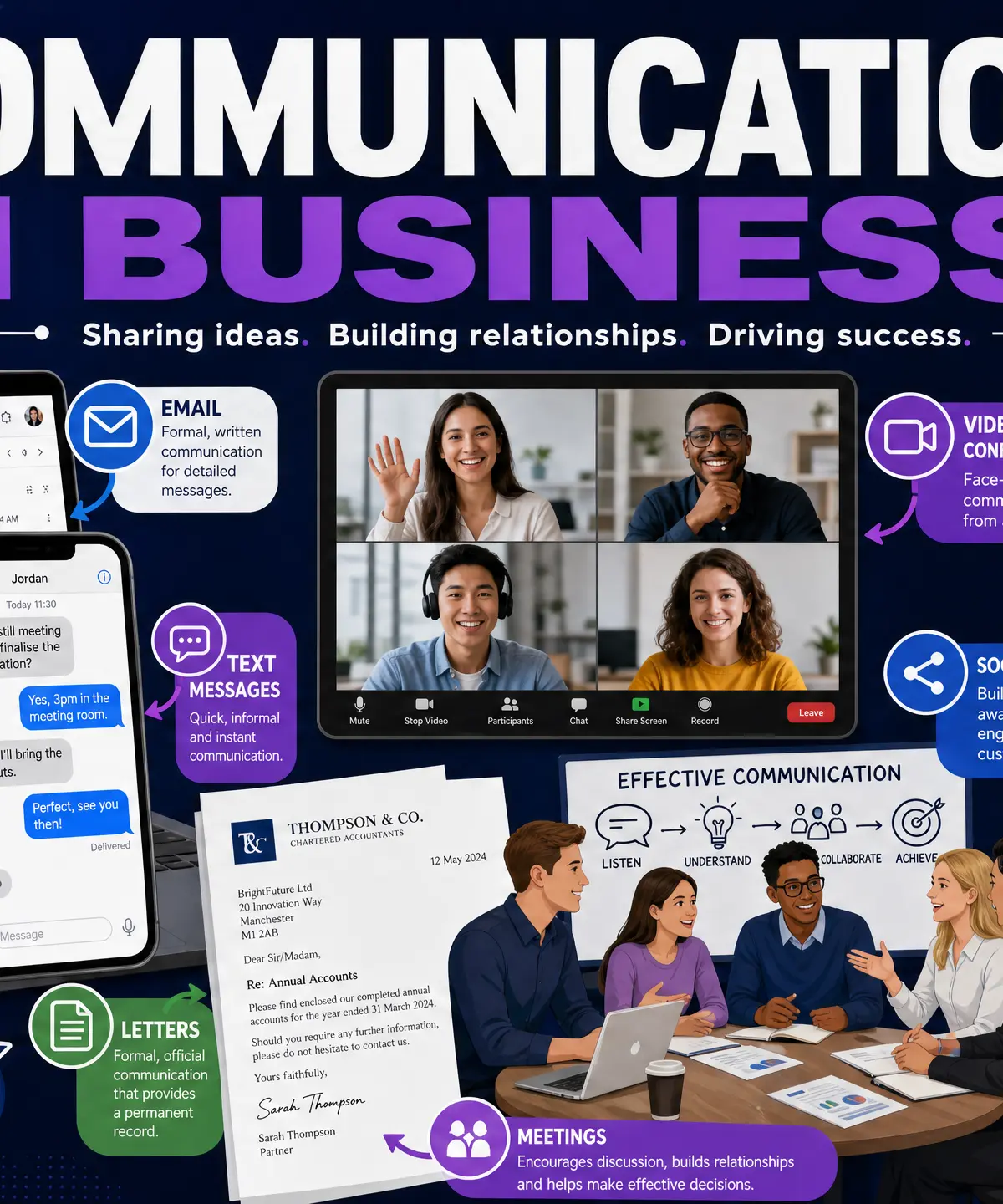
Communication is the lifeblood of any business. It is the process by which information, instructions, and ideas are shared between a business and its internal and external stakeholders. Examiners frequently test your understanding of why businesses must communicate effectively, the various methods available to them, and how to select the most appropriate method for a given scenario.
Crucially, the modern business landscape has been revolutionised by digital technology. You must be prepared to evaluate how digital communication has impacted business activity, balancing the benefits of speed and reach against the risks of information overload and cybersecurity threats. This topic directly links to human resources, motivation, and customer service.
The Podcast
Listen to our comprehensive 10-minute revision podcast covering all the core concepts, exam tips, and a quick-fire recall quiz:
Methods of Communication
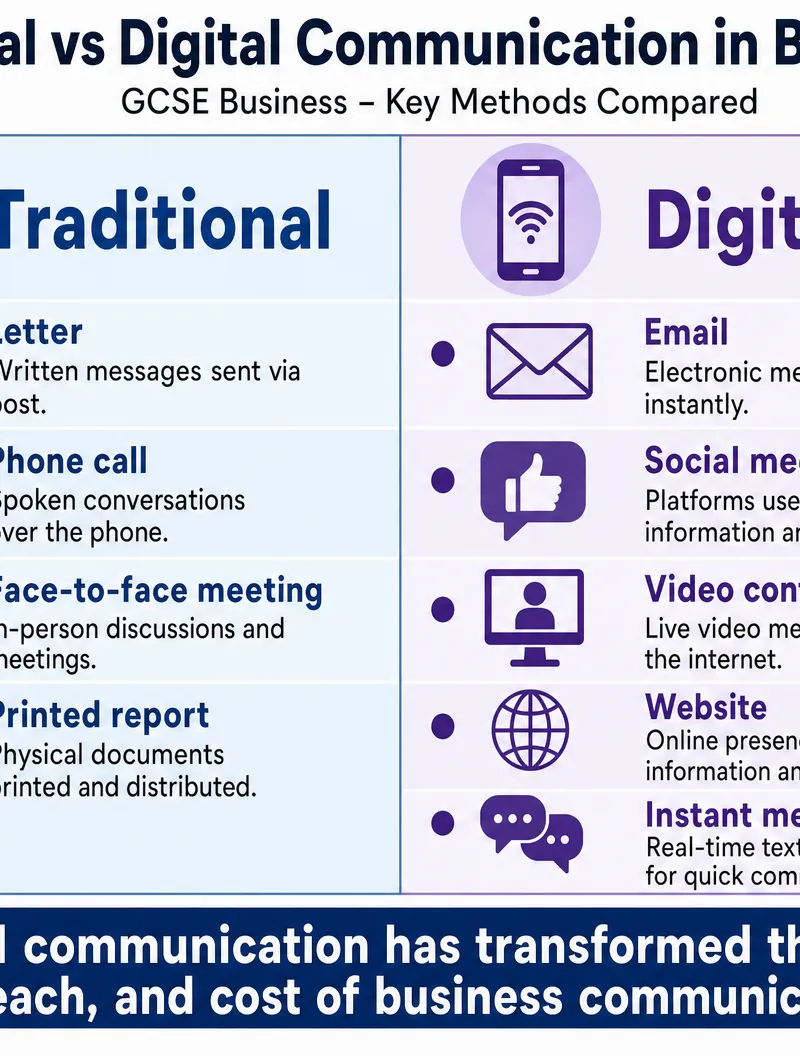
Businesses have a wide array of communication methods at their disposal. Examiners expect you to be able to identify these and, more importantly, evaluate their suitability.
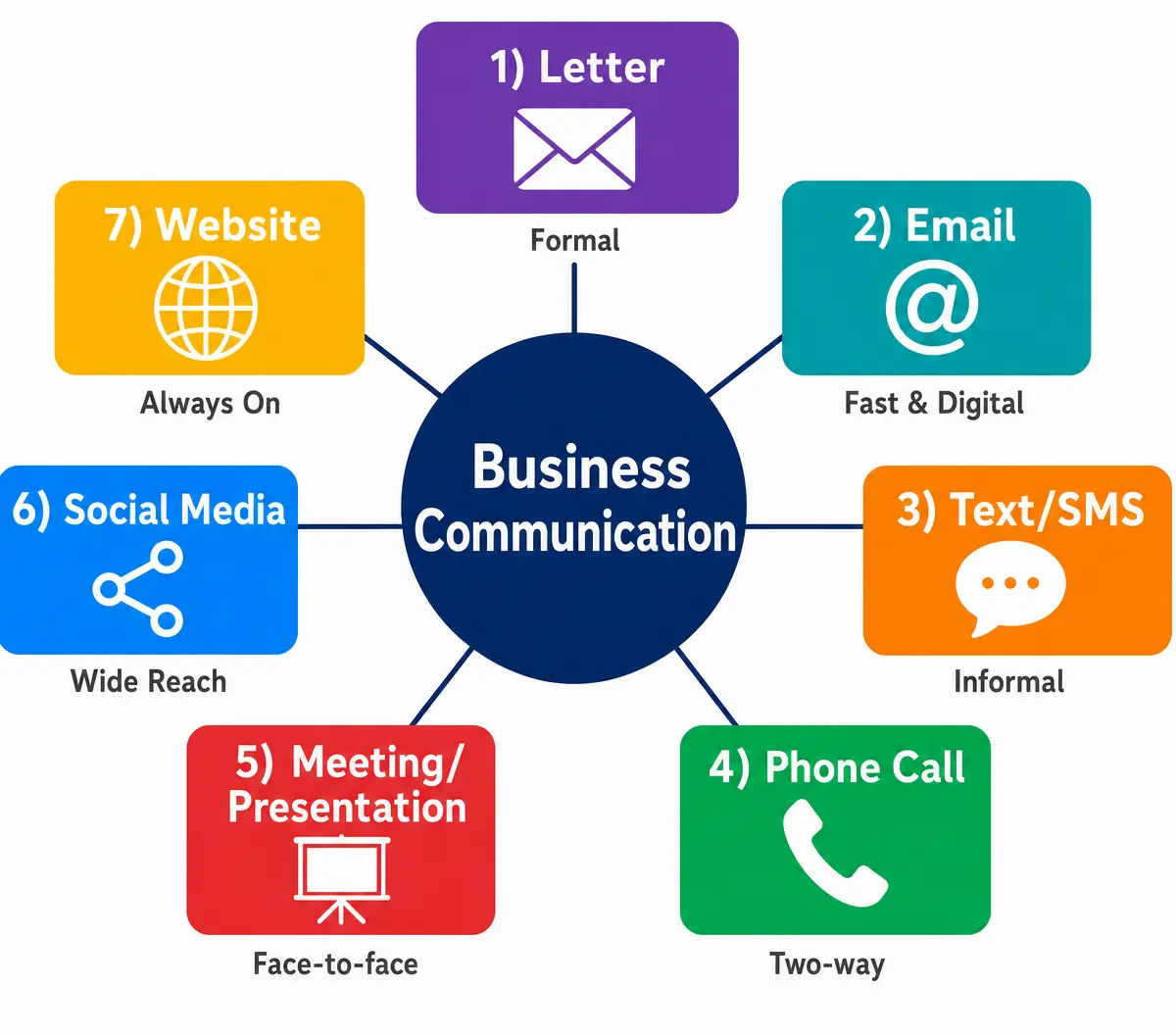
1. The Letter
Format: Formal, written document sent by post.
Best for: Official correspondence, legal notices, formal complaints, or contracts.
Exam Focus: Letters provide a permanent written record and convey a professional tone. However, their major drawback is speed; they are too slow for urgent matters.
2. Email
Format: Electronic messages sent instantly over the internet.
Best for: Fast, written communication to one or many recipients; sending attachments.
Exam Focus: Email is fast, cheap, and provides a written record. However, candidates must note the risk of 'information overload' where important messages are missed in busy inboxes.
3. Text/SMS
Format: Short, instant messages sent to mobile devices.
Best for: Urgent, informal updates or brief reminders (e.g., appointment reminders for customers).
Exam Focus: Excellent for immediate attention, but highly inappropriate for complex, sensitive, or formal business matters.
4. Phone Call
Format: Real-time, spoken conversation.
Best for: Urgent matters requiring discussion, resolving complex issues quickly, or conveying tone/empathy.
Exam Focus: Phone calls allow for two-way communication and immediate feedback. The limitation is the lack of a permanent written record unless notes are taken.
5. Meetings & Presentations
Format: Face-to-face (or virtual) gatherings.
Best for: Collaborative decision-making, brainstorming, or communicating major changes to a team.
Exam Focus: Highly effective for ensuring understanding and reading body language. However, they are time-consuming and expensive to organise.
6. Social Media
Format: Platforms like Instagram, LinkedIn, or X (Twitter).
Best for: Marketing, building brand awareness, and engaging directly with a wide customer base.
Exam Focus: Offers massive reach at a low cost. The risk is that negative feedback is highly public and can damage a brand's reputation rapidly.
7. Website
Format: A business's online presence.
Best for: Providing 24/7 information to customers, e-commerce, and building credibility.
Exam Focus: Essential for modern businesses to reach a global market, but requires constant maintenance and is largely one-way communication.
The Importance of Business Communication
Examiners often ask why good communication matters. You must be able to link communication to specific business outcomes.
- Motivation: Employees who are kept informed feel valued and are more productive.
- Coordination: Ensures all departments are working towards the same objectives.
- Decision Making: Managers need accurate, timely information to make effective choices.
- Customer Satisfaction: Clear communication builds trust and loyalty with customers.
The Cost of Poor Communication: Examiners reward candidates who understand the negative consequences. Poor communication leads to mistakes, low morale, wasted time, and ultimately, lost sales and reduced profit.
The Influence of Digital Communication
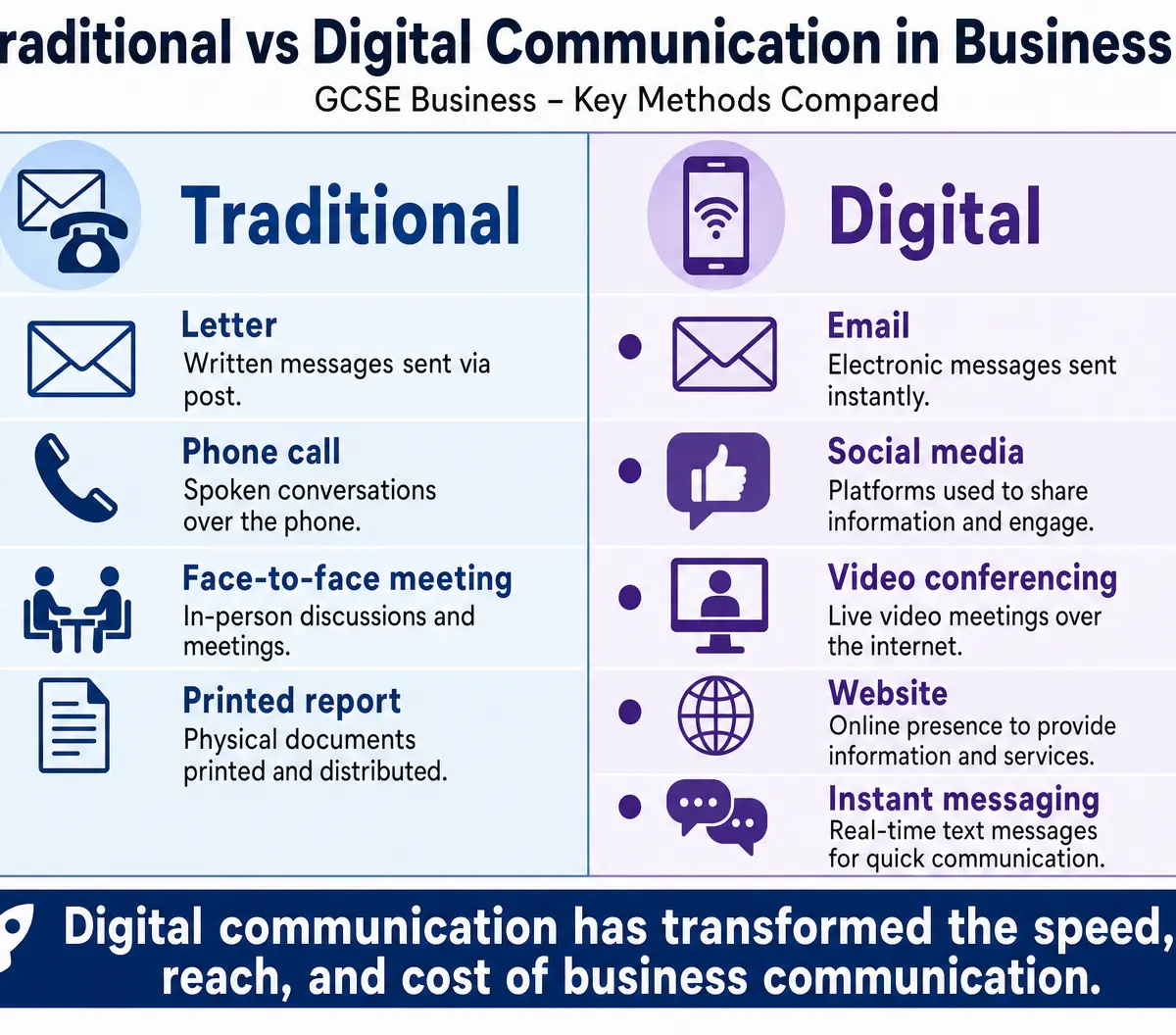
The shift towards digital communication is a major theme in the specification. You must be able to analyse its impact on business activity.
Key Impacts
- Speed and Efficiency: Information is shared globally in seconds, allowing businesses to react faster to market changes.
- Cost Reduction: Digital methods (like email or video conferencing) are significantly cheaper than traditional methods (like postage or travel).
- Global Reach: Businesses can easily communicate with customers and suppliers worldwide.
- Remote Working: Digital tools (Zoom, Teams, Slack) have enabled flexible working arrangements, reducing the need for expensive office space.
- Data Collection: Digital communication leaves a trail of data that businesses can analyse to improve their strategies.
Challenges
- Cybersecurity: Increased reliance on digital communication raises the risk of hacking and data breaches.
- Information Overload: Employees can become stressed and less productive if bombarded with too many emails and messages.
- Loss of Tone: Written digital messages can easily be misinterpreted compared to face-to-face communication.
Visual Resources
2 diagrams and illustrations
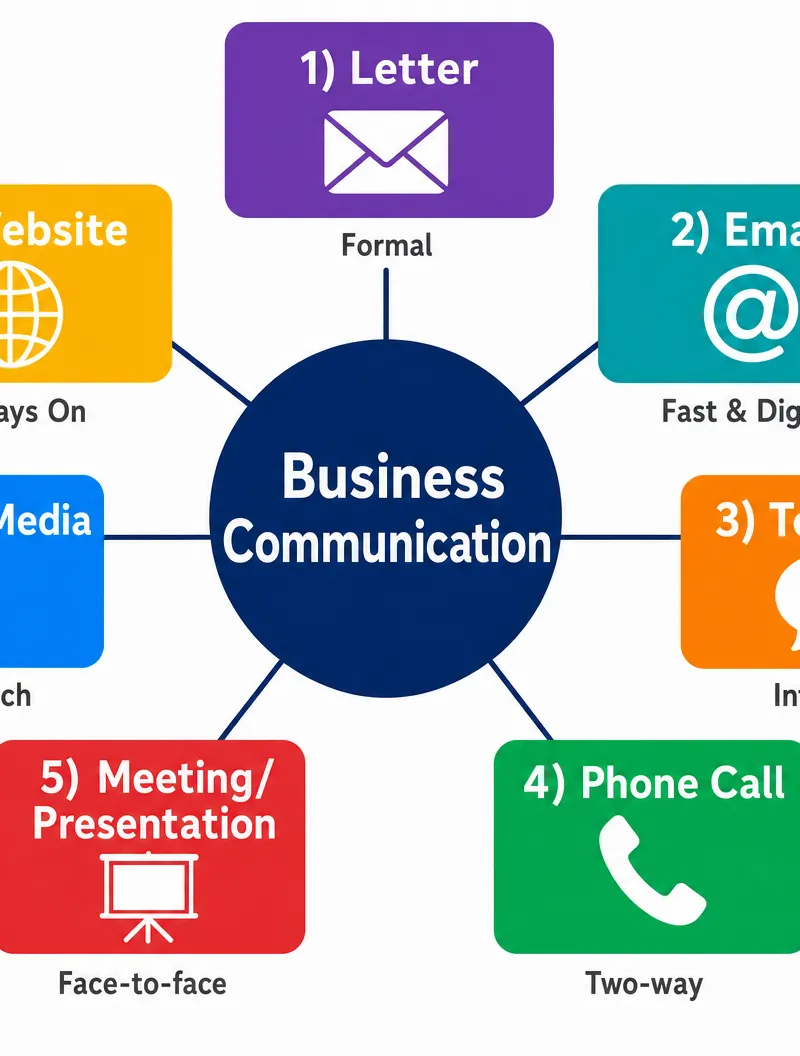
Interactive Diagrams
1 interactive diagram to visualise key concepts
Conceptual Flow Outline
Internal vs External Communication Flows
Worked Examples
3 worked examples — open one to explore the question and available guidance.
Practice Questions
Try the question, then reveal an answer plan or example response
Explain two reasons why effective communication is important for a business. (6 marks)
Hint: Think about what happens when communication goes right (e.g., motivation) or what happens when it goes wrong (e.g., mistakes).
A graphic design agency currently communicates with its remote workers via email. The manager is considering switching to video conferencing for weekly team updates. Evaluate whether this is a good idea. (9 marks)
Hint: Compare the benefits of video conferencing (face-to-face, tone) against the benefits of email (written record, time-flexible). Make a final decision.
State one method of written communication. (1 mark)
Hint: Think of a method that provides a permanent physical or digital record.
Explain one way digital communication has impacted business activity. (3 marks)
Hint: Think about speed, cost, or reach. Make your point, then explain the consequence.
Identify two risks to a business of using social media to communicate with customers. (2 marks)
Hint: What can go wrong when communication is public?
Exam technique
How to turn what you know into marks
How to approach the question
Always identify the 'Command Word' and the 'Context'. If the question mentions a specific business (e.g., a plumber), your answer must relate to plumbing, not a multinational tech company.
How to structure your answer
- State questions
- Short, sharp sentences. No explanation needed. Do not waste time here.
- Discuss questions
- Paragraph 1: Option A benefits. Paragraph 2: Option B benefits (or Option A drawbacks). Paragraph 3: Conclusion with a justified recommendation.
- Explain questions
- Use the BLT structure: Because, Leading to, Therefore. 'Email is good BECAUSE it is fast, LEADING TO quicker decisions, THEREFORE increasing efficiency.'
Timing
Approximately 1 minute per mark. For a 9-mark question, spend 2 minutes planning and 7 minutes writing.
Common pitfalls
- Listing communication methods without explaining *why* they are suitable.
- Ignoring the context. Recommending a national TV advert for a local window cleaner.
- Forgetting that communication is two-way. It's not just about sending messages, but receiving feedback.
What the command words want
- Analyse
- Examine in detail, showing causes and effects. (6 marks)
- Explain
- Make a point and develop it with a reason or consequence. (3-4 marks)
- State/Identify
- Give a fact or name. No explanation required. (1 mark)
- Evaluate/Recommend
- Judge the success or failure of something, providing a balanced argument and a final, justified decision. (9-12 marks)
Watch or listen (optional)
Test your understanding of Communication in business
Active recall beats re-reading. Take an instant quiz now to test what you’ve learned and lock it into long-term memory.
A week of Premium from your first lesson · Then the free plan continues · No card, no charge