OCR · GCSE · Business
Course version: J204 · Version from Sept 2019
Market segmentation
Market segmentation is the strategic foundation of modern business marketing, transforming how companies identify and target customers. By understanding this topic, you unlock the ability to analyse how businesses make crucial decisions about their products, pricing, and promotional strategies — a core skill examiners look for.
- 4 min read
- 3 worked examples
- 5 practice questions
- 6 key terms
Check what you remember
Read the wording for your board, then hide it and explain Market Segmentation in your own words. Rough notes are fine. This is a self-check, with no mark or grade.
Reference: OCR
The process of dividing a target market into smaller groups of consumers with shared characteristics or needs.
Study Notes
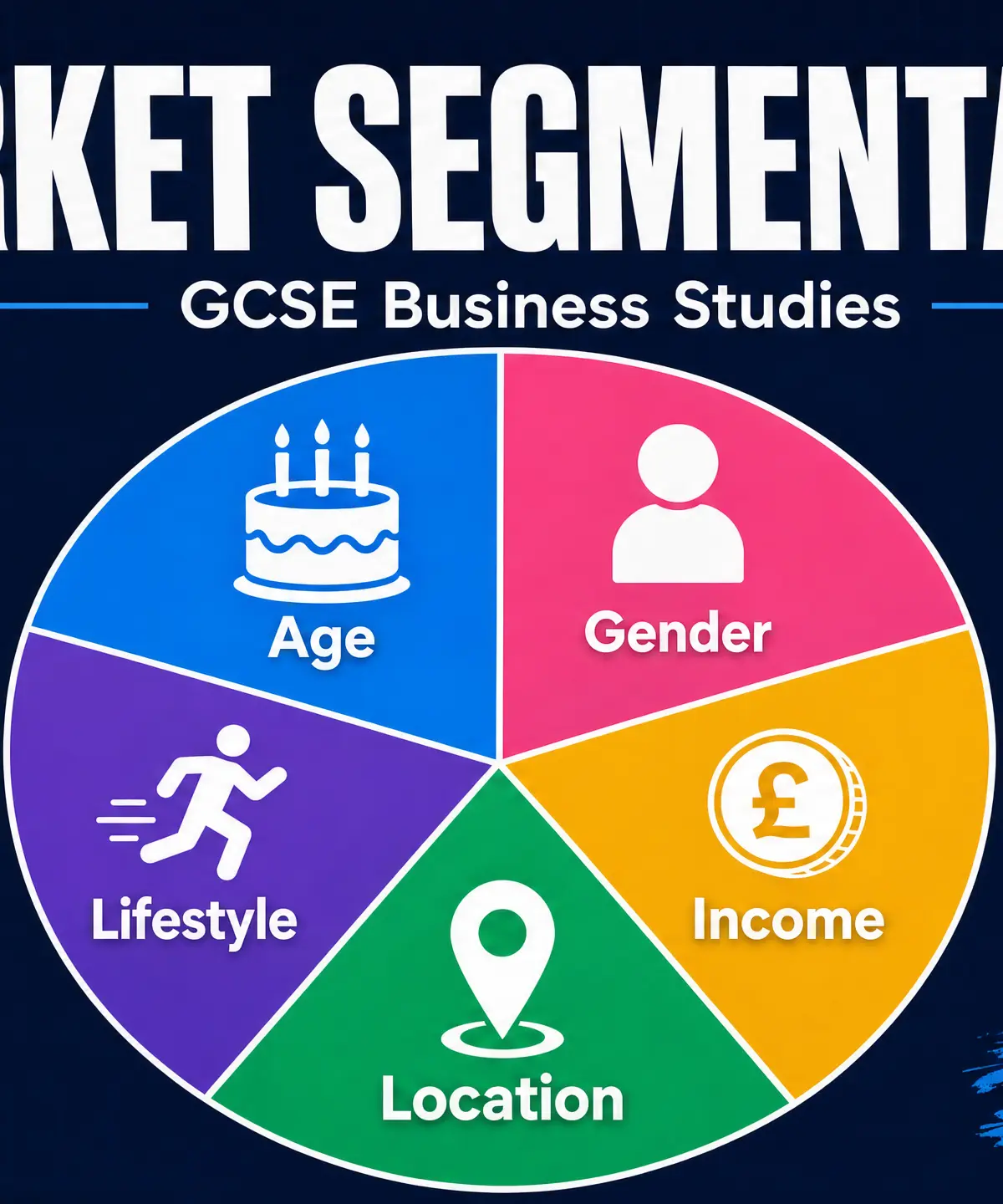
Overview
Market segmentation is the process of dividing a broad target market into smaller, more defined groups of consumers who share common needs, interests, or characteristics. In the modern business environment, a 'one-size-fits-all' approach rarely works. Instead, businesses use segmentation to design and implement tailored strategies for specific target audiences. For GCSE Business candidates, understanding segmentation is critical because it links directly to the marketing mix (the 4Ps). Examiners expect you not only to define the different methods of segmentation but, crucially, to apply them to specific business scenarios and explain why a business would choose a particular method.
The Key Segmentation Variables
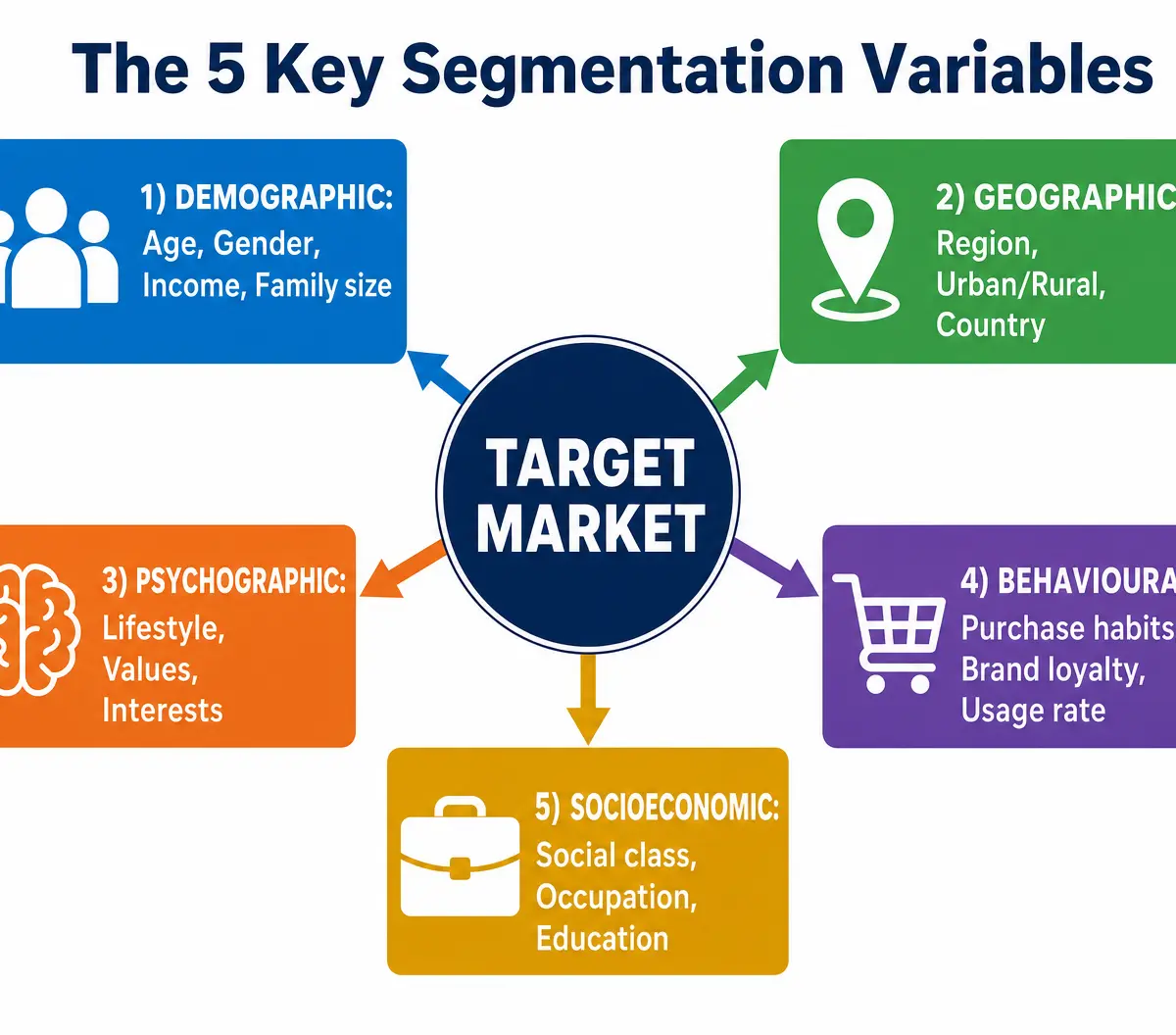
Demographic Segmentation
What it is: Dividing the market based on measurable characteristics of the population.
Key Variables: Age, gender, income, family size, occupation.
Business Application: This is the most common form of segmentation. A toy manufacturer like LEGO segments by age (Duplo for toddlers, Technic for older children, Creator Expert for adults). A luxury brand like Rolex segments by income. Examiners love demographic segmentation because it is easy to apply to almost any business scenario.
Geographic Segmentation
What it is: Dividing the market based on location.
Key Variables: Country, region, urban/rural, climate.
Business Application: A clothing retailer might stock heavy winter coats in their Scottish stores while promoting lighter jackets in Cornwall. Multinational companies must adapt geographically; for example, McDonald's alters its menu based on local cultural and religious preferences in different countries.
Psychographic Segmentation
What it is: Dividing the market based on psychological traits.
Key Variables: Lifestyle, values, attitudes, personality, interests.
Business Application: This is increasingly important in modern marketing. A brand like Patagonia targets consumers who value environmental sustainability. A fitness brand targets those who see health as a core part of their identity. This is harder to measure than demographics but often creates stronger brand loyalty.
Behavioural Segmentation
What it is: Dividing the market based on consumer behaviour towards a product.
Key Variables: Purchase habits, brand loyalty, usage rate, benefits sought.
Business Application: A coffee shop might segment by usage rate, offering loyalty cards to frequent daily buyers. A software company might offer a basic free version for casual users and a premium paid version for heavy, professional users.
Socioeconomic Segmentation
What it is: Dividing the market based on social class and economic status.
Key Variables: Social grade (e.g., the A, B, C1, C2, D, E classification system in the UK).
Business Application: Premium supermarkets like Waitrose target the AB socioeconomic groups (higher managerial and professional), while discount retailers like Aldi or Lidl might target a broader socioeconomic range with a focus on value.
Linking Segmentation to the Marketing Mix
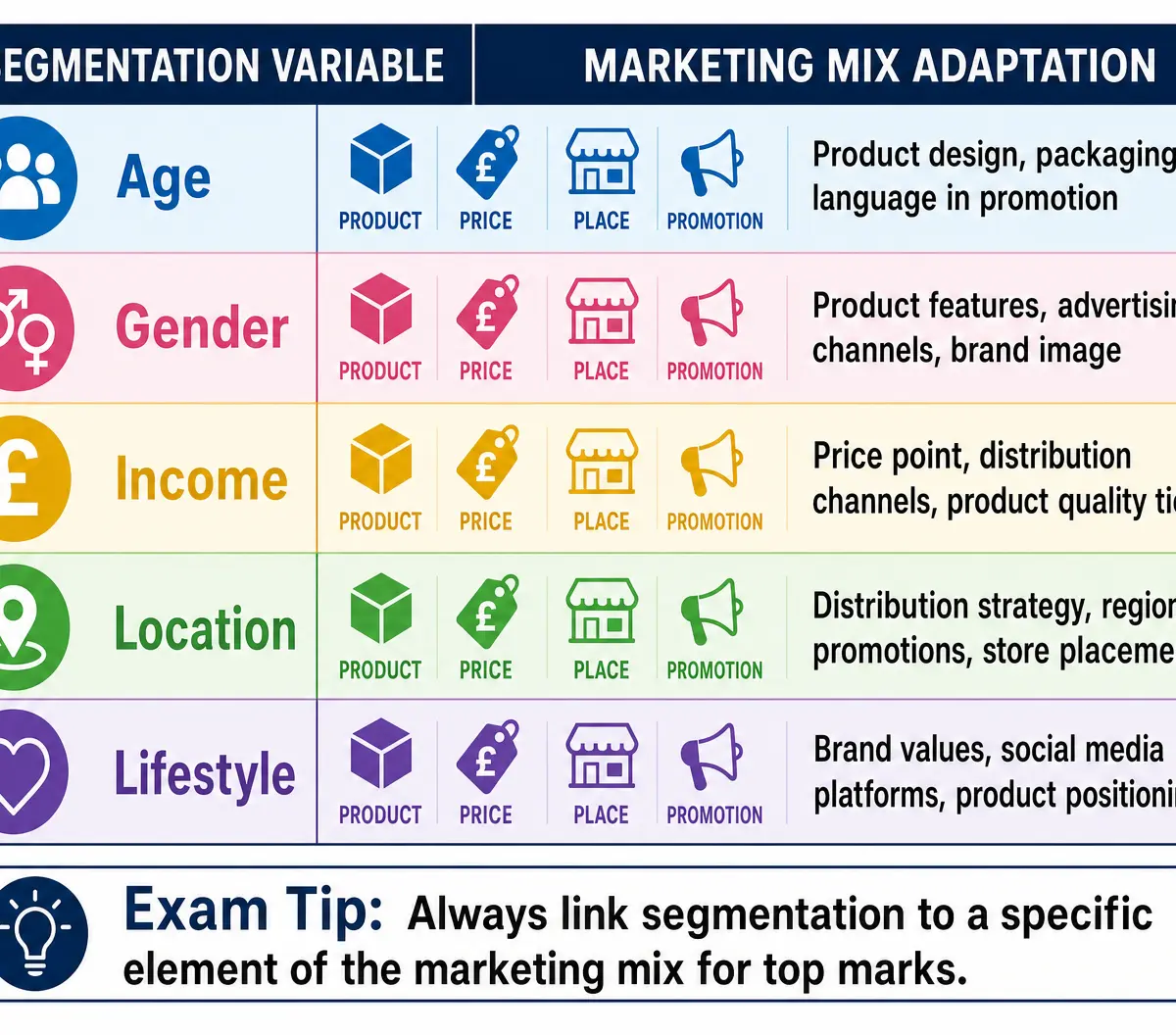
This is where candidates earn top marks. You must show how a segmentation decision impacts the 4Ps:
- Product: Features, design, and packaging must appeal to the specific segment (e.g., bright colours for children).
- Price: The pricing strategy must reflect the segment's income and willingness to pay (e.g., premium pricing for high-income segments).
- Place: Distribution channels must match where the segment shops (e.g., online for younger demographics, high street for older demographics).
- Promotion: Advertising methods and messages must reach and resonate with the segment (e.g., TikTok influencers for teens, newspaper ads for retirees).
Listen to the Podcast
For a deeper dive into these concepts, including examiner tips and a quick-fire recall quiz, listen to our dedicated Market Segmentation podcast:
Visual Resources
2 diagrams and illustrations
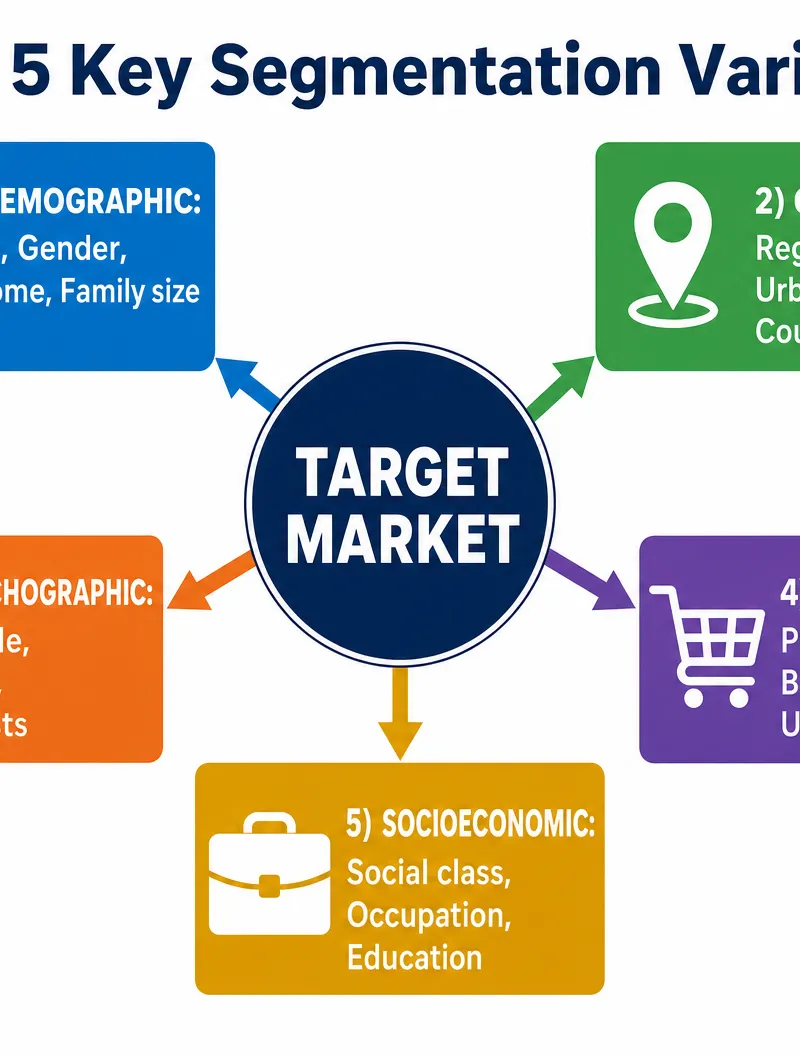
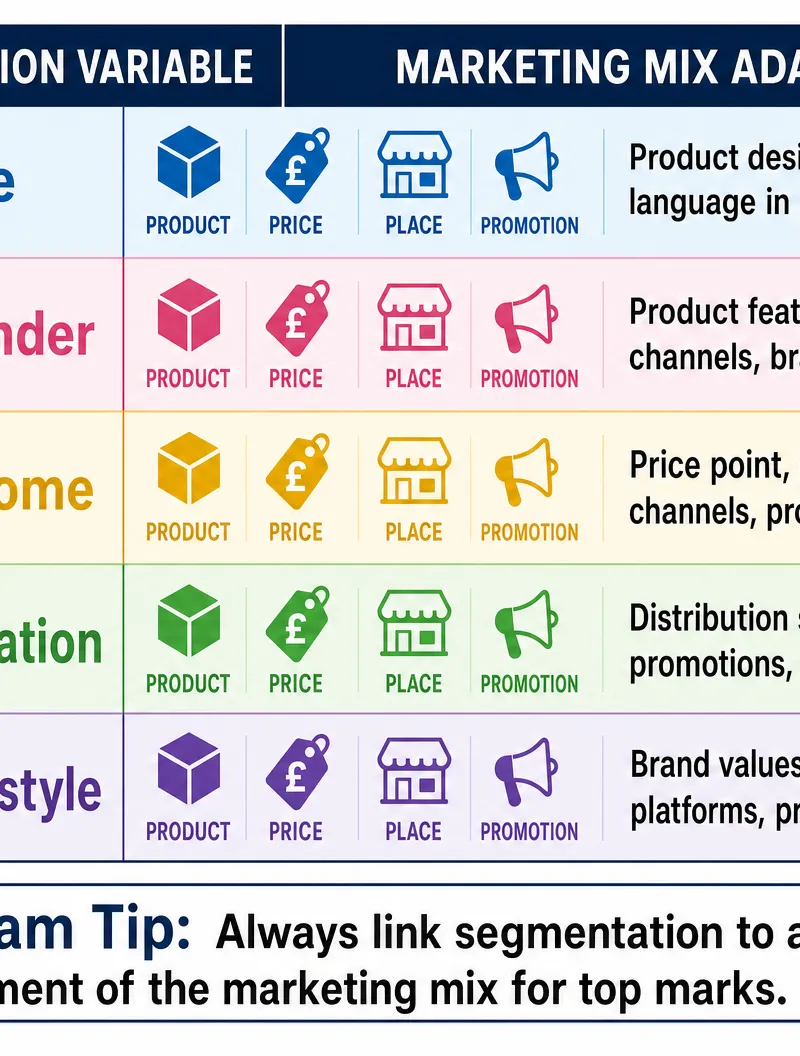
Interactive Diagrams
1 interactive diagram to visualise key concepts
Conceptual Flow Outline
The process from broad market to tailored marketing mix.
Worked Examples
3 worked examples — open one to explore the question and available guidance.
Practice Questions
Try the question, then reveal an answer plan or example response
State two demographic variables a business could use to segment its market. (2 marks)
Hint: Think about measurable facts about a person.
Explain how a gym might use psychographic segmentation. (3 marks)
Hint: Psychographic relates to lifestyle and values. How do people view fitness?
Analyse one benefit to a smartphone manufacturer of segmenting its market by income. (6 marks)
Hint: Build a chain of reasoning: Income segment -> tailored product/price -> customer satisfaction -> business impact.
A new vegan restaurant is opening in a large town. The owners are deciding whether to focus their marketing on geographic segmentation (local residents) or psychographic segmentation (people who value animal welfare and sustainability). Justify which method they should choose. (9 marks)
Hint: Discuss the pros/cons of both, then make a clear decision based on the specific nature of a vegan restaurant.
Explain how behavioural segmentation differs from demographic segmentation. (4 marks)
Hint: Compare 'who' the customer is with 'how' they act.
Exam technique
How to turn what you know into marks
How to approach the question
Always identify the context (the specific business) first. Underline the command word. If the question asks for a specific number of methods (e.g., 'Explain two...'), only write two.
How to structure your answer
- Analyse questions
- Identify the factor → Explain the immediate effect → Explain the knock-on effect on the business (e.g., revenue, profit, market share).
- Explain questions
- Point (identify the variable) → Context (apply to the business) → Explanation (how they use it) → Impact (effect on sales/costs).
- Evaluate questions
- Option 1 (Pros/Cons in context) → Option 2 (Pros/Cons in context) → Judgement (Which is better and WHY).
Timing
Approximately 1 minute per mark. Spend 1-2 minutes planning 9-mark or 12-mark questions.
Common pitfalls
- Listing variables (age, gender, etc.) without explaining how the business would actually use them.
- Ignoring the context — giving a generic answer about a car company when the question is about a local bakery.
- Failing to link the segmentation method to the marketing mix (4Ps).
- Confusing demographic and psychographic segmentation.
What the command words want
- Analyse
- Build a chain of reasoning showing causes and impacts on the business. (6 marks)
- Explain
- Make a point and develop it with a linked reason. Use words like 'because' or 'therefore'. (3-4 marks)
- State/Identify
- Short, precise answer. No explanation needed. (1 mark)
- Evaluate/Justify
- Consider both sides (or multiple options), apply to context, and provide a supported final decision. (9-12 marks)
Watch or listen (optional)
Test your understanding of Market segmentation
Active recall beats re-reading. Take an instant quiz now to test what you’ve learned and lock it into long-term memory.
A week of Premium from your first lesson · Then the free plan continues · No card, no charge