OCR · GCSE · Business
Course version: J204 · Version from Sept 2019
Sources of finance
Every business needs money to survive and grow, but choosing where that money comes from is a critical decision. This study guide covers the internal and external sources of finance, their pros and cons, and how examiners test your ability to match the right finance to specific business scenarios.
- 5 min read
- 3 worked examples
- 5 practice questions
- 6 key terms
Check what you remember
Read the wording for your board, then hide it and explain Retained Profit in your own words. Rough notes are fine. This is a self-check, with no mark or grade.
Reference: OCR
Profit kept within the business to fund future expansion rather than being paid out as dividends.
Study Notes
Overview
Finance is the lifeblood of any business. Whether a start-up needs cash to buy its first batch of inventory or an established multinational wants to expand overseas, choosing the right source of finance is crucial. This topic covers the various ways businesses raise money, divided into internal sources (from within the business) and external sources (from outside).
Examiners consistently test this topic because it links directly to business strategy, risk, and cash flow. You will be expected not only to identify these sources but to evaluate their suitability for different contexts. A common pitfall is recommending a source of finance that a business in the given scenario could not realistically access (e.g., a start-up using retained profit). Understanding the trade-offs—such as losing control by issuing shares versus paying interest on a loan—is key to accessing the highest mark bands.
Listen to our comprehensive podcast for an in-depth review of these concepts:
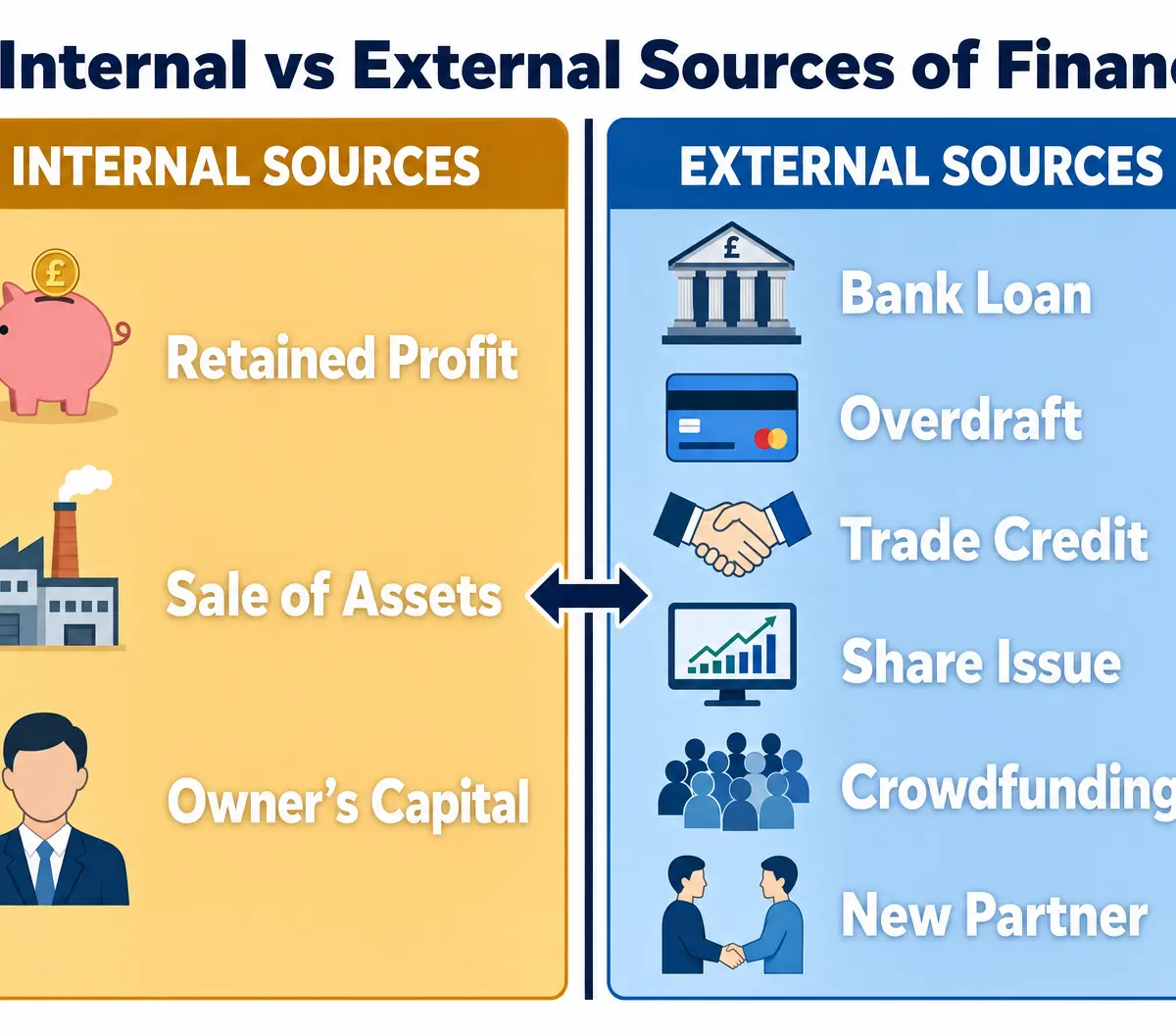
Internal Sources of Finance
Internal sources are funds found inside the business. They are generally considered 'free' because they do not incur interest, but they have opportunity costs.
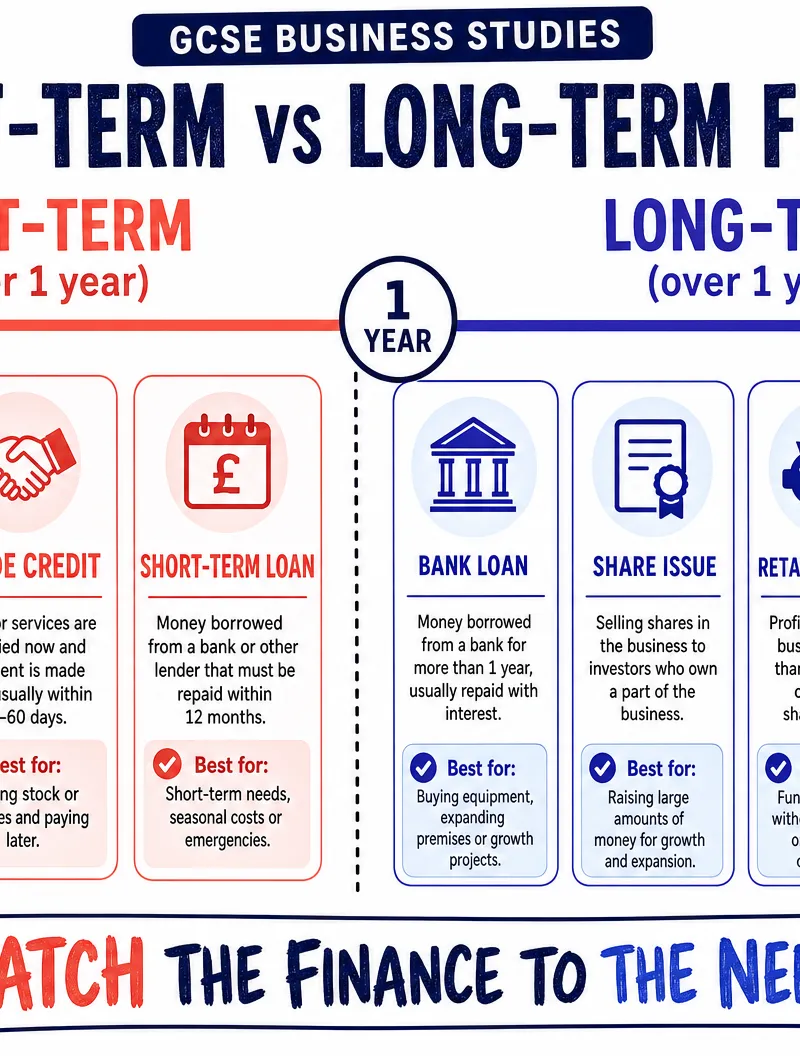
Retained Profit
What it is: Profit kept in the business after taxes and dividends have been paid.
Pros: No interest to pay; does not dilute ownership or control.
Cons: Once spent, it cannot be used elsewhere; not available to new start-ups or loss-making businesses.
Sale of Assets
What it is: Selling items the business owns (e.g., old machinery, vehicles, or buildings) to raise cash.
Pros: Quick way to raise cash without borrowing; clears out obsolete equipment.
Cons: The business loses the asset and its potential future use; can take time to find a buyer for large assets.
Owner's Capital
What it is: Personal savings put into the business by the entrepreneur.
Pros: Shows commitment to the business (which helps when asking banks for loans); no interest payments.
Cons: The owner risks losing their personal savings if the business fails.
External Sources of Finance
External sources involve bringing in money from outside the business. These often come with costs such as interest or a loss of control.
Bank Loan
What it is: A fixed amount of money borrowed from a bank, repaid in regular installments with interest over a set period.
Pros: Provides a guaranteed lump sum for major purchases; the business retains full ownership.
Cons: Interest must be paid regardless of profit; the bank usually requires collateral (security) which can be seized if the loan isn't repaid.
Overdraft
What it is: An agreement with the bank allowing a business to spend more money than it has in its account, up to an agreed limit.
Pros: Highly flexible for managing day-to-day cash flow shortages; interest is only paid on the amount borrowed.
Cons: Very high interest rates; the bank can demand repayment at any time.
Trade Credit
What it is: Buying goods or services from a supplier now and paying for them later (usually within 30, 60, or 90 days).
Pros: Helps cash flow as the business can sell the goods before having to pay the supplier.
Cons: Missing payment deadlines damages the relationship with the supplier and can result in losing credit facilities.
Share Issue
What it is: Raising capital by selling portions of ownership (shares) in a limited company to investors.
Pros: Can raise massive amounts of capital; the money does not need to be repaid, and no interest is charged.
Cons: Original owners lose a percentage of control; shareholders expect a share of profits (dividends).
Crowdfunding
What it is: Raising small amounts of money from a large number of people, typically via online platforms.
Pros: Good for start-ups; acts as market research to prove demand; no interest payments.
Cons: Can be time-consuming; if the target amount isn't reached, the money is often returned to investors.
The Role of the Finance Function
The finance department is responsible for keeping track of the money flowing in and out of the business. Their key roles include:
- Providing Financial Information: Creating cash flow forecasts, income statements, and balance sheets.
- Supporting Decision Making: Advising managers on whether they can afford to expand, hire new staff, or launch a marketing campaign.
- Managing Cash Flow: Ensuring the business always has enough liquid cash to pay its bills on time.
Worked Examples
3 worked examples — open one to explore the question and available guidance.
Practice Questions
Try the question, then reveal an answer plan or example response
Explain one benefit to a business of using retained profit rather than a bank loan to fund expansion. (3 marks)
Hint: Think about the cost of borrowing.
A clothing retailer wants to buy a new line of winter coats. Recommend whether they should use an overdraft or trade credit. (6 marks)
Hint: Consider the timeline of selling the coats versus paying for them.
Identify two external sources of finance. (2 marks)
Hint: Money coming from outside the business.
Explain one disadvantage of raising finance through crowdfunding. (3 marks)
Hint: What happens if you don't reach your target?
Evaluate the impact on a private limited company of issuing more shares to fund a new factory. (9 marks)
Hint: Look at both the financial benefits and the loss of control.
Exam technique
How to turn what you know into marks
How to approach the question
Read the context carefully. Highlight the size of the business, its age, and what it needs the money for.
How to structure your answer
- Explain questions
- BLT structure: Because, Leading to, Therefore. State the point, explain why it happens, explain the impact on the business.
- Evaluate questions
- Option 1 (Pros/Cons) -> Option 2 (Pros/Cons) -> Justified Conclusion.
Timing
Approximately 1 minute per mark.
Common pitfalls
- Recommending retained profit for a brand new start-up.
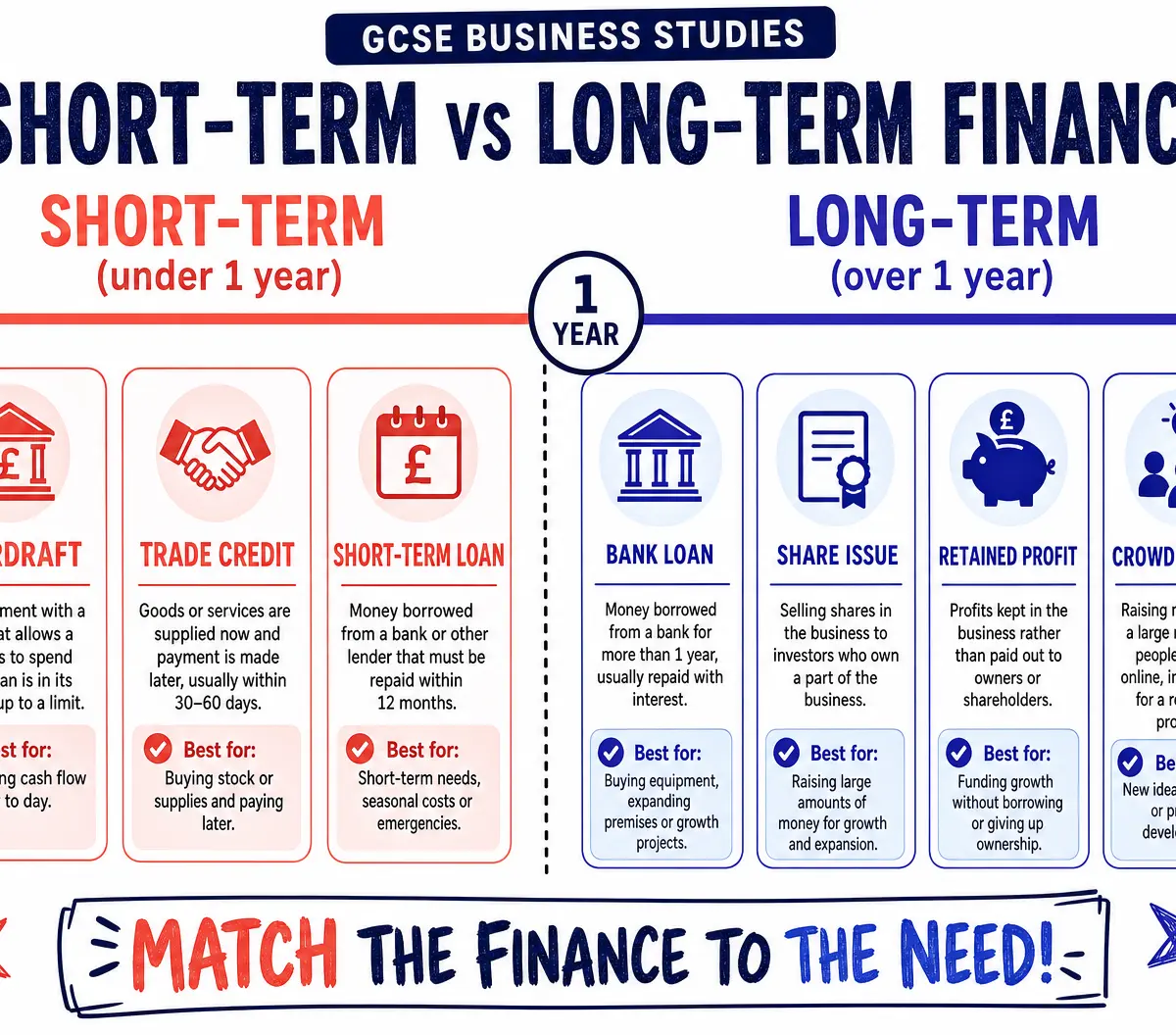
- Confusing an overdraft (short-term, flexible) with a bank loan (long-term, fixed).
- Failing to mention the loss of control when discussing share issues.
What the command words want
- Analyse
- Examine the impacts or consequences in detail, linking causes to effects.
- Explain
- Make a point and develop it with two linked steps of reasoning.
- State/Identify
- Provide a single word or short phrase. No explanation needed.
- Evaluate/Recommend
- Weigh up the pros and cons of different options in context and provide a final judgement.
Watch or listen (optional)
Test your understanding of Sources of finance
Active recall beats re-reading. Take an instant quiz now to test what you’ve learned and lock it into long-term memory.
A week of Premium from your first lesson · Then the free plan continues · No card, no charge