OCR · GCSE · Business
Course version: J204 · Version from Sept 2019
The interdependent nature of business
Master the core of GCSE Business with this comprehensive guide to the interdependent nature of business. Learn how Operations, Finance, Marketing, and Human Resources connect, and discover how examiners reward candidates who can analyse the ripple effects of business decisions.
- 5 min read
- 3 worked examples
- 5 practice questions
- 6 key terms
Check what you remember
Read the wording for your board, then hide it and explain Interdependence in your own words. Rough notes are fine. This is a self-check, with no mark or grade.
Reference: OCR
The way in which the different functional areas of a business rely on each other to operate effectively.
Study Notes
Overview
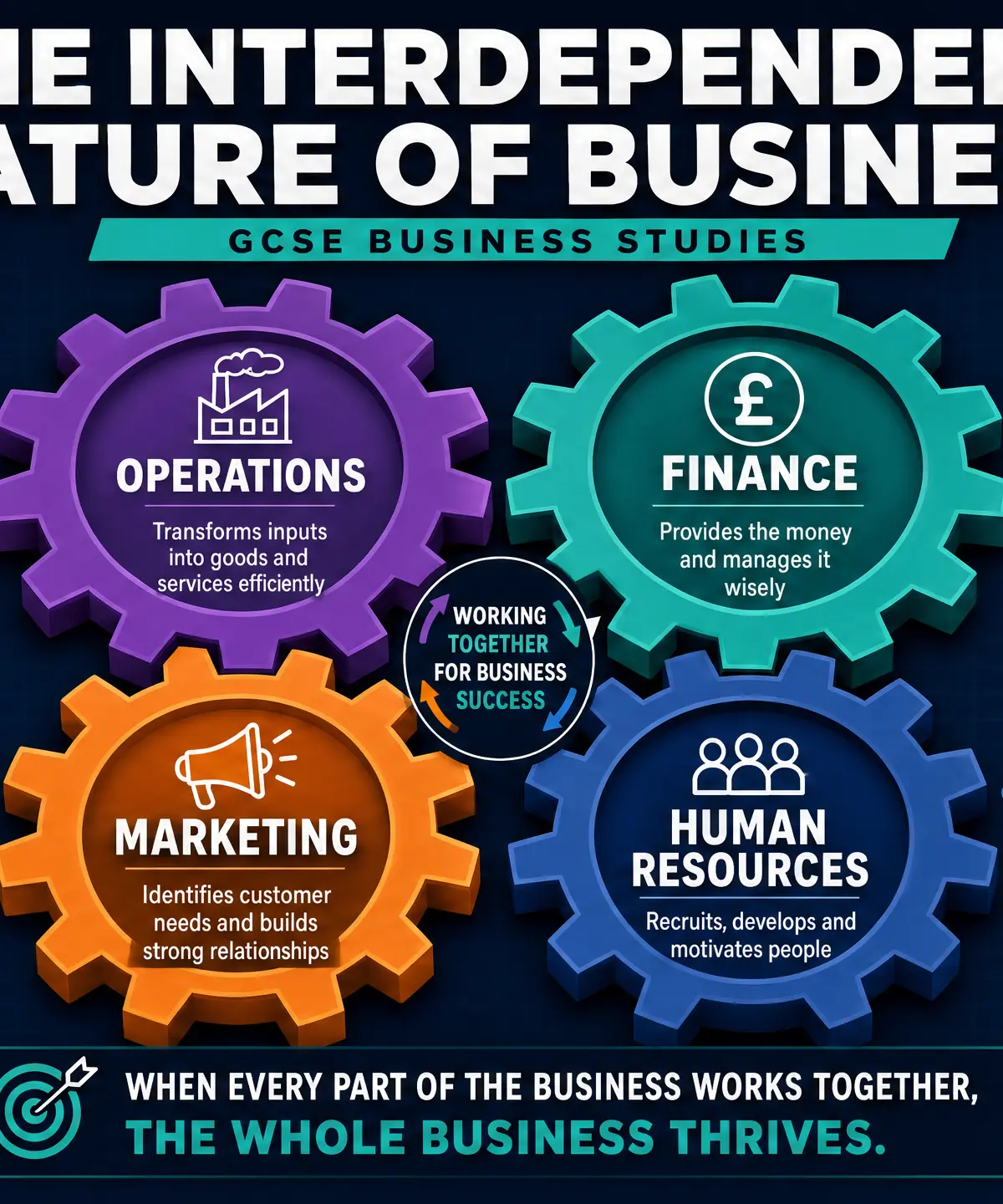
The interdependent nature of business is the concept that no department or functional area operates in isolation. Think of a business like a human body: the heart, lungs, and brain all have distinct roles, but they must work together for the body to survive. In a business, the four main functional areas—Operations, Finance, Marketing, and Human Resources (HR)—are deeply connected. Every decision made in one area creates a ripple effect across the others.
For GCSE candidates, this is one of the most critical topics. Examiners consistently use this area to differentiate between average and top-tier students. While a Level 2 answer might describe a marketing decision in isolation, a Level 4 answer will analyse how that marketing decision impacts operational capacity, strains financial cash flow, and requires HR to recruit new staff. This guide will show you how to trace these connections and secure maximum marks.
Listen to our comprehensive audio guide for a deep dive into these concepts:
The Four Functional Areas
Operations
Role: Operations is responsible for transforming inputs (raw materials, labour) into outputs (goods and services) efficiently and to the required quality standard.
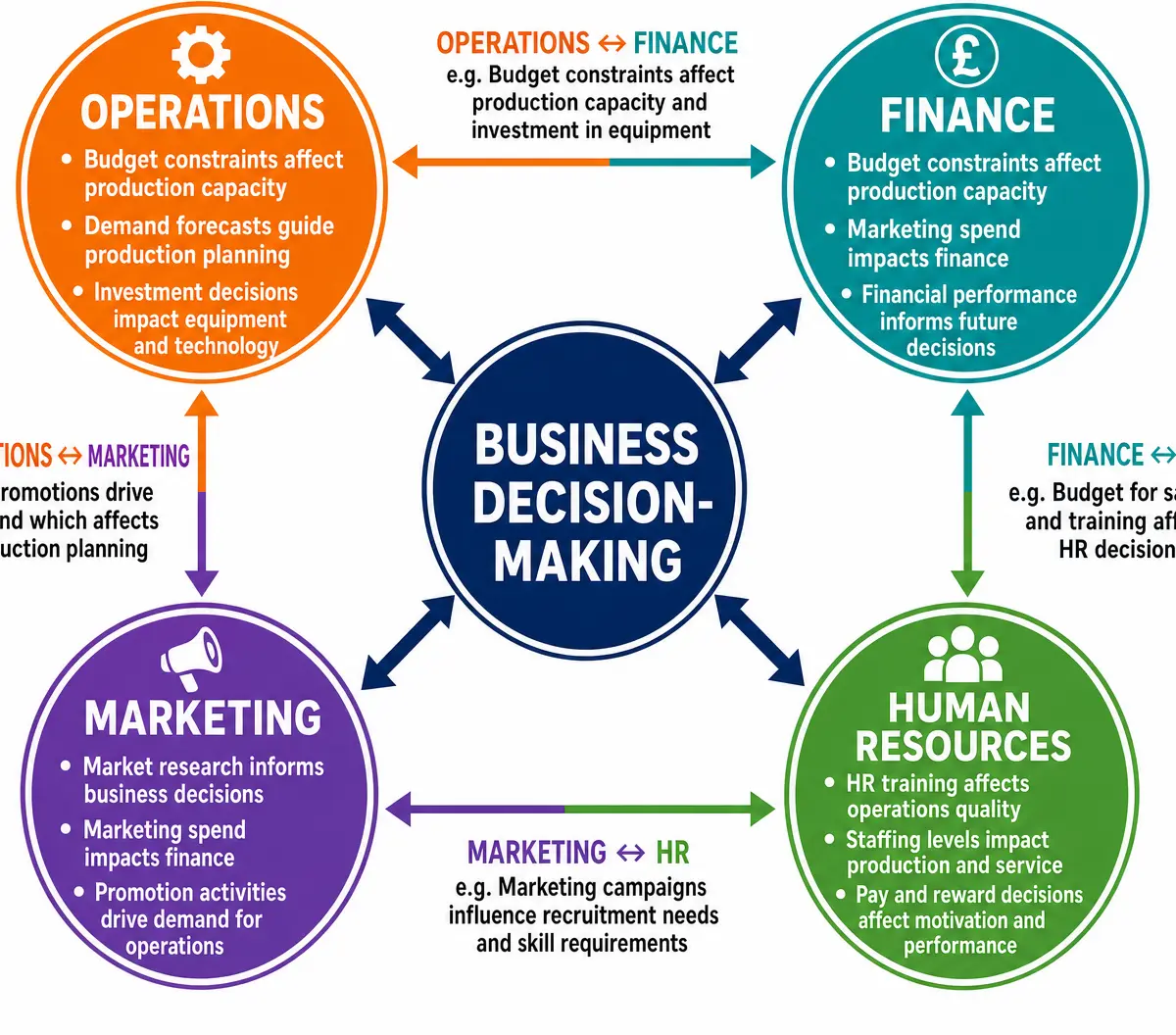
Interdependence: Operations relies on Finance for the budget to purchase equipment and materials. It relies on Marketing to provide accurate sales forecasts so it knows how much to produce. It depends on Human Resources to hire skilled production workers and provide necessary training.
Finance
Role: The Finance function manages the money flowing in and out of the business. It is responsible for securing funds, controlling costs, monitoring cash flow, and calculating profit.
Interdependence: Finance provides the capital that allows Operations to invest in new machinery. It sets the budget constraints for Marketing campaigns. It works with HR to determine affordable wage rates and bonus structures. In return, Finance depends on the other departments to stick to their budgets and generate the revenue needed for survival.
Marketing
Role: Marketing identifies customer needs, develops products to meet those needs, sets pricing strategies, and promotes the business to drive sales.
Interdependence: Marketing tells Operations what features customers want and how many units are likely to sell. It relies on Finance to fund advertising campaigns and market research. It works with HR to ensure the sales and customer service teams are properly trained to represent the brand.
Human Resources (HR)
Role: HR manages the people within the business. This includes recruitment, selection, training, motivation, performance management, and employment law compliance.
Interdependence: HR recruits the production staff needed by Operations. It ensures the Marketing team has the right creative talent. It works closely with Finance because wages and training are often a business's largest costs. If HR fails to motivate staff, productivity in Operations drops, which ultimately hurts Finance.
Risk and Reward in Decision-Making
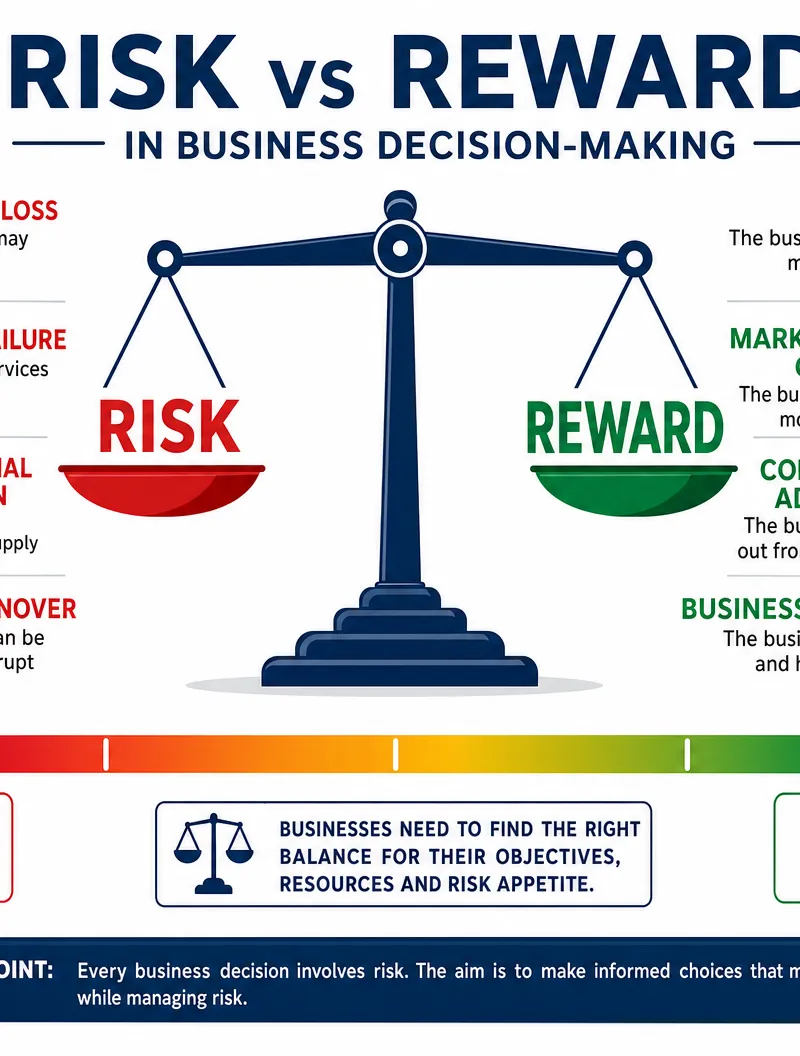
Every business decision involves balancing risk and reward.
Risk is the possibility that a decision will lead to a negative outcome, such as financial loss, damage to reputation, or operational failure.
Reward is the potential positive outcome, such as increased profit, larger market share, or a stronger competitive advantage.
Generally, higher risk is associated with the potential for higher reward. For example, expanding into a completely new international market is highly risky (unknown customer preferences, currency fluctuations, different laws) but offers massive potential rewards (access to millions of new customers). Conversely, staying in a local, established market is low risk but offers limited growth potential.
When evaluating business decisions in an exam, you must weigh the risks against the rewards, considering the specific context of the business (e.g., its size, financial stability, and market conditions).

Using Financial Information
Businesses rely on quantitative financial data to make informed decisions and measure performance. Key tools include:
- Profit and Loss Accounts: Show whether a business is making a surplus (revenue > costs) or a deficit. Used to assess overall financial health.
- Cash Flow Forecasts: Predict the money flowing in and out. Crucial for ensuring the business can pay its day-to-day bills, even if it is profitable on paper.
- Financial Ratios: Metrics like Gross Profit Margin and Net Profit Margin allow businesses to compare performance over time or against competitors.
However, examiners also expect you to recognise the limitations of purely quantitative data. Good decision-making also requires qualitative data, such as customer feedback, employee morale, and brand perception.

Interactive Diagrams
1 interactive diagram to visualise key concepts
Conceptual Flow Outline
The web of interdependence in business decision-making
Worked Examples
3 worked examples — open one to explore the question and available guidance.
Practice Questions
Try the question, then reveal an answer plan or example response
A fast-food chain has decided to switch all its packaging to 100% biodegradable materials. This new packaging is 15% more expensive than the old plastic packaging. Analyse how this decision will impact the different functional areas of the business. (6 marks)
Hint: Think about the cost impact on Finance, the operational changes, and how Marketing can use this.
State two functional areas of a business. (2 marks)
Hint: Remember the FOMO acronym.
Explain one risk and one reward of launching a new product into a highly competitive market. (4 marks)
Hint: State the risk/reward, then use 'this means that' to explain it.
Evaluate the importance of cash flow forecasting for a rapidly expanding business. (9 marks)
Hint: Consider why expansion drains cash, but also consider what other financial documents might be needed.
Explain how poor quality control in Operations can impact the Marketing department. (3 marks)
Hint: Think about the customer's reaction to poor quality and how Marketing has to deal with it.
Exam technique
How to turn what you know into marks
How to approach the question
Always highlight the specific business context in the scenario (e.g., 'small bakery', 'multinational tech firm') and ensure your analysis applies to that specific context.
How to structure your answer
- Analyse questions
- Use the P.I.E. structure (Point, Impact, Effect on another department) to show interdependence.
- Explain questions
- Use the 'This means that... Therefore...' chain of reasoning to develop your points.
- Evaluate questions
- Introduction → Point for → Point against → Contextualised Judgement (Conclusion).
Timing
Approximately 1 minute per mark. For a 12-mark question, spend 2 minutes planning and 10 minutes writing.
Common pitfalls
- Writing about functional areas in isolation without showing how they connect.
- Confusing profit with cash flow.
- Providing generic conclusions that don't relate to the specific business in the case study.
What the command words want
- Analyse
- Examine the consequences of an action, showing cause and effect across different parts of the business.
- Explain
- Give a reason and develop it using connective phrases.
- State / Identify
- Provide a simple fact or piece of information. No explanation needed.
- Evaluate / Justify
- Weigh up different options, consider the context, and make a clear, supported decision.
Watch or listen (optional)
Test your understanding of The interdependent nature of business
Active recall beats re-reading. Take an instant quiz now to test what you’ve learned and lock it into long-term memory.
A week of Premium from your first lesson · Then the free plan continues · No card, no charge