OCR · GCSE · Business
Course version: J204 · Version from Sept 2019
The role of the finance function
Master the core engine of any business: the Finance Function. This guide covers how financial information drives planning, shapes decision-making, and influences every aspect of business activity, providing you with the exact knowledge examiners are looking for.
- 6 min read
- 3 worked examples
- 5 practice questions
- 6 key terms
Check what you remember
Read the wording for your board, then hide it and explain Finance Function in your own words. Rough notes are fine. This is a self-check, with no mark or grade.
Reference: OCR
The department responsible for managing the financial resources of a business, including recording transactions, planning, and supporting decisions.
Study Notes
Overview
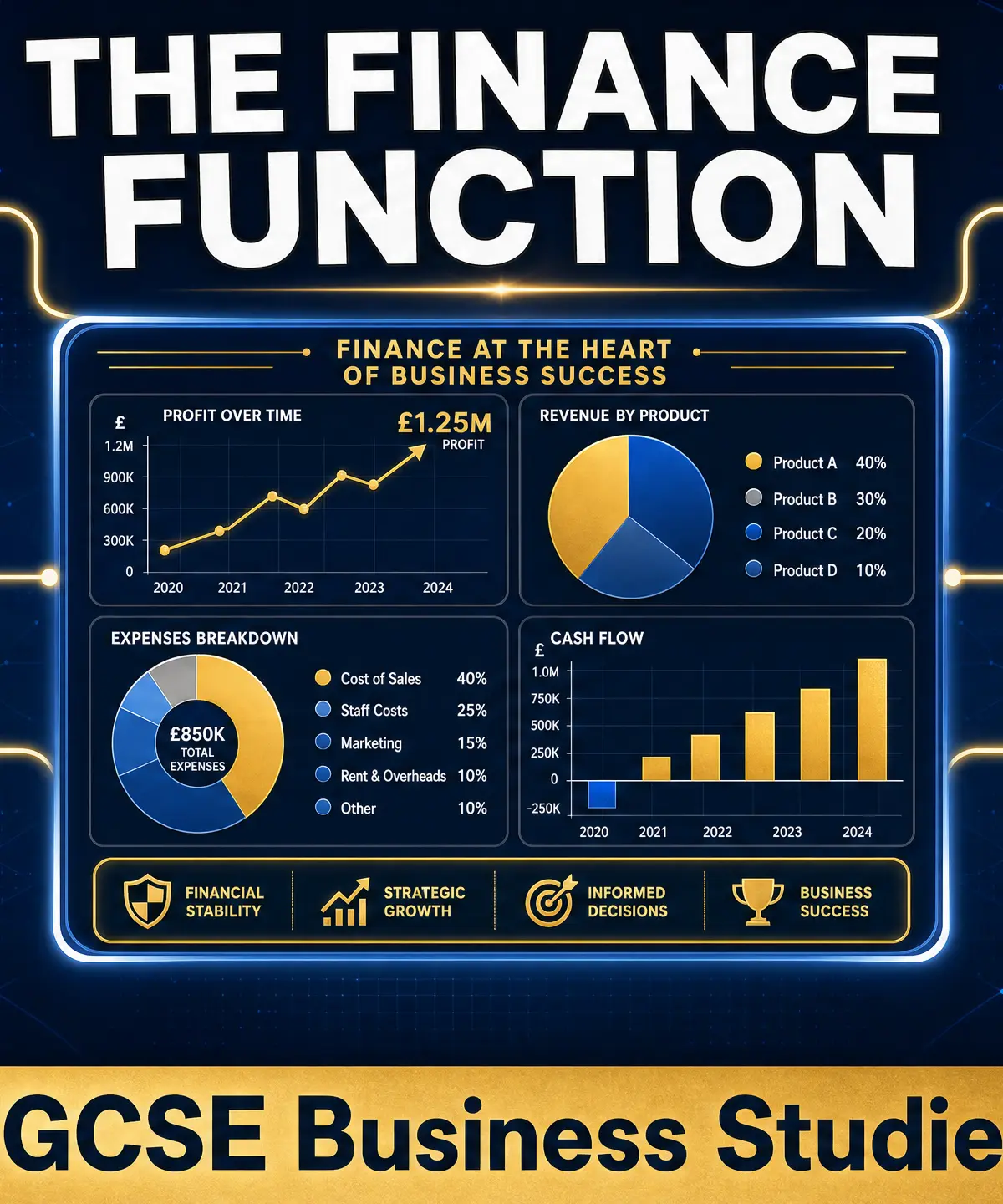
The finance function is the beating heart of any business, whether it's a small local bakery or a massive multinational corporation. Its fundamental purpose is to manage the business's money, but its role goes far beyond simply counting cash. Examiners expect candidates to understand that the finance function acts as an information hub, providing the data necessary for the business to plan for the future, make informed strategic decisions, and ultimately survive and grow.
In your GCSE exam, you will be tested not just on what the finance function is, but on how it links to other functional areas like marketing, operations, and human resources. You must be able to evaluate the impact of financial information on business success and failure. A business operating without a strong finance function is flying blind; it cannot set realistic budgets, measure its profitability, or secure external investment.
Listen to our comprehensive revision podcast to solidify your understanding:
The Four Core Roles of the Finance Function
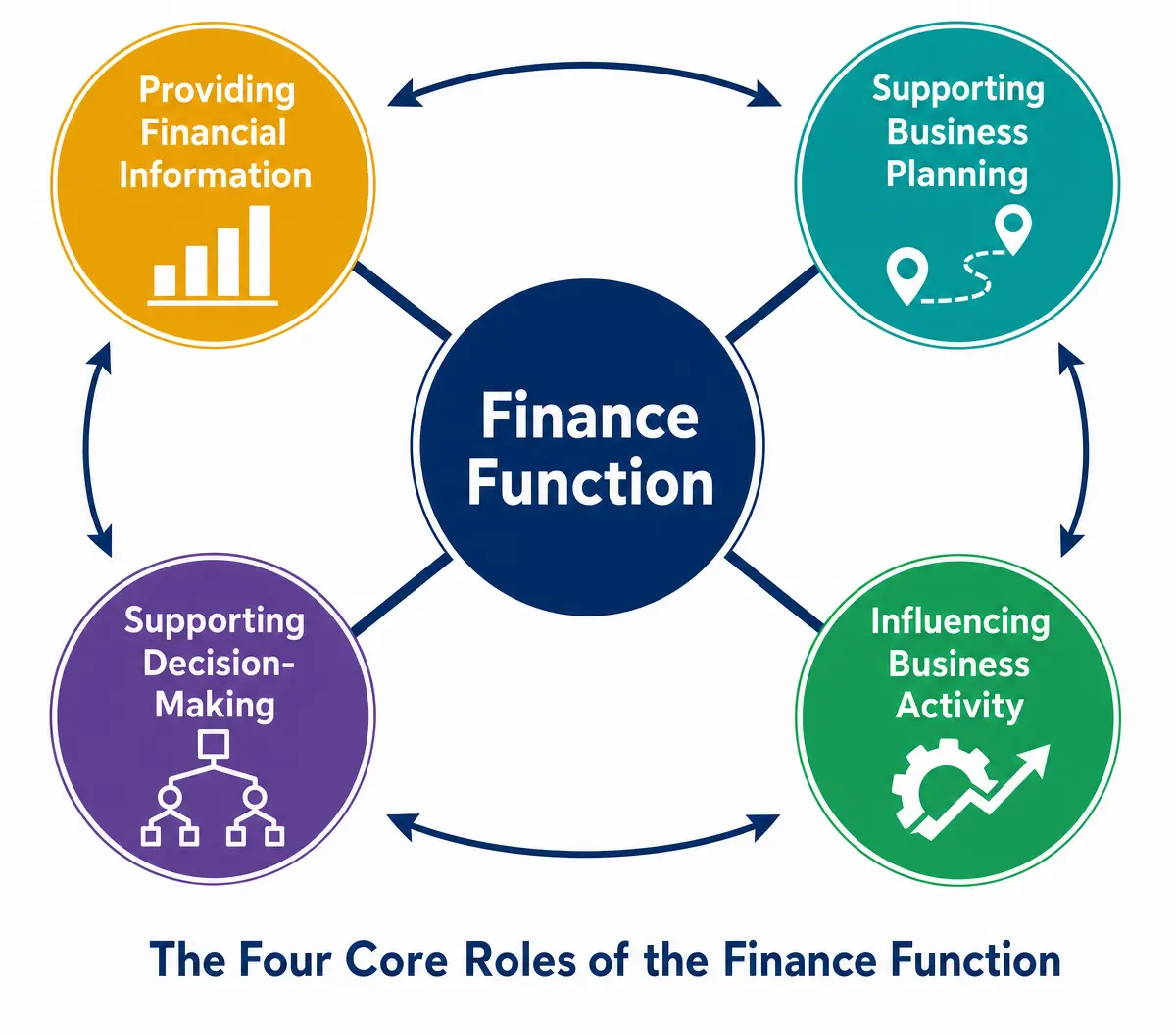
1. Providing Financial Information
What it involves: The most basic role of the finance function is keeping accurate records of all money flowing into and out of the business. This involves preparing key financial documents such as the Income Statement (profit and loss), the Statement of Financial Position (balance sheet), and Cash Flow Forecasts.
Why it matters: Accurate financial information is the foundation of all business activity. Without it, a business cannot know if it is making a profit, if it has enough cash to pay its bills, or if it is liable for taxes.
Exam Focus: Examiners often ask why financial information must be accurate and timely. The key point to make is that inaccurate information leads to poor decision-making, which can ultimately cause business failure.
2. Supporting Business Planning
What it involves: The finance function uses historical financial data to help the business plan for the future. This is primarily done through setting budgets (financial plans for future spending and revenue) and creating financial forecasts.
Why it matters: Planning allows a business to allocate its resources effectively. If the finance function predicts a cash shortage in three months' time, the business can plan ahead by arranging an overdraft or delaying a major purchase.
Exam Focus: You must be able to explain how budgets help control spending. A common exam point is that budgets provide a target for managers to aim for, which can motivate staff but also cause conflict if the budget is set too low.
3. Supporting Business Decision-Making
What it involves: Every major business decision has a financial consequence. The finance function provides managers with the analysis needed to make these choices. This includes calculating the costs of different options, performing break-even analysis, and assessing the potential return on investment.
Why it matters: Decisions based on gut feeling are risky. Decisions based on financial data are calculated risks. If a business is deciding whether to launch a new product or open a new store, the finance function will calculate the expected costs and revenues to see if the decision is financially viable.
Exam Focus: In case study questions, use the financial data provided in the insert to justify a decision. For example, "The business should choose Option A because the break-even point is 500 units lower, reducing the risk of making a loss."
4. Influencing Business Activity
What it involves: The finance function doesn't just observe; it actively shapes what the business does. It monitors performance against targets (variance analysis) and restricts or enables the activities of other departments based on available funds.
Why it matters: The finance function acts as a control mechanism. If marketing wants to spend £50,000 on a new campaign, the finance function determines if the business can afford it. It ensures that the business operates within its means.
Exam Focus: Candidates are often asked to explain the relationship between the finance function and other departments. Remember that the finance function holds the purse strings; its decisions directly impact what other departments can achieve.
Cross-Functional Links
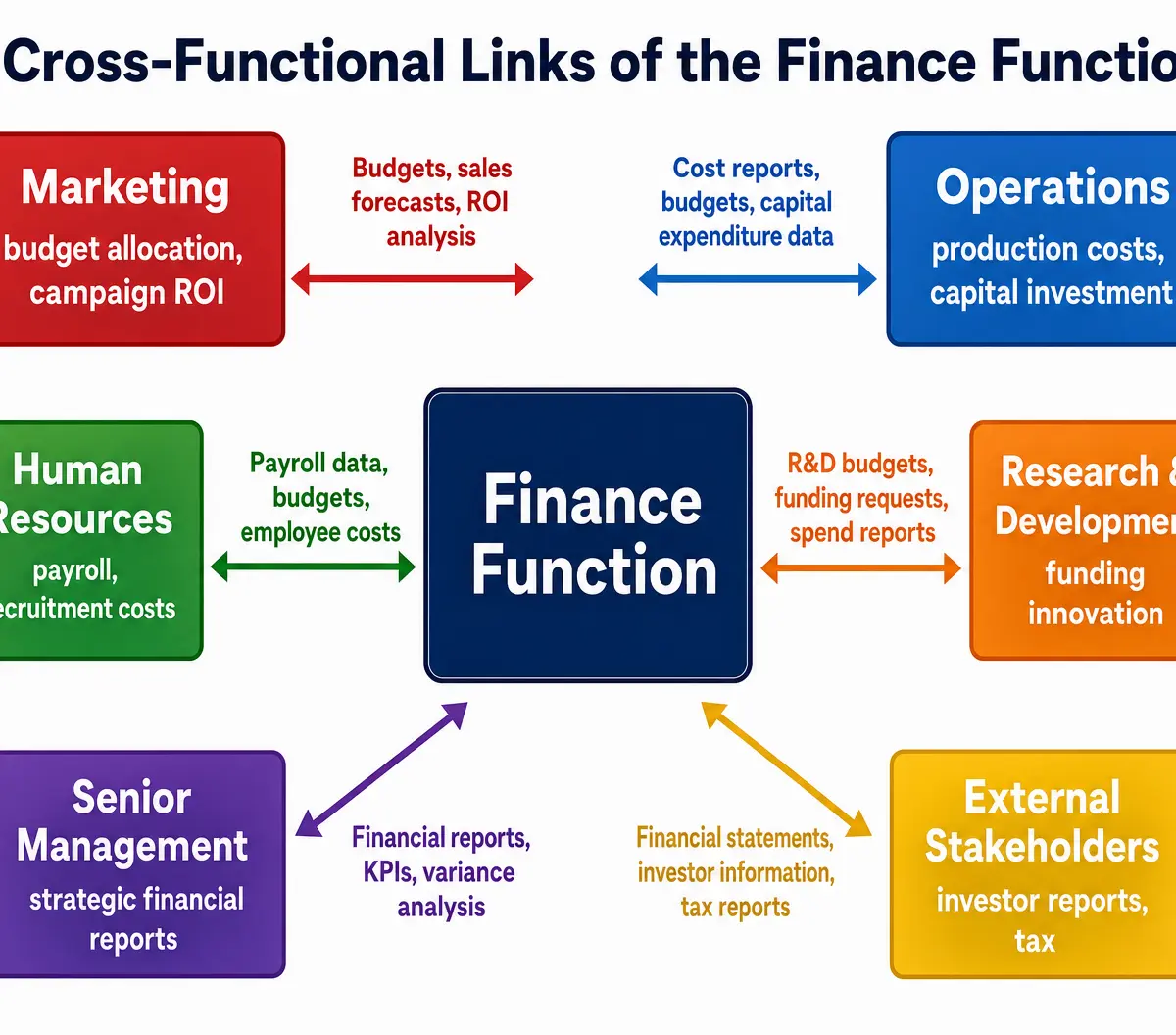
Examiners heavily reward candidates who can demonstrate synoptic thinking — linking the finance function to other areas of the business.
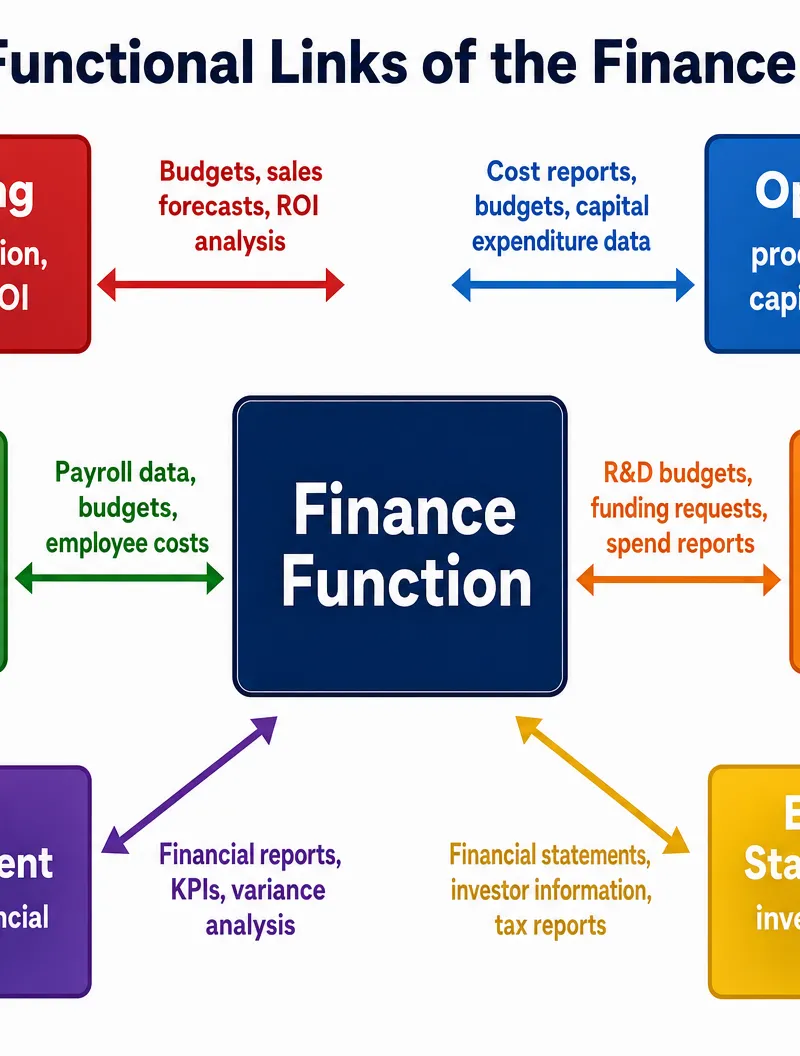
- Finance and Marketing: Finance sets the marketing budget and analyses the return on investment (ROI) of marketing campaigns. Marketing provides finance with sales forecasts.
- Finance and Operations: Finance provides the capital needed for operations to purchase new machinery or raw materials. Operations provides finance with production cost data.
- Finance and Human Resources: Finance sets the budget for recruitment, training, and payroll. HR informs finance of staffing needs and wage changes.
Second-Order Concepts in Business
Causation
Why do businesses fail? Often, it is a failure of the finance function. Poor cash flow management (cause) leads to an inability to pay suppliers (immediate consequence), which stops production and ultimately leads to insolvency (long-term consequence).
Consequence
When the finance function provides accurate, timely data, the consequence is informed decision-making. This reduces risk and increases the likelihood of long-term profitability and growth.
Significance
The finance function is significant because it is the only function that has a complete overview of the entire business's performance. It translates the activities of all other departments into a single, measurable metric: money.
Visual Resources
2 diagrams and illustrations
Interactive Diagrams
1 interactive diagram to visualise key concepts
Conceptual Flow Outline
The core roles of the finance function and their outputs.
Worked Examples
3 worked examples — open one to explore the question and available guidance.
Practice Questions
Try the question, then reveal an answer plan or example response
State two roles of the finance function. (2 marks)
Hint: Think of the P-P-D-I acronym.
Explain one way the finance function influences the marketing department. (3 marks)
Hint: How does marketing pay for its advertising campaigns?
A clothing retailer is experiencing a drop in sales. Explain how the finance function can help the business respond to this situation. (4 marks)
Hint: What data can finance provide to show *where* the problem is, and how can they plan to survive the drop?
Analyse the importance of accurate financial information to a business seeking a bank loan. (6 marks)
Hint: Think about risk from the bank's perspective. What documents will they want to see?
Evaluate whether supporting decision-making is the most important role of the finance function. (9 marks)
Hint: Argue why decision-making is crucial, then argue why another role (like providing information or planning) might be more foundational.
Exam technique
How to turn what you know into marks
How to approach the question
Always identify the command word, the business context (if any), and the specific topic before writing.
How to structure your answer
- Explain questions
- Use the BLT structure: Because (reason), Leading to (consequence), Therefore (impact on the business).
- Evaluate questions
- State the benefits, state the drawbacks/alternatives, and write a strong conclusion starting with 'It depends on...'
- Calculate questions
- Always show your working out. Even if the final answer is wrong, you can pick up marks for the correct method.
Timing
Approximately 1 minute per mark, leaving 5-10 minutes at the end of the paper to check your answers.
Common pitfalls
- Confusing cash flow with profit. They are different concepts.
- Writing generic answers in case study questions. You MUST use the name of the business or data from the text.
- Describing what the finance function does without explaining the *impact* of those actions on the business.
What the command words want
- Analyse
- Build a logical chain of reasoning showing causes and effects in context. (6 marks)
- Explain
- Make a point and develop it with a linked consequence. Use words like 'therefore' or 'which leads to'. (2-4 marks)
- State / Identify
- A simple factual answer. No explanation needed. (1 mark)
- Evaluate / Discuss
- Look at both sides of an argument and reach a justified conclusion based on the evidence. (9-12 marks)
Watch or listen (optional)
Test your understanding of The role of the finance function
Active recall beats re-reading. Take an instant quiz now to test what you’ve learned and lock it into long-term memory.
A week of Premium from your first lesson · Then the free plan continues · No card, no charge