Study Notes
Overview
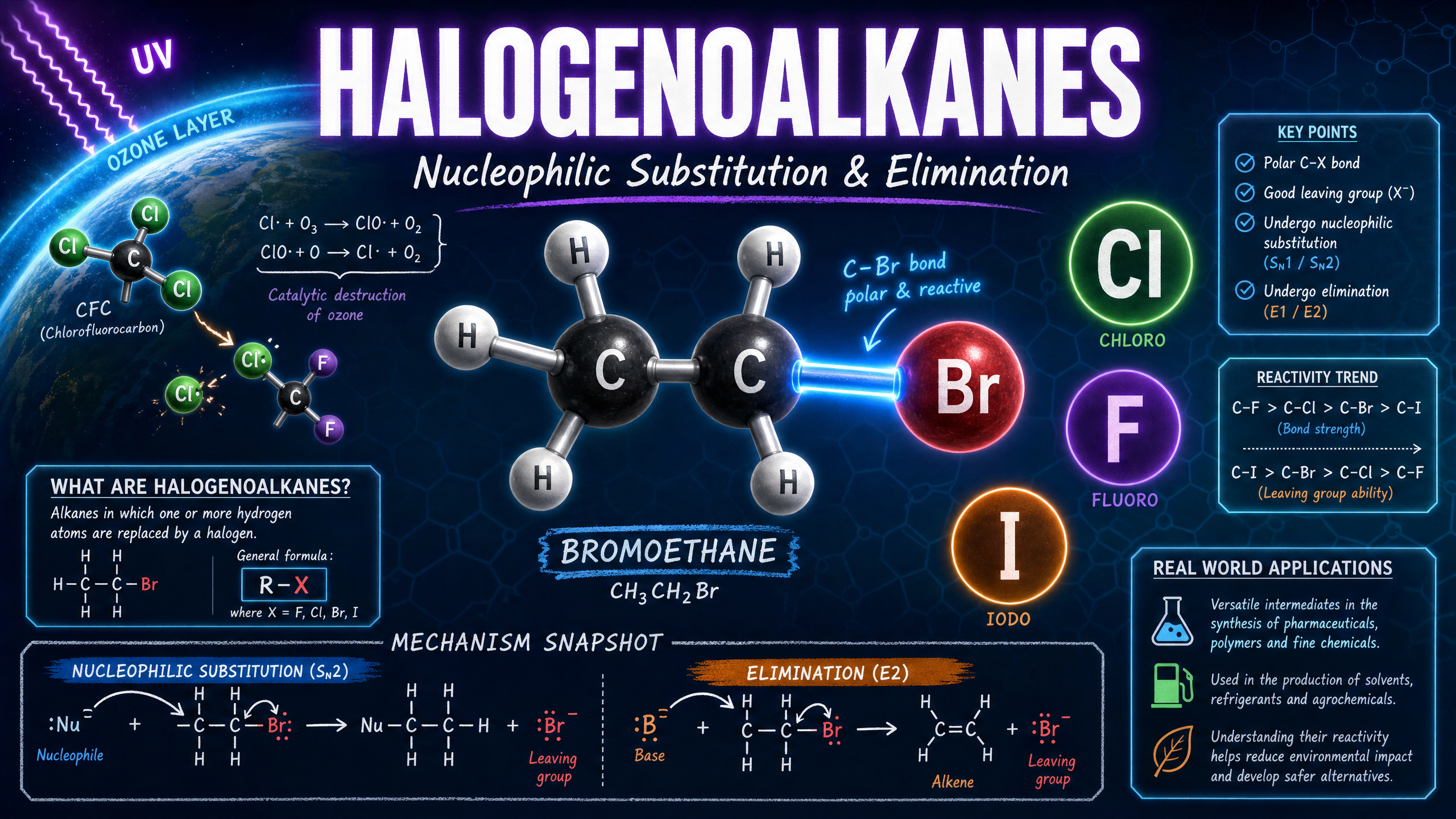
Halogenoalkanes are organic compounds where one or more hydrogen atoms in an alkane have been replaced by a halogen atom (fluorine, chlorine, bromine, or iodine). They are incredibly important in organic synthesis because they are much more reactive than alkanes.
This reactivity stems from the polar carbon-halogen bond. Because halogens are more electronegative than carbon, the carbon atom becomes electron-deficient (\delta+), making it a prime target for nucleophiles. Understanding these mechanisms is crucial, as they form the foundation for many synthetic pathways in chemistry.
In exams, you will frequently be asked to draw mechanisms, explain reactivity trends based on bond enthalpies, and compare substitution versus elimination reactions. You'll also need to know the environmental impact of chlorofluorocarbons (CFCs).
Key Concepts
Concept 1: Nucleophilic Substitution ($S_N2$)
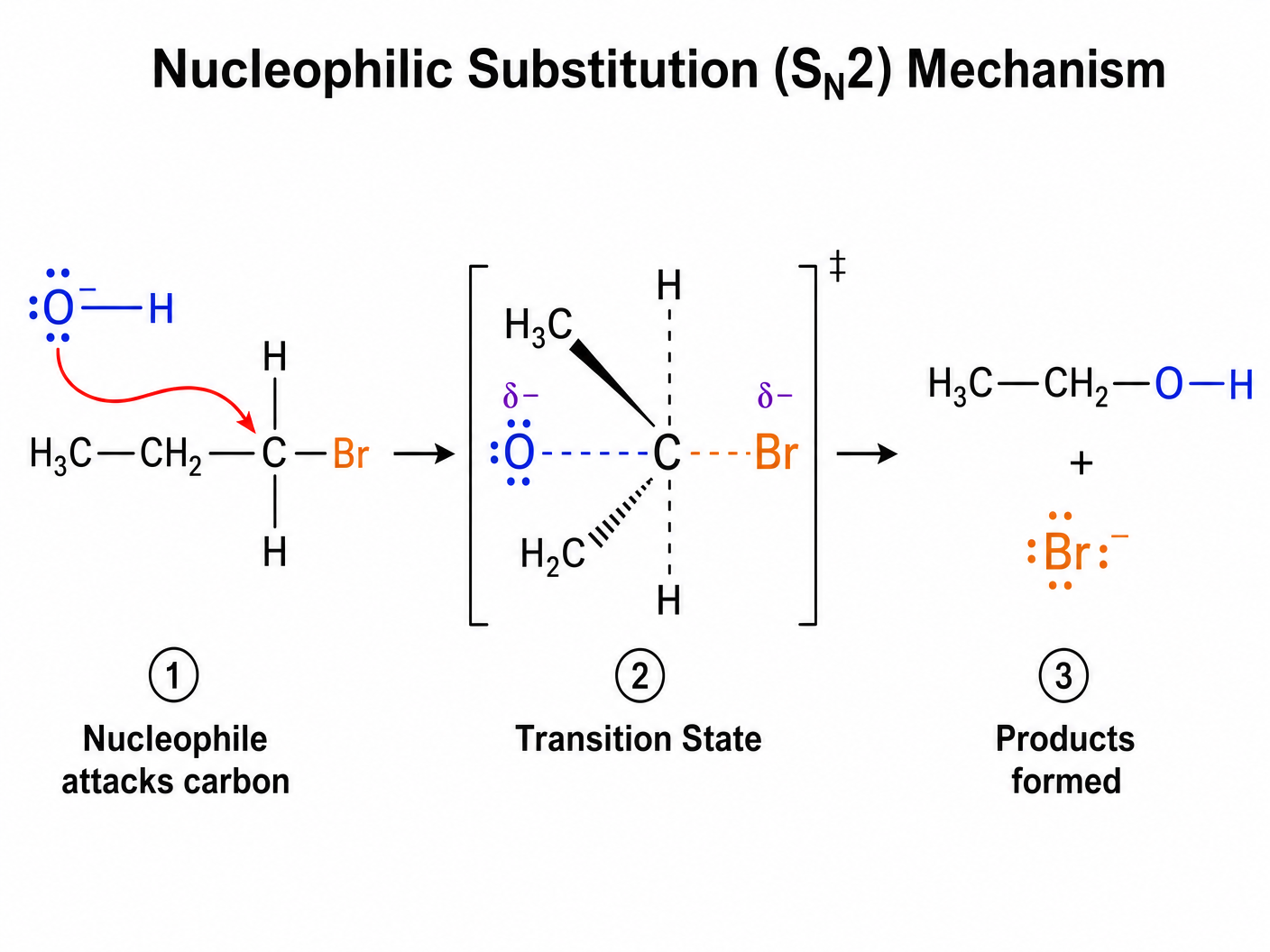
Because the carbon attached to the halogen is \delta+, it is susceptible to attack by nucleophiles (electron pair donors). The nucleophile donates a lone pair to the carbon, forming a new bond, while the carbon-halogen bond breaks heterolytically, releasing the halide ion (the leaving group).
Key Reactions:
- With aqueous NaOH/KOH: Forms alcohols. The OH^- ion acts as the nucleophile. Conditions: warm, aqueous solvent.
- With KCN in ethanol: Forms nitriles. The CN^- ion is the nucleophile. Conditions: warm, ethanolic solvent. Examiner Tip: This reaction is vital because it extends the carbon chain by one carbon atom!
- With excess NH_3: Forms primary amines. The NH_3 molecule is the nucleophile. Conditions: heated in a sealed tube.
Concept 2: Elimination Reactions
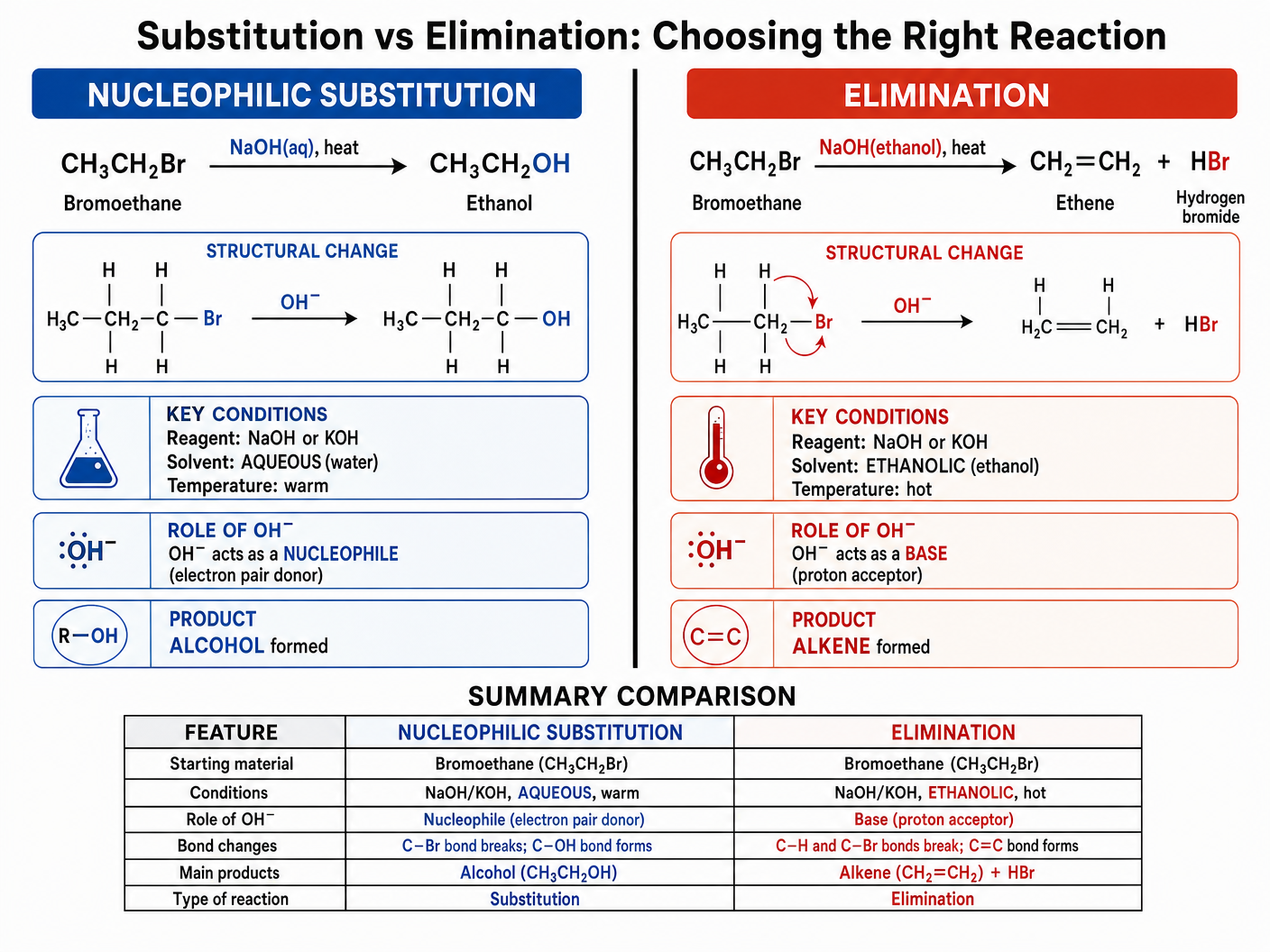
Under different conditions, the hydroxide ion (OH^-) can act as a base (proton acceptor) rather than a nucleophile. It removes a hydrogen ion (H^+) from a carbon atom adjacent to the C-X bond. The electrons from the C-H bond form a carbon-carbon double bond, and the halide ion leaves.
Key Conditions:
- Reagent: NaOH or KOH
- Solvent: Ethanol (no water present)
- Conditions: Hot (reflux)
- Product: Alkene
Examiner Tip: The solvent is the critical difference! Aqueous = Substitution (Alcohol). Ethanolic = Elimination (Alkene).
Concept 3: Bond Enthalpy and Reactivity
The rate of reaction of halogenoalkanes depends on the strength of the carbon-halogen bond (bond enthalpy), NOT the polarity of the bond.
- C-F bond: Strongest bond (highest bond enthalpy). Fluoroalkanes are the least reactive.
- C-I bond: Weakest bond (lowest bond enthalpy). Iodoalkanes are the most reactive.
Reactivity Trend: Iodoalkanes > Bromoalkanes > Chloroalkanes > Fluoroalkanes.
Concept 4: Ozone Depletion by CFCs
Chlorofluorocarbons (CFCs) were widely used as refrigerants and propellants because they are unreactive under normal conditions. However, in the upper atmosphere, UV radiation provides enough energy to break the C-Cl bond homolytically, forming chlorine radicals (Cl\bullet).
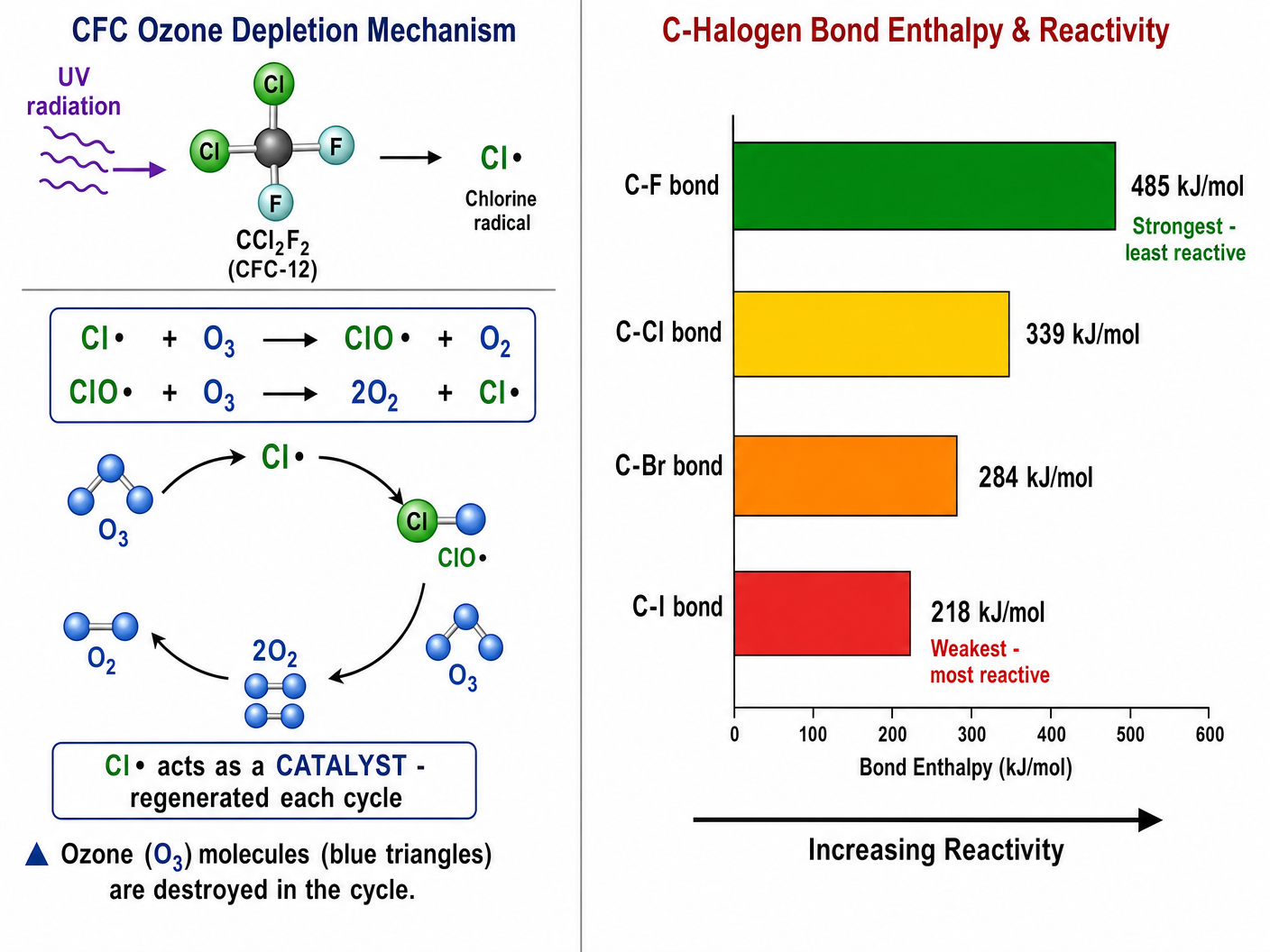
These chlorine radicals act as catalysts in the breakdown of ozone (O_3) into oxygen (O_2).
The Catalytic Cycle:
- Cl\bullet + O_3 \rightarrow ClO\bullet + O_2
- ClO\bullet + O_3 \rightarrow 2O_2 + Cl\bullet
Overall equation: 2O_3 \rightarrow 3O_2
The chlorine radical is regenerated, meaning a single CFC molecule can destroy thousands of ozone molecules.
Practical Applications
**Testing the Rate of Hydrolysis (Required Practical Context)**You can compare the reactivity of different halogenoalkanes by hydrolysing them in the presence of silver nitrate solution (AgNO_3(aq)). The water acts as a weak nucleophile.
RX + H_2O \rightarrow ROH + H^+ + X^-
As the halide ions (X^-) are produced, they react with the silver ions (Ag^+) to form a precipitate of silver halide (AgX).
- Iodoalkane: Yellow precipitate (AgI) forms rapidly.
- Bromoalkane: Cream precipitate (AgBr) forms slower.
- Chloroalkane: White precipitate (AgCl) forms very slowly.
This proves experimentally that the C-I bond breaks most easily.
Podcast Episode
Listen to our 10-minute deep dive on Halogenoalkanes for expert tips and a quick-fire recall quiz!
Visual Resources
3 diagrams and illustrations
Interactive Diagrams
2 interactive diagrams to visualise key concepts
Conceptual Flow Outline
Flowchart showing how reaction conditions determine whether substitution or elimination occurs.
Conceptual Flow Outline
Summary of bond enthalpy and reactivity trends.
Worked Examples
3 detailed examples with solutions and examiner commentary
Practice Questions
Test your understanding — click to reveal model answers
State the reagent and conditions required to convert 1-bromobutane into butanenitrile.
Hint: Think about how to add a carbon atom to the chain.
Explain why chlorofluorocarbons (CFCs) are damaging to the ozone layer. Include relevant equations in your answer.
Hint: What does UV light do to the C-Cl bond? How does the resulting species react with ozone?
A student reacts 2-bromo-2-methylpropane with hot ethanolic potassium hydroxide. Name the mechanism, state the role of the hydroxide ion, and draw the structure of the organic product.
Hint: Look closely at the solvent. What type of reaction happens in ethanol?
Compare the rates of hydrolysis of 1-chlorobutane, 1-bromobutane, and 1-iodobutane. Explain your answer.
Hint: Which bond is the strongest? Which is the weakest?
When 1-bromopropane reacts with ammonia, the product is propan-1-amine. Why must excess ammonia be used?
Hint: What happens to the HBr produced in the reaction?