Study Notes
Overview
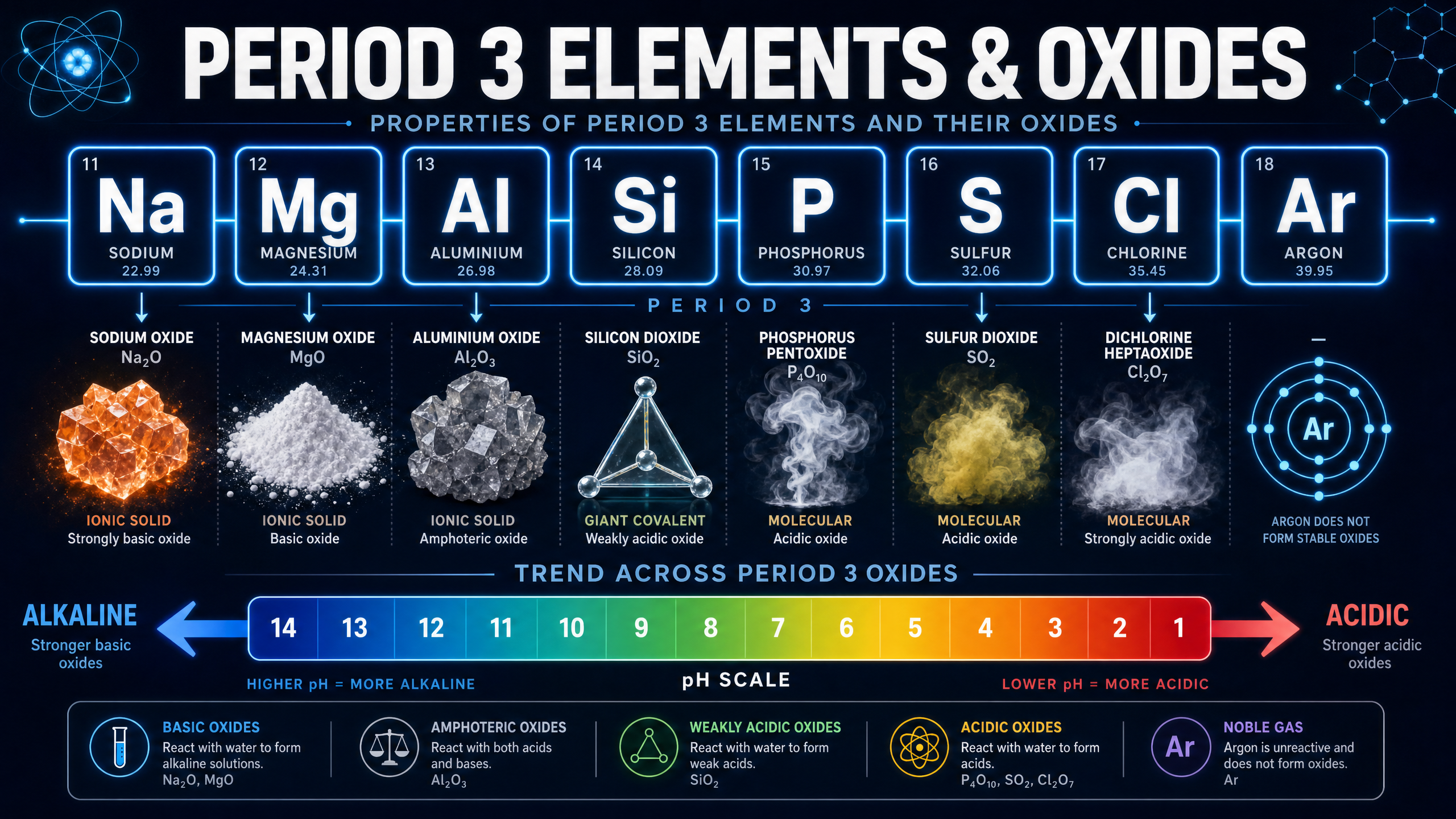
This topic explores the physical and chemical properties of the Period 3 elements (Sodium to Argon) and their oxides. It is a fundamental part of A-Level Chemistry because it perfectly illustrates how atomic structure and bonding dictate macroscopic properties. You will learn to explain the dramatic changes in melting points across the period and the shift from basic to acidic behaviour in the oxides.
Examiners frequently test this topic through long-answer (6-mark) questions requiring you to link structure, bonding, and energy. You must also be prepared to write perfectly balanced equations for the reactions of oxides with water, acids, and alkalis. Understanding this topic is crucial as it builds upon your knowledge of atomic structure, periodicity, and acid-base equilibria.
Key Concepts
Concept 1: Reactions of Period 3 Elements with Water
The reactivity of Period 3 elements with water decreases across the period. Sodium reacts vigorously with cold water to form a strongly alkaline solution of sodium hydroxide and hydrogen gas. Magnesium reacts very slowly with cold water to form sparingly soluble magnesium hydroxide, but reacts rapidly with steam to form magnesium oxide and hydrogen.
Why does this happen? Sodium has a lower first ionisation energy than magnesium. It loses its single outer electron more easily than magnesium loses its two outer electrons, making it more reactive.
Example:
2Na_{(s)} + 2H_2O_{(l)} \rightarrow 2NaOH_{(aq)} + H_{2(g)} (pH 13-14)
$Mg_{(s)} + 2H_2O_{(l)} \rightarrow Mg(OH){2(aq)} + H{2(g)}$ (pH 9-10)
Mg_{(s)} + H_2O_{(g)} \rightarrow MgO_{(s)} + H_{2(g)}
Concept 2: Formation of Period 3 Oxides
The elements from sodium to sulfur react with oxygen to form oxides. The highest oxidation states are usually achieved, corresponding to the group number.
- Sodium burns with a yellow flame: 4Na + O_2 \rightarrow 2Na_2O
- Magnesium burns with a brilliant white flame: 2Mg + O_2 \rightarrow 2MgO
- Aluminium burns brightly: 4Al + 3O_2 \rightarrow 2Al_2O_3
- Silicon burns when heated strongly: Si + O_2 \rightarrow SiO_2
- Phosphorus burns with a white flame producing white smoke: P_4 + 5O_2 \rightarrow P_4O_{10}
- Sulfur burns with a blue flame: S + O_2 \rightarrow SO_2
Concept 3: Reactions of Oxides with Water
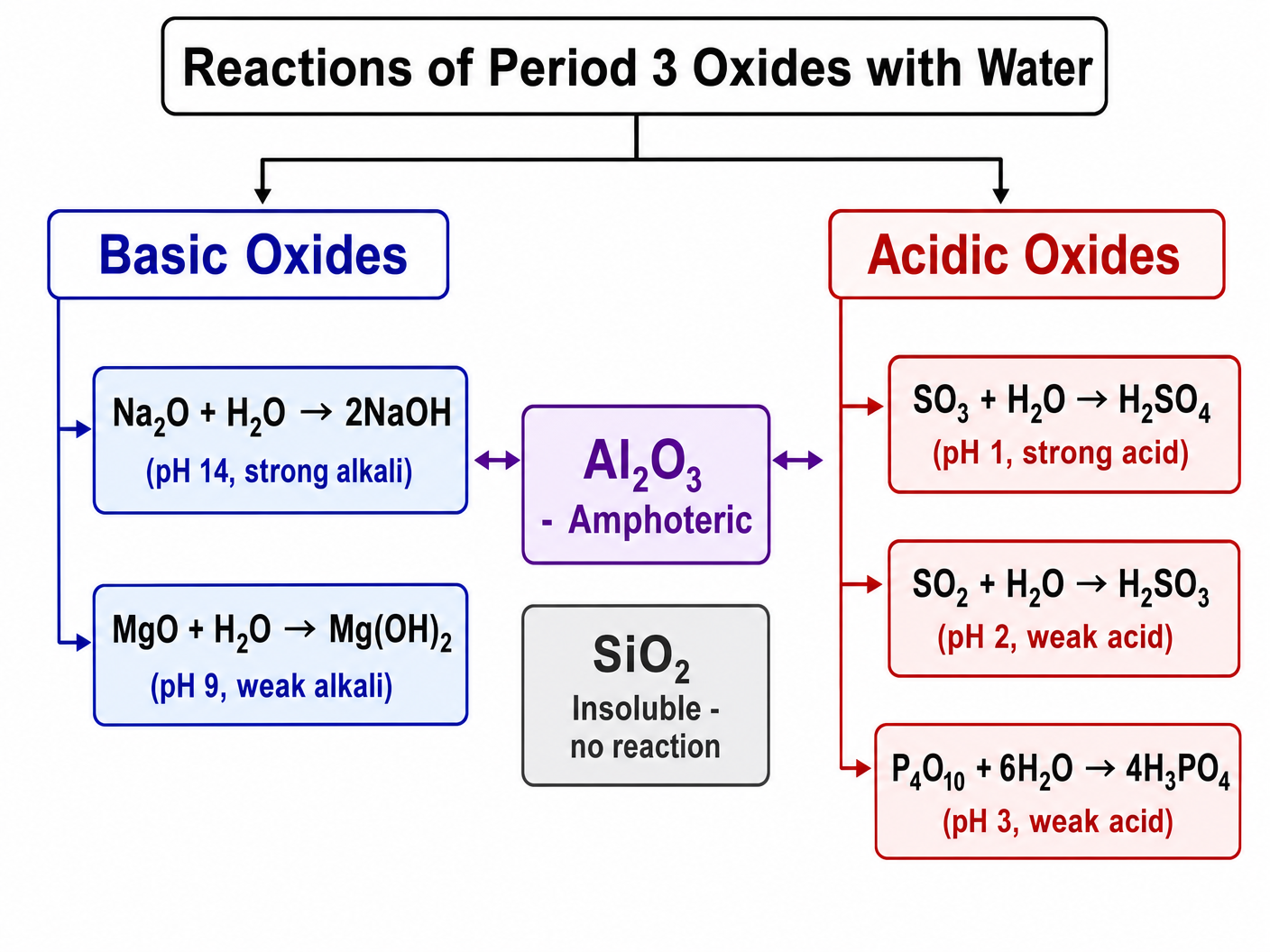
The acid-base nature of the oxides changes from basic to amphoteric to acidic across the period. This is directly related to their bonding. Ionic oxides (Na, Mg) contain O^{2-} ions which act as strong bases, accepting protons from water to form hydroxide ions. Covalent oxides (P, S) react with water to form acidic solutions.
- Basic Oxides: Na_2O reacts vigorously to form NaOH (pH 14). MgO reacts sparingly to form Mg(OH)_2 (pH 9).
- Amphoteric Oxide: Al_2O_3 is insoluble in water.
- Acidic Oxides: P_4O_{10} reacts vigorously to form H_3PO_4 (pH 1-2). SO_2 forms weak H_2SO_3 (pH 2-3). SO_3 forms strong H_2SO_4 (pH 0-1).
- Insoluble: SiO_2 is a giant covalent macromolecule and does not react with or dissolve in water.
Concept 4: Amphoteric Behaviour of Aluminium Oxide
Aluminium oxide (Al_2O_3) is amphoteric, meaning it reacts with both acids and bases. This is a classic exam question.
Reacting as a base (with acid):
Al_2O_3 + 6HCl \rightarrow 2AlCl_3 + 3H_2O
Reacting as an acid (with hot concentrated alkali):
Al_2O_3 + 2NaOH + 3H_2O \rightarrow 2NaAl(OH)_4
(Forms sodium tetrahydroxoaluminate)
Concept 5: Melting Point Trends Across Period 3
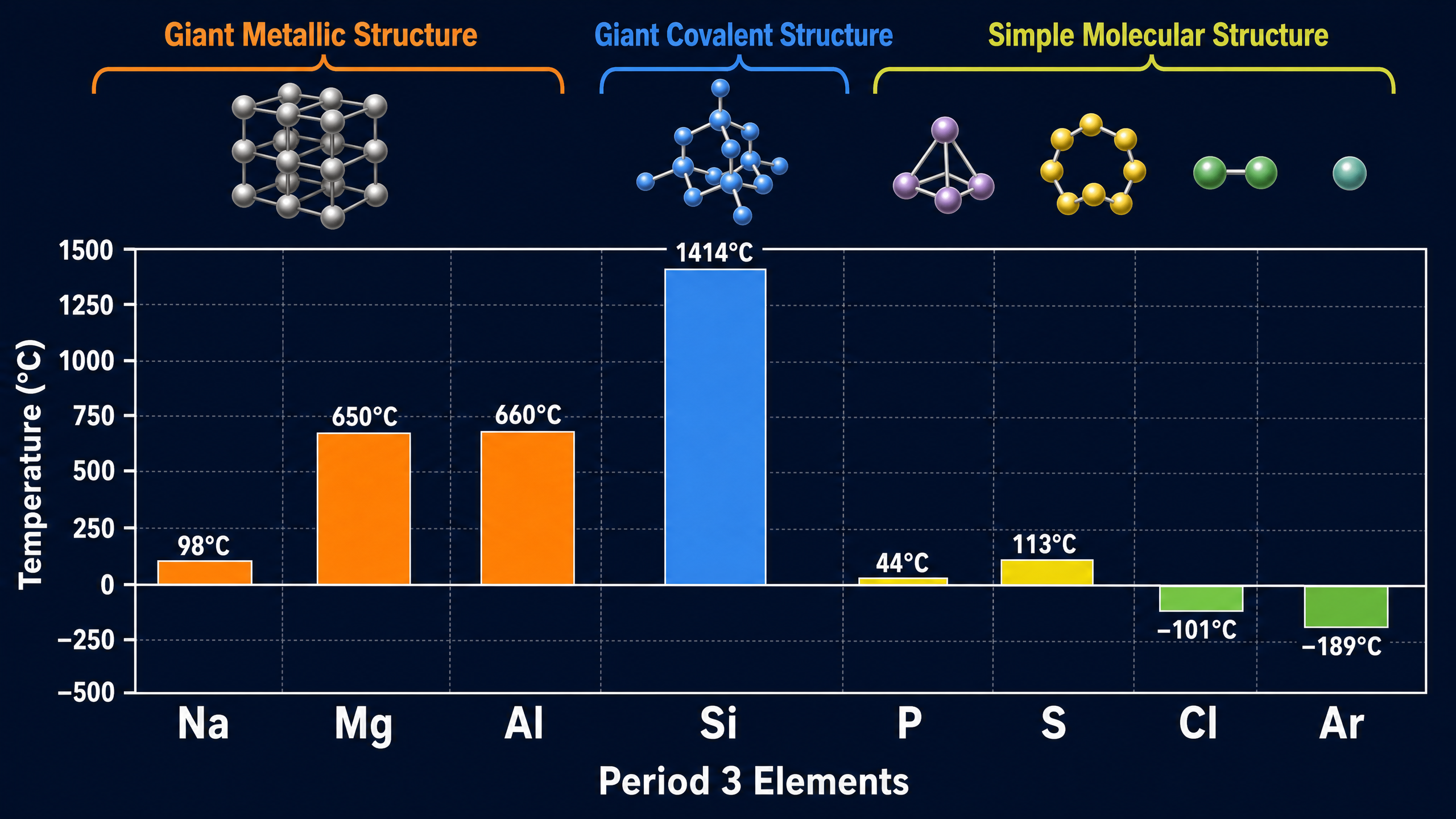
The melting points across Period 3 depend entirely on the structure and bonding of the elements.
- Na, Mg, Al (Giant Metallic): Melting points increase from Na to Al. The charge on the metal ion increases (+1 to +3) and the number of delocalised electrons per atom increases. This leads to stronger metallic bonding, requiring more energy to break.
- Si (Giant Covalent): Has the highest melting point. It forms a macromolecular structure with strong covalent bonds between all atoms, requiring massive amounts of energy to break.
- P, S, Cl, Ar (Simple Molecular/Atomic): Have low melting points as only weak van der Waals forces exist between molecules. The melting point depends on the size of the molecule: S_8 > P_4 > Cl_2 > Ar. Larger molecules have stronger van der Waals forces.
Listen to the A-Level Chemistry Unlocked podcast episode for a full audio review of this topic.
Mathematical/Scientific Relationships
There are no specific mathematical formulas to calculate for this topic, but you must be able to balance complex chemical equations. Always check that both the number of atoms and the overall charge are balanced on both sides of the equation.
Practical Applications
- Magnesium Hydroxide: Used as an antacid (milk of magnesia) to neutralise excess stomach acid because it is a weak alkali and safe to ingest.
- Silicon Dioxide: The main component of sand and quartz, used extensively in making glass and ceramics due to its high melting point and unreactive nature.
- Sulfur Dioxide: Used in the Contact Process to manufacture sulfuric acid, one of the most important industrial chemicals globally.
Visual Resources
2 diagrams and illustrations
Interactive Diagrams
2 interactive diagrams to visualise key concepts
Conceptual Flow Outline
Flowchart showing the relationship between bonding type and acid-base character in Period 3 oxides.
Conceptual Flow Outline
Summary of Period 3 oxide reactions with water and resulting pH.
Worked Examples
3 detailed examples with solutions and examiner commentary
Practice Questions
Test your understanding — click to reveal model answers
Write an equation for the reaction of sulfur trioxide with water and state the pH of the resulting solution. (2 marks)
Hint: Sulfur trioxide produces a strong diprotic acid.
Explain why the melting point of sulfur (S8) is higher than that of phosphorus (P4). (2 marks)
Hint: Think about the size of the molecules and the forces between them.
Silicon dioxide and phosphorus(V) oxide are both covalent oxides. Explain why silicon dioxide is a solid with a high melting point, whereas phosphorus(V) oxide is a solid with a relatively low melting point. (4 marks)
Hint: Compare their exact structure types (giant vs simple).
Sodium oxide forms a solution with a higher pH than magnesium oxide when added to water. Explain why. (2 marks)
Hint: Consider the solubility of the products formed.
Write an equation for the reaction of silicon dioxide with hot concentrated sodium hydroxide. (1 mark)
Hint: It forms a silicate salt.