AQA · GCSE · Chemistry
Energy changes
Master the critical differences between exothermic and endothermic reactions, learn to interpret reaction profiles, and calculate bond energies. This topic is a guaranteed mark-earner if you understand the direction of energy transfer.
- 7 min read
- 3 worked examples
- 5 practice questions
- 6 key terms
Study Notes
Overview
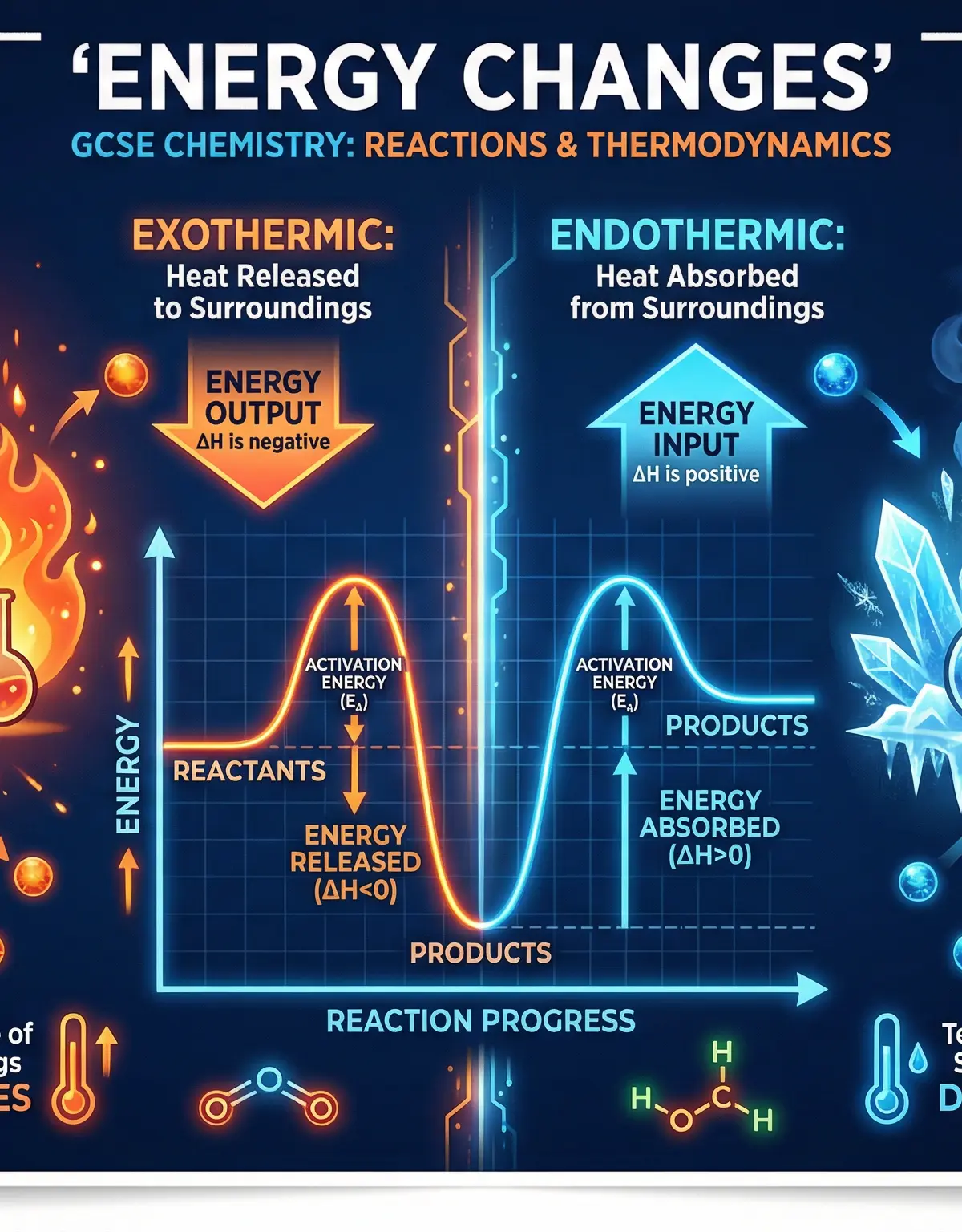
Welcome to Energy Changes (Topic 4.5), a fundamental area of GCSE Chemistry. Every chemical reaction involves an energy transfer—energy is never created or destroyed, only moved between the reacting chemicals and their surroundings. Understanding whether a reaction releases heat (exothermic) or absorbs heat (endothermic) is crucial not just for passing your exams, but for understanding real-world applications like hand warmers, sports injury packs, and hydrogen fuel cells.
Examiners love this topic because it tests multiple skills: your ability to recall definitions, interpret graphical data (reaction profiles), and perform multi-step calculations (bond energies). It also links heavily to rates of reaction and equilibrium. Let's break down the core concepts so you can secure maximum marks.
Key Concepts
Concept 1: Exothermic and Endothermic Reactions
In chemistry, we divide the universe into two parts: the system (the reacting chemicals) and the surroundings (everything else, including the test tube, the air, and the thermometer).
An exothermic reaction is one that transfers energy to the surroundings. Because energy is leaving the system and entering the surroundings, the temperature of the surroundings increases.
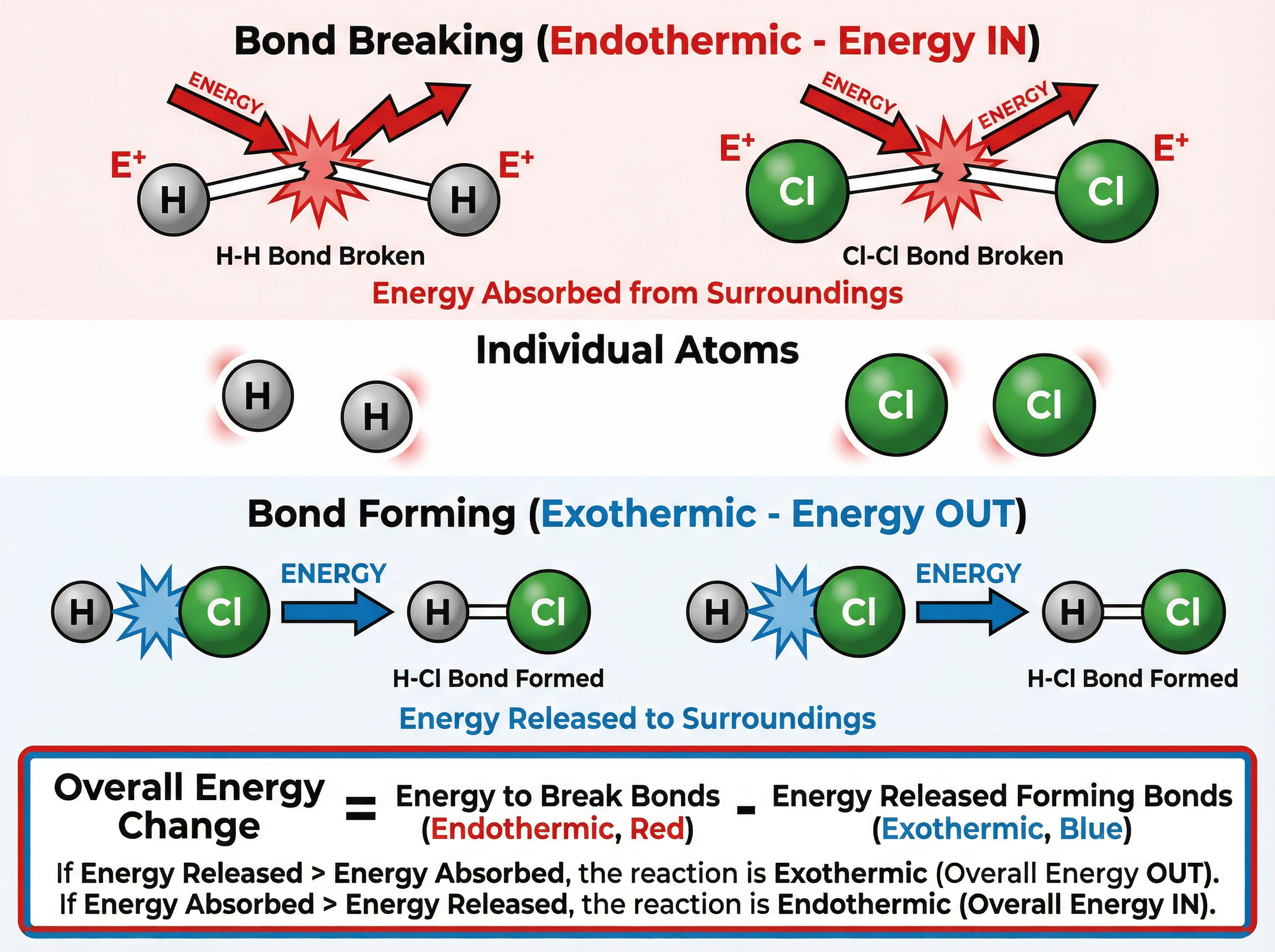
Why does this happen? During a chemical reaction, old bonds are broken and new bonds are formed. In an exothermic reaction, the energy released when new bonds are formed is greater than the energy required to break the old bonds. The 'spare' energy is released as heat.
Example: Combustion of methane (CH₄ + 2O₂ → CO₂ + 2H₂O). When you light a Bunsen burner, you are performing an exothermic reaction. The heat you feel is the energy being transferred to the surroundings.
An endothermic reaction is one that takes in energy from the surroundings. Because energy is entering the system from the surroundings, the temperature of the surroundings decreases.
Why does this happen? In an endothermic reaction, the energy required to break the old bonds is greater than the energy released when new bonds are formed. The system must pull in extra energy from its environment to make the reaction happen.
Example: The reaction between citric acid and sodium hydrogencarbonate. If you mix these in a test tube, the tube will feel freezing cold to the touch as it absorbs heat from your hand.
Concept 2: Reaction Profiles
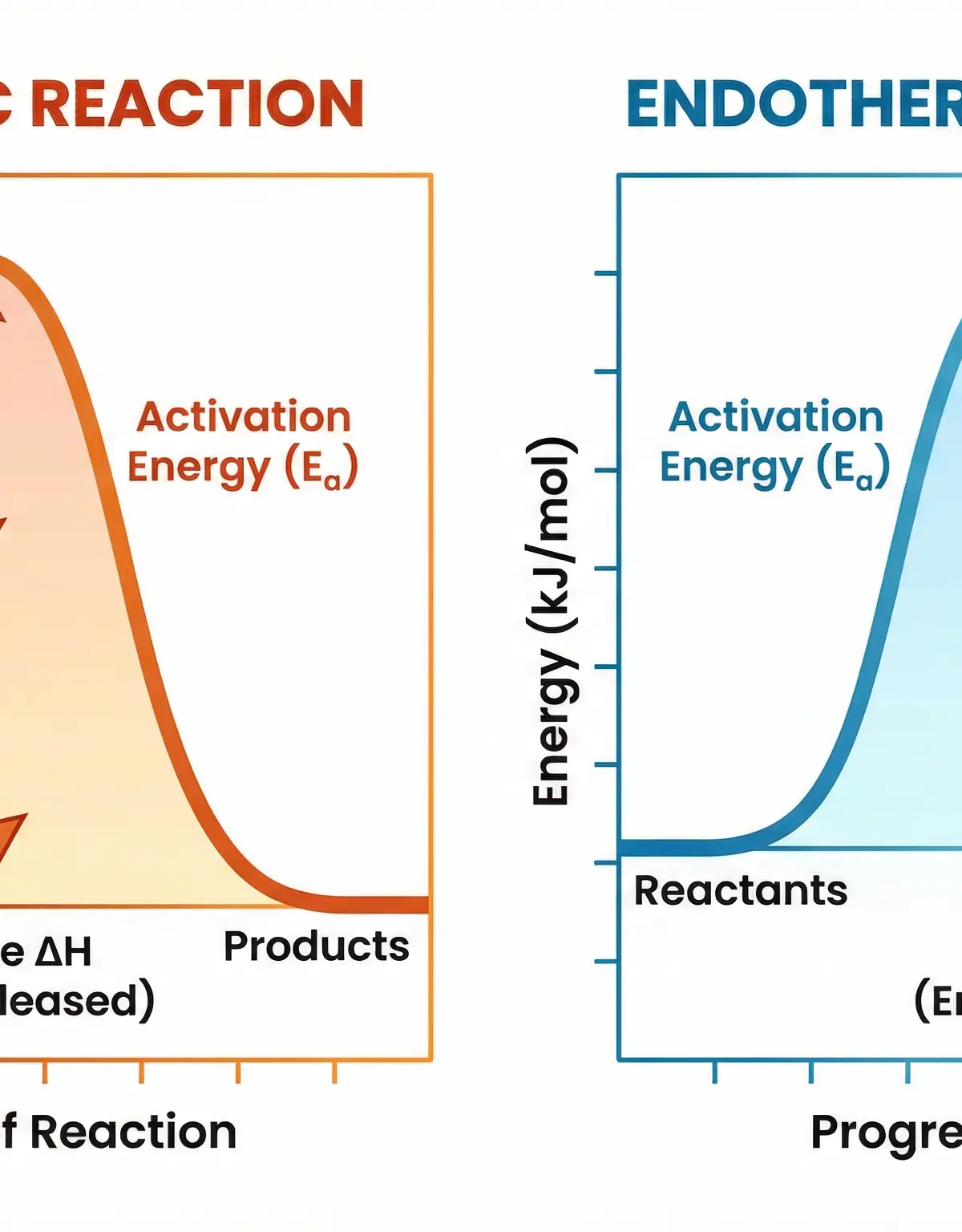
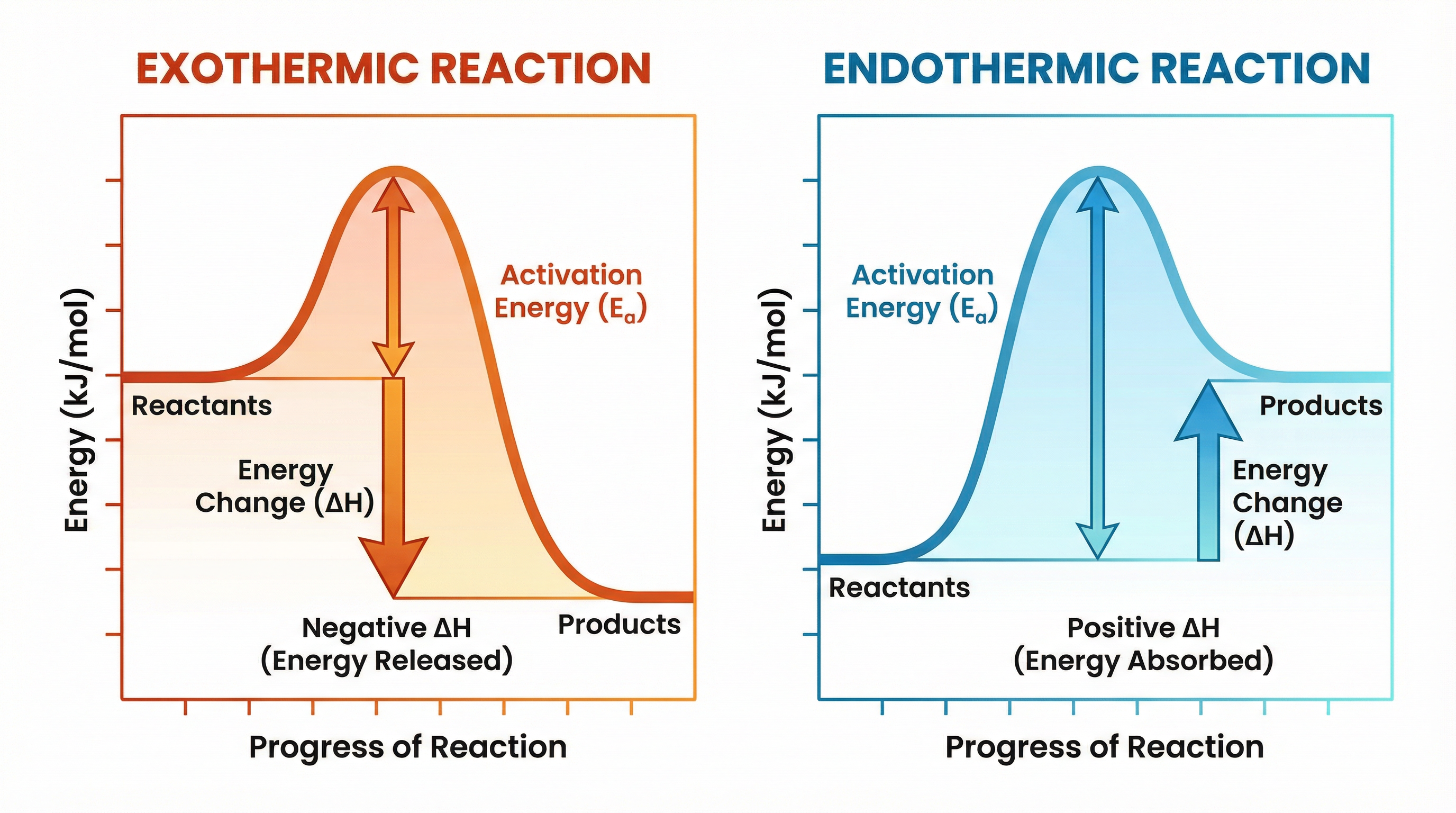
Reaction profiles (or energy level diagrams) are graphs that show the relative energies of reactants and products, the activation energy, and the overall energy change of a reaction.
- Reactants and Products: The horizontal lines represent the energy of the chemicals.
- Activation Energy (Ea): This is the minimum amount of energy that particles must have to react when they collide. It is represented by the 'hump' or curve on the graph. Crucial Examiner Tip: The activation energy arrow MUST start from the reactants line and go straight up to the peak of the curve.
- Overall Energy Change (ΔH): This is the difference in energy between the reactants and the products.
For an exothermic profile, the products are at a lower energy level than the reactants. The overall energy change is negative (energy has been lost to the surroundings).
For an endothermic profile, the products are at a higher energy level than the reactants. The overall energy change is positive (energy has been gained from the surroundings).
Concept 3: Bond Energy Calculations
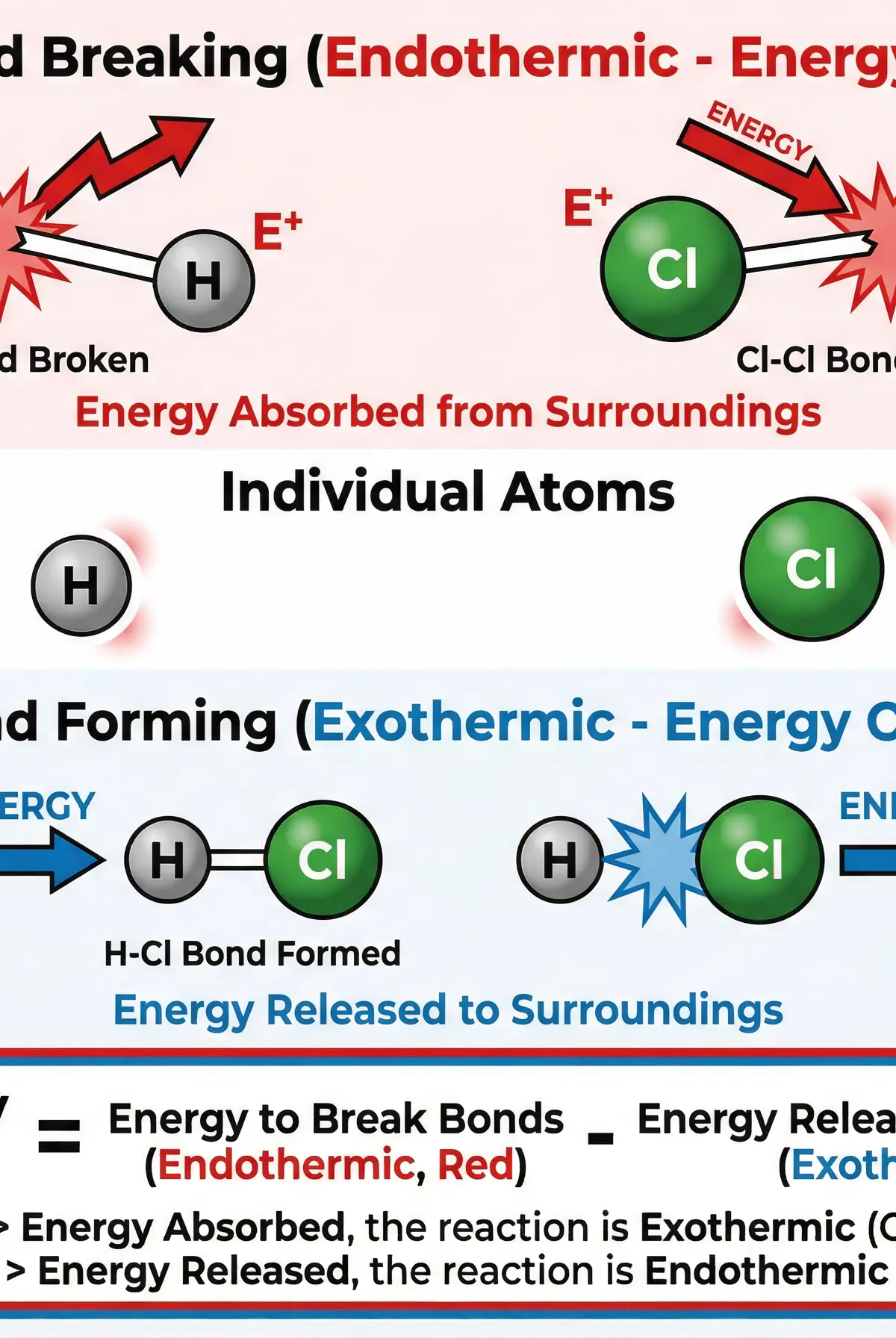
To calculate the overall energy change for a reaction, you need to use bond energies. A bond energy is the amount of energy required to break one mole of a particular covalent bond.
The Golden Rule:
- Breaking bonds is Endothermic (requires energy IN).
- Making bonds is Exothermic (releases energy OUT).
The Formula:
Overall Energy Change = Total Energy to Break Bonds - Total Energy Released Forming Bonds
If the final answer is negative, the reaction is exothermic. If positive, it is endothermic.
Concept 4: Chemical Cells and Fuel Cells (Higher Tier / Chemistry Only)
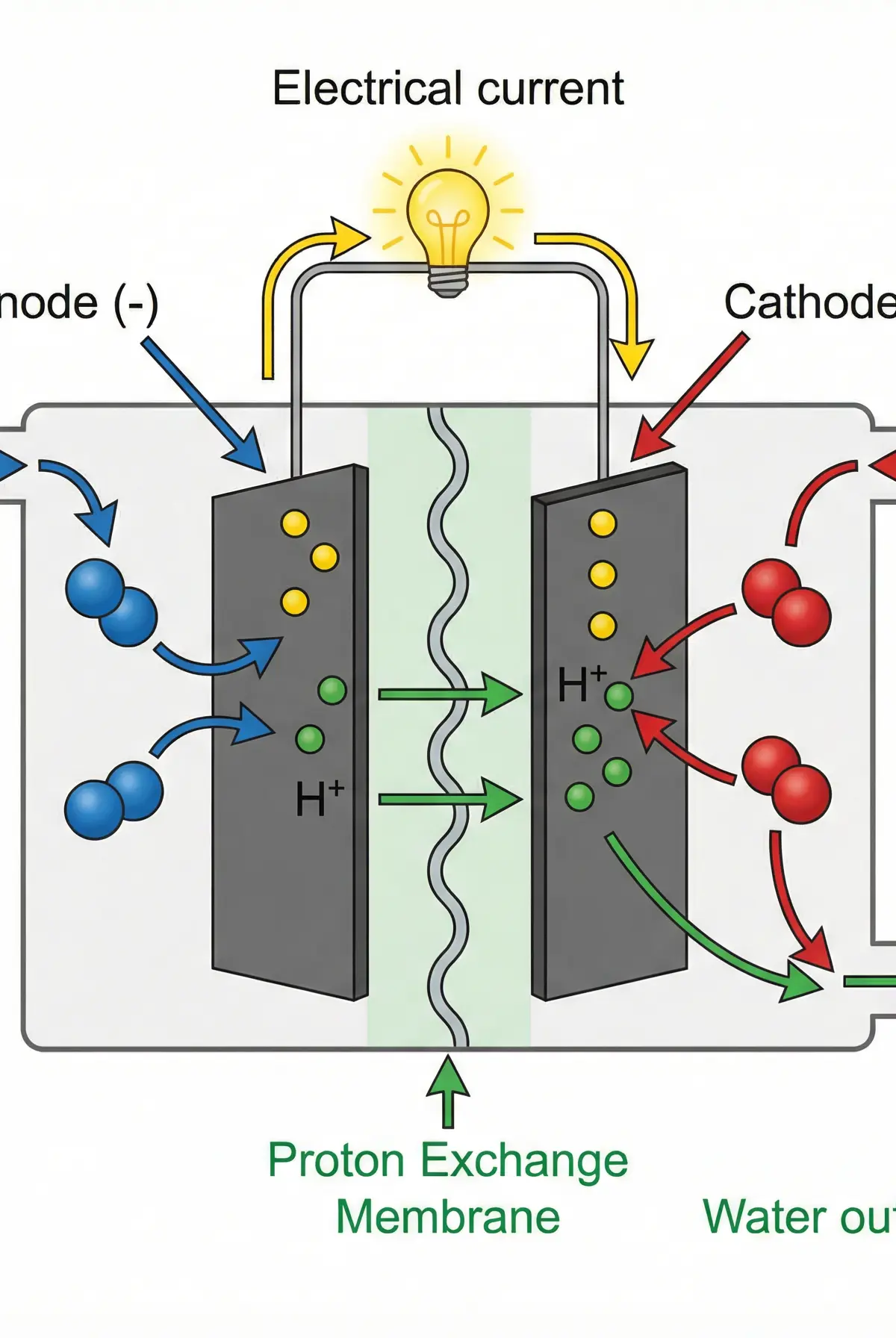
Cells and batteries use chemical reactions to produce electricity. A simple cell can be made by placing two different metals (electrodes) into a liquid that conducts electricity (an electrolyte). The difference in reactivity between the two metals creates a voltage.
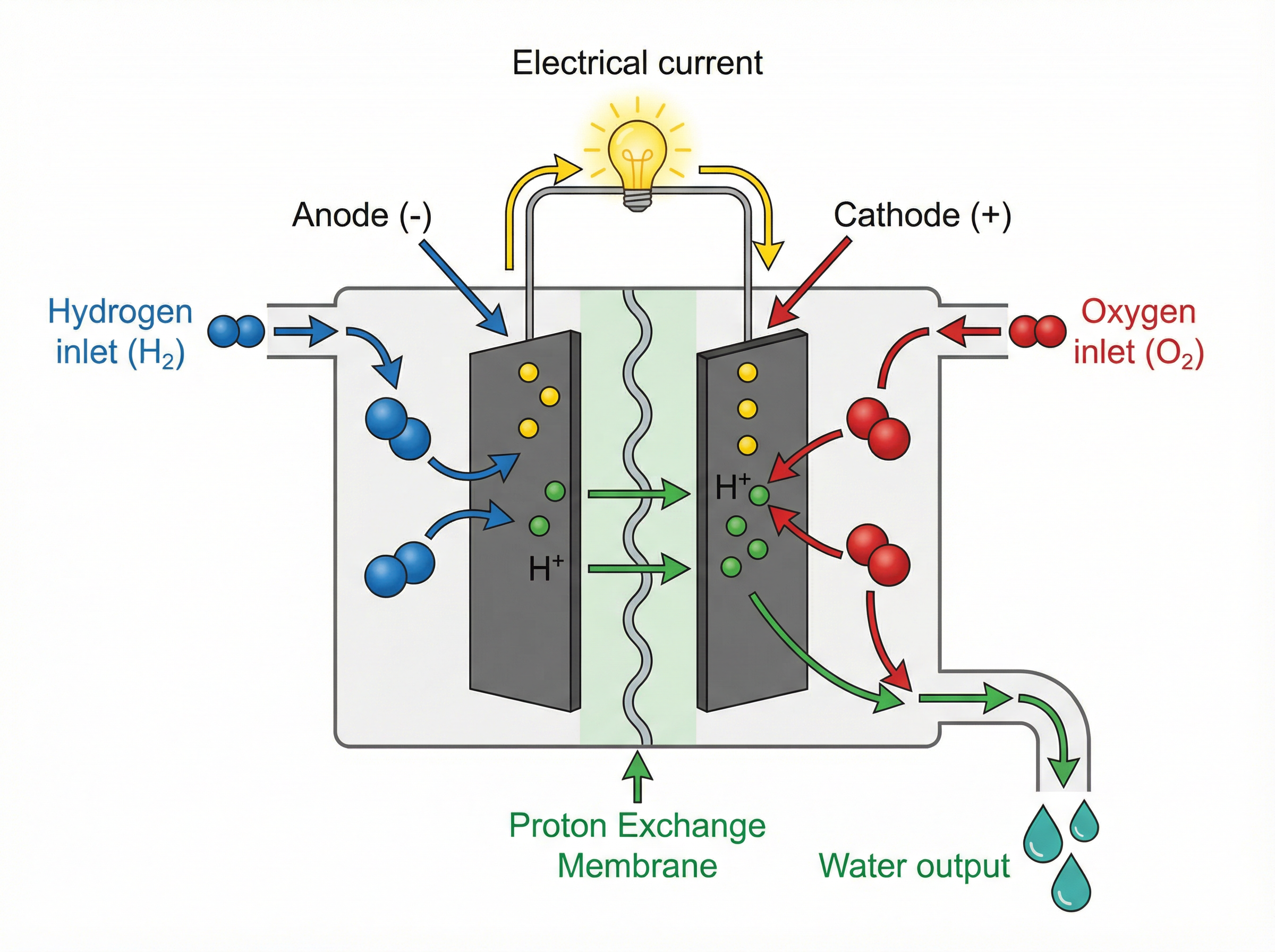
A hydrogen fuel cell is a special type of cell that uses hydrogen and oxygen to generate electricity.
- At the anode (negative electrode), hydrogen molecules are oxidised (lose electrons) to form hydrogen ions (H⁺).
- The electrons flow through the external circuit to the cathode, creating the electrical current.
- The H⁺ ions move through the electrolyte to the cathode.
- At the cathode (positive electrode), oxygen reacts with the H⁺ ions and the electrons to form water.
The overall reaction is simply: 2H₂ + O₂ → 2H₂O. The only waste product is water, making them an environmentally friendly alternative to fossil fuels.
Listen to the Podcast
For a full audio review of this topic, listen to our 10-minute revision podcast:
Mathematical/Scientific Relationships
Overall Energy Change (ΔH) = Energy to Break Bonds - Energy Released Forming Bonds
- Energy to Break Bonds: Sum of all bond energies for the reactants.
- Energy Released Forming Bonds: Sum of all bond energies for the products.
- Units: kJ/mol (kilojoules per mole).
- Sign: A negative (-) result means exothermic. A positive (+) result means endothermic.
Practical Applications
Required Practical: Temperature Changes
Aim: To investigate the variables that affect temperature changes in reacting solutions (e.g., acid plus alkali).
Method:
- Measure 30 cm³ of dilute hydrochloric acid and transfer it to a polystyrene cup.
- Stand the cup inside a beaker. This provides insulation and stability.
- Use a thermometer to measure the initial temperature of the acid.
- Measure 5 cm³ of sodium hydroxide solution and pour it into the cup.
- Fit a lid with a hole on the cup and gently stir the solution with the thermometer through the hole.
- Record the highest temperature reached.
- Repeat steps 4-6, adding a further 5 cm³ of sodium hydroxide each time, until a total of 40 cm³ has been added.
- Repeat the whole experiment and calculate mean maximum temperatures.
Examiner Focus: Examiners frequently ask why a polystyrene cup and lid are used. The answer is to reduce heat loss to the surroundings, ensuring the temperature reading is as accurate as possible.
Visual Resources
3 diagrams and illustrations
Interactive Diagrams
2 interactive diagrams to visualise key concepts
Conceptual Flow Outline
Flowchart for identifying reaction types from temperature data.
Conceptual Flow Outline
The two-step process of chemical reactions involving bond breaking and bond forming.
Worked Examples
3 worked examples — open one to explore the question and available guidance.
Practice Questions
Test your understanding — click to reveal model answers
A student mixes two colourless liquids. The temperature of the mixture drops from 20°C to 14°C. State the type of reaction that has occurred and explain why the temperature dropped.
Hint: Think about the 'EX exits, EN enters' rule. If the surroundings (the thermometer) got colder, where did the heat go?
Draw a fully labelled reaction profile for an exothermic reaction. You must include labels for the axes, reactants, products, activation energy, and overall energy change.
Hint: For exothermic, do the products have more or less energy than the reactants?
Methane reacts with oxygen: CH₄ + 2O₂ → CO₂ + 2H₂O.
Bond energies (kJ/mol): C-H = 413, O=O = 498, C=O = 805, O-H = 464.
Calculate the overall energy change for this reaction.
Hint: Draw out the full displayed structures first. CH4 has four C-H bonds. 2O2 means two O=O bonds. CO2 has two C=O bonds. 2H2O means four O-H bonds in total.
Explain, in terms of bond breaking and bond forming, why the combustion of methane is an exothermic reaction.
Hint: Compare the amount of energy needed to break the bonds with the amount of energy released when forming the new bonds.
Write the half-equation for the reaction that occurs at the anode (negative electrode) in a hydrogen fuel cell.
Hint: Hydrogen gas enters the anode. What does it turn into, and what does it lose in the process?
Test your understanding of Energy changes
Active recall beats re-reading. Take an instant quiz now to test what you’ve learned and lock it into long-term memory.
7 days Premium · Then free forever · No card, no charge