AQA · GCSE · Chemistry
The rate and extent of chemical change
Master the rate and extent of chemical change, from calculating reaction speeds to predicting equilibrium shifts. This core GCSE Chemistry topic teaches you how to control chemical reactions—a vital skill for both your exams and the chemical industry.
- 7 min read
- 3 worked examples
- 5 practice questions
- 6 key terms
Study Notes
Overview
This topic is all about the speed of chemical reactions and how far they go before stopping. In the chemical industry, time is money. Understanding how to make reactions happen faster (the rate of reaction) and how to maximise the amount of product formed (the extent of reaction) is crucial for manufacturing everything from fertilisers to pharmaceuticals.
In this topic, you will learn how to measure the rate of a reaction, how to interpret rate graphs, and how factors like temperature, concentration, pressure, and surface area affect reaction speed. We will explain these effects using Collision Theory. You will also explore the role of catalysts in providing alternative reaction pathways. For Higher Tier candidates, the second half of this topic introduces reversible reactions, dynamic equilibrium, and Le Chatelier's Principle, which allows you to predict how changing conditions will shift the position of equilibrium.
Listen to our comprehensive audio guide for this topic below:
Key Concepts
Concept 1: Measuring Rate of Reaction
The rate of a chemical reaction tells us how fast the reactants are turned into products. We can measure this in two main ways: by measuring how quickly a reactant is used up, or how quickly a product is formed. For example, if a reaction produces a gas, we can measure the volume of gas produced over time using a gas syringe, or the loss in mass as the gas escapes.
Example: If 50 cm³ of hydrogen gas is produced in 20 seconds, the mean rate of reaction is 50 ÷ 20 = 2.5 cm³/s.
Concept 2: Collision Theory and Activation Energy
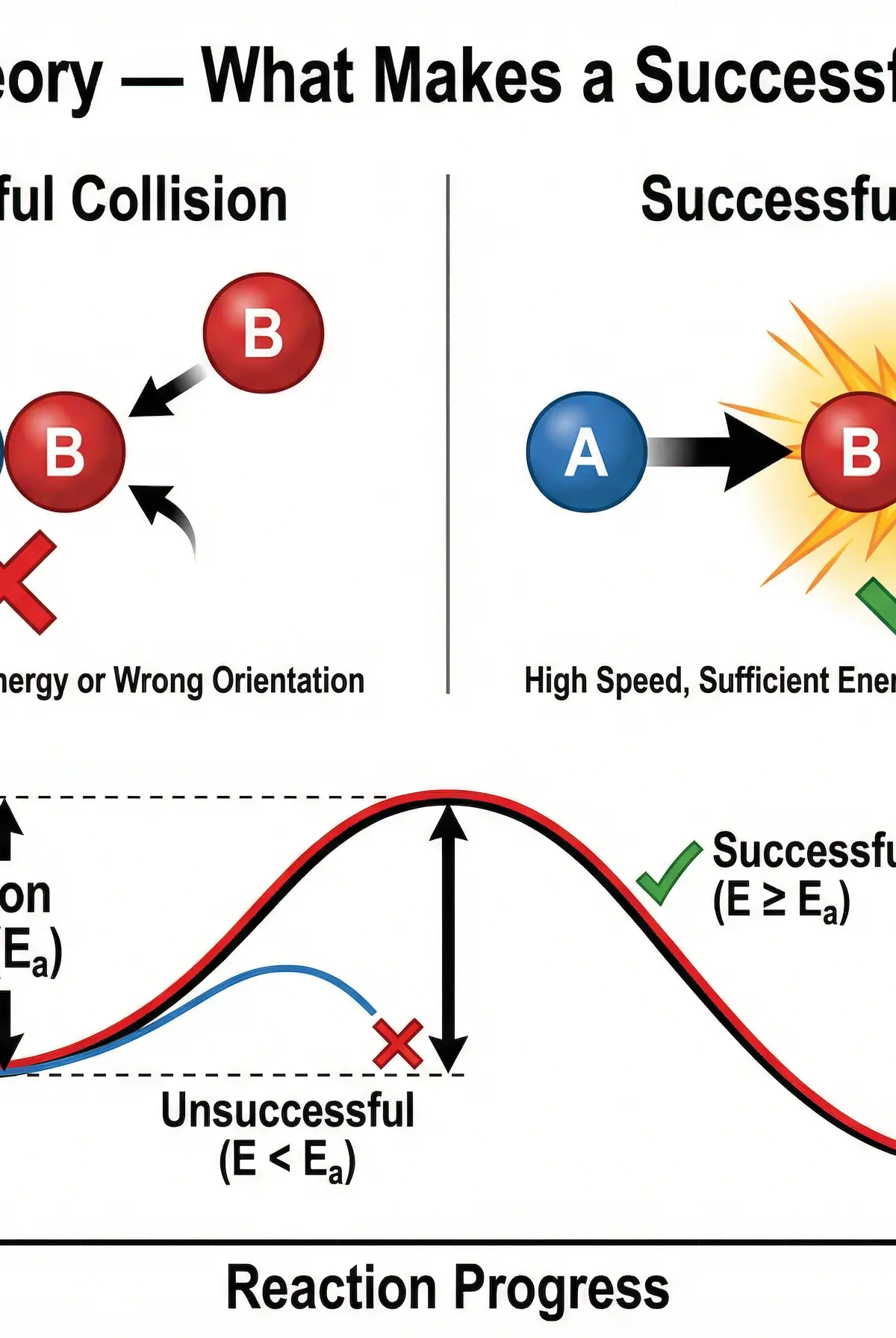
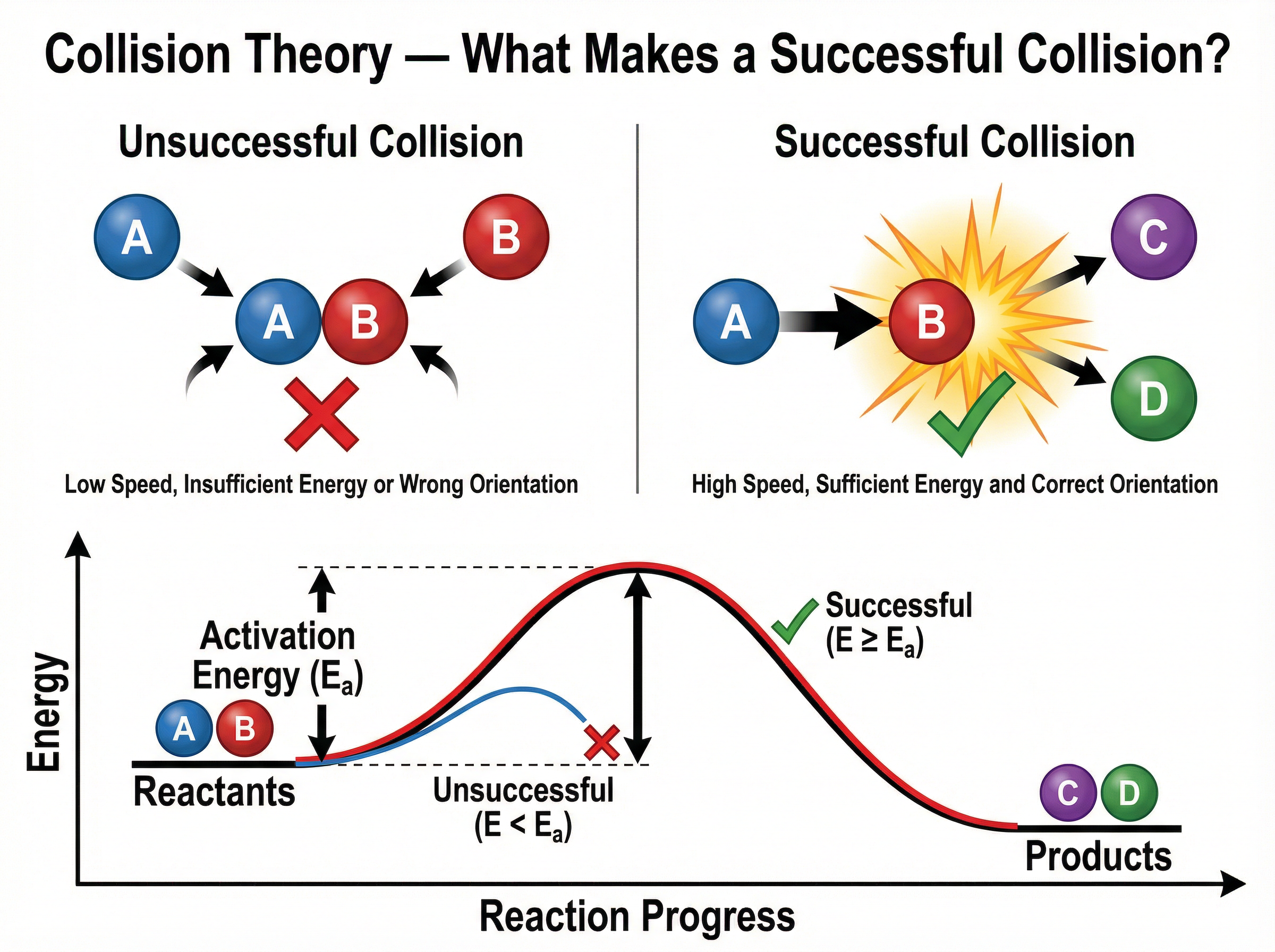
For a chemical reaction to occur, reactant particles must collide with each other. However, not all collisions result in a reaction. A successful collision requires two things:
- The particles must collide with the correct orientation.
- The particles must have enough energy to break existing bonds.
The minimum amount of energy that particles must have to react when they collide is called the activation energy. If particles collide with less energy than the activation energy, they simply bounce off each other without reacting.
Concept 3: Factors Affecting Rate of Reaction
Four main factors affect the rate of a chemical reaction. When explaining these in an exam, you must always refer to the frequency of successful collisions.
- Temperature: Increasing the temperature gives the particles more kinetic energy. They move faster, resulting in a higher frequency of collisions. More importantly, a higher proportion of the particles have energy greater than or equal to the activation energy, so a higher proportion of collisions are successful.
- Concentration/Pressure: Increasing the concentration of a solution, or the pressure of a reacting gas, means there are more particles in the same volume. This leads to a higher frequency of collisions.
- Surface Area: Breaking a solid reactant into smaller pieces increases its surface area to volume ratio. This means more particles are exposed at the surface and available to react, leading to a higher frequency of collisions.
- Catalysts: A catalyst is a substance that increases the rate of a chemical reaction without being used up itself. It does this by providing an alternative reaction pathway that has a lower activation energy. Because the activation energy is lower, a higher proportion of the reactant particles have enough energy to react when they collide.
Concept 4: Reversible Reactions and Dynamic Equilibrium (HT)
Some chemical reactions are reversible, meaning the products can react to produce the original reactants. This is represented by a double-headed arrow (⇌). If a reversible reaction is carried out in a closed system (where no reactants or products can escape), it will eventually reach dynamic equilibrium.
At dynamic equilibrium, the forward and reverse reactions are occurring at exactly the same rate. As a result, the concentrations of the reactants and products remain constant.
Concept 5: Le Chatelier's Principle (HT)
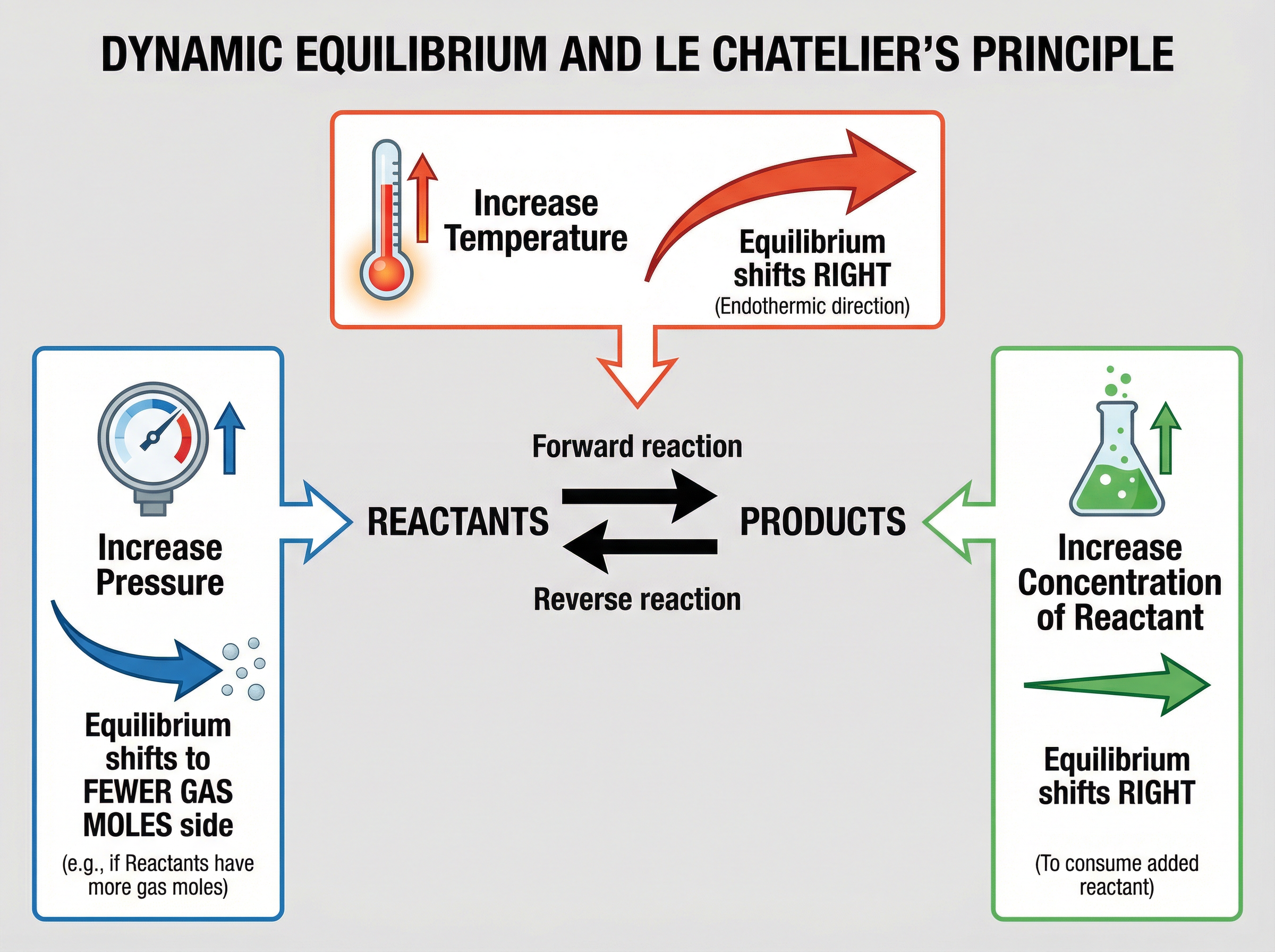
Le Chatelier's Principle states that if a change is made to the conditions of a system at equilibrium, the system will respond to counteract that change. We can use this to predict how the position of equilibrium will shift.
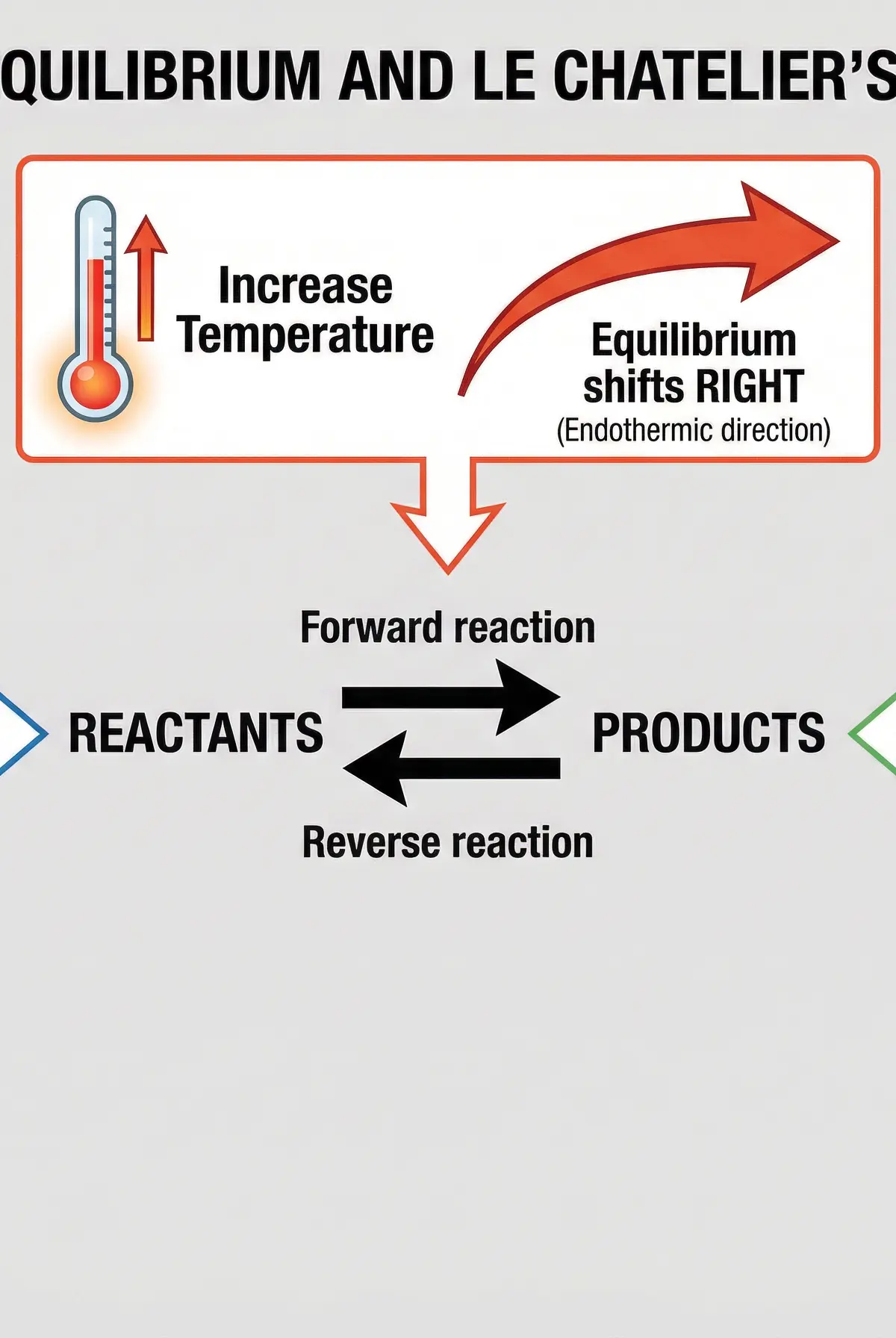
- Changing Concentration: If you increase the concentration of a reactant, the system will try to decrease it by making more product (equilibrium shifts to the right).
- Changing Temperature: If you increase the temperature, the system will try to decrease it by favouring the endothermic reaction. If you decrease the temperature, the system favours the exothermic reaction.
- Changing Pressure (for gases): If you increase the pressure, the system will try to decrease it by shifting to the side of the equation with the fewest moles of gas molecules.
Mathematical/Scientific Relationships
Mean Rate of Reaction
- Formula:
Mean rate of reaction = quantity of reactant used ÷ time taken - Formula:
Mean rate of reaction = quantity of product formed ÷ time taken - Units: g/s (mass), cm³/s (volume), or mol/s (moles - HT only)
- Must memorise
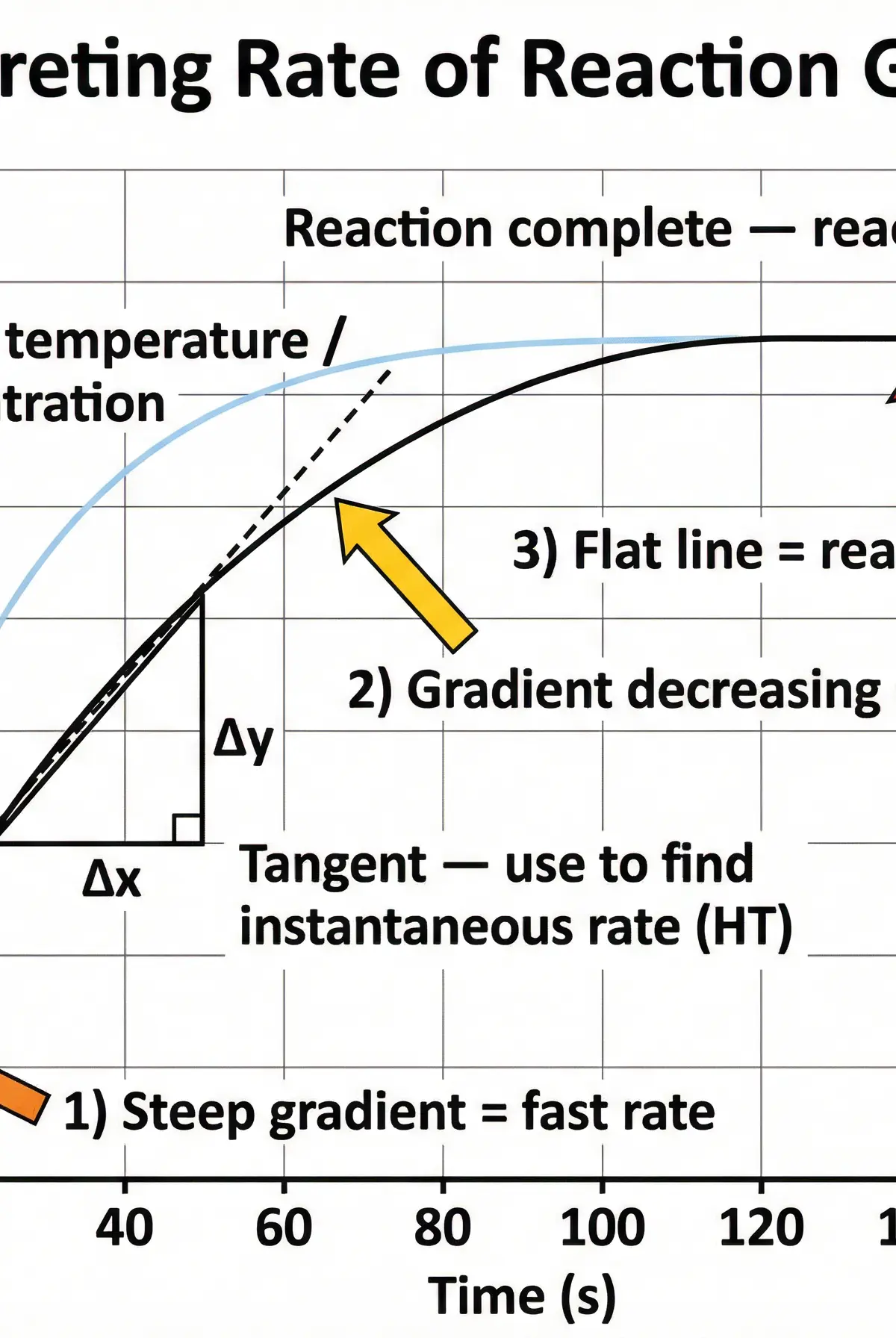
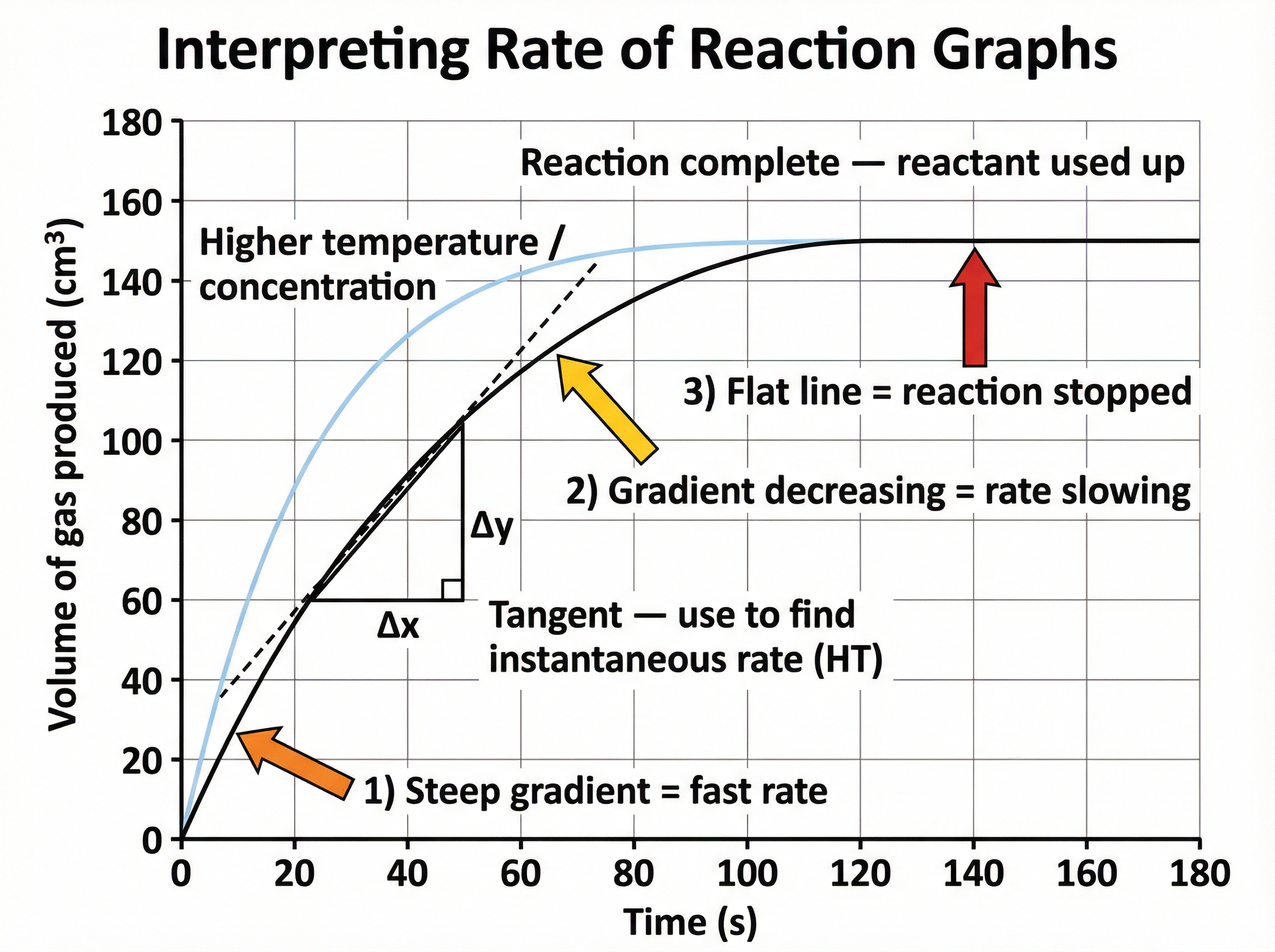
**Calculating Instantaneous Rate from a Graph (HT)**To find the rate at a specific time, you must draw a tangent to the curve at that time and calculate its gradient.
- Formula:
Gradient = change in y ÷ change in x
Practical Applications
Required Practical: Investigating the effect of concentration on rate of reactionThere are two common methods to investigate this:
-
Measuring the decreasing light transmission (Disappearing Cross):
- Method: React sodium thiosulfate with hydrochloric acid in a conical flask placed over a black cross. The reaction produces solid sulfur, making the solution turn cloudy.
- Measurement: Time how long it takes for the cross to disappear.
- Common Error: Judging exactly when the cross disappears is subjective and varies between individuals.
-
Measuring the volume of gas produced:
- Method: React magnesium ribbon with hydrochloric acid in a conical flask attached to a gas syringe (or inverted measuring cylinder in a water trough).
- Measurement: Record the volume of hydrogen gas produced at regular time intervals.
- Common Error: Gas escaping before the bung is placed on the flask.
In industry, the Haber Process is used to manufacture ammonia from nitrogen and hydrogen. This is a reversible reaction: N₂(g) + 3H₂(g) ⇌ 2NH₃(g). The forward reaction is exothermic. Industrial chemists must carefully choose the temperature and pressure to balance the rate of reaction with the yield of ammonia (the extent of reaction) while keeping costs down.
Visual Resources
3 diagrams and illustrations
Interactive Diagrams
2 interactive diagrams to visualise key concepts
Conceptual Flow Outline
Flowchart showing the requirements for a successful collision according to Collision Theory.
Conceptual Flow Outline
Summary of Le Chatelier's Principle and equilibrium shifts.
Worked Examples
3 worked examples — open one to explore the question and available guidance.
Practice Questions
Test your understanding — click to reveal model answers
A student investigates the reaction between magnesium and dilute hydrochloric acid. State two ways the student could increase the rate of this reaction. (2 marks)
Hint: Think about the state of the magnesium and the state of the acid.
Explain how a catalyst increases the rate of a reaction. (2 marks)
Hint: What does a catalyst do to the activation energy, and how does it do it?
The graph shows the volume of gas produced over time for a reaction. Explain why the line becomes horizontal after 40 seconds. (2 marks)
Hint: What happens to the reactants as the reaction progresses?
Nitrogen dioxide (NO₂) is a brown gas. It can react to form dinitrogen tetroxide (N₂O₄), which is a colourless gas. The equation is: 2NO₂(g) ⇌ N₂O₄(g). The forward reaction is exothermic. A sealed syringe contains a mixture of NO₂ and N₂O₄ at equilibrium. Explain what happens to the colour of the mixture if the syringe is placed in a hot water bath. (4 marks) (HT only)
Hint: Apply Le Chatelier's Principle for temperature. Which direction will the equilibrium shift, and what colour is on that side?
The Haber process uses a temperature of 450°C and a pressure of 200 atmospheres to produce ammonia: N₂(g) + 3H₂(g) ⇌ 2NH₃(g). The forward reaction is exothermic. Explain why a pressure of 200 atmospheres is used instead of 10 atmospheres. (3 marks) (HT only)
Hint: Look at the number of moles of gas on each side of the equation. How does pressure affect equilibrium and rate?
Test your understanding of The rate and extent of chemical change
Active recall beats re-reading. Take an instant quiz now to test what you’ve learned and lock it into long-term memory.
7 days Premium · Then free forever · No card, no charge