Pearson Edexcel · GCSE · Chemistry
Rates of reaction and energy changes
Master the speed of chemical reactions and the energy they release or absorb. This high-yield topic connects collision theory to real-world applications and guarantees marks for graphing and calculations.
- 7 min read
- 3 worked examples
- 5 practice questions
- 6 key terms
Study Notes
Overview
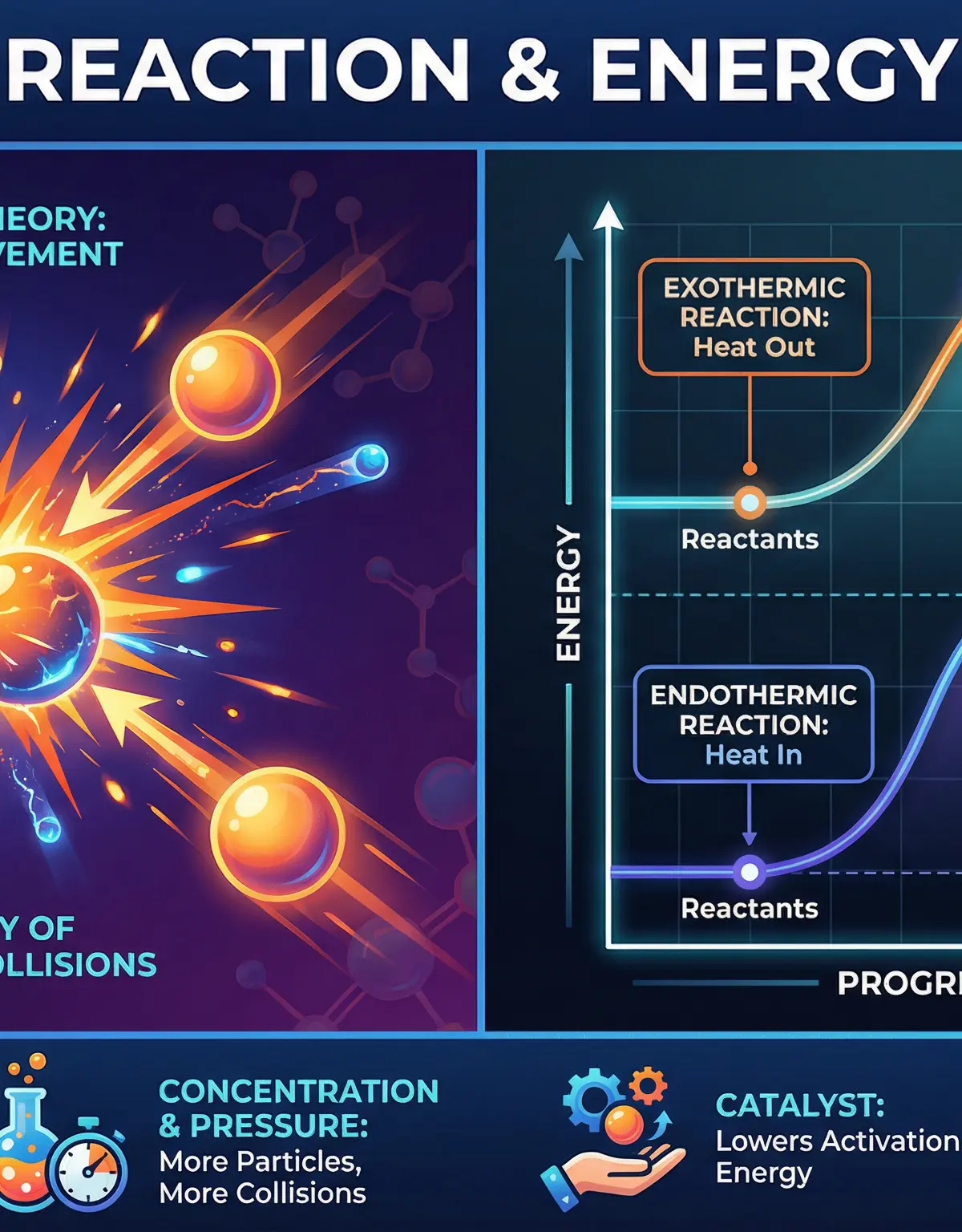
Rates of reaction and energy changes is a fundamental topic in GCSE Chemistry that bridges theoretical concepts with observable phenomena. It explores not just what happens in a chemical reaction, but how fast it happens and why energy is released or absorbed. This topic is heavily tested because it allows examiners to assess multiple skills simultaneously: explaining abstract concepts using collision theory, interpreting and drawing graphical data (reaction profiles), and performing mathematical calculations (bond energies).
Understanding these concepts is crucial for industrial chemistry, where controlling the rate and energy of reactions can make processes safer and more economically viable. You will often find synoptic links between this topic and others, such as reversible reactions, equilibrium, and the Haber process. Exam questions typically range from simple recall of the factors affecting rate to complex, multi-step calculations and 6-mark extended response questions requiring detailed explanations using particle models.
Key Concepts
Concept 1: Collision Theory
For a chemical reaction to occur, reactant particles must collide with each other. However, a collision only results in a reaction if two conditions are met: the particles must collide with the correct orientation, and they must collide with sufficient energy. This minimum amount of energy required to break the existing bonds and start the reaction is known as the activation energy (E_a).
Think of activation energy as a toll booth on a road. If a car (particle) doesn't have enough money (energy) to pay the toll, it can't pass through and continue its journey (react). Therefore, the rate of a chemical reaction depends entirely on the frequency of successful collisions.
Concept 2: Factors Affecting Rate of Reaction
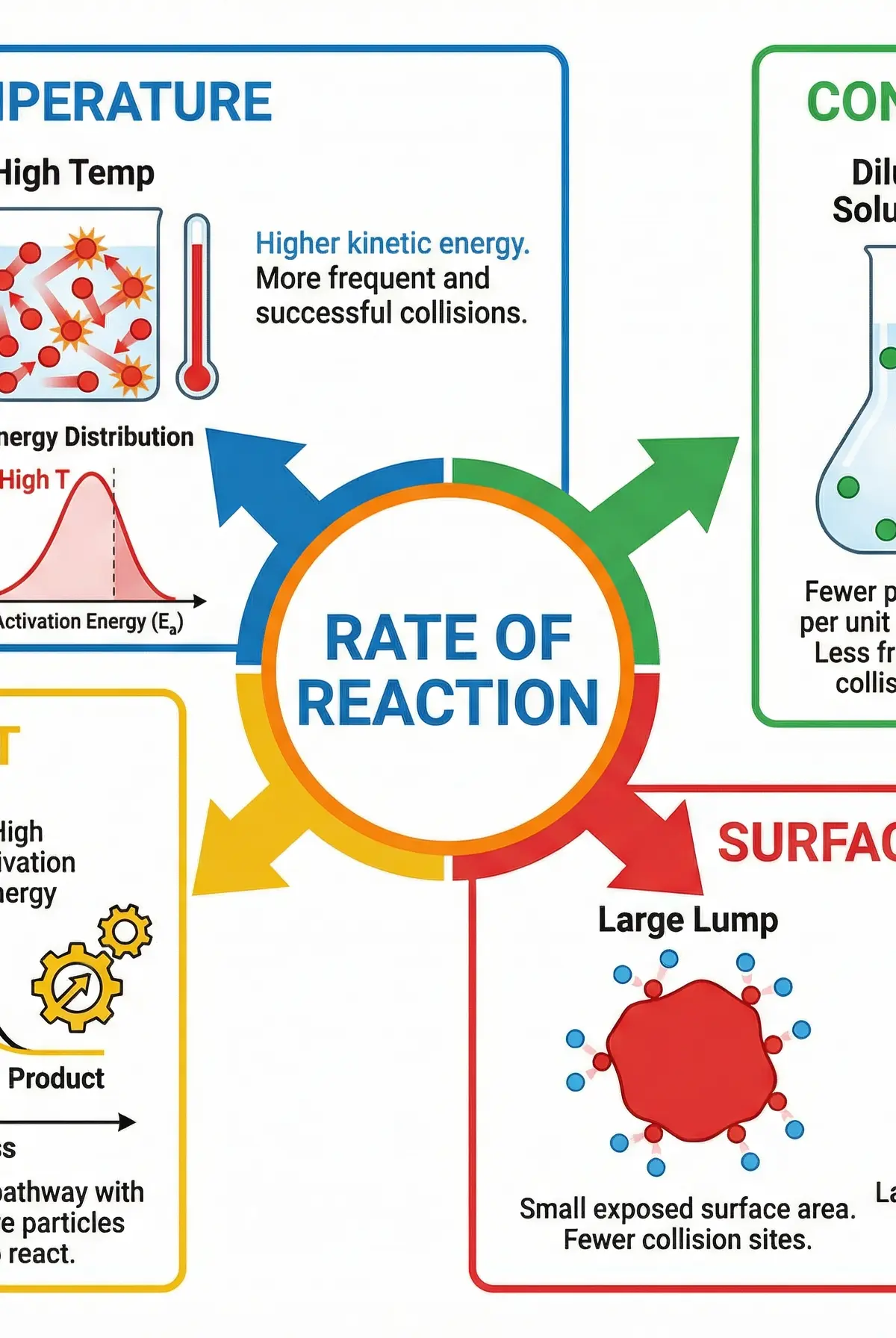
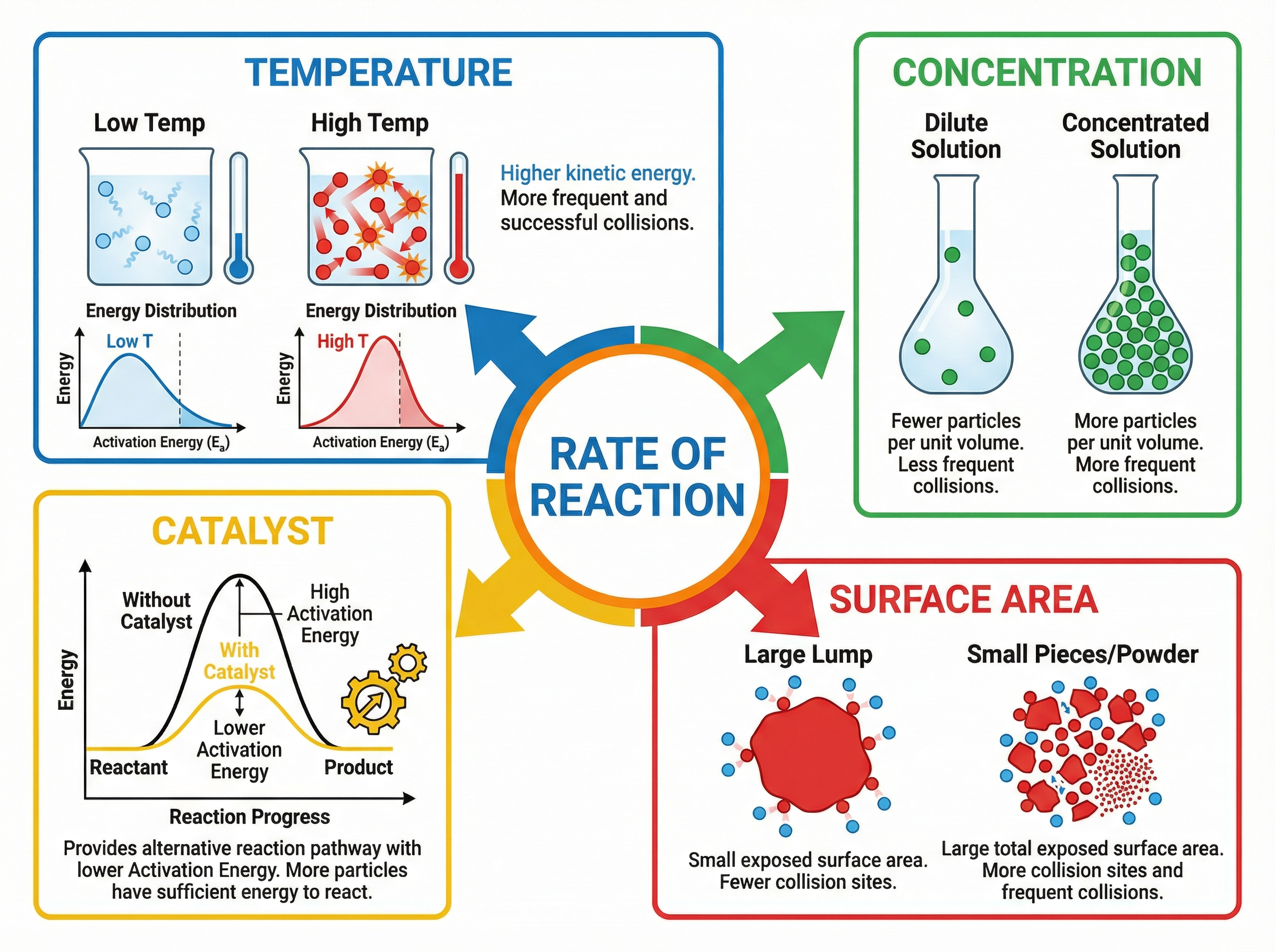
There are four primary factors that can increase the rate of a reaction:
- Temperature: Increasing the temperature gives particles more kinetic energy. They move faster, resulting in more frequent collisions. Crucially, because they have more energy, a higher proportion of collisions will have energy equal to or greater than the activation energy. This leads to a significant increase in the frequency of successful collisions.
- Concentration (Solutions) / Pressure (Gases): Increasing concentration or pressure means there are more reactant particles in the same given volume. This crowding forces the particles closer together, leading to more frequent collisions.
- Surface Area (Solids): If a solid reactant is broken into smaller pieces or ground into a powder, its surface area to volume ratio increases. This exposes more particles to the other reactant, providing more sites for collisions to occur, thus increasing the collision frequency.
- Catalysts: A catalyst is a substance that speeds up a chemical reaction without being used up or chemically changed itself. It achieves this by providing an alternative reaction pathway that has a lower activation energy. Consequently, a greater proportion of particles will have sufficient energy to react upon collision.
Concept 3: Energy Changes (Exothermic and Endothermic)
Chemical reactions involve energy transfers between the reacting substances and their surroundings, usually in the form of heat.
- Exothermic Reactions: These reactions transfer energy to the surroundings, causing the temperature of the surroundings to increase. Examples include combustion, oxidation, and neutralisation.
- Endothermic Reactions: These reactions take in energy from the surroundings, causing the temperature of the surroundings to decrease. Examples include thermal decomposition and the reaction between citric acid and sodium hydrogencarbonate.
Concept 4: Reaction Profiles
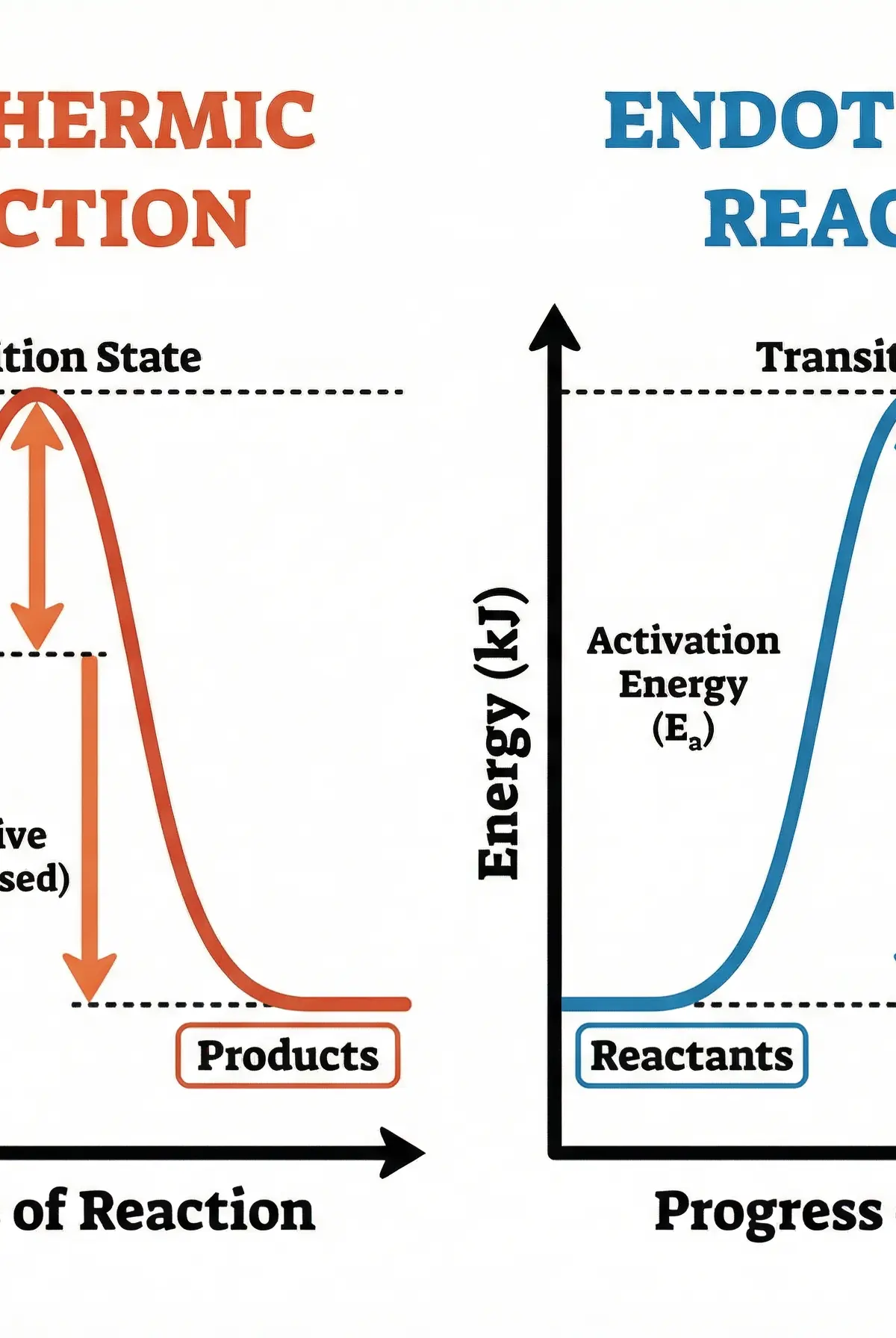
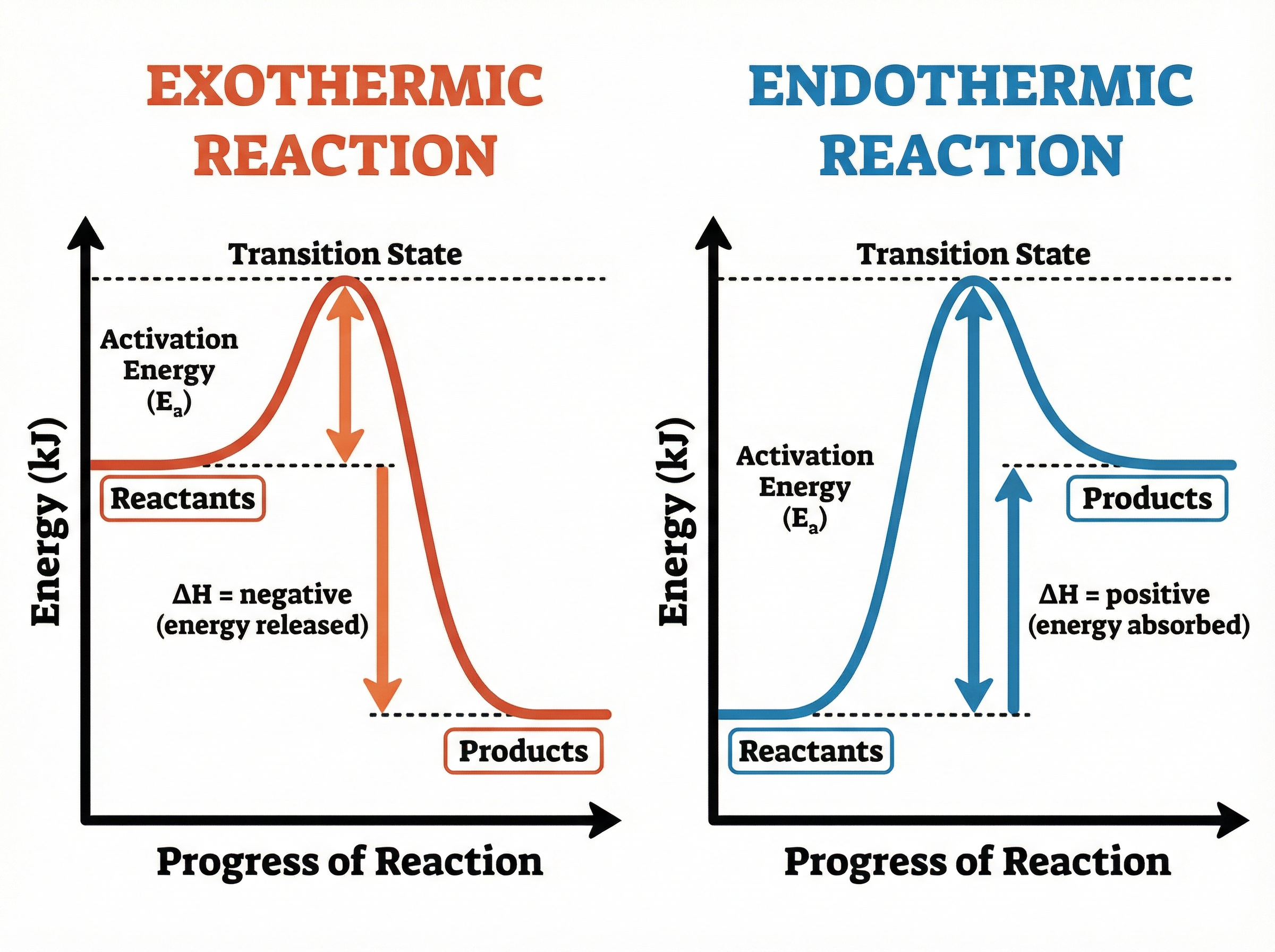
Reaction profiles (or energy level diagrams) are graphical representations of the energy changes during a reaction. They show the relative energies of reactants and products, the activation energy, and the overall energy change (\Delta H).
- Exothermic Profile: The products are at a lower energy level than the reactants. The difference in height represents the energy released (negative \Delta H).
- Endothermic Profile: The products are at a higher energy level than the reactants. The difference in height represents the energy absorbed (positive \Delta H).
In both profiles, the activation energy is shown as an upward arrow starting from the reactant energy level to the peak of the curve.
Concept 5: Bond Energy Calculations
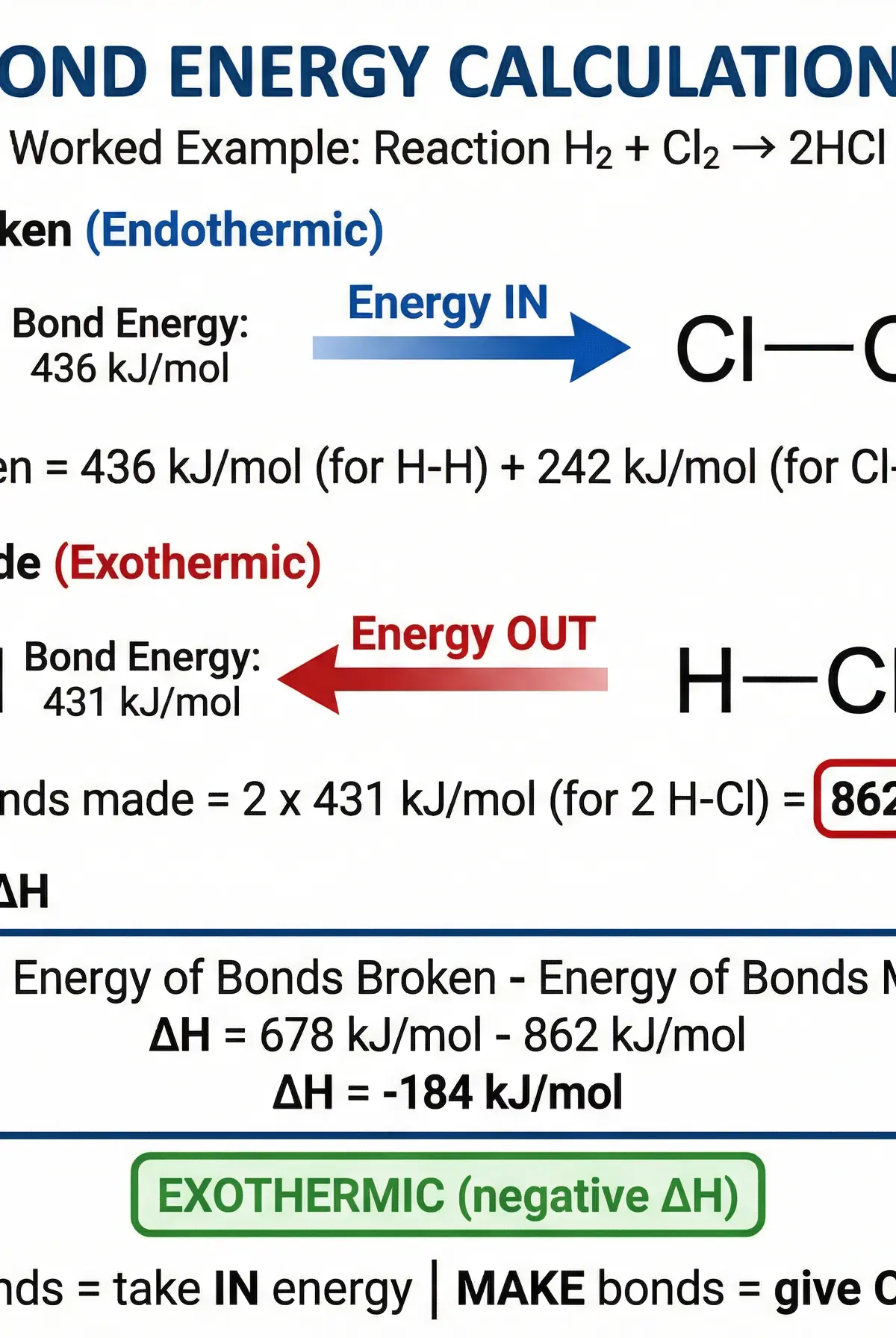
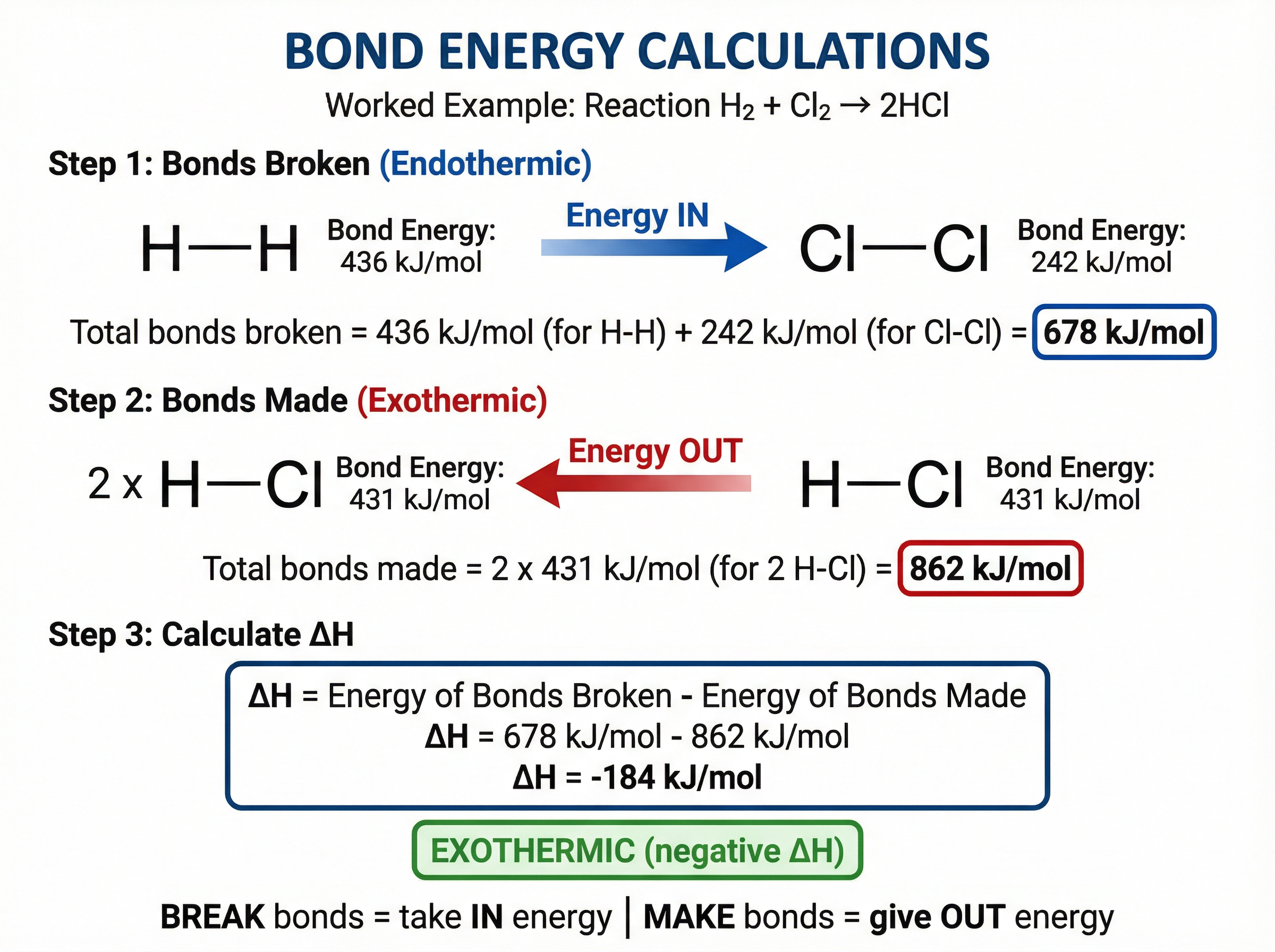
During a chemical reaction, existing bonds in the reactants must be broken, and new bonds in the products must be formed.
- Bond breaking is endothermic: Energy must be supplied to break bonds.
- Bond making is exothermic: Energy is released when new bonds form.
To calculate the overall energy change (\Delta H) for a reaction, you use the formula:
\Delta H = \text{Total energy needed to break bonds} - \text{Total energy released making bonds}
If the calculated \Delta H is negative, the reaction is exothermic. If it is positive, the reaction is endothermic.
Mathematical/Scientific Relationships
- Rate of Reaction Formula:
- \text{Rate} = \frac{\text{Amount of reactant used}}{\text{Time}}
- \text{Rate} = \frac{\text{Amount of product formed}}{\text{Time}}
- Units: g/s, cm³/s, or mol/s.
- Overall Energy Change (\Delta H):
- \Delta H = \sum(\text{Bonds Broken}) - \sum(\text{Bonds Made})
- Units: kJ/mol.
Practical Applications
**Required Practical: Investigating the effect of concentration on the rate of reaction.**There are two common methods examiners test:
- Measuring the volume of gas produced: Reacting magnesium ribbon with hydrochloric acid and collecting the hydrogen gas in a gas syringe or inverted measuring cylinder. You measure the volume of gas produced at regular time intervals.
- Observing a colour change (The 'Disappearing Cross' experiment): Reacting sodium thiosulfate with hydrochloric acid produces a cloudy precipitate of solid sulfur. You place the flask over a piece of paper with a black cross drawn on it and measure the time it takes for the cross to disappear from view when looking down through the solution.
Common Examiner Focus: They often ask about control variables (e.g., keeping temperature and total volume constant), identifying anomalous results on a graph, and explaining why the rate decreases over time as reactants are used up.
Visual Resources
3 diagrams and illustrations
Interactive Diagrams
2 interactive diagrams to visualise key concepts
Conceptual Flow Outline
Flowchart showing how increasing temperature increases the rate of reaction.
Conceptual Flow Outline
Flowchart showing how a catalyst increases the rate of reaction.
Worked Examples
3 worked examples — open one to explore the question and available guidance.
Practice Questions
Test your understanding — click to reveal model answers
State two ways to increase the rate of reaction between a solid marble chip and hydrochloric acid.
Hint: Think about the state symbols of the reactants.
A student measures the temperature change when ammonium nitrate is dissolved in water. The initial temperature is 20°C and the final temperature is 14°C. State what type of energy change this is and explain why.
Hint: Did the surroundings get hotter or colder?
Sketch a reaction profile for an exothermic reaction. Label the axes, reactants, products, activation energy, and overall energy change.
Hint: Remember which way the activation energy arrow must point.
Explain how a catalyst increases the rate of a reaction.
Hint: Does a catalyst give particles more energy, or does it change the requirement?
Calculate the energy change for the combustion of methane: CH₄ + 2O₂ → CO₂ + 2H₂O.
Bond energies (kJ/mol): C-H = 413, O=O = 498, C=O = 805, H-O = 464.
Hint: Draw out the full displayed structures of all molecules first to count the bonds correctly.
Test your understanding of Rates of reaction and energy changes
Active recall beats re-reading. Take an instant quiz now to test what you’ve learned and lock it into long-term memory.
7 days Premium · Then free forever · No card, no charge