Pearson Edexcel · GCSE · Chemistry
Separate chemistry 2
Master the fundamentals of hydrocarbons with this essential guide to alkanes and alkenes. You'll learn to draw structural formulas, distinguish saturated from unsaturated molecules, and ace the classic bromine water test—key skills that frequently appear in 4-6 mark exam questions.
- 4 min read
- 3 worked examples
- 5 practice questions
- 6 key terms
Study Notes
Overview
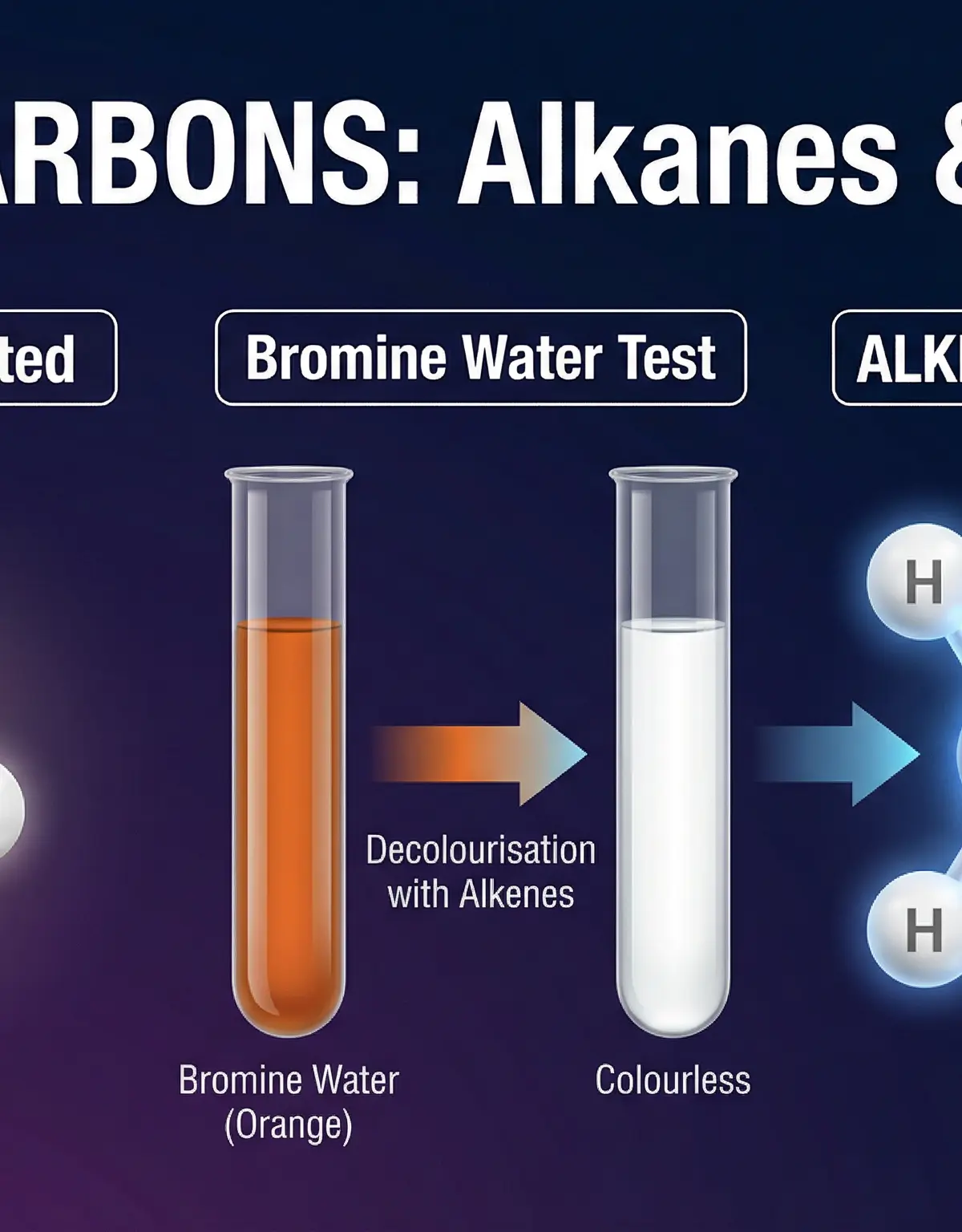
This topic is the foundation of organic chemistry. Hydrocarbons—compounds containing only carbon and hydrogen—are the building blocks of fuels, plastics, and many materials we use daily. In your exam, you will be expected to draw their structures accurately, explain their properties, and write balanced chemical equations for their reactions.
Understanding the difference between alkanes (saturated) and alkenes (unsaturated) is crucial. Examiners frequently test this through the bromine water practical and by asking you to identify functional groups. This topic also links heavily to crude oil fractional distillation and the environmental impacts of combustion.
Key Concepts
Concept 1: Alkanes (Saturated Hydrocarbons)
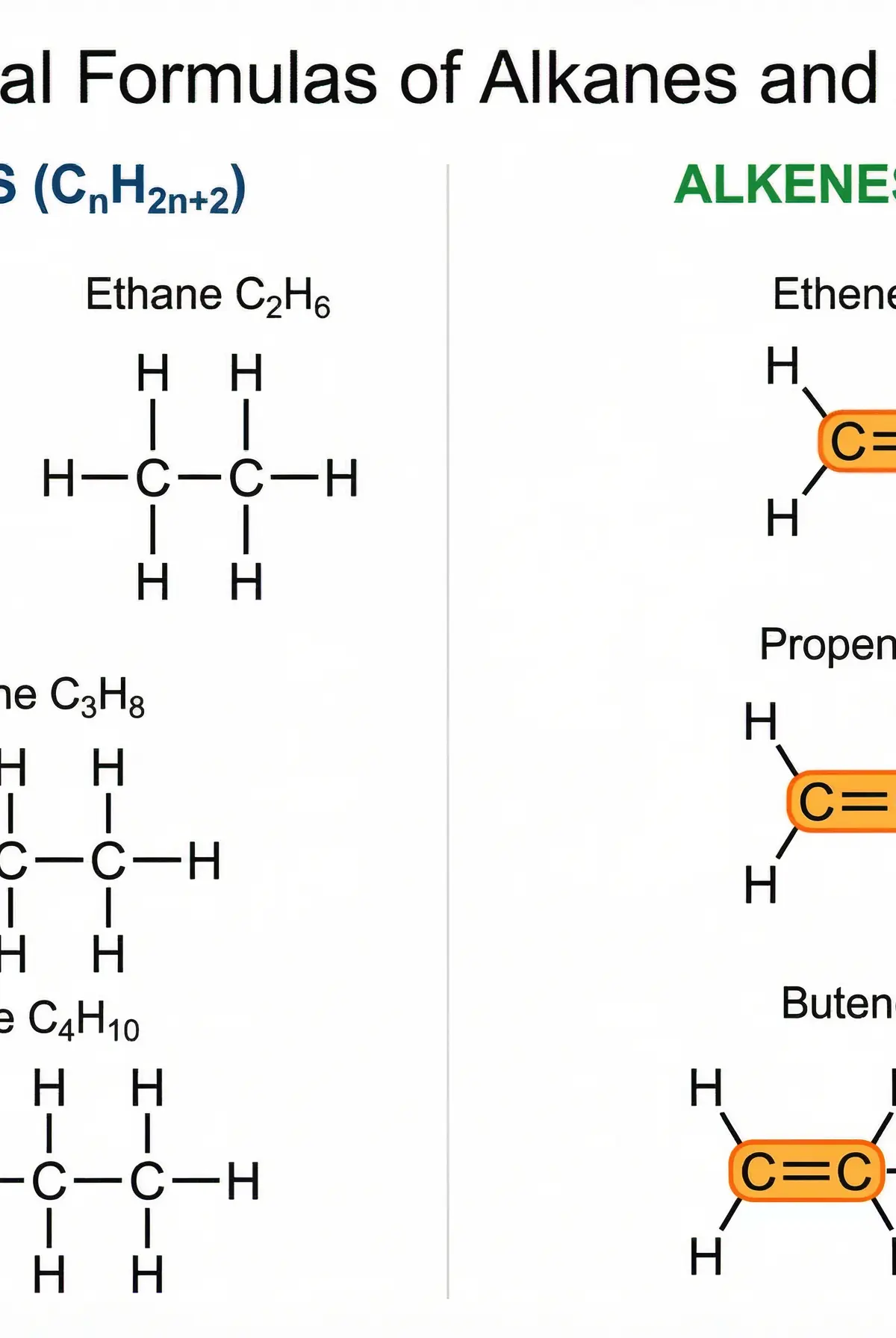
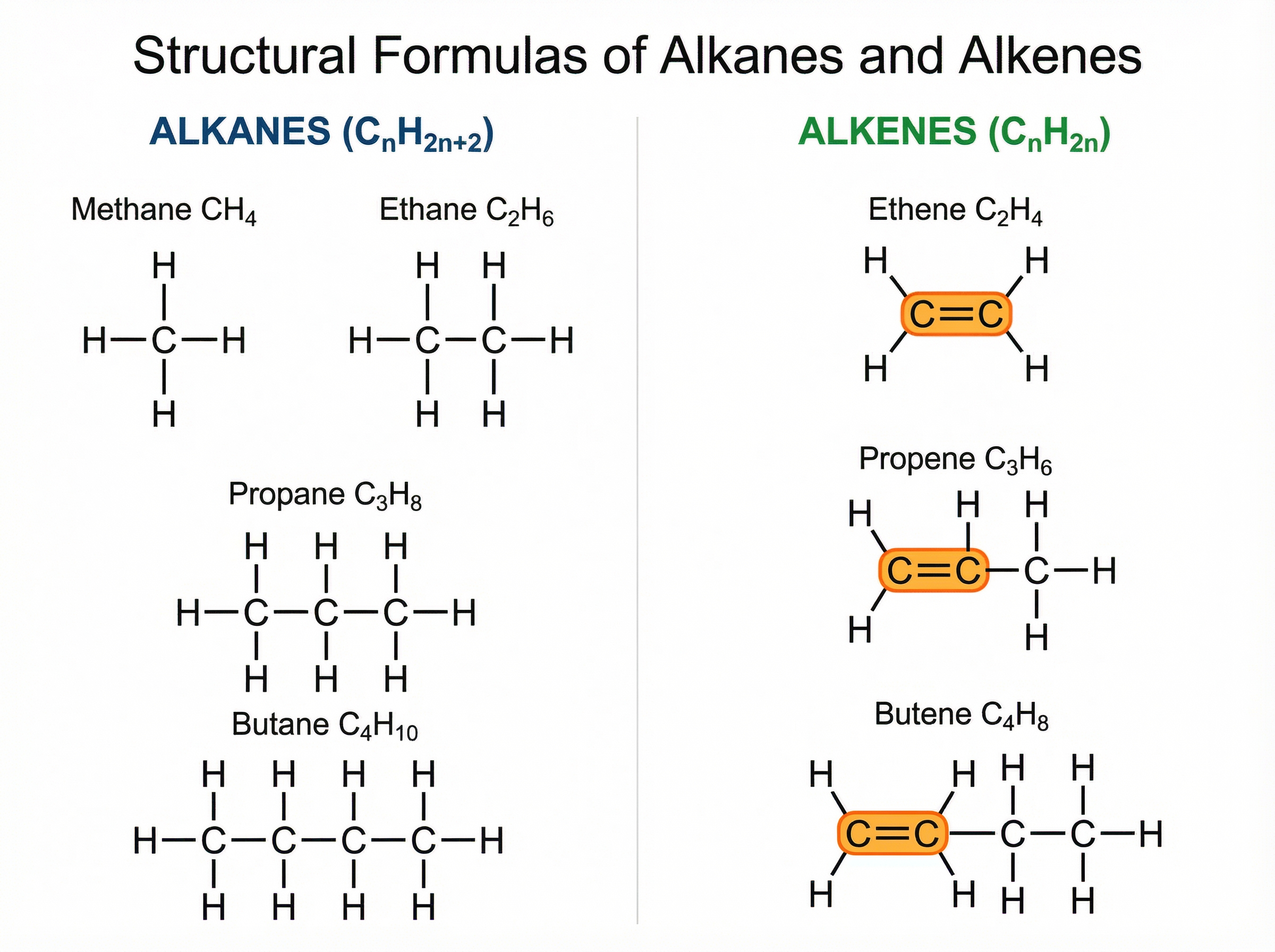
Alkanes are a homologous series of hydrocarbons with the general formula C\textsubscript{n}H\textsubscript{2n+2}. They are described as saturated because they contain only single covalent bonds between carbon atoms (C-C). Every carbon atom is bonded to the maximum possible number of hydrogen atoms.
Example: Methane (CH\textsubscript{4}) is the simplest alkane. Ethane (C\textsubscript{2}H\textsubscript{6}), propane (C\textsubscript{3}H\textsubscript{8}), and butane (C\textsubscript{4}H\textsubscript{10}) follow in the series. When drawing these, you must show every single bond as a distinct line connecting the atoms.
Concept 2: Alkenes (Unsaturated Hydrocarbons)
Alkenes are a homologous series with the general formula C\textsubscript{n}H\textsubscript{2n}. They are unsaturated because they contain a carbon-carbon double bond (C=C). This double bond is their functional group and makes them significantly more reactive than alkanes.
Example: Ethene (C\textsubscript{2}H\textsubscript{4}) is the simplest alkene. The double bond means there is 'room' for other atoms to add onto the molecule, which is why alkenes undergo addition reactions.
Concept 3: The Bromine Water Test
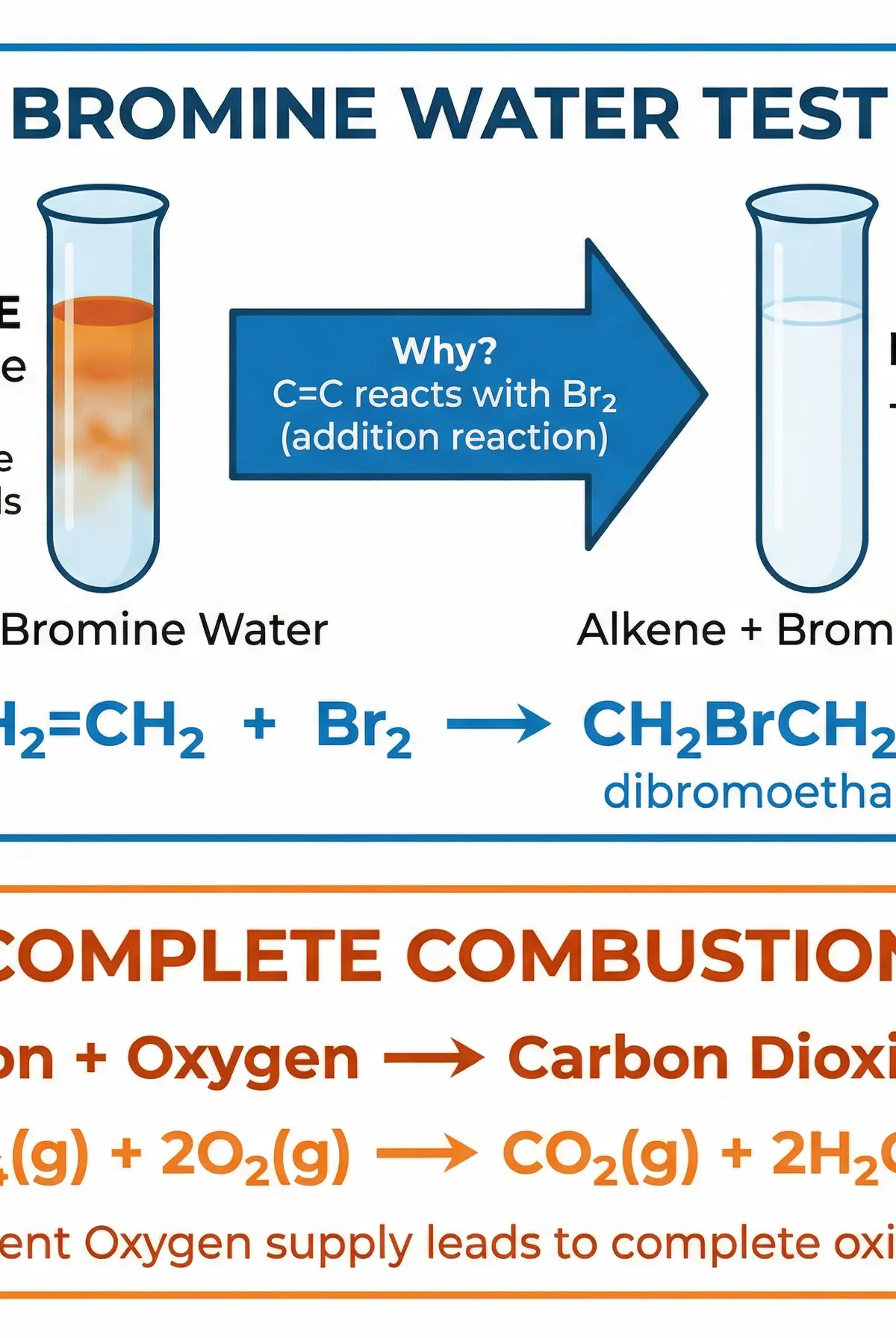
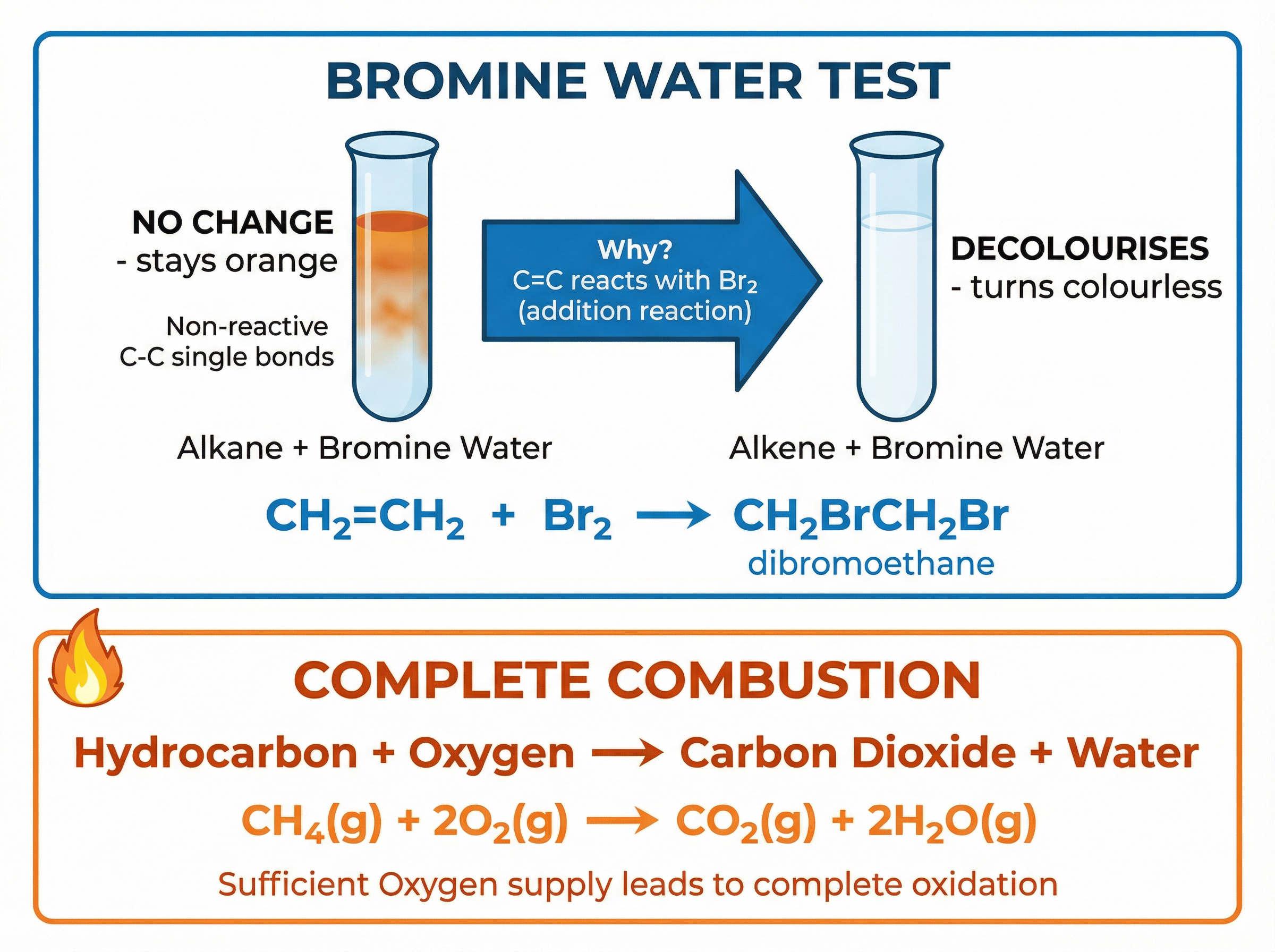
This is the standard test to distinguish between an alkane and an alkene. Bromine water is an orange-brown solution.
- With an Alkane: There is no reaction under normal conditions. The solution remains orange.
- With an Alkene: The solution decolourises (turns colourless). This happens because the alkene undergoes an addition reaction with the bromine across the C=C double bond, forming a colourless dibromoalkane.
Concept 4: Complete Combustion
When hydrocarbons burn in a plentiful supply of oxygen, they undergo complete combustion. The carbon is oxidised to carbon dioxide, and the hydrogen is oxidised to water. This reaction releases a significant amount of energy.
Example Equation: CH\textsubscript{4}(g) + 2O\textsubscript{2}(g) \rightarrow CO\textsubscript{2}(g) + 2H\textsubscript{2}O(g)
Mathematical/Scientific Relationships
- Alkane General Formula: C_nH_{2n+2} (Must memorise)
- Alkene General Formula: C_nH_{2n} (Must memorise)
Practical Applications
Alkanes are primarily used as fuels (e.g., methane in natural gas, octane in camping stoves) due to the large amount of energy released during combustion. Alkenes are the crucial starting materials for making polymers (plastics) like poly(ethene), which is used in shopping bags and bottles.
Visual Resources
2 diagrams and illustrations
Interactive Diagrams
2 interactive diagrams to visualise key concepts
Conceptual Flow Outline
Flowchart showing how to classify and test a hydrocarbon.
Conceptual Flow Outline
Overview of common addition reactions of alkenes.
Worked Examples
3 worked examples — open one to explore the question and available guidance.
Practice Questions
Test your understanding — click to reveal model answers
What is the general formula for the alkane homologous series?
Hint: Think about how many hydrogens there are compared to carbons in methane (CH4).
Draw the displayed structure of propene.
Hint: Propene has 3 carbon atoms. Remember it's an alkene, so it needs a double bond.
A student tests an unknown hydrocarbon gas with bromine water. The bromine water turns from orange to colourless. Identify the type of hydrocarbon and explain this reaction.
Hint: What type of bond causes this colour change?
Write the balanced symbol equation for the complete combustion of butane (C4H10).
Hint: Remember the products of complete combustion are always CO2 and H2O. You may need to use halves or double the whole equation to balance the oxygen.
Explain why alkanes are described as saturated hydrocarbons.
Hint: Break the term down into two parts: 'saturated' and 'hydrocarbon'.
Test your understanding of Separate chemistry 2
Active recall beats re-reading. Take an instant quiz now to test what you’ve learned and lock it into long-term memory.
7 days Premium · Then free forever · No card, no charge