OCR · GCSE · Chemistry
Topic C5: Monitoring and controlling chemical reactions
Master the mathematics and mechanics of chemical reactions with this comprehensive guide to C5. From mole calculations to dynamic equilibrium, you'll learn how to predict, control, and measure chemical changes to secure top marks in your GCSE exams.
- 5 min read
- 3 worked examples
- 5 practice questions
- 6 key terms
Study Notes
Overview

Topic C5 is the cornerstone of quantitative chemistry. It bridges the gap between theoretical concepts and practical laboratory work, teaching you how to measure, monitor, and control chemical reactions. This topic is essential because it introduces the mathematical tools required to calculate reacting masses, concentrations, and gas volumes—skills that are heavily assessed in both structured and unstructured exam questions.
You will also explore collision theory and dynamic equilibrium, concepts that connect directly to industrial applications like the Haber process. Examiners frequently test this topic through multi-step calculation questions and extended response items requiring you to apply Le Chatelier's principle. Mastery of C5 not only secures significant marks but also provides the foundational understanding necessary for advanced study in Chemistry.
Key Concepts
Concept 1: The Mole and Avogadro's Constant
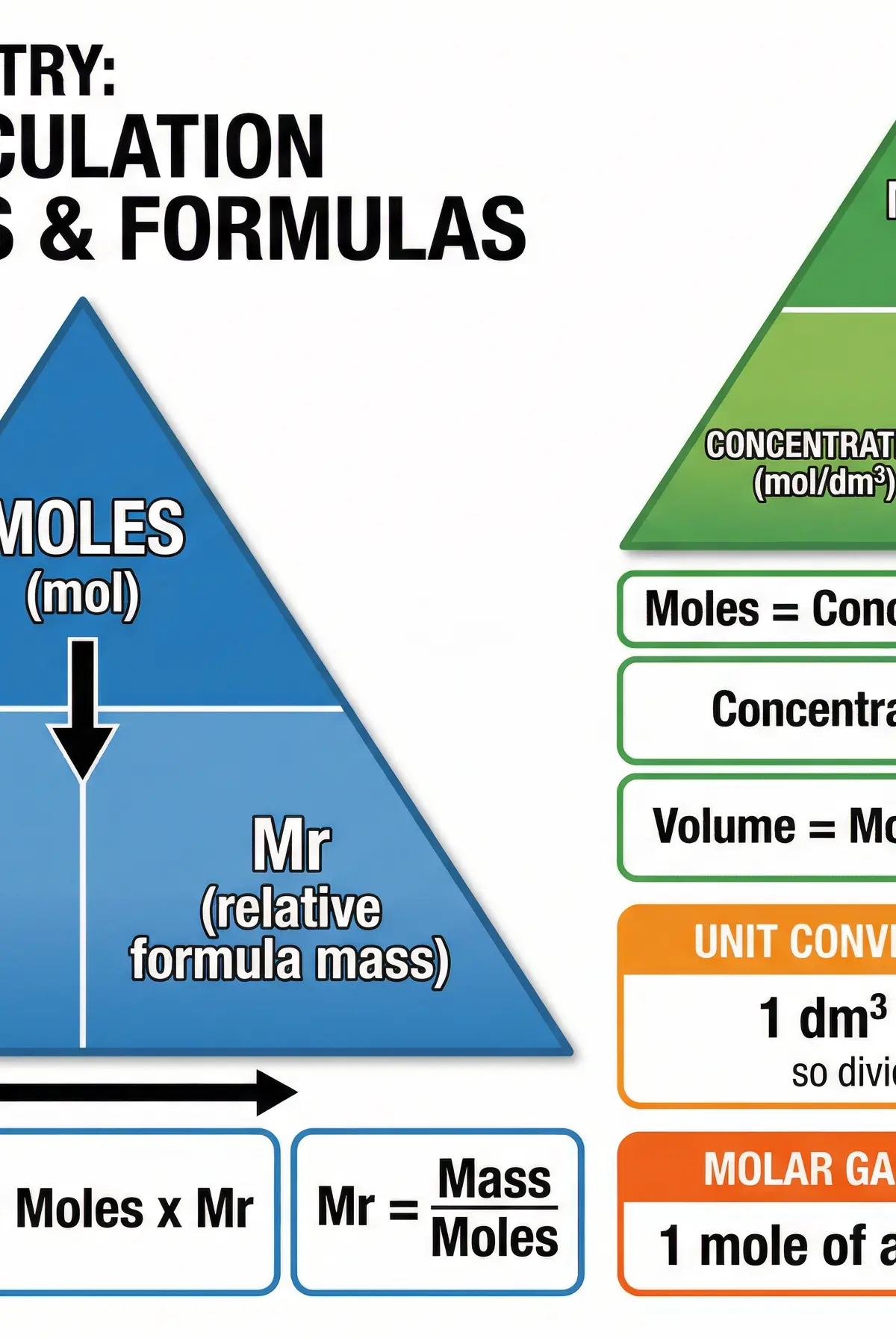
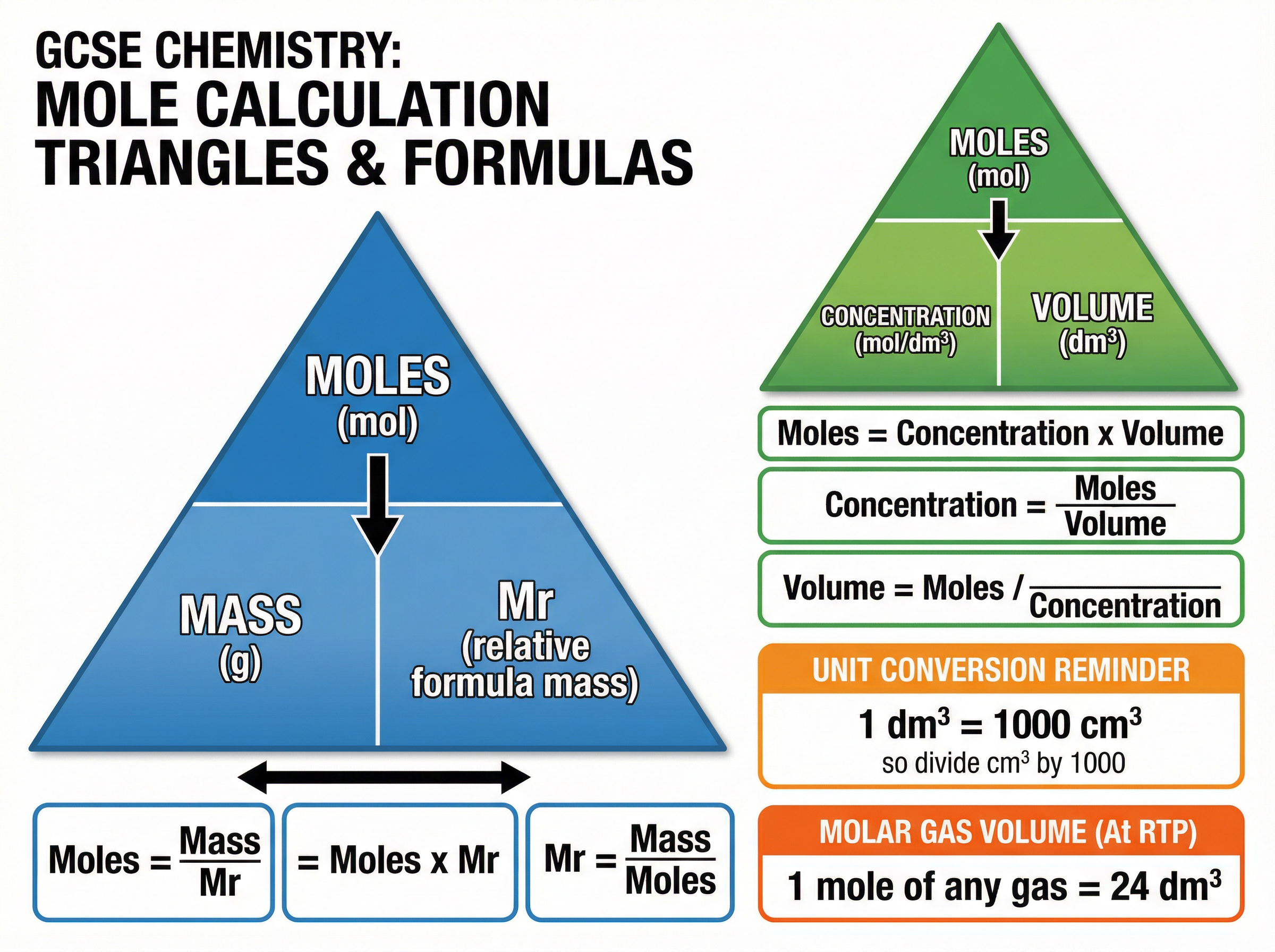
The mole is the standard unit for the amount of substance in chemistry. Because atoms are too small to count individually, we group them into 'moles'. One mole contains 6.02 \times 10^{23} particles (Avogadro's constant). The mass of one mole of any substance is equal to its relative formula mass (M_r) in grams.
Understanding this allows you to convert between mass and the number of particles. Examiners often test this by asking you to calculate the number of moles in a given mass, or vice versa.
Example: Calculate the number of moles in 88g of carbon dioxide (CO_2).
M_r of CO_2 = 12 + (16 \times 2) = 44.
Moles = Mass / M_r = 88 / 44 = 2 moles.
Concept 2: Concentration of Solutions
Concentration measures how much solute is dissolved in a given volume of solvent, typically expressed in mol/dm^3. This is a critical concept for titrations and required practicals. The most common error candidates make is failing to convert volumes from cm^3 to dm^3 before calculating. Always divide cm^3 by 1000 to get dm^3.
Example: Calculate the concentration of a solution containing 0.5 moles of NaCl dissolved in 250 cm^3 of water.
Volume in dm^3 = 250 / 1000 = 0.25 dm^3.
Concentration = Moles / Volume = 0.5 / 0.25 = 2.0 mol/dm^3.
Concept 3: Rates of Reaction and Collision Theory
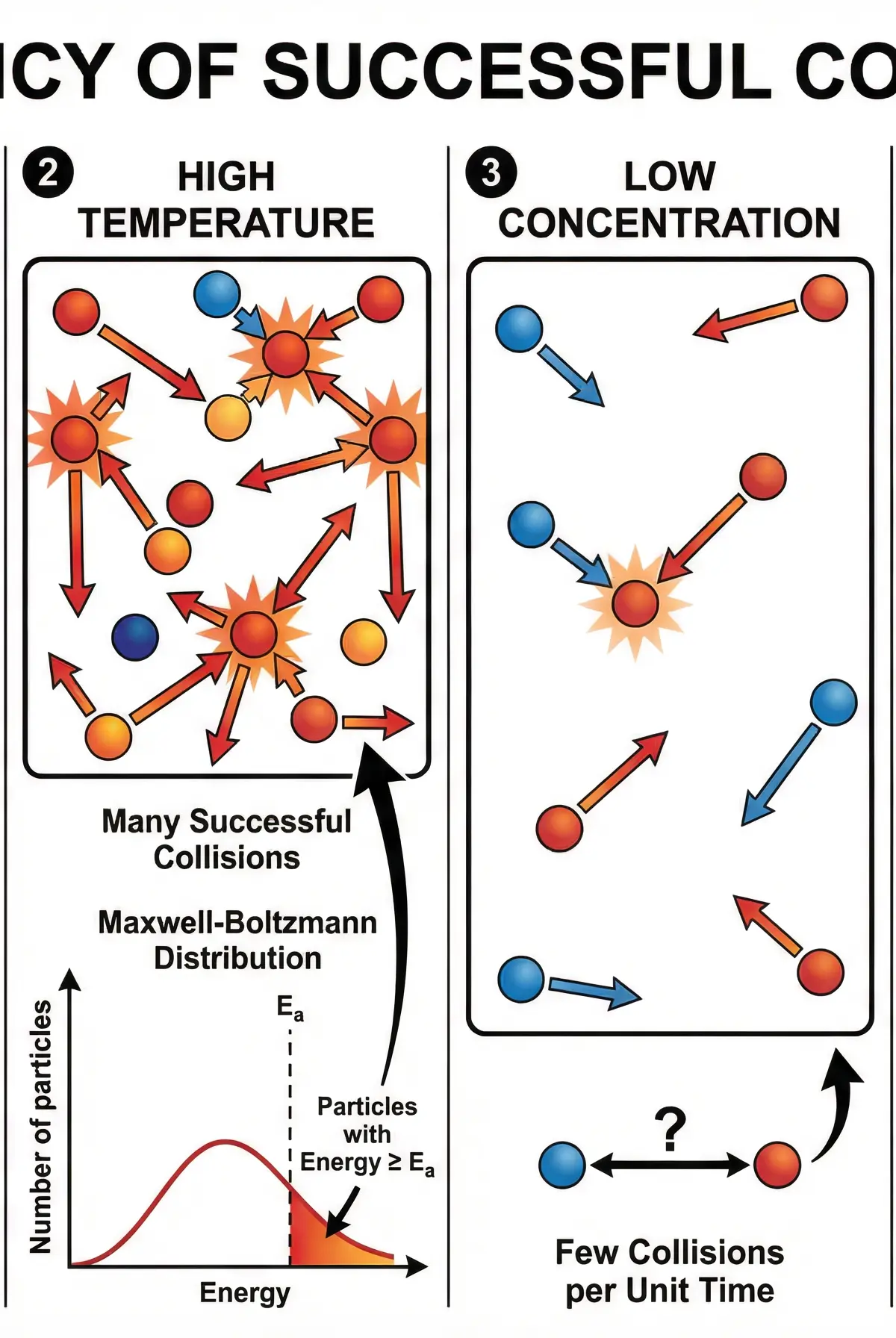
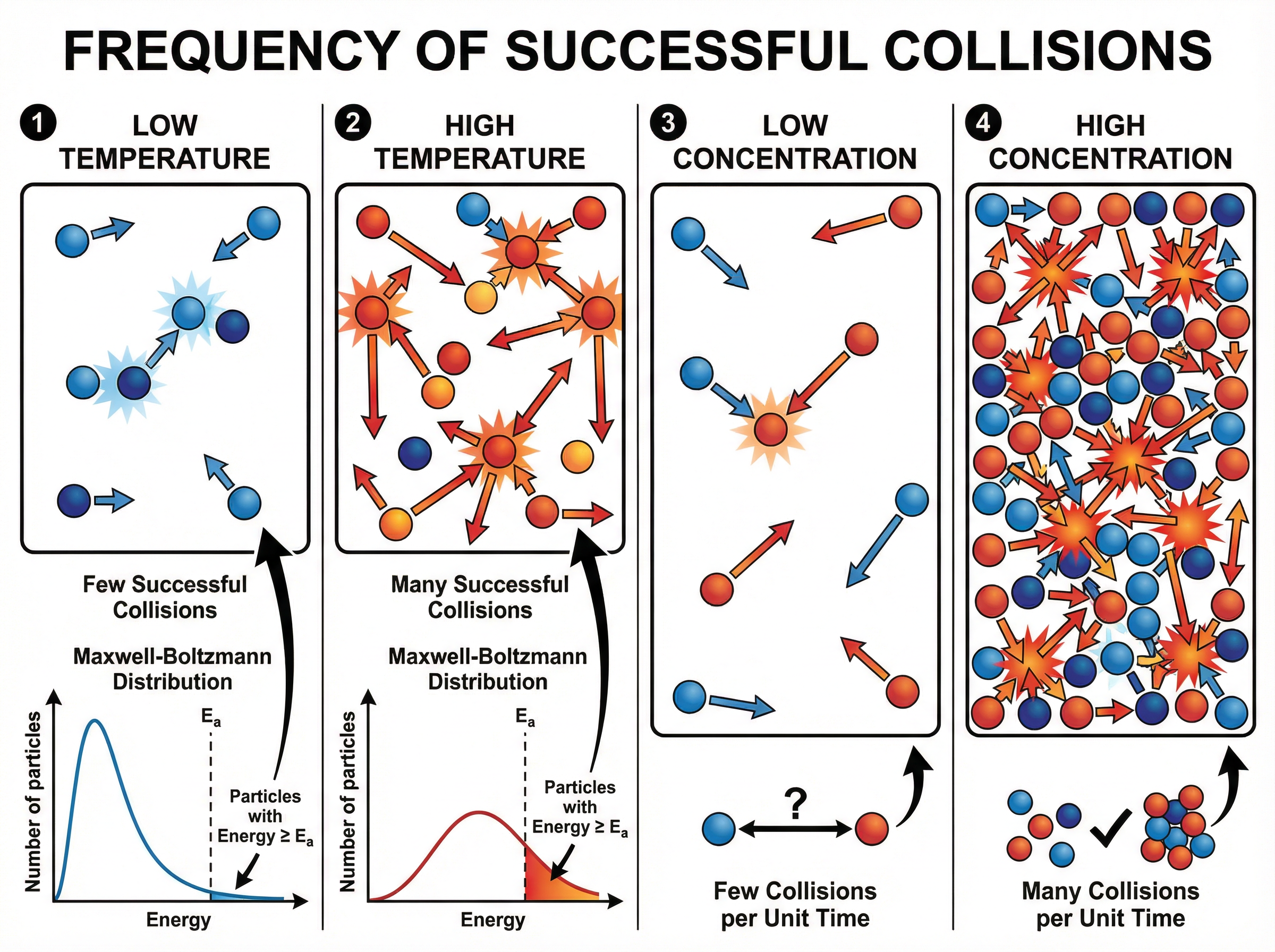
For a chemical reaction to occur, reactant particles must collide with sufficient energy to break existing bonds. This minimum energy threshold is called the activation energy. Collision theory states that the rate of a reaction depends on the frequency of successful collisions between reacting particles.
Factors affecting the rate include temperature, concentration, pressure (for gases), and surface area. Increasing any of these increases the frequency of collisions. Increasing temperature also increases the proportion of particles with energy greater than the activation energy, leading to more successful collisions per unit time.
Concept 4: Dynamic Equilibrium and Le Chatelier's Principle
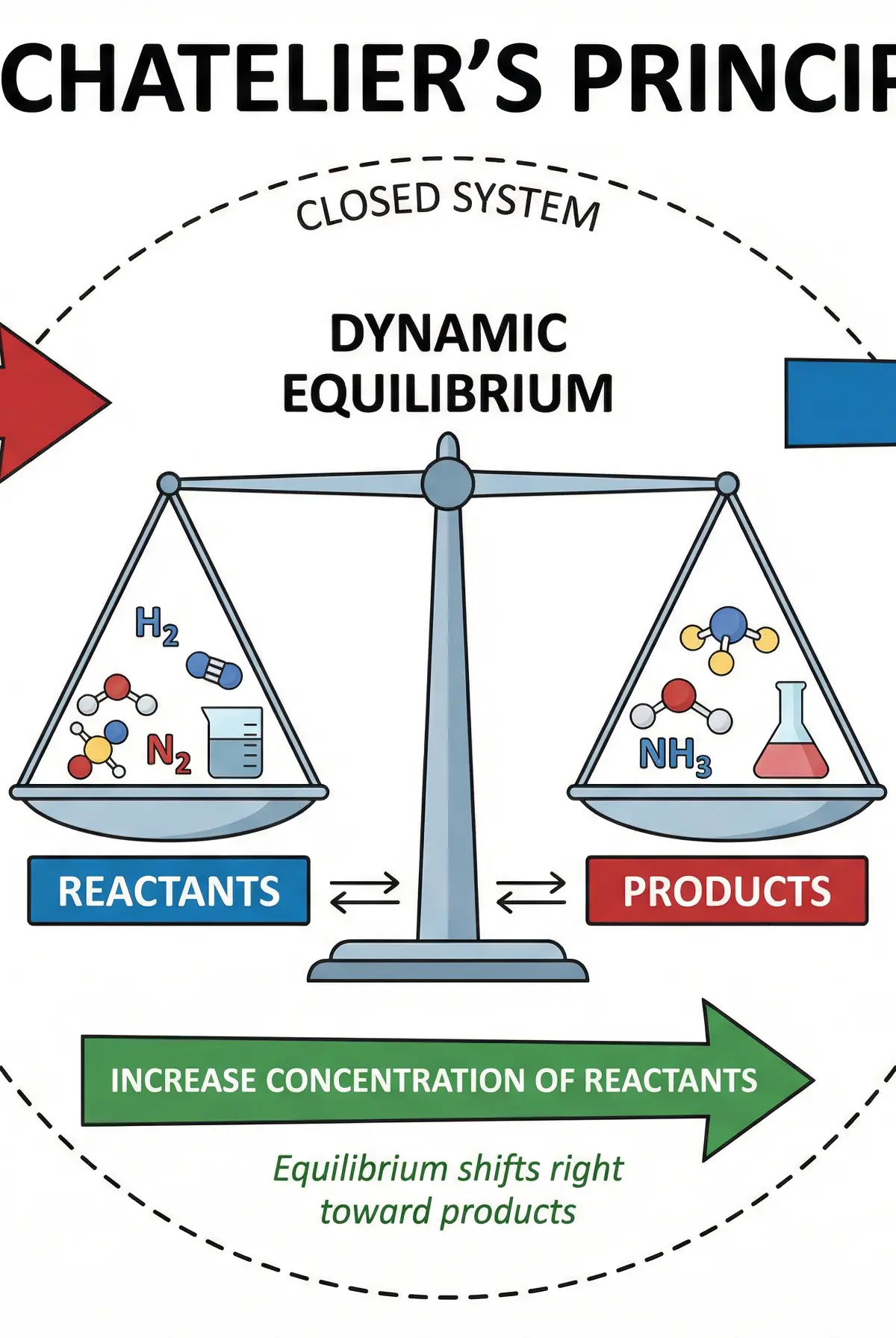
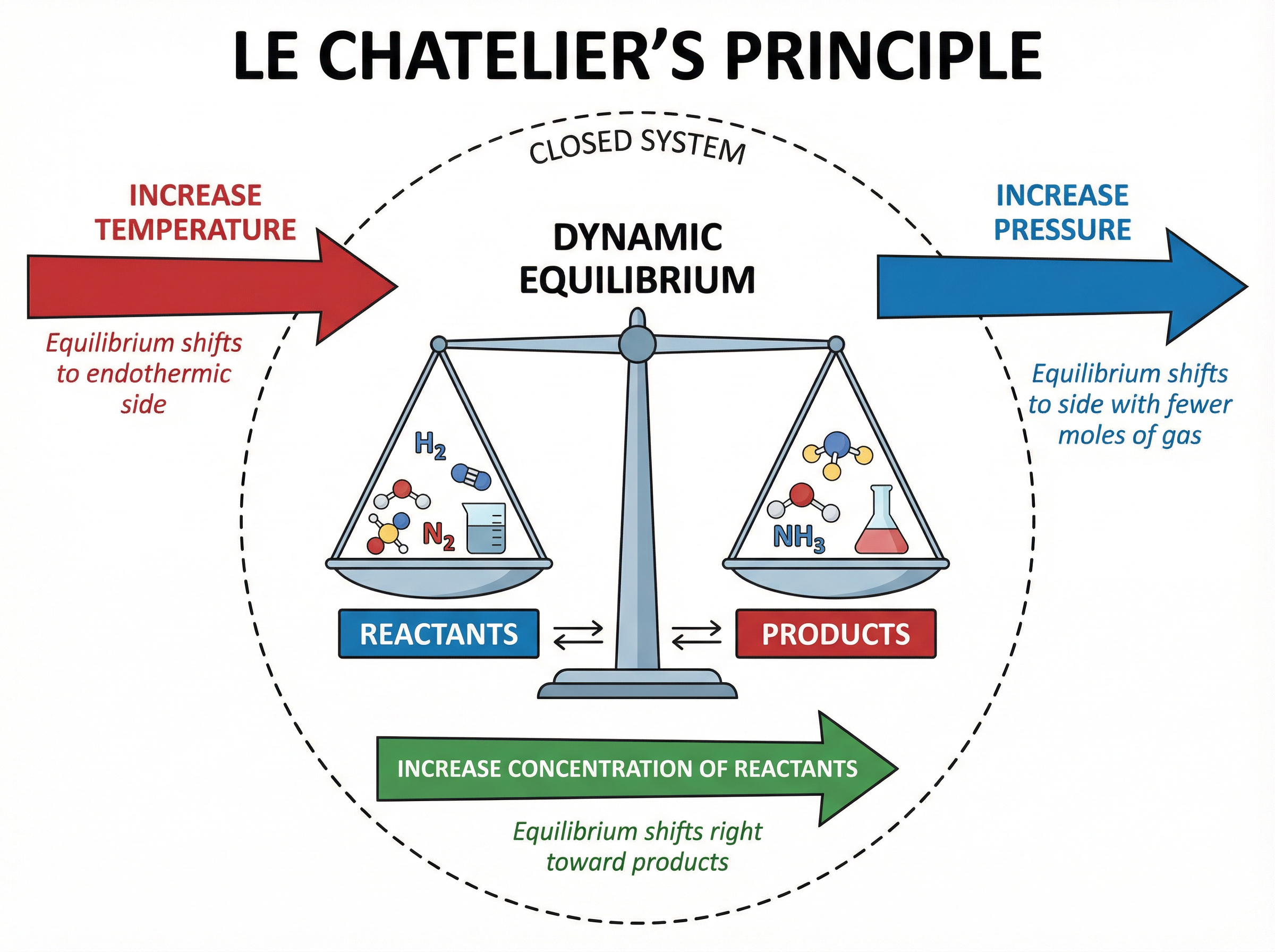
In a closed system, a reversible reaction will eventually reach dynamic equilibrium. At this point, the rate of the forward reaction equals the rate of the reverse reaction, and the concentrations of reactants and products remain constant (though not necessarily equal).
Le Chatelier's Principle states that if a change is made to the conditions of a system at equilibrium, the system will respond to counteract that change. This principle is vital for predicting how changes in temperature, pressure, or concentration will affect the yield of a reversible reaction.
Mathematical/Scientific Relationships
- Moles = Mass / M_r (Must memorise)
- Concentration (mol/dm^3) = Moles / Volume (dm^3) (Must memorise)
- Volume of Gas (dm^3) = Moles \times 24 (At room temperature and pressure; Must memorise)
- Percentage Yield = (Actual Yield / Theoretical Yield) \times 100 (Must memorise)
- Atom Economy = (M_r of desired product / Sum of M_r of all products) \times 100 (Must memorise)
Practical Applications
Required Practical: TitrationTitrations are used to determine the exact concentration of an acid or alkali. You must know how to use a pipette to measure a precise volume of one solution into a conical flask, add an indicator (like phenolphthalein), and use a burette to add the other solution until the indicator changes colour (the end-point).
Industrial Application: The Haber ProcessThe production of ammonia (NH_3) from nitrogen and hydrogen is a classic example of dynamic equilibrium. The forward reaction is exothermic, and there are fewer moles of gas on the product side. Therefore, high pressure and low temperature favour the yield of ammonia. However, a low temperature would make the reaction too slow, so a compromise temperature of 450^\circ C and an iron catalyst are used to achieve an acceptable yield at a reasonable rate.
Audio Revision
Listen to the comprehensive podcast episode covering all these topics, perfect for revising on the go:
Visual Resources
3 diagrams and illustrations
Interactive Diagrams
2 interactive diagrams to visualise key concepts
Conceptual Flow Outline
Simplified Reaction Profile for an Exothermic Reaction
Conceptual Flow Outline
Step-by-step guide for Titration Calculations
Worked Examples
3 worked examples — open one to explore the question and available guidance.
Practice Questions
Test your understanding — click to reveal model answers
Calculate the percentage yield if the theoretical yield of a reaction is 50g but only 40g is obtained.
Hint: Use the formula: (Actual Yield / Theoretical Yield) x 100
Explain why a catalyst increases the rate of a reaction.
Hint: Think about the reaction pathway and activation energy.
The Haber process is used to produce ammonia: N_2(g) + 3H_2(g) \rightleftharpoons 2NH_3(g). The forward reaction is exothermic. Predict and explain the effect of increasing the pressure on the yield of ammonia.
Hint: Count the moles of gas on the reactant and product sides of the equation.
Calculate the atom economy for making hydrogen by reacting coal with steam: C(s) + 2H_2O(g) \rightarrow CO_2(g) + 2H_2(g). (A_r: C=12, H=1, O=16)
Hint: Identify the desired product and calculate the total Mr of all products.
A student investigates the rate of reaction between marble chips and hydrochloric acid. State two ways the student could increase the rate of this reaction without changing the temperature.
Hint: Think about the state of the reactants (solid and solution).
Test your understanding of Topic C5: Monitoring and controlling chemical reactions
Active recall beats re-reading. Take an instant quiz now to test what you’ve learned and lock it into long-term memory.
7 days Premium · Then free forever · No card, no charge