Eduqas · GCSE · Chemistry
Carbon compounds
Master the chemistry of carbon compounds, from the fractional distillation of crude oil to the creation of complex polymers. This topic is heavily examined every year and forms the foundation for understanding fuels, plastics, and the petrochemical industry.
- 6 min read
- 3 worked examples
- 5 practice questions
- 6 key terms
Study Notes
Overview
This topic explores the fundamental chemistry of carbon compounds, focusing on crude oil as our primary source of hydrocarbons. It is a cornerstone of GCSE Chemistry because it links simple molecular structures to massive global industries: fuels and plastics. Examiners consistently test this topic to assess your ability to draw structures accurately, predict chemical reactions, and explain industrial processes like fractional distillation and cracking.
Understanding carbon chemistry is crucial because it connects directly to environmental topics (like combustion and climate change) and materials science (like polymerisation). Exam questions typically range from straightforward 1-mark recall of functional groups to complex 6-mark extended response questions requiring you to compare addition and condensation polymerisation or explain how boiling points change within a homologous series.
Listen to the full revision podcast here:
Key Concepts
Concept 1: Crude Oil and Fractional Distillation
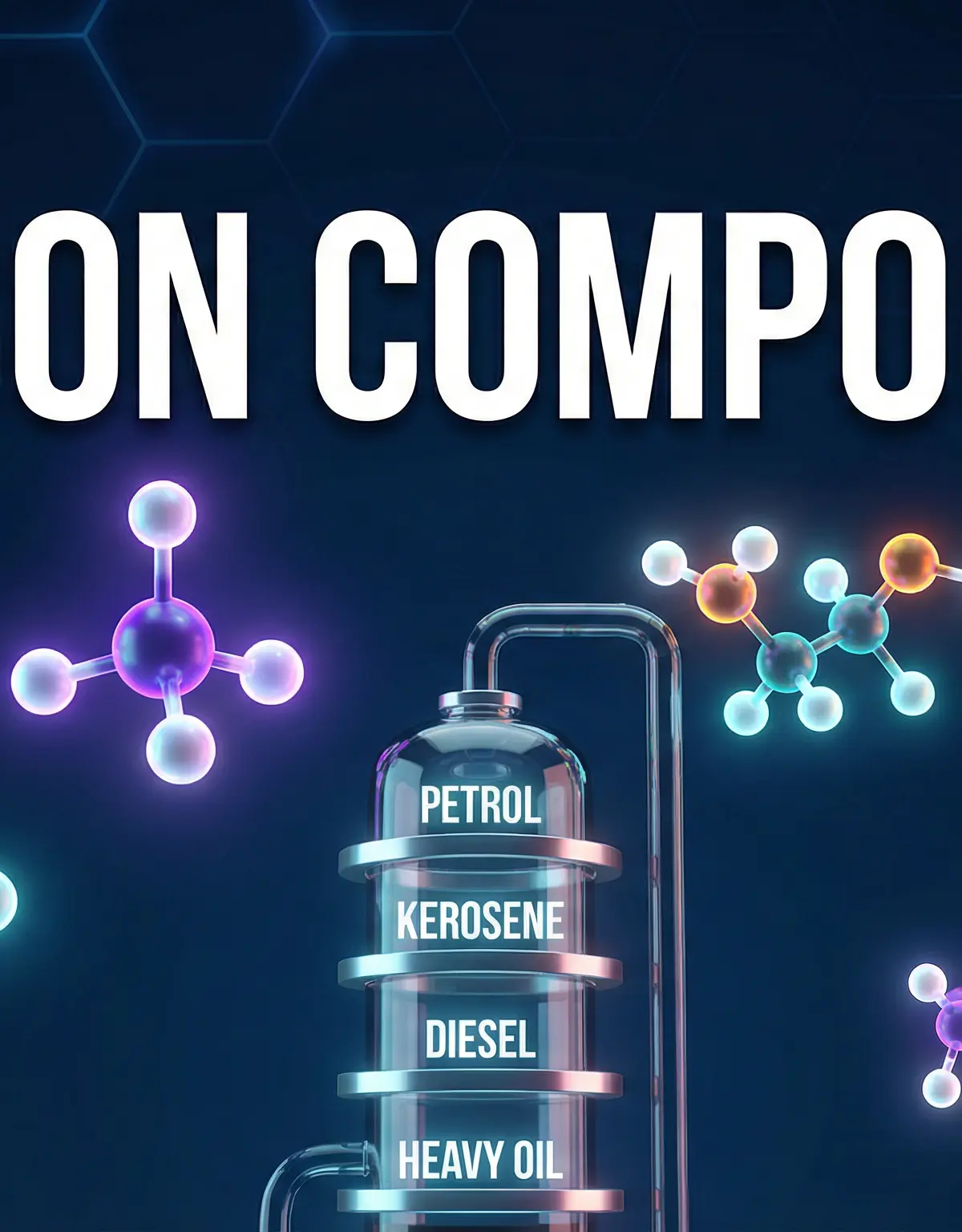
Crude oil is a finite resource found in rocks, formed over millions of years from the remains of ancient biomass, mainly plankton. It is a complex mixture of hydrocarbons—compounds containing only carbon and hydrogen atoms. Because it's a mixture, the different hydrocarbons must be separated to be useful, a process achieved through fractional distillation.
The process works because different hydrocarbons have different boiling points. The crude oil is heated until it vaporises, and the vapour enters a fractionating column that is hot at the bottom and cooler at the top. As the vapours rise, they cool and condense back into liquids at their specific boiling points. Crucially, examiners want you to link molecular size to boiling point: larger molecules have stronger intermolecular forces, requiring more energy to overcome, hence higher boiling points. They condense lower down the column.
Example: Bitumen (used for roads) has very large molecules and condenses at the hot bottom of the column. Petrol (used for cars) has smaller molecules and condenses higher up where it is cooler.
Concept 2: Cracking
Fractional distillation produces many large, heavy hydrocarbons that are not in high demand as fuels. However, there is a massive demand for smaller, lighter fractions like petrol. To solve this supply-and-demand issue, the petrochemical industry uses cracking to break down large alkane molecules into smaller, more useful alkanes and alkenes.
There are two main methods:
- Catalytic cracking: Vaporise the heavy hydrocarbon and pass it over a hot zeolite catalyst.
- Steam (thermal) cracking: Vaporise the heavy hydrocarbon, mix with steam, and heat to a very high temperature.
Cracking is a thermal decomposition reaction. It always produces at least one alkene because there are not enough hydrogen atoms to fully saturate all the new smaller molecules. This is vital because alkenes are the starting materials (monomers) for making plastics.
Concept 3: The Homologous Series
A homologous series is a 'family' of organic compounds that have the same general formula, the same functional group, and similar chemical properties. Each successive member differs by a -CH_2- unit. You must know four series:
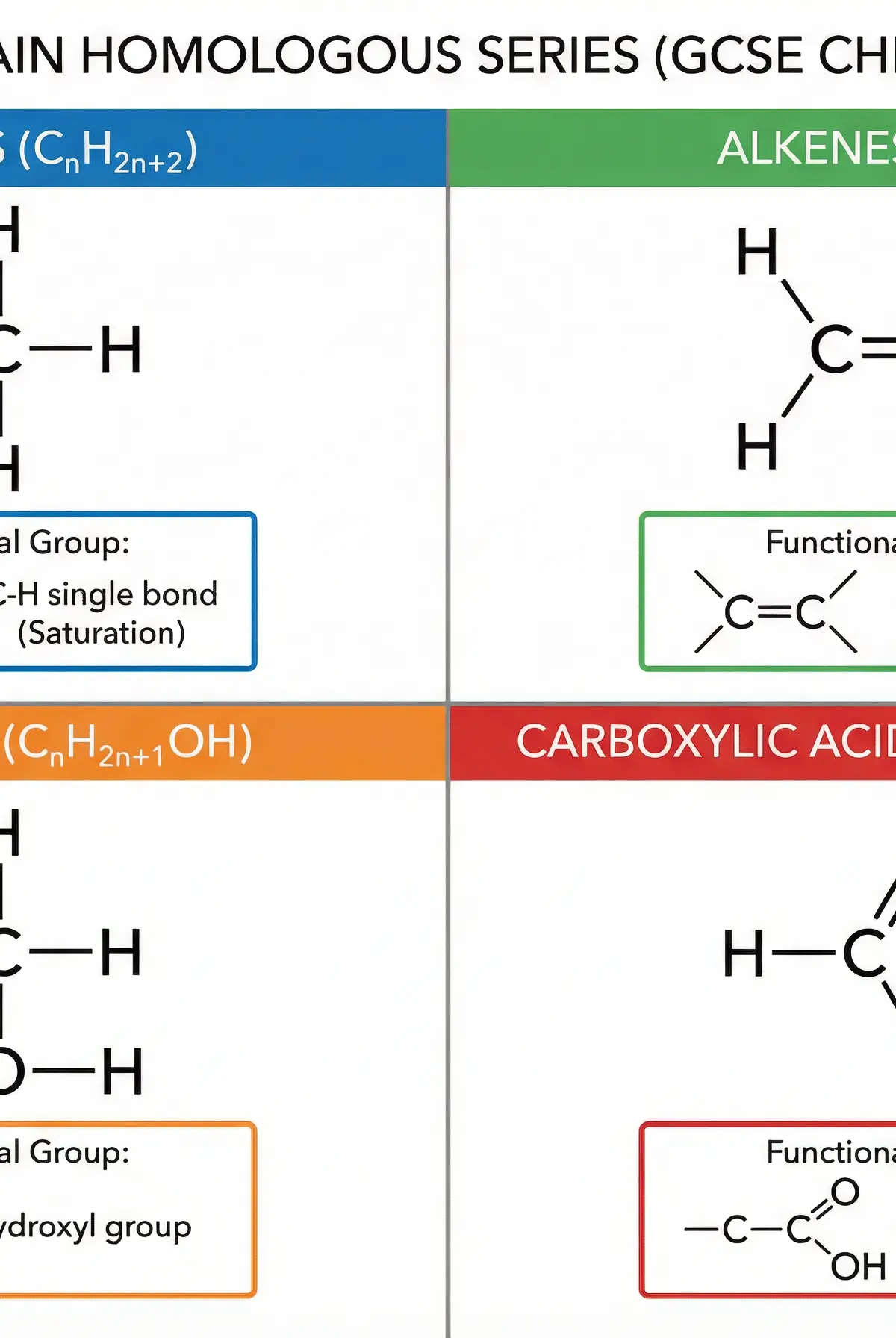
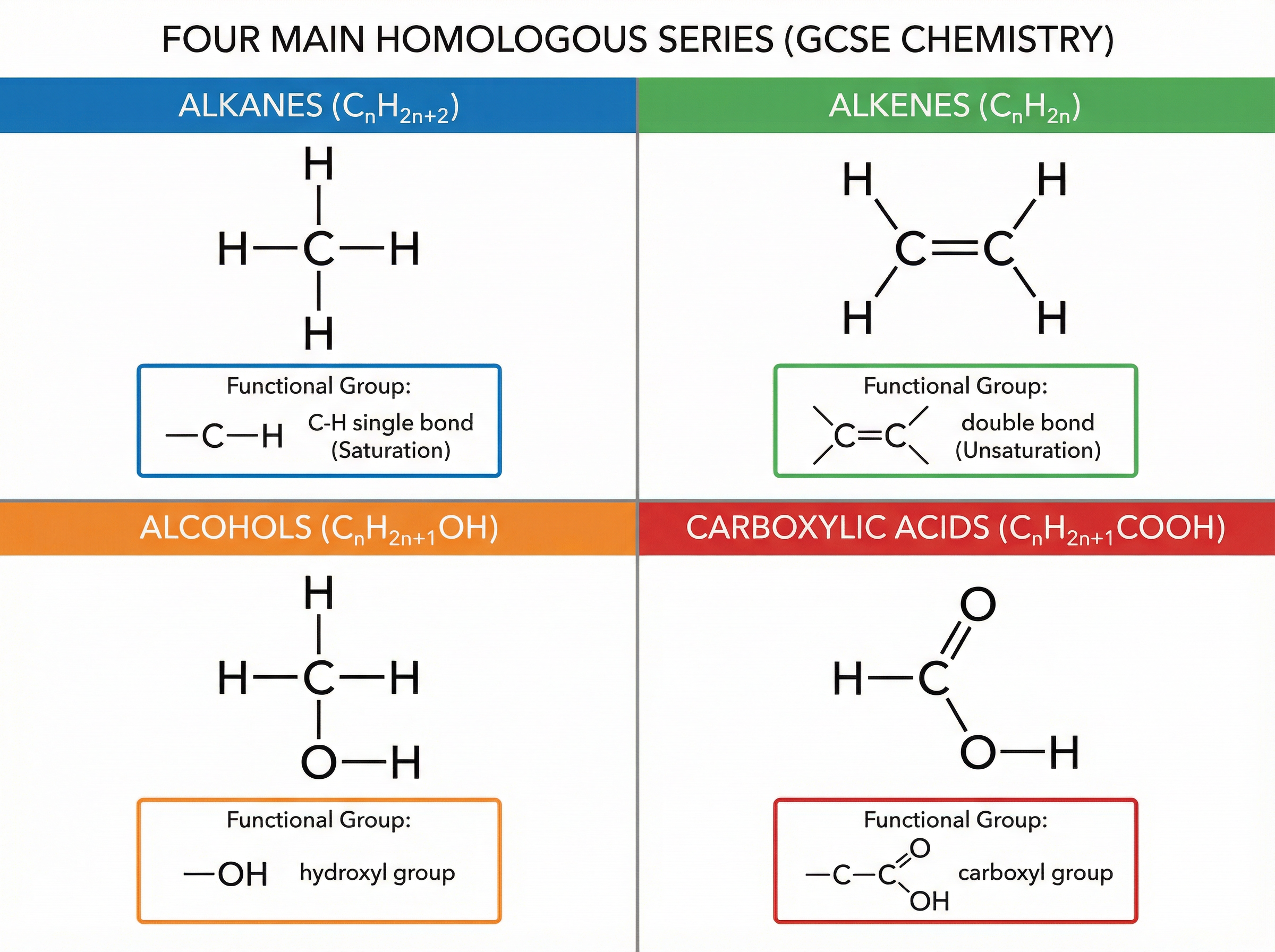
- Alkanes: Saturated hydrocarbons (only single bonds). General formula C_n H_{2n+2}. They are generally unreactive but combust well.
- Alkenes: Unsaturated hydrocarbons containing a C=C double bond. General formula C_n H_{2n}. They are more reactive and will decolourise orange bromine water.
- Alcohols: Contain the hydroxyl functional group (-OH). General formula C_n H_{2n+1}OH. They combust, react with sodium to produce hydrogen, and can be oxidised to carboxylic acids.
- Carboxylic Acids: Contain the carboxyl functional group (-COOH). General formula C_n H_{2n+1}COOH. They are weak acids that partially ionise in water.
Concept 4: Polymerisation
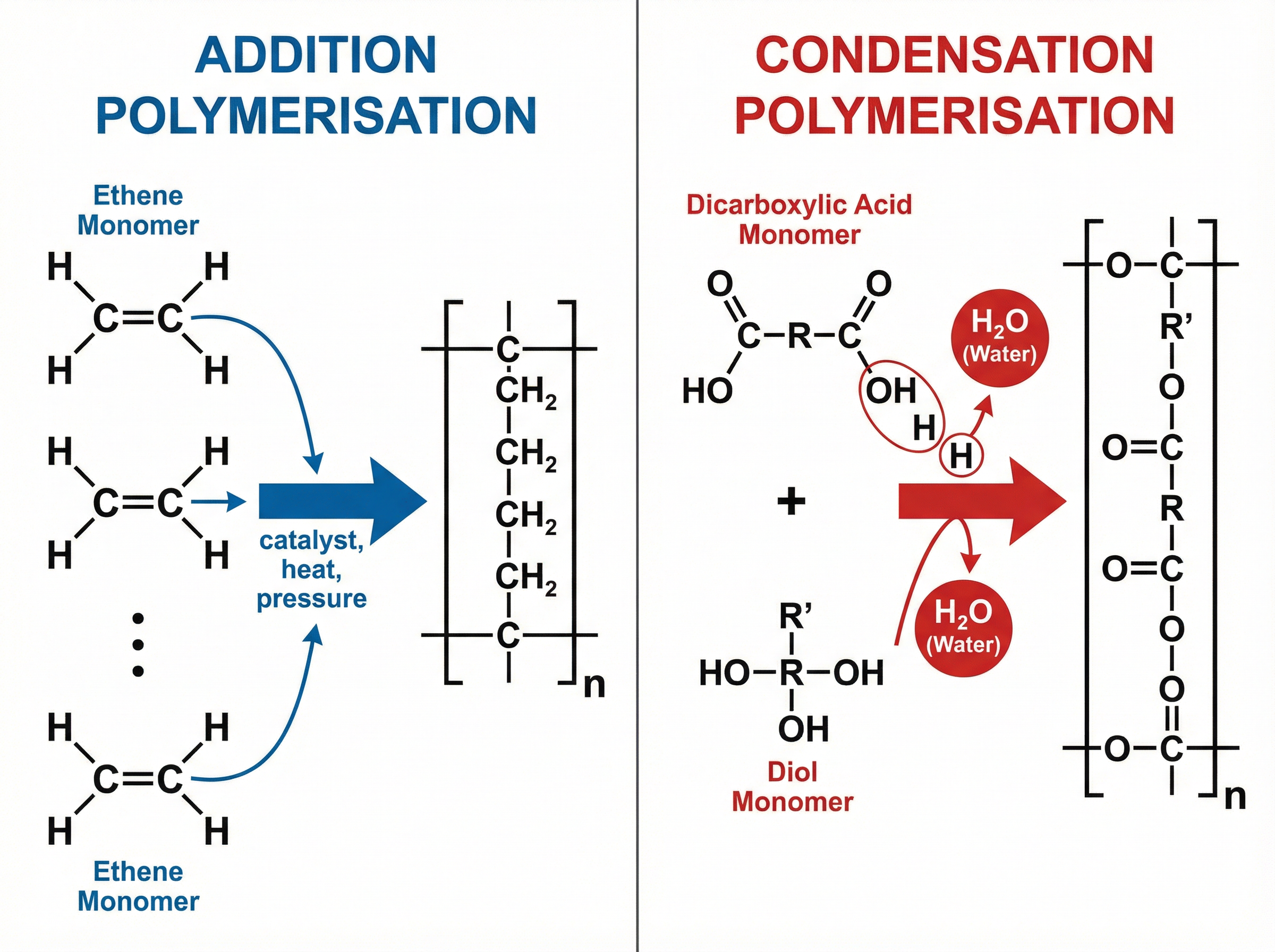
Polymerisation is the joining together of many small molecules (monomers) to form a very large molecule (polymer).
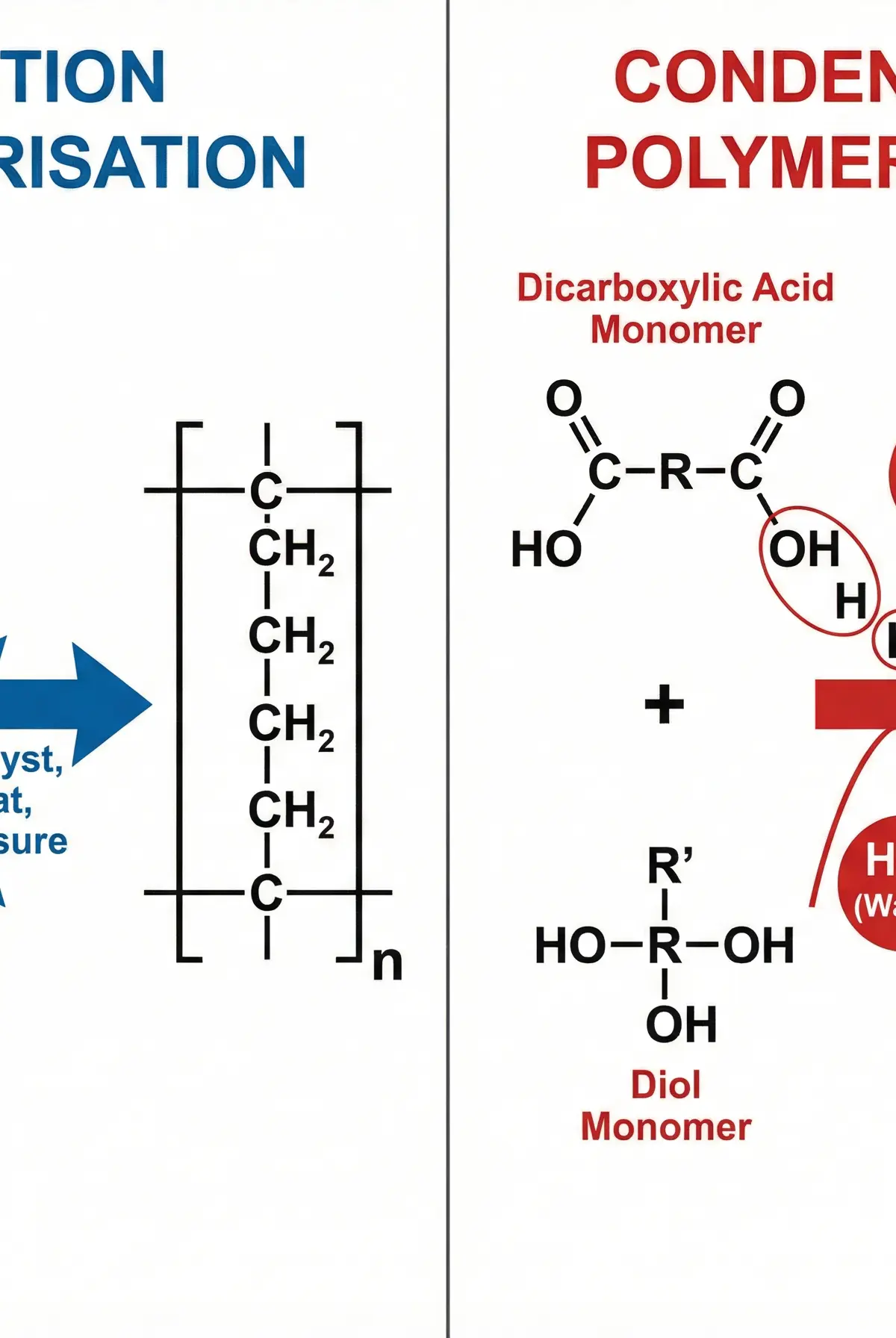
Addition Polymerisation: Involves monomers with a C=C double bond (alkenes). The double bond opens up to connect to neighbouring molecules. No other product is formed. For example, ethene monomers join to form poly(ethene).
Condensation Polymerisation: Involves monomers with two functional groups. When these monomers react and join, they lose small molecules such as water (H_2O) or hydrogen chloride (HCl). For example, a dicarboxylic acid reacts with a diol to form a polyester and water.
Mathematical/Scientific Relationships
- Alkane General Formula: C_n H_{2n+2}
- Alkene General Formula: C_n H_{2n}
- Alcohol General Formula: C_n H_{2n+1}OH
- Carboxylic Acid General Formula: C_n H_{2n+1}COOH
Note: In these formulas, 'n' represents the number of carbon atoms. You must memorise these formulas as they are not provided in the exam.
Practical Applications
- Combustion of Fuels: Alkanes are our primary fuels. Complete combustion (plenty of oxygen) produces CO_2 and H_2O. Incomplete combustion (limited oxygen) produces carbon monoxide (CO) or carbon soot (C), which has serious health and environmental impacts.
- Testing for Alkenes: The bromine water test is a standard chemical test. Adding orange bromine water to an alkene causes an addition reaction across the double bond, turning the solution colourless. Alkanes will not react, and the solution remains orange.
Visual Resources
2 diagrams and illustrations
Interactive Diagrams
2 interactive diagrams to visualise key concepts
Conceptual Flow Outline
Flowchart summarising the fractional distillation process.
Conceptual Flow Outline
The cracking process and the uses of its products.
Worked Examples
3 worked examples — open one to explore the question and available guidance.
Practice Questions
Test your understanding — click to reveal model answers
Explain why the boiling point of alkanes increases as the number of carbon atoms increases. (3 marks)
Hint: Think about the forces *between* the molecules, not the bonds *inside* them.
Compare addition polymerisation and condensation polymerisation. (4 marks)
Hint: Compare the types of monomers used and the products formed in each reaction.
A student tests two colourless liquids, A and B. Liquid A decolourises bromine water. Liquid B does not. Identify the homologous series of liquid A and liquid B. (2 marks)
Hint: Which homologous series is unsaturated and reacts with bromine?
Write the balanced chemical equation for the complete combustion of propane (C_3H_8). (3 marks)
Hint: Complete combustion always reacts with $O_2$ to produce $CO_2$ and $H_2O$. Balance the carbons first, then hydrogens, then oxygens.
Draw the fully displayed structural formula for propanoic acid. (2 marks)
Hint: Prop- means 3 carbons. The acid functional group is -COOH. Remember carbon must have 4 bonds, oxygen 2, hydrogen 1.
Test your understanding of Carbon compounds
Active recall beats re-reading. Take an instant quiz now to test what you’ve learned and lock it into long-term memory.
7 days Premium · Then free forever · No card, no charge