Eduqas · GCSE · Chemistry
Energy changes in chemistry
Master the core concepts of Energy Changes in Chemistry, from identifying exothermic and endothermic reactions to mastering reaction profiles and calculating bond energies. This topic is essential for your GCSE exams, combining conceptual understanding with vital mathematical skills.
- 6 min read
- 3 worked examples
- 5 practice questions
- 6 key terms
Study Notes
Overview
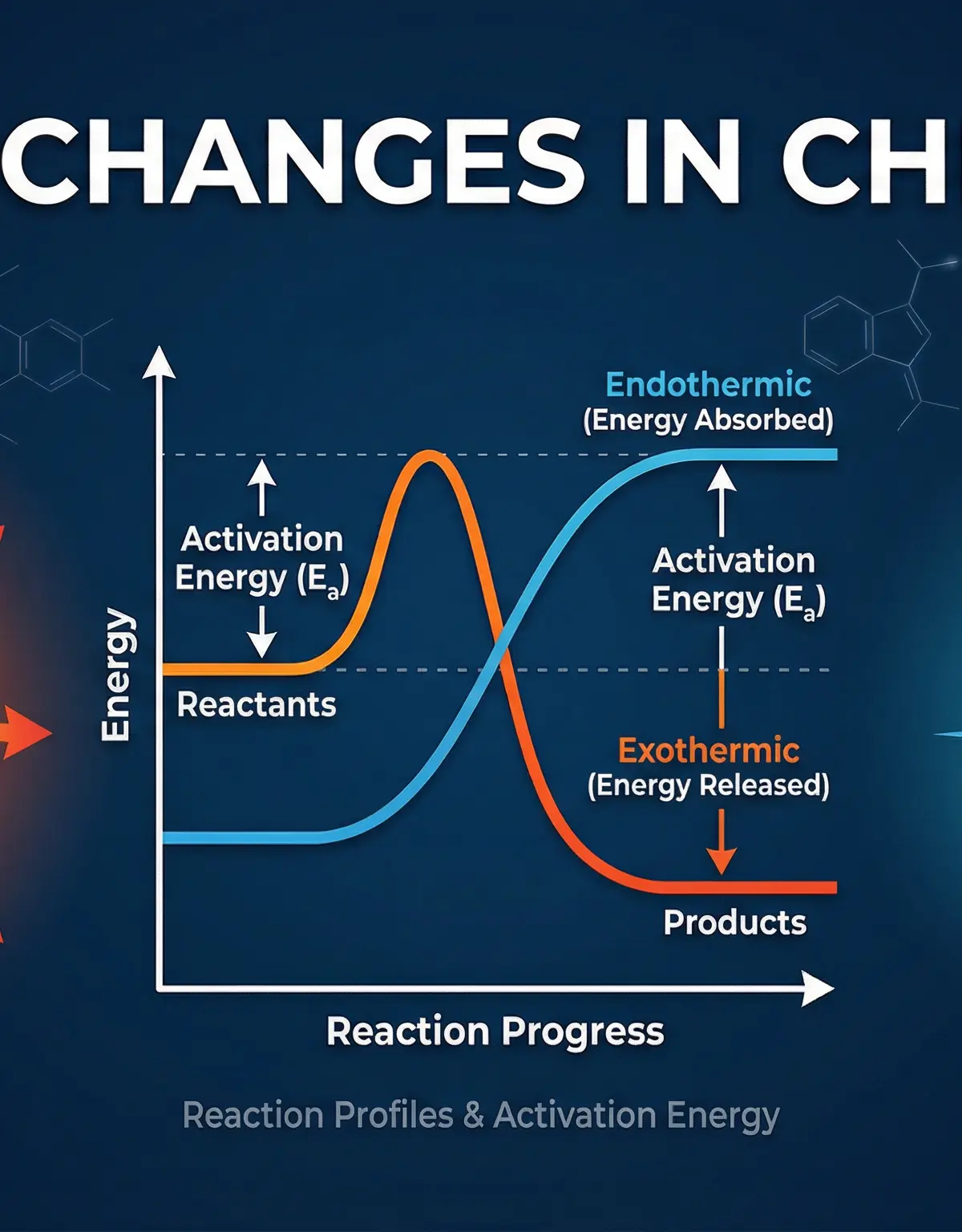
Energy Changes in Chemistry is a fundamental topic that explores the relationship between chemical reactions and the transfer of energy. Every chemical reaction involves energy: breaking bonds in reactants requires an input of energy, while forming new bonds in products releases energy. Understanding which of these processes dominates allows us to classify reactions as either exothermic or endothermic.
This topic is crucial because it bridges theoretical chemistry with real-world applications, from designing self-heating cans to developing clean energy solutions like hydrogen fuel cells. Examiners frequently test this area through a mix of qualitative descriptions, graphical interpretations (reaction profiles), and quantitative calculations (bond energies). Mastering this topic will secure you significant marks across multiple assessment objectives.
Listen to our comprehensive revision podcast for a deep dive into these concepts:
Key Concepts
Concept 1: Exothermic and Endothermic Reactions
In chemistry, we must always consider the direction of energy transfer between the chemical system (the reactants and products) and the surroundings (everything else, including the thermometer and the beaker).
An exothermic reaction is one where energy is transferred from the system to the surroundings. Because the surroundings gain energy, their temperature increases. This occurs because more energy is released when new bonds form in the products than is required to break the bonds in the reactants.
Example: Combustion, neutralisation, and oxidation reactions are typically exothermic. Hand warmers use the exothermic oxidation of iron to release heat.
An endothermic reaction is one where energy is taken in from the surroundings to the system. Because the surroundings lose energy, their temperature decreases. This occurs because more energy is required to break the bonds in the reactants than is released when new bonds form in the products.
Example: Thermal decomposition and the reaction of citric acid and sodium hydrogencarbonate are endothermic. Sports injury cold packs use an endothermic reaction to cool down quickly.
Concept 2: Reaction Profiles
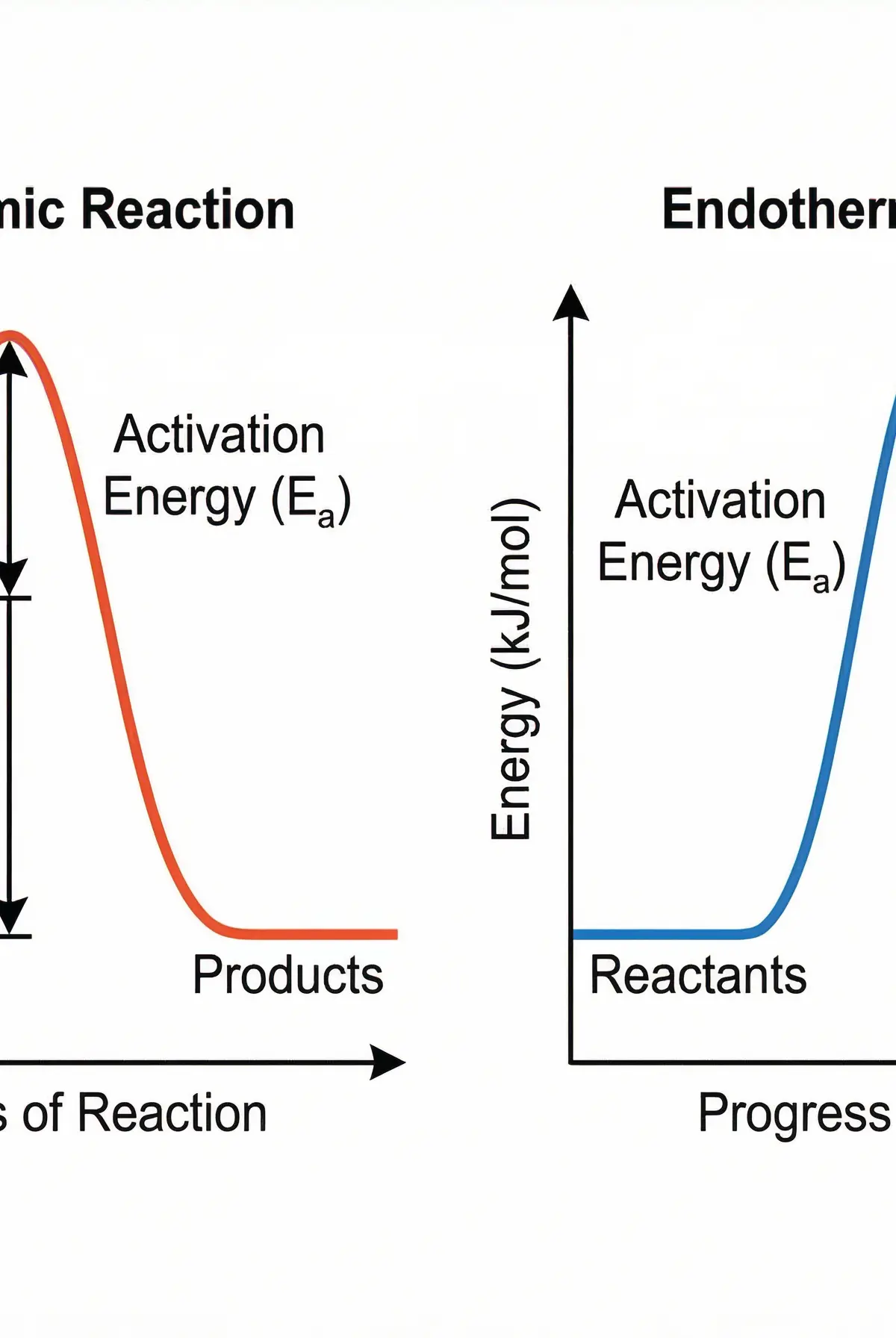
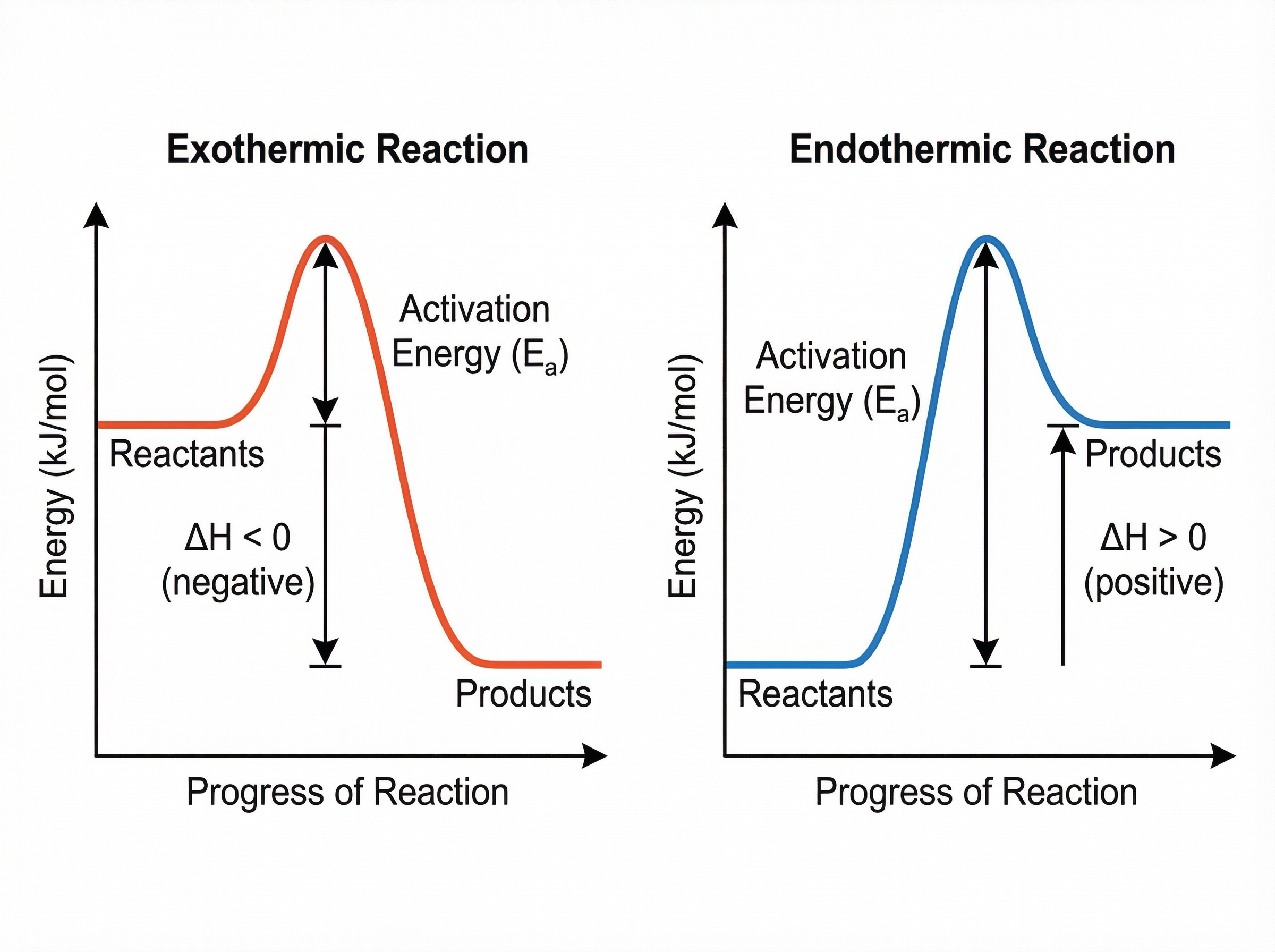
Reaction profiles (or energy level diagrams) are graphical representations of the energy changes during a chemical reaction. They show the relative energies of reactants and products, the activation energy, and the overall energy change.
- Activation Energy (E_a): The minimum amount of energy that colliding particles must possess for a reaction to occur. On a profile, it is always an upward arrow from the reactants' energy level to the peak of the curve.
- Overall Energy Change (\Delta H): The difference in energy between the reactants and the products.
For an exothermic profile, the products are at a lower energy level than the reactants. The \Delta H arrow points downwards, indicating a negative energy change.
For an endothermic profile, the products are at a higher energy level than the reactants. The \Delta H arrow points upwards, indicating a positive energy change.
Concept 3: Bond Energy Calculations
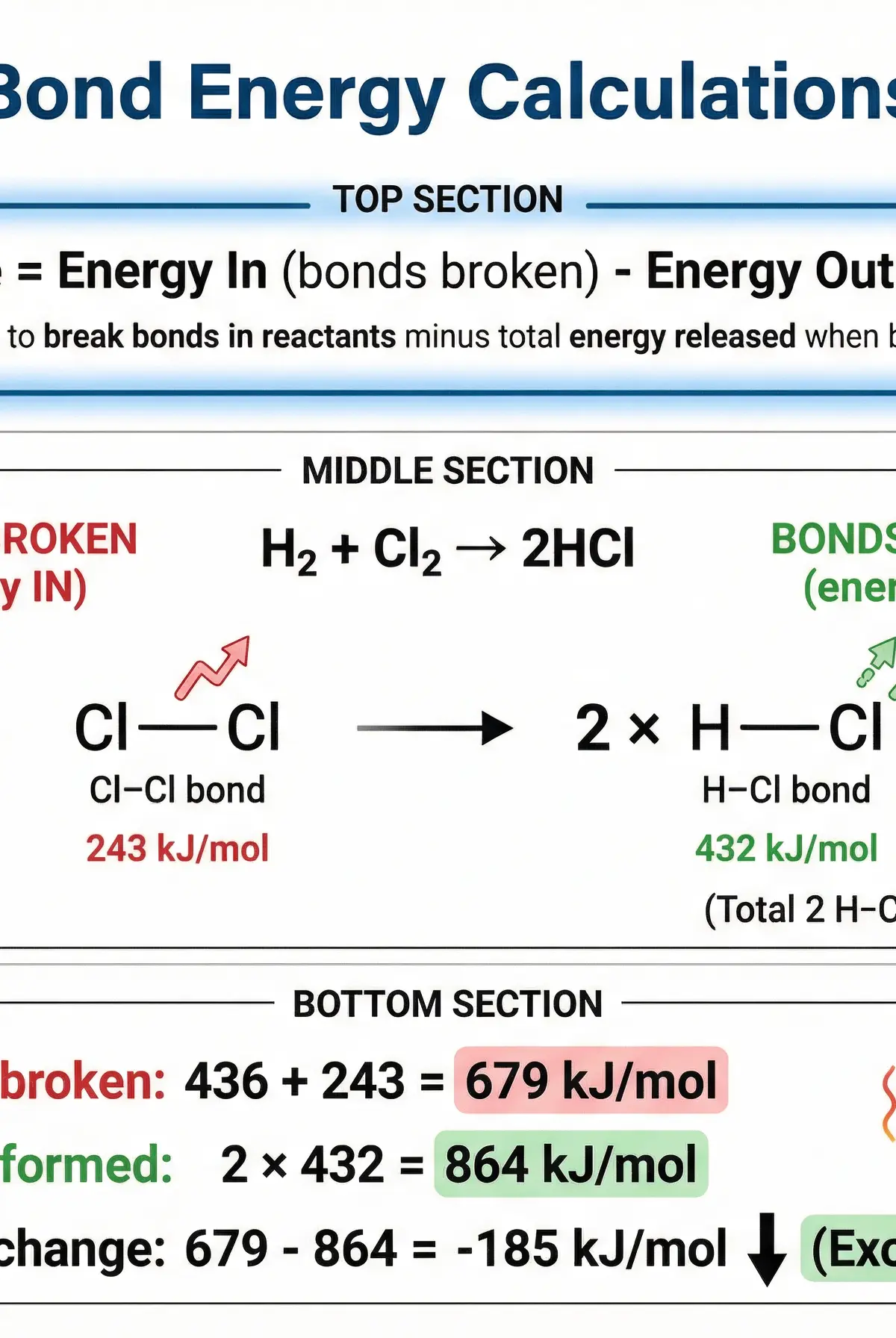
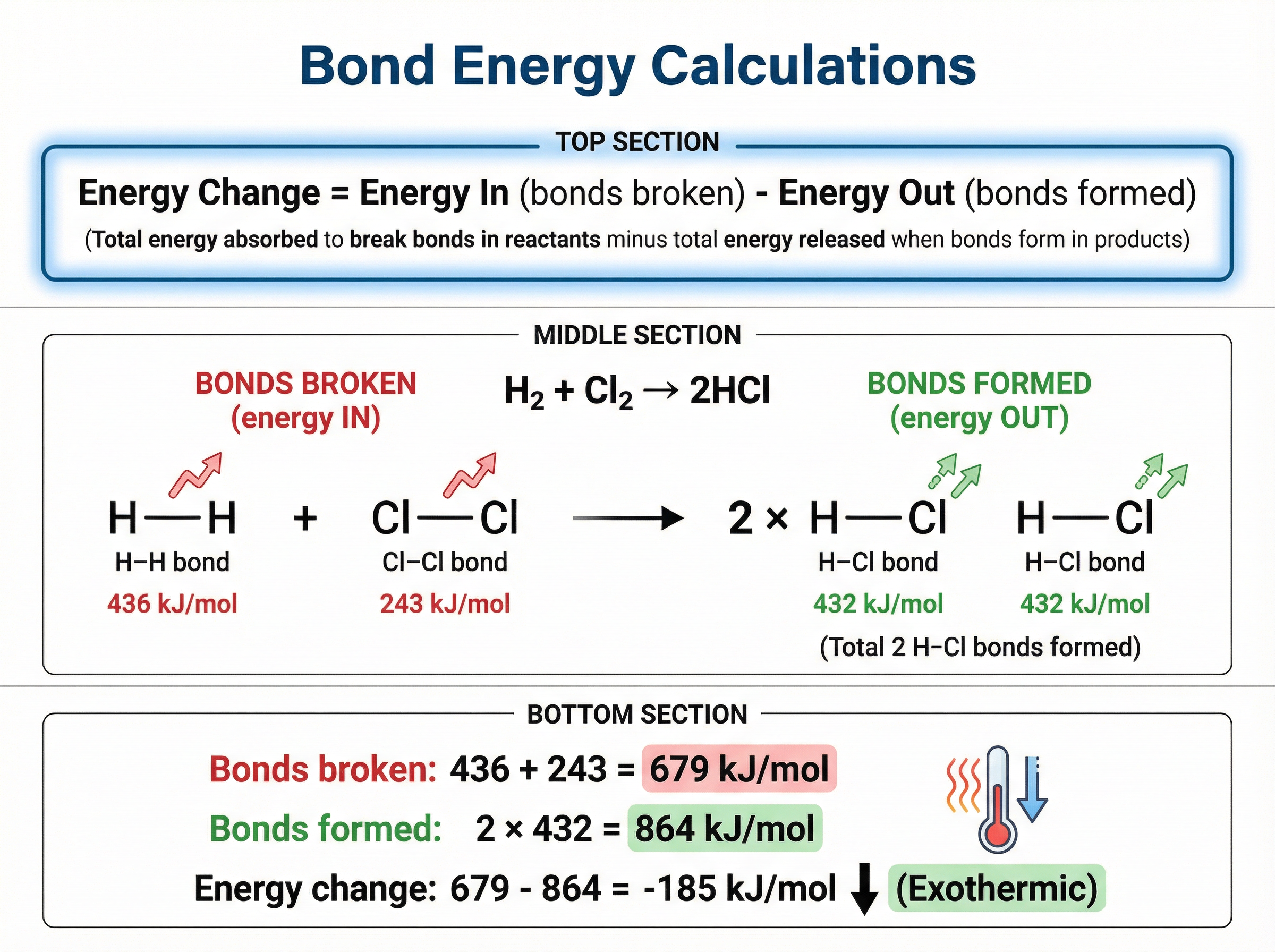
During a chemical reaction, old bonds are broken and new bonds are formed. We can calculate the overall energy change if we know the specific bond energies (the energy required to break one mole of a particular bond, measured in kJ/mol).
- Energy In: Calculate the total energy required to break all bonds in the reactants. (Endothermic process)
- Energy Out: Calculate the total energy released when all bonds in the products are formed. (Exothermic process)
- Overall Change: Subtract 'Energy Out' from 'Energy In'.
If the result is negative, the reaction is exothermic. If positive, it is endothermic.
Concept 4: Chemical Cells and Fuel Cells
Chemical Cells: A simple cell can be made by connecting two different metals in contact with an electrolyte. The difference in reactivity between the metals generates a potential difference (voltage). However, these cells are non-rechargeable; once one of the reactants is depleted, the reaction stops.
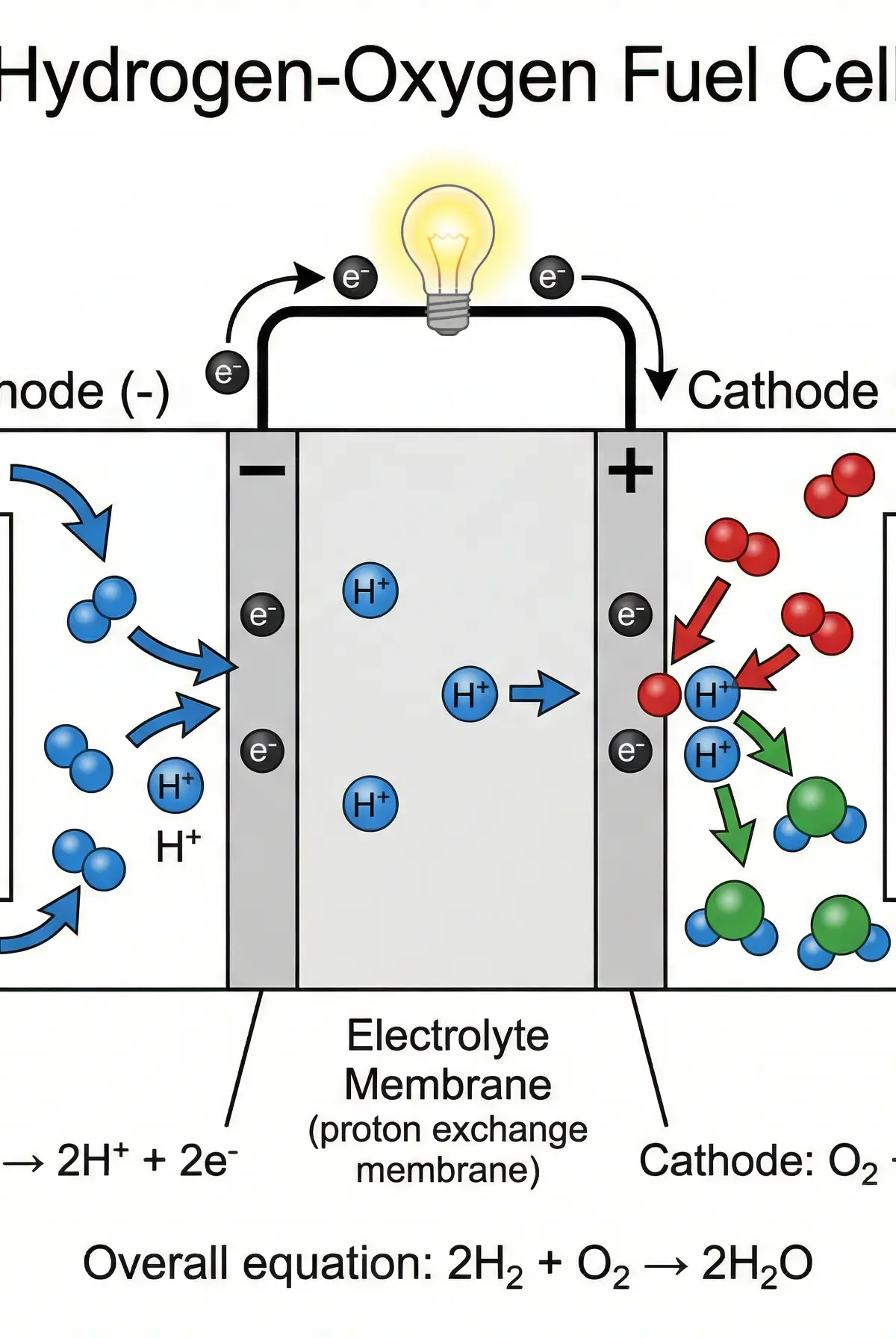
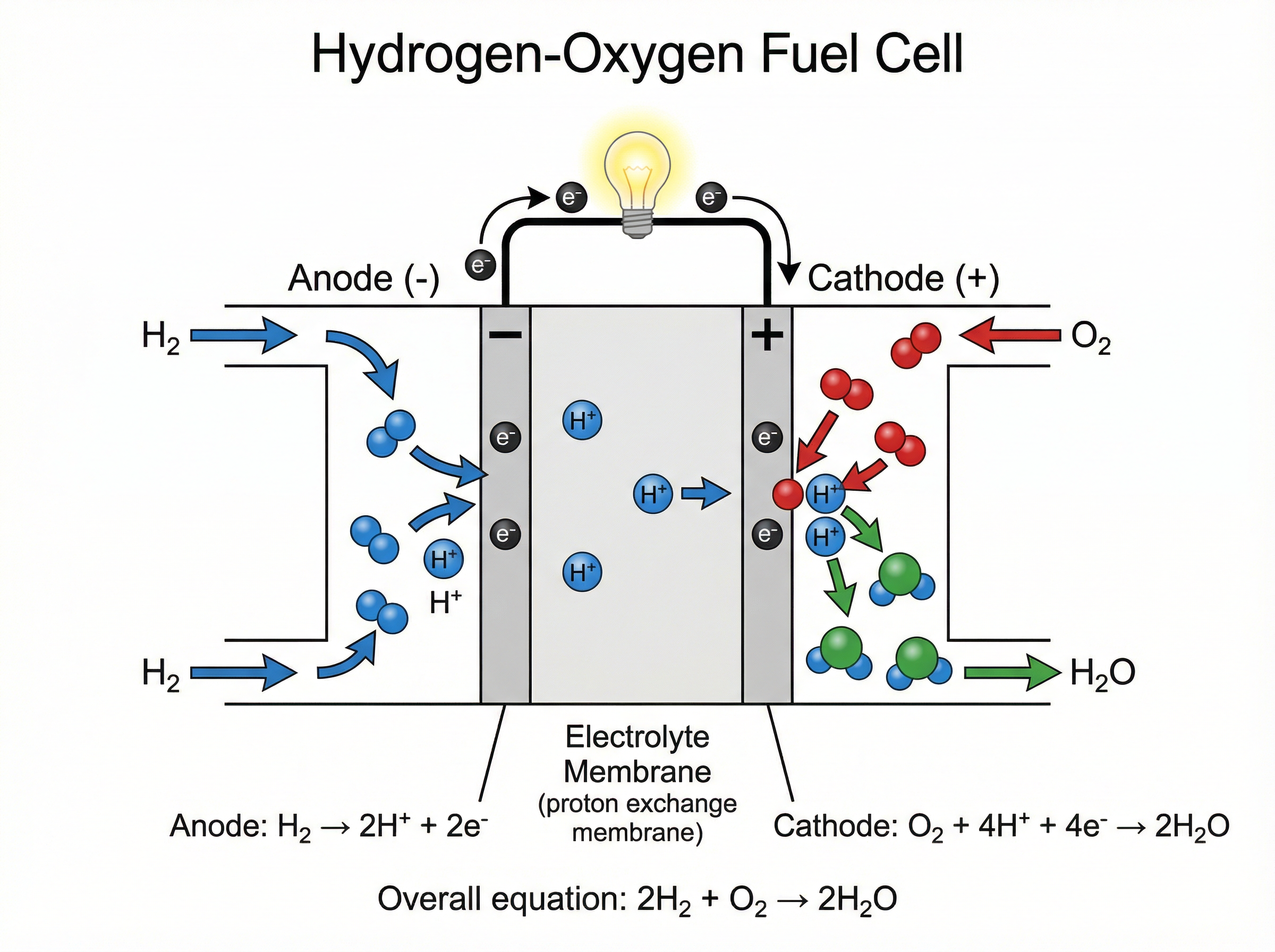
Fuel Cells: A fuel cell produces a continuous voltage as long as it is supplied with an external fuel (like hydrogen) and oxygen. In a hydrogen-oxygen fuel cell, hydrogen is oxidised at the anode, and oxygen is reduced at the cathode. The only product is water, making it a clean energy alternative to combustion engines. However, the hydrogen fuel is often produced from fossil fuels, and it is difficult to store and transport.
Mathematical/Scientific Relationships
Overall Energy Change = Total Energy to Break Bonds - Total Energy Released Forming Bonds
- Symbolic Form: \Delta H = \Sigma \text{Bonds Broken} - \Sigma \text{Bonds Formed}
- Units: kJ/mol (kilojoules per mole)
- Must memorise: Yes. This formula is not typically provided on the data sheet.
Overall Equation for Hydrogen Fuel Cell:
2H_2 + O_2 \rightarrow 2H_2O
Half-Equations for Hydrogen Fuel Cell:
- Anode (Oxidation): H_2 \rightarrow 2H^+ + 2e^-
- Cathode (Reduction): O_2 + 4H^+ + 4e^- \rightarrow 2H_2O
Practical Applications
Required Practical: Investigating Temperature ChangesStudents are required to investigate the variables that affect temperature changes in reacting solutions, such as the reaction between an acid and an alkali (neutralisation).
- Apparatus: Polystyrene cup (acts as an insulator to reduce heat loss to the surroundings), beaker (for stability), thermometer with a lid (to prevent heat loss via convection).
- Method: Measure a set volume of acid into the cup. Record the initial temperature. Add a set volume/mass of the second reactant (e.g., alkali or metal). Stir and record the maximum (or minimum) temperature reached. Calculate the temperature change.
- Common Errors: The biggest source of error is heat loss to the surroundings. Using a polystyrene cup with a lid minimizes this, making the maximum temperature recorded more accurate.
- Examiner Focus: Examiners often ask why a polystyrene cup is used instead of a glass beaker, or ask candidates to plot the temperature changes on a graph and extrapolate lines to find the theoretical maximum temperature change.
Visual Resources
3 diagrams and illustrations
Interactive Diagrams
2 interactive diagrams to visualise key concepts
Conceptual Flow Outline
Flowchart for calculating overall energy changes using bond energies.
Conceptual Flow Outline
Process flow of a Hydrogen-Oxygen Fuel Cell.
Worked Examples
3 worked examples — open one to explore the question and available guidance.
Practice Questions
Test your understanding — click to reveal model answers
A student investigates the temperature change when zinc reacts with copper sulfate solution. The initial temperature is 21.0 °C and the maximum temperature reached is 34.5 °C. State whether this reaction is exothermic or endothermic and explain your answer. (2 marks)
Hint: Look at the temperature change. Did the surroundings get hotter or colder?
Sketch a fully labelled reaction profile for an endothermic reaction. (4 marks)
Hint: Remember where the products line should be relative to the reactants line for an endothermic reaction.
Hydrogen peroxide decomposes into water and oxygen. The overall energy change is -196 kJ/mol. Explain what this value tells you about the bond breaking and bond making processes in this reaction. (3 marks)
Hint: What does the negative sign mean? How does that relate to MEX BENDO?
Explain why a polystyrene cup is used instead of a glass beaker when investigating temperature changes in chemical reactions. (2 marks)
Hint: Think about the properties of polystyrene compared to glass.
Write the half-equation for the reaction that occurs at the cathode in a hydrogen fuel cell. (2 marks)
Hint: What gas enters at the cathode, and what does it react with to form water?
Test your understanding of Energy changes in chemistry
Active recall beats re-reading. Take an instant quiz now to test what you’ve learned and lock it into long-term memory.
7 days Premium · Then free forever · No card, no charge