AQA · A-Level · Economics
The Balance of Payments
The Balance of Payments is one of the most analytically demanding topics in AQA A-Level Economics, requiring candidates to disaggregate complex international financial flows and evaluate competing policy responses within a global trade context. Understanding why the UK has run a persistent current account deficit — and what can realistically be done about it — sits at the heart of Paper 2 and Paper 3 evaluation questions. Mastery of the Marshall-Lerner Condition, J-Curve effect, and the distinction between expenditure-switching and expenditure-reducing policies will unlock the highest mark bands.
- 9 min read
- 3 worked examples
- 5 practice questions
- 9 key terms
Study Notes
Overview
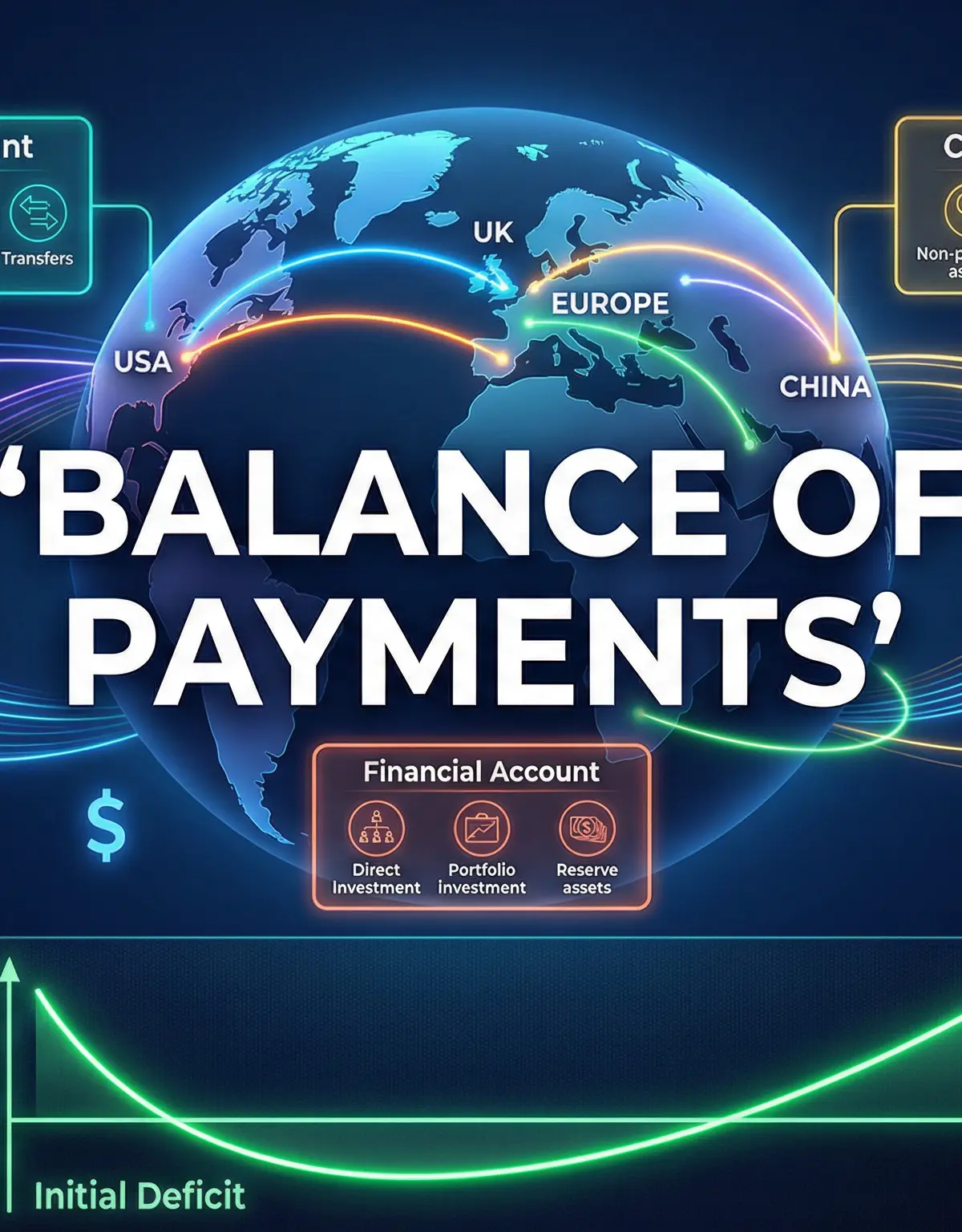
The Balance of Payments (BoP) is a systematic record of all economic transactions between residents of a country and the rest of the world over a defined period, typically one calendar year. For AQA A-Level Economics candidates, this topic sits within Theme 4 (A Global Perspective) and is examined across both Paper 2 and Paper 3. Examiners expect candidates to demonstrate not merely definitional knowledge but the capacity to analyse the causes of disequilibria, evaluate the effectiveness of correction policies, and make sustained judgements about the trade-offs involved.
The UK provides a compelling real-world case study: it has run a persistent current account deficit for most of the past three decades, reaching approximately 8.3% of GDP in 2022 — one of the largest in the UK's post-war history. Understanding why this deficit persists, and what can realistically be done about it, is the analytical core of this topic. Assessment Objective weightings for this topic are AO1 (knowledge): 20%, AO2 (application): 25%, AO3 (analysis): 30%, and AO4 (evaluation): 25% — signalling that evaluation is the primary differentiator between mark bands.
The Three Accounts of the Balance of Payments
The Current Account
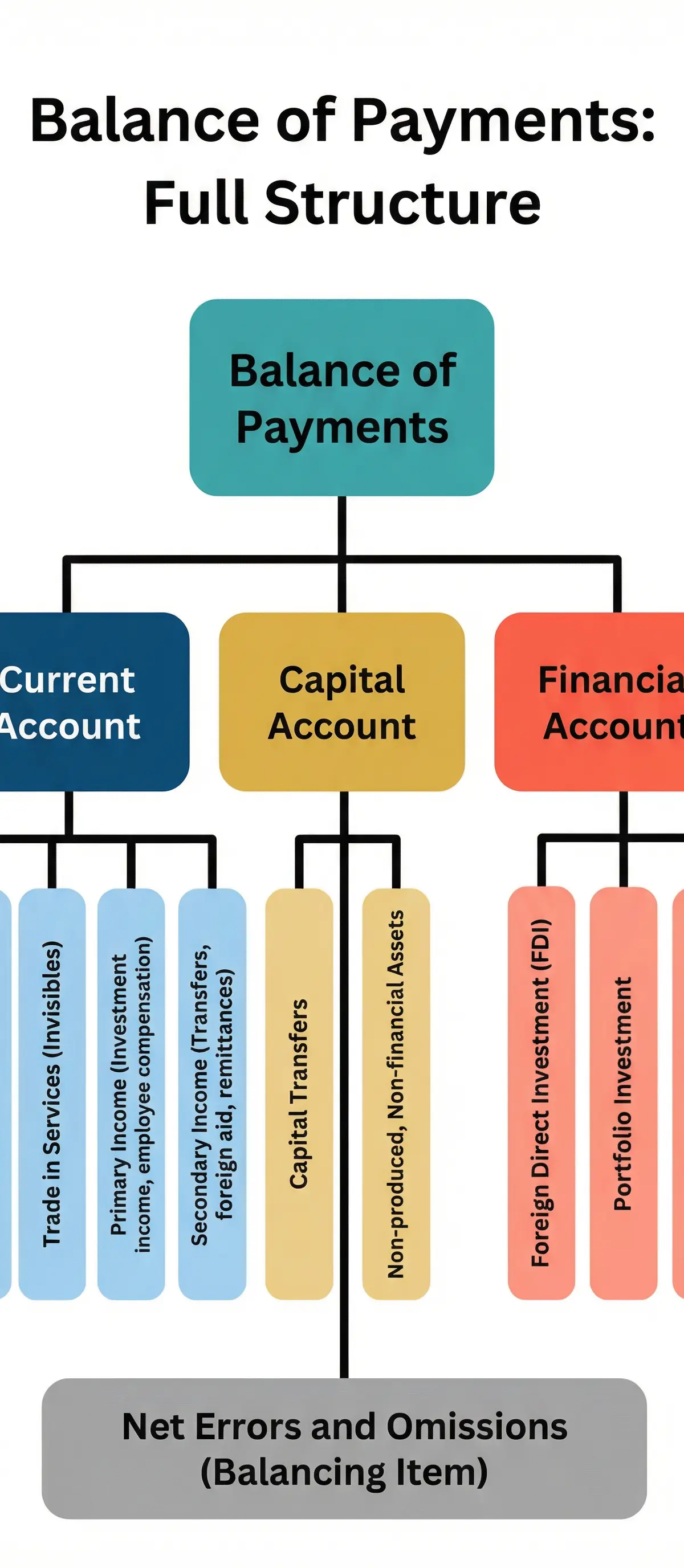
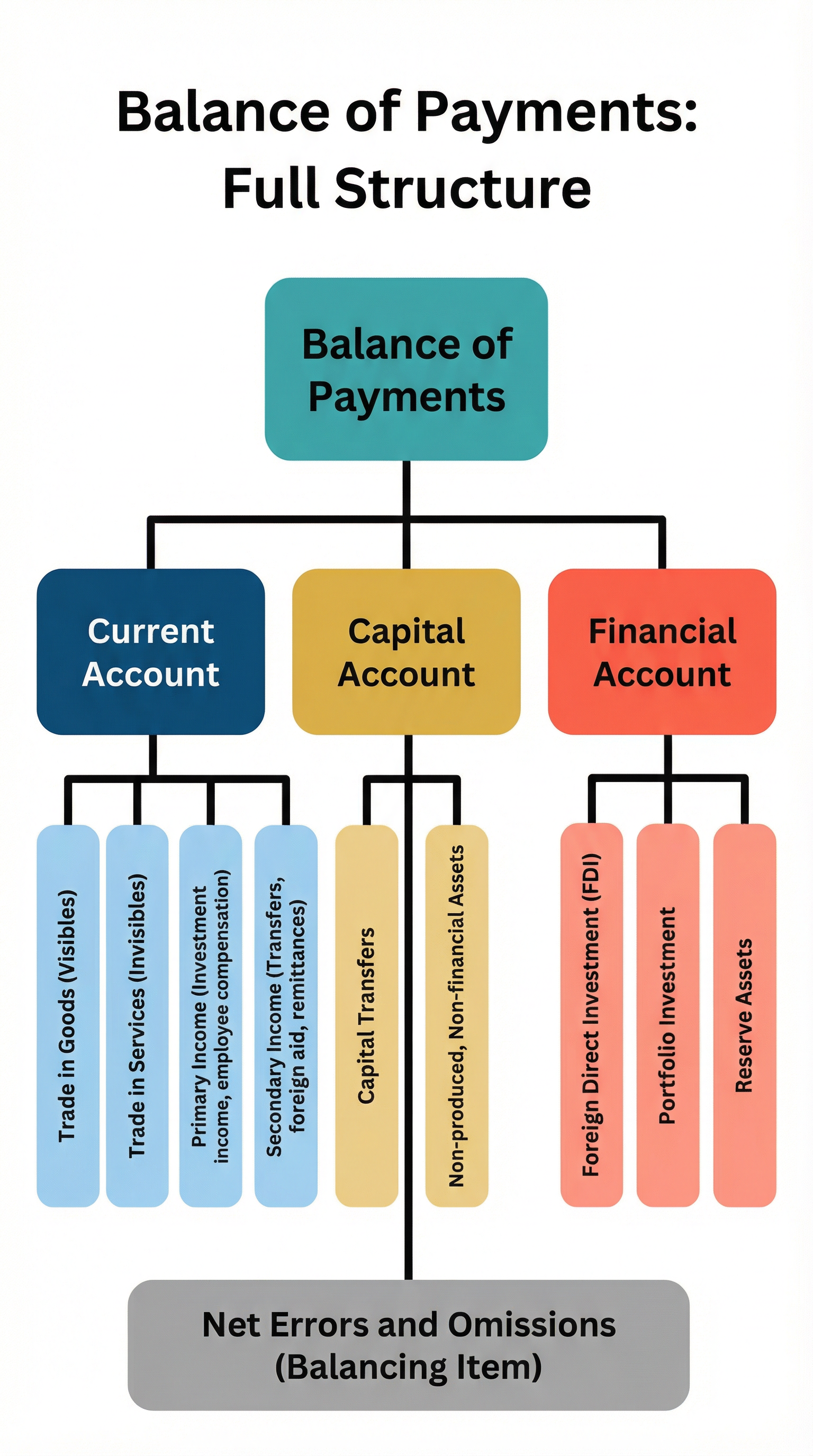
The Current Account is the most extensively examined component of the BoP. It records the flow of goods, services, and income between the UK and the rest of the world. Critically, it comprises four distinct sub-components, and candidates who omit any of them will be penalised by examiners.
Trade in Goods (Visibles): Records exports and imports of physical, tangible goods — manufactured products, raw materials, food, energy. The UK has run a persistent deficit in goods for decades, reflecting the structural decline of manufacturing since the 1980s. In 2023, the UK goods deficit stood at approximately £180 billion, driven by imports of machinery, vehicles, and energy.
Trade in Services (Invisibles): Records exports and imports of intangible services — financial services, insurance, legal and professional services, education, and tourism. The UK runs a consistent surplus in services, underpinned by the global pre-eminence of the City of London. In 2023, the services surplus was approximately £130 billion. This surplus partially offsets the goods deficit, but is insufficient to eliminate the overall current account deficit.
Primary Income: Covers investment income flows — dividends and interest earned on UK-owned assets abroad, minus dividends and interest paid to foreign owners of UK assets. It also includes compensation of employees for cross-border workers. This component can fluctuate significantly with global interest rates and the profitability of multinational corporations.
Secondary Income (Current Transfers): Covers unilateral transfers with no corresponding exchange of goods or services — foreign aid disbursements, migrant remittances, and contributions to international bodies. Historically, UK contributions to the EU budget were a significant deficit item here; post-Brexit, this has changed.
The Capital Account
The Capital Account is relatively small in the UK context. It records capital transfers (such as debt forgiveness or inheritance taxes paid by migrants) and transactions in non-produced, non-financial assets such as patents, copyrights, and land. While candidates should be aware of its existence, it rarely drives high-mark examination questions.
The Financial Account
The Financial Account records flows of financial investment between the UK and the rest of the world. It has three principal components:
Foreign Direct Investment (FDI): Long-term investment in productive capacity — a foreign firm building a factory or acquiring a controlling stake in a UK company. FDI is considered the most stable form of capital inflow, reflecting long-run confidence in an economy.
Portfolio Investment: Purchases of financial assets (shares, bonds) without a controlling interest. Portfolio investment is inherently more volatile than FDI and can reverse rapidly in response to changes in investor sentiment or relative interest rates.
Reserve Assets: Foreign currency reserves held by the Bank of England. Changes in reserves reflect official intervention in foreign exchange markets.
The critical macroeconomic identity that high-level candidates must articulate is: a current account deficit must be financed by a financial account surplus. If the UK spends more on imports than it earns from exports, it must attract an equivalent inflow of foreign capital. This means foreign investors are acquiring UK assets — government gilts, property, equities. While this is sustainable in the short run, persistent reliance on volatile 'hot money' portfolio flows creates macroeconomic vulnerability.
Causes of Current Account Disequilibria
Examiners award marks for distinguishing between cyclical and structural causes of a current account deficit.
Cyclical Causes: During periods of strong economic growth, rising real incomes increase consumer spending, including on imported goods. The income elasticity of demand for imports means that as GDP rises, import spending rises proportionally more. Cyclical deficits tend to self-correct as the economy moves through the business cycle — during recessions, import demand contracts and the deficit narrows.
Structural Causes: These reflect deep-seated, persistent weaknesses in an economy's productive capacity. The UK's structural goods deficit reflects the long-run deindustrialisation that accelerated from the 1980s onwards. The UK now imports the majority of its manufactured goods from economies with lower unit labour costs or higher productivity. This is directly linked to the UK's productivity gap: UK output per hour worked is approximately 15-20% below that of Germany and France, and further behind the United States. Without sustained investment in skills, infrastructure, and technology, structural deficits are unlikely to self-correct.
Consequences of a Persistent Current Account Deficit
Candidates must evaluate consequences rather than simply listing them. A persistent current account deficit can:
- Exert downward pressure on the exchange rate, as the supply of sterling in foreign exchange markets exceeds demand. A depreciating pound raises import prices, contributing to cost-push inflation.
- Represent a drag on Aggregate Demand: since AD = C + I + G + (X - M), a widening deficit reduces net exports and therefore AD, potentially slowing growth.
- Create dependency on foreign capital: financing the deficit through financial account inflows means the UK economy becomes vulnerable to sudden reversals of capital flows — a 'sudden stop' scenario.
However, evaluation requires candidates to note that a current account deficit is not inherently harmful. For a developing economy, a deficit may reflect high investment in imported capital goods that will expand productive capacity. For the UK, a goods deficit coexists with a services surplus, and the overall deficit may be sustainable if financed by stable FDI rather than volatile portfolio flows.
Policies to Correct a Current Account Deficit
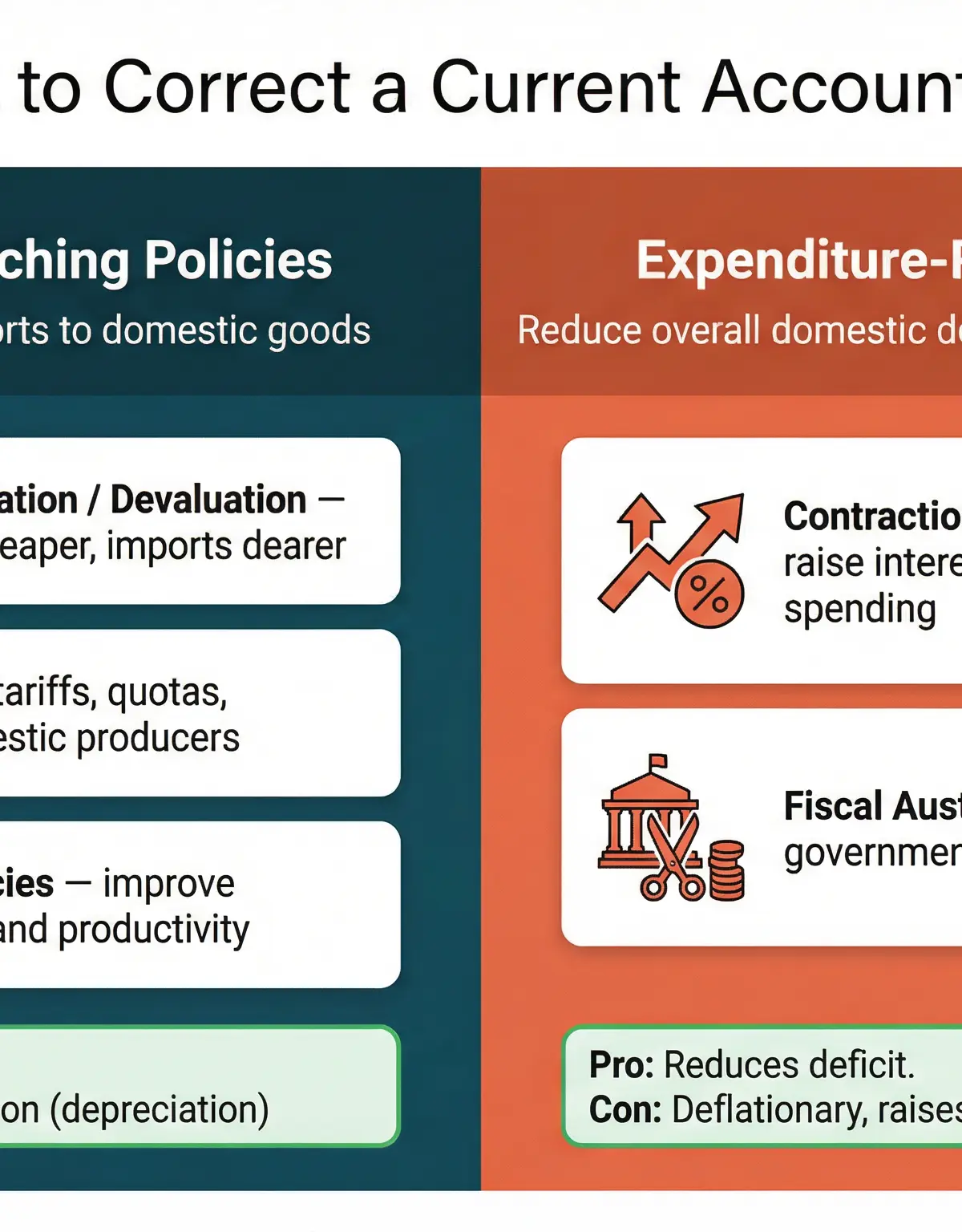
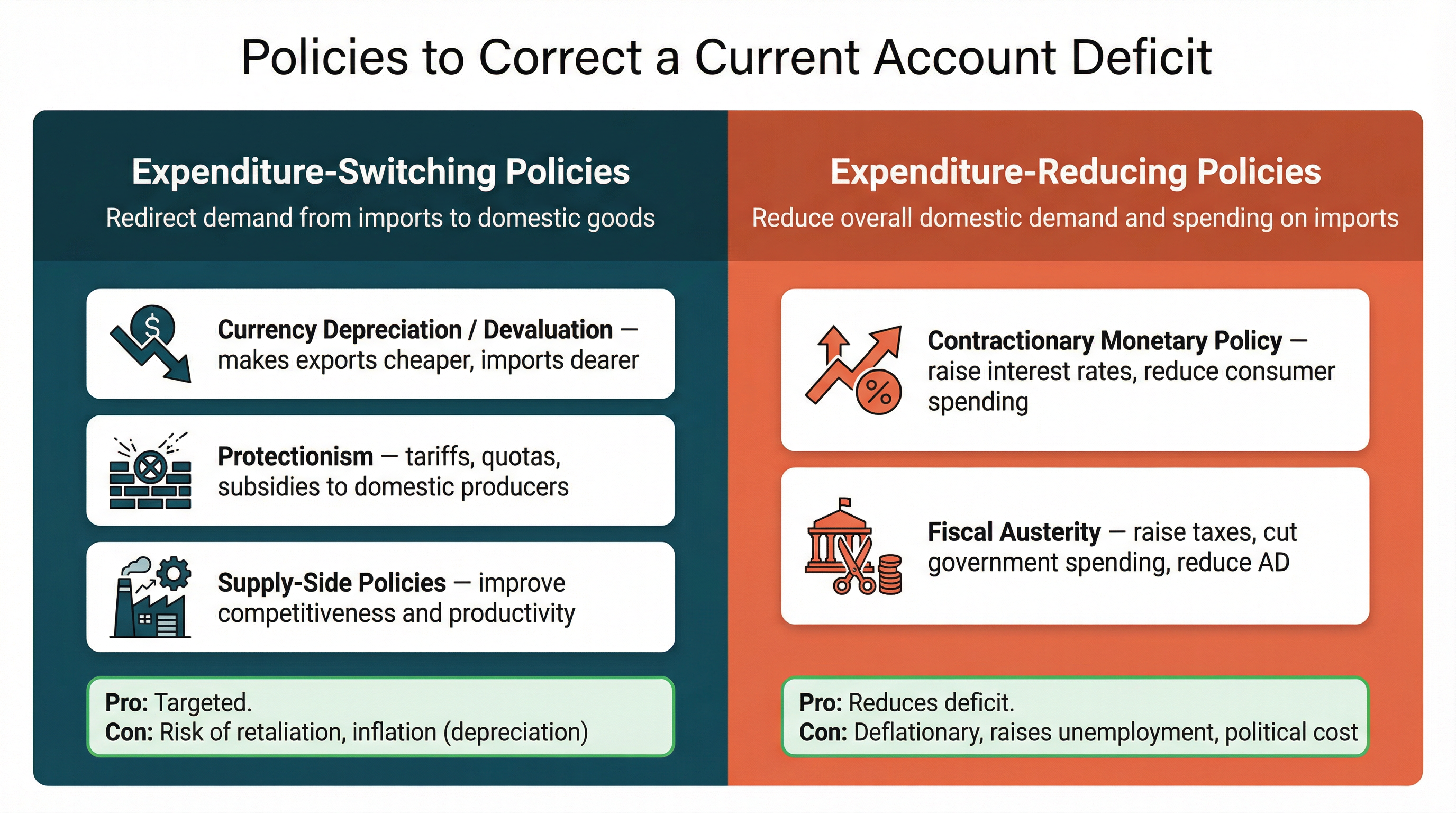
Examiners specifically require candidates to distinguish between expenditure-switching and expenditure-reducing policies.
Expenditure-Switching Policies redirect domestic demand away from imports and towards domestically produced goods:
- Currency Depreciation/Devaluation: A fall in the exchange rate makes exports cheaper for foreign buyers and imports more expensive for domestic consumers. Effectiveness depends on the Marshall-Lerner Condition.
- Protectionism: Tariffs, import quotas, and subsidies to domestic producers. Effective in the short run but risks WTO violations and retaliatory measures from trading partners.
- Supply-Side Policies: Improving productivity, skills, and infrastructure to make domestic producers more internationally competitive. The most sustainable long-run solution, but slow to take effect.
Expenditure-Reducing Policies lower overall domestic demand, thereby reducing import spending:
- Contractionary Monetary Policy: Raising interest rates reduces consumer borrowing and spending, lowering import demand. However, higher rates also attract capital inflows, potentially appreciating the exchange rate and worsening the trade balance.
- Fiscal Austerity: Reducing government spending or raising taxes contracts aggregate demand. Effective but carries significant costs — lower growth, higher unemployment, and political unpopularity.
The Marshall-Lerner Condition and J-Curve Effect
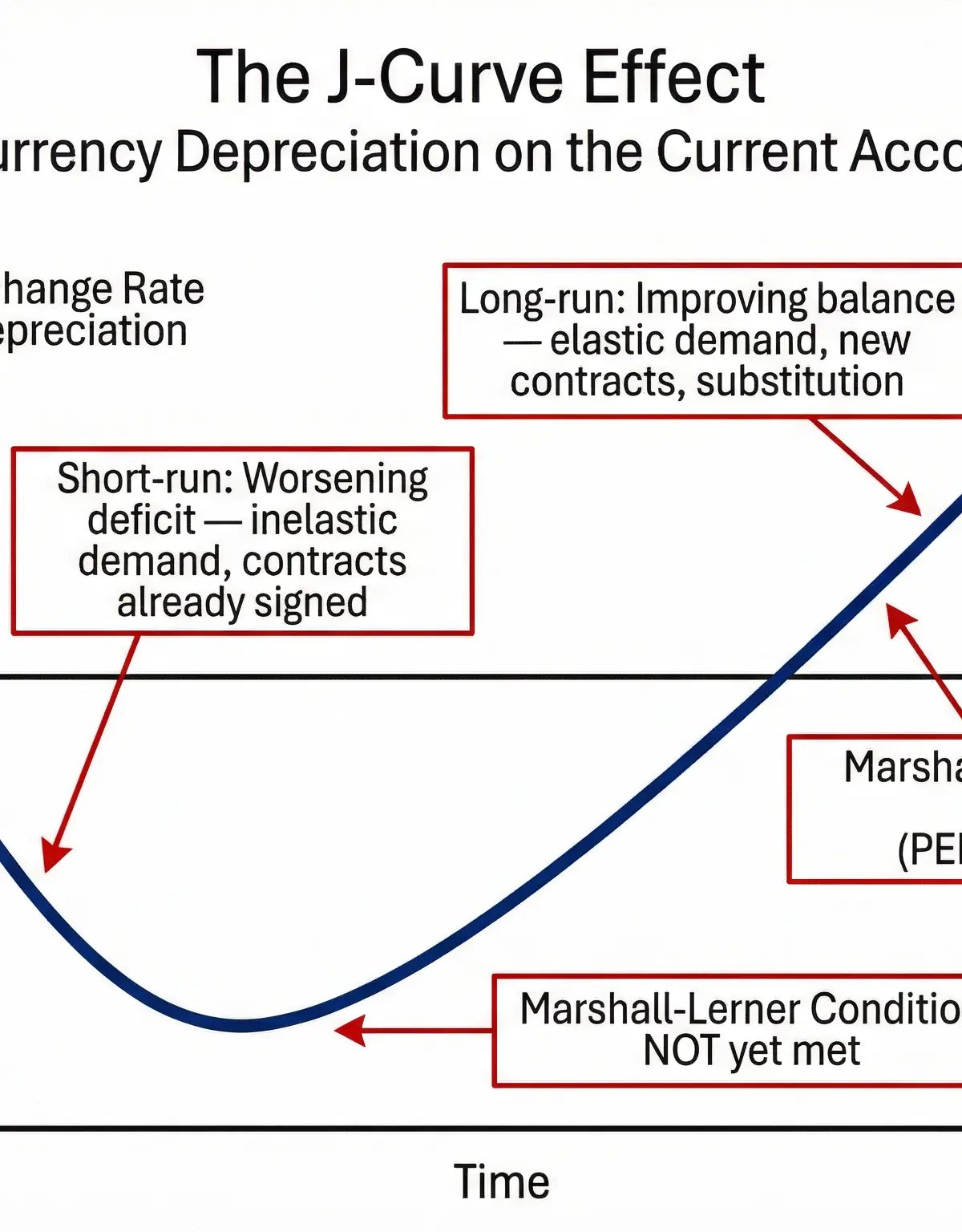
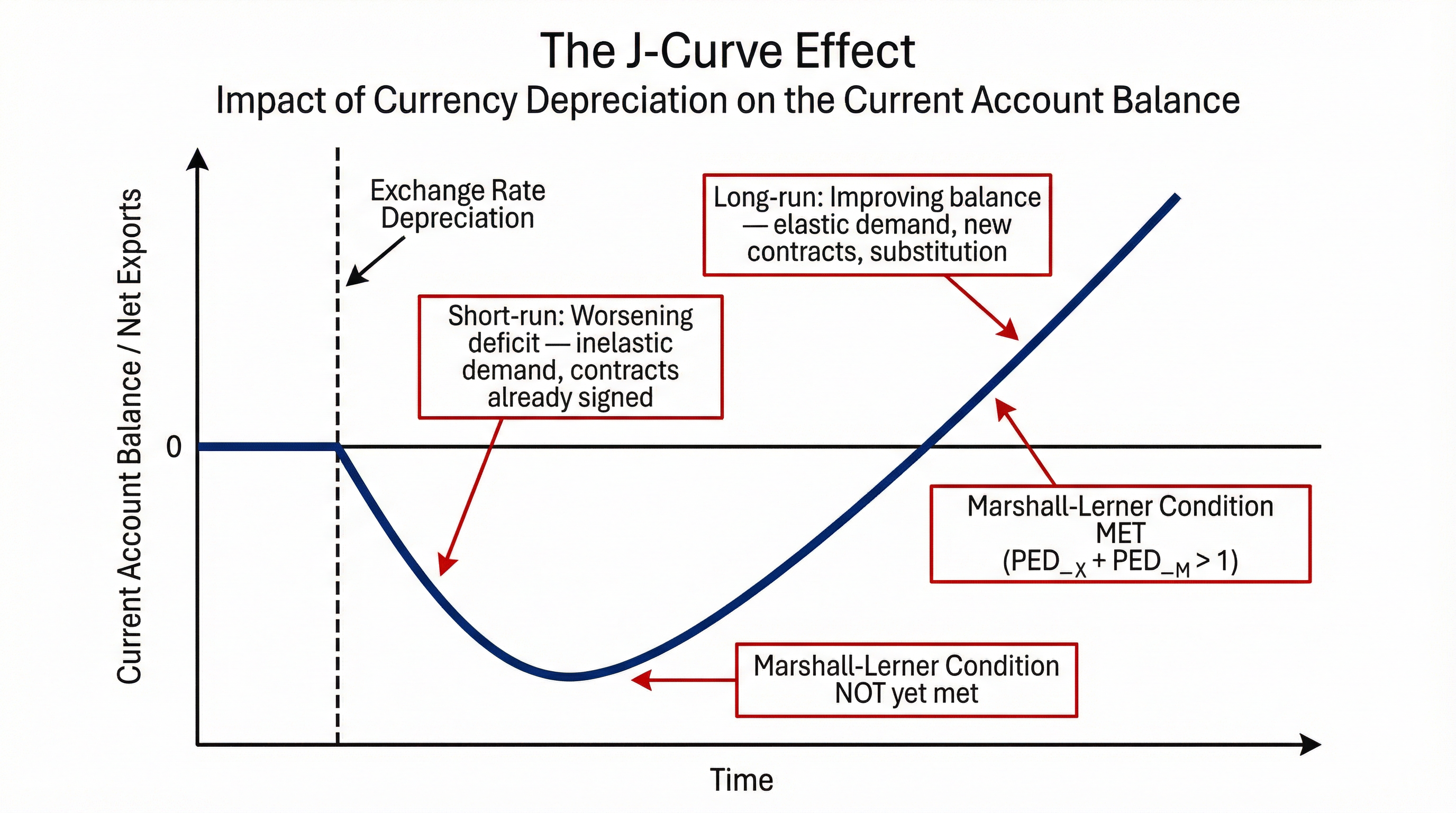
The Marshall-Lerner Condition states that a currency depreciation will improve the current account balance only if the sum of the price elasticity of demand for exports (PED_X) and the price elasticity of demand for imports (PED_M) exceeds unity in absolute value: |PED_X| + |PED_M| > 1.
In the short run, demand for both exports and imports tends to be price inelastic — existing contracts must be honoured, consumers have not yet found substitutes, and supply chains have not adjusted. Consequently, the Marshall-Lerner Condition is not met in the short run, and depreciation initially worsens the current account deficit (the value of imports rises as prices increase, while export volumes do not yet respond sufficiently).
In the long run, as price elasticities increase, the condition is met and the trade balance improves. This dynamic — an initial deterioration followed by eventual improvement — traces the shape of the letter J, giving rise to the J-Curve effect. Candidates must explicitly reference time lags and the distinction between short-run and long-run elasticities when applying this analysis.
Visual Resources
3 diagrams and illustrations
Interactive Diagrams
3 interactive diagrams to visualise key concepts
Conceptual Flow Outline
Full structure of the Balance of Payments — all three accounts and their sub-components
Conceptual Flow Outline
The Marshall-Lerner Condition and J-Curve: how depreciation affects the current account over time
Conceptual Flow Outline
Policy options to correct a current account deficit — with associated risks and trade-offs
Worked Examples
3 worked examples — open one to explore the question and available guidance.
Practice Questions
Test your understanding — click to reveal model answers
Explain two causes of the UK's persistent current account deficit. (8 marks)
Hint: Think about structural causes (deindustrialisation, productivity gap) rather than just cyclical factors. Each cause needs a developed explanation of the mechanism, not just a statement.
Assess the view that expenditure-switching policies are more effective than expenditure-reducing policies in correcting a current account deficit. (25 marks)
Hint: Define both policy types clearly. Analyse the mechanisms and effectiveness of each. Apply the Marshall-Lerner Condition and J-Curve to depreciation. Consider UK-specific factors. Reach a clear, sustained judgement — do not sit on the fence.
Explain the relationship between the current account and the financial account of the Balance of Payments. (8 marks)
Hint: Start with the accounting identity — the BoP always balances. Explain WHY a current account deficit must be financed by a financial account surplus. Then evaluate the implications of different types of financial account inflows (FDI vs portfolio investment).
Explain the Marshall-Lerner Condition and its relevance to the J-Curve effect. (12 marks)
Hint: Define the Marshall-Lerner Condition precisely with the formula. Explain why it may not be met in the short run. Then explain how this generates the J-Curve pattern. Use the concepts of price elasticity of demand and time lags explicitly.
To what extent is a current account deficit always harmful to an economy? (25 marks)
Hint: Consider both the potential harms (downward pressure on exchange rate, reduced AD, dependency on foreign capital) and the circumstances under which a deficit may not be harmful (developing economies, services surplus, FDI-financed). Use UK and international examples. Reach a clear, qualified judgement.
Test your understanding of The Balance of Payments
Active recall beats re-reading. Take an instant quiz now to test what you’ve learned and lock it into long-term memory.
7 days Premium · Then free forever · No card, no charge