OCR · GCSE · Economics
Inflation and its Control
This study guide delves into the critical economic concept of inflation, a cornerstone of the OCR GCSE Economics specification. It explores how inflation is measured, its causes and consequences, and the policies used to control it, providing students with the analytical tools and specific knowledge required to excel in their examinations.
- 7 min read
- 2 worked examples
- 2 practice questions
- 6 key terms
Study Notes

Overview
Inflation is a core macroeconomic objective and a recurring theme in the OCR GCSE Economics exam. It represents a sustained increase in the general price level, eroding the purchasing power of money. A thorough understanding of this topic is essential, as examiners expect candidates to not only define inflation but also to analyse its causes (demand-pull and cost-push), evaluate its consequences for various economic agents (consumers, producers, savers, and the government), and critically assess the effectiveness of policies used to control it, primarily monetary policy. This guide will equip you with the precise definitions, analytical frameworks, and evaluative skills needed to tackle questions on inflation with confidence. Marks are awarded for demonstrating clear knowledge (AO1), applying this knowledge to specific contexts (AO2), and developing well-supported analysis and evaluation (AO3).
Key Concepts & Developments
Measuring Inflation: The Consumer Prices Index (CPI)
What it is: The CPI is the main measure of inflation in the UK. It is a weighted index of the prices of a representative basket of over 700 goods and services purchased by a typical household. The Office for National Statistics (ONS) tracks the price changes of these items monthly.
Why it matters: Examiners expect you to know that the CPI is the target measure for the Bank of England. You must be able to interpret CPI data, for example, explaining that a fall in the CPI rate from 5% to 3% represents disinflation (prices are still rising, but more slowly), not deflation (a fall in the general price level). Quoting specific data from charts or tables is crucial for securing AO2 marks.
Specific Knowledge: The Bank of England's Monetary Policy Committee (MPC) has an inflation target of 2% CPI (±1%). If inflation moves outside this range, the Governor of the Bank of England must write a letter to the Chancellor of the Exchequer explaining why.
Causes of Inflation
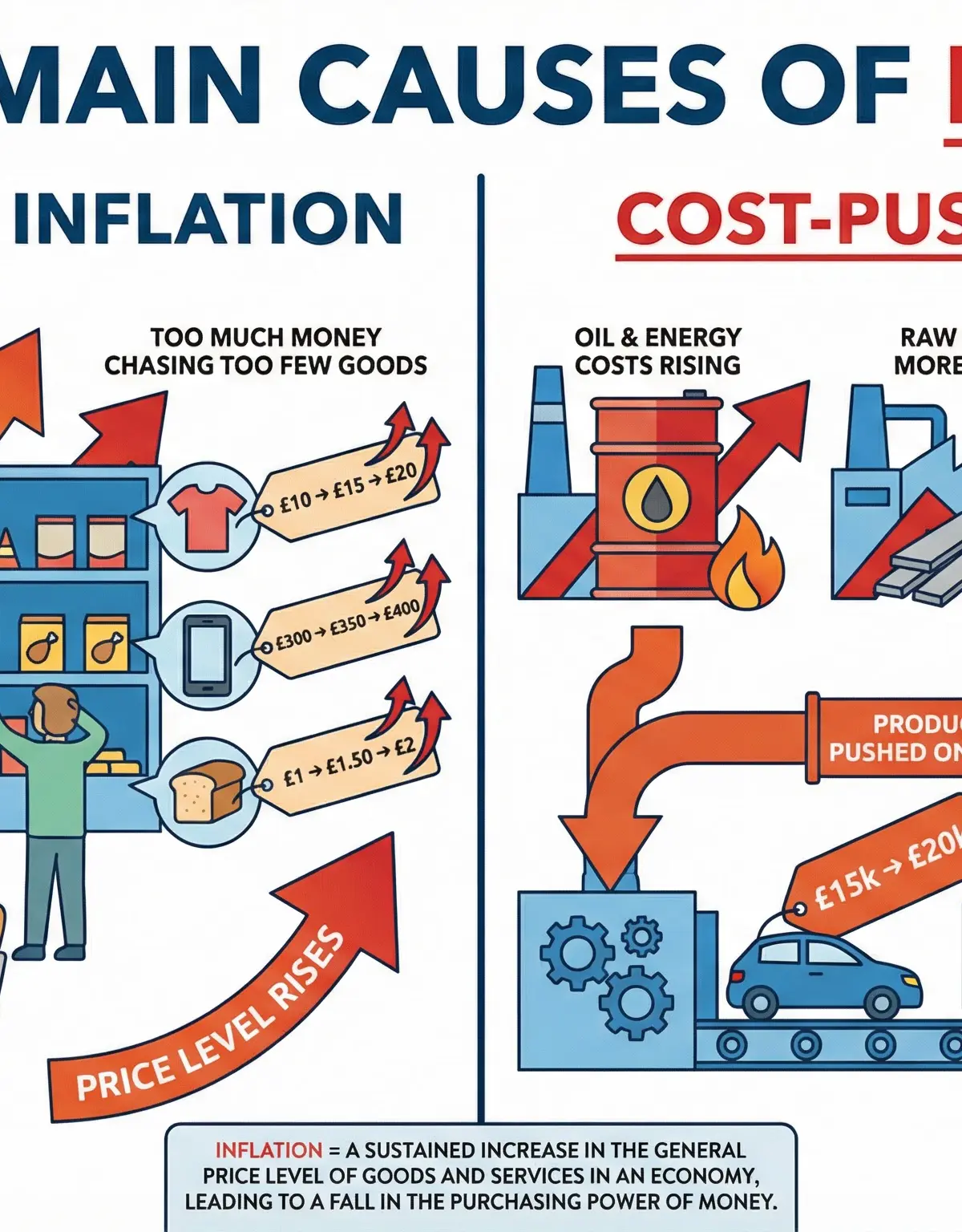
1. Demand-Pull Inflation
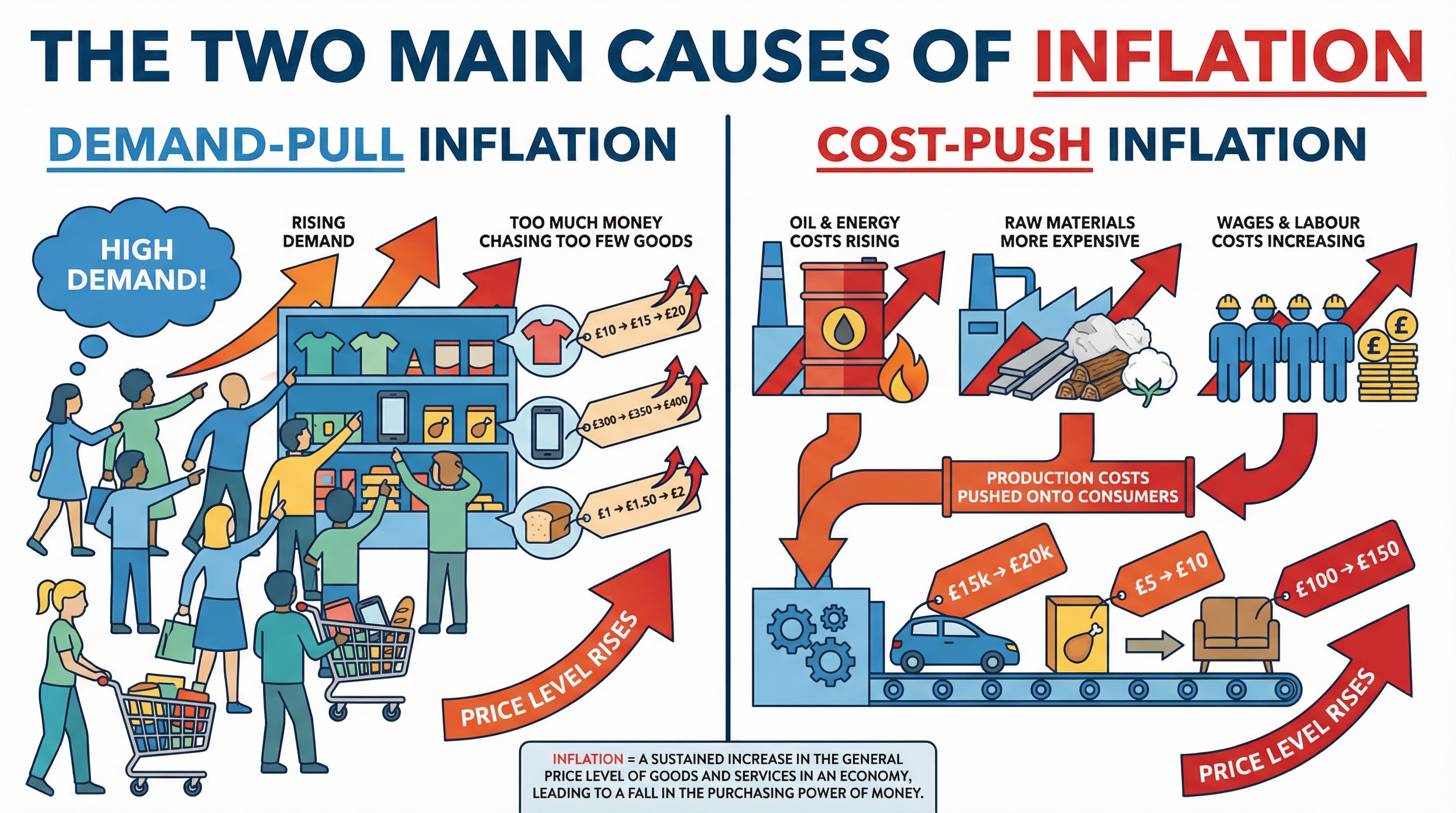
What happened: This occurs when aggregate demand (total spending in the economy) grows faster than aggregate supply (the economy's ability to produce goods and services). It is often described as "too much money chasing too few goods."
Why it matters: Candidates need to be able to identify the causes of rising aggregate demand and link them to inflationary pressures. This requires a clear chain of reasoning.
Specific Knowledge: Causes include: lower interest rates (reducing the cost of borrowing and encouraging spending), lower income or corporation tax (increasing disposable income and profits), a boom in the housing market (making homeowners feel wealthier), or a depreciation in the exchange rate (making exports cheaper and imports more expensive).
2. Cost-Push Inflation
What happened: This occurs when firms face rising costs of production, which they then pass on to consumers in the form of higher prices to protect their profit margins.
Why it matters: This demonstrates an understanding of the supply-side of the economy. Candidates should be able to explain how specific cost increases lead to a rise in the general price level.
Specific Knowledge: Causes include: rising prices of imported raw materials (e.g., oil), wage increases that are not matched by productivity gains, or an increase in business taxes like VAT.
Controlling Inflation
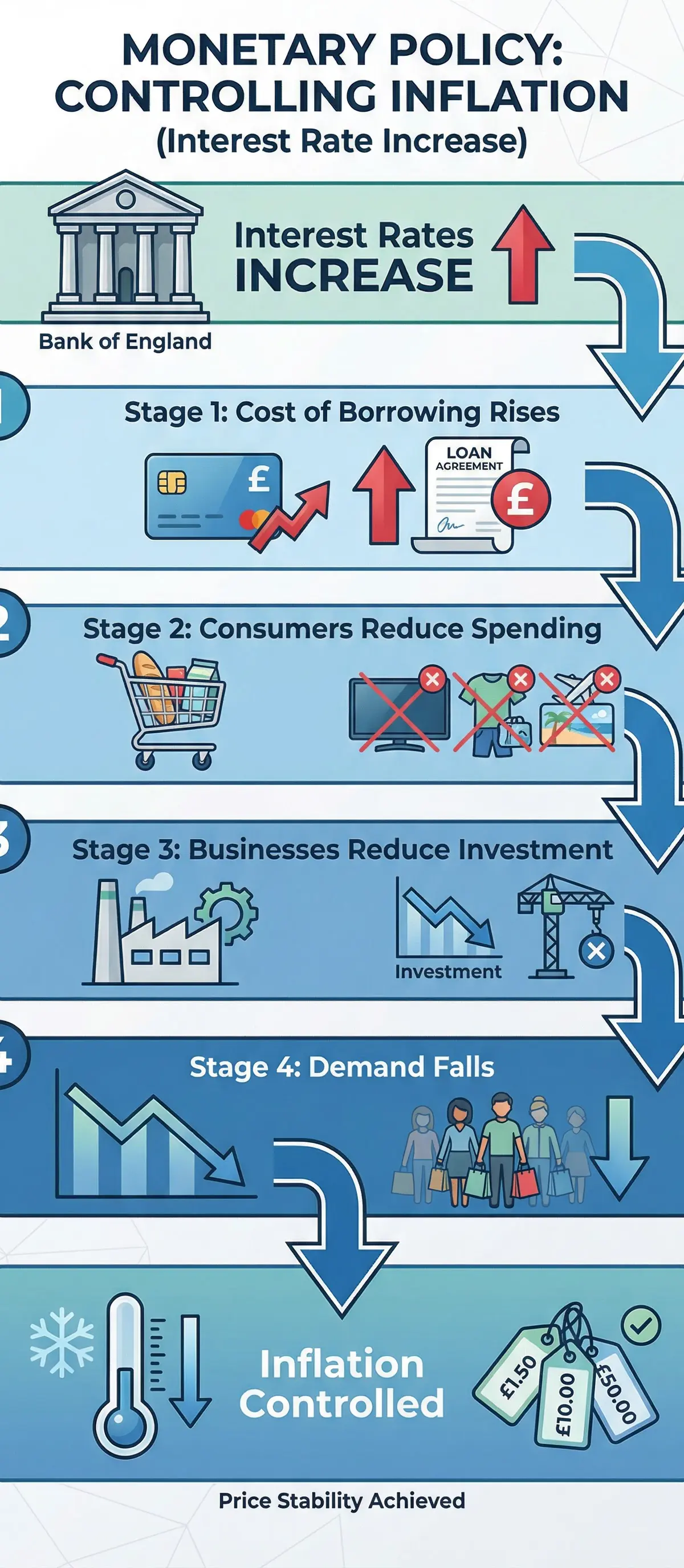
1. Monetary Policy
What it is: Actions undertaken by the Bank of England to influence the supply of money and credit in the economy. The main tool is the Bank Rate (interest rate).
Why it matters: This is the primary method for controlling inflation in the UK. Candidates must understand the transmission mechanism through which changes in the Bank Rate affect aggregate demand and inflation.
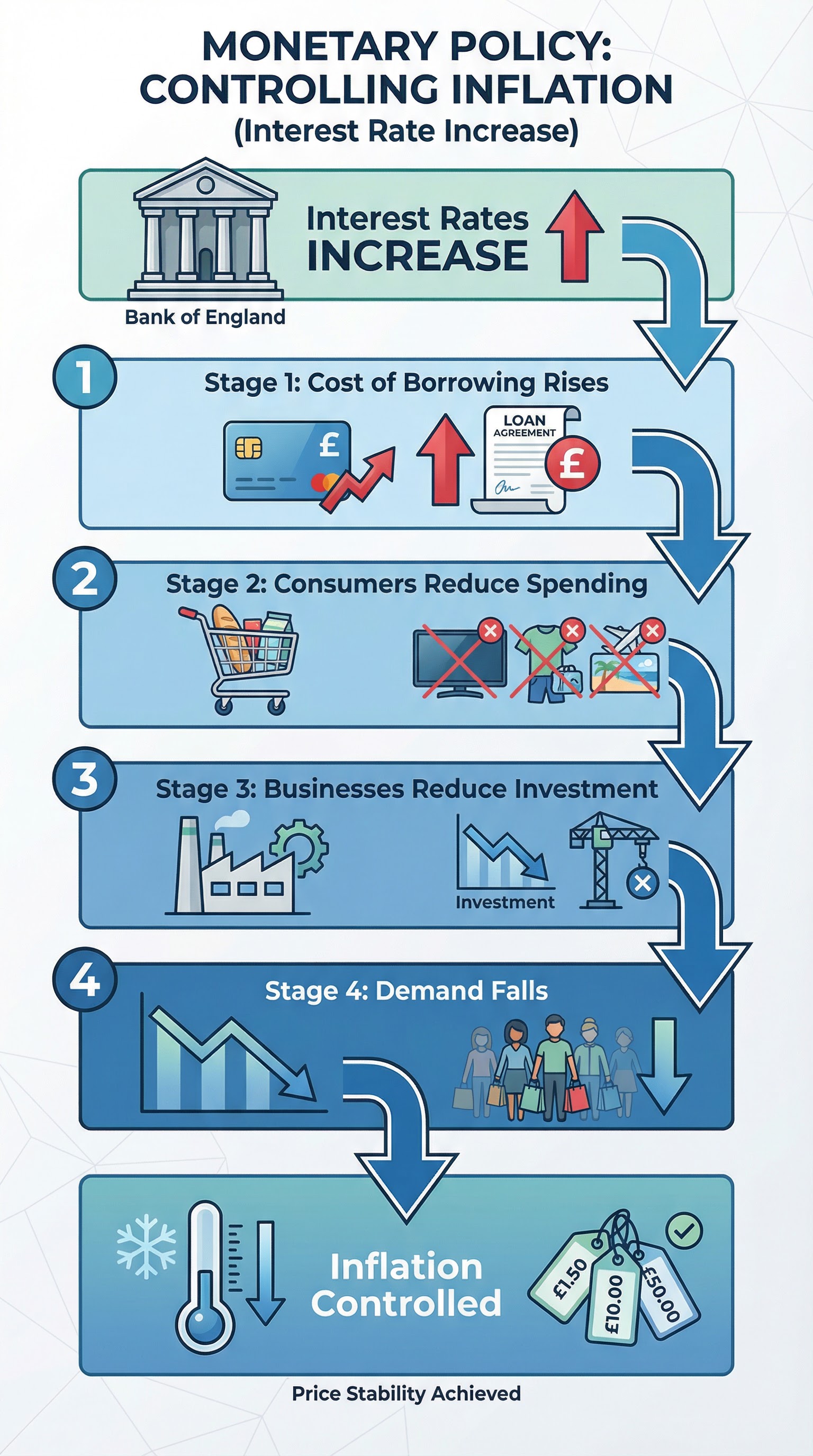
Key Actions: To reduce inflation, the Bank of England increases interest rates. This increases the cost of borrowing for consumers and businesses, making them less likely to take out loans for consumption and investment. It also increases the reward for saving, encouraging people to save rather than spend. This reduces aggregate demand, easing demand-pull inflationary pressures.
2. Supply-Side Policies
What it is: Government policies aimed at increasing the productive capacity of the economy (shifting aggregate supply to the right). They are not a short-term fix but can help control inflation in the long run.
Why it matters: This provides an alternative perspective for evaluation questions. While monetary policy manages demand, supply-side policies tackle cost-push pressures and increase the economy's non-inflationary growth rate.
Key Actions: Examples include investment in education and training to improve labour productivity, privatisation and deregulation to increase competition and efficiency, and investment in infrastructure to reduce business costs.
Second-Order Concepts
Causation
Inflation is rarely caused by a single factor. It is often a combination of demand-pull and cost-push pressures. For example, a global boom might increase demand for UK exports (demand-pull) while also pushing up global commodity prices like oil (cost-push). High-level analysis involves recognising these interactions.
Consequence
The consequences of inflation are not uniform. There are winners and losers. Borrowers with fixed-rate debt win as the real value of their debt erodes. Savers with low interest rates lose as the real value of their savings falls. Workers whose wages do not keep pace with inflation lose purchasing power. Evaluation requires specifying who is affected and how.
Change & Continuity
The UK has experienced periods of high inflation (e.g., the 1970s) and periods of relative price stability. The continuous objective of the government and Bank of England is to maintain low and stable inflation. The main change has been the method, with the focus shifting from government controls to independent central bank management via monetary policy since 1997.
Significance
Low and stable inflation is significant because it creates a stable economic environment, encouraging investment and long-term growth. High and volatile inflation creates uncertainty, discourages saving, and can lead to a loss of international competitiveness, which is why it is a primary target of macroeconomic policy.
Source Skills
When presented with a data source (e.g., a chart of the CPI rate over time), candidates must engage with it directly. To earn AO2 marks, you must quote specific figures from the source. For example, "As the chart shows, inflation peaked at 5.2% in 2011 before falling to 0% in 2015." You should then use this data to support your analysis (AO3), for example, by linking the fall in inflation to the effects of the global financial crisis on aggregate demand. Always consider the time period and any major economic events that might explain the trends shown in the data.
Worked Examples
2 worked examples — open one to explore the question and available guidance.
Practice Questions
Test your understanding — click to reveal model answers
Explain two likely consequences of a sustained period of high inflation for UK consumers. (6 marks)
Hint: Think about purchasing power and savings. Be specific about who is affected.
Analyse how a depreciation of the pound sterling exchange rate could cause inflation in the UK. (9 marks)
Hint: Consider the impact on both import prices (cost-push) and export demand (demand-pull).
Test your understanding of Inflation and its Control
Active recall beats re-reading. Take an instant quiz now to test what you’ve learned and lock it into long-term memory.
7 days Premium · Then free forever · No card, no charge