Production Possibility Frontiers (PPFs) — OCR GCSE Study Guide
Exam Board: OCR | Level: GCSE
This guide provides a comprehensive, exam-focused breakdown of Production Possibility Frontiers (PPFs) for OCR GCSE Economics (J205). It decodes how to secure marks on questions about opportunity cost, efficiency, and economic growth, moving you from basic understanding to analytical application.
## Overview
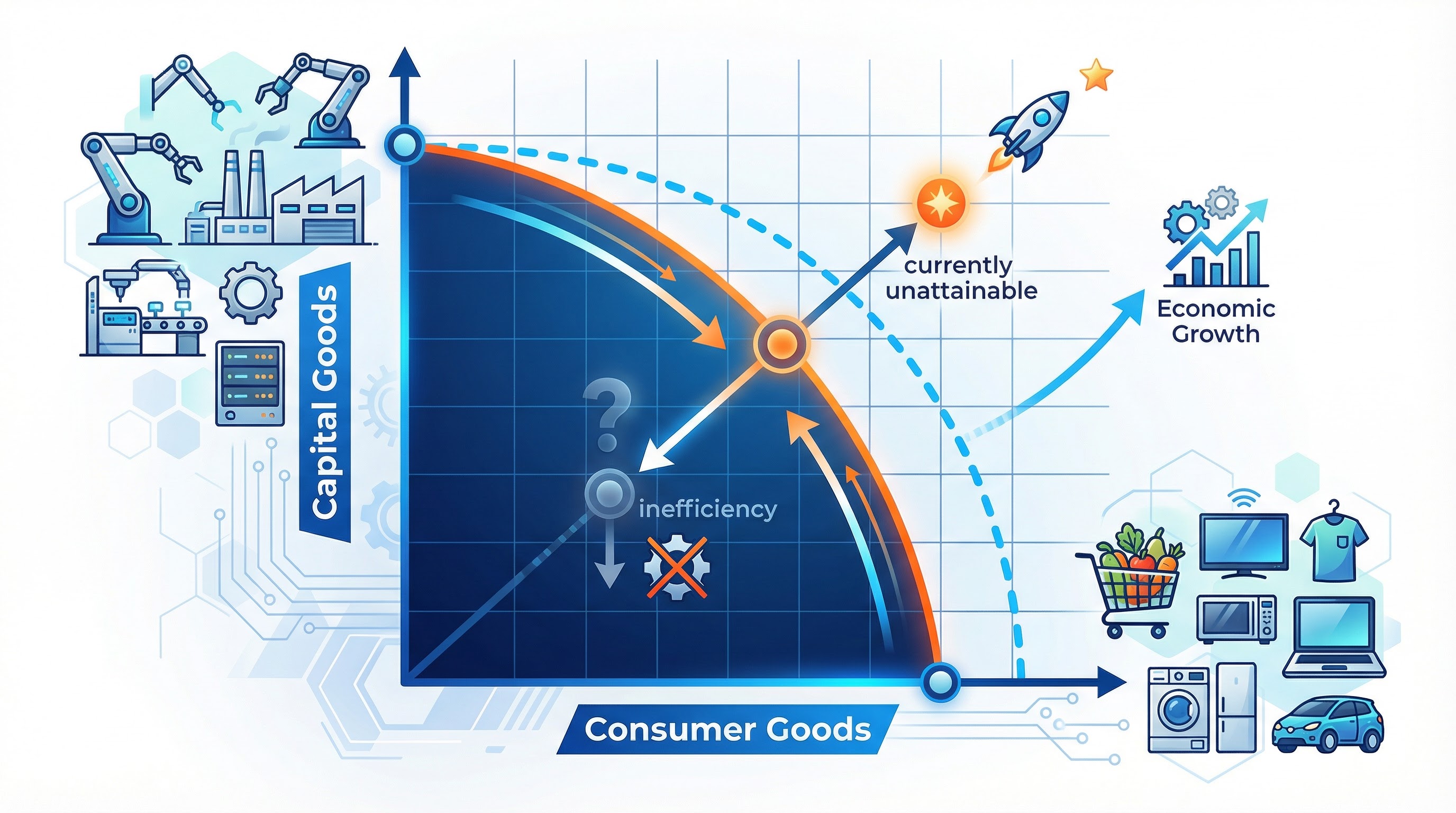
The Production Possibility Frontier (PPF) is a fundamental model in economics that illustrates the concepts of scarcity, choice, and opportunity cost. For the OCR J205 specification, a precise understanding of the PPF is essential. It represents the maximum productive potential of an economy at a specific point in time, given a fixed level of resources and technology. Examiners expect candidates to not only draw and label the PPF accurately but also to interpret what different points on, inside, and outside the curve represent. Furthermore, a key area for awarding marks is the ability to distinguish between a movement along the curve (resource reallocation) and a shift of the entire curve (economic growth or contraction). This guide will equip you with the specific knowledge and analytical skills required to confidently tackle any PPF-related question.
## Key Concepts
### Productive Efficiency vs. Inefficiency
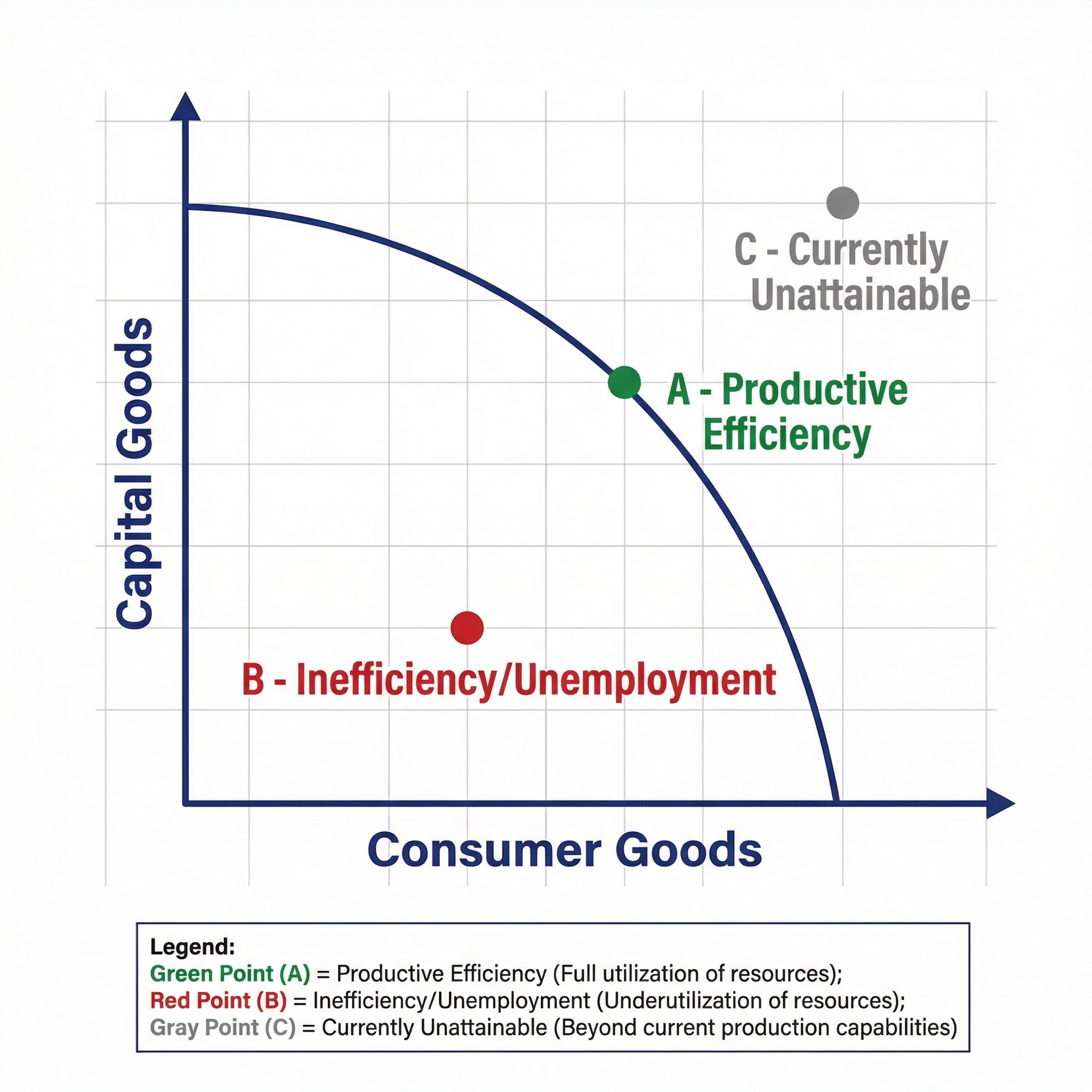
**What it is**: Productive efficiency occurs when an economy is using all of its available resources to produce the maximum possible output. On a PPF diagram, this is represented by any point **on** the curve. In contrast, any point **inside** the curve signifies productive inefficiency, meaning resources such as labour or capital are unemployed or underutilised.
**Why it matters**: Examiners frequently award marks for correctly identifying and explaining these points. For instance, a question might ask you to explain why an economy might be operating inside its PPF. A good response would link this to real-world scenarios like a recession, leading to unemployment and idle factories.
**Specific Knowledge**: You must be able to state that points on the curve (e.g., Point A) mean all factors of production are fully employed, while points inside the curve (e.g., Point B) indicate unemployment of resources.
### Opportunity Cost
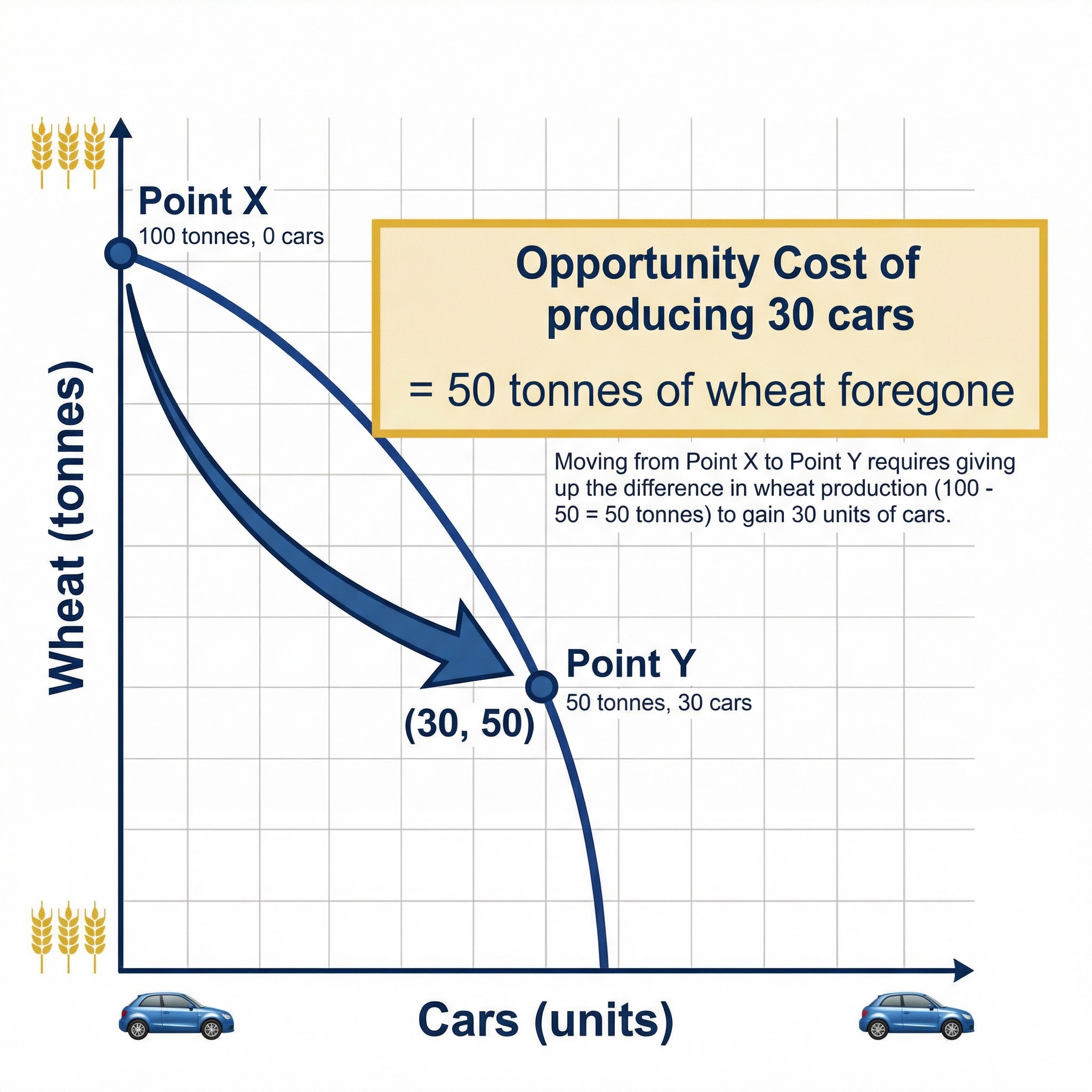
**What it is**: Opportunity cost is the value of the next best alternative foregone when making a choice. The PPF is a powerful tool for illustrating this. When an economy moves along the PPF to produce more of one good, it must produce less of the other. The amount of the other good given up is the opportunity cost.
**Why it matters**: Calculating and explaining opportunity cost is a core skill. Marks are awarded for precise calculations. For example, if moving from producing 100 cars to 80 cars allows an economy to increase wheat production from 200 to 300 tonnes, the opportunity cost of producing the extra 100 tonnes of wheat is 20 cars.
**Specific Knowledge**: Be prepared to calculate opportunity cost from a table of data or a diagram. Always state the units of the good being given up (e.g., '20 cars', not just '20').
### Movements Along vs. Shifts of the PPF
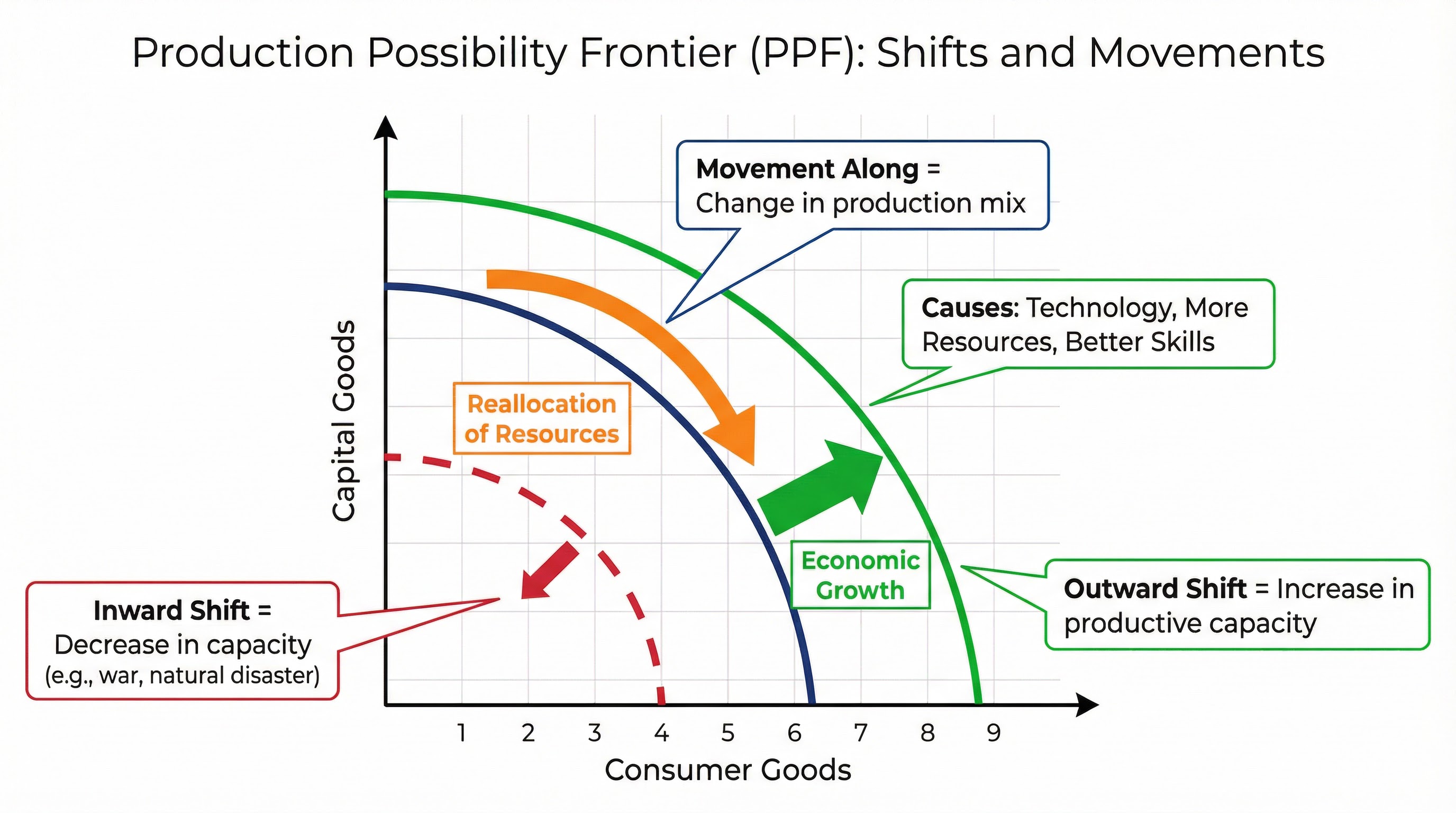
**What it is**: This is a critical distinction. A **movement along** the PPF shows a change in the combination of goods being produced, with the economy reallocating its existing resources. A **shift of the PPF** represents a change in the economy's total productive capacity. An outward shift signifies economic growth, while an inward shift indicates a decrease in capacity.
**Why it matters**: This is a common area of confusion for candidates. Marks are specifically awarded for explaining the causes of shifts. An outward shift is caused by an increase in the quantity or quality of the Factors of Production (Capital, Enterprise, Land, Labour - remember **CELL**).
**Specific Knowledge**: You must be able to provide specific examples of what causes a PPF to shift outwards, such as: an increase in the workforce due to immigration (Labour), investment in new machinery (Capital), discovery of new raw materials (Land), or technological advancements (Enterprise/Capital).
## The Shape of the PPF
### Concave (Bowed Outward)
**What it means**: A PPF is typically drawn as a curve that is concave to the origin (bowed outwards). This shape reflects the principle of **increasing opportunity cost**. As an economy dedicates more resources to producing one good, the opportunity cost of producing additional units of that good increases. This is because resources are not perfectly adaptable from producing one good to another. For example, a highly skilled software engineer is not as productive working on a farm.
### Linear (Straight Line)
**What it means**: A straight-line PPF indicates **constant opportunity cost**. This is a more theoretical scenario where the factors of production are perfectly substitutable between the two goods. For every extra unit of Good A produced, a constant amount of Good B is given up. While less common in reality, it is a concept you should be aware of.
## Podcast: Mastering the PPF
For an in-depth audio walkthrough of these concepts, listen to our dedicated podcast episode. We cover core theory, exam tips, and a quick-fire quiz to test your knowledge.
{{asset:production_possibility_frontiers_podcast.mp3}}